

GWAS on family history of Alzheimer’s disease
Open accessPublished version of a preprint
The DOI matches its Crossref record; 58 of the 58 references it cites were found in a registry or an index.
Abstract
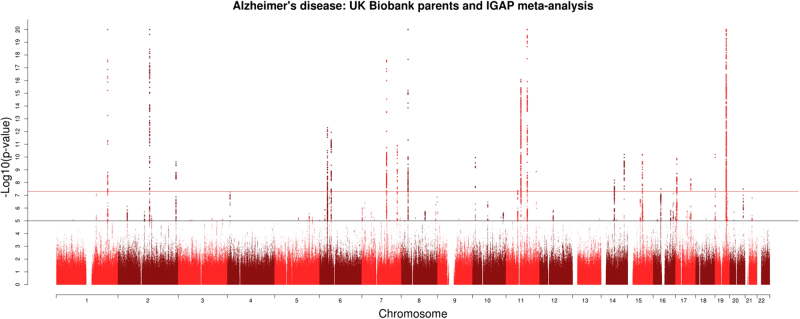
Alzheimer’s disease (AD) is a public health priority for the 21st century. Risk reduction currently revolves around lifestyle changes with much research trying to elucidate the biological underpinnings. We show that self-report of parental history of Alzheimer’s dementia for case ascertainment in a genome-wide association study of 314,278 participants from UK Biobank (27,696 maternal cases, 14,338 paternal cases) is a valid proxy for an AD genetic study. After meta-analysing with published consortium data ( n = 74,046 with 25,580 cases across the discovery and replication analyses), three new AD-associated loci ( P < 5 × 10 −8 ) are identified. These contain genes relevant for AD and neurodegeneration: ADAM10 , BCKDK/KAT8 and ACE . Novel gene-based loci include drug targets such as VKORC1 (warfarin dose). We report evidence that the association of SNPs in the TOMM40 gene with AD is potentially mediated by both gene expression and DNA methylation in the prefrontal cortex. However, it is likely that multiple variants are affecting the trait and gene methylation/expression. Our discovered loci may help to elucidate the biological mechanisms underlying AD and, as they contain genes that are drug targets for other diseases and disorders, warrant further exploration for potential precision medicine applications.
Overview
The claims and statistics of this paper haven’t been checked yet.
Free: it reads the open-access text and checks the first 5 claims that cite a source we can check. Create a free account to check every claim.
Integrity signals
Registry
Cites
Statistics
Figures
Verification
Claims the paper makes
The claims and statistics of this paper haven’t been checked yet.
Free: it reads the open-access text and checks the first 5 claims that cite a source we can check. Create a free account to check every claim.
Claims other papers make about this one
Each is checked against this paper’s own text: does it say what the citing paper says it does?
The source backs part of the claim, not all of it — or backs it for a different population, condition or comparison.
In the citing paper
“the basis of the observed association between age of dementia onset and these variants in TSPAN14 and TSPAN10 (both with a deleterious correlation) may result from disruption of a protective role of ADAM10.”
From Genetic associations with age at dementia onset in the PSEN1 E280A Colombian kindred (2023) · cites this paper as [27]
Experimental — accuracy not yet measuredThe source backs part of the claim, not all of it — or backs it for a different population, condition or comparison.
In the citing paper
“Several genesassoci-ated with AD incidence (APOE, CLU, ABCA7, SORL1, INPP5D, and PLCG2)(Jansen et al., 2019; Kunkle et al., 2019; Marioni et al., 2018) also function in lipid transport or signaling.”
From Alzheimer’s Patient Microglia Exhibit Enhanced Aging and Unique Transcriptional Activation (2020) · cites this paper as Marioni et al., 2018
Experimental — accuracy not yet measuredThe source backs part of the claim, not all of it — or backs it for a different population, condition or comparison.
In the citing paper
“non-coding mutations also modulate AD risk [4–6], likely through modifying gene expression.”
From Association of SPI1 haplotypes with altered SPI1 gene expression and Alzheimer’s disease risk (2022) · cites this paper as [6]
Experimental — accuracy not yet measuredThe source backs part of the claim, not all of it — or backs it for a different population, condition or comparison.
In the citing paper
“PLCG2 polymorphisms are associated with both reduced and increased risk of Alzheimer’s disease (AD) and with longevity.”
From Multi-omics analyses reveal novel effects of PLCγ2 deficiency in the mouse brain (2023) · cites this paper as [6]
Experimental — accuracy not yet measuredThe source backs part of the claim, not all of it — or backs it for a different population, condition or comparison.
In the citing paper
“other rare PLCG2 variants, such as M28L (rs61749044) that confers a modest increased risk of AD (OR ≈ 1.16) [1, 4, 7–13]”
From PLCγ2 deficiency compromises systemic immune tolerance and erodes myelin homeostasis while enhancing oxidative metabolism in the mouse brain (2026) · cites this paper as [10]
Experimental — accuracy not yet measured
20 more claims about this paper
Create a free account to see every claim other papers make about this one.
Self-check
Percentages, sums and reported differences re-computed from the paper’s own numbers.
The self-check needs the paper’s full text.
Citations
Cites
Sudlow, C., Gallacher, J., Allen, N., Beral, V., Burton, P., Danesh, J., Downey, P., Elliott, P., Green, J., Landray, M., et al. (2015) · PLOS Medicine · doi:10.1371/journal.pmed.1001779 · Cited by 12,728 · cited 13×
“There was complete sign-concordance between UK Biobank and IGAP for all 21 SNPs (Supplementary Table 4).”
BackgroundInfluentialA map of human genome variation from population-scale sequencing.
The 1000 Genomes Project Consortium (2010) · Nature · doi:10.1038/nature09534 · Cited by 7,877
Dementia prevention, intervention, and care
Livingston, G., Sommerlad, A., Orgeta, V., Costafreda, S. G., Huntley, J., Ames, D., Ballard, C., Banerjee, S., Burns, A., Cohen-Mansfield, J., et al. (2017) · The Lancet · doi:10.1016/s0140-6736(17)31363-6 · Cited by 6,072
LD Score regression distinguishes confounding from polygenicity in genome-wide association studies
Schizophrenia Working Group of the Psychiatric Genomics Consortium, Bulik-Sullivan, B. K., Loh, P.-R., Finucane, H. K., Ripke, S., Yang, J., Patterson, N., Daly, M. J., Price, A. L., & Neale, B. M. (2015) · Nature Genetics · doi:10.1038/ng.3211 · Cited by 5,559 · cited 2×
“…as 314,278 + 74,046 = 388,324) were included along with expression Quantitative Trait Loci (QTL) summary output from the Common Mind Consortium, which contains data on >600 dorsolateral prefrontal cortex samples, and DNA methylation QTL summary output on 258 prefrontal cortex samples (age >13) 18 .”
MethodSelf-citationMETAL: fast and efficient meta-analysis of genomewide association scans
Willer, C. J., Li, Y., & Abecasis, G. R. (2010) · Bioinformatics · doi:10.1093/bioinformatics/btq340 · Cited by 5,205
Genetic studies of body mass index yield new insights for obesity biology
Study, T. L. C., Locke, A. E., The ADIPOGen Consortium, The AGEN-BMI Working Group, The CARDIOGRAMplusC4D Consortium, The CKDGen Consortium, The, G. L. G. C., The, I. C. B. P., The MAGIC Investigators, The MuTHER Consortium, et al. (2015) · Nature · doi:10.1038/nature14177 · Cited by 4,534
Self-citationCommon SNPs explain a large proportion of the heritability for human height
Yang, J., Benyamin, B., McEvoy, B. P., Gordon, S., Henders, A. K., Nyholt, D. R., Madden, P. A., Heath, A. C., Martin, N. G., Montgomery, G. W., et al. (2010) · Nature Genetics · doi:10.1038/ng.608 · Cited by 4,446
Self-citationMeta-Analysis of 74,046 Individuals Identifies 11 New Susceptibility Loci for Alzheimer’s Disease
(EADI), E. A. D. I., Lambert, J.-C., (GERAD), G. A. E. R. I. A. D., Alzheimer's Disease Genetic Consortium (ADGC), (CHARGE), C. F. H. A. A. R. I. G. E., Ibrahim-Verbaas, C. A., Harold, D., Naj, A. C., Sims, R., Bellenguez, C., et al. (2013) · Nature Genetics · doi:10.1038/ng.2802 · Cited by 4,336 · cited 1×
“Downstream quality control steps conducted for the current analysis included removing (1) those with nonBritish ancestry based on both self-report and a principal components analysis, (2) outliers based on heterozygosity and missingness, (3) individuals with sex chromosome configurations that were neither XX nor XY, (…”
MethodSelf-citationAn atlas of genetic correlations across human diseases and traits
ReproGen Consortium, Bulik-Sullivan, B., Psychiatric Genomics Consortium, Genetic Consortium for Anorexia Nervosa of the Wellcome Trust Case Control Consortium 3, Finucane, H. K., Anttila, V., Gusev, A., Day, F. R., Loh, P.-R., Duncan, L., et al. (2015) · Nature Genetics · doi:10.1038/ng.3406 · Cited by 4,255 · cited 1×
“Linkage disequilibrium score (LDSC) regression was used to estimate the genetic correlation between the maternal and paternal AD GWAS results and to test for residual confounding in the meta-analysis by examining the LDSC intercept 12,13 .”
MethodFunctional mapping and annotation of genetic associations with FUMA
Watanabe, K., Taskesen, E., van Bochoven, A., & Posthuma, D. (2017) · Nature Communications · doi:10.1038/s41467-017-01261-5 · Cited by 4,083 · cited 1×
“The number of independent loci from the meta-analysis was determined by using the default settings in FUMA 14 .”
Method
Cited by
Items 301–400 of 588
Beyond the factor indeterminacy problem using genome-wide association data
Sullivan, M. L. C., Schwaba, T., Harden, K. P., Grotzinger, A. D., Nivard, M. G., & Tucker–Drob, E. M. (2024) · Nature Human Behaviour · doi:10.1038/s41562-023-01789-1 · Cited by 15
“The APOE region is known to be associated with risk for cognitive ageing and dementia 71 .”
Occlusion dysfunction and Alzheimer’s disease: Mendelian randomization study
Wang, Q., Zhen, W., Hu, R., Wang, Z., Sun, Y., Sun, W., Huang, C., Xu, J., & Zhang, H. (2024) · Frontiers in Aging Neuroscience · doi:10.3389/fnagi.2024.1423322 · Cited by 12
Yang, M. Y., Zinkgraf, M. S., Fitzgerald-Cook, C., Harrison, B. R., Putzier, A., Promislow, D., & Wang, A. M. (2023) · G3 Genes Genomes Genetics · doi:10.1093/g3journal/jkad132 · Cited by 12
“Human GWA studies for AD associations have helped to identify numerous susceptibility loci, mostly from European populations (Marioni et al. 2018; Jansen et al. 2019; Kunkle et al. 2019).”
BackgroundAdvances in multiplex PCR for Alzheimer's disease diagnostics targeting CDK genes
Lim, K., Kim, S., Yang, S., Chun, S., & Joo, J. (2021) · Neuroscience Letters · doi:10.1016/j.neulet.2021.135715 · Cited by 11
“Genome-wide association studies (GWAS) have begun to define the mutational status of individual AD risk-associated genes and gradually revealed a potent biomarker for targeting AD therapeutics [5].”
Neuronal Cell Cycle Re-Entry Enhances Neuropathological Features in App NLF Knock-In Mice
Barrett, T., Stangis, K. A., Saito, T., Saido, T. C., & Park, K. H. J. (2021) · Journal of Alzheimer s Disease · doi:10.3233/jad-210091 · Cited by 13
“Specifically, KAT8 , BHMG1 , and ANKRD31 are all involved in the control of cell cycle progression or regulation, and have been implicated by GWAS studies as being mechanistically involved in AD [27–30].”
Zang, F., Zhu, Y., Zhang, Q., Tan, C., Wang, Q., Xie, C., & Initiative, A. D. N. (2021) · CNS Neuroscience & Therapeutics · doi:10.1111/cns.13716 · Cited by 11
“9-11 Despite the conflicting findings in polymorphism, one human postmortem study with brain tissues revealed that LRP1 levels from the middle frontal cortex were significantly reduced in AD patients compared with healthy controls.”
Self-citationMechanistic Approach to Immunity and Immunotherapy of Alzheimer’s Disease: A Review
Islam, M. R., Rabbi, M. A., Hossain, T., Sultana, S., & Uddin, S. (2024) · ACS Chemical Neuroscience · doi:10.1021/acschemneuro.4c00360 · Cited by 16
Counil, H., Silva, R. O., Rabanel, J., Zaouter, C., Haddad, M., Khedher, M. R. B., Brambilla, D., Fülöp, T., Patten, S. A., & Ramassamy, C. (2025) · Journal of Extracellular Biology · doi:10.1002/jex2.70027 · Cited by 12
Mosaic patterns of selection in genomic regions associated with diverse human traits
Abraham, A., LaBella, A. L., Capra, J. A., & Rokas, A. (2022) · PLoS Genetics · doi:10.1371/journal.pgen.1010494 · Cited by 12
Dai, J., Xu, Y., Wang, T., & Zeng, P. (2022) · Progress in Neuro-Psychopharmacology and Biological Psychiatry · doi:10.1016/j.pnpbp.2022.110700 · Cited by 10
Ghalayini, J., & Boulianne, G. L. (2023) · Frontiers in Neuroscience · doi:10.3389/fnins.2023.1166973 · Cited by 11
“Recent AD GWAS meta-analyses identified common genetic variants in the Ace locus outside of exonic regions, which are associated with an increased risk of AD (Marioni et al., 2018; Kunkle et al., 2019).”
BackgroundThe role of SPP / SPPL intramembrane proteases in membrane protein homeostasis
Mentrup, T., Leinung, N., Patel, M., Fluhrer, R., & Schröder, B. (2023) · FEBS Journal · doi:10.1111/febs.16941 · Cited by 13
Using Transcriptomic Hidden Variables to Infer Context-Specific Genotype Effects in the Brain
Ng, B., Casazza, W., Patrick, E., Tasaki, S., Novakovsky, G., Felsky, D., Ma, Y., Bennett, D. A., Gaiteri, C., Jager, P. L. D., et al. (2019) · The American Journal of Human Genetics · doi:10.1016/j.ajhg.2019.07.016 · Cited by 12
Liu, G., Zhang, H., Liu, B., & Ji, X. (2019) · Brain · doi:10.1093/brain/awz305 · Cited by 10
Genetic architecture of neurodegenerative dementias.
Clarimón, J., Moreno-Grau, S., Cervera-Carles, L., Dols-Icardo, O., Sánchez-Juan, P., & Ruiz, A. (2020) · Neuropharmacology · doi:10.1016/j.neuropharm.2020.108014 · Cited by 10
Ramamurthy, E., Welch, G., Cheng, J., Yuan, Y., Gunsalus, L. M., Bennett, D. A., Tsai, L., & Pfenning, A. R. (2020) · bioRxiv (Cold Spring Harbor Laboratory) · doi:10.1101/2020.03.26.010330 · Cited by 10
Kuzma, A. B., Valladares, O., Greenfest‐Allen, E., Nicaretta, H. I., Kirsch, M., Ren, Y., Katanić, Ž., White, H., Wilk, A. J., Bass, L., et al. (2024) · medRxiv · doi:10.1101/2024.10.07.24315029 · Cited by 10
Single nucleus sequencing fails to detect microglial activation in human tissue
Thrupp, N., Frigerio, C. S., Wolfs, L., Skene, N. G., Poovathingal, S., Fourne, Y., Matthews, P. M., Theys, T., Mancuso, R., de Strooper, B., et al. (2020) · bioRxiv (Cold Spring Harbor Laboratory) · doi:10.1101/2020.04.13.035386 · Cited by 9
“…response, and genes within loci carrying AD genetic risk, as identified in Genome-Wide Association Studies (GWAS) (Efthymiou and Goate, 2017; Jansen et al., 2019; Kunkle et al., 2019; Lambert et al., 2013; Marioni et al., 2018), for example, APOE, TREM2, APOC1, CD33 (Sala Frigerio et al., 2019).”
BackgroundYuan, S., Li, W., Ling, Y., Huang, X., Feng, A., Tan, S., He, N., Li, L., Li, S., Xu, A., et al. (2023) · BMC Public Health · doi:10.1186/s12889-023-17050-3 · Cited by 13
“The 29 SNP sites that were highly correlated with AD were selected from previous Genome-wide association study (GWAS) [22–24].”
MethodZhang, H., Wang, Y., Zhao, H., Wang, W., & Han, F. (2024) · Frontiers in Aging Neuroscience · doi:10.3389/fnagi.2024.1423707 · Cited by 11
“Validation set one included 42,034 cases and 506,921 controls, and this study identified three new AD-related loci ( p 5 × 10 − 8 ) (Marioni et al., 2018).”
BackgroundHu, T., Liu, Q., Dai, Q., Parrish, R. L., Buchman, A. S., Tasaki, S., Seyfried, N. T., Wang, Y., Bennett, D. A., Jager, P. L. D., et al. (2025) · Alzheimer s Research & Therapy · doi:10.1186/s13195-025-01774-y · Cited by 19
“TOMM40 is a known risk gene of AD dementia [1] and has been associated with family history of AD [50].”
Self-citationZhan, L., Li, J., Jew, B., & Sul, J. H. (2021) · PLoS Genetics · doi:10.1371/journal.pgen.1009772 · Cited by 9
Investigation of Mitochondrial Related Variants in a Cerebral Small Vessel Disease Cohort
Dunn, P. J., Harvey, N. R., Maksemous, N., Smith, R. A., Sutherland, H. G. E., Haupt, L. M., & Griffiths, L. R. (2022) · Molecular Neurobiology · doi:10.1007/s12035-022-02914-3 · Cited by 11
Are Alzheimer's and coronary artery diseases genetically related to longevity?
Bellou, E., & Escott‐Price, V. (2023) · Frontiers in Psychiatry · doi:10.3389/fpsyt.2022.1102347 · Cited by 10
Zhang, S., Cao, H., Chen, K., Gao, T., Zhao, H., Zheng, C., Wang, T., Zeng, P., & Wang, K. (2024) · International Journal of Public Health · doi:10.3389/ijph.2024.1606868 · Cited by 9
Gao, S., Wang, T., Han, Z., Hu, Y., Zhu, P., Xue, Y., Huang, C., Chen, Y., & Liu, G. (2024) · Briefings in Bioinformatics · doi:10.1093/bib/bbae140 · Cited by 13
“…conducted a large-scale meta-analysis of AD GWAS and GWAX by combining the discovery datasets from GR@ACE, IGAP 2019 stage 1 + 2 [8], UK Biobank [10] and the replication datasets from the European Alzheimer’s Disease Biobank (JPND-EADB) project, PGC-ALZ, GR@ACE, AD and GBCS, Neocodex and…”
BackgroundMethodInfluentialEpigenetic processes in Alzheimer's disease
Castanho, I., & Lunnon, K. (2019) · Elsevier eBooks · doi:10.1016/b978-0-12-813796-3.00008-0 · Cited by 12
Green, Z. D., Vidoni, E. D., Swerdlow, R. H., Burns, J. M., Morris, J. K., & Honea, R. A. (2022) · Journal of Alzheimer s Disease · doi:10.3233/jad-210326 · Cited by 10
“Data from the UK Biobank has highlighted the viability of family history as a proxy-phenotype of AD [2], and proxy-genome-wide association studies have recently been used to identify novel risk-incurring gene loci [3, 4].”
BackgroundHassan, M., Shahzadi, S., Yasir, M., Chun, W., & Kloczkowski, A. (2023) · Scientific Reports · doi:10.1038/s41598-023-45347-1 · Cited by 12
Chandrashekar, H., Simándi, Z., Choi, H., Ryu, H.-S., Waldman, A. J., Nikish, A., Muppidi, S. S., Gong, W., Paquet, D., & Phillips‐Cremins, J. E. (2024) · bioRxiv (Cold Spring Harbor Laboratory) · doi:10.1101/2024.02.27.582395 · Cited by 13
“Genome-wide association studies have uncovered more than 70 SAD-associated common single nucleotide variants 15-27 , and widespread transcriptional changes have been reported in post-mortem tissue from SAD patients 12, 13, 28 .”
BackgroundIntegrative multi-omics QTL colocalization maps regulatory architecture in aging human brainPreprint
Cao, X., Sun, H., Feng, R., Mazumder, R., Najar, C. F. B. A., Li, Y., Jager, P. L. D., Bennett, D. A., Dey, K. K., & Wang, G. (2025) · medRxiv · doi:10.1101/2025.04.17.25326042 · Cited by 16
regionalpcs improve discovery of DNA methylation associations with complex traits
Eulalio, T. Y., Sun, M., Gevaert, O., Greicius, M. D., Montine, T. J., Nachun, D. C., & Montgomery, S. B. (2025) · Nature Communications · doi:10.1038/s41467-024-55698-6 · Cited by 9
“These results support previous studies that implicated DNA methylation in the vicinity of APOE in AD pathogenesis 84,85 .”
The effect of Alzheimer's disease genetic factors on limbic white matter microstructure
Lorenz, A., Sathe, A., Zaras, D., Yang, Y., Durant, A., Kim, M. E., Gao, C., Newlin, N. R., Ramadass, K., Kanakaraj, P., et al. (2025) · Alzheimer s & Dementia · doi:10.1002/alz.70130 · Cited by 11
“To assess the impact of genetic risk for AD on WM microstructure, we calculated a PGS for AD based on the GWAS summary statistics from Marioni et al. (2018).”
NIAGADS: A data repository for Alzheimer's disease and related dementia genomics
Kuzma, A. B., Valladares, O., Greenfest‐Allen, E., Nicaretta, H. I., Kirsch, M., Ren, Y., Katanić, Ž., White, H., Wilk, A. J., Bass, L., et al. (2025) · Alzheimer s & Dementia · doi:10.1002/alz.70255 · Cited by 21
Liu, S., Bush, W. S., Akinyemi, R., Byrd, G. S., Caban‐Holt, A., Rajabli, F., Reitz, C., Kunkle, B. W., Tosto, G., Vance, J. M., et al. (2025) · PLoS Genetics · doi:10.1371/journal.pgen.1011701 · Cited by 9
“In contrast to the direct LOAD phenotyping approaches described above, Marioni et al. (2018) contributed a study using proxy-phenotypes based on family history (GWAX), leveraging data from large electronic health records available for UK Biobank participants ages 40–69 [94].”
Leeming, P. J., Mercuri-Svik, J., & Stojanovski, D. (2025) · Molecular and Cellular Biology · doi:10.1080/10985549.2025.2566671 · Cited by 11
“43 – 45 Targeted biochemical studies of individual subunits in human models are necessary to unveil how they function in protein import or in broader mitochondrial processes to provide insights into disease pathology.”
Shared genes and pathways in dementia: Insights from genome‐wide association studies
Loi, K. J., Radtke, N., Kiriluk, C., Noureldein, M. H., Feldman, E. L., Bakulski, K. M., & Chen, K. S. (2025) · Alzheimer s & Dementia · doi:10.1002/alz.70845 · Cited by 9
“Large biobanks, such as UK Biobank, Million Veteran Program, and Biobank Japan provide extensive genomic data for such analyses.”
InfluentialGarcía, M. F., Townsley, K. G., Pruitt, A., Davidson, E., Balafkan, N., Warrell, J., Huang, T.-C., Kibowen, A., Chu, Z., Dai, Y., et al. (2026) · Nature Neuroscience · doi:10.1038/s41593-026-02247-7 · Cited by 19
“…depressive disorder 135 , obsessive-compulsive disorder 136 , post-traumatic stress disorder 137 , SCZ 138 , Cross disorder 139 , Alzheimer disease 140 , Parkinson disease 141 , amyotrophic lateral sclerosis 142 , Tou-rette’s 143 , migraine 144 , chronic pain 145 and neurotic personality traits…”
Identifying Protein Biomarkers in Blood for Alzheimer's Disease
Zhao, T., Hu, Y., Zang, T., & Wang, Y. (2020) · Frontiers in Cell and Developmental Biology · doi:10.3389/fcell.2020.00472 · Cited by 8
Involvement of transposable elements in Alzheimer’s disease pathogenesis
Mustafin, R. N., & Хуснутдинова, Э. К. (2024) · Vavilov Journal of Genetics and Breeding · doi:10.18699/vjgb-24-27 · Cited by 10
“In 2018, a genome-wide association study (GWAS) of DNA samples from 314,278 patients showed an association of the ACE , ADAM10 , BCKDK/KAT8 , TOMM40 , VKORC1 genes with AD (Marioni et al., 2018).”
BackgroundEnduru, N., Fernandes, B. S., & Zhao, Z. (2024) · Frontiers in Genetics · doi:10.3389/fgene.2024.1376050 · Cited by 9
The Role of Dynamic Histone Modifications in Learning Behavior
Fischer, A. (2019) · Current topics in behavioral neurosciences · doi:10.1007/7854_2019_108 · Cited by 9
Shi, L., Winchester, L. M., Liu, B. Y., Killick, R., Ribé, E. M., Westwood, S., Baird, A. L., Buckley, N. J., Hong, S., Dobričić, V., et al. (2020) · Journal of Alzheimer s Disease · doi:10.3233/jad-200208 · Cited by 8
Variation in VKORC1 Is Associated with Vascular Dementia
Mur, J., McCartney, D. L., Chasman, D. I., Visscher, P. M., Terrera, G. M., Cox, S. R., Russ, T. C., & Marioni, R. E. (2021) · Journal of Alzheimer s Disease · doi:10.3233/jad-201256 · Cited by 8
Self-citationHeterogeneous effects of genetic risk for Alzheimer’s disease on the phenome
Wu, H. M., Goate, A. M., & O’Reilly, P. F. (2021) · Translational Psychiatry · doi:10.1038/s41398-021-01518-0 · Cited by 8
“In recent years, GWAS performed on family history of AD [18] or “AD-byproxy” [19], based on parental AD/dementia status and age, has been demonstrated as a powerful way of identifying risk variants for AD.”
BackgroundSelf-citationKretzschmar, G. C., Alencar, N. M., da Silva, S. S. L., Sulzbach, C. D., Meissner, C. G., Petzl‐Erler, M. L., de Souza, R. L. R., & Boldt, A. B. W. (2021) · Frontiers in Molecular Biosciences · doi:10.3389/fmolb.2021.632314 · Cited by 8
Integration with systems biology approaches and -omics data to characterize risk variation
Young, H. E., Cote, A. C., & Huckins, L. M. (2022) · Elsevier eBooks · doi:10.1016/b978-0-12-819602-1.00017-6 · Cited by 10
Association of ADAM10 gene variants with sporadic Parkinson's disease in Chinese Han population
Zhou, M., Lin, Y., Lu, L., Zhang, Z., Guo, W., Peng, G., Zhang, W., Zhu, Z., Wu, Z., Mo, M., et al. (2021) · The Journal of Gene Medicine · doi:10.1002/jgm.3319 · Cited by 8
Excitatory Neuron-Derived Interleukin-34 Controls Cortical Developmental Microglia FunctionPreprint
Devlin, B. A., Nguyen, D. M., Ribeiro, D., Grullon, G., Clark, M. J., Finn, A., Ceasrine, A. M., Oxendine, S. R., Deja, M., Shah, A., et al. (2024) · bioRxiv (Cold Spring Harbor Laboratory) · doi:10.1101/2024.05.10.589920 · Cited by 8
Dynamic convergence of neurodevelopmental disorder risk genes across neurodevelopmentPreprint
García, M. F., Townsley, K. G., Pruitt, A., Davidson, E., Balafkan, N., Warrell, J., Huang, T.-C., Kibowen, A., Chu, Z., Dai, Y., et al. (2024) · bioRxiv (Cold Spring Harbor Laboratory) · doi:10.1101/2024.08.23.609190 · Cited by 12
The Biological Intersection Between Chemotherapy-Related Cognitive Impairment and Alzheimer Disease
Torre, M., Zanella, C. A., & Feany, M. Β. (2025) · American Journal Of Pathology · doi:10.1016/j.ajpath.2024.12.013 · Cited by 8
“24,25 More generally, single nucleotide polymorphisms in genes involved in DNA damage repair and oxidative stress are associated with different cognitive trajectories in breast cancer patients after adjuvant therapy (aromatase inhibitor and/or chemotherapy).”
A common 19 bp APOE enhancer deletion is protective against Alzheimer’s disease in African Americans
Brutman, J. N., Busald, T., Nizamis, E., Kaufman, E. J., Lin, E., Hendricks, N. E., Chintamen, S., Sulovari, A., Smukowski, S. N., Ye, Y., et al. (2026) · Nature Communications · doi:10.1038/s41467-026-68808-3 · Cited by 8
“Importantly, SPI1 falls within a GWAS locus for AD 4,5,29,30 and variants in this locus that lower SPI1 expression are protective for AD 31 .”
Benefits and Challenges of Rare Genetic Variation in Alzheimer’s Disease
Grozeva, D., Saad, S., Menzies, G. E., & Sims, R. (2019) · Current Genetic Medicine Reports · doi:10.1007/s40142-019-0161-5 · Cited by 11
Savignac, C., Villeneuve, S., Badhwar, A., Saltoun, K., Shafighi, K., Zajner, C., Sharma, V., Taliun, S. A. G., Farhan, S. M. K., Poirier, J., et al. (2022) · PLoS Biology · doi:10.1371/journal.pbio.3001863 · Cited by 12
Cellular specificity is key to deciphering epigenetic changes underlying Alzheimer's disease
Signal, B., Suárez, T. G. P., Taberlay, P. C., & Woodhouse, A. (2023) · Neurobiology of Disease · doi:10.1016/j.nbd.2023.106284 · Cited by 8
Are Ischemic Stroke and Alzheimer’s Disease Genetically Consecutive Pathologies?
Filippenkov, I. B., Владимирович, Х. А., Mozgovoy, I. V., Dergunova, L. V., & Limborska, S. A. (2023) · Biomedicines · doi:10.3390/biomedicines11102727 · Cited by 7
Kong, F., Wu, T., Dai, J., Cai, J., Zhai, Z., Zhu, Z., Xu, Y., & Sun, T. (2024) · PLoS ONE · doi:10.1371/journal.pone.0295008 · Cited by 9
Oh, S., Kim, S., Lee, J., Park, B., Won, J. H., & Park, H. (2024) · NeuroImage Clinical · doi:10.1016/j.nicl.2024.103660 · Cited by 9
“Existing genetic studies on AD have compiled various characteristics, including clinical information such as survival time, family history, and AAO, and identified genetic risk factors associated with AD (Marioni et al., 2018; Wang et al., 2015; Wightman et al., 2021).”
BackgroundYuan, S., Liu, Q., Huang, X., Tan, S., Bai, Z., Yu, J., Lei, F., Le, H., Ye, Q., Peng, X., et al. (2024) · Alzheimer s Research & Therapy · doi:10.1186/s13195-024-01663-w · Cited by 12
“Instead, 29 SNP loci strongly associated with AD, as identified in previous genome-wide association studies (GWAS), were selected for this study (Supplementary material Table S1) [16–18].”
Self-citationInTACT: An adaptive and powerful framework for joint‐tissue transcriptome‐wide association studies
Bae, Y. E., Wu, L., & Wu, C. (2021) · Genetic Epidemiology · doi:10.1002/gepi.22425 · Cited by 7
“The estimated heritability of AD is between 60% and 80% (Gatz et al., 2006) and GWAS have identified more than 40 AD risk loci (Jansen et al., 2019; Kunkle et al., 2019; Marioni et al., 2018).”
BackgroundNg, B., Casazza, W., Kim, N. H., Wang, C., Farhadi, F., Tasaki, S., Bennett, D. A., Jager, P. L. D., Gaiteri, C., & Mostafavi, S. (2021) · PLoS Genetics · doi:10.1371/journal.pgen.1009918 · Cited by 7
Miyoshi, E., Morabito, S., & Swarup, V. (2021) · Neurobiology of Disease · doi:10.1016/j.nbd.2021.105530 · Cited by 7
Exploiting family history in aggregation unit-based genetic association tests
Wang, Y., Chen, H., Peloso, G. M., DeStefano, A. L., & Dupuis, J. (2021) · European Journal of Human Genetics · doi:10.1038/s41431-021-00980-0 · Cited by 7
Nazarian, A., Loika, Y., He, L., Culminskaya, I. V., & Kulminski, A. M. (2022) · Alzheimer s & Dementia · doi:10.1002/alz.12540 · Cited by 8
Abdullah, M., Wah, Y. B., Majeed, A. B. A., Zakaria, Y., & Shaadan, N. (2022) · Pertanika journal of science & technology · doi:10.47836/pjst.30.2.19 · Cited by 10
“Genetic studies provide an opportunity to elucidate the cause of a disease for early detection or cure (Marioni et al., 2018; Tanzi, 2012; Waring & Rosenberg, 2008).”
BackgroundJavor, J., Ďurmanová, V., Párnická, Z., Minárik, G., Králová, M., Pečeňák, J., Vašečková, B., Režnáková, V., Šutovský, S., Gmitterová, K., et al. (2020) · International Journal of Immunogenetics · doi:10.1111/iji.12489 · Cited by 7
“, 2019), other studies failed to confirm rs3865444 as a risk variant or reported inconsistent results across different European-based populations (Ebbert et al., 2014; Lambert et al., 2013; Marioni et al., 2018; Moreno-Grau et al., 2018; Siokas et al., 2020; Walker et al., 2015).”
ResultМолекулярно-биологические аспекты депрессивных состояний: современный взгляд на проблему
Ushakova, V. M., Морозова, А. Ю., Reznik, A. M., Kostyuk, G. P., & Chekhonin, V. P. (2020) · Molecular Biology · doi:10.31857/s0026898420050110 · Cited by 12
de Rochemonteix, M., Napolioni, V., Sanyal, N., Belloy, M. E., Caporaso, N. E., Landi, M. T., Greicius, M. D., Chatterjee, N., & Han, S. S. (2020) · American Journal of Epidemiology · doi:10.1093/aje/kwaa132 · Cited by 8
“This data included 14 SNPs that were identified from previous GWAS (P 5 × 10⁻⁸), conducted in either White (28–31) or Asian populations (32–34) listed in the National Human Genome Research Institute GWAS catalog (https://www.ebi.ac.uk/gwas/).”
MethodInfluentialMarczyk, M., Macioszek, A., Tobiasz, J., Polańska, J., & Żyła, J. (2021) · Frontiers in Genetics · doi:10.3389/fgene.2021.767358 · Cited by 8
“In recent years, GWAS reveals plenty of genetic locations related to common diseases, e.g., type 2 diabetes (Billings and Florez, 2010), Alzheimer disease (Marioni et al., 2018), or many types of cancer (Sud et al., 2017).”
BackgroundA genetic and proteomic comparison of key AD biomarkers across tissues
Marsh, T. W., Western, D., Timsina, J., Gorijala, P., Yang, C., Pastor, P., Liu, M., Morris, J. C., Bateman, R. J., Schindler, S. E., et al. (2024) · Alzheimer's & Dementia · doi:10.1002/alz.14139 · Cited by 6
“NfLalsoshowed a higher correlation in AD patients, ( r = 0.27, p = 0.03) than in controls ( r = 0.07, p = 0.28; Fisher’s z = 1.37, p = 0.17), although the difference was not significant.”
InfluentialDai, L., Jiang, C., Cui, Q., Huang, L., Chen, S., Zhang, Y., Luo, X., Zhang, P., Li, J., & Zhang, Y. (2025) · The Journal of Prevention of Alzheimer s Disease · doi:10.1016/j.tjpad.2024.100020 · Cited by 6
Joseph, P. V., Abbas, M., Goodney, G. A., Diallo, A. F., & Gaye, A. (2024) · Scientific Reports · doi:10.1038/s41598-024-71669-9 · Cited by 7
Ling, Y., Yuan, S., Huang, X., Tan, S., Cheng, H., Li, L., Li, S., Huang, L., Xu, A., & Lyu, J. (2024) · Translational Psychiatry · doi:10.1038/s41398-024-03131-3 · Cited by 6
“Based on previous genome-wide association studies (GWAS) [22 – 24], we carefully selected 29 single nucleotide polymorphisms (SNPs) that exhibited signi fi cant associations with AD.”
MethodXue, F., Gao, L., Chen, T., Chen, H., Zhang, H., Wang, T., Han, Z., Gao, S., Wang, L., Hu, Y., et al. (2022) · Journal of Alzheimer s Disease · doi:10.3233/jad-220086 · Cited by 9
Family History of AD /Dementia, Polygenic Risk Score for AD , and Parkinson's Disease
Xu, X., Li, Y., Wang, J., Cao, Y., Feng, C., Guo, Y. H., Zong, G., Sun, L., & Gao, X. (2023) · Movement Disorders Clinical Practice · doi:10.1002/mdc3.13919 · Cited by 7
“37,38 A comprehensive family history assessment includes detailed information on who in the pedigree or family tree is the one af fl icted with AD/dementia and how the diagnosis is established.”
BackgroundFuture Treatment of Alzheimer Disease
Keskin, A. O., Durmaz, N., Uncu, G., Erzurumluoglu, E., Yıldırım, Z., Tuncer, N., & Adapınar, D. Ö. (2019) · IntechOpen eBooks · doi:10.5772/intechopen.85096 · Cited by 10
“Discovering risk loci by GWAS studies may help to enlighten the biological mechanisms underlying AD because the reported genes might have been target for medicines, thereby this issue promises further investigation in order to improve gene therapy strategies and thus precision medicine concept for AD [101].”
BackgroundIntegration of multidimensional splicing data and GWAS summary statistics for risk gene discovery
Ji, Y., Wei, Q., Chen, R., Wang, Q., Tao, R., & Li, B. (2022) · PLoS Genetics · doi:10.1371/journal.pgen.1009814 · Cited by 6
Ou, Y., Liu, Y., Wu, B., Tan, L., & Yu, J. (2022) · Annals of Translational Medicine · doi:10.21037/atm-22-1156 · Cited by 5
“…GWAS summary statistics: (I) the International Genomics of Alzheimer’s Project (IGAP) GWAS Stage 1 result (N=21,982 cases, 41,944 controls) (18) ; (II) maternal family history of AD (N=27,696 cases, 260,980 controls); and (III) paternal family history of AD (N=14,338 cases, 245,941 controls) (19).”
Genetic underpinnings of sociability in the UK BiobankPreprint
Bralten, J., Klemann, C. J. H. M., Mota, N. R., Witte, W. D., Arango, C., Fabbri, C., Kas, M. J., van der Wee, N. J. A., Penninx, B. W. J. H., Serretti, A., et al. (2019) · bioRxiv (Cold Spring Harbor Laboratory) · doi:10.1101/781195 · Cited by 7
“…to the neurological disorder AD, we did not find a phenotypic link between our sociability construct and having a family history of AD, even though the family history measure in the UKBB has been reported to capture AD risk in previous genetic studies (Jansen et al., 2019; Marioni et al., 2018).”
ResultMolecular Networks and Key Regulators of the Dysregulated Neuronal System in Alzheimer’s Disease
Wang, M., Li, A., Sekiya, M., Beckmann, N. D., Quan, X., Schrode, N., Fernando, M. B., Yu, A., Zhu, L., Cao, J., et al. (2019) · doi:10.1101/788323 · Cited by 6
Albiñana, C., Zhu, Z., Borbye‐Lorenzen, N., Boelt, S. G., Cohen, A. S., Skogstrand, K., Wray, N. R., Revez, J. A., Privé, F., Petersen, L. V., et al. (2022) · medRxiv · doi:10.1101/2022.06.08.22276164 · Cited by 6
Self-citationFongang, B., Sargurupremraj, M., Jian, X., Mishra, A., Damotte, V., Bis, J. C., Kang-Hsien, F., Li, G., Yang, J., Hilal, S., et al. (2022) · bioRxiv (Cold Spring Harbor Laboratory) · doi:10.1101/2022.10.11.509802 · Cited by 7
Self-citationSalas, I. H., Paumier, A., Tao, T., Derevyanko, A., Switzler, C., Burgado, J., Movsesian, M., Metanat, S., Dawoodtabar, T., Asbell, Q. N., et al. (2024) · bioRxiv (Cold Spring Harbor Laboratory) · doi:10.1101/2024.10.30.621182 · Cited by 7
Cook, N., Yang, C., Zeng, Y., Sivasankaran, S. K., Song, S., Talozzi, L., Western, D., Yang, C., Liu, Y., Guen, Y. L., et al. (2025) · medRxiv · doi:10.1101/2025.10.31.25339089 · Cited by 13
“While genome-wide associafon studies (GWAS) have transformed our understanding of AD, idenffying over 70 risk loci 16,17 , sex-straffied GWAS have remained comparafvely small, revealing only select sex-50 biased genefc loci 18–22 .”
Rationale and emerging evidence for microglial replacement in Alzheimer’s disease
Bang, J. Y., & Yoo, Y. (2025) · Molecules and Cells · doi:10.1016/j.mocell.2025.100265 · Cited by 8
de la Fuente, J., Londoño-Correa, D., & Tucker–Drob, E. M. (2025) · Bioinformatics · doi:10.1093/bioinformatics/btaf568 · Cited by 6
“We drew GWAS summary statistics obtained from the UK Biobank for seven cognitive tests: trail-making tests-B ( n ¼ 78 547), tower rearranging ( n ¼ 11 263), verbal numerical reasoning (VNR, n ¼ 171 304), symbol digit substitution ( n ¼ 87 741), memory pairs-matching test ( n ¼ 331 679), matrix pattern recognition ( n…”
InfluentialNazarian, A., Cook, B., Morado, M., & Kulminski, A. M. (2023) · Genes · doi:10.3390/genes14091666 · Cited by 6
Gene-gene functional relationships in Alzheimer's disease: CELF1 regulates KLC1 alternative splicing
Kikuchi, M., Viet, J., Nagata, K., Sato, M., David, G., Audic, Y., Silverman, M. A., Yamamoto, M. L., Akatsu, H., Hashizume, Y., et al. (2024) · Biochemical and Biophysical Research Communications · doi:10.1016/j.bbrc.2024.150025 · Cited by 5
Luo, R., Zeraatkar, D., Glymour, M. M., Ellis, R. J., Estiri, H., & Patel, C. J. (2024) · BMC Medicine · doi:10.1186/s12916-024-03424-w · Cited by 6
Jeon, S., Salvo, M. A., Alia, A. O., Popović, J., Zagardo, M., Chandra, S., Nassan, M. M., Gate, D., Vassar, R. J., & Cuddy, L. K. (2024) · Neurobiology of Disease · doi:10.1016/j.nbd.2024.106729 · Cited by 7
“ACE has been identified in multiple large scale genome-wide association studies and proteome wide-association studies as being a significant AD risk gene (Ge et al., 2023; Jansen et al., 2019; Kunkle et al., 2019; Marioni et al., 2018).”
BackgroundBao, J., Lee, B. N., Wen, J., Kim, M., Mu, S., Yang, S., Davatzikos, C. A., Long, Q., Ritchie, M. D., & Shen, L. (2024) · Annual Review of Biomedical Data Science · doi:10.1146/annurev-biodatasci-102423-121021 · Cited by 10
Enhancing Gene Expression Predictions Using Deep Learning and Functional Annotations
Ramprasad, P., Ren, J., & Pan, W. (2024) · Genetic Epidemiology · doi:10.1002/gepi.22595 · Cited by 7
Chandler, H. L., Wheeler, J., Escott‐Price, V., Murphy, K., & Lancaster, T. M. (2024) · Alzheimer s & Dementia · doi:10.1002/alz.14455 · Cited by 5
Yang, T., Wei, P., & Pan, W. (2020) · Bioinformatics · doi:10.1093/bioinformatics/btaa898 · Cited by 5
Identifying genetic markers enriched by brain imaging endophenotypes in Alzheimer’s disease
Kim, M., Wu, R., Yao, X., Saykin, A. J., Moore, J. H., Shen, L., & Initiative, A. D. N. (2022) · BMC Medical Genomics · doi:10.1186/s12920-022-01323-8 · Cited by 6
Genetic variant rs11136000 upregulates clusterin expression and reduces Alzheimer’s disease risk
Ma, J., & Qiu, S. (2022) · Frontiers in Neuroscience · doi:10.3389/fnins.2022.926830 · Cited by 7
“UK Biobank (maternal) (Marioni et al., 2018) GWAX Proxy 27,696 260,980 European”
BackgroundMethodInfluentialHeser, K., Kleineidam, L., Wagner, M., Luppa, M., Löbner, M., Wiese, B., Oey, A., König, H., Brettschneider, C., van der Leeden, C., et al. (2023) · Journal of Alzheimer s Disease · doi:10.3233/jad-230410 · Cited by 7
“Importantly, compelling evidence supports the biology behind the easily assessable, non-invasive variable of family history (also cf. [28, 29]).”
A comparative study of structural variant calling in WGS from Alzheimer’s disease families
Malamon, J. S., Farrell, J. J., Xia, L. C., Dombroski, B. A., Lee, W.-P., Das, G., Vardarajan, B. N., Way, J., Kuzma, A. B., Valladares, O., et al. (2024) · Life Science Alliance · doi:10.26508/lsa.202302181 · Cited by 6
“…Steinberg et al, 2015; Tosto et al, 2015; Herold et al, 2016; Jakobsdottir et al, 2016; Kohli et al, 2016; Deming et al, 2017; Mez et al, 2017; Sims et al, 2017; Marioni et al, 2018; Zhou et al, 2018; Baker et al, 2019; Jansen et al, 2019; Kunkle et al, 2019; Zhang et al, 2019; Bis et al, 2020).”
Evaluation of common and rare variants of Alzheimer's disease-causal genes in Parkinson's disease
Zeng, Q., Pan, H., Zhao, Y., Wang, Y., Xu, Q., Tan, J., Yan, X., Li, J., Tang, B., & Guo, J. (2022) · Parkinsonism & Related Disorders · doi:10.1016/j.parkreldis.2022.02.016 · Cited by 5
Multi-omics analyses reveal novel effects of PLCγ2 deficiency in the mouse brain
Hopp, S. C., Rogers, J. G., Smith, S., Campos, G., Miller, H., Barannikov, S., Kuri, E. G., Wang, H., Han, X., Bieniek, K. F., et al. (2023) · doi:10.1101/2023.12.06.570499 · Cited by 7
Metadata
- Authors
- Marioni, R. E., Harris, S. E., Zhang, Q., McRae, A. F., Hagenaars, S. P., Hill, W. D., Davies, G., Ritchie, C. W., Gale, C. R., Starr, J. M., Goate, A. M., Porteous, D. J., Yang, J., Evans, K. L., Deary, I. J., Wray, N. R., & Visscher, P. M.
- Affiliations
- Institute of Genetics and Cancer (GB)
- The University of Queensland (AU)
- King's College London (GB)
- University of Edinburgh (GB)
- Alzheimer Scotland (GB)
- Icahn School of Medicine at Mount Sinai (US)
- Corresponding author
- Marioni, Riccardo E.
- ORCID
- Venue
- Translational Psychiatry
- Published
- 2018-05-18
- Volume
- 8
- Issue
- 1
- Pages
- 99-99
- ISSN
- 2158-3188 (ISSN-L)
- PMC
- PMC5959890
- OpenAlex
- W2787933178
- Cited by
- 564
- References
- 58
- Citations by year
- 2026: 34 · 2025: 50 · 2024: 89 · 2023: 62 · 2022: 76 · 2021: 103 · 2020: 90 · 2019: 50 · 2018: 9
- FWCI
- 45.94
- Type
- journal article
- Language
- en
- Update notices
- correction (2019-06-06)
- Open access
- gold
- doi.org
- Licence
- cc-by
- creativecommons.org/licenses/by/4.0 (tdm)
- creativecommons.org/licenses/by/4.0 (vor)
- Locations
- Translational Psychiatry (publishedVersion, cc-by)
- bioRxiv (Cold Spring Harbor Laboratory) (acceptedVersion, other-oa)
- Europe PMC (PubMed Central) (publishedVersion, other-oa)
- PubMed Central (publishedVersion, cc-by)
- PubMed (publishedVersion)
- ePrints Soton (University of Southampton) (acceptedVersion)
- DOAJ (DOAJ: Directory of Open Access Journals) (submittedVersion)
- Research Portal (King's College London) (submittedVersion, other-oa)
- Edinburgh Research Explorer (University of Edinburgh) (submittedVersion, cc-by)
- Funders
- JPB Foundation
- South London and Maudsley NHS Foundation Trust
- Denali Therapeutics
- National Institute for Health and Care Research (NF-SI-0508-10082, NF-SI-0513-10085)
- Age UK (MR/K026992/1)
- King's College London
- University of Edinburgh (MR/K026992/1)
- University of Queensland
- Centre for Cognitive Ageing and Cognitive Epidemiology (MR/K026992/1)
- Dementias Platform UK (MR/L015382/1)
- National Institutes of Health
- Directorate for Biological Sciences
- Medical Research Council (MR/K026992/1, MR/L015382/1, 1113400, 1078037, 1078901, MC_PC_17228, MC_UU_12011/2, MC_UU_12011/1)
- Biotechnology and Biological Sciences Research Council (MR/K026992/1)
- National Health and Medical Research Council (1113400, 1078901, 1078037)
- National Institute on Aging (RF1AG054014, U01AG049508, U01AG052411, U24AG021886)
- Topics
- Life Sciences › Neuroscience › Cellular and Molecular Neuroscience › Alzheimer's disease research and treatments
- Health Sciences › Medicine › Psychiatry and Mental health › Dementia and Cognitive Impairment Research
- Life Sciences › Biochemistry, Genetics and Molecular Biology › Genetics › Genetic Associations and Epidemiology
- Keywords
- Alzheimer's disease, family history (medicine), parental history, case ascertainment, genetic loci, ADAM10, BCKDK, ACE, VKORC1, TOMM40, DNA methylation, gene expression, prefrontal cortex, neurodegeneration, therapeutic target, precision medicine
- MeSH terms
- Aged, Alzheimer Disease, Apolipoproteins E, Female, Humans, Male, Medical History Taking, Risk Factors, Genetic Predisposition to Disease, Polymorphism, Single Nucleotide, Genome-Wide Association Study, Genetic Loci
About these checks
Registry, retraction, Cites and statistics results are computed, not judged, with one exception: a printed reference that no index lists is read once by a model before it counts as a citation error. Claims are extracted by a model and kept only when their quote appears verbatim in the text; each cited source is then checked, with a model’s help, for whether it says what the claim relies on. Those verdicts can be wrong — read the claim’s quote and the cited source before relying on one.
Statistics and arithmetic are recomputed, not judged.
Confidence bands are shown only for fields calibrated on our annotated test set. None is calibrated yet, so no band is shown.
What counts as a claim ›How we measure confidence ›How we check this ›
Are you an author, or do you see a problem with this page? Request a review
Data sources
Bibliographic data: Semantic Scholar, OpenAlex, Crossref.
Contains information from the Semantic Scholar Academic Graph Datasets, made available under the ODC Attribution License (ODC-BY 1.0).
Semantic Scholar’s data is described in: Kinney, R., et al. (2023). The Semantic Scholar Open Data Platform. arXiv:2301.10140.
