

GWAS on family history of Alzheimer’s disease
Open accessPublished version of a preprint
The DOI matches its Crossref record; 58 of the 58 references it cites were found in a registry or an index.
Abstract
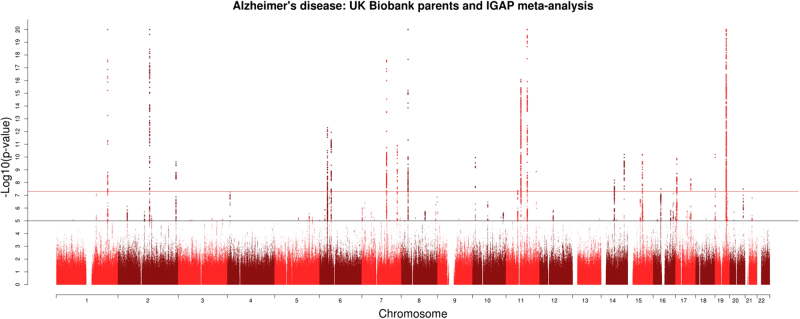
Alzheimer’s disease (AD) is a public health priority for the 21st century. Risk reduction currently revolves around lifestyle changes with much research trying to elucidate the biological underpinnings. We show that self-report of parental history of Alzheimer’s dementia for case ascertainment in a genome-wide association study of 314,278 participants from UK Biobank (27,696 maternal cases, 14,338 paternal cases) is a valid proxy for an AD genetic study. After meta-analysing with published consortium data ( n = 74,046 with 25,580 cases across the discovery and replication analyses), three new AD-associated loci ( P < 5 × 10 −8 ) are identified. These contain genes relevant for AD and neurodegeneration: ADAM10 , BCKDK/KAT8 and ACE . Novel gene-based loci include drug targets such as VKORC1 (warfarin dose). We report evidence that the association of SNPs in the TOMM40 gene with AD is potentially mediated by both gene expression and DNA methylation in the prefrontal cortex. However, it is likely that multiple variants are affecting the trait and gene methylation/expression. Our discovered loci may help to elucidate the biological mechanisms underlying AD and, as they contain genes that are drug targets for other diseases and disorders, warrant further exploration for potential precision medicine applications.
Overview
The claims and statistics of this paper haven’t been checked yet.
Free: it reads the open-access text and checks the first 5 claims that cite a source we can check. Create a free account to check every claim.
Integrity signals
Registry
Cites
Statistics
Figures
Verification
Claims the paper makes
The claims and statistics of this paper haven’t been checked yet.
Free: it reads the open-access text and checks the first 5 claims that cite a source we can check. Create a free account to check every claim.
Claims other papers make about this one
Each is checked against this paper’s own text: does it say what the citing paper says it does?
The source backs part of the claim, not all of it — or backs it for a different population, condition or comparison.
In the citing paper
“the basis of the observed association between age of dementia onset and these variants in TSPAN14 and TSPAN10 (both with a deleterious correlation) may result from disruption of a protective role of ADAM10.”
From Genetic associations with age at dementia onset in the PSEN1 E280A Colombian kindred (2023) · cites this paper as [27]
Experimental — accuracy not yet measuredThe source backs part of the claim, not all of it — or backs it for a different population, condition or comparison.
In the citing paper
“Several genesassoci-ated with AD incidence (APOE, CLU, ABCA7, SORL1, INPP5D, and PLCG2)(Jansen et al., 2019; Kunkle et al., 2019; Marioni et al., 2018) also function in lipid transport or signaling.”
From Alzheimer’s Patient Microglia Exhibit Enhanced Aging and Unique Transcriptional Activation (2020) · cites this paper as Marioni et al., 2018
Experimental — accuracy not yet measuredThe source backs part of the claim, not all of it — or backs it for a different population, condition or comparison.
In the citing paper
“non-coding mutations also modulate AD risk [4–6], likely through modifying gene expression.”
From Association of SPI1 haplotypes with altered SPI1 gene expression and Alzheimer’s disease risk (2022) · cites this paper as [6]
Experimental — accuracy not yet measuredThe source backs part of the claim, not all of it — or backs it for a different population, condition or comparison.
In the citing paper
“PLCG2 polymorphisms are associated with both reduced and increased risk of Alzheimer’s disease (AD) and with longevity.”
From Multi-omics analyses reveal novel effects of PLCγ2 deficiency in the mouse brain (2023) · cites this paper as [6]
Experimental — accuracy not yet measuredThe source backs part of the claim, not all of it — or backs it for a different population, condition or comparison.
In the citing paper
“other rare PLCG2 variants, such as M28L (rs61749044) that confers a modest increased risk of AD (OR ≈ 1.16) [1, 4, 7–13]”
From PLCγ2 deficiency compromises systemic immune tolerance and erodes myelin homeostasis while enhancing oxidative metabolism in the mouse brain (2026) · cites this paper as [10]
Experimental — accuracy not yet measured
20 more claims about this paper
Create a free account to see every claim other papers make about this one.
Self-check
Percentages, sums and reported differences re-computed from the paper’s own numbers.
The self-check needs the paper’s full text.
Citations
Cites
Sudlow, C., Gallacher, J., Allen, N., Beral, V., Burton, P., Danesh, J., Downey, P., Elliott, P., Green, J., Landray, M., et al. (2015) · PLOS Medicine · doi:10.1371/journal.pmed.1001779 · Cited by 12,728 · cited 13×
“There was complete sign-concordance between UK Biobank and IGAP for all 21 SNPs (Supplementary Table 4).”
BackgroundInfluentialA map of human genome variation from population-scale sequencing.
The 1000 Genomes Project Consortium (2010) · Nature · doi:10.1038/nature09534 · Cited by 7,877
Dementia prevention, intervention, and care
Livingston, G., Sommerlad, A., Orgeta, V., Costafreda, S. G., Huntley, J., Ames, D., Ballard, C., Banerjee, S., Burns, A., Cohen-Mansfield, J., et al. (2017) · The Lancet · doi:10.1016/s0140-6736(17)31363-6 · Cited by 6,072
LD Score regression distinguishes confounding from polygenicity in genome-wide association studies
Schizophrenia Working Group of the Psychiatric Genomics Consortium, Bulik-Sullivan, B. K., Loh, P.-R., Finucane, H. K., Ripke, S., Yang, J., Patterson, N., Daly, M. J., Price, A. L., & Neale, B. M. (2015) · Nature Genetics · doi:10.1038/ng.3211 · Cited by 5,559 · cited 2×
“…as 314,278 + 74,046 = 388,324) were included along with expression Quantitative Trait Loci (QTL) summary output from the Common Mind Consortium, which contains data on >600 dorsolateral prefrontal cortex samples, and DNA methylation QTL summary output on 258 prefrontal cortex samples (age >13) 18 .”
MethodSelf-citationMETAL: fast and efficient meta-analysis of genomewide association scans
Willer, C. J., Li, Y., & Abecasis, G. R. (2010) · Bioinformatics · doi:10.1093/bioinformatics/btq340 · Cited by 5,205
Genetic studies of body mass index yield new insights for obesity biology
Study, T. L. C., Locke, A. E., The ADIPOGen Consortium, The AGEN-BMI Working Group, The CARDIOGRAMplusC4D Consortium, The CKDGen Consortium, The, G. L. G. C., The, I. C. B. P., The MAGIC Investigators, The MuTHER Consortium, et al. (2015) · Nature · doi:10.1038/nature14177 · Cited by 4,534
Self-citationCommon SNPs explain a large proportion of the heritability for human height
Yang, J., Benyamin, B., McEvoy, B. P., Gordon, S., Henders, A. K., Nyholt, D. R., Madden, P. A., Heath, A. C., Martin, N. G., Montgomery, G. W., et al. (2010) · Nature Genetics · doi:10.1038/ng.608 · Cited by 4,446
Self-citationMeta-Analysis of 74,046 Individuals Identifies 11 New Susceptibility Loci for Alzheimer’s Disease
(EADI), E. A. D. I., Lambert, J.-C., (GERAD), G. A. E. R. I. A. D., Alzheimer's Disease Genetic Consortium (ADGC), (CHARGE), C. F. H. A. A. R. I. G. E., Ibrahim-Verbaas, C. A., Harold, D., Naj, A. C., Sims, R., Bellenguez, C., et al. (2013) · Nature Genetics · doi:10.1038/ng.2802 · Cited by 4,336 · cited 1×
“Downstream quality control steps conducted for the current analysis included removing (1) those with nonBritish ancestry based on both self-report and a principal components analysis, (2) outliers based on heterozygosity and missingness, (3) individuals with sex chromosome configurations that were neither XX nor XY, (…”
MethodSelf-citationAn atlas of genetic correlations across human diseases and traits
ReproGen Consortium, Bulik-Sullivan, B., Psychiatric Genomics Consortium, Genetic Consortium for Anorexia Nervosa of the Wellcome Trust Case Control Consortium 3, Finucane, H. K., Anttila, V., Gusev, A., Day, F. R., Loh, P.-R., Duncan, L., et al. (2015) · Nature Genetics · doi:10.1038/ng.3406 · Cited by 4,255 · cited 1×
“Linkage disequilibrium score (LDSC) regression was used to estimate the genetic correlation between the maternal and paternal AD GWAS results and to test for residual confounding in the meta-analysis by examining the LDSC intercept 12,13 .”
MethodFunctional mapping and annotation of genetic associations with FUMA
Watanabe, K., Taskesen, E., van Bochoven, A., & Posthuma, D. (2017) · Nature Communications · doi:10.1038/s41467-017-01261-5 · Cited by 4,083 · cited 1×
“The number of independent loci from the meta-analysis was determined by using the default settings in FUMA 14 .”
Method
Cited by
Items 101–200 of 588
rs34331204 regulates TSPAN13 expression and contributes to Alzheimer’s disease with sex differences
Hu, Y., Zhang, H., Liu, B., Gao, S., Wang, T., Han, Z., International Genomics of Alzheimer’s Project (IGAP), Ji, X., & Liu, G. (2020) · Brain · doi:10.1093/brain/awaa302 · Cited by 63
“We thank the International Genomics of Alzheimer’s Project (IGAP) and UK Biobank for the AD GWAS summary statis- tics.”
MethodProgress in Polygenic Composite Scores in Alzheimer’s and Other Complex Diseases
Chasioti, D., Yan, J., Nho, K., & Saykin, A. J. (2019) · Trends in Genetics · doi:10.1016/j.tig.2019.02.005 · Cited by 61
Genetic underpinnings of sociability in the general population
Bralten, J., Mota, N. R., Klemann, C. J. H. M., De Witte, W., Laing, E., Collier, D. A., de Kluiver, H., Bauduin, S. E. E. C., Arango, C., Ayuso-Mateos, J. L., et al. (2021) · Neuropsychopharmacology · doi:10.1038/s41386-021-01044-z · Cited by 60
“history of AD, and has been reported to capture AD risk in previous UKBB genetic studies [38, 70].”
ResultA genome‐wide association meta‐analysis of all‐cause and vascular dementia
The Mega Vascular Cognitive Impairment and Dementia (MEGAVCID) consortium (2024) · Alzheimer s & Dementia · doi:10.1002/alz.14115 · Cited by 70
“Although VaD in UKBB was defined based on ICD-10 codes, we used the family history of dementia GWAS (“imputed dementia”) recently published by Marioni et al. 18 for ACD.”
MethodElectronic health records: the next wave of complex disease genetics
Wolford, B. N., Willer, C. J., & Surakka, I. (2018) · Human Molecular Genetics · doi:10.1093/hmg/ddy081 · Cited by 60
Integrate GWAS, eQTL, and mQTL Data to Identify Alzheimer’s Disease-Related Genes
Zhao, T., Hu, Y., Zang, T., & Wang, Y. (2019) · Frontiers in Genetics · doi:10.3389/fgene.2019.01021 · Cited by 72
Age-dependent effect of APOE and polygenic component on Alzheimer's disease
Bellou, E., Baker, E. A., Leonenko, G., Bracher‐Smith, M., Daunt, P., Menzies, G. E., Williams, J. H., & Escott‐Price, V. (2020) · Neurobiology of Aging · doi:10.1016/j.neurobiolaging.2020.04.024 · Cited by 55
“Although the analysis by proxy was been used previously (Marioni et al., 2018), it should be noted that the parental AD has been grouped by the designers of the UKBB with other forms of dementia whose prevalence at different age groups could potentially bias our results.”
Liu, H., Hu, Y., Zhang, Y., Zhang, H., Gao, S., Wang, L., Wang, T., Han, Z., Sun, B.-L., & Liu, G. (2022) · Alzheimer's Research & Therapy · doi:10.1186/s13195-022-00963-3 · Cited by 51
“Andrews and colleagues recently summarized and discussed 40 AD susceptibility loci with genome-wide significance, which were identified by at least one of the four studies [10], including GWAS 2013 [6], GWAS+GWAX 2018 [13], GWAS+GWAX 2019 [14], and GWAS 2019 [9].”
BackgroundMethodResultInfluentialPeripheral blood DNA methylation differences in twin pairs discordant for Alzheimer’s disease
Konki, M., Malonzo, M., Karlsson, I., Lindgrén, N., Ghimire, B. R., Smolander, J., Scheinin, N. M., Ollikainen, M., Laiho, A., Elo, L. L., et al. (2019) · Clinical Epigenetics · doi:10.1186/s13148-019-0729-7 · Cited by 53
“Together with APOE ε 4 , these known variants explain approximately 29% of the heritability [4, 6 – 8] leaving a large fraction unexplained.”
BackgroundWang, L., Qiao, Y., Zhang, H., Zhang, Y., Hua, J., Jin, S., & Liu, G. (2020) · Journal of Alzheimer’s Disease · doi:10.3233/jad-190713 · Cited by 51
“phenotype for AD case-control status was assessed 149 via self-report [19].”
BackgroundMethodInfluentialHu, Y., Zhang, Y., Zhang, H., Gao, S., Wang, L., Wang, T., Han, Z., Sun, B., & Liu, G. (2022) · Molecular Psychiatry · doi:10.1038/s41380-022-01695-4 · Cited by 51
“However, the selfreport parental AD status may not exactly reflect the clinically diagnosed AD status [70, 75].”
BackgroundPolygenic risk and pleiotropy in neurodegenerative diseases
Bellou, E., Stevenson-Hoare, J., & Escott-Price, V. (2020) · Neurobiology of Disease · doi:10.1016/j.nbd.2020.104953 · Cited by 50
HENA, heterogeneous network-based data set for Alzheimer’s disease
Sügis, E., Dauvillier, J., Leontjeva, A., Adler, P., Hindie, V., Moncion, T., Collura, V., Daudin, R., Loe-Mie, Y., Herault, Y., et al. (2019) · Scientific Data · doi:10.1038/s41597-019-0152-0 · Cited by 50
“Interestingly, the genes ACE, ADAMTS4 and CLNK, recently reported in three independent GWAS meta analysis publications 109–111 were classified as Alzheimer’s disease-related genes with the corresponding probabilities 0.81, 0.93 and 0.88 while random forest did not classify them as Alzheimer’s…”
BackgroundMethodInfluentialYuan, S., Ma, W., Yang, R., Xu, F., Han, D., Huang, T., Peng, M., Xu, A., & Lyu, J. (2022) · BMC Geriatrics · doi:10.1186/s12877-022-03298-8 · Cited by 57
“In this study, 29 independent single nucleotide polymorphisms (SNPs) previously demonstrated to have a significant association with AD based on genome-wide association studies (GWASs) were selected [10, 26, 27].”
BackgroundWhat does heritability of Alzheimer’s disease represent?
Baker, E. A., Leonenko, G., Schmidt, K. M., Hill, M., Myers, A., Shoai, M., de Rojas, I., Tesi, N., Holstege, H. H., van der Flier, W. M., et al. (2023) · PLoS ONE · doi:10.1371/journal.pone.0281440 · Cited by 61
Cary, G. A., Wiley, J. C., Gockley, J., Keegan, S., Amirtha Ganesh, S. S., Heath, L., Butler, R. R., Mangravite, L. M., Logsdon, B. A., Longo, F. M., et al. (2024) · Alzheimer's & Dementia: Translational Research & Clinical Interventions · doi:10.1002/trc2.12461 · Cited by 49
Advanced Overview of Biomarkers and Techniques for Early Diagnosis of Alzheimer’s Disease
Rani, S., Dhar, S. B., Khajuria, A., Gupta, D., Jaiswal, P. K., Singla, N., Kaur, M., Singh, G., & Barnwal, R. P. (2023) · Cellular and Molecular Neurobiology · doi:10.1007/s10571-023-01330-y · Cited by 48
Pleiotropic Roles of P2X7 in the Central Nervous System
Kanellopoulos, J. M., & Delarasse, C. (2019) · Frontiers in Cellular Neuroscience · doi:10.3389/fncel.2019.00401 · Cited by 48
The role of genetic risk factors of Alzheimer’s disease in synaptic dysfunction
Fu, W.-Y., & Ip, N. Y. (2023) · Seminars in Cell & Developmental Biology · doi:10.1016/j.semcdb.2022.07.011 · Cited by 48
Stefanovski, L., Meier, J. M., Pai, R. K., Triebkorn, P., Lett, T. A. P., Martin, L., Bülau, K., Hofmann‐Apitius, M., Solodkin, A., McIntosh, A. R., et al. (2021) · Frontiers in Neuroinformatics · doi:10.3389/fninf.2021.630172 · Cited by 56
“The most recent three genome-wide association studies have identified 40 independent risk loci (Marioni et al., 2018; Jansen et al., 2019; Kunkle et al., 2019).”
BackgroundCuddy, L. K., Prokopenko, D., Cunningham, E. P., Brimberry, R., Song, P., Kirchner, R., Chapman, B., Hofmann, O., Hide, W., Procissi, D., et al. (2020) · Science Translational Medicine · doi:10.1126/scitranslmed.aaz2541 · Cited by 49
Accounting for age of onset and family history improves power in genome-wide association studies
Pedersen, E. M., Agerbo, E., Plana‐Ripoll, O., Grove, J., Dreier, J. W., Musliner, K. L., Bækvad‐Hansen, M., Athanasiadis, G. I., Schork, A. J., Bybjerg‐Grauholm, J., et al. (2022) · The American Journal of Human Genetics · doi:10.1016/j.ajhg.2022.01.009 · Cited by 42
Wu, Y., Sun, Z., Zheng, Q., Miao, J., Dorn, S., Mukherjee, S., Fletcher, J. M., & Lu, Q. (2024) · Nature Genetics · doi:10.1038/s41588-024-01963-9 · Cited by 45
“Despite these critiques, GWAX remains essential to AD studies 5–10 , raising We included two approaches to correct for survival bias.”
InfluentialGenetic risk factors for Alzheimer disease: emerging roles of microglia in disease pathomechanisms
Takatori, S., Wang, W., Iguchi, A., & Tomita, T. (2019) · Advances in Experimental Medicine and Biology · doi:10.1007/978-3-030-05542-4_5 · Cited by 44
Progress and trends in neurological disorders research based on deep learning
Iqbal, M. S., Heyat, M. B. B., Parveen, S., Hayat, M. A. B., Roshanzamir, M., Alizadehsani, R., Akhtar, F., Sayeed, E., Hussain, S., Hussein, H. S., et al. (2024) · Computerized Medical Imaging and Graphics · doi:10.1016/j.compmedimag.2024.102400 · Cited by 53
Prokopenko, D., Hecker, J., Kirchner, R., Chapman, B. A., Hoffman, O., Mullin, K., Hide, W., Bertram, L., Laird, N., DeMeo, D. L., et al. (2020) · Scientific Reports · doi:10.1038/s41598-020-61883-6 · Cited by 44
Single cell transcriptomes and multiscale networks from persons with and without Alzheimer’s disease
Wang, Q., Antone, J., Alsop, E. B., Reiman, R. A., Funk, C. C., Bendl, J. M., Dudley, J. T., Liang, W. S., Karr, T. L., Roussos, P., et al. (2024) · Nature Communications · doi:10.1038/s41467-024-49790-0 · Cited by 52
“…networks in oligodendrocytes, known erythrocyte regulators, and peripheral blood hematocrit We observed that two reported AD risk loci, rs11118328 31 (chr1:207677194) and rs9429780 24,32 (chr1: 1:207493845) are both eQTLs for Complement Receptor 1 ( CR1 ) expression in oligodendrocytes…”
Petralla, S., Panayotova, M., Franchina, E., Fricker, G., & Puris, E. (2024) · Pharmaceutics · doi:10.3390/pharmaceutics16070948 · Cited by 49
Omics in Neurodegenerative Disease: Hope or Hype?
Diaz‐Ortiz, M. E., & Chen‐Plotkin, A. S. (2020) · Trends in Genetics · doi:10.1016/j.tig.2019.12.002 · Cited by 43
“C) Venn diagram showing genes implicated across neurodegenerative diseases in part due to GWAS [7, 8, 13, 18, 21, 53, 58, 61, 63].”
BackgroundTank, R., Ward, J., Flegal, K. E., Smıth, D. J., Bailey, M. E. S., Cavanagh, J., & Lyall, D. M. (2021) · Neuropsychopharmacology · doi:10.1038/s41386-021-01190-4 · Cited by 45
Largest GWAS (N=1,126,563) of Alzheimer’s Disease Implicates Microglia and Immune Cells
Wightman, D. P., Jansen, I. E., Savage, J. E., Shadrin, A. A., Bahrami, S., Rongve, A., Børte, S., Winsvold, B. S., Drange, O. K., Martinsen, A. E., et al. (2020) · medRxiv · doi:10.1101/2020.11.20.20235275 · Cited by 42
Yeung, C. H. C., Yeung, S. L. A., Kwok, M. K., Zhao, J. V., & Schooling, C. M. (2023) · European Journal of Epidemiology · doi:10.1007/s10654-023-01015-2 · Cited by 48
Wu, P.-F., Lü, H., Zhou, X., Liang, X., Li, R., Zhang, W., Li, D., & Xia, K. (2021) · Journal of sport and health science/Journal of Sport and Health Science · doi:10.1016/j.jshs.2021.01.008 · Cited by 46
A review of brain imaging biomarker genomics in Alzheimer’s disease: implementation and perspectives
Li, L., Yu, X., Sheng, C., Jiang, X., Zhang, Q., Han, Y., & Jiang, J. (2022) · Translational Neurodegeneration · doi:10.1186/s40035-022-00315-z · Cited by 43
“UK Biobank (n = 116,196) Meta-analysis 4 genes (HBEGF, ECHDC3, SPPL2A and SCIMP) 2018 [34] Marioni et al.”
BackgroundInfluentialSelf-citationFirdaus, Z., & Li, X. (2024) · International Journal of Molecular Sciences · doi:10.3390/ijms25042320 · Cited by 51
“They confirmed the findings of Marioni et al. that the genetic architecture of LOAD is more strongly associated with a maternal family history of AD than with a paternal family history of AD [226].”
ResultTakata, K., Ginhoux, F., & Shimohama, S. (2021) · Biochemical Pharmacology · doi:10.1016/j.bcp.2021.114754 · Cited by 45
Synapses, Microglia, and Lipids in Alzheimer’s Disease
Paasila, P. J., Aramideh, J. A., Sutherland, G. T., & Graeber, M. B. (2022) · Frontiers in Neuroscience · doi:10.3389/fnins.2021.778822 · Cited by 47
“, 2011), including with concurrent meta-analyses (Lambert et al., 2013; Marioni et al., 2018; Jansen et al., 2019; Kunkle et al., 2019).”
Comprehensive Overview of Alzheimer’s Disease: Etiological Insights and Degradation Strategies
Singh, M. K., Shin, Y., Ju, S., Han, S., Kim, S. S., & Kang, I. (2024) · International Journal of Molecular Sciences · doi:10.3390/ijms25136901 · Cited by 49
“These investigations are crucial in order to determine the functional significance of the identified loci in the pathophysiology of AD [12,66,67].”
BackgroundCurtis, D., & Bandyopadhyay, S. (2020) · Annals of Human Genetics · doi:10.1111/ahg.12410 · Cited by 41
Emerging genetic complexity and rare genetic variants in neurodegenerative brain diseases
Perrone, F., Cacace, R., van der Zee, J., & Van Broeckhoven, C. (2021) · Genome Medicine · doi:10.1186/s13073-021-00878-y · Cited by 38
Chandrashekar, P. B., Alatkar, S., Wang, J., Hoffman, G. E., He, C., Jin, T., Khullar, S., Bendl, J., Fullard, J. F., Roussos, P., et al. (2023) · Genome Medicine · doi:10.1186/s13073-023-01248-6 · Cited by 37
Association of autoimmune diseases with Alzheimer's disease: A mendelian randomization study
Yeung, C. H. C., Yeung, S. L. A., & Schooling, C. M. (2022) · Journal of Psychiatric Research · doi:10.1016/j.jpsychires.2022.09.052 · Cited by 42
Dong, Z., Xu, M., Sun, X., & Wang, X. (2023) · Journal of Translational Medicine · doi:10.1186/s12967-023-04357-3 · Cited by 38
“When the GWAS data for AD (ebi-a-GCST005921 [19]) as the exposure of interest and the GWAS data for endometrial cancer “ebi-a-GCST006465” [20] as the outcome, we found very-low-density lipoprotein (VLDL) to be a significant intermediate variable linking AD with cancer (IVW method) (Table 3).”
MethodHook, P. W., & McCallion, A. S. (2020) · Genome Research · doi:10.1101/gr.256578.119 · Cited by 48
“2018) neededminormodifications after processing, and the GWAS summary statistics for Alzheimer disease (Marioni et al. 2018) have been modified since analysis (see Marioni et al.”
MethodThe ABC's of Alzheimer risk gene ABCA7
Duchateau, L., Wawrzyniak, N., & Sleegers, K. (2024) · Alzheimer s & Dementia · doi:10.1002/alz.13805 · Cited by 39
“11 Furthermore, in Europeans, associations have been found for SNPs rs4147929, 11,27,28 rs3752246, 29,30 rs3752231, 31,32 rs111278892, 33 and rs12151021 9,34–36 in GWAS studies, and rs78117248 in an ABCA7 resequencing study 37 (Table S2).”
The development of ADAM10 endocytosis inhibitors for the treatment of Alzheimer’s disease
Musardo, S., Therin, S., Pelucchi, S., D’Andrea, L., Stringhi, R., Ribeiro, A., Manca, A., Balducci, C., Pagano, J., Sala, C., et al. (2022) · Molecular Therapy · doi:10.1016/j.ymthe.2022.03.024 · Cited by 35
“ADAM10 is also strictly associated with AD because it acts as the a-secretase for the neuronal cleavage of APP(5) and has been identified as a risk locus for AD in genomewide association studies (GWASs).(30,31) Platelet levels of ADAM10 are reduced in AD, and plasma and cerebrospinal fluid (CSF) levels of a soluble an…”
BackgroundWatts, J. A., Grunseich, C., Rodriguez, Y., Liu, Y., Li, D., Burdick, J. T., Bruzel, A., Crouch, R. J., Mahley, R. W., Wilson, S. H., et al. (2022) · Nucleic Acids Research · doi:10.1093/nar/gkac1107 · Cited by 41
Alzheimer Disease Pathogenesis: The Role of Autoimmunity
Lim, B., Prassas, I., & Diamandis, E. P. (2020) · The Journal of Applied Laboratory Medicine · doi:10.1093/jalm/jfaa171 · Cited by 37
Identification of putative causal loci in whole-genome sequencing data via knockoff statistics
He, Z., Liu, L., Wang, C., Guen, Y. L., Lee, J., Gogarten, S. M., Lu, F., Montgomery, S. B., Tang, H., Silverman, E. K., et al. (2021) · Nature Communications · doi:10.1038/s41467-021-22889-4 · Cited by 48
Genome-wide association study and functional validation implicates JADE1 in tauopathy
Farrell, K. W., Kim, S., Han, N., Iida, M. A., Gonzalez, E. M., Otero‐García, M., Walker, J. M., Richardson, T. E., Renton, A. E., Andrews, S. J., et al. (2021) · Acta Neuropathologica · doi:10.1007/s00401-021-02379-z · Cited by 40
Self-citationAlbiñana, C., Zhu, Z., Borbye‐Lorenzen, N., Boelt, S. G., Cohen, A. S., Skogstrand, K., Wray, N. R., Revez, J. A., Privé, F., Petersen, L. V., et al. (2023) · Nature Communications · doi:10.1038/s41467-023-36392-5 · Cited by 37
“…major depression 102 , bipolar disorder 103 , autism spectrum disorder 104 , attention de fi cit hyperactivity disorder 105 , Alz-heimer ’ s disease 106 , educational attainment 107 , multiple sclerosis 108 , amyotrophic lateral sclerosis 109 , type 1 diabetes 110 , Crohn ’ s disease 111 ,…”
Self-citationLee, B., Yao, X., Shen, L., & Initiative, A. D. N. (2022) · BMC Genomics · doi:10.1186/s12864-022-08584-8 · Cited by 37
“PRSS36 has been highlighted in [10] and [18] for its high genetic associationwith AD (p = 4 × 10⁻⁸ in the former; p = 3 × 10⁻⁸ in the latter.”
Bracher-Smith, M., Leonenko, G., Baker, E., Crawford, K., Graham, A. C., Salih, D. A., Howell, B. W., Hardy, J., & Escott-Price, V. (2022) · Neurobiology of Aging · doi:10.1016/j.neurobiolaging.2022.07.009 · Cited by 31
Mortberg, M. A., Vallabh, S. M., & Minikel, E. V. (2022) · Scientific Reports · doi:10.1038/s41598-022-21820-1 · Cited by 35
Defining functional variants associated with Alzheimer’s disease in the induced immune response
Harwood, J. C., Leonenko, G., Sims, R., Escott‐Price, V., Williams, J. H., & Holmans, P. (2021) · Brain Communications · doi:10.1093/braincomms/fcab083 · Cited by 36
“We replicated the TWAS using independent summary statistics from UK Biobank GWAS.”
InfluentialGenetic Analyses of Alzheimer’s Disease in China: Achievements and Perspectives
Zhang, D., Xu, M., Bi, R., & Yao, Y. (2019) · ACS Chemical Neuroscience · doi:10.1021/acschemneuro.8b00435 · Cited by 33
Yuan, S., Wu, W., Ma, W., Huang, X., Huang, T., Peng, M., Xu, A., & Lyu, J. (2022) · Journal of Translational Medicine · doi:10.1186/s12967-022-03621-2 · Cited by 32
Yap, C. X., Vo, D., Heffel, M. G., Bhattacharya, A., Wen, C. H., Yang, Y., Kemper, K. E., Zeng, J., Zheng, Z., Zhu, Z., et al. (2024) · Science Advances · doi:10.1126/sciadv.adn7655 · Cited by 34
“We calculated PGS weights for ASD ( 36 ), schizophrenia ( 37 ), Alzheimer’s disease [specifically using the Marioni et al. ( 38 ) GWAS summary statistics for reasons described previously ( 91 )], WMHs ( 42 ), major depressive disorder ( 39 ), years of education (also referred to as educational…”
MethodGenetic Variability in Molecular Pathways Implicated in Alzheimer's Disease: A Comprehensive Review
Vogrinc, D., Goričar, K., & Dolžan, V. (2021) · Frontiers in Aging Neuroscience · doi:10.3389/fnagi.2021.646901 · Cited by 36
“SPPL2A rs59685680 was associated with AD (Marioni et al., 2018).”
BackgroundInfluentialInduction of dopaminergic neurons for neuronal subtype-specific modeling of psychiatric disease risk
Powell, S. K., O’Shea, C. P., Townsley, K. G., Prytkova, I., Dobrindt, K., Elahi, R., Iskhakova, M., Lambert, T. Y., Valada, A., Liao, W., et al. (2021) · Molecular Psychiatry · doi:10.1038/s41380-021-01273-0 · Cited by 33
Ghanbari, M., Munshi, S. T., Ma, B., Lendemeijer, B., Bansal, S., Adams, H. H. H., Wang, W., Goth, K., Slump, D. E., van den Hout, M. C. G. N., et al. (2019) · Human Mutation · doi:10.1002/humu.23872 · Cited by 33
Genetics of Alzheimer’s Disease in the African American Population
Logue, M. W., Dasgupta, S., & Farrer, L. A. (2023) · Journal of Clinical Medicine · doi:10.3390/jcm12165189 · Cited by 31
Transfer Learning for Classification of Alzheimer's Disease Based on Genome Wide Data
Alatrany, A. S., Khan, W., Hussain, A. J., Mustafina, J., & Al‐Jumeily, D. (2023) · IEEE Transactions on Computational Biology and Bioinformatics · doi:10.1109/tcbb.2022.3233869 · Cited by 35
Excitatory Neuron-Derived Interleukin-34 Controls Cortical Developmental Microglia Function
Devlin, B. A., Nguyen, D. M., Ribeiro, D., Grullon, G., Clark, M. J., Finn, A., Ceasrine, A. M., Oxendine, S. R., Deja, M., Shah, A., et al. (2024) · Immunity · doi:10.1016/j.immuni.2025.06.002 · Cited by 40
Gerring, Z. F., Lupton, M. K., Edey, D., Gamazon, E. R., & Derks, E. M. (2020) · Alzheimer s Research & Therapy · doi:10.1186/s13195-020-00611-8 · Cited by 43
“[16] applied Summary-data-based Mendelian Randomization (SMR) [17] to GWAS summary data from a meta-analysis of proxy Alzheimer’s disease cases from the UK Biobank and IGAP meta-analysis summary data, and eQTL data from over 600 frontal cortex samples from the Common Mind Consortium.”
MethodYang, X., Zhang, J., Chen, S., Weissman, S., Olatosi, B., & Li, X. (2021) · AIDS · doi:10.1097/qad.0000000000002736 · Cited by 30
Park, J.-H., Park, I., Youm, E. M., Lee, S., Park, J.-H., Lee, J., Lee, D. Y., Byun, M. S., Lee, J. H., Yi, D., et al. (2021) · Translational Psychiatry · doi:10.1038/s41398-021-01412-9 · Cited by 30
“The search for additional genetic risk factors through genome-wide association studies (GWAS) conducted mainly in European populations have yielded a few dozen genetic loci, beyond APOE ε 4, associated with LOAD 8 – 12 .”
The MUC6/AP2A2 Locus and Its Relevance to Alzheimer’s Disease: A Review
Nelson, P. T., Fardo, D. W., & Katsumata, Y. (2020) · Journal of Neuropathology & Experimental Neurology · doi:10.1093/jnen/nlaa024 · Cited by 31
Novikova, G., Andrews, S. J., Renton, A. E., & Marcora, E. (2021) · Molecular Neurodegeneration · doi:10.1186/s13024-021-00449-0 · Cited by 29
“, AD-by-proxy) and undertook SMR integrating with eQTL and meQTL data from dorsolateral prefrontal cortex, identifying highly significant associations with expression of CR1, TOMM40 and KAT8 amongst other genes [46].”
MethodNew Insights into Microglial Mechanisms of Memory Impairment in Alzheimer’s Disease
Li, N., Deng, M., Hu, G., Li, N., Yuan, H., & Zhou, Y. (2022) · Biomolecules · doi:10.3390/biom12111722 · Cited by 35
Fominykh, V., Shadrin, A. A., Jaholkowski, P. P., Bahrami, S., Athanasiu, L., Wightman, D. P., Uffelmann, E., Posthuma, D., Selbæk, G., Dale, A. M., et al. (2023) · Neurobiology of Disease · doi:10.1016/j.nbd.2023.106174 · Cited by 30
“…other GWAS for AD and MS (Kunkle et al., 2017, Lambert et al., 2013, Jansen et al., 2019, Kunkle et al., 2021, Schwartzentruber et al., 2021, Marioni et al., 2018, Bellenguez et al., 2022, Escott-Price et al., 2014, Mez et al., 2017, Zhou et al., 2018, Jun et al., 2017), and previous cFDR…”
Association of SPI1 haplotypes with altered SPI1 gene expression and Alzheimer’s disease risk
Cao, H., Initiative, A. D. N., Zhou, X., Chen, Y., Ip, F. C. F., Chen, Y., Lai, N. C. H., Lo, R. M. N., Tong, E. P. S., Mok, V. C. T., et al. (2022) · Journal of Alzheimer s Disease · doi:10.3233/jad-215311 · Cited by 29
“Specifically, three single-nucleotide polymorphisms (SNPs) of SPI1 —rs3740688, rs1057233, and rs78245530—protect against AD risk in populations of European descent [4–6].”
InfluentialLutz, M. W., Sprague, D., & Chiba‐Falek, O. (2019) · Alzheimer s & Dementia · doi:10.1016/j.jalz.2019.04.014 · Cited by 29
Amyloid, tau and risk of Alzheimer’s disease: a Mendelian randomization study
Yeung, C. H. C., Lau, K. W. D., Yeung, S. L. A., & Schooling, C. M. (2020) · European Journal of Epidemiology · doi:10.1007/s10654-020-00683-8 · Cited by 29
“Genetic associations with maternal or paternal Alzheimer’s disease were obtained from a linear regression model and converted to odds ratios using observed sample prevalence [16].”
BackgroundMethodInfluentialZhang, X., Farrell, J. J., Tong, T., Hu, J., Zhu, C., Alzheimer's Disease Sequencing Project, Wang, L., Mayeux, R. P., Haines, J. L., Pericak‐Vance, M. A., et al. (2021) · Alzheimer s & Dementia · doi:10.1002/alz.12396 · Cited by 29
de la Fuente, J., Grotzinger, A. D., Marioni, R. E., Nivard, M. G., & Tucker-Drob, E. M. (2022) · PLOS Genetics · doi:10.1371/journal.pgen.1010208 · Cited by 28
“In the bottom portion of Table 1 we provide key descriptive of summary statistics from our multivariate meta-analysis and from two recent meta-analyses that have combined GWAS and GWAX AD data [3,16].”
BackgroundMethodInfluentialSelf-citationAlzheimer’s Disease Genetics: Review of Novel Loci Associated with Disease
Tábuas‐Pereira, M., Santana, I. J., Guerreiro, R. J., & Brás, J. (2020) · Current Genetic Medicine Reports · doi:10.1007/s40142-020-00182-y · Cited by 30
de Rojas, I., Moreno-Grau, S., Tesi, N., Grenier-Boley, B., Andrade, V., Jansen, I., Pedersen, N. L., Stringa, N., Zettergren, A., Hernández, I., et al. (2019) · doi:10.1101/19012021 · Cited by 28
“For this study we used the published summary statistics of Marioni et al.(9).”
BackgroundMethodInfluentialNovikova, G., Kapoor, M., TCW, J., Abud, E. M., Efthymiou, A. G., Cheng, H., Fullard, J. F., Bendl, J., Roussos, P., Poon, W. W., et al. (2019) · doi:10.1101/694281 · Cited by 27
Self-citationHeritable polygenic editing: the next frontier in genomic medicine?
Visscher, P. M., Gyngell, C., Yengo, L., & Savulescu, J. (2025) · Nature · doi:10.1038/s41586-024-08300-4 · Cited by 37
Self-citationNovikova, G., Marcora, E., Kapoor, M., TCW, J., Renton, A. E., Efthymiou, A. M., Abud, E. M., Bendl, J. M., Cheng, H. M., Fullard, J. F., et al. (2020) · Alzheimer's & Dementia · doi:10.1002/alz.043897 · Cited by 27
Self-citationYing, Q., Xing, X., Liu, L., Lin, A., Jacobs, N., & Liang, G. (2021) · Annual International Conference of the IEEE Engineering in Medicine and Biology Society (EMBC) · doi:10.1109/embc46164.2021.9630174 · Cited by 35
Beyond the amyloid cascade: An update of Alzheimer's disease pathophysiology
Gouilly, D., Rafiq, M., Nogueira, L., Salabert, A., Payoux, P., Péran, P., & Pariente, J. (2023) · Revue Neurologique · doi:10.1016/j.neurol.2022.12.006 · Cited by 35
Gutman, B., Shmilovitch, A.-H., Aran, D., & Shelly, S. (2024) · JMIR Neurotechnology · doi:10.2196/59556 · Cited by 38
“2 region in both familial and sporadic forms [95,96].”
Zhu, Z., Yang, Y., Xiao, Z., Zhao, Q., Wu, W., Liang, X., Luo, J., Cao, Y., Shao, M., Guo, Q., et al. (2020) · Aging Clinical and Experimental Research · doi:10.1007/s40520-020-01661-6 · Cited by 28
Fulton‐Howard, B., Goate, A., Adelson, R. P., Koppel, J. L., Gordon, M. L., Barzilai, N., Atzmon, G., Davies, P., & Freudenberg‐Hua, Y. (2020) · Neurobiology of Aging · doi:10.1016/j.neurobiolaging.2020.09.014 · Cited by 29
Self-citationLi, S., Weinstein, G., Zare, H., Teumer, A., Völker, U., Friedrich, N., Knol, M. J., Satizábal, C. L., Petyuk, V., Adams, H. H. H., et al. (2020) · Brain Communications · doi:10.1093/braincomms/fcaa176 · Cited by 29
Garcia‐Segura, M. E., Durainayagam, B. R., Liggi, S., Graça, G., Jiménez, B., Dehghan, A., Tzoulaki, I., Karaman, İ., Elliott, P., & Griffin, J. L. (2022) · Journal of Neurochemistry · doi:10.1111/jnc.15719 · Cited by 25
“Gene- based analysis with MAGMA (de Leeuw et al., 2015) using summary statistics from 388 364 individuals in the UK- Biobank and IGAP cohorts (Marioni et al., 2018) revealed 18 178 gene- level associations with human AD SNPs, of which 1664 were considered significant (combined p- value 0.05).”
MethodInfluentialLing, Y., Yuan, S., Huang, X., Tan, S., Huang, T., Xu, A., & Lyu, J. (2023) · Journal of Neurology · doi:10.1007/s00415-023-11672-8 · Cited by 32
Maj, C., Azevedo, T., Giansanti, V., Borisov, O., Dimitri, G. M., Spasov, S. E., Initiative, A. D. N., Lió, P., & Merelli, I. (2019) · Frontiers in Genetics · doi:10.3389/fgene.2019.00726 · Cited by 32
“Interestingly, the same gene is also the only one (among the 11 APOE interacting genes) significantly associated with AD according to a transcription wide association analysis performed according to a GWAS on AD in UK Biobank dataset (Marioni et al., 2018) and public available on TWAS hub 17 .”
MethodAlzheimer’s Disease: the Potential of Epigenetic Treatments and Current Clinical Candidates
Coneys, R., & Wood, I. C. (2020) · Neurodegenerative Disease Management · doi:10.2217/nmt-2019-0034 · Cited by 27
Chen, F., Chen, H., Jia, Y., Lu, H., Tan, Q., & Zhou, X. (2020) · Experimental and Therapeutic Medicine · doi:10.3892/etm.2020.9216 · Cited by 27
“The largest meta‐analytic genome‐wide association study identified branched chain keto acid dehydrogenase kinase/KAT8 as a new AD‐associated loci (28).”
Polygenic resilience scores capture protective genetic effects for Alzheimer’s disease
Hou, J., Hess, J., Armstrong, N. J., Bis, J. C., Grenier‐Boley, B., Karlsson, I., Leonenko, G., Numbers, K. T., O’Brien, E. K., Shadrin, A. A., et al. (2022) · Translational Psychiatry · doi:10.1038/s41398-022-02055-0 · Cited by 27
Hemonnot-Girard, A.-L., Meersseman, C., Pastore, M., Garcia, V., Linck, N., Rey, C., Chebbi, A., Jeanneteau, F., Ginsberg, S. D., Lachuer, J., et al. (2022) · Journal of Neuroinflammation · doi:10.1186/s12974-022-02581-0 · Cited by 24
“We used a list of curated genes from an extensive GWAS study, converting the human ID genes to the respective murine orthologs [48].”
MethodYuan, S., Huang, X., Zhang, L., Ling, Y., Tan, S., Peng, M., Xu, A., & Lyu, J. (2023) · Frontiers in Neuroscience · doi:10.3389/fnins.2023.1216686 · Cited by 25
“The LUR model for air pollutants in 2010 was developed by ESCAPE monitoring conducted between January 26, 2010, and January 18, 1 http://www.sahsu.org/ 2 http://www.bioshare.eu/ 3 https://www.escapeproject.eu/ Abbreviations: AD, Alzheimer’s disease; AD-GRS, Alzheimer’s disease genetic risk score; GWASs, genome-wide as…”
MethodInfluentialKey variants via the Alzheimer's Disease Sequencing Project whole genome sequence data
Wang, Y., Sarnowski, C., Lin, H., Pitsillides, A., Heard‐Costa, N. L., Choi, S. H., Wang, D., Bis, J. C., Blue, E., (ADNI), T. A. D. N. I., et al. (2024) · Alzheimer s & Dementia · doi:10.1002/alz.13705 · Cited by 28
“The top STAAR results overlapping GWAS loci are shown in Table S2.”
Impact of Vitamin D Binding Protein Levels on Alzheimer’s Disease: A Mendelian Randomization Study
Zhang, H., Wang, T., Han, Z., Wang, L., Zhang, Y., Wang, L., & Liu, G. (2020) · Journal of Alzheimer s Disease · doi:10.3233/jad-191051 · Cited by 25
“Second, we selected multiple AD GWAS datasets from IGAP [21], CTG laboratory [26], and UK Biobank [27].”
InfluentialHow understudied populations have contributed to our understanding of Alzheimer’s disease genetics
Dehghani, N., Brás, J., & Guerreiro, R. J. (2021) · Brain · doi:10.1093/brain/awab028 · Cited by 25
Kim, Y. S., Choi, S., Kim, K.-Y., Pelaez, J. M. N., Perkins, G. A., Choi, S., Kim, J., Nazarenkov, N., Rissman, R. A., Ju, W., et al. (2024) · Journal of Neuroinflammation · doi:10.1186/s12974-024-03214-4 · Cited by 27
“In humans, eQTL rs4661188 for APOA1BP showed significant inverse interaction with family history of AD [10], and APOA1BP has been identified as a susceptibility locus for migraine [11].”
Guo, M. G., Reynolds, D. L., Ang, C. E., Liu, Y., Zhao, Y., Donohue, L. K. H., Siprashvili, Z., Yang, X., Yoo, Y., Mondal, S., et al. (2023) · Nature Genetics · doi:10.1038/s41588-023-01533-5 · Cited by 27
Metadata
- Authors
- Marioni, R. E., Harris, S. E., Zhang, Q., McRae, A. F., Hagenaars, S. P., Hill, W. D., Davies, G., Ritchie, C. W., Gale, C. R., Starr, J. M., Goate, A. M., Porteous, D. J., Yang, J., Evans, K. L., Deary, I. J., Wray, N. R., & Visscher, P. M.
- Affiliations
- Institute of Genetics and Cancer (GB)
- The University of Queensland (AU)
- King's College London (GB)
- University of Edinburgh (GB)
- Alzheimer Scotland (GB)
- Icahn School of Medicine at Mount Sinai (US)
- Corresponding author
- Marioni, Riccardo E.
- ORCID
- Venue
- Translational Psychiatry
- Published
- 2018-05-18
- Volume
- 8
- Issue
- 1
- Pages
- 99-99
- ISSN
- 2158-3188 (ISSN-L)
- PMC
- PMC5959890
- OpenAlex
- W2787933178
- Cited by
- 564
- References
- 58
- Citations by year
- 2026: 34 · 2025: 50 · 2024: 89 · 2023: 62 · 2022: 76 · 2021: 103 · 2020: 90 · 2019: 50 · 2018: 9
- FWCI
- 45.94
- Type
- journal article
- Language
- en
- Update notices
- correction (2019-06-06)
- Open access
- gold
- doi.org
- Licence
- cc-by
- creativecommons.org/licenses/by/4.0 (tdm)
- creativecommons.org/licenses/by/4.0 (vor)
- Locations
- Translational Psychiatry (publishedVersion, cc-by)
- bioRxiv (Cold Spring Harbor Laboratory) (acceptedVersion, other-oa)
- Europe PMC (PubMed Central) (publishedVersion, other-oa)
- PubMed Central (publishedVersion, cc-by)
- PubMed (publishedVersion)
- ePrints Soton (University of Southampton) (acceptedVersion)
- DOAJ (DOAJ: Directory of Open Access Journals) (submittedVersion)
- Research Portal (King's College London) (submittedVersion, other-oa)
- Edinburgh Research Explorer (University of Edinburgh) (submittedVersion, cc-by)
- Funders
- JPB Foundation
- South London and Maudsley NHS Foundation Trust
- Denali Therapeutics
- National Institute for Health and Care Research (NF-SI-0508-10082, NF-SI-0513-10085)
- Age UK (MR/K026992/1)
- King's College London
- University of Edinburgh (MR/K026992/1)
- University of Queensland
- Centre for Cognitive Ageing and Cognitive Epidemiology (MR/K026992/1)
- Dementias Platform UK (MR/L015382/1)
- National Institutes of Health
- Directorate for Biological Sciences
- Medical Research Council (MR/K026992/1, MR/L015382/1, 1113400, 1078037, 1078901, MC_PC_17228, MC_UU_12011/2, MC_UU_12011/1)
- Biotechnology and Biological Sciences Research Council (MR/K026992/1)
- National Health and Medical Research Council (1113400, 1078901, 1078037)
- National Institute on Aging (RF1AG054014, U01AG049508, U01AG052411, U24AG021886)
- Topics
- Life Sciences › Neuroscience › Cellular and Molecular Neuroscience › Alzheimer's disease research and treatments
- Health Sciences › Medicine › Psychiatry and Mental health › Dementia and Cognitive Impairment Research
- Life Sciences › Biochemistry, Genetics and Molecular Biology › Genetics › Genetic Associations and Epidemiology
- Keywords
- Alzheimer's disease, family history (medicine), parental history, case ascertainment, genetic loci, ADAM10, BCKDK, ACE, VKORC1, TOMM40, DNA methylation, gene expression, prefrontal cortex, neurodegeneration, therapeutic target, precision medicine
- MeSH terms
- Aged, Alzheimer Disease, Apolipoproteins E, Female, Humans, Male, Medical History Taking, Risk Factors, Genetic Predisposition to Disease, Polymorphism, Single Nucleotide, Genome-Wide Association Study, Genetic Loci
About these checks
Registry, retraction, Cites and statistics results are computed, not judged, with one exception: a printed reference that no index lists is read once by a model before it counts as a citation error. Claims are extracted by a model and kept only when their quote appears verbatim in the text; each cited source is then checked, with a model’s help, for whether it says what the claim relies on. Those verdicts can be wrong — read the claim’s quote and the cited source before relying on one.
Statistics and arithmetic are recomputed, not judged.
Confidence bands are shown only for fields calibrated on our annotated test set. None is calibrated yet, so no band is shown.
What counts as a claim ›How we measure confidence ›How we check this ›
Are you an author, or do you see a problem with this page? Request a review
Data sources
Bibliographic data: Semantic Scholar, OpenAlex, Crossref.
Contains information from the Semantic Scholar Academic Graph Datasets, made available under the ODC Attribution License (ODC-BY 1.0).
Semantic Scholar’s data is described in: Kinney, R., et al. (2023). The Semantic Scholar Open Data Platform. arXiv:2301.10140.
