

Psychobiological factors of resilience and depression in late life
Open accessThe DOI matches its Crossref record; 346 of the 362 references it cites were found in a registry or an index; 38 of the 355 sources its claims cite were checked for support.
Abstract
In contrast to traditional perspectives of resilience as a stable, trait-like characteristic, resilience is now recognized as a multidimentional, dynamic capacity influenced by life-long interactions between internal and environmental resources. We review psychosocial and neurobiological factors associated with resilience to late-life depression (LLD). Recent research has identified both psychosocial characteristics associated with elevated LLD risk (e.g., insecure attachment, neuroticism) and psychosocial processes that may be useful intervention targets (e.g., self-efficacy, sense of purpose, coping behaviors, social support). Psychobiological factors include a variety of endocrine, genetic, inflammatory, metabolic, neural, and cardiovascular processes that bidirectionally interact to affect risk for LLD onset and course of illness. Several resilience-enhancing intervention modalities show promise for the prevention and treatment of LLD, including cognitive/psychological or mind–body (positive psychology; psychotherapy; heart rate variability biofeedback; meditation), movement-based (aerobic exercise; yoga; tai chi), and biological approaches (pharmacotherapy, electroconvulsive therapy). Additional research is needed to further elucidate psychosocial and biological factors that affect risk and course of LLD. In addition, research to identify psychobiological factors predicting differential treatment response to various interventions will be essential to the development of more individualized and effective approaches to the prevention and treatment of LLD.
Overview
CoChat Summary
TL;DR
This review synthesizes psychosocial and psychobiological factors associated with resilience and risk for late-life depression (LLD), framing resilience as a multidimensional, dynamic capacity. It also reviews resilience-enhancing interventions and calls for research to identify psychobiological predictors of differential treatment response.
Key findings
- Resilience correlates include secure attachment, positive emotionality, extraversion/conscientiousness/grit, self-efficacy, mastery, sense of purpose, active/accommodative coping, social support, and volunteering; LLD risk correlates include insecure attachment, neuroticism, passive coping, loneliness, Val/Met allele, APOE-e4, SLC6A4, female sex, neurodegeneration, white matter hyperintensities, shortened telomeres, lower heart rate variability, hippocampal atrophy, lower DHEA, and low or very high estrogen availability.
- Positive psychology interventions showed moderate effects on well-being (r = 0.29) and depressive symptoms (r = 0.31); psychotherapy had a number needed to treat of 3, with effects for CBT (g = 0.45), problem-solving therapy (g = 0.46), and life review therapy (g = 0.59); mindfulness-based CBT had g = 0.55.
- Second-generation antidepressants produced response rates of 44% vs 35% for placebo, with higher response in 10–12-week trials (55%) than 6–8-week trials (38%); discontinuation due to adverse events was 8–27% vs 1–11% for placebo.
- ECT was associated with remission rates of 51% overall and 73–90% in older adults, with standardized effect sizes of 0.91 compared to sham ECT.
Methods
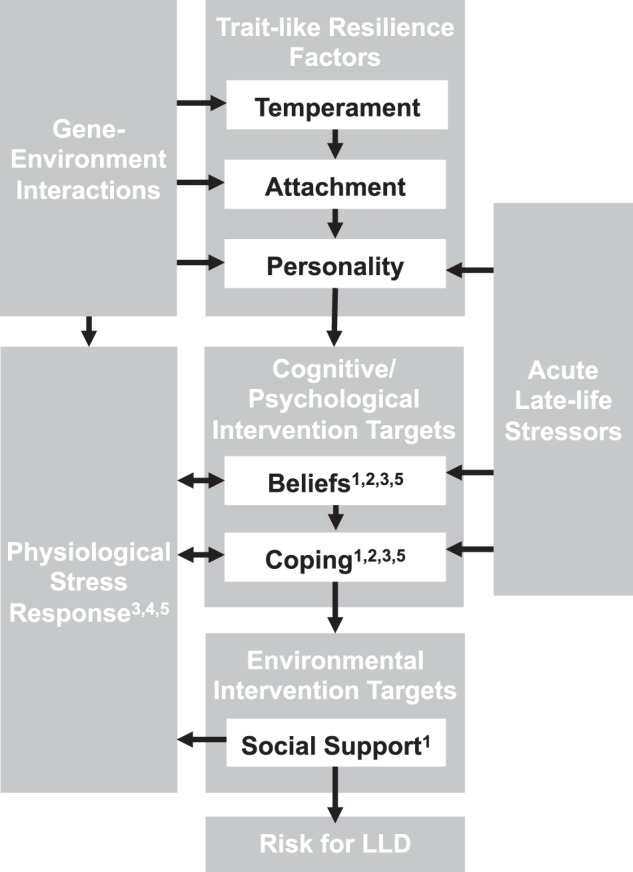
- Design: narrative review of psychosocial and neurobiological factors associated with resilience to LLD, including a proposed biopsychosocial model (Table 1, Fig. 1).
- Data/sample: no primary sample; synthesizes prior meta-analyses, longitudinal studies, randomized controlled trials, and reviews across general, older adult, and LLD populations.
- Analysis: narrative synthesis of resilience/vulnerability correlates and intervention efficacy; no systematic search strategy or meta-analytic pooling is reported.
Limitations
- Stated: “Additional research is needed to further elucidate psychosocial and biological factors that affect risk and course of LLD” and to identify psychobiological factors predicting differential treatment response.
- Stated: no RCTs to date have examined the efficacy of HRV biofeedback in LLD; one meta-analysis could not estimate psychotherapy effects on HPA/ANS regulation due to methodological heterogeneity.
- Evident from text: as a narrative review, it does not report a systematic search, inclusion criteria, or formal quality assessment, and findings are synthesized across heterogeneous studies and populations.
Model-written summary. Check it against the paper before relying on it.
Integrity signals
Registry
Cites
Statistics
Figures
Verification
Claims the paper makes
30 Valid · 6 Not valid · 191 Not checked · 13 Own results and interpretations
At least one cited source doesn’t support this claim or points to a different paper, and none confirmed it — see the verdicts below.
In the paper
“In LLD, correlates included low amygdala blood perfusion at rest and greater functional connectivity between the amygdala and the ventral default mode network228.”
§ Psychobiological factors of resilience and depression in late life > Psychobiological resilience factors > Neuroimaging biomarkers of emotion regulation, coping, and grit
What the sources say
- Disputedcites [228] 228. Leaver AM Resilience and amygdala function in older healthy and depressed adults J. Affect. Disord. 2018 237 27 34 10.1016/j.jad.2018.04.109 29754022 PMC5995579 sourceExperimental — accuracy not yet measured
The Results (Amygdalar Functional Connectivity with Prefrontal Networks) report the opposite direction: greater amygdala–ventral default-mode-network connectivity was associated with lower resilience scores. The paper says this negative relationship was present in both depressed and nondepressed volunteers, rather than greater connectivity being a correlate of higher resilience in late-life depression. (LLM, conf=0.88)
Checked by a reasoning model — may be wrong.
plainstates an association- Asserted: passes — The authors put it forward as true.
- Checkable: passes — It can be checked against evidence.
- Load-bearing: unclear — It is unclear whether the paper’s conclusions depend on it.
- Based: passes — The paper gives a reason why it holds.
- Disputed
The cited sources support only part of this claim — read each source’s verdict below.
In the paper
“Longitudinal studies27 as well as studies of children raised in orphanages28 indicate that disorganized attachment during infancy predicts greater amygdala volume—a hypothesized biomarker of difficulty with emotion regulation28.”
§ Psychobiological factors of resilience and depression in late life > Psychological resilience factors > Attachment
What the sources say
- Supportedcites [27] 27. Lyons-Ruth K Pechtel P Yoon SA Anderson CM Teicher MH Disorganized attachment in infancy predicts greater amygdala volume in adulthood Behav. Brain Res. 2016 308 83 93 10.1016/j.bbr.2016.03.050 27060720 PMC5017306 source
The Abstract and Results §3.3 of our copy state exactly this: in a 30-year longitudinal study of impoverished, highly stressed families, increased left amygdala volume in adulthood was associated with disorganized infant attachment behavior and disrupted maternal communication at 18 months (overall partial r = .679, p = .004; infant disorganization alone partial r = .543, p = .030), and the Conclusions frame it as disorganized early attachment promoting increased amygdala volume. The paper's own title asserts the same prediction. Two qualifiers the citing sentence drops are worth noting but do not contradict it: the effect was left-lateralized (right amygdala relations were non-significant) and the cohort was small (n = 18, described in the Discussion as a 'proof of construct' preliminary study) drawn from a high-risk low-income sample. (LLM, conf=0.85)
- Partly supportedcites [28] 28. Tottenham N Prolonged institutional rearing is associated with atypically large amygdala volume and difficulties in emotion regulation Dev. Sci. 2010 13 46 61 10.1111/j.1467-7687.2009.00852.x 20121862 PMC2817950 sourceExperimental — accuracy not yet measured
Our copy of Tottenham et al. (2010) supports the orphanage-rearing arm of the claim: Results > Morphometry reports that adjusted amygdala volume was associated with age adopted out of the orphanage (F(1,33)=8.43, p<0.007), and the Introduction/Hypothesis frames larger amygdala volume as an index of emotion-regulation difficulty and anxiety (with only a trend, r(28)=-0.34, p=0.06, for go-nogo errors to negative faces, per Results > Behavior). However, the paper never measures or reports attachment: 'disorganized attachment' does not appear, and attachment is mentioned only in the Introduction as an area of concern for PI children, credited to other works (Smyke, Dumitrescu, & Zeanah, 2002; O'Connor & Rutter, 2000). So the predictor the citing sentence attributes to this source — disorganized attachment in infancy — is not what this study tested; its predictor was duration/timing of institutional rearing. (LLM, conf=0.82)
hedgedstates a cause- Asserted: passes — The authors put it forward as true.
- Checkable: passes — It can be checked against evidence.
- Load-bearing: unclear — It is unclear whether the paper’s conclusions depend on it.
- Based: passes — The paper gives a reason why it holds.
- Supported
The cited sources support only part of this claim — read each source’s verdict below.
In the paper
“Religion and spirituality have been shown to prospectively reduce risk for depression73.”
§ Psychobiological factors of resilience and depression in late life > Psychological resilience factors > Religion and spirituality
What the sources say
- Partly supportedcites [73] 73. Miller L Religiosity and major depression in adults at high risk: a ten-year prospective study Am. J. Psychiatry 2012 169 89 94 10.1176/appi.ajp.2011.10121823 21865527 PMC3547523 sourceExperimental — accuracy not yet measured
Our copy does report a 10-year prospective protective effect: high personal importance of religion/spirituality predicted about one-fourth the odds of major depression overall (OR=0.24, 95% CI=0.06–0.95) and about one-tenth in the high-risk group. But the claim's breadth is not matched: the effect was 'found to exist primarily against recurrence rather than onset' and was significant only in the high-risk-with-prior-episode stratum, frequent attendance at religious services and denomination were not significantly associated, and the authors hedge in their conclusion ('may have a protective effect… particularly in adults with a history of parental depression'). So the source supports a prospective protective association for personal importance of religion/spirituality in a high-risk sample, not a general, demonstrated reduction in depression risk by 'religion and spirituality'. (LLM, conf=0.72)
plainstates a cause- Asserted: passes — The authors put it forward as true.
- Checkable: passes — It can be checked against evidence.
- Load-bearing: passes — The paper’s conclusions depend on it.
- Based: passes — The paper gives a reason why it holds.
- Partly supported
The cited sources support only part of this claim — read each source’s verdict below.
In the paper
“Research suggests that chronic stress-associated stimulation of the hypothalamic pituitary adrenal (HPA) axis and associated over-secretion of the stress hormone cortisol contribute to neurodegeneration120,121 that may increase risk for both LLD and cognitive decline.”
§ Psychobiological factors of resilience and depression in late life > Cognitive factors affecting resilience in LLD
What the sources say
- Partly supportedcites [120] 120. Smith SM Vale WW The role of the hypothalamic-pituitary-adrenal axis in neuroendocrine responses to stress Dialogues Clin. Neurosci. 2006 8 383 17290797 10.31887/DCNS.2006.8.4/ssmith PMC3181830 sourceExperimental — accuracy not yet measured
Our copy (Smith & Vale 2006) supports only the generic upstream part of the claim: the HPA axis section states that 'inadequate or excessive activation of the HPA axis may contribute to the development of pathologies,' the limbic-system section notes that hippocampal, prefrontal and amygdalar neurons 'may serve as a link between the stress system and neuropsychiatric disorders,' and the Conclusions link inappropriate stress-response regulation to affective disorders and major depression. The decisive parts of the claim are not in our copy: searches for neurodegeneration, neuronal death/toxicity, cognitive decline, dementia and late-life depression returned no passage stating that chronic HPA stimulation and cortisol over-secretion cause neurodegeneration or thereby raise risk for LLD or cognitive decline; the paper's treatment of chronic stress and glucocorticoids (limbic sections) concerns feedback regulation of HPA output, not neurodegeneration. The paper is also a mechanistic review of neuroendocrine stress regulation, so the risk statement is not its finding. (LLM, conf=0.68)
- Not checked yetcites [121] 121. Salvat-Pujol N Hypothalamic-pituitary-adrenal axis activity and cognition in major depression: the role of remission status Psychoneuroendocrinology 2017 76 38 48 10.1016/j.psyneuen.2016.11.007 27883963 source
hedgedstates a possible cause- Asserted: passes — The authors put it forward as true.
- Checkable: passes — It can be checked against evidence.
- Load-bearing: passes — The paper’s conclusions depend on it.
- Based: passes — The paper gives a reason why it holds.
- Partly supported
The cited sources support only part of this claim — read each source’s verdict below.
In the paper
“Individual differences in cognitive reserve are determined by such factors as early-life general cognitive ability/intelligence, education level, occupation complexity, physical exercise, social engagement, and ongoing cognitive engagement126.”
§ Psychobiological factors of resilience and depression in late life > Cognitive factors affecting resilience in LLD
What the sources say
- Partly supportedcites [126] 126. Stern Y Cognitive reserve Neuropsychologia 2009 47 2015 2028 10.1016/j.neuropsychologia.2009.03.004 19467352 PMC2739591 sourceExperimental — accuracy not yet measured
The 'Measures of Reserve' section and the 'Epidemiologic Evidence for CR' section support most of the list: IQ/premorbid and childhood cognition, educational attainment, occupational attainment, and leisure activities split into intellectual and social (visiting friends/relatives) are all described as contributing independently to CR, with the statement that CR 'at any point in one's lifetime it results from a combination of exposures'. Two items are not supported as stated: the paper's own rCBF work found that 'substantive complexity of occupation ... correlated very strongly with education and, therefore, did not contribute significantly in this model' (Evidence for CR From Studies of Regional Cerebral Blood Flow), so occupation complexity rather than occupational attainment is not what the paper attributes reserve to; and physical exercise appears only as a biological mechanism (neurogenesis, BDNF) and as a correlate of the 'physical demands' occupational feature, not as one of the listed CR proxies in 'Measures of Reserve'. The claim's 'determined by' is also stronger than the paper's hedged 'associated with'/'contributes to'. (LLM, conf=0.72)
plainstates a cause- Asserted: passes — The authors put it forward as true.
- Checkable: passes — It can be checked against evidence.
- Load-bearing: passes — The paper’s conclusions depend on it.
- Based: passes — The paper gives a reason why it holds.
- Partly supported
161 more claims · 19 with their cited sources checked
Create a free account to see all 240 claims and to verify the 317 references still open.
- It may state two separate claims as one. 62
- Probably not a substantial claim. 17
Claims other papers make about this one
Each is checked against this paper’s own text: does it say what the citing paper says it does?
The source backs part of the claim, not all of it — or backs it for a different population, condition or comparison.
In the citing paper
“Although challenging to translate into humans, healthy lifestyle factors such as moderate physical activity, dietary quality and cognitive stimulation are associated with resilience-building.61”
From The role of epigenetics in psychological resilience (2021) · cites this paper as [61]
Experimental — accuracy not yet measured
Self-check
Percentages, sums and reported differences re-computed from the paper’s own numbers.
Each contradiction between two passages listed here was confirmed by an independent check.
Rated minor: it would not touch a result — a value no result rests on, a p-value that stays on the same side of the significance level, or a conflict that is clerical, resolved elsewhere in the paper, or outside its own findings.
In the paper
§ Psychobiological factors of resilience and depression in late life > Psychobiological resilience factors > Endocrine changes in aging and depression
“Individuals with LLD demonstrate lower DHEA levels compared to non-depressed older adults, and DHEA levels increase with remission163.”
§ Psychobiological factors of resilience and depression in late life > References
“163. Fabian TJ Endogenous concentrations of DHEA and DHEA-S decrease with remission of depression in older adults”
Citations
Cites
1 retracted
Vasudev, A., Arena, A., Burhan, A. M., Ionson, E., Hirjee, H., Maldeniya, P., Wetmore, S., & Newman, R. I. (2016) · BJPsych Open · doi:10.1192/bjpo.bp.115.002394 · Cited by 11
RetractedEysenck, H. J. (1985) · Behaviour Research and Therapy · doi:10.1016/0005-7967(85)90087-7 · Cited by 31,975
“Stress: appraisal and coping,”
Folkman, S. (2013) · Encyclopedia of Behavioral Medicine · doi:10.1007/978-1-4419-1005-9_215 · Cited by 27,833
Generalized expectancies for internal versus external control of reinforcement.
Rotter, J. B. (1966) · Psychological Monographs: General and Applied · doi:10.1037/h0092976 · Cited by 21,937
Happiness is everything, or is it? Explorations on the meaning of psychological well-being.
Ryff, C. D. (1989) · Journal of Personality and Social Psychology · doi:10.1037/0022-3514.57.6.1069 · Cited by 14,847
On Happiness and Human Potentials: A Review of Research on Hedonic and Eudaimonic Well-Being
Ryan, R. M., & Deci, E. L. (2001) · Annual Review of Psychology · doi:10.1146/annurev.psych.52.1.141 · Cited by 11,567
Positive psychology: An introduction.
Seligman, M. E. P., & Csikszentmihalyi, M. (2000) · American Psychologist · doi:10.1037/0003-066x.55.1.5 · Cited by 11,351
Diener, E. (1984) · Psychological Bulletin · doi:10.1037/0033-2909.95.3.542 · Cited by 11,023
Diener, E. (2009) · Social Indicators Research Series · doi:10.1007/978-90-481-2350-6_2 · Cited by 10,950
Mindfulness-based interventions in context: Past, present, and future
Kabat-Zinn, J. (2003) · Clinical Psychology: Science and Practice · doi:10.1093/clipsy.bpg016 · Cited by 8,615
Research works printed but not linked: 3
- 18. Bowlby J Attachment and Loss: Attachment 1969 New York, NY Basic Books
- 19. Bowlby J Attachment and Loss: Separation 1973 New York, NY Basic Books
- 314. Sackeim HA Electroconvulsive therapy in late-life depression Clin. Geriatr. Psychopharmacol. 2004 4 385 422
Cited by
Older Adults and the Mental Health Effects of COVID-19
Vahia, I. V., Jeste, D. V., & Reynolds, C. F. (2020) · JAMA · doi:10.1001/jama.2020.21753 · Cited by 519
Szymkowicz, S. M., Gerlach, A. R., Homiack, D., & Taylor, W. D. (2023) · Translational Psychiatry · doi:10.1038/s41398-023-02464-9 · Cited by 196
“Resilience factors may decrease the risk of a depressive episode, reduce severity or duration of that episode, or increase likelihood of recovery [267, 268].”
BackgroundThe role of epigenetics in psychological resilience
Smeeth, D., Beck, S., Karam, E. G., & Pluess, M. (2021) · The Lancet Psychiatry · doi:10.1016/s2215-0366(20)30515-0 · Cited by 108
The geroscience agenda: Toxic stress, hormetic stress, and the rate of aging
Epel, E. S. (2020) · Ageing Research Reviews · doi:10.1016/j.arr.2020.101167 · Cited by 123
Gabriel, I., Creedy, D., & Coyne, E. (2020) · Nursing Open · doi:10.1002/nop2.543 · Cited by 103
Herhaus, B., Kersting, A., Brähler, E., & Petrowski, K. (2020) · Journal of Affective Disorders · doi:10.1016/j.jad.2020.07.020 · Cited by 102
Resilience Programs for Children and Adolescents: A Systematic Review and Meta-Analysis
Pinto, T. M., Laurence, P. G., Macedo, C. R., & de Macedo, E. C. (2021) · Frontiers in Psychology · doi:10.3389/fpsyg.2021.754115 · Cited by 118
Lyu, Y., Yu, Y., Chen, S., Lu, S., & Ni, S. (2021) · Applied Psychology: Health and Well-Being · doi:10.1111/aphw.12276 · Cited by 66
The heterogeneity of late-life depression and its pathobiology: a brain network dysfunction disorder
Jellinger, K. A. (2023) · Journal of Neural Transmission · doi:10.1007/s00702-023-02648-z · Cited by 65
“In addition, psychobiological factors include a variety of genetic, endocrine, inflammation, metabolic, neural, cardiovascular, and other processes that bidirectionally interact to affect the risk for LLD and the course of illness (Laird et al. 2019), and which may influence the risk of future suicidal behavior (Galfa…”
BackgroundSutin, A. R., Luchetti, M., Aschwanden, D., Lee, J., Sesker, A. A., Stéphan, Y., & Terracciano, A. (2022) · Journal of Affective Disorders · doi:10.1016/j.jad.2022.04.084 · Cited by 73
“Empirically, individuals with a greater sense of purpose tend to have better mental health over time (Laird et al., 2019; Wood and Joseph, 2010), and initial cross-sectional evidence indicates Fig.”
BackgroundJavani, G., Babri, S., Farajdokht, F., Ghaffari‐Nasab, A., & Mohaddes, G. (2022) · Mechanisms of Ageing and Development · doi:10.1016/j.mad.2022.111632 · Cited by 54
Late Life Depression: The Essentials and the Essential Distinctions
Husain-Krautter, S., & Ellison, J. M. (2021) · FOCUS The Journal of Lifelong Learning in Psychiatry · doi:10.1176/appi.focus.20210006 · Cited by 77
Hsieh, H., Huang, I.-Y., Liu, Y., Chen, W., Lee, Y.-W., & Hsu, H. (2020) · International Journal of Environmental Research and Public Health · doi:10.3390/ijerph17082905 · Cited by 57
“Many interventions have been effective for enhancing one’s resilience, such as positive psychology, psychotherapy, biofeedback, meditation, and yoga [19].”
BackgroundResilience to depression: Implication for psychological vaccination
Dai, Q., & Smith, G. D. (2023) · Frontiers in Psychiatry · doi:10.3389/fpsyt.2023.1071859 · Cited by 69
“Resilience is often manifested in biological, psychological, and social levels (23, 24).”
BackgroundWang, J., Xiao-lin, H., Chen, Y., & Lin, C. (2020) · Journal of Affective Disorders · doi:10.1016/j.jad.2020.07.051 · Cited by 61
Drazich, B. F., Li, Q., Perrin, N., Szanton, S. L., Lee, J. W., Huang, C.-M., Carlson, M. C., Samuel, L. J., Regier, N. G., Rebok, G. W., et al. (2022) · Aging & Mental Health · doi:10.1080/13607863.2022.2046695 · Cited by 57
“It is important to note that this study’s mediation effect sizes are small; therefore, researchers should explore other contributors to older adult resilience during the pandemic such as biological stress response, physical health, or psychosocial characteristics (Laird et al., 2019; Vahia et al., 2020).”
BackgroundLate-Life Depression: A Narrative Review on Risk Factors and Prevention
Vyas, C. M., & Okereke, O. I. (2020) · Harvard Review of Psychiatry · doi:10.1097/hrp.0000000000000240 · Cited by 58
Brief Resilience Scale (BRS) Portuguese Version: validity and metrics for the older adult population
da Silva‐Sauer, L., de la Torre‐Luque, A., Smith, B. W., Lins, M. C. M. C., Andrade, S. M., & Fernández‐Calvo, B. (2020) · Aging & Mental Health · doi:10.1080/13607863.2020.1753015 · Cited by 53
Emotional Impact of COVID-19 Lockdown Among the Spanish Population
González, E. G., Toro, L. B., Cagigal, V., Roldán, A., Beltrán, M. J. M., & Halty, L. (2020) · Frontiers in Psychology · doi:10.3389/fpsyg.2020.616978 · Cited by 48
Wisdom, Resilience, and Well-Being in Later Life
Jeste, D. V., Alexopoulos, G. S., Blazer, D. G., Lavretsky, H., Sachdev, P. S., & Reynolds, C. F. (2024) · Annual Review of Clinical Psychology · doi:10.1146/annurev-clinpsy-081423-031855 · Cited by 56
Self-citationBrand Experience on Brand Attachment: The Role of Interpersonal Interaction, Feedback, and Advocacy
Hongsuchon, T., Rahardja, U., Khan, A., Wu, T.-H., Hung, C.-W., Chang, R.-H., Hsu, C.-H., & Chen, S. (2023) · Emerging Science Journal · doi:10.28991/esj-2023-07-04-014 · Cited by 97
“Brand experience stimulates customers' visual, auditory, and olfactory senses, leaving a deep impression on them and providing them with a unique experience, forming brand attachment [72].”
BackgroundA Scoping Review on Biopsychosocial Predictors of Mental Health among Older Adults
Murniati, N., Aufa, B. A., Kusuma, D., & Kamso, S. (2022) · International Journal of Environmental Research and Public Health · doi:10.3390/ijerph191710909 · Cited by 57
“A recent investigation in adults with LLD stated that grit was associated with reduced severity of depression, apathy, and anxiety [61].”
BackgroundZhou, S. C., Luo, D., Wang, X. Q., Zhu, J., Wu, S., Sun, T., Li, X. Y., Kang, L., Ma, S., Lu, B., et al. (2022) · Journal of Affective Disorders · doi:10.1016/j.jad.2022.05.085 · Cited by 44
Mougharbel, F., Sampasa‐Kanyinga, H., Heidinger, B. A., Corace, K., Hamilton, H. A., & Goldfield, G. S. (2021) · Frontiers in Public Health · doi:10.3389/fpubh.2021.680028 · Cited by 43
“These associations may be attributed to older adults being better able to cope and be more resilient in crisis due to biological stress response, personality attributes, life experience, as well as a better financial stability, social and economic status (58).”
BackgroundWen, Z., Wang, H., Liang, Q., Liu, L., Zhang, W., & Zhang, X. (2024) · Journal of Affective Disorders · doi:10.1016/j.jad.2024.08.062 · Cited by 57
Unmet Healthcare Needs Predict Depression Symptoms among Older Adults
Eimontas, J., Gegieckaitė, G., Zamalijeva, O., & Pakalniškienė, V. (2022) · International Journal of Environmental Research and Public Health · doi:10.3390/ijerph19158892 · Cited by 43
Pietrzak, R. H., Levy, B. R., Tsai, J., & Southwick, S. M. (2020) · American Journal of Geriatric Psychiatry · doi:10.1016/j.jagp.2020.08.006 · Cited by 36
Purpose in life and stress: An individual-participant meta-analysis of 16 samples
Sutin, A. R., Luchetti, M., Stéphan, Y., Sesker, A. A., & Terracciano, A. (2023) · Journal of Affective Disorders · doi:10.1016/j.jad.2023.10.149 · Cited by 44
“Purpose in life, the feeling that one ’ s life is goal oriented and has direction (Ryff, 1995), is a psychological resource that has been associated with better physical (Musich et al., 2018), cognitive (Sutin et al., 2023a), and mental (Laird et al., 2019) health.”
BackgroundPurpose in life as an asset for well-being and a protective factor against depression in adolescents
Barcaccia, B., Couyoumdjian, A., Consiglio, M. D., Papa, C., Cancellieri, U. G., & Cervin, M. (2023) · Frontiers in Psychology · doi:10.3389/fpsyg.2023.1250279 · Cited by 66
“Previous studies in adults and older adults have found that the presence of purpose in life and of conceptually similar constructs, such as meaning in life, is negatively associated with symptoms of depression and anxiety, and plays a beneficial role in counteracting them (Pearson et al., 2015; Yek et al., 2017; Salt…”
BackgroundAdult attachment predicts the seven-year course of recurrent depression in primary care
Conradi, H. J., Kamphuis, J. H., & de Jonge, P. (2018) · Journal of Affective Disorders · doi:10.1016/j.jad.2017.08.009 · Cited by 33
Cristóbal-Narváez, P., Haro, J. M., & Koyanagi, A. (2021) · Journal of Affective Disorders · doi:10.1016/j.jad.2021.12.041 · Cited by 42
Liang, B., Zou, F.-H., Fu, L., & Liao, H.-L. (2020) · BioMed Research International · doi:10.1155/2020/5358467 · Cited by 35
“ALT (U/L) 33 (17-49) 38 (17-52) 32 (18-46) 0.”
Wu, X., Chen, B., Di, Z., Jiang, S., Xu, H., Shi, M., Hu, R., Sun, S., Song, Z., Liu, J., et al. (2022) · BMC Neuroscience · doi:10.1186/s12868-022-00746-4 · Cited by 42
“Moreover, our previous studies confirmed that increased glutamate concentration in the hippocampus (HIP) of depressed rats leads to neurotoxicity and apoptosis of neurons and astrocytes [25], and chronic stress leads to structural and morphological alternations such as dendritic spine loss, dendritic atrophy, and volu…”
BackgroundRisk Prediction Models for Depression in Community-Dwelling Older Adults
Murri, M. B., Cattelani, L., Chesani, F., Palumbo, P., Triolo, F., & Alexopoulos, G. S. (2022) · American Journal of Geriatric Psychiatry · doi:10.1016/j.jagp.2022.05.017 · Cited by 33
Nazari, N., Zekiy, A. O., Feng, L.-S., & Griffiths, M. D. (2021) · International Journal of Mental Health and Addiction · doi:10.1007/s11469-021-00540-z · Cited by 32
“Persistence of the positive emotion may be an effective coping strategy to reduce the risk of depression in traumatic situations in which individuals’ resilient abilities are critical (Fredrickson et al., 2003; Laird et al., 2019).”
BackgroundYazdanirad, S., Sadeghian, M., Naeini, M. J., Abbasi, M., & Mousavi, S. M. (2021) · Heliyon · doi:10.1016/j.heliyon.2021.e06808 · Cited by 31
“It has been reported that people with low resilience are prone to stress, anxiety, and interpersonal problems when they are faced to life problems, and may exhibit risky behaviors (Laird et al., 2019).”
Psychometric validation of the Persian version of the Emotional Style Questionnaire
Nazari, N., & Griffiths, M. D. (2022) · Current Psychology · doi:10.1007/s12144-020-01205-1 · Cited by 30
Asif, S., Mulic‐Lutvica, A., Axfors, C., Eckerdal, P., Iliadis, S. I., Fransson, E., & Skalkidou, A. (2020) · BJOG An International Journal of Obstetrics & Gynaecology · doi:10.1111/1471-0528.16271 · Cited by 38
Borges, M. K., Jeuring, H. W., Marijnissen, R. M., Munster, B. C. V., Aprahamian, I., van den Brink, R. H. S., Hoogendijk, E. O., & Voshaar, R. C. O. (2022) · Journal of the American Geriatrics Society · doi:10.1111/jgs.18021 · Cited by 32
Manigault, A. W., Kuhlman, K. R., Irwin, M. R., Cole, S. W., Ganz, P. A., Crespi, C. M., & Bower, J. E. (2022) · Psychological Science · doi:10.1177/09567976221079633 · Cited by 32
“Accordingly, our primary measure of resilience did not include behavioral factors such as physical activity, sleep, and nutrition, despite the potential impact of these factors on resilience (Laird et al., 2019; Schetter & Dolbier, 2011).”
BackgroundPatrick, R. E., Dickinson, R. A., Gentry, M. T., Kim, J. U., Oberlin, L. E., Park, S., Principe, J. L., Teixeira, A. L., & Weisenbach, S. L. (2024) · Journal of Affective Disorders · doi:10.1016/j.jad.2024.04.017 · Cited by 28
Post-COVID-19 Psychiatric Symptoms in the Elderly: The Role of Gender and Resilience
Janiri, D., Tosato, M., Simonetti, A., Montanari, S., Terenzi, B., Catinari, A., Mori, L. D., Ferrajoli, G. F., Kotzalidis, G. D., Landi, F., et al. (2022) · Journal of Personalized Medicine · doi:10.3390/jpm12122016 · Cited by 30
“Despite resilience being long-considered as a stable trait, it is a multifactorial construct that may respond to treatment at later age [46].”
BackgroundSalutogenic constructs across Pakistan and Germany: A cross sectional study
Bibi, A., Lin, M., & Margraf, J. (2019) · International Journal of Clinical and Health Psychology · doi:10.1016/j.ijchp.2019.10.001 · Cited by 27
Purpose in life and markers of immunity and inflammation: Testing pathways of episodic memory
Sutin, A. R., Stéphan, Y., Luchetti, M., & Terracciano, A. (2023) · Journal of Psychosomatic Research · doi:10.1016/j.jpsychores.2023.111487 · Cited by 29
Sun, T., Zhang, S.-E., Yin, H., Li, Q., Li, Y., Li, L., Gao, Y., Huang, X., & Liu, B. (2022) · Frontiers in Psychology · doi:10.3389/fpsyg.2022.847536 · Cited by 29
“Generally, there are three types of perspectives on defining complex construct of resilience, including a basic attribute (a trait) that is utilized by individuals, a dynamic process (a state) with bidirectional relations to positive and negative factors, and a performance outcome (a function) when challenged by one o…”
BackgroundYang, N., Qi, Y., Lu, J., Hu, J., & Ren, Y. (2021) · Children and Youth Services Review · doi:10.1016/j.childyouth.2021.106182 · Cited by 30
Ren, Y., Rong, T. A. N. G., Hua, S. U. N., & Xin, L. I. (2021) · Iranian Journal of Public Health · doi:10.18502/ijph.v50i3.5594 · Cited by 36
Setoyama, D., Yoshino, A., Takamura, M., Okada, G., Iwata, M., Tsunetomi, K., Ohgidani, M., Kuwano, N., Yoshimoto, J., Okamoto, Y., et al. (2020) · Journal of Affective Disorders · doi:10.1016/j.jad.2020.09.118 · Cited by 23
Ward, M. D., Turner, N., Briggs, R., O’Halloran, A. M., & Kenny, R. A. (2020) · Journal of Affective Disorders · doi:10.1016/j.jad.2020.08.089 · Cited by 26
Lee, S. (2023) · Journal of Physical Activity and Health · doi:10.1123/jpah.2022-0455 · Cited by 17
Sanna, F., Loy, F., Piras, R., Moat, A., & Masala, C. (2021) · Frontiers in Neuroscience · doi:10.3389/fnins.2021.599593 · Cited by 24
Pasha, H., Omidvar, S., Faramarzi, M., & Bakhtiari, A. (2023) · BMC Psychiatry · doi:10.1186/s12888-023-04677-0 · Cited by 22
“First, older people have greater resilience to the mental health effects of a crisis [30].”
BackgroundWilson, C. A., Plouffe, R. A., & Saklofske, D. H. (2021) · Canadian Journal on Aging / La Revue canadienne du vieillissement · doi:10.1017/s0714980821000155 · Cited by 26
“…Journal on Aging / La Revue canadienne du vieillissement & Toussaint, 2013), other measures of resilience (e.g., Karairmak, 2010), depression (e.g., Laird, Krause, Funes, & Lavretsky, 2019), anxiety (e.g., Keil, Vaske, Kenn, Rief, & Stenzel, 2017), stress (e.g., Gomez et al., 2013), and quality of…”
Cao, L., Ao, X., Zheng, Z., Ran, Z., & Lang, J. (2024) · Frontiers in Psychology · doi:10.3389/fpsyg.2024.1466327 · Cited by 36
Rolandi, E., Rossi, M., Colombo, M. M., Pettinato, L., Signore, F. D., Aglieri, V., Bottini, G., & Guaita, A. (2024) · The Journals of Gerontology Series B · doi:10.1093/geronb/gbae132 · Cited by 28
Sutin, A. R., Luchetti, M., Stéphan, Y., & Terracciano, A. (2021) · Aging & Mental Health · doi:10.1080/13607863.2021.1937055 · Cited by 19
“First, sense of purpose is an aspect of well-being, and earlier in adulthood it is associated with better mental health, including lower risk of depression (Laird et al., 2019; Ta bl e 2.”
BackgroundSutin, A. R., Luchetti, M., Stéphan, Y., & Terracciano, A. (2021) · Mental health and physical activity · doi:10.1016/j.mhpa.2021.100412 · Cited by 22
da Silva‐Sauer, L., Lima, T. R. G., da Fonsêca, É. K. G., de la Torre‐Luque, A., Yu, X., & Fernández‐Calvo, B. (2021) · Trends in Psychology · doi:10.1007/s43076-021-00073-3 · Cited by 27
Aslan, I. H., & Baldwin, D. S. (2020) · Journal of Affective Disorders · doi:10.1016/j.jad.2020.10.064 · Cited by 22
The interaction of physical activity and sleep quality with depression and anxiety in older adults
Yuan, Y., Huang, W., Hu, C., & Zhang, W. (2025) · Frontiers in Public Health · doi:10.3389/fpubh.2025.1674459 · Cited by 26
Pinto, T. M., Veiga, V. M. N., & de Macedo, E. C. (2024) · Journal of Behavioral and Cognitive Therapy · doi:10.1016/j.jbct.2024.100495 · Cited by 36
Wagner, M., Guimond, A., Kubzansky, L. D., Zhang, Y., Bennett, D. A., Barnes, L. L., & Grodstein, F. (2022) · Innovation in Aging · doi:10.1093/geroni/igac019 · Cited by 20
“Purpose in life has been considered in recent years as a target of intervention for preventing and treating late-life depression (Laird et al., 2019; Windsor et al., 2015); thus, we also examined interrelations of depressive symptoms and purpose in life to better understand their joint…”
BackgroundThe Relationship Between Loneliness and Positive Affect in Older Adults
Davidson, E. J., Taylor, C. T., Ayers, C. R., Quach, N. E., Tu, X. M., & Lee, E. (2021) · American Journal of Geriatric Psychiatry · doi:10.1016/j.jagp.2021.11.002 · Cited by 23
Wang, Y., Ge, F., Wan, M., & Zhang, J. (2021) · Psychiatry Investigation · doi:10.30773/pi.2020.0330 · Cited by 20
Depressive symptoms in older adults: the role of physical activity and social support
Moya, C. A. M., Soares, F. C., Lima, R. A., de Barros, M. V. G., & Bezerra, J. (2021) · Trends in Psychiatry and Psychotherapy · doi:10.47626/2237-6089-2020-0093 · Cited by 24
Giusti, E. M., Veronesi, G., Callegari, C., Borchini, R., Castelnuovo, G., Gianfagna, F., Iacoviello, L., & Ferrario, M. (2023) · Psychiatry Research · doi:10.1016/j.psychres.2023.115305 · Cited by 23
“However, the protective role of this variable on mental health disorders through an array of biological and psychological processes is known (Curtin et al., 2022; Laird et al., 2019; Watters et al., 2021).”
Almutawa, N., & Al-Mutairi, N. (2021) · Frontiers in Psychiatry · doi:10.3389/fpsyt.2021.801002 · Cited by 22
“(40) indicated that this resilience could reflect internal factors, such as biological stress response, cognitive capacity, personality traits, or external factors, such as financial stability and social status.”
BackgroundNunes, K. G., & da Rocha, N. S. (2021) · Quality of Life Research · doi:10.1007/s11136-021-02920-3 · Cited by 26
“In simple terms, psychological resilience may be a neuroprotective factor [24].”
BackgroundQi, C., & Yang, N. (2024) · Frontiers in Psychology · doi:10.3389/fpsyg.2023.1279577 · Cited by 37
O'Brien, E. J., Whitman, K., Buerke, M. L., Galfalvy, H., & Szántó, K. (2022) · American Journal of Geriatric Psychiatry · doi:10.1016/j.jagp.2022.12.192 · Cited by 22
Zhang, L., Cruz-Gonzalez, M. A., Lin, Z., Ouyang, X., Zhao, F., & Alegria, M. M. (2022) · Frontiers in Public Health · doi:10.3389/fpubh.2022.953155 · Cited by 15
Bergeron, C. D., Boolani, A., Jansen, E. C., & Smith, M. L. (2021) · Frontiers in Public Health · doi:10.3389/fpubh.2021.674847 · Cited by 16
Cuoco, S., Carotenuto, I., Cappiello, A., Bisogno, R., Picillo, M., Pellecchia, M. T., Barone, P., & Erro, R. (2021) · Neurological Sciences · doi:10.1007/s10072-021-05784-0 · Cited by 18
Dorais, S., & Gutiérrez, D. (2021) · Religions · doi:10.3390/rel12080573 · Cited by 27
Predictors of Cognitive Improvement Following Treatment for Late-Life Depression
Siddarth, P., Funes, C. M., Laird, K. T., Ercoli, L., & Lavretsky, H. (2021) · Journal of Geriatric Psychiatry and Neurology · doi:10.1177/0891988720915515 · Cited by 15
Self-citationBabatunde, O. A., Ramkumar, S. P., Nguyen, S. A., Okereke, O. I., Clark, F. A., Nagar, A., Osazuwa‐Peters, N., & Boakye, E. A. (2024) · Preventive Medicine · doi:10.1016/j.ypmed.2024.107921 · Cited by 15
Sutin, A. R., Luchetti, M., Stéphan, Y., & Terracciano, A. (2023) · Journal of the International Neuropsychological Society · doi:10.1017/s1355617723000516 · Cited by 15
“…cognitive status or depression may undermine the positive association between purpose and cognitive function because both of these factors are associated with purpose (Laird et al., 2019; Sutin et al., 2023) and impair performance on cognitive tasks (Henry et al., 2004; Semkovska et al., 2019).”
BackgroundAkcan, G., Erol, E., & Köse, Ö. B. (2023) · European Journal of Trauma & Dissociation · doi:10.1016/j.ejtd.2023.100345 · Cited by 15
Speech as a Biomarker for Disease Detection
Botelho, C., Abad, A., Schultz, T., & Trancoso, I. M. (2024) · IEEE Access · doi:10.1109/access.2024.3506433 · Cited by 29
Sense of purpose in life and subjective cognitive failures
Sutin, A. R., Aschwanden, D., Luchetti, M., Stéphan, Y., & Terracciano, A. (2022) · Personality and Individual Differences · doi:10.1016/j.paid.2022.111874 · Cited by 15
Yıldırım, H. (2021) · Health & Social Care in the Community · doi:10.1111/hsc.13542 · Cited by 17
Hope and resilience among patients affected by unipolar and bipolar depression
Favale, D., Nacci, M., Bellomo, A., Torales, J. C., Castaldelli-Maia, J. M., & Ventriglio, A. (2023) · International Journal of Social Psychiatry · doi:10.1177/00207640221147166 · Cited by 13
“…was well-matched for age among sex and diagnostic groups and this may be a strength point of comparisons made: the mean age of patients was 42.5 ± 13.3 and this may avoid the possible impact of older age on hope and resilience, as discussed in the international literature (Laird et al., 2019).”
BackgroundInfluentialMickey, B. J., Ginsburg, Y., Jensen, E., & Maixner, D. F. (2021) · Journal of Psychiatric Research · doi:10.1016/j.jpsychires.2021.12.028 · Cited by 14
Reimagining Resilience in Aging: Leveraging AI/ML, Big Data Analytics, and Systems Innovation
Chen, J., Maguire, T. K., McCoy, R. G., Thomas, S. B., & Reynolds, C. F. (2025) · American Journal of Geriatric Psychiatry · doi:10.1016/j.jagp.2025.05.007 · Cited by 16
Regulatory emotional self-efficacy and anxiety in times of pandemic: a gender perspective
Cuadrado, E., Rich‐Ruiz, M., Gutiérrez‐Domingo, T., Luque, B., Castillo‐Mayén, R., Villaécija, J., & Farhane‐Medina, N. Z. (2022) · Health Psychology and Behavioral Medicine · doi:10.1080/21642850.2022.2158831 · Cited by 13
“…previous studies that have related positive dispositional beliefs (Bozda ğ , 2021; Taroyan et al., 2020; Y ı ld ı r ı m & Güler, 2021) and resilience (Laird et al., 2019; Masten, 2011; Thomas & Zolkoski, 2020) to emotional regulation and mental health, as well as with research fi nding that…”
BackgroundYao, N., Nazari, N., Veiskarami, H. A., & Griffiths, M. D. (2022) · Cognitive Processing · doi:10.1007/s10339-022-01101-5 · Cited by 9
McLaurin, N., Tabibi, D., Wang, T., Alhalimi, T., Lehrer, H. M., Harrison, L., Tanaka, H., & Steinhardt, M. A. (2024) · Preventing Chronic Disease · doi:10.5888/pcd21.230189 · Cited by 12
Chen, J., Liu, L., Chang, S., & Lu, C.-P. (2023) · Machine Learning with Applications · doi:10.1016/j.mlwa.2023.100494 · Cited by 16
Regional gray matter volume correlates with anxiety, apathy, and resilience in geriatric depression
Krause, B., Siddarth, P., Milillo, M. M., Kilpatrick, L. A., Narr, K. L., & Lavretsky, H. (2023) · International Psychogeriatrics · doi:10.1017/s1041610223000510 · Cited by 12
Self-citationInfluence of resilience on perceived stress and depression among Taiwanese army military personnel
Chao, E., Chen, S., Hong, Y., & Chiang, H. (2023) · Stress and Health · doi:10.1002/smi.3247 · Cited by 12
Reliability and Validity of the German Version of the Emotional Style Questionnaire
Jekauc, D., Mülberger, L., Weyland, S., Ennigkeit, F., Wunsch, K., Krell‐Roesch, J., & Fritsch, J. (2021) · Frontiers in Psychology · doi:10.3389/fpsyg.2021.749585 · Cited by 12
Bulteau, S., Péré, M., Blanchin, M., Poulet, E., Brunelin, J., Sauvaget, A., & Sebille, V. (2021) · Frontiers in Psychology · doi:10.3389/fpsyg.2021.631614 · Cited by 12
“Identifying such clinical factors associated with Negative SelfReference pave the way for concomitant synergistic adjuvant interventions that may be promising throughout their ability to reduce ruminations, negative self-image, and improve cognitive capacities as well as perceived self-efficacy (Donse et al., 2018; Ne…”
Enkhbayar, D., Ko, J., Oh, S., Ferdushi, R., Kim, J., Key, J., & Urtnasan, E. (2025) · Bioengineering · doi:10.3390/bioengineering12020186 · Cited by 10
“This variability highlights the need for explainable AI models to accurately predict depression, emphasizing the potential of phenotypic data to provide deeper insights [8].”
Belic, I., Winskel, H., Allen, K. R., & Longstaff, M. G. (2024) · Journal of Technology in Behavioral Science · doi:10.1007/s41347-024-00437-3 · Cited by 12
Associations of Frailty with Neuropsychiatric Symptoms of Alzheimer’s Disease: A Longitudinal Study
Chi, H., Ma, L., Wang, Z., Sheng, Z.-H., Liu, J.-Y., Mi, Y., Fu, Y., Huang, Y., Han, S.-L., Gao, P., et al. (2024) · Journal of Alzheimer s Disease · doi:10.3233/jad-231111 · Cited by 14
Bulteau, S., Malo, R., Holland, Z., Laurin, A., & Sauvaget, A. (2023) · Wiley Interdisciplinary Reviews Cognitive Science · doi:10.1002/wcs.1644 · Cited by 16
“Multimodal approaches are more effective that a unique isolated treatment (Candlish et al., 2019; Laird et al., 2019; Wilkinson et al., 2019).”
BackgroundWhen Harry Met Sally: Older Adult Spouses’ First Encounter Reminiscing and Well-Being
Mroz, E. L., Shah, M., Lan, H., Duker, A., Sperduto, C. M., Levy, B. R., & Monin, J. K. (2022) · The Gerontologist · doi:10.1093/geront/gnac053 · Cited by 9
Garcia, M. A., Li, X., Allen, P. A., Delahanty, D. L., Eppelheimer, M. S., Houston, J. R., Johnson, D. M., Loth, F., Maleki, J., Vorster, S. J., et al. (2021) · The Cerebellum · doi:10.1007/s12311-021-01251-w · Cited by 10
Simon, M., Barczak‐Scarboro, N. E., Pexa, B. S., Register‐Mihalik, J. K., Kerr, Z. Y., & DeFreese, J. D. (2024) · International Journal of Sport and Exercise Psychology · doi:10.1080/1612197x.2024.2324433 · Cited by 12
“Our fi ndings regarding resilience agree with extant literature on the general adult and geriatric population and establishes consistent fi ndings in this unique group of student-athletes (Laird, Krause, et al., 2019; Laird, Lavretsky, et al., 2019).”
Self-Compassion As A Mediator of The Relationship Between Psychological Inflexibility and Resilience
Büyüköksüz, E., & Tekin, I. (2023) · Spiritual Psychology and Counseling · doi:10.37898/spiritualpc.1276031 · Cited by 12
“Studies have also shown that certain aspects of resilience, such as positive feelings, meaning-making, cognitive flexibility, and successful coping, can preserve from the negative outcomes of mental health problems (Laird et al., 2019; Southwick et al., 2005).”
Background
Metadata
- Authors
- Laird, K. T., Krause, B., Funes, C., & Lavretsky, H.
- Affiliations
- University of California, Los Angeles (US)
- Corresponding author
- Lavretsky, Helen
- Venue
- Translational Psychiatry
- Published
- 2019-02-14
- Volume
- 9
- Issue
- 1
- Pages
- 88-88
- ISSN
- 2158-3188 (ISSN-L)
- PMC
- PMC6375932
- OpenAlex
- W2912992939
- Cited by
- 229
- References
- 362
- Citations by year
- 2026: 23 · 2025: 27 · 2024: 35 · 2023: 40 · 2022: 38 · 2021: 40 · 2020: 23 · 2019: 2
- FWCI
- 30.05
- Type
- journal article
- Language
- en
- Open access
- gold
- doi.org
- Licence
- cc-by
- creativecommons.org/licenses/by/4.0 (tdm)
- creativecommons.org/licenses/by/4.0 (vor)
- Locations
- Translational Psychiatry (publishedVersion, cc-by)
- Europe PMC (PubMed Central) (publishedVersion, cc-by)
- PubMed Central (publishedVersion, cc-by)
- PubMed (publishedVersion)
- DOAJ (DOAJ: Directory of Open Access Journals) (submittedVersion)
- eScholarship (California Digital Library) (submittedVersion)
- eScholarship (California Digital Library) (submittedVersion, cc-by)
- Funders
- U.S. Department of Health & Human Services | NIH | National Center for Complementary and Integrative Health (AT009198)
- Topics
- Social Sciences › Psychology › Clinical Psychology › Resilience and Mental Health
- Health Sciences › Medicine › Public Health, Environmental and Occupational Health › Aging, Health, and Disability
- Social Sciences › Psychology › Developmental and Educational Psychology › Aging and Gerontology Research
- Keywords
- resilience, geriatric depression, psychobiological factors, insecure attachment, neuroticism, self-efficacy, sense of purpose, coping, social support, neuroinflammation, genetic risk, hormonal factors, positive psychology, heart rate variability biofeedback, meditation, aerobic exercise, yoga, Tai Chi, pharmacotherapy, electroconvulsive therapy, depression prevention, personalized treatment
- MeSH terms
- Neuroticism, Aging, Depression, Electroconvulsive Therapy, Humans, Psychotherapy, Mind-Body Therapies, Resilience, Psychological
About these checks
Registry, retraction, Cites and statistics results are computed, not judged, with one exception: a printed reference that no index lists is read once by a model before it counts as a citation error. Claims are extracted by a model and kept only when their quote appears verbatim in the text; each cited source is then checked, with a model’s help, for whether it says what the claim relies on. Those verdicts can be wrong — read the claim’s quote and the cited source before relying on one.
The claim verdicts this report counts are experimental: their accuracy is not yet measured.
A language model drew the claims from the paper on 2026-10-04, under version 3 of the claim definition (model deepseek-v4.1-flash, prompt extract-v3).
A second model labelled each claim on 2026-10-04 (model jev-1.13-20260917, definition revision gold-guideline-v0.2).
Cited sources are checked with a language model’s help (gpt-6-sol and qwen3.8-omni-flash).
Statistics and arithmetic are recomputed, not judged.
Confidence bands are shown only for fields calibrated on our annotated test set. None is calibrated yet, so no band is shown.
What counts as a claim ›How we measure confidence ›How we check this ›
Are you an author, or do you see a problem with this page? Request a review
Data sources
Bibliographic data: Semantic Scholar, OpenAlex, Crossref.
Contains information from the Semantic Scholar Academic Graph Datasets, made available under the ODC Attribution License (ODC-BY 1.0).
Semantic Scholar’s data is described in: Kinney, R., et al. (2023). The Semantic Scholar Open Data Platform. arXiv:2301.10140.
