

Psychobiological factors of resilience and depression in late life
Open accessThe DOI matches its Crossref record; 346 of the 362 references it cites were found in a registry or an index; 38 of the 355 sources its claims cite were checked for support.
Abstract
In contrast to traditional perspectives of resilience as a stable, trait-like characteristic, resilience is now recognized as a multidimentional, dynamic capacity influenced by life-long interactions between internal and environmental resources. We review psychosocial and neurobiological factors associated with resilience to late-life depression (LLD). Recent research has identified both psychosocial characteristics associated with elevated LLD risk (e.g., insecure attachment, neuroticism) and psychosocial processes that may be useful intervention targets (e.g., self-efficacy, sense of purpose, coping behaviors, social support). Psychobiological factors include a variety of endocrine, genetic, inflammatory, metabolic, neural, and cardiovascular processes that bidirectionally interact to affect risk for LLD onset and course of illness. Several resilience-enhancing intervention modalities show promise for the prevention and treatment of LLD, including cognitive/psychological or mind–body (positive psychology; psychotherapy; heart rate variability biofeedback; meditation), movement-based (aerobic exercise; yoga; tai chi), and biological approaches (pharmacotherapy, electroconvulsive therapy). Additional research is needed to further elucidate psychosocial and biological factors that affect risk and course of LLD. In addition, research to identify psychobiological factors predicting differential treatment response to various interventions will be essential to the development of more individualized and effective approaches to the prevention and treatment of LLD.
Overview
CoChat Summary
TL;DR
This review synthesizes psychosocial and psychobiological factors associated with resilience and risk for late-life depression (LLD), framing resilience as a multidimensional, dynamic capacity. It also reviews resilience-enhancing interventions and calls for research to identify psychobiological predictors of differential treatment response.
Key findings
- Resilience correlates include secure attachment, positive emotionality, extraversion/conscientiousness/grit, self-efficacy, mastery, sense of purpose, active/accommodative coping, social support, and volunteering; LLD risk correlates include insecure attachment, neuroticism, passive coping, loneliness, Val/Met allele, APOE-e4, SLC6A4, female sex, neurodegeneration, white matter hyperintensities, shortened telomeres, lower heart rate variability, hippocampal atrophy, lower DHEA, and low or very high estrogen availability.
- Positive psychology interventions showed moderate effects on well-being (r = 0.29) and depressive symptoms (r = 0.31); psychotherapy had a number needed to treat of 3, with effects for CBT (g = 0.45), problem-solving therapy (g = 0.46), and life review therapy (g = 0.59); mindfulness-based CBT had g = 0.55.
- Second-generation antidepressants produced response rates of 44% vs 35% for placebo, with higher response in 10–12-week trials (55%) than 6–8-week trials (38%); discontinuation due to adverse events was 8–27% vs 1–11% for placebo.
- ECT was associated with remission rates of 51% overall and 73–90% in older adults, with standardized effect sizes of 0.91 compared to sham ECT.
Methods
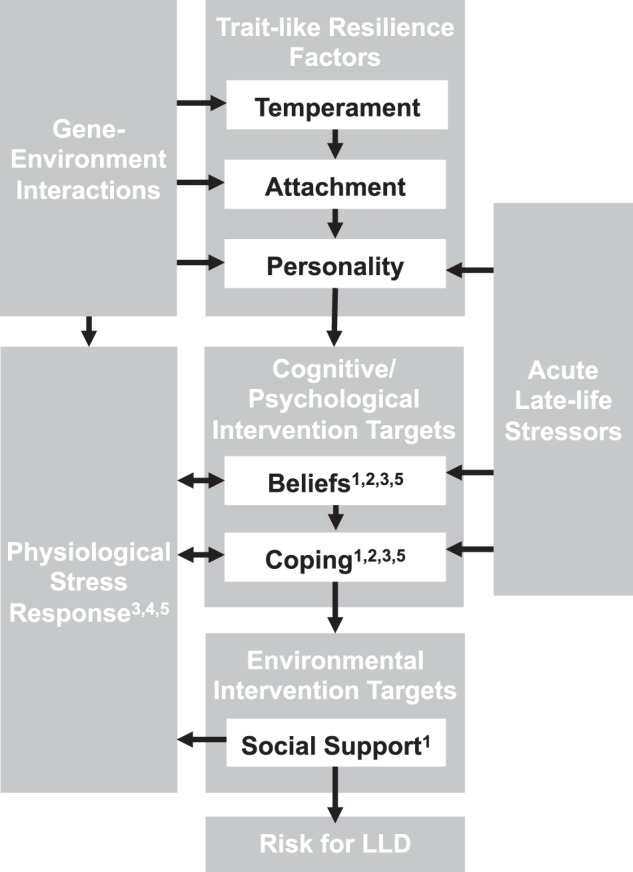
- Design: narrative review of psychosocial and neurobiological factors associated with resilience to LLD, including a proposed biopsychosocial model (Table 1, Fig. 1).
- Data/sample: no primary sample; synthesizes prior meta-analyses, longitudinal studies, randomized controlled trials, and reviews across general, older adult, and LLD populations.
- Analysis: narrative synthesis of resilience/vulnerability correlates and intervention efficacy; no systematic search strategy or meta-analytic pooling is reported.
Limitations
- Stated: “Additional research is needed to further elucidate psychosocial and biological factors that affect risk and course of LLD” and to identify psychobiological factors predicting differential treatment response.
- Stated: no RCTs to date have examined the efficacy of HRV biofeedback in LLD; one meta-analysis could not estimate psychotherapy effects on HPA/ANS regulation due to methodological heterogeneity.
- Evident from text: as a narrative review, it does not report a systematic search, inclusion criteria, or formal quality assessment, and findings are synthesized across heterogeneous studies and populations.
Model-written summary. Check it against the paper before relying on it.
Integrity signals
Registry
Cites
Statistics
Figures
Verification
Claims the paper makes
30 Valid · 6 Not valid · 191 Not checked · 13 Own results and interpretations
At least one cited source doesn’t support this claim or points to a different paper, and none confirmed it — see the verdicts below.
In the paper
“In LLD, correlates included low amygdala blood perfusion at rest and greater functional connectivity between the amygdala and the ventral default mode network228.”
§ Psychobiological factors of resilience and depression in late life > Psychobiological resilience factors > Neuroimaging biomarkers of emotion regulation, coping, and grit
What the sources say
- Disputedcites [228] 228. Leaver AM Resilience and amygdala function in older healthy and depressed adults J. Affect. Disord. 2018 237 27 34 10.1016/j.jad.2018.04.109 29754022 PMC5995579 sourceExperimental — accuracy not yet measured
The Results (Amygdalar Functional Connectivity with Prefrontal Networks) report the opposite direction: greater amygdala–ventral default-mode-network connectivity was associated with lower resilience scores. The paper says this negative relationship was present in both depressed and nondepressed volunteers, rather than greater connectivity being a correlate of higher resilience in late-life depression. (LLM, conf=0.88)
Checked by a reasoning model — may be wrong.
plainstates an association- Asserted: passes — The authors put it forward as true.
- Checkable: passes — It can be checked against evidence.
- Load-bearing: unclear — It is unclear whether the paper’s conclusions depend on it.
- Based: passes — The paper gives a reason why it holds.
- Disputed
The cited sources support only part of this claim — read each source’s verdict below.
In the paper
“Longitudinal studies27 as well as studies of children raised in orphanages28 indicate that disorganized attachment during infancy predicts greater amygdala volume—a hypothesized biomarker of difficulty with emotion regulation28.”
§ Psychobiological factors of resilience and depression in late life > Psychological resilience factors > Attachment
What the sources say
- Supportedcites [27] 27. Lyons-Ruth K Pechtel P Yoon SA Anderson CM Teicher MH Disorganized attachment in infancy predicts greater amygdala volume in adulthood Behav. Brain Res. 2016 308 83 93 10.1016/j.bbr.2016.03.050 27060720 PMC5017306 source
The Abstract and Results §3.3 of our copy state exactly this: in a 30-year longitudinal study of impoverished, highly stressed families, increased left amygdala volume in adulthood was associated with disorganized infant attachment behavior and disrupted maternal communication at 18 months (overall partial r = .679, p = .004; infant disorganization alone partial r = .543, p = .030), and the Conclusions frame it as disorganized early attachment promoting increased amygdala volume. The paper's own title asserts the same prediction. Two qualifiers the citing sentence drops are worth noting but do not contradict it: the effect was left-lateralized (right amygdala relations were non-significant) and the cohort was small (n = 18, described in the Discussion as a 'proof of construct' preliminary study) drawn from a high-risk low-income sample. (LLM, conf=0.85)
- Partly supportedcites [28] 28. Tottenham N Prolonged institutional rearing is associated with atypically large amygdala volume and difficulties in emotion regulation Dev. Sci. 2010 13 46 61 10.1111/j.1467-7687.2009.00852.x 20121862 PMC2817950 sourceExperimental — accuracy not yet measured
Our copy of Tottenham et al. (2010) supports the orphanage-rearing arm of the claim: Results > Morphometry reports that adjusted amygdala volume was associated with age adopted out of the orphanage (F(1,33)=8.43, p<0.007), and the Introduction/Hypothesis frames larger amygdala volume as an index of emotion-regulation difficulty and anxiety (with only a trend, r(28)=-0.34, p=0.06, for go-nogo errors to negative faces, per Results > Behavior). However, the paper never measures or reports attachment: 'disorganized attachment' does not appear, and attachment is mentioned only in the Introduction as an area of concern for PI children, credited to other works (Smyke, Dumitrescu, & Zeanah, 2002; O'Connor & Rutter, 2000). So the predictor the citing sentence attributes to this source — disorganized attachment in infancy — is not what this study tested; its predictor was duration/timing of institutional rearing. (LLM, conf=0.82)
hedgedstates a cause- Asserted: passes — The authors put it forward as true.
- Checkable: passes — It can be checked against evidence.
- Load-bearing: unclear — It is unclear whether the paper’s conclusions depend on it.
- Based: passes — The paper gives a reason why it holds.
- Supported
The cited sources support only part of this claim — read each source’s verdict below.
In the paper
“Religion and spirituality have been shown to prospectively reduce risk for depression73.”
§ Psychobiological factors of resilience and depression in late life > Psychological resilience factors > Religion and spirituality
What the sources say
- Partly supportedcites [73] 73. Miller L Religiosity and major depression in adults at high risk: a ten-year prospective study Am. J. Psychiatry 2012 169 89 94 10.1176/appi.ajp.2011.10121823 21865527 PMC3547523 sourceExperimental — accuracy not yet measured
Our copy does report a 10-year prospective protective effect: high personal importance of religion/spirituality predicted about one-fourth the odds of major depression overall (OR=0.24, 95% CI=0.06–0.95) and about one-tenth in the high-risk group. But the claim's breadth is not matched: the effect was 'found to exist primarily against recurrence rather than onset' and was significant only in the high-risk-with-prior-episode stratum, frequent attendance at religious services and denomination were not significantly associated, and the authors hedge in their conclusion ('may have a protective effect… particularly in adults with a history of parental depression'). So the source supports a prospective protective association for personal importance of religion/spirituality in a high-risk sample, not a general, demonstrated reduction in depression risk by 'religion and spirituality'. (LLM, conf=0.72)
plainstates a cause- Asserted: passes — The authors put it forward as true.
- Checkable: passes — It can be checked against evidence.
- Load-bearing: passes — The paper’s conclusions depend on it.
- Based: passes — The paper gives a reason why it holds.
- Partly supported
The cited sources support only part of this claim — read each source’s verdict below.
In the paper
“Research suggests that chronic stress-associated stimulation of the hypothalamic pituitary adrenal (HPA) axis and associated over-secretion of the stress hormone cortisol contribute to neurodegeneration120,121 that may increase risk for both LLD and cognitive decline.”
§ Psychobiological factors of resilience and depression in late life > Cognitive factors affecting resilience in LLD
What the sources say
- Partly supportedcites [120] 120. Smith SM Vale WW The role of the hypothalamic-pituitary-adrenal axis in neuroendocrine responses to stress Dialogues Clin. Neurosci. 2006 8 383 17290797 10.31887/DCNS.2006.8.4/ssmith PMC3181830 sourceExperimental — accuracy not yet measured
Our copy (Smith & Vale 2006) supports only the generic upstream part of the claim: the HPA axis section states that 'inadequate or excessive activation of the HPA axis may contribute to the development of pathologies,' the limbic-system section notes that hippocampal, prefrontal and amygdalar neurons 'may serve as a link between the stress system and neuropsychiatric disorders,' and the Conclusions link inappropriate stress-response regulation to affective disorders and major depression. The decisive parts of the claim are not in our copy: searches for neurodegeneration, neuronal death/toxicity, cognitive decline, dementia and late-life depression returned no passage stating that chronic HPA stimulation and cortisol over-secretion cause neurodegeneration or thereby raise risk for LLD or cognitive decline; the paper's treatment of chronic stress and glucocorticoids (limbic sections) concerns feedback regulation of HPA output, not neurodegeneration. The paper is also a mechanistic review of neuroendocrine stress regulation, so the risk statement is not its finding. (LLM, conf=0.68)
- Not checked yetcites [121] 121. Salvat-Pujol N Hypothalamic-pituitary-adrenal axis activity and cognition in major depression: the role of remission status Psychoneuroendocrinology 2017 76 38 48 10.1016/j.psyneuen.2016.11.007 27883963 source
hedgedstates a possible cause- Asserted: passes — The authors put it forward as true.
- Checkable: passes — It can be checked against evidence.
- Load-bearing: passes — The paper’s conclusions depend on it.
- Based: passes — The paper gives a reason why it holds.
- Partly supported
The cited sources support only part of this claim — read each source’s verdict below.
In the paper
“Individual differences in cognitive reserve are determined by such factors as early-life general cognitive ability/intelligence, education level, occupation complexity, physical exercise, social engagement, and ongoing cognitive engagement126.”
§ Psychobiological factors of resilience and depression in late life > Cognitive factors affecting resilience in LLD
What the sources say
- Partly supportedcites [126] 126. Stern Y Cognitive reserve Neuropsychologia 2009 47 2015 2028 10.1016/j.neuropsychologia.2009.03.004 19467352 PMC2739591 sourceExperimental — accuracy not yet measured
The 'Measures of Reserve' section and the 'Epidemiologic Evidence for CR' section support most of the list: IQ/premorbid and childhood cognition, educational attainment, occupational attainment, and leisure activities split into intellectual and social (visiting friends/relatives) are all described as contributing independently to CR, with the statement that CR 'at any point in one's lifetime it results from a combination of exposures'. Two items are not supported as stated: the paper's own rCBF work found that 'substantive complexity of occupation ... correlated very strongly with education and, therefore, did not contribute significantly in this model' (Evidence for CR From Studies of Regional Cerebral Blood Flow), so occupation complexity rather than occupational attainment is not what the paper attributes reserve to; and physical exercise appears only as a biological mechanism (neurogenesis, BDNF) and as a correlate of the 'physical demands' occupational feature, not as one of the listed CR proxies in 'Measures of Reserve'. The claim's 'determined by' is also stronger than the paper's hedged 'associated with'/'contributes to'. (LLM, conf=0.72)
plainstates a cause- Asserted: passes — The authors put it forward as true.
- Checkable: passes — It can be checked against evidence.
- Load-bearing: passes — The paper’s conclusions depend on it.
- Based: passes — The paper gives a reason why it holds.
- Partly supported
161 more claims · 19 with their cited sources checked
Create a free account to see all 240 claims and to verify the 317 references still open.
- It may state two separate claims as one. 62
- Probably not a substantial claim. 17
Claims other papers make about this one
Each is checked against this paper’s own text: does it say what the citing paper says it does?
The source backs part of the claim, not all of it — or backs it for a different population, condition or comparison.
In the citing paper
“Although challenging to translate into humans, healthy lifestyle factors such as moderate physical activity, dietary quality and cognitive stimulation are associated with resilience-building.61”
From The role of epigenetics in psychological resilience (2021) · cites this paper as [61]
Experimental — accuracy not yet measured
Self-check
Percentages, sums and reported differences re-computed from the paper’s own numbers.
Each contradiction between two passages listed here was confirmed by an independent check.
Rated minor: it would not touch a result — a value no result rests on, a p-value that stays on the same side of the significance level, or a conflict that is clerical, resolved elsewhere in the paper, or outside its own findings.
In the paper
§ Psychobiological factors of resilience and depression in late life > Psychobiological resilience factors > Endocrine changes in aging and depression
“Individuals with LLD demonstrate lower DHEA levels compared to non-depressed older adults, and DHEA levels increase with remission163.”
§ Psychobiological factors of resilience and depression in late life > References
“163. Fabian TJ Endogenous concentrations of DHEA and DHEA-S decrease with remission of depression in older adults”
Citations
Cites
1 retracted
Vasudev, A., Arena, A., Burhan, A. M., Ionson, E., Hirjee, H., Maldeniya, P., Wetmore, S., & Newman, R. I. (2016) · BJPsych Open · doi:10.1192/bjpo.bp.115.002394 · Cited by 11
RetractedEysenck, H. J. (1985) · Behaviour Research and Therapy · doi:10.1016/0005-7967(85)90087-7 · Cited by 31,975
“Stress: appraisal and coping,”
Folkman, S. (2013) · Encyclopedia of Behavioral Medicine · doi:10.1007/978-1-4419-1005-9_215 · Cited by 27,833
Generalized expectancies for internal versus external control of reinforcement.
Rotter, J. B. (1966) · Psychological Monographs: General and Applied · doi:10.1037/h0092976 · Cited by 21,937
Happiness is everything, or is it? Explorations on the meaning of psychological well-being.
Ryff, C. D. (1989) · Journal of Personality and Social Psychology · doi:10.1037/0022-3514.57.6.1069 · Cited by 14,847
On Happiness and Human Potentials: A Review of Research on Hedonic and Eudaimonic Well-Being
Ryan, R. M., & Deci, E. L. (2001) · Annual Review of Psychology · doi:10.1146/annurev.psych.52.1.141 · Cited by 11,567
Positive psychology: An introduction.
Seligman, M. E. P., & Csikszentmihalyi, M. (2000) · American Psychologist · doi:10.1037/0003-066x.55.1.5 · Cited by 11,351
Diener, E. (1984) · Psychological Bulletin · doi:10.1037/0033-2909.95.3.542 · Cited by 11,023
Diener, E. (2009) · Social Indicators Research Series · doi:10.1007/978-90-481-2350-6_2 · Cited by 10,950
Mindfulness-based interventions in context: Past, present, and future
Kabat-Zinn, J. (2003) · Clinical Psychology: Science and Practice · doi:10.1093/clipsy.bpg016 · Cited by 8,615
Mindfulness-based interventions in context: Past, present, and future.
Kabat-Zinn, J. (2003) · Clinical Psychology: Science and Practice · doi:10.1093/clipsy/bpg016 · Cited by 8,612
Influence of life stress on depression: moderation by a polymorphism in the 5-HTT gene
Caspi, A., Sugden, K., Moffitt, T. E., Taylor, A., Craig, I. W., Harrington, H., McClay, J., Mill, J., Martin, J., Braithwaite, A., et al. (2003) · Science · doi:10.1126/science.1083968 · Cited by 8,120
Взаимосвязь статуса занятости и пола с уровнем психологического благополучия
М.Р., Н., & С.И., Б. (2026) · Cifra LLC Journals · doi:10.60797/irj.2026.170.43 · Cited by 7,950
Grit: perseverance and passion for long-term goals
Duckworth, A. L., Peterson, C., Matthews, M. D., & Kelly, D. R. (2007) · Journal of Personality and Social Psychology · doi:10.1037/0022-3514.92.6.1087 · Cited by 6,911
Lippa, N. C., & Sanderson, S. C. (2013) · Human Heredity · doi:10.1159/000353712 · Cited by 6,078
Positive Psychology Progress: Empirical Validation of Interventions.
Seligman, M. E. P., Steen, T. A., Park, N., & Peterson, C. (2005) · American Psychologist · doi:10.1037/0003-066x.60.5.410 · Cited by 5,947
Mechanisms Linking Social Ties and Support to Physical and Mental Health
Thoits, P. A. (2011) · Journal of Health and Social Behavior · doi:10.1177/0022146510395592 · Cited by 4,076
Domingos da Silveira da Luz, A. C., Pereira Dias, G., do Nascimento Bevilaqua, M. C., Cocks, G., Gardino, P. F., Thuret, S., & Nardi, A. E. (2013) · Neuropsychobiology · doi:10.1159/000353269 · Cited by 3,995
Egan, M. F., Kojima, M., Callicott, J. H., Goldberg, T. E., Kolachana, B. S., Bertolino, A., Zaitsev, E., Gold, B., Goldman, D., Dean, M., et al. (2003) · Cell · doi:10.1016/s0092-8674(03)00035-7 · Cited by 3,888
Inflammation and Its Discontents: The Role of Cytokines in the Pathophysiology of Major Depression
Miller, A. H., Maletic, V., & Raison, C. L. (2009) · Biological Psychiatry · doi:10.1016/j.biopsych.2008.11.029 · Cited by 3,848
Pursuing Happiness: The Architecture of Sustainable Change
Lyubomirsky, S., Sheldon, K. M., & Schkade, D. (2005) · Review of General Psychology · doi:10.1037/1089-2680.9.2.111 · Cited by 3,203
Hammen, C. (2005) · Annual Review of Clinical Psychology · doi:10.1146/annurev.clinpsy.1.102803.143938 · Cited by 2,979
Sin, N. L., & Lyubomirsky, S. (2009) · Journal of Clinical Psychology · doi:10.1002/jclp.20593 · Cited by 2,955
Stern, Y. (2009) · Neuropsychologia · doi:10.1016/j.neuropsychologia.2009.03.004 · Cited by 2,943
The Neuroscience of Mindfulness Meditation
Tang, Y.-Y., Hölzel, B. K., & Posner, M. I. (2015) · Nature reviews. Neuroscience · doi:10.1038/nrn3916 · Cited by 2,889
Fredrickson, B. L., Tugade, M. M., Waugh, C. E., & Larkin, G. R. (2003) · Journal of Personality and Social Psychology · doi:10.1037/0022-3514.84.2.365 · Cited by 2,797
Uchino, B. N., Cacioppo, J. T., & Kiecolt-Glaser, J. K. (1996) · Psychological Bulletin · doi:10.1037/0033-2909.119.3.488 · Cited by 2,727
Miller, G. E., Chen, E., & Zhou, E. S. (2007) · Psychological Bulletin · doi:10.1037/0033-2909.133.1.25 · Cited by 2,467
Cacioppo, J. T., Hughes, M. E., Waite, L. J., Hawkley, L. C., & Thisted, R. A. (2006) · Psychology and Aging · doi:10.1037/0882-7974.21.1.140 · Cited by 2,380
Does low self-esteem predict depression and anxiety? A meta-analysis of longitudinal studies.
Sowislo, J. F., & Orth, U. (2013) · Psychological Bulletin · doi:10.1037/a0028931 · Cited by 2,123
Mindfulness-based therapy: a comprehensive meta-analysis
Khoury, B., Lecomte, T., Fortin, G., Masse, M., Therien, P., Bouchard, V., Chapleau, M.-A., Paquin, K., & Hofmann, S. G. (2013) · Clinical Psychology Review · doi:10.1016/j.cpr.2013.05.005 · Cited by 2,003
The role of the hypothalamic-pituitary-adrenal axis in neuroendocrine responses to stress
Smith, S. M., & Vale, W. W. (2006) · Dialogues in Clinical Neuroscience · doi:10.31887/dcns.2006.8.4/ssmith · Cited by 1,948
Heart rate variability as an index of regulated emotional responding
Appelhans, B. M., & Luecken, L. J. (2006) · Review of General Psychology · doi:10.1037/1089-2680.10.3.229 · Cited by 1,893
Shaffer, F., McCraty, R., & Zerr, C. L. (2014) · Frontiers in Psychology · doi:10.3389/fpsyg.2014.01040 · Cited by 1,866
A meta-analytic review of benefit finding and growth.
Helgeson, V. S., Reynolds, K. A., & Tomich, P. L. (2006) · Journal of Consulting and Clinical Psychology · doi:10.1037/0022-006x.74.5.797 · Cited by 1,864
What is resilience? A review and concept analysis.
Windle, G. (2011) · Reviews in Clinical Gerontology · doi:10.1017/s0959259810000420 · Cited by 1,761
Gu, J., Strauss, C., Bond, R., & Cavanagh, K. (2015) · Clinical Psychology Review · doi:10.1016/j.cpr.2015.01.006 · Cited by 1,712
(2003) · The Lancet · doi:10.1016/s0140-6736(03)12705-5 · Cited by 1,706
Whitepaper: Defining and investigating cognitive reserve, brain reserve, and brain maintenance
Stern, Y., Arenaza‐Urquijo, E. M., Bartrés‐Faz, D., Belleville, S., Cantilon, M., Chetelat, G., Ewers, M., Franzmeier, N., Kempermann, G., Kremen, W. S., et al. (2020) · Alzheimer's & Dementia · doi:10.1016/j.jalz.2018.07.219 · Cited by 1,703
The potential role of hypocortisolism in the pathophysiology of stress-related bodily disorders
Heim, C., Ehlert, U., & Hellhammer, D. H. (2000) · Psychoneuroendocrinology · doi:10.1016/s0306-4530(99)00035-9 · Cited by 1,688
Livingston, J. D., & Boyd, J. E. (2010) · Social Science & Medicine · doi:10.1016/j.socscimed.2010.09.030 · Cited by 1,677
Charney, D. S. (2004) · American Journal of Psychiatry · doi:10.1176/appi.ajp.161.2.195 · Cited by 1,605
Glial reduction in the subgenual prefrontal cortex in mood disorders
Öngür, D., Drevets, W. C., & Price, J. L. (1998) · Proceedings of the National Academy of Sciences · doi:10.1073/pnas.95.22.13290 · Cited by 1,525
Thoits, P. A. (1982) · Journal of Health and Social Behavior · doi:10.2307/2136511 · Cited by 1,507
Evidence for a life-span theory of socioemotional selectivity
Carstensen, L. L. (1995) · Current Directions in Psychological Science · doi:10.1111/1467-8721.ep11512261 · Cited by 1,458
Risk Factors for Depression Among Elderly Community Subjects: A Systematic Review and Meta-Analysis
Cole, M. G., & Dendukuri, N. (2003) · American Journal of Psychiatry · doi:10.1176/appi.ajp.160.6.1147 · Cited by 1,368
Depression and cardiovascular disease: a clinical review
Hare, D. L., Toukhsati, S. R., Johansson, P., & Jaarsma, T. (2014) · European Heart Journal · doi:10.1093/eurheartj/eht462 · Cited by 1,362
Nicholson, A., Kuper, H., & Hemingway, H. (2006) · European Heart Journal · doi:10.1093/eurheartj/ehl338 · Cited by 1,353
Kemp, A. H., Quintana, D. S., Gray, M. A., Felmingham, K. L., Brown, K., & Gatt, J. M. (2010) · Biological Psychiatry · doi:10.1016/j.biopsych.2009.12.012 · Cited by 1,286
Gold, P. W., & Chrousos, G. P. (2002) · Molecular Psychiatry · doi:10.1038/sj.mp.4001032 · Cited by 1,274
Loneliness in Older Persons: A Predictor of Functional Decline and Death
Perissinotto, C. M., Stijacic Cenzer, I., & Covinsky, K. E. (2012) · Archives of Internal Medicine · doi:10.1001/archinternmed.2012.1993 · Cited by 1,269
Childhood maltreatment predicts adult inflammation in a life-course study
Danese, A., Pariante, C. M., Caspi, A., Taylor, A., & Poulton, R. (2007) · Proceedings of the National Academy of Sciences · doi:10.1073/pnas.0610362104 · Cited by 1,264
Making sense of loss and benefiting from the experience: two construals of meaning.
Davis, C. G., Nolen-Hoeksema, S., & Larson, J. (1998) · Journal of Personality and Social Psychology · doi:10.1037/0022-3514.75.2.561 · Cited by 1,168
Umetani, K., Singer, D. H., McCraty, R., & Atkinson, M. (1998) · Journal of the American College of Cardiology · doi:10.1016/s0735-1097(97)00554-8 · Cited by 1,145
Brandtstädter, J., & Renner, G. (1990) · Psychology and Aging · doi:10.1037/0882-7974.5.1.58 · Cited by 1,131
The Brain on Stress: Vulnerability and Plasticity of the Prefrontal Cortex over the Life Course
McEwen, B. S., & Morrison, J. H. (2013) · Neuron · doi:10.1016/j.neuron.2013.06.028 · Cited by 1,079
Attachment and Loss: Sadness and Depression
Albert, S., & Bowlby, J. (1982) · Journal of Marriage and the Family · doi:10.2307/351282 · Cited by 1,063
Hariri, A. R., Goldberg, T. E., Mattay, V. S., Kolachana, B. S., Callicott, J. H., Egan, M. F., & Weinberger, D. R. (2003) · The Journal of Neuroscience · doi:10.1523/jneurosci.23-17-06690.2003 · Cited by 1,045
Antoni, M. H., Lehman, J. M., Kilbourn, K. M., Boyers, A. E., Culver, J. L., Alferi, S. M., Yount, S. E., McGregor, B. A., Arena, P. L., Harris, S. D., et al. (2001) · Health Psychology · doi:10.1037/0278-6133.20.1.20 · Cited by 1,011
Rippetoe, P. A., & Rogers, R. W. (1987) · Journal of Personality and Social Psychology · doi:10.1037//0022-3514.52.3.596 · Cited by 977
The association between social relationships and depression: A systematic review
Santini, Z. I., Koyanagi, A., Tyrovolas, S., Mason, C., & Haro, J. M. (2015) · Journal of Affective Disorders · doi:10.1016/j.jad.2014.12.049 · Cited by 949
A mechanism converting psychosocial stress into mononuclear cell activation
Bierhaus, A., Wolf, J., Andrassy, M., Rohleder, N., Humpert, P. M., Petrov, D., Ferstl, R., von Eynatten, M., Wendt, T., Rudofsky, G., et al. (2003) · Proceedings of the National Academy of Sciences · doi:10.1073/pnas.0438019100 · Cited by 927
Sheldon, K. M., & Lyubomirsky, S. (2006) · The Journal of Positive Psychology · doi:10.1080/17439760500510676 · Cited by 925
The vascular depression hypothesis: mechanisms linking vascular disease with depression
Taylor, W. D., Aizenstein, H. J., & Alexopoulos, G. S. (2013) · Molecular Psychiatry · doi:10.1038/mp.2013.20 · Cited by 923
The Association between Job Strain and Atrial Fibrillation: Results from the Swedish WOLF Study
Fransson, E. I., Stadin, M., Nordin, M., Malm, D., Knutsson, A., Alfredsson, L., & Westerholm, P. J. M. (2015) · BioMed Research International · doi:10.1155/2015/371905 · Cited by 914
Tottenham, N., Hare, T. A., Quinn, B. T., McCarry, T. W., Nurse, M., Gilhooly, T., Millner, A., Galvan, A., Davidson, M. C., Eigsti, I., et al. (2010) · Developmental Science · doi:10.1111/j.1467-7687.2009.00852.x · Cited by 905
Peters, R. (2006) · Postgraduate Medical Journal · doi:10.1136/pgmj.2005.036665 · Cited by 894
Heart rate variability biofeedback: how and why does it work?
Lehrer, P. M., & Gevirtz, R. (2014) · Frontiers in Psychology · doi:10.3389/fpsyg.2014.00756 · Cited by 883
Penninx, B. W., Milaneschi, Y., Lamers, F., & Vogelzangs, N. (2013) · BMC Medicine · doi:10.1186/1741-7015-11-129 · Cited by 839
Piet, J., & Hougaard, E. (2011) · Clinical Psychology Review · doi:10.1016/j.cpr.2011.05.002 · Cited by 807
MRI-defined vascular depression
(1997) · American Journal of Psychiatry · doi:10.1176/ajp.154.4.497 · Cited by 770
Sex, stress and the hippocampus: allostasis, allostatic load and the aging process
MCEWEN, B. (2002) · Neurobiology of Aging · doi:10.1016/s0197-4580(02)00027-1 · Cited by 753
Differential Benefits of Volunteering Across the Life Course
Van Willigen, M. (2000) · The Journals of Gerontology Series B: Psychological Sciences and Social Sciences · doi:10.1093/geronb/55.5.s308 · Cited by 752
A systematic review of neurobiological and clinical features of mindfulness meditations
Chiesa, A., & Serretti, A. (2010) · Psychological Medicine · doi:10.1017/s0033291709991747 · Cited by 749
Cytokine Production and Treatment Response in Major Depressive Disorder
Lanquillon, S. (2000) · Neuropsychopharmacology · doi:10.1016/s0893-133x(99)00134-7 · Cited by 735
Emotion Regulation in Older Age
Urry, H. L., & Gross, J. J. (2010) · Current Directions in Psychological Science · doi:10.1177/0963721410388395 · Cited by 724
Lyubomirsky, S., Dickerhoof, R., Boehm, J. K., & Sheldon, K. M. (2011) · Emotion · doi:10.1037/a0022575 · Cited by 720
Hostile Marital Interactions, Proinflammatory Cytokine Production, and Wound Healing
Kiecolt-Glaser, J. K., Loving, T. J., Stowell, J. R., Malarkey, W. B., Lemeshow, S., Dickinson, S. L., & Glaser, R. (2005) · Archives of General Psychiatry · doi:10.1001/archpsyc.62.12.1377 · Cited by 715
Depression and coronary heart disease
Carney, R. M., & Freedland, K. E. (2017) · Nature Reviews Cardiology · doi:10.1038/nrcardio.2016.181 · Cited by 705
Coping flexibility and psychological adjustment to stressful life changes: A meta-analytic review.
Cheng, C., Lau, H.-P. B., & Chan, M.-P. S. (2014) · Psychological Bulletin · doi:10.1037/a0037913 · Cited by 664
Kappelmann, N., Lewis, G., Dantzer, R., Jones, P. B., & Khandaker, G. M. (2018) · Molecular Psychiatry · doi:10.1038/mp.2016.167 · Cited by 659
Neuronal plasticity and survival in mood disorders
Duman, R. S., Malberg, J., Nakagawa, S., & D’Sa, C. (2000) · Biological Psychiatry · doi:10.1016/s0006-3223(00)00935-5 · Cited by 652
Gender Differences in Self-Concept and Psychological Well-Being in Old Age: A Meta-Analysis
Pinquart, M., & Sorensen, S. (2001) · The Journals of Gerontology Series B: Psychological Sciences and Social Sciences · doi:10.1093/geronb/56.4.p195 · Cited by 646
Cotter, D. (2002) · Cerebral Cortex · doi:10.1093/cercor/12.4.386 · Cited by 634
Loneliness, social support networks, mood and wellbeing in community‐dwelling elderly
Golden, J., Conroy, R. M., Bruce, I., Denihan, A., Greene, E., Kirby, M., & Lawlor, B. A. (2009) · International Journal of Geriatric Psychiatry · doi:10.1002/gps.2181 · Cited by 610
Formal Volunteering as a Protective Factor for Older Adults' Psychological Well-Being
Greenfield, E. A., & Marks, N. F. (2004) · The Journals of Gerontology Series B: Psychological Sciences and Social Sciences · doi:10.1093/geronb/59.5.s258 · Cited by 600
Yoga, mindfulness-based stress reduction and stress-related physiological measures: A meta-analysis.
Pascoe, M. C., Thompson, D. R., & Ski, C. F. (2017) · Psychoneuroendocrinology · doi:10.1016/j.psyneuen.2017.08.008 · Cited by 570
Clinically defined vascular depression
(1997) · American Journal of Psychiatry · doi:10.1176/ajp.154.4.562 · Cited by 557
Miller, G. E., Chen, E., Sze, J., Marin, T., Arevalo, J. M. G., Doll, R., Ma, R., & Cole, S. W. (2008) · Biological Psychiatry · doi:10.1016/j.biopsych.2008.03.017 · Cited by 552
Depressive symptoms, cognitive decline, and risk of AD in older persons
Wilson, R. S., Barnes, L. L., Mendes de Leon, C. F., Aggarwal, N. T., Schneider, J. S., Bach, J., Pilat, J., Beckett, L. A., Arnold, S. E., Evans, D. A., et al. (2002) · Neurology · doi:10.1212/wnl.59.3.364 · Cited by 528
Religious Involvement, Stress, and Mental Health: Findings from the 1995 Detroit Area Study
Ellison, C. G., Boardman, J. D., Williams, D. R., & Jackson, J. S. (2001) · Social Forces · doi:10.1353/sof.2001.0063 · Cited by 527
Depressive symptoms and risk of dementia: The Framingham Heart Study
Saczynski, J. S., Beiser, A., Seshadri, S., Auerbach, S., Wolf, P. A., & Au, R. (2010) · Neurology · doi:10.1212/wnl.0b013e3181e62138 · Cited by 488
Exercise and the immune system: a model of the stress response?
Hoffman-Goetz, L., & Pedersen, B. K. (1994) · Immunology Today · doi:10.1016/0167-5699(94)90177-5 · Cited by 481
Maintenance Treatment of Major Depression in Old Age
Reynolds, C. F., Dew, M. A., Pollock, B. G., Mulsant, B. H., Frank, E., Miller, M. D., Houck, P. R., Mazumdar, S., Butters, M. A., Stack, J. A., et al. (2006) · New England Journal of Medicine · doi:10.1056/nejmoa052619 · Cited by 476 · cited 1×
“Additional evidence for the role of inflammation in depression comes from studies indicating that (1) pro-inflammatory factors precede depressive symptom onset(191), (2) antidepressant treatments reduce pro-inflammatory factors(192), and (3) anti-cytokine therapy”
BackgroundVerhagen, M., van der Meij, A., van Deurzen, P. A. M., Janzing, J. G. E., Arias-Vásquez, A., Buitelaar, J. K., & Franke, B. (2010) · Molecular Psychiatry · doi:10.1038/mp.2008.109 · Cited by 470
Estrogen Effects on Cognitive and Synaptic Health Over the Lifecourse
Hara, Y., Waters, E. M., McEwen, B. S., & Morrison, J. H. (2015) · Physiological Reviews · doi:10.1152/physrev.00036.2014 · Cited by 470
Newcomb, M. D., & Harlow, L. L. (1986) · Journal of Personality and Social Psychology · doi:10.1037//0022-3514.51.3.564 · Cited by 469
Barnes, D. E., Alexopoulos, G. S., Lopez, O. L., Williamson, J. D., & Yaffe, K. (2006) · Archives of General Psychiatry · doi:10.1001/archpsyc.63.3.273 · Cited by 465
White matter hyperintensities in late life depression: a systematic review
Herrmann, L. L., Le Masurier, M., & Ebmeier, K. P. (2007) · Journal of Neurology, Neurosurgery & Psychiatry · doi:10.1136/jnnp.2007.124651 · Cited by 456
Holzman, J. B., & Bridgett, D. J. (2017) · Neuroscience & Biobehavioral Reviews · doi:10.1016/j.neubiorev.2016.12.032 · Cited by 449
Wegner, M., Helmich, I., Machado, S., Nardi, A., Arias-Carrion, O., & Budde, H. (2014) · CNS & Neurological Disorders - Drug Targets · doi:10.2174/1871527313666140612102841 · Cited by 446
Yaffe, K. (2012) · Archives of General Psychiatry · doi:10.1001/archgenpsychiatry.2011.1481 · Cited by 445
Forsythe, C. J., & Compas, B. E. (1987) · Cognitive Therapy and Research · doi:10.1007/bf01175357 · Cited by 442
Karavidas, M. K., Lehrer, P. M., Vaschillo, E., Vaschillo, B., Marin, H., Buyske, S., Malinovsky, I., Radvanski, D., & Hassett, A. (2007) · Applied Psychophysiology and Biofeedback · doi:10.1007/s10484-006-9029-z · Cited by 440
Cerebral White Matter Lesions and Depressive Symptoms in Elderly Adults
de Groot, J. C., de Leeuw, F.-E., Oudkerk, M., Hofman, A., Jolles, J., & Breteler, M. M. B. (2000) · Archives of General Psychiatry · doi:10.1001/archpsyc.57.11.1071 · Cited by 438
Zautra, A. J., Davis, M. C., Reich, J. W., Nicassario, P., Tennen, H., Finan, P., Kratz, A., Parrish, B., & Irwin, M. R. (2008) · Journal of Consulting and Clinical Psychology · doi:10.1037/0022-006x.76.3.408 · Cited by 430
Gratacòs, M., González, J. R., Mercader, J. M., de Cid, R., Urretavizcaya, M., & Estivill, X. (2007) · Biological Psychiatry · doi:10.1016/j.biopsych.2006.08.025 · Cited by 428
Hakulinen, C., Elovainio, M., Pulkki-Råback, L., Virtanen, M., Kivimäki, M., & Jokela, M. (2015) · Depression and Anxiety · doi:10.1002/da.22376 · Cited by 418
Inflammation and depression: a causal or coincidental link to the pathophysiology?
Leonard, B. E. (2018) · Acta Neuropsychiatrica · doi:10.1017/neu.2016.69 · Cited by 409
Aging free from negative stereotypes: Successful memory in China among the American deaf.
Levy, B., & Langer, E. (1994) · Journal of Personality and Social Psychology · doi:10.1037/0022-3514.66.6.989 · Cited by 402
Spirituality, Religion, and Depression in the Terminally Ill
Nelson, C. J., Rosenfeld, B., Breitbart, W., & Galietta, M. (2002) · Psychosomatics · doi:10.1176/appi.psy.43.3.213 · Cited by 399
Meisner, B. A. (2012) · The Journals of Gerontology Series B: Psychological Sciences and Social Sciences · doi:10.1093/geronb/gbr062 · Cited by 384
A systematic review of randomised control trials on the effects of yoga on stress measures and mood
Pascoe, M. C., & Bauer, I. E. (2015) · Journal of Psychiatric Research · doi:10.1016/j.jpsychires.2015.07.013 · Cited by 366
Hakulinen, C., Pulkki-Råback, L., Virtanen, M., Jokela, M., Kivimäki, M., & Elovainio, M. (2018) · Heart · doi:10.1136/heartjnl-2017-312663 · Cited by 355
Volunteering and Depression in Later Life: Social Benefit or Selection Processes?
Li, Y., & Ferraro, K. F. (2005) · Journal of Health and Social Behavior · doi:10.1177/002214650504600106 · Cited by 350
Major Depressive Disorder Treatment Guidelines in America and Europe
Davidson, J. R. T. (2010) · The Journal of Clinical Psychiatry · doi:10.4088/jcp.9058se1c.04gry · Cited by 344
Age Differences in Stress, Coping, and Appraisal: Findings from the Normative Aging Study
Aldwin, C. M., Sutton, K. J., Chiara, G., & Spiro, A. (1996) · The Journals of Gerontology Series B: Psychological Sciences and Social Sciences · doi:10.1093/geronb/51b.4.p179 · Cited by 340
Become more optimistic by imagining a best possible self: Effects of a two week intervention
Meevissen, Y. M. C., Peters, M. L., & Alberts, H. J. E. M. (2011) · Journal of Behavior Therapy and Experimental Psychiatry · doi:10.1016/j.jbtep.2011.02.012 · Cited by 335
McDade, T. W., Hawkley, L. C., & Cacioppo, J. T. (2006) · Psychosomatic Medicine · doi:10.1097/01.psy.0000221371.43607.64 · Cited by 326
Can Meditation Slow Rate of Cellular Aging? Cognitive Stress, Mindfulness, and Telomeres
Epel, E., Daubenmier, J., Moskowitz, J. T., Folkman, S., & Blackburn, E. (2009) · Annals of the New York Academy of Sciences · doi:10.1111/j.1749-6632.2009.04414.x · Cited by 324
Depressive symptoms in late life: a 10-year follow-up
Heikkinen, R.-L., & Kauppinen, M. (2004) · Archives of Gerontology and Geriatrics · doi:10.1016/j.archger.2003.10.004 · Cited by 319
Lavretsky, H., Epel, E. S., Siddarth, P., Nazarian, N., Cyr, N. S., Khalsa, D. S., Lin, J., Blackburn, E., & Irwin, M. R. (2013) · International Journal of Geriatric Psychiatry · doi:10.1002/gps.3790 · Cited by 298
Self-citationSocial relations and depression in late life—A systematic review
Schwarzbach, M., Luppa, M., Forstmeier, S., König, H., & Riedel‐Heller, S. G. (2014) · International Journal of Geriatric Psychiatry · doi:10.1002/gps.3971 · Cited by 298
Peters, M. L., Flink, I. K., Boersma, K., & Linton, S. J. (2010) · The Journal of Positive Psychology · doi:10.1080/17439761003790963 · Cited by 297
Blake, H., Mo, P., Malik, S., & Thomas, S. (2009) · Clinical Rehabilitation · doi:10.1177/0269215509337449 · Cited by 297
Conceptualizing and Re-Evaluating Resilience Across Levels of Risk, Time, and Domains of Competence
Vanderbilt-Adriance, E., & Shaw, D. S. (2008) · Clinical Child and Family Psychology Review · doi:10.1007/s10567-008-0031-2 · Cited by 293
A meta-analytic examination of work and general locus of control.
Wang, Q., Bowling, N. A., & Eschleman, K. J. (2010) · Journal of Applied Psychology · doi:10.1037/a0017707 · Cited by 292
Hosang, G. M., Shiles, C., Tansey, K. E., McGuffin, P., & Uher, R. (2014) · BMC Medicine · doi:10.1186/1741-7015-12-7 · Cited by 292
Religiosity and Major Depression in Adults at High Risk: A Ten-Year Prospective Study
Miller, L., Wickramaratne, P., Gameroff, M. J., Sage, M., Tenke, C. E., & Weissman, M. M. (2012) · American Journal of Psychiatry · doi:10.1176/appi.ajp.2011.10121823 · Cited by 292
Sheline, Y. I., Pieper, C. F., Barch, D. M., Welsh-Boehmer, K., McKinstry, R. C., MacFall, J. R., D’Angelo, G., Garcia, K. S., Gersing, K., Wilkins, C., et al. (2010) · Archives of General Psychiatry · doi:10.1001/archgenpsychiatry.2009.204 · Cited by 291
Pro-inflammatory cytokines and treatment response to escitaloprsam in major depressive disorder
Eller, T., Vasar, V., Shlik, J., & Maron, E. (2008) · Progress in Neuro-Psychopharmacology and Biological Psychiatry · doi:10.1016/j.pnpbp.2007.09.015 · Cited by 290
A Model of Internalized Stigma and Its Effects on People With Mental Illness
Drapalski, A. L., Lucksted, A., Perrin, P. B., Aakre, J. M., Brown, C. H., DeForge, B. R., & Boyd, J. E. (2013) · Psychiatric Services · doi:10.1176/appi.ps.001322012 · Cited by 287
Koenig, J., Kemp, A. H., Beauchaine, T. P., Thayer, J. F., & Kaess, M. (2016) · Clinical Psychology Review · doi:10.1016/j.cpr.2016.04.013 · Cited by 285
O'Connor, M. K., Knapp, R., Husain, M., Rummans, T. A., Petrides, G., Smith, G., Mueller, M., Snyder, K., Bernstein, H., Rush, A. J., et al. (2001) · The American Journal of Geriatric Psychiatry · doi:10.1097/00019442-200111000-00006 · Cited by 279
MRI and neuropsychological differences in early- and late-life-onset geriatric depression
Salloway, S., Malloy, P., Kohn, R., Gillard, E., Duffy, J., Rogg, J., Tung, G., Richardson, E., Thomas, C., & Westlake, R. (1996) · Neurology · doi:10.1212/wnl.46.6.1567 · Cited by 278
Fung, H. H., Carstensen, L. L., & Lang, F. R. (2001) · The International Journal of Aging and Human Development · doi:10.2190/1abl-9be5-m0x2-lr9v · Cited by 271
Neuropsychological mechanism underlying antidepressant effect: a systematic meta-analysis
Ma, Y. (2015) · Molecular Psychiatry · doi:10.1038/mp.2014.24 · Cited by 270
A Model of Placebo Response in Antidepressant Clinical Trials
Rutherford, B. R., & Roose, S. P. (2013) · American Journal of Psychiatry · doi:10.1176/appi.ajp.2012.12040474 · Cited by 268
Siepmann, M., Aykac, V., Unterdörfer, J., Petrowski, K., & Mueck-Weymann, M. (2008) · Applied Psychophysiology and Biofeedback · doi:10.1007/s10484-008-9064-z · Cited by 265
Black, D. S., Cole, S. W., Irwin, M. R., Breen, E., St. Cyr, N. M., Nazarian, N., Khalsa, D. S., & Lavretsky, H. (2013) · Psychoneuroendocrinology · doi:10.1016/j.psyneuen.2012.06.011 · Cited by 249
Self-citationBeyond Stereotypes: Using Socioemotional Selectivity Theory to Improve Messaging to Older Adults
Carstensen, L. L., & Hershfield, H. E. (2021) · Current Directions in Psychological Science · doi:10.1177/09637214211011468 · Cited by 246
Lam, L. C. W., Chau, R. C. M., Wong, B. M. L., Fung, A. W. T., Tam, C. W. C., Leung, G. T. Y., Kwok, T. C. Y., Leung, T. Y. S., Ng, S. P., & Chan, W. M. (2012) · Journal of the American Medical Directors Association · doi:10.1016/j.jamda.2012.03.008 · Cited by 245
Entsuah, A. R., Huang, H., & Thase, M. E. (2001) · The Journal of Clinical Psychiatry · doi:10.4088/jcp.v62n1106 · Cited by 245
(1989) · The Journal of Neuropsychiatry and Clinical Neurosciences · doi:10.1176/jnp.1.2.135 · Cited by 245
Khazanov, G. K., & Ruscio, A. M. (2016) · Psychological Bulletin · doi:10.1037/bul0000059 · Cited by 240
Lysaker, P. H., Davis, L. W., Warman, D. M., Strasburger, A., & Beattie, N. (2007) · Psychiatry Research · doi:10.1016/j.psychres.2006.03.007 · Cited by 237
Effect of antidepressant treatment on peripheral inflammation markers – A meta-analysis
Więdłocha, M., Marcinowicz, P., Krupa, R., Janoska-Jaździk, M., Janus, M., Dębowska, W., Mosiołek, A., Waszkiewicz, N., & Szulc, A. (2018) · Progress in Neuro-Psychopharmacology and Biological Psychiatry · doi:10.1016/j.pnpbp.2017.04.026 · Cited by 233
Acute Efficacy of ECT in the Treatment of Major Depression in the Old-Old
Tew, J. D., Mulsant, B. H., Haskett, R. F., Prudic, J., Thase, M. E., Crowe, R. R., Dolata, D., Begley, A. E., Reynolds, C. F., & Sackeim, H. A. (1999) · American Journal of Psychiatry · doi:10.1176/ajp.156.12.1865 · Cited by 231
Nelson, J. C., Delucchi, K., & Schneider, L. S. (2008) · The American Journal of Geriatric Psychiatry · doi:10.1097/01.jgp.0000308883.64832.ed · Cited by 230 · cited 1×
“Additional evidence for the role of inflammation in depression comes from studies indicating that (1) pro-inflammatory factors precede depressive symptom onset(191), (2) antidepressant treatments reduce pro-inflammatory factors(192), and (3) anti-cytokine therapy”
BackgroundGeda, Y. E., Knopman, D. S., Mrazek, D. A., Jicha, G. A., Smith, G. E., Negash, S., Boeve, B. F., Ivnik, R. J., Petersen, R. C., Pankratz, V. S., et al. (2006) · Archives of Neurology · doi:10.1001/archneur.63.3.435 · Cited by 230
Hippocampal Morphology and Distinguishing Late-Onset From Early-Onset Elderly Depression
Ballmaier, M., Narr, K. L., Toga, A. W., Elderkin-Thompson, V., Thompson, P. M., Hamilton, L., Haroon, E., Pham, D., Heinz, A., & Kumar, A. (2008) · American Journal of Psychiatry · doi:10.1176/appi.ajp.2007.07030506 · Cited by 226
Efficacy of electroconvulsive therapy in bipolar versus unipolar major depression: a meta‐analysis
Dierckx, B., Heijnen, W. T., van den Broek, W. W., & Birkenhäger, T. K. (2012) · Bipolar Disorders · doi:10.1111/j.1399-5618.2012.00997.x · Cited by 224
Depression in the United States and Japan: Gender, marital status, and SES patterns
Inaba, A., Thoits, P. A., Ueno, K., Gove, W. R., Evenson, R. J., & Sloan, M. (2005) · Social Science & Medicine · doi:10.1016/j.socscimed.2005.07.014 · Cited by 224
Seery, M. D., Leo, R. J., Lupien, S. P., Kondrak, C. L., & Almonte, J. L. (2013) · Psychological Science · doi:10.1177/0956797612469210 · Cited by 222
Neuropsychological Differences Between Late-Onset and Recurrent Geriatric Major Depression
Rapp, M. A., Dahlman, K., Sano, M., Grossman, H. T., Haroutunian, V., & Gorman, J. M. (2005) · American Journal of Psychiatry · doi:10.1176/appi.ajp.162.4.691 · Cited by 219
The Practice of Exposure Therapy: Relevance of Cognitive-Behavioral Theory and Extinction Theory
Abramowitz, J. S. (2013) · Behavior Therapy · doi:10.1016/j.beth.2013.03.003 · Cited by 218
Dehydroepiandrosterone (DHEA): Hypes and Hopes
Rutkowski, K., Sowa, P., Rutkowska-Talipska, J., Kuryliszyn-Moskal, A., & Rutkowski, R. (2014) · Drugs · doi:10.1007/s40265-014-0259-8 · Cited by 216
Pietrzak, R. H., & Cook, J. M. (2013) · Depression and Anxiety · doi:10.1002/da.22083 · Cited by 215
Can biological tests assist prediction of suicide in mood disorders?
Mann, J. J., Currier, D., Stanley, B., Oquendo, M. A., Amsel, L. V., & Ellis, S. P. (2006) · The International Journal of Neuropsychopharmacology · doi:10.1017/s1461145705005687 · Cited by 215
Orth, U., Robins, R. W., Meier, L. L., & Conger, R. D. (2016) · Journal of Personality and Social Psychology · doi:10.1037/pspp0000038 · Cited by 214
Overweight and Obesity Affect Treatment Response in Major Depression
Kloiber, S., Ising, M., Reppermund, S., Horstmann, S., Dose, T., Majer, M., Zihl, J., Pfister, H., Unschuld, P. G., Holsboer, F., et al. (2007) · Biological Psychiatry · doi:10.1016/j.biopsych.2006.10.001 · Cited by 208
Pinquart, M., Duberstein, P. R., & Lyness, J. M. (2006) · American Journal of Psychiatry · doi:10.1176/ajp.2006.163.9.1493 · Cited by 204
Shahidi, M., Mojtahed, A., Modabbernia, A., Mojtahed, M., Shafiabady, A., Delavar, A., & Honari, H. (2011) · International Journal of Geriatric Psychiatry · doi:10.1002/gps.2545 · Cited by 200
Adult attachment representations and depressive symptoms: A meta-analysis
Dagan, O., Facompré, C. R., & Bernard, K. (2018) · Journal of Affective Disorders · doi:10.1016/j.jad.2018.04.091 · Cited by 197
Managing depression in older age: psychological interventions
Cuijpers, P., Karyotaki, E., Pot, A. M., Park, M., & Reynolds, C. F. (2014) · Maturitas · doi:10.1016/j.maturitas.2014.05.027 · Cited by 192
Duivis, H. E., de Jonge, P., Penninx, B. W., Na, B. Y., Cohen, B. E., & Whooley, M. A. (2011) · American Journal of Psychiatry · doi:10.1176/appi.ajp.2011.10081163 · Cited by 191
Sense of purpose as a psychological resource for aging well.
Windsor, T. D., Curtis, R. G., & Luszcz, M. A. (2015) · Developmental Psychology · doi:10.1037/dev0000023 · Cited by 190
The meditative mind: a comprehensive meta-analysis of MRI studies.
Boccia, M., Piccardi, L., & Guariglia, P. (2015) · BioMed Research International · doi:10.1155/2015/419808 · Cited by 187
Aizenstein, H. J., Butters, M. A., Wu, M., Mazurkewicz, L. M., Stenger, V. A., Gianaros, P. J., Becker, J. T., Reynolds, C. F., & Carter, C. S. (2009) · The American Journal of Geriatric Psychiatry · doi:10.1097/jgp.0b013e31817b60af · Cited by 187
The brain mineralocorticoid receptor and stress resilience
ter Heegde, F., De Rijk, R. H., & Vinkers, C. H. (2015) · Psychoneuroendocrinology · doi:10.1016/j.psyneuen.2014.10.022 · Cited by 187
Feeling Good About Giving: The Benefits (and Costs) of Self-Interested Charitable BehaviorPreprint
Anik, L., Aknin, L. B., Norton, M. I., & Dunn, E. W. (2009) · SSRN Electronic Journal · doi:10.2139/ssrn.1444831 · Cited by 187
Lavretsky, H., Reinlieb, M., St. Cyr, N., Siddarth, P., Ercoli, L. M., & Senturk, D. (2015) · American Journal of Psychiatry · doi:10.1176/appi.ajp.2014.14070889 · Cited by 184
Self-citationReligious involvement and health outcomes among older persons in Taiwan
Yeager, D. M., Glei, D. A., Au, M., Lin, H.-S., Sloan, R. P., & Weinstein, M. (2006) · Social Science & Medicine · doi:10.1016/j.socscimed.2006.05.007 · Cited by 182
Midanik, L. T., Soghikian, K., Ransom, L. J., & Tekawa, I. S. (1995) · The Journals of Gerontology Series B: Psychological Sciences and Social Sciences · doi:10.1093/geronb/50b.1.s59 · Cited by 180
Heilig, M., Zachrisson, O., Thorsell, A., Ehnvall, A., Mottagui-Tabar, S., Sjögren, M., Åsberg, M., Ekman, R., Wahlestedt, C., & Ågren, H. (2004) · Journal of Psychiatric Research · doi:10.1016/s0022-3956(03)00101-8 · Cited by 177
Neurohemodynamic correlates of ′OM′ chanting: A pilot functional magnetic resonance imaging study
Gangadhar, B., Kalyani, B., Venkatasubramanian, G., Arasappa, R., Rao, N., Kalmady, S., Behere, R., Rao, H., & Vasudev, M. (2011) · International Journal of Yoga · doi:10.4103/0973-6131.78171 · Cited by 175
Vascular Risk Factors and Depression in Later Life: A Systematic Review and Meta-Analysis
Valkanova, V., & Ebmeier, K. P. (2013) · Biological Psychiatry · doi:10.1016/j.biopsych.2012.10.028 · Cited by 173
Lachman, M. E., & Agrigoroaei, S. (2010) · PLoS ONE · doi:10.1371/journal.pone.0013297 · Cited by 173
Peripheral and central mechanisms of stress resilience
Pfau, M. L., & Russo, S. J. (2015) · Neurobiology of Stress · doi:10.1016/j.ynstr.2014.09.004 · Cited by 170
Boerner, K. (2004) · The Journals of Gerontology Series B: Psychological Sciences and Social Sciences · doi:10.1093/geronb/59.1.p35 · Cited by 169
Hollocks, M. J., Lawrence, A. J., Brookes, R. L., Barrick, T. R., Morris, R. G., Husain, M., & Markus, H. S. (2015) · Brain · doi:10.1093/brain/awv304 · Cited by 166
Clinical-pathologic study of depressive symptoms and cognitive decline in old age
Wilson, R. S., Capuano, A. W., Boyle, P. A., Hoganson, G. M., Hizel, L. P., Shah, R. C., Nag, S., Schneider, J. A., Arnold, S. E., & Bennett, D. A. (2014) · Neurology · doi:10.1212/wnl.0000000000000715 · Cited by 165
Holvast, F., Burger, H., de Waal, M. M. W., van Marwijk, H. W. J., Comijs, H. C., & Verhaak, P. F. M. (2015) · Journal of Affective Disorders · doi:10.1016/j.jad.2015.06.036 · Cited by 164
Developmental cascades linking stress inoculation, arousal regulation, and resilience
Lyons, D. (2009) · Frontiers in Behavioral Neuroscience · doi:10.3389/neuro.08.032.2009 · Cited by 163
Zhao, K., Bai, Z. G., Bo, A., & Chi, I. (2016) · International Journal of Geriatric Psychiatry · doi:10.1002/gps.4494 · Cited by 161
Acts of Kindness and Acts of Novelty Affect Life Satisfaction
Buchanan, K. E., & Bardi, A. (2010) · The Journal of Social Psychology · doi:10.1080/00224540903365554 · Cited by 159
Yoga practice improves executive function by attenuating stress levels
Gothe, N. P., Keswani, R. K., & McAuley, E. (2016) · Biological Psychology · doi:10.1016/j.biopsycho.2016.10.010 · Cited by 159
Depression and coronary heart disease: A review for cardiologists
Carney, R. M., Freedland, K. E., Sheline, Y. I., & Weiss, E. S. (1997) · Clinical Cardiology · doi:10.1002/clc.4960200304 · Cited by 159
Zakowski, S. G., Hall, M. H., Klein, L. C., & Baum, A. (2001) · Annals of Behavioral Medicine · doi:10.1207/s15324796abm2303_3 · Cited by 157
Bower, J. E., Kemeny, M. E., Taylor, S. E., & Fahey, J. L. (2003) · Annals of Behavioral Medicine · doi:10.1207/s15324796abm2502_11 · Cited by 155
Reitzes, D. C., Mutran, E. J., & Fernandez, M. E. (1996) · The Gerontologist · doi:10.1093/geront/36.5.649 · Cited by 154
Depressive Symptoms and Cognitive Decline in Community‐Dwelling Older Adults
Köhler, S., van Boxtel, M. P. J., van Os, J., Thomas, A. J., O'Brien, J. T., Jolles, J., Verhey, F. R. J., & Allardyce, J. (2010) · Journal of the American Geriatrics Society · doi:10.1111/j.1532-5415.2010.02807.x · Cited by 152
Birnie, K., Garland, S. N., & Carlson, L. E. (2010) · Psycho-Oncology · doi:10.1002/pon.1651 · Cited by 151
Paller, K. A., Creery, J. D., Florczak, S. M., Weintraub, S., Mesulam, M.-M., Reber, P. J., Kiragu, J., Rooks, J., Safron, A., Morhardt, D., et al. (2015) · American Journal of Alzheimer's Disease & Other Dementias® · doi:10.1177/1533317514545377 · Cited by 150
Prakhinkit, S., Suppapitiporn, S., Tanaka, H., & Suksom, D. (2014) · The Journal of Alternative and Complementary Medicine · doi:10.1089/acm.2013.0205 · Cited by 149
Dechamps, A. (2010) · Archives of Internal Medicine · doi:10.1001/archinternmed.2009.489 · Cited by 149
Response Inhibition Predicts Poor Antidepressant Treatment Response in Very Old Depressed Patients
Sneed, J. R., Roose, S. P., Keilp, J. G., Krishnan, K. R. R., Alexopoulos, G. S., & Sackeim, H. A. (2007) · The American Journal of Geriatric Psychiatry · doi:10.1097/jgp.0b013e3180302513 · Cited by 146
Chen, Y., Chang, L., Liu, C., Ho, Y., Weng, S., & Tsai, T. (2018) · Journal of Nursing Scholarship · doi:10.1111/jnu.12377 · Cited by 143
Disorganized attachment in infancy predicts greater amygdala volume in adulthood
Lyons-Ruth, K., Pechtel, P., Yoon, S. A., Anderson, C. M., & Teicher, M. H. (2016) · Behavioural Brain Research · doi:10.1016/j.bbr.2016.03.050 · Cited by 142
A randomized controlled trial of Kundalini yoga in mild cognitive impairment
Eyre, H. A., Siddarth, P., Acevedo, B., Van Dyk, K., Paholpak, P., Ercoli, L., St. Cyr, N., Yang, H., Khalsa, D. S., & Lavretsky, H. (2017) · International Psychogeriatrics · doi:10.1017/s1041610216002155 · Cited by 142
Self-citation
Research works printed but not linked: 3
- 18. Bowlby J Attachment and Loss: Attachment 1969 New York, NY Basic Books
- 19. Bowlby J Attachment and Loss: Separation 1973 New York, NY Basic Books
- 314. Sackeim HA Electroconvulsive therapy in late-life depression Clin. Geriatr. Psychopharmacol. 2004 4 385 422
Cited by
Older Adults and the Mental Health Effects of COVID-19
Vahia, I. V., Jeste, D. V., & Reynolds, C. F. (2020) · JAMA · doi:10.1001/jama.2020.21753 · Cited by 519
Szymkowicz, S. M., Gerlach, A. R., Homiack, D., & Taylor, W. D. (2023) · Translational Psychiatry · doi:10.1038/s41398-023-02464-9 · Cited by 196
“Resilience factors may decrease the risk of a depressive episode, reduce severity or duration of that episode, or increase likelihood of recovery [267, 268].”
BackgroundThe role of epigenetics in psychological resilience
Smeeth, D., Beck, S., Karam, E. G., & Pluess, M. (2021) · The Lancet Psychiatry · doi:10.1016/s2215-0366(20)30515-0 · Cited by 108
The geroscience agenda: Toxic stress, hormetic stress, and the rate of aging
Epel, E. S. (2020) · Ageing Research Reviews · doi:10.1016/j.arr.2020.101167 · Cited by 120
Gabriel, I., Creedy, D., & Coyne, E. (2020) · Nursing Open · doi:10.1002/nop2.543 · Cited by 103
Metadata
- Authors
- Laird, K. T., Krause, B., Funes, C., & Lavretsky, H.
- Affiliations
- University of California, Los Angeles (US)
- Corresponding author
- Lavretsky, Helen
- Venue
- Translational Psychiatry
- Published
- 2019-02-14
- Volume
- 9
- Issue
- 1
- Pages
- 88-88
- ISSN
- 2158-3188 (ISSN-L)
- PMC
- PMC6375932
- OpenAlex
- W2912992939
- Cited by
- 229
- References
- 362
- Citations by year
- 2026: 23 · 2025: 27 · 2024: 35 · 2023: 40 · 2022: 38 · 2021: 40 · 2020: 23 · 2019: 2
- FWCI
- 30.05
- Type
- journal article
- Language
- en
- Open access
- gold
- doi.org
- Licence
- cc-by
- creativecommons.org/licenses/by/4.0 (tdm)
- creativecommons.org/licenses/by/4.0 (vor)
- Locations
- Translational Psychiatry (publishedVersion, cc-by)
- Europe PMC (PubMed Central) (publishedVersion, cc-by)
- PubMed Central (publishedVersion, cc-by)
- PubMed (publishedVersion)
- DOAJ (DOAJ: Directory of Open Access Journals) (submittedVersion)
- eScholarship (California Digital Library) (submittedVersion)
- eScholarship (California Digital Library) (submittedVersion, cc-by)
- Funders
- U.S. Department of Health & Human Services | NIH | National Center for Complementary and Integrative Health (AT009198)
- Topics
- Social Sciences › Psychology › Clinical Psychology › Resilience and Mental Health
- Health Sciences › Medicine › Public Health, Environmental and Occupational Health › Aging, Health, and Disability
- Social Sciences › Psychology › Developmental and Educational Psychology › Aging and Gerontology Research
- Keywords
- resilience, geriatric depression, psychobiological factors, insecure attachment, neuroticism, self-efficacy, sense of purpose, coping, social support, neuroinflammation, genetic risk, hormonal factors, positive psychology, heart rate variability biofeedback, meditation, aerobic exercise, yoga, Tai Chi, pharmacotherapy, electroconvulsive therapy, depression prevention, personalized treatment
- MeSH terms
- Neuroticism, Aging, Depression, Electroconvulsive Therapy, Humans, Psychotherapy, Mind-Body Therapies, Resilience, Psychological
About these checks
Registry, retraction, Cites and statistics results are computed, not judged, with one exception: a printed reference that no index lists is read once by a model before it counts as a citation error. Claims are extracted by a model and kept only when their quote appears verbatim in the text; each cited source is then checked, with a model’s help, for whether it says what the claim relies on. Those verdicts can be wrong — read the claim’s quote and the cited source before relying on one.
The claim verdicts this report counts are experimental: their accuracy is not yet measured.
A language model drew the claims from the paper on 2026-10-04, under version 3 of the claim definition (model deepseek-v4.1-flash, prompt extract-v3).
A second model labelled each claim on 2026-10-04 (model jev-1.13-20260917, definition revision gold-guideline-v0.2).
Cited sources are checked with a language model’s help (gpt-6-sol and qwen3.8-omni-flash).
Statistics and arithmetic are recomputed, not judged.
Confidence bands are shown only for fields calibrated on our annotated test set. None is calibrated yet, so no band is shown.
What counts as a claim ›How we measure confidence ›How we check this ›
Are you an author, or do you see a problem with this page? Request a review
Data sources
Bibliographic data: Semantic Scholar, OpenAlex, Crossref.
Contains information from the Semantic Scholar Academic Graph Datasets, made available under the ODC Attribution License (ODC-BY 1.0).
Semantic Scholar’s data is described in: Kinney, R., et al. (2023). The Semantic Scholar Open Data Platform. arXiv:2301.10140.
