

The DOI matches its Crossref record; 39 of the 39 references it cites were found in a registry or an index; none of the 29 sources its claims cite is checked for support yet.
Antidepressant side effects and their impact on treatment outcome in people with major depressive disorder: an iSPOT-D report
Open accessAbstract
Side effects to antidepressant medications are common and can impact the prognosis of successful treatment outcome in people with major depressive disorder (MDD). However, few studies have investigated the severity of side effects over the course of treatment and their association with treatment outcome. Here we assessed the severity of side effects and the impact of treatment type and anxiety symptoms over the course of treatment, as well as whether side effects were associated with treatment outcome. Participants were N = 1008 adults with a current diagnosis of single-episode or recurrent, nonpsychotic MDD. Participants were randomised to receive escitalopram, sertraline, or venlafaxine-extended release with equal probability and reassessed at 8 weeks regarding Hamilton Rating Scale Depression (HRSD 17 ) and Quick Inventory of Depressive Symptomatology (QIDS-SR 16 ) remission and response. Severity of side effects were assessed using the Frequency, Intensity, and Burden of Side Effects Rating (FIBSER) scale and assessed at day 4 and weeks 2, 4, 6, and 8. Frequency, intensity, and burden of side effects were greatest at week 2, then only frequency and intensity of side effects gradually decreased up to week 6. Treatment type and anxiety symptoms did not impact the severity of side effects. A greater burden—but not frequency or intensity—of side effects was associated with poorer treatment outcome and as early as 4 days post-treatment. Together, this work provides an informative mapping of the progression of side effects throughout the treatment course and their association with treatment outcome. Importantly, the burden of side effects that are present as early as 4 days post-treatment predicts poorer treatment outcome and should be monitored closely. iSPOT-D: Registry name: ClinicalTrials.gov. Registration number: NCT00693849.
Overview
AI snapshot
Written from the paper’s full text.
TL;DR
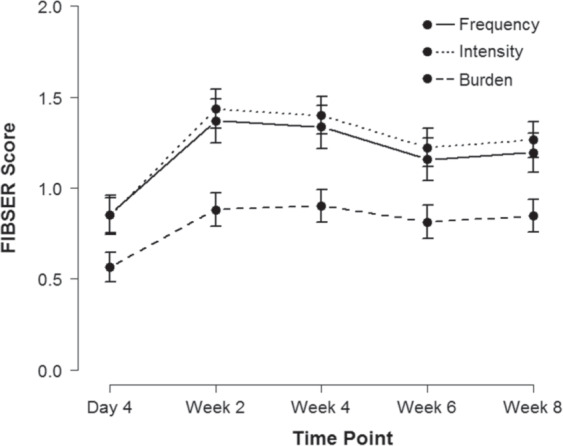
In N = 1008 adults with major depressive disorder randomized to escitalopram, sertraline, or venlafaxine-XR, side-effect frequency, intensity, and burden peaked at week 2; frequency and intensity then declined up to week 6, while burden did not decline after week 4. Greater side-effect burden predicted poorer treatment outcome, including as early as day 4, whereas treatment type and anxiety symptoms did not affect side-effect severity.
Key findings
- Side effects were greatest at week 2. Frequency and intensity gradually decreased up to week 6, but burden did not decrease after week 4 and endured throughout treatment; mean FIBSER burden was 0.56 (SD 1.11) at day 4, 0.88 (SD 1.25) at week 2, 0.90 (SD 1.20) at week 4, 0.81 (SD 1.18) at week 6, and 0.85 (SD 1.20) at week 8.
- Treatment type, DASS42 anxiety, HRSD17 anxiety/somatization, and presence of anxious depression did not improve model fit for side-effect severity (e.g., treatment type p = 0.162 for frequency, p = 0.091 for intensity, p = 0.149 for burden; anxiety predictors all p > 0.05). There were also no differences in maximum frequency, intensity, or burden between anxious and non-anxious depression.
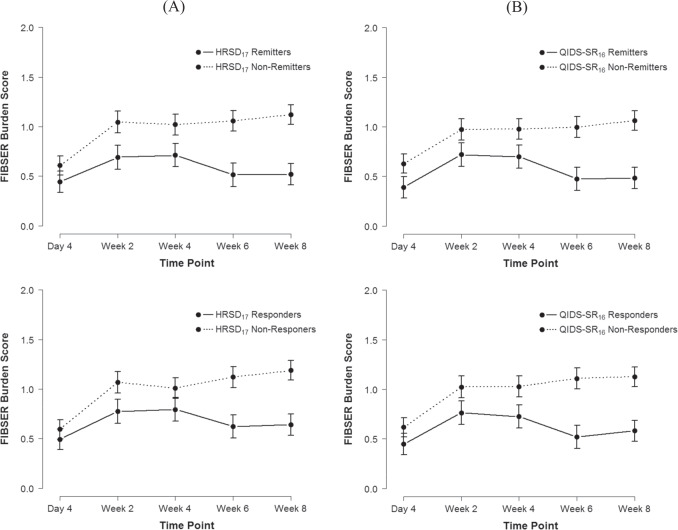
- Greater burden of side effects was associated with poorer QIDS-SR16 remission and response at every timepoint except week 4 QIDS-SR16 response; at day 4, QIDS-SR16 remission OR = 0.69 (95% CI 0.51–0.92, p = 0.016) and response OR = 0.70 (95% CI 0.53–0.91, p = 0.010). For HRSD17, greater burden at week 2 was associated with poorer remission (OR = 0.76, 95% CI 0.60–0.95, p = 0.015), and greater intensity at week 6 was associated with poorer remission (OR = 0.68, 95% CI 0.50–0.93, p = 0.015).
- Adverse events occurred in 473/1008 participants (46.9%); 1016 adverse events were reported, of which 804 (79.1%) were related to antidepressant treatment. Adverse events were not associated with HRSD17 or QIDS-SR16 remission and response (all p > 0.05).
Methods
- Phase-IV, multi-site, international, randomized, open-label trial; N = 1008 adults aged 18–65 with current single-episode or recurrent, nonpsychotic MDD diagnosed by MINI-Plus per DSM-IV, requiring HRSD17 > 16 at entry. Participants were randomized with equal probability to escitalopram, sertraline, or venlafaxine-extended release; data were collected between December 1, 2008 and September 30, 2013.
- Side-effect severity was measured with the self-reported FIBSER at day 4 and weeks 2, 4, 6, and 8. Depression severity was assessed with HRSD17 and QIDS-SR16; remission was HRSD17 ≤ 7 or QIDS-SR16 ≤ 5, and response was ≥50% decrease from baseline.
- Hierarchical linear mixed-effect models tested timepoint, treatment type, anxiety measures, and anxious depression against side-effect scores, with subject as a random effect and covariates age, sex, baseline QIDS-SR16, dosage at study outcome, and age of MDD onset; model comparison used AIC/BIC. Pearson correlations and logistic regression models, adjusted for the same covariates, tested associations between side effects and treatment outcome.
Limitations
- Stated in the paper: findings are limited to the antidepressants used in the study; specific side effects were not assessed and side effects could not be matched with their corresponding severity; allowed non-psychotropic medications may have been misinterpreted as study-treatment side effects; and DSM-IV criteria were used, so the DSM-5 anxious distress specifier was not assessed.
- Evident from the text: the trial was open-label with no placebo arm and participants knew which medication they were taking, so expectancy effects on side-effect reporting cannot be ruled out. Also, both FIBSER and QIDS-SR16 are self-reported, which the paper notes may help explain why burden associations were found for QIDS-SR16 but not clinician-rated HRSD17.
Model-written summary. Check it against the paper before relying on it.
Integrity signals
Registry
Cites
Statistics
Figures
Verification
Claims the paper makes
33 Own result · 19 Not checked yet · 11 Own method · 7 Own interpretation · 1 No basis given
A result the paper reports from its own data — it cites no other source for it, so there is none to check. The quote shows it is in the paper.
In the paper
“A greater burden—but not frequency or intensity—of side effects was associated with poorer treatment outcome and as early as 4 days post-treatment.”
§ Antidepressant side effects and their impact on treatment outcome in people with major depressive disorder: an iSPOT-D report > Abstract
plaincorrelationaln = 1,008- Asserted: passes — The authors put it forward as true.
- Checkable: passes — It can be checked against evidence.
- Load-bearing: passes — The paper’s conclusions depend on it.
- Based: passes — The paper gives a reason why it holds.
A result the paper reports from its own data — it cites no other source for it, so there is none to check. The quote shows it is in the paper.
In the paper
“Frequency, intensity, and burden of side effects were greatest at week 2, then only frequency and intensity of side effects gradually decreased up to week 6.”
§ Antidepressant side effects and their impact on treatment outcome in people with major depressive disorder: an iSPOT-D report > Abstract
plainn = 1,008- Asserted: passes — The authors put it forward as true.
- Checkable: passes — It can be checked against evidence.
- Load-bearing: unclear — It is unclear whether the paper’s conclusions depend on it.
- Based: passes — The paper gives a reason why it holds.
- Rests on an assumption: Missing data are missing at random.
A result the paper reports from its own data — it cites no other source for it, so there is none to check. The quote shows it is in the paper.
In the paper
“A greater burden—but not frequency or intensity—of side effects was associated with poorer treatment outcome and as early as 4 days post-treatment.”
§ Antidepressant side effects and their impact on treatment outcome in people with major depressive disorder: an iSPOT-D report > Abstract
plaincorrelationaln = 1,008- Asserted: passes — The authors put it forward as true.
- Checkable: passes — It can be checked against evidence.
- Load-bearing: passes — The paper’s conclusions depend on it.
- Based: passes — The paper gives a reason why it holds.
A result the paper reports from its own data — it cites no other source for it, so there is none to check. The quote shows it is in the paper.
In the paper
“Treatment type and anxiety symptoms did not impact the severity of side effects.”
- Also stated in: § Frequency, intensity, and burden of side effects · plain
“However, including treatment type, DASS42 anxiety, HRSD17 anxiety/somatization, or the presence of anxious depression did not improve the model’s fit to the data (for significant covariates, see Supplementary Material).”
- Also stated in: § Frequency, intensity, and burden of side effects · plain
“However, there were no differences in the maximum frequency, intensity, or burden of side effects in people with HRSD or syndromal anxious depression compared to non-anxious depression (see Supplementary Table 5).”
§ Antidepressant side effects and their impact on treatment outcome in people with major depressive disorder: an iSPOT-D report > Abstract
plainn = 1,008- Asserted: passes — The authors put it forward as true.
- Checkable: passes — It can be checked against evidence.
- Load-bearing: passes — The paper’s conclusions depend on it.
- Based: passes — The paper gives a reason why it holds.
- Rests on an assumption: Missing data are missing at random.
- Also stated in: § Frequency, intensity, and burden of side effects · plain
A result the paper reports from its own data — it cites no other source for it, so there is none to check. The quote shows it is in the paper.
In the paper
“Treatment type and anxiety symptoms did not impact the severity of side effects.”
- Also stated in: § Frequency, intensity, and burden of side effects · plain
“However, including treatment type, DASS42 anxiety, HRSD17 anxiety/somatization, or the presence of anxious depression did not improve the model’s fit to the data (for significant covariates, see Supplementary Material).”
§ Antidepressant side effects and their impact on treatment outcome in people with major depressive disorder: an iSPOT-D report > Abstract
plainn = 1,008- Asserted: passes — The authors put it forward as true.
- Checkable: passes — It can be checked against evidence.
- Load-bearing: passes — The paper’s conclusions depend on it.
- Based: passes — The paper gives a reason why it holds.
- Rests on an assumption: Missing data are missing at random.
- Also stated in: § Frequency, intensity, and burden of side effects · plain
A result the paper reports from its own data — it cites no other source for it, so there is none to check. The quote shows it is in the paper.
In the paper
“However, there were no differences in the maximum frequency, intensity, or burden of side effects in people with HRSD or syndromal anxious depression compared to non-anxious depression (see Supplementary Table 5).”
§ Antidepressant side effects and their impact on treatment outcome in people with major depressive disorder: an iSPOT-D report > Results > Frequency, intensity, and burden of side effects
plain- Asserted: passes — The authors put it forward as true.
- Checkable: passes — It can be checked against evidence.
- Load-bearing: unclear — It is unclear whether the paper’s conclusions depend on it.
- Based: passes — The paper gives a reason why it holds.
- Rests on an assumption: Missing data are missing at random.
A result the paper reports from its own data — it cites no other source for it, so there is none to check. The quote shows it is in the paper.
In the paper
“Frequency, intensity, and burden of side effects were greatest at week 2, then only frequency and intensity of side effects gradually decreased up to week 6.”
§ Antidepressant side effects and their impact on treatment outcome in people with major depressive disorder: an iSPOT-D report > Abstract
plainn = 1,008- Asserted: passes — The authors put it forward as true.
- Checkable: passes — It can be checked against evidence.
- Load-bearing: unclear — It is unclear whether the paper’s conclusions depend on it.
- Based: passes — The paper gives a reason why it holds.
- Rests on an assumption: Missing data are missing at random.
A result the paper reports from its own data — it cites no other source for it, so there is none to check. The quote shows it is in the paper.
In the paper
“The best fitting models overall (i.e., “the timepoint models”) included subjects as a random effect, the fixed effect timepoint, as well as the fixed effect covariates of age, sex baseline depression severity, dosage at study outcome, and age of MDD onset”
§ Antidepressant side effects and their impact on treatment outcome in people with major depressive disorder: an iSPOT-D report > Results > Frequency, intensity, and burden of side effects
plaincorrelational- Asserted: passes — The authors put it forward as true.
- Checkable: passes — It can be checked against evidence.
- Load-bearing: unclear — It is unclear whether the paper’s conclusions depend on it.
- Based: passes — The paper gives a reason why it holds.
- Rests on an assumption: Missing data are missing at random.
A result the paper reports from its own data — it cites no other source for it, so there is none to check. The quote shows it is in the paper.
In the paper
“A greater burden—but not frequency or intensity—of side effects was associated with poorer treatment outcome and as early as 4 days post-treatment.”
§ Antidepressant side effects and their impact on treatment outcome in people with major depressive disorder: an iSPOT-D report > Abstract
plainn = 1,008- Asserted: passes — The authors put it forward as true.
- Checkable: passes — It can be checked against evidence.
- Load-bearing: passes — The paper’s conclusions depend on it.
- Based: passes — The paper gives a reason why it holds.
A result the paper reports from its own data — it cites no other source for it, so there is none to check. The quote shows it is in the paper.
In the paper
“Furthermore, depression severity was only weakly correlated with side effects, suggesting that the reduction of frequency and intensity of side effects was not just a proxy of a reduction in depression severity.”
§ Antidepressant side effects and their impact on treatment outcome in people with major depressive disorder: an iSPOT-D report > Discussion
plaincorrelational- Asserted: passes — The authors put it forward as true.
- Checkable: passes — It can be checked against evidence.
- Load-bearing: passes — The paper’s conclusions depend on it.
- Based: passes — The paper gives a reason why it holds.
- It may state two separate claims as one. 13
- Probably not a substantial claim. 21
A result the paper reports from its own data — it cites no other source for it, so there is none to check. The quote shows it is in the paper.
In the paper
“Finally, burden of side effects—but not frequency or intensity of side effects—were associated with poorer treatment outcome and as early as 4 days post-treatment.”
§ Antidepressant side effects and their impact on treatment outcome in people with major depressive disorder: an iSPOT-D report > Discussion
plaincorrelational- Asserted: passes — The authors put it forward as true.
- Checkable: passes — It can be checked against evidence.
- Load-bearing: passes — The paper’s conclusions depend on it.
- Based: passes — The paper gives a reason why it holds.
It may state two separate claims as one.
A result the paper reports from its own data — it cites no other source for it, so there is none to check. The quote shows it is in the paper.
In the paper
“However, burden of side effects did not decrease after 4 weeks of treatment and endured throughout the course of antidepressant treatment.”
§ Antidepressant side effects and their impact on treatment outcome in people with major depressive disorder: an iSPOT-D report > Discussion
plain- Asserted: passes — The authors put it forward as true.
- Checkable: passes — It can be checked against evidence.
- Load-bearing: passes — The paper’s conclusions depend on it.
- Based: passes — The paper gives a reason why it holds.
It may state two separate claims as one.
A result the paper reports from its own data — it cites no other source for it, so there is none to check. The quote shows it is in the paper.
In the paper
“Frequency and intensity of side effects at week 2 were greater compared to weeks 6 (both p = 0.002) and 8 (p = 0.012 and 0.009, respectively), but not week 4.”
§ Antidepressant side effects and their impact on treatment outcome in people with major depressive disorder: an iSPOT-D report > Results > Post hoc tests
plain- Asserted: passes — The authors put it forward as true.
- Checkable: passes — It can be checked against evidence.
- Load-bearing: unclear — It is unclear whether the paper’s conclusions depend on it.
- Based: passes — The paper gives a reason why it holds.
It may state two separate claims as one.
- Rests on an assumption: Missing data are missing at random.
In the paper
“For example, people with anxious depression were found to have a greater maximum frequency, intensity, and burden of side effects compared to people with non-anxious depression in the Sequenced Treatment Alternatives to Relieve Depression (STAR*D) trial [12].”
§ Antidepressant side effects and their impact on treatment outcome in people with major depressive disorder: an iSPOT-D report > Introduction
What the sources say
- Not checked yetcites [12] Fava M, Rush AJ, Alpert JE, Balasubramani GK, Wisniewski SR, Carmin CN, et al. Difference in treatment outcome in outpatients with anxious versus nonanxious depression: a STAR*D report. Am J Psychiatry. 2008;165:342–51. https://doi.org/10.1176/appi.ajp.2007.06111868 source
plaincorrelational- Asserted: passes — The authors put it forward as true.
- Checkable: passes — It can be checked against evidence.
- Load-bearing: fails — The paper’s conclusions may not depend on it.
- Based: passes — The paper gives a reason why it holds.
Probably not a substantial claim. The paper’s conclusions may not depend on it.
None of the sources cited for this claim have been checked yet.
In the paper
“Anxious depression is present in approximately half of the MDD population and is commonly defined either syndromally (i.e., co-occurring MDD and anxiety disorder diagnoses) or using 17-item Hamilton Rating Scale Depression (HRSD17) criteria (i.e., MDD diagnosis and an HRSD17 anxiety/somatisation factor score of ≥7 [9–11]).”
§ Antidepressant side effects and their impact on treatment outcome in people with major depressive disorder: an iSPOT-D report > Introduction
What the sources say
- Not checked yetcites [9] Ionescu DF, Niciu MJ, Henter ID, Zarate CA. Defining anxious depression: a review of the literature. CNS Spectr. 2013;18:252–60. https://doi.org/10.1017/S1092852913000114 source
- Not checked yetcites [10] Braund TA, Palmer DM, Williams LM, Harris AW. Characterising anxiety in major depressive disorder and its use in predicting antidepressant treatment outcome: an iSPOT-D report. Aust NZ J Psychiatry. 2019. https://doi.org/10.1177/0004867419835933. source
- Not checked yetcites [11] Gaspersz R, Nawijn L, Lamers F, Penninx B. Patients with anxious depression: overview of prevalence, pathophysiology and impact on course and treatment outcome. Curr Opin Psychiatry. 2018;31:17–25. https://doi.org/10.1097/YCO.0000000000000376 source
plain- Asserted: passes — The authors put it forward as true.
- Checkable: passes — It can be checked against evidence.
- Load-bearing: fails — The paper’s conclusions may not depend on it.
- Based: passes — The paper gives a reason why it holds.
Probably not a substantial claim. The paper’s conclusions may not depend on it.
In the paper
“However, these associations are not found in all definitions of anxious depression, with Gaspersz et al. [14]. finding no differences in the frequency of side effects between people with syndromal and non-syndromal anxious depression.”
§ Antidepressant side effects and their impact on treatment outcome in people with major depressive disorder: an iSPOT-D report > Introduction
What the sources say
- Not checked yetcites [14] Gaspersz R, Lamers F, Kent JM, Beekman A, Smit JH, van Hemert AM, et al. Anxious distress predicts subsequent treatment outcome and side effects in depressed patients starting antidepressant treatment. J Psychiatr Res. 2017;84:41–8. https://doi.org/10.1016/j.jpsychires.2016.09.018 source
plain- Asserted: passes — The authors put it forward as true.
- Checkable: passes — It can be checked against evidence.
- Load-bearing: fails — The paper’s conclusions may not depend on it.
- Based: passes — The paper gives a reason why it holds.
Probably not a substantial claim. The paper’s conclusions may not depend on it.
None of the sources cited for this claim have been checked yet.
In the paper
“The QIDS-SR16 has also shown good internal consistency (α = 0.86), as well as convergent and discriminant validity [20, 23].”
§ Antidepressant side effects and their impact on treatment outcome in people with major depressive disorder: an iSPOT-D report > Methods > Depression severity
What the sources say
- Not checked yetcites [20] Rush AJ, Trivedi MH, Ibrahim HM, Carmody TJ, Arnow B, Klein DN, et al. The 16-Item Quick Inventory of Depressive Symptomatology (QIDS), clinician rating (QIDS-C), and self-report (QIDS-SR): a psychometric evaluation in patients with chronic major depression. Biol Psychiatry. 2003;54:573–83. https://doi.org/10.1016/s0006-3223(02)01866-8 source
- Not checked yetcites [23] Cameron IM, Crawford JR, Cardy AH, du Toit SW, Lawton K, Hay S, et al. Psychometric properties of the Quick Inventory of Depressive Symptomatology (QIDS-SR) in UK primary care. J Psychiatr Res. 2013;47:592–8. https://doi.org/10.1016/j.jpsychires.2013.01.019 source
plain- Asserted: passes — The authors put it forward as true.
- Checkable: passes — It can be checked against evidence.
- Load-bearing: fails — The paper’s conclusions may not depend on it.
- Based: passes — The paper gives a reason why it holds.
Probably not a substantial claim. The paper’s conclusions may not depend on it. It may state two separate claims as one.
None of the sources cited for this claim have been checked yet.
In the paper
“Selective serotonin reuptake inhibitors (SSRIs) and serotonin–norepinephrine reuptake inhibitors (SNRIs) are first-line pharmacological treatments for people with major depressive disorder (MDD) [1] and anxiety disorders [2].”
§ Antidepressant side effects and their impact on treatment outcome in people with major depressive disorder: an iSPOT-D report > Introduction
What the sources say
plain- Asserted: passes — The authors put it forward as true.
- Checkable: passes — It can be checked against evidence.
- Load-bearing: fails — The paper’s conclusions may not depend on it.
- Based: passes — The paper gives a reason why it holds.
Probably not a substantial claim. The paper’s conclusions may not depend on it. It may state two separate claims as one.
In the paper
“Some, but not all studies suggest that anxious depression increases the severity of side effects (for a review, see Ionescu et al. [8]).”
§ Antidepressant side effects and their impact on treatment outcome in people with major depressive disorder: an iSPOT-D report > Introduction
What the sources say
- Not checked yetcites Ionescu et al. [8] Ionescu DF, Niciu MJ, Richards EM, Zarate CA, Jr. Pharmacologic treatment of dimensional anxious depression: a review. Prim Care Companion CNS Disord. 2014. https://doi.org/10.4088/PCC.13r01621. source
hedgeddirect- Asserted: passes — The authors put it forward as true.
- Checkable: passes — It can be checked against evidence.
- Load-bearing: fails — The paper’s conclusions may not depend on it.
- Based: passes — The paper gives a reason why it holds.
Probably not a substantial claim. The paper’s conclusions may not depend on it.
None of the sources cited for this claim have been checked yet.
In the paper
“Participants were diagnosed on the Mini-International Neuropsychiatric Interview—Plus (MINI-Plus) [17] according to Diagnostic and Statistical Manual of Mental Disorders (DSM)-IV criteria [18].”
§ Antidepressant side effects and their impact on treatment outcome in people with major depressive disorder: an iSPOT-D report > Methods > Participants
What the sources say
- Not checked yetcites [17] Sheehan DV, Lecrubier Y, Sheehan KH, Amorim P, Janavs J, Weiller E, et al. The Mini-International Neuropsychiatric Interview (M.I.N.I.): the development and validation of a structured diagnostic psychiatric interview for DSM-IV and ICD-10. J Clin Psychiatry. 1998;59:22–33.
- Not checked yetcites [18] American Psychiatric Association. Diagnostic and Statistical Manual of Mental Disorders. Vol. 4. Washington, DC: American Psychiatric Association; 1994.
plainn = 1,008- Asserted: passes — The authors put it forward as true.
- Checkable: passes — It can be checked against evidence.
- Load-bearing: fails — The paper’s conclusions may not depend on it.
- Based: passes — The paper gives a reason why it holds.
Probably not a substantial claim. The paper’s conclusions may not depend on it.
In the paper
“Previous studies suggest that frequency, intensity, and burden of side effects are impacted by antidepressant treatment type, anxiety symptoms, and the presence of anxious depression (for a review, see Ionescu et al. [8]).”
§ Antidepressant side effects and their impact on treatment outcome in people with major depressive disorder: an iSPOT-D report > Introduction
What the sources say
- Not checked yetcites Ionescu et al. [8] Ionescu DF, Niciu MJ, Richards EM, Zarate CA, Jr. Pharmacologic treatment of dimensional anxious depression: a review. Prim Care Companion CNS Disord. 2014. https://doi.org/10.4088/PCC.13r01621. source
hedgedcorrelational- Asserted: passes — The authors put it forward as true.
- Checkable: passes — It can be checked against evidence.
- Load-bearing: fails — The paper’s conclusions may not depend on it.
- Based: passes — The paper gives a reason why it holds.
Probably not a substantial claim. The paper’s conclusions may not depend on it.
What the paper did — it cites no source for this, so there is none to check. The quote shows it is in the paper.
In the paper
“Forty-two participants dropped out due to safety, tolerability, or efficacy reasons (see Supplementary Table 3 for distribution of last recorded FIBSER scores).”
§ Antidepressant side effects and their impact on treatment outcome in people with major depressive disorder: an iSPOT-D report > Results > Demographics
plainn = 2- Asserted: passes — The authors put it forward as true.
- Checkable: passes — It can be checked against evidence.
- Load-bearing: fails — The paper’s conclusions may not depend on it.
- Based: passes — The paper gives a reason why it holds.
Probably not a substantial claim. The paper’s conclusions may not depend on it.
In the paper
“Post hoc t tests were performed using estimated marginal means and corrected for using the Bonferroni–Holm [31] method.”
§ Antidepressant side effects and their impact on treatment outcome in people with major depressive disorder: an iSPOT-D report > Methods > Statistical analysis
What the sources say
- Not checked yetcites [31] Holm S. A simple sequentially rejective multiple test procedure. Scand J Stat. 1979;6:65–70.
plain- Asserted: passes — The authors put it forward as true.
- Checkable: passes — It can be checked against evidence.
- Load-bearing: fails — The paper’s conclusions may not depend on it.
- Based: passes — The paper gives a reason why it holds.
Probably not a substantial claim. The paper’s conclusions may not depend on it.
In the paper
“The HRSD17 has shown good internal consistency (α = 79) and test–retest reliability (r = 0.87) in a recent meta-analysis [22].”
§ Antidepressant side effects and their impact on treatment outcome in people with major depressive disorder: an iSPOT-D report > Methods > Depression severity
What the sources say
- Not checked yetcites [22] Trajković G, Starčević V, Latas M, Leštarević M, Ille T, Bukumirić Z, et al. Reliability of the Hamilton Rating Scale for Depression: a meta-analysis over a period of 49 years. Psychiatry Res. 2011;189:1–9. https://doi.org/10.1016/j.psychres.2010.12.007 source
plain- Asserted: passes — The authors put it forward as true.
- Checkable: passes — It can be checked against evidence.
- Load-bearing: fails — The paper’s conclusions may not depend on it.
- Based: passes — The paper gives a reason why it holds.
Probably not a substantial claim. The paper’s conclusions may not depend on it. It may state two separate claims as one.
None of the sources cited for this claim have been checked yet.
In the paper
“However, SSRIs and SNRIs are associated with a range of side effects, including loss of appetite, weight loss, drowsiness, dizziness, fatigue, headaches, increased suicidal thoughts, nausea/vomiting, sexual dysfunction, and increased risk of cardiovascular and cerebrovascular events [3–5].”
§ Antidepressant side effects and their impact on treatment outcome in people with major depressive disorder: an iSPOT-D report > Introduction
What the sources say
- Not checked yetcites [3] Wang SM, Han C, Bahk WM, Lee SJ, Patkar AA, Masand PS, et al. Addressing the side effects of contemporary antidepressant drugs: a comprehensive review. Chonnam Med J. 2018;54:101–12. https://doi.org/10.4068/cmj.2018.54.2.101 source
- Not checked yetcites [4] Moret C, Isaac M, Briley M. Problems associated with long-term treatment with selective serotonin reuptake inhibitors. J. Psychopharmacol. 2009;23:967–74. https://doi.org/10.1177/0269881108093582 source
- Not checked yetcites [5] Jakobsen JC, Katakam KK, Schou A, Hellmuth SG, Stallknecht SE, Leth-Møller K, et al. Selective serotonin reuptake inhibitors versus placebo in patients with major depressive disorder. A systematic review with meta-analysis and trial sequential analysis. BMC Psychiatry. 2017;7:58. https://doi.org/10.1186/s12888-016-1173-2 source
plaincorrelational- Asserted: passes — The authors put it forward as true.
- Checkable: passes — It can be checked against evidence.
- Load-bearing: passes — The paper’s conclusions depend on it.
- Based: passes — The paper gives a reason why it holds.
Probably not a substantial claim. It may state two separate claims as one.
What the paper did — it cites no source for this, so there is none to check. The quote shows it is in the paper.
In the paper
“The iSPOT-D trial was designed with no placebo arm and participants were aware of the medication that they were taking to best match real-world practice.”
§ Antidepressant side effects and their impact on treatment outcome in people with major depressive disorder: an iSPOT-D report > Methods > Study overview
plain- Asserted: passes — The authors put it forward as true.
- Checkable: passes — It can be checked against evidence.
- Load-bearing: passes — The paper’s conclusions depend on it.
- Based: passes — The paper gives a reason why it holds.
It may state two separate claims as one.
What the paper did — it cites no source for this, so there is none to check. The quote shows it is in the paper.
In the paper
“iSPOT-D: Registry name: ClinicalTrials.gov. Registration number: NCT00693849.”
§ Antidepressant side effects and their impact on treatment outcome in people with major depressive disorder: an iSPOT-D report > Abstract
plain- Asserted: passes — The authors put it forward as true.
- Checkable: passes — It can be checked against evidence.
- Load-bearing: fails — The paper’s conclusions may not depend on it.
- Based: passes — The paper gives a reason why it holds.
Probably not a substantial claim. The paper’s conclusions may not depend on it.
What the paper did — it cites no source for this, so there is none to check. The quote shows it is in the paper.
In the paper
“All participants were either antidepressant medication naive or washed out.”
§ Antidepressant side effects and their impact on treatment outcome in people with major depressive disorder: an iSPOT-D report > Methods > Study overview
plain- Asserted: passes — The authors put it forward as true.
- Checkable: passes — It can be checked against evidence.
- Load-bearing: passes — The paper’s conclusions depend on it.
- Based: passes — The paper gives a reason why it holds.
Probably not a substantial claim.
In the paper
“Gaspersz et al. [14]. found that syndromal anxious depression did not predict severity of side effects.”
§ Antidepressant side effects and their impact on treatment outcome in people with major depressive disorder: an iSPOT-D report > Discussion
What the sources say
- Not checked yetcites [14] Gaspersz R, Lamers F, Kent JM, Beekman A, Smit JH, van Hemert AM, et al. Anxious distress predicts subsequent treatment outcome and side effects in depressed patients starting antidepressant treatment. J Psychiatr Res. 2017;84:41–8. https://doi.org/10.1016/j.jpsychires.2016.09.018 source
plain- Asserted: passes — The authors put it forward as true.
- Checkable: passes — It can be checked against evidence.
- Load-bearing: fails — The paper’s conclusions may not depend on it.
- Based: passes — The paper gives a reason why it holds.
Probably not a substantial claim. The paper’s conclusions may not depend on it.
What the paper did — it cites no source for this, so there is none to check. The quote shows it is in the paper.
In the paper
“Participants provided written informed consent after receiving a complete description of the study.”
§ Antidepressant side effects and their impact on treatment outcome in people with major depressive disorder: an iSPOT-D report > Methods > Participants
plainn = 1,008- Asserted: passes — The authors put it forward as true.
- Checkable: passes — It can be checked against evidence.
- Load-bearing: fails — The paper’s conclusions may not depend on it.
- Based: passes — The paper gives a reason why it holds.
Probably not a substantial claim. The paper’s conclusions may not depend on it.
In the paper
“because participants were diagnosed with DSM-IV criteria, the DSM-5 anxious distress specifier definition was not assessed [11].”
§ Antidepressant side effects and their impact on treatment outcome in people with major depressive disorder: an iSPOT-D report > Discussion
What the sources say
- Not checked yetcites [11] Gaspersz R, Nawijn L, Lamers F, Penninx B. Patients with anxious depression: overview of prevalence, pathophysiology and impact on course and treatment outcome. Curr Opin Psychiatry. 2018;31:17–25. https://doi.org/10.1097/YCO.0000000000000376 source
plaindirect- Asserted: passes — The authors put it forward as true.
- Checkable: passes — It can be checked against evidence.
- Load-bearing: fails — The paper’s conclusions may not depend on it.
- Based: passes — The paper gives a reason why it holds.
Probably not a substantial claim. The paper’s conclusions may not depend on it.
What the paper did — it cites no source for this, so there is none to check. The quote shows it is in the paper.
In the paper
“While the FIBSER specifically targets side effects due to antidepressant medication, other protocol allowed non-psychotropic medications may have been misinterpreted for study treatment side effects and could impact the findings.”
§ Antidepressant side effects and their impact on treatment outcome in people with major depressive disorder: an iSPOT-D report > Discussion
hedgedconditional- Asserted: passes — The authors put it forward as true.
- Checkable: passes — It can be checked against evidence.
- Load-bearing: fails — The paper’s conclusions may not depend on it.
- Based: passes — The paper gives a reason why it holds.
Probably not a substantial claim. The paper’s conclusions may not depend on it. It may state two separate claims as one.
What the paper did — it cites no source for this, so there is none to check. The quote shows it is in the paper.
In the paper
“The study was approved by institutional or ethical review boards at each site, and its protocols followed International Conference on Harmonization and Good Clinical Practice principles, the U.S. Food and Drug Administration Code of Federal Regulations, and country-specific guidelines (see Supplementary Table 1 for individual iSPOT-D study management sites and investigators).”
§ Antidepressant side effects and their impact on treatment outcome in people with major depressive disorder: an iSPOT-D report > Methods > Participants
plain- Asserted: passes — The authors put it forward as true.
- Checkable: passes — It can be checked against evidence.
- Load-bearing: fails — The paper’s conclusions may not depend on it.
- Based: passes — The paper gives a reason why it holds.
Probably not a substantial claim. The paper’s conclusions may not depend on it. It may state two separate claims as one.
A conclusion the paper draws from its own results — it cites no other source for it, so there is none to check. The quote shows it is in the paper.
In the paper
“Given that we found no differences in either the maximum reported side effects or frequency, intensity, and burden of side effects across timepoints between people with anxious and non-anxious depression, our difference in findings may be attributable to either a difference in the clinical severity of samples or lack of covariate controls.”
§ Antidepressant side effects and their impact on treatment outcome in people with major depressive disorder: an iSPOT-D report > Discussion
hedgedconditional- Asserted: passes — The authors put it forward as true.
- Checkable: passes — It can be checked against evidence.
- Load-bearing: fails — The paper’s conclusions may not depend on it.
- Based: passes — The paper gives a reason why it holds.
Probably not a substantial claim. The paper’s conclusions may not depend on it. It may state two separate claims as one.
In the paper
“The enduring perceived burden of side effects is a commonly reported issue that contributes to the myriad of issues related to treatment adherence and efficacy [36].”
§ Antidepressant side effects and their impact on treatment outcome in people with major depressive disorder: an iSPOT-D report > Discussion
What the sources say
- Not checked yetcites [36] Sansone RA, Sansone LA. Antidepressant adherence: are patients taking their medications? Innov Clin Neurosci. 2012;9:41–6.
plaindirect- Asserted: passes — The authors put it forward as true.
- Checkable: passes — It can be checked against evidence.
- Load-bearing: unclear — It is unclear whether the paper’s conclusions depend on it.
- Based: passes — The paper gives a reason why it holds.
It may state two separate claims as one.
In the paper
“Furthermore, while the HRSD17 is a multidimensional construct measuring both anxiety and depression, the QIDS-SR16 is a unidimensional construct measuring depression alone [38].”
§ Antidepressant side effects and their impact on treatment outcome in people with major depressive disorder: an iSPOT-D report > Discussion
What the sources say
- Not checked yetcites [38] McClintock SM, Haley C, Bernstein IH. Psychometric considerations of depression symptom rating scales. Neuropsychiatry. 2011;1:611–23. https://doi.org/10.2217/Npy.11.59 source
plain- Asserted: passes — The authors put it forward as true.
- Checkable: passes — It can be checked against evidence.
- Load-bearing: passes — The paper’s conclusions depend on it.
- Based: passes — The paper gives a reason why it holds.
It may state two separate claims as one.
What the paper did — it cites no source for this, so there is none to check. The quote shows it is in the paper.
In the paper
“All psychotropic medications (except sleep aids and anxiolytics) were discontinued and washed out prior to baseline assessments.”
§ Antidepressant side effects and their impact on treatment outcome in people with major depressive disorder: an iSPOT-D report > Methods > Protocol treatment
plain- Asserted: passes — The authors put it forward as true.
- Checkable: passes — It can be checked against evidence.
- Load-bearing: passes — The paper’s conclusions depend on it.
- Based: passes — The paper gives a reason why it holds.
Probably not a substantial claim.
The paper relies on this without support.
Missing data are missing at random.
“Mixed effect models are well suited to the data as they retain participants with missing data and allow for the post hoc tests.”
Claims other papers make about this one
Each is checked against this paper’s own text: does it say what the citing paper says it does?
The source backs part of the claim, not all of it — or backs it for a different population, condition or comparison.
In the citing paper
“such a lifestyle intervention is further devoid of side effects of pharmacotherapy [107].”
From Personalized machine learning guided intervention for optimizing lifestyle behaviors in depression: a pilot study (2026) · cites this paper as [107]
Experimental — accuracy not yet measuredIn the citing paper
“Patients may discontinue chronic treatment due to lack of rapid and consistent treatment benefits, 37 treatmentrelated adverse events (AEs), [37][38][39][40] and expectations of treatment that are misaligned with the treatment goals of HCPs.41,42”
From Digital health technologies and major depressive disorder (2023) · cites this paper as [41]
Self-check
Percentages, sums and reported differences re-computed from the paper’s own numbers.
Each contradiction between two passages listed here was confirmed by an independent check.
Rated major: it would touch a result — a value a result rests on, reported and recomputed p-values on opposite sides of the significance level, two passages that conflict with no sign which is right, or a cited work retracted before this paper was published.
In the paper
§ Antidepressant side effects and their impact on treatment outcome in people with major depressive disorder: an iSPOT-D report > Abstract
“A greater burden—but not frequency or intensity—of side effects was associated with poorer treatment outcome and as early as 4 days post-treatment.”
§ Antidepressant side effects and their impact on treatment outcome in people with major depressive disorder: an iSPOT-D report > Results > Side effects predicting antidepressant treatment outcome
“greater intensity of side effects at week 6 was associated with poorer HRSD17 remission.”
Rated major: it would touch a result — a value a result rests on, reported and recomputed p-values on opposite sides of the significance level, two passages that conflict with no sign which is right, or a cited work retracted before this paper was published.
In the paper
§ Antidepressant side effects and their impact on treatment outcome in people with major depressive disorder: an iSPOT-D report > Discussion
“Associations between burden of side effects were only found for QIDS-SR16 and not for the HRSD17”
§ Antidepressant side effects and their impact on treatment outcome in people with major depressive disorder: an iSPOT-D report > Results > Side effects predicting antidepressant treatment outcome
“A greater burden of side effects at week 2 was associated with poorer HRSD17 remission”
Rated major: it would touch a result — a value a result rests on, reported and recomputed p-values on opposite sides of the significance level, two passages that conflict with no sign which is right, or a cited work retracted before this paper was published.
In the paper
§ Antidepressant side effects and their impact on treatment outcome in people with major depressive disorder: an iSPOT-D report > Results > Side effects predicting antidepressant treatment outcome
“A greater intensity of side effects at week 2 was also associated with poorer remission.”
§ Antidepressant side effects and their impact on treatment outcome in people with major depressive disorder: an iSPOT-D report > Results > Side effects predicting antidepressant treatment outcome
“| Intensity | 1.20 | 1.20 | 0.94, 1.54 | 0.150 | 1.15 | 0.89, 1.49 | 0.280 | 1.36 | 1.05, 1.78 | 0.022 | 1.26 | 0.98, 1.62 | 0.076 |”
Citations
Cites
Fitting Linear Mixed-Effects Models Using lme4
Bates, D., Mächler, M., Bolker, B., & Walker, S. (2015) · Journal of Statistical Software · doi:10.18637/jss.v067.i01 · Cited by 86,835
A new look at the statistical model identification
Akaike, H. (1974) · IEEE Transactions on Automatic Control · doi:10.1109/tac.1974.1100705 · Cited by 51,879
Estimating the Dimension of a Model
Schwarz, G. (1978) · The Annals of Statistics · doi:10.1214/aos/1176344136 · Cited by 47,033
Hamilton, M. (1960) · Journal of Neurology, Neurosurgery & Psychiatry · doi:10.1136/jnnp.23.1.56 · Cited by 32,817 · cited 2×
“Depression severity Depression severity was assessed using the HRSD17 [19] and the 16-Item Quick Inventory of Depressive Symptomatology-Self-Rated (QIDS-SR16) [20, 21].”
MethodlmerTest Package: Tests in Linear Mixed Effects Models
Kuznetsova, A., Brockhoff, P. B., & Christensen, R. H. B. (2017) · Journal of Statistical Software · doi:10.18637/jss.v082.i13 · Cited by 24,346
A Simple Sequentially Rejective Multiple Test Procedure
(1979) · Scandinavian Journal of Statistics · doi:10.2307/4615733 · Cited by 21,526
(1998) · The Journal of Clinical Psychiatry · Cited by 19,139
(1998) · PubMed · Cited by 10,216
A New Look at the Statistical Model Identification
Akaike, H. (1974) · Springer series in statistics · doi:10.1007/978-1-4612-1694-0_16 · Cited by 4,202
Malhi, G. S., & Mann, J. J. (2018) · The Lancet · doi:10.1016/s0140-6736(18)31948-2 · Cited by 4,099
Research works printed but not linked: 2
- American Psychiatric Association. Diagnostic and Statistical Manual of Mental Disorders. Vol. 4. Washington, DC: American Psychiatric Association; 1994.
- Cleary P, Guy W. Factor analysis of the Hamilton Depression Scale. Drugs Exp Clin Res. 1977;1:115–20.
Cited by
Sorted by citations
The brain-gut-microbiota interplay in depression: A key to design innovative therapeutic approaches
Varesi, A., Campagnoli, L. I. M., Chirumbolo, S., Candiano, B., Carrara, A., Ricevuti, G., Esposito, C., & Pascale, A. (2023) · Pharmacological Research · doi:10.1016/j.phrs.2023.106799 · Cited by 88
Medicinal Cannabis Prescribing in Australia: An Analysis of Trends Over the First Five Years
Macphail, S. L., Bedoya‐Pérez, M. A., Cohen, R., Kotsirilos, V., McGregor, I. S., & Cairns, E. A. (2022) · Frontiers in Pharmacology · doi:10.3389/fphar.2022.885655 · Cited by 65
Flavonols in Action: Targeting Oxidative Stress and Neuroinflammation in Major Depressive Disorder
Jembrek, M. J., Oršolić, N., Karlović, D., & Peitl, V. (2023) · International Journal of Molecular Sciences · doi:10.3390/ijms24086888 · Cited by 58
Marconcin, P., Barak, S., Ferrari, G., Gouveia, É. R., Nascimento, M. D. M., Willig, R., Varela, M., & Marques, A. (2022) · International Journal of Environmental Research and Public Health · doi:10.3390/ijerph192114055 · Cited by 48
Williams, L. M., Carpenter, W. T., Carretta, C. M., Papanastasiou, E., & Vaidyanathan, U. (2023) · CNS Spectrums · doi:10.1017/s1092852923002420 · Cited by 49
Metadata
- Authors
- Braund, T. A., Tillman, G., Palmer, D. M., Gordon, E., Rush, A. J., & Harris, A. W. F.
- Affiliations
- The University of Sydney (AU)
- Federation University (AU)
- Westmead Institute for Medical Research (AU)
- National University of Singapore (SG)
- Corresponding author
- Braund, Taylor A.
- Venue
- Translational Psychiatry
- Published
- 2021-08-04
- Volume
- 11
- Issue
- 1
- Pages
- 417-417
- ISSN
- 2158-3188 (ISSN-L)
- PMC
- PMC8338944
- OpenAlex
- W3191823183
- Semantic Scholar
- 178e60eb49964e9bf6468c466a9b1a8826a82c8a
- Cited by
- 135
- References
- 39
- Citations by year
- 2026: 32 · 2025: 39 · 2024: 32 · 2023: 21 · 2022: 11
- FWCI
- 9.34
- Type
- journal article
- Language
- en
- Open access
- gold
- doi.org
- Locations
- Translational Psychiatry (publishedVersion, cc-by)
- PubMed Central (publishedVersion, cc-by)
- PubMed (publishedVersion)
- National University of Singapore (submittedVersion, cc-by)
- FedUni ResearchOnline (Federation University Australia) (submittedVersion, cc-by)
- DOAJ (DOAJ: Directory of Open Access Journals) (submittedVersion, cc-by-sa)
- Topics
- Health Sciences › Medicine › Pharmacology (medical) › Treatment of Major Depression
- Social Sciences › Psychology › Experimental and Cognitive Psychology › Anxiety, Depression, Psychometrics, Treatment, Cognitive Processes
- Social Sciences › Psychology › Clinical Psychology › Psychotherapy Techniques and Applications
- Keywords
- antidepressant side effects, major depressive disorder, treatment outcomes, escitalopram, sertraline, venlafaxine, selective serotonin reuptake inhibitors, anxiety symptoms
- MeSH terms
- Adult, Antidepressive Agents, Major Depressive Disorder, Humans, Citalopram, Treatment Outcome, Sertraline
About these checks
Registry, retraction, Cites and statistics results are computed, not judged, with one exception: a printed reference that no index lists is read once by a model before it counts as a citation error. Claims are extracted by a model and kept only when their quote appears verbatim in the text; each cited source is then checked, with a model’s help, for whether it says what the claim relies on. Those verdicts can be wrong — read the claim’s quote and the cited source before relying on one.
A language model drew the claims from the paper on 2026-10-09, under version 3 of the claim definition (model deepseek-v4.1-flash, prompt extract-v3).
A second model labelled each claim on 2026-10-09 (model jev-1.13-20260917, definition revision gold-guideline-v0.2).
Statistics and arithmetic are recomputed, not judged.
Confidence bands are shown only for fields calibrated on our annotated test set. None is calibrated yet, so no band is shown.
What counts as a claim ›How we measure confidence ›How we check this ›
Are you an author, or do you see a problem with this page? Request a review
