

Emotional adaptation during a crisis: decline in anxiety and depression after the initial weeks of COVID-19 in the United States
Open accessPublished version of a preprint
The DOI matches its Crossref record; 33 of the 33 references it cites were found in a registry or an index.
Abstract
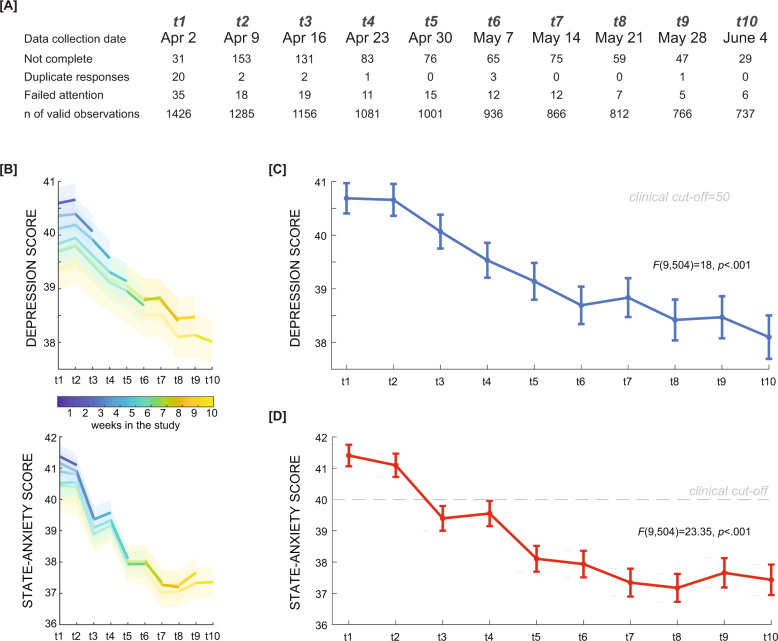
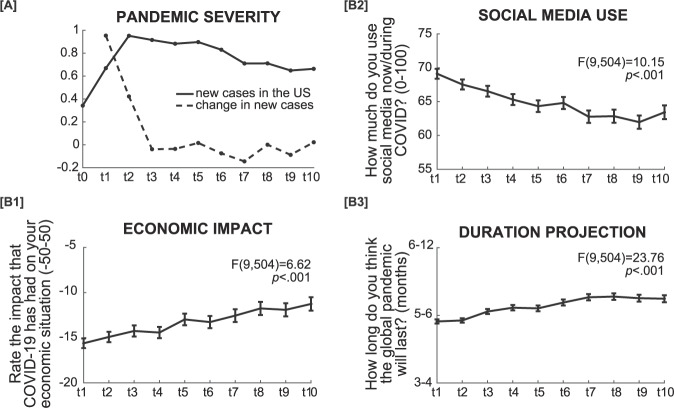
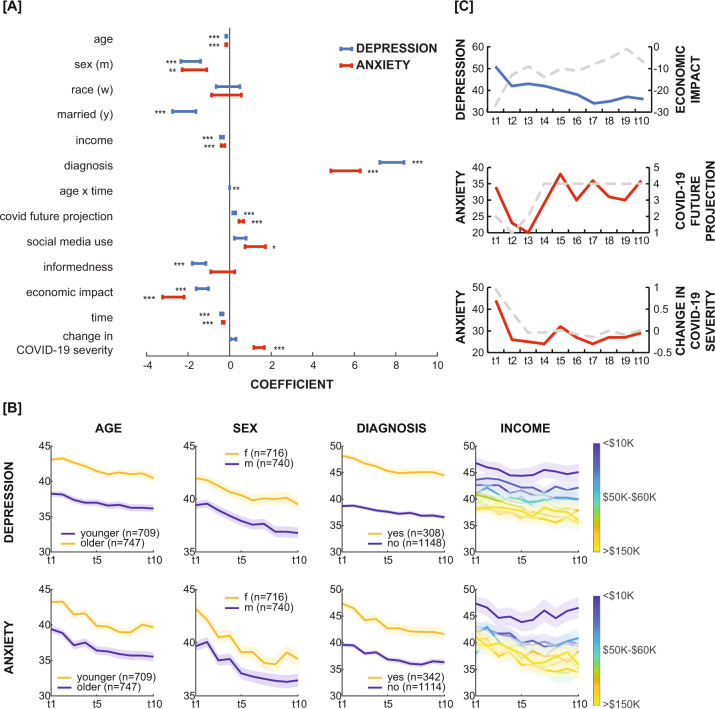
Crises such as the COVID-19 pandemic are known to exacerbate depression and anxiety, though their temporal trajectories remain under-investigated. The present study aims to investigate fluctuations in depression and anxiety using the COVID-19 pandemic as a model crisis. A total of 1512 adults living in the United States enrolled in this online study beginning April 2, 2020 and were assessed weekly for 10 weeks (until June 4, 2020). We measured depression and anxiety using the Zung Self-Rating Depression scale and State-Trait Anxiety Inventory (state subscale), respectively, along with demographic and COVID-related surveys. Linear mixed-effects models were used to examine factors contributing to longitudinal changes in depression and anxiety. We found that depression and anxiety levels were high in early April, but declined over time. Being female, younger age, lower-income, and previous psychiatric diagnosis correlated with higher overall levels of anxiety and depression; being married additionally correlated with lower overall levels of depression, but not anxiety. Importantly, worsening of COVID-related economic impact and increase in projected pandemic duration exacerbated both depression and anxiety over time. Finally, increasing levels of informedness correlated with decreasing levels of depression, while increased COVID-19 severity (i.e., 7-day change in cases) and social media use were positively associated with anxiety over time. These findings not only provide evidence for overall emotional adaptation during the initial weeks of the pandemic, but also provide insight into overlapping, yet distinct, factors contributing to depression and anxiety throughout the first wave of the pandemic.
Overview
The claims and statistics of this paper haven’t been checked yet.
Free: it reads the open-access text and checks the first 5 claims that cite a source we can check. Create a free account to check every claim.
Integrity signals
Registry
Cites
Statistics
Figures
Verification
Claims the paper makes
The claims and statistics of this paper haven’t been checked yet.
Free: it reads the open-access text and checks the first 5 claims that cite a source we can check. Create a free account to check every claim.
Claims other papers make about this one
Each is checked against this paper’s own text: does it say what the citing paper says it does?
The source backs part of the claim, not all of it — or backs it for a different population, condition or comparison.
In the citing paper
“studies of general North American samples (e.g., Asmundson & Taylor, 2020; Shuster et al., 2021) found higher anxiety scores in May 2020 relative to subsequent pandemic assessment timepoints”
From Examining the effects of prior Acceptance and Commitment Therapy (ACT) treatment among anxious cancer survivors during the COVID-19 pandemic: Evidence from a randomized controlled trial (2022) · cites this paper as Shuster et al., 2021
Experimental — accuracy not yet measured
Self-check
Percentages, sums and reported differences re-computed from the paper’s own numbers.
The self-check needs the paper’s full text.
Citations
Cites
Fitting Linear Mixed-Effects Models Using lme4
Bates, D., Mächler, M., Bolker, B., & Walker, S. (2015) · Journal of Statistical Software · doi:10.18637/jss.v067.i01 · Cited by 86,835
(1970) · Cited by 24,983
lmerTest Package: Tests in Linear Mixed Effects Models
Kuznetsova, A., Brockhoff, P. B., & Christensen, R. H. B. (2017) · Journal of Statistical Software · doi:10.18637/jss.v082.i13 · Cited by 24,346
A self-rating depression scale
ZUNG, W. W. K. (1965) · Archives of General Psychiatry · doi:10.1001/archpsyc.1965.01720310065008 · Cited by 9,813
Pierce, M., Hope, H., Ford, T., Hatch, S., Hotopf, M., John, A., Kontopantelis, E., Webb, R., Wessely, S., McManus, S., et al. (2020) · The Lancet Psychiatry · doi:10.1016/s2215-0366(20)30308-4 · Cited by 2,621
The construct of resilience: implications for interventions and social policies
LUTHAR, S. S., & CICCHETTI, D. (2000) · Development and Psychopathology · doi:10.1017/s0954579400004156 · Cited by 2,374
Prevalence of depression symptoms in US adults before and during the COVID-19 pandemic
Ettman, C. K., Abdalla, S. M., Cohen, G. H., Sampson, L., Vivier, P. M., & Galea, S. (2020) · JAMA Network Open · doi:10.1001/jamanetworkopen.2020.19686 · Cited by 2,138
Uncertainty and anticipation in anxiety: an integrated neurobiological and psychological perspective
Grupe, D. W., & Nitschke, J. B. (2013) · Nature Reviews Neuroscience · doi:10.1038/nrn3524 · Cited by 2,007
Why is depression more prevalent in women?
Albert, P. R. (2015) · Journal of Psychiatry and Neuroscience · doi:10.1503/jpn.150205 · Cited by 1,785
Liu, C. H., Zhang, E., Wong, G. T. F., Hyun, S., & Hahm, H. “. (2020) · Psychiatry Research · doi:10.1016/j.psychres.2020.113172 · Cited by 1,157
Research works printed but not linked: 2
- RStudio Desktop Professional Edition 1.4.1106-5.
- Allison P. Missing data. Thousand Oaks, CA: SAGE Publications, Inc.; 2002.
Cited by
Cénat, J. M., Farahi, S. M. M. M., Dalexis, R. D., Darius, W. P., Bekarkhanechi, F. M., Poisson, H., Broussard, C., Ukwu, G., Auguste, E., Nguyen, D. D., et al. (2022) · Journal of Affective Disorders · doi:10.1016/j.jad.2022.07.011 · Cited by 192
Kurapov, A., Kalaitzaki, A. E., Keller, V., Danyliuk, I., & Kowatsch, T. (2023) · Frontiers in Psychiatry · doi:10.3389/fpsyt.2023.1134780 · Cited by 207
Wirkner, J., Christiansen, H., Knaevelsrud, C., Lüken, U., Wurm, S., Schneider, S., & Brakemeier, E. (2021) · European Psychologist · doi:10.1027/1016-9040/a000465 · Cited by 80
Fernández, R. S., Crivelli, L., Guimet, N. M., Allegri, R., Picco, S., & Pedreira, M. E. (2022) · Scientific Reports · doi:10.1038/s41598-022-09663-2 · Cited by 52
Ettman, C. K., Cohen, G. H., Abdalla, S. M., Trinquart, L., Castrucci, B. C., Bork, R. H., Clark, M. A., Wilson, I. B., Vivier, P. M., & Galea, S. (2022) · Science Advances · doi:10.1126/sciadv.abm9737 · Cited by 33
“They also found that worsening economic situation due to COVID-19 was associated with increased depression over time ( 32 ).”
Alegria, M. M., Cruz-Gonzalez, M. A., O’Malley, I. S., Álvarez, K., Stein, G. L., Fuentes, L., Eddington, K. M., Poindexter, C., Markle, S. L., Thorndike, A. N., et al. (2022) · Behaviour Research and Therapy · doi:10.1016/j.brat.2022.104102 · Cited by 19
Leung, X. Y., Wu, L. L., & Sun, J. (2022) · Journal of Travel Research · doi:10.1177/00472875221095210 · Cited by 25
“At the tail phase of a pandemic, people’s depression and anxiety levels toward COVID-19 have declined (Shuster et al. 2021).”
BackgroundTang, N. K. Y., McEnery, K. A. M., Chandler, L., Toro, C. T., Walasek, L., Friend, H., Gu, S., Singh, S. P., & Meyer, C. (2022) · BJPsych Open · doi:10.1192/bjo.2022.523 · Cited by 28
COVID-19-Related Stressors and Clinical Mental Health Symptoms in a Northeast US Sample
Monnig, M. A., Clark, S. E., Avila, J. C., Sokolovsky, A. W., Padovano, H. T., Goodyear, K., Aston, E. R., Haass‐Koffler, C. L., Tidey, J. W., Ahluwalia, J. S., et al. (2023) · International Journal of Environmental Research and Public Health · doi:10.3390/ijerph20021367 · Cited by 18
“, low income or unemployed) [7,22,26,31] are three groups consistently found to be at a heightened risk for adverse mental health outcomes during the pandemic.”
BackgroundChan, J. K., Marzuki, A. A., Vafa, S., Thanaraju, A., Yap, J., Chan, X. W., Harris, H. A., Todi, K., & Schaefer, A. (2024) · BMC Psychology · doi:10.1186/s40359-024-01715-8 · Cited by 22
Herrmann, K., Beese, F., Wollgast, L., Mauz, E., Kersjes, C., Hoebel, J., & Wachtler, B. (2024) · Frontiers in Public Health · doi:10.3389/fpubh.2024.1397392 · Cited by 18
Hrbková, L., & Kudrnáč, A. (2024) · Journal of Public Policy · doi:10.1017/s0143814x24000059 · Cited by 13
“Previous research has found that negative emotional responses to the outbreak, such as anxiety, declined over time (Gallagher et al. 2022; Shuster et al. 2021), which would imply that the willingness to comply with measures and trust in government should also vary over time based on levels of fear.”
Levy, C., Younossi, Z. M., Mayo, M. J., Kremer, A. E., Pate, J., Ieyoub, J., Zincavage, R. M., Padilla, B., Ito, D., & Perez, C. (2025) · Liver International · doi:10.1111/liv.70276 · Cited by 12
Social avoidance can be quantified as navigation in abstract social space
Schafer, M., & Schiller, D. (2025) · Communications Psychology · doi:10.1038/s44271-025-00215-8 · Cited by 10
Wang, C. X., Kohli, R., Olaker, V. R., Terebuh, P., Xu, R., Kaelber, D. C., & Davis, P. B. (2024) · Molecular Psychiatry · doi:10.1038/s41380-024-02414-x · Cited by 7
Fishbein, J. N., & Arch, J. J. (2022) · Journal of Contextual Behavioral Science · doi:10.1016/j.jcbs.2022.03.006 · Cited by 6
COVID-19 Concerns, Information Needs, and Adverse Mental Health Outcomes among U.S. Soldiers
Quartana, P. J., Beymer, M. R., Gomez, S. A. Q., Adler, A. B., Santo, T. J., Thomas, J. L., & Bell, A. M. (2023) · Military Medicine · doi:10.1093/milmed/usad350 · Cited by 7
Online Learning Anxiety and their Academic Self-Efficacy During the COVID-19 Crisis
Chaleila, W. A., Qadan, E., Touma, L. G.-A., Assaly, I., Atamna, U., Habayib, H., & Masarweh, A. (2024) · Online Learning · doi:10.24059/olj.v28i2.3428 · Cited by 11
Ahmed, S. M. M., Gasmalha, M. E. A., Ahmed, A. B. M., Mohammed, K. A. E., Alrawa, S. S. K., Fadhl, H., Salih, M. A. M., Hussein, I. A. M., Salih, A. M. A. M., Elsharif, H. I. A., et al. (2025) · Conflict and Health · doi:10.1186/s13031-025-00695-9 · Cited by 6
“This may be related to humans’ ability to adapt to prolonged stressors [29].”
Gilbert, P. A., Soweid, L., Holdefer, P. J., Kersten, S. K., & Mulia, N. (2023) · PLoS ONE · doi:10.1371/journal.pone.0284435 · Cited by 4
Lee, B.-H. J., Holleman, A., & Proeschold‐Bell, R. J. (2024) · Social Science & Medicine · doi:10.1016/j.socscimed.2024.116651 · Cited by 6
“…in mental health patterns after the onset of COVID-19 have suggested that while there were initial spikes in mental health symptoms directly following COVID-19 ’ s onset, these numbers returned to normal levels as time passed (Shuster et al., 2021; Riehm et al., 2021; Daly and Robinson, 2022).”
BackgroundASA 2022 Data-Driven Decision Making: Book of short papers
Edited by: Enrico di Bella, L. F., Fabbris, L., di Bella, E., & Lagazio, C. (2023) · Proceedings e report · doi:10.36253/979-12-215-0106-3 · Cited by 7
Richardson, T., Ashworth, S., Sood, M., McKell, E., Maguire, N., Alwan, N. A., & Smith, D. M. (2025) · Journal of Public Health Research · doi:10.1177/22799036251395263 · Cited by 5
Almeida, S., Frasquilho, D., Cordeiro, M. T., Neto, T., Sousa, B., Cardoso, F., & Oliveira-Maia, A. J. (2024) · Cancer Reports · doi:10.1002/cnr2.70008 · Cited by 3
“Supporting this hypothesis, there is some evidence in the general population suggesting emotional adaptation with a decrease in anxiety and depression after the initial weeks of COVID-19 [92].”
ResultMultidimensional Hardships in the U.S. During the COVID-19 Pandemic
Dhongde, S., & Glassman, B. (2023) · Social Indicators Research · doi:10.1007/s11205-023-03176-9 · Cited by 3
“Shuster et al. (2020) surveyed adults in the U.S. for 10 weeks starting in April 2020 and found that the worsening economic impact of COVID-19 increased both depression and anxiety.”
BackgroundHughes, T. F., Song, R., Wang, Y., Jacobsen, E. P., Chang, C. H., & Ganguli, M. (2025) · Aging & Mental Health · doi:10.1080/13607863.2025.2505565 · Cited by 2
“…align with studies that found older adults reported their mental health was negatively affected at the start of the pandemic (Pierce et al., 2020; Robinson et al., 2022; Weber et al., 2023), but that symptoms decreased to pre-pandemic levels by mid-2020 (Riehm et al., 2021; Shuster et al., 2021).”
Wyszomirska, J., Bąk‐Sosnowska, M., & Daniel‐Sielańczyk, A. (2023) · International Journal of Environmental Research and Public Health · doi:10.3390/ijerph20031847 · Cited by 2
“Moreover, in a study by Shuster and colleagues [37], the fluctuation of depression and anxiety was explored using the COVID-19 pandemic as a model crisis.”
MethodCOVID-19 stigma and depression across race, ethnicity and residence
Rahman, R., Azhar, S., Wernick, L. J., Huang, D., Maschi, T. M., Rosenblatt, C., & Patel, R. (2023) · Social Work in Health Care · doi:10.1080/00981389.2023.2193263 · Cited by 3
“During the H1N1 epidemic, depression and anxiety initially escalated but rapidly declined (Shuster et al., 2021).”
BackgroundQuality of life and psychopathology in different COVID-19 pandemic periods: A longitudinal study
Triantafillou, E., Tsellos, P., Christodoulou, N., Tzavara, C. K., & Christodoulou, G. N. (2024) · Psychiatriki · doi:10.22365/jpsych.2024.010 · Cited by 4
Park, J., Lee, S., Gu, X., Fiore, V. G., Sul, S., & Chung, D. (2024) · Scientific Reports · doi:10.1038/s41598-024-81898-7 · Cited by 1
“No statistical methods were used to predetermine sample sizes, but our final sample size was set to align with those reported in previous publications examining individuals’ compliance with COVID-19 prevention measures 42,69 .”
Self-citationLatent classes of resilience in a nationwide sample of US adults during COVID-19 pandemic
Huang, J., Chepkorir, J., Gross, A. L., Phan, P., Pavlovic, N., & Hladek, M. D. (2025) · Frontiers in Psychology · doi:10.3389/fpsyg.2025.1462386 · Cited by 1
Keterkaitan Kecemasan Dan Kualitas Hidup Keluarga Pada Masa Pandemi Covid-19
Prasetyowati, C. D. (2022) · Jurnal Smart Keperawatan · doi:10.34310/jskp.v9i1.606
Psychological Impacts of the COVID-19 Pandemic
Powell, S. K., Saali, A., Serafini, R. A., O’Shea, C. P., Frere, J. J., & Katz, C. L. (2022) · Springer eBooks · doi:10.1007/978-3-031-08045-6_10 · Cited by 2
Kapfhammer, H. (2022) · Springer eBooks · doi:10.1007/978-3-662-65873-4_11
Are Italian youngsters adequately equipped for an after-pandemic upswing?
Bollani, L., Zio, S. D., & Fabbris, L. (2023) · Proceedings e report · doi:10.36253/979-12-215-0106-3.07
Impact of the COVID-19 pandemic on the mental state of Polish students
Florek, S., Meca, K., Czogalik, Ł., Piegza, M. J., Dębski, P. G., & Pudło, R. (2024) · Current Problems of Psychiatry · doi:10.12923/2353-8627/2024-0005
Zegarra-Valdivia, J. A., Vilca, B. N. C., Perez‐Fernandez, L. A., Casimiro‐Arana, M. D. R., Arana‐Nombera, H. A., Gallegos‐Manayay, V. N., Oliva‐Piscoya, M. D. R., Alamo‐Medina, R. E., Abanto‐Saldaña, E. S., Vásquez‐Zuñe, N., et al. (2025) · Frontiers in Public Health · doi:10.3389/fpubh.2025.1562894
French, N. J., Freichel, R., Kahveci, S., Werntz, A. J., Howell, J. L., Lindgren, K. P., O’Shea, B. A., Boker, S. M., & Teachman, B. A. (2025) · Clinical Psychological Science · doi:10.1177/21677026251359621 · Cited by 1
“By contrast, another study of U.S. adults ages 18 to 64 found that age had no relationship with the decline in anxiety after the initial COVID-19 spike (Shuster et al., 2021).”
The Impact of COVID-19 on Mental Health and Substance Use in the United States
Olayinka, O. O., & Tumenta, T. (2025) · Springer eBooks · doi:10.1007/978-3-031-90255-0_21
Marmolejo-Murillo, L. G., Vuelvas-Olmos, C. R., Campos, T. G., Luna-Villegas, L. E., & Cortés-Álvarez, N. Y. (2025) · Revista Bio Ciencias · doi:10.15741/revbio.13.e1923
Yan, L., Ji, C., Zhang, Y., Xia, L.-P., Shi, J.-Q., Gong, W.-J., & Huang, H. (2026) · BMC Nursing · doi:10.1186/s12912-026-04538-7
“Future training may therefore benefit from moving beyond knowledge delivery alone and incorporating scenario-based strategies for emotional adaptation [21], cognitive reframing [22], and reducing catastrophic thinking [23].”
A computational account of how affective states influence economic decisions
Heerema, R. (2023) · theses.fr (ABES) · doi:10.70675/a319dd46z4623z4805z9223zb939a0acf611
Burus, T., & Borger, T. N. (2026) · Preventive Medicine Reports · doi:10.1016/j.pmedr.2026.103554
“Early pandemic-related analyses generally observed increases in anxiety and depressive symptoms during the initial months of 2020, with some evidence of attenuation as the pandemic progressed (Ettman et al., 2020; Shuster et al., 2021).”
Bednářová, A., Kalymon, Y., Mikula, P., Hlaváčová, N., Obsuth, I., & Jarčušková, D. (2026) · International Journal of Public Health · doi:10.3389/ijph.2026.1610017
“However, as the war continues, many individuals face chronic stressors and cumulative losses, suggesting the potential for worsening psychological outcomes over time [5].”
Age-related differences in the mental health burden among Ukrainians during war and forced migration
Spitsyna, L. (2026) · Frontiers in Public Health · doi:10.3389/fpubh.2026.1947740
“…and depression among people are common responses in people from countries experiencing crisis and war (7, 15–17) High levels of depression and anxiety have been reported among people affected by the war in Ukraine (18), particularly if respondents believe that the crisis will last a long time (19).”
Metadata
- Authors
- Shuster, A., O’Brien, M., Luo, Y., Berner, L. A., Perl, O., Heflin, M., Kulkarni, K., Chung, D., Na, S., Fiore, V. G., & Gu, X.
- Affiliations
- Icahn School of Medicine at Mount Sinai (US)
- Virginia Tech (US)
- Ulsan National Institute of Science and Technology (KR)
- Corresponding author
- Gu, Xiaosi
- ORCID
- Venue
- Translational Psychiatry
- Published
- 2021-08-20
- Volume
- 11
- Issue
- 1
- Pages
- 435-435
- ISSN
- 2158-3188 (ISSN-L)
- PMC
- PMC8377451
- OpenAlex
- W3195430565
- Cited by
- 45
- References
- 33
- Citations by year
- 2026: 4 · 2025: 10 · 2024: 10 · 2023: 10 · 2022: 10 · 2021: 1
- FWCI
- 5.29
- Type
- journal article
- Language
- en
- Open access
- gold
- doi.org
- Licence
- cc-by
- creativecommons.org/licenses/by/4.0 (tdm)
- creativecommons.org/licenses/by/4.0 (vor)
- Locations
- Translational Psychiatry (publishedVersion, cc-by)
- medRxiv (acceptedVersion)
- SSRN Electronic Journal (acceptedVersion)
- PubMed Central (publishedVersion, cc-by)
- PubMed (publishedVersion)
- VTechWorks (Virginia Tech) (submittedVersion, cc-by)
- Scholarworks@UNIST (Ulsan National Institute of Science and Technology) (submittedVersion)
- DOAJ (DOAJ: Directory of Open Access Journals) (submittedVersion, cc-by-sa)
- Funders
- U.S. Department of Health & Human Services | NIH | National Institute of Mental Health (R21MH120789, R01MH124115, R01MH122611)
- U.S. Department of Health & Human Services | NIH | National Institute on Minority Health and Health Disparities (R01MH123069)
- Icahn School of Medicine at Mount Sinai (N/A)
- Topics
- Social Sciences › Psychology › Clinical Psychology › COVID-19 and Mental Health
- Health Sciences › Medicine › Public Health, Environmental and Occupational Health › Maternal Mental Health During Pregnancy and Postpartum
- Social Sciences › Psychology › Experimental and Cognitive Psychology › Anxiety, Depression, Psychometrics, Treatment, Cognitive Processes
- Keywords
- COVID-19 pandemic, depression, anxiety, emotional adjustment, temporal trajectories, crisis, economic impact, pandemic duration, social media use, COVID-19 severity, informedness, marital status, income, sex differences, psychiatric history, United States
- MeSH terms
- Emotional Adjustment, COVID-19, SARS-CoV-2, Adult, Anxiety, Depression, Female, Humans, United States, Pandemics
About these checks
Registry, retraction, Cites and statistics results are computed, not judged, with one exception: a printed reference that no index lists is read once by a model before it counts as a citation error. Claims are extracted by a model and kept only when their quote appears verbatim in the text; each cited source is then checked, with a model’s help, for whether it says what the claim relies on. Those verdicts can be wrong — read the claim’s quote and the cited source before relying on one.
Statistics and arithmetic are recomputed, not judged.
Confidence bands are shown only for fields calibrated on our annotated test set. None is calibrated yet, so no band is shown.
What counts as a claim ›How we measure confidence ›How we check this ›
Are you an author, or do you see a problem with this page? Request a review
Data sources
Bibliographic data: Semantic Scholar, OpenAlex, Crossref.
Contains information from the Semantic Scholar Academic Graph Datasets, made available under the ODC Attribution License (ODC-BY 1.0).
Semantic Scholar’s data is described in: Kinney, R., et al. (2023). The Semantic Scholar Open Data Platform. arXiv:2301.10140.
