

Emotional adaptation during a crisis: decline in anxiety and depression after the initial weeks of COVID-19 in the United States
Open accessPublished version of a preprint
The DOI matches its Crossref record; 33 of the 33 references it cites were found in a registry or an index.
Abstract
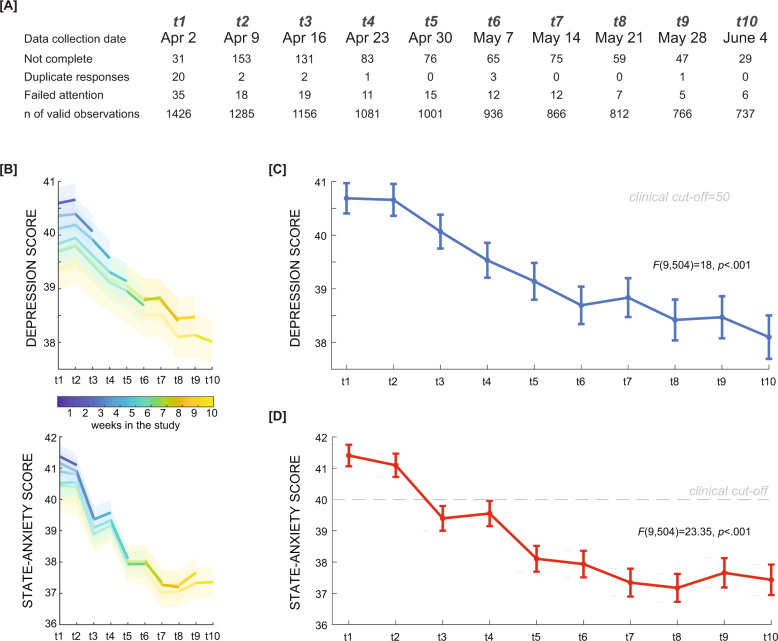
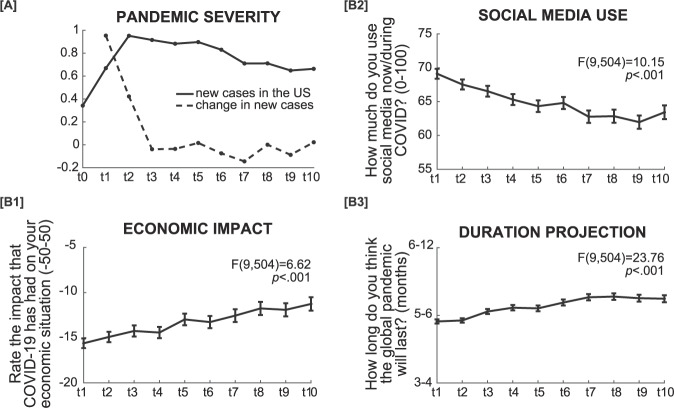
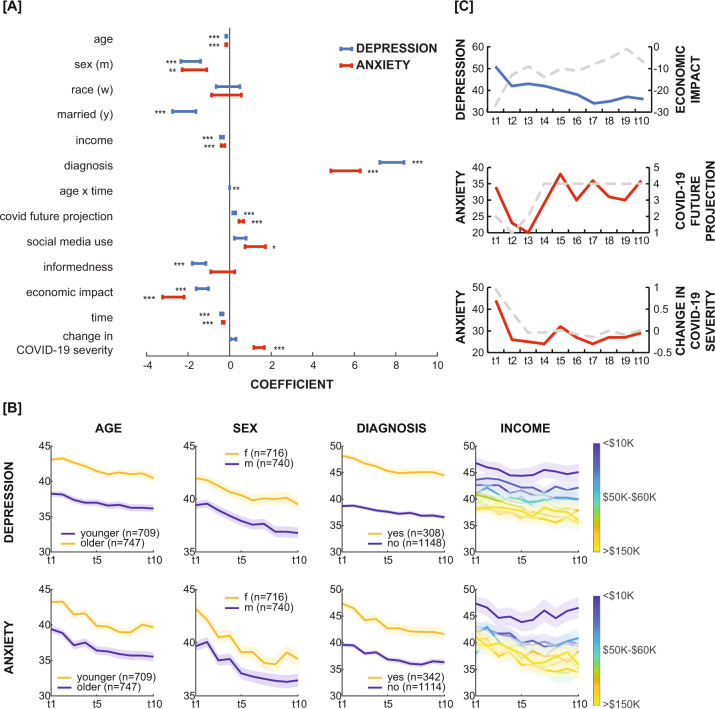
Crises such as the COVID-19 pandemic are known to exacerbate depression and anxiety, though their temporal trajectories remain under-investigated. The present study aims to investigate fluctuations in depression and anxiety using the COVID-19 pandemic as a model crisis. A total of 1512 adults living in the United States enrolled in this online study beginning April 2, 2020 and were assessed weekly for 10 weeks (until June 4, 2020). We measured depression and anxiety using the Zung Self-Rating Depression scale and State-Trait Anxiety Inventory (state subscale), respectively, along with demographic and COVID-related surveys. Linear mixed-effects models were used to examine factors contributing to longitudinal changes in depression and anxiety. We found that depression and anxiety levels were high in early April, but declined over time. Being female, younger age, lower-income, and previous psychiatric diagnosis correlated with higher overall levels of anxiety and depression; being married additionally correlated with lower overall levels of depression, but not anxiety. Importantly, worsening of COVID-related economic impact and increase in projected pandemic duration exacerbated both depression and anxiety over time. Finally, increasing levels of informedness correlated with decreasing levels of depression, while increased COVID-19 severity (i.e., 7-day change in cases) and social media use were positively associated with anxiety over time. These findings not only provide evidence for overall emotional adaptation during the initial weeks of the pandemic, but also provide insight into overlapping, yet distinct, factors contributing to depression and anxiety throughout the first wave of the pandemic.
Overview
The claims and statistics of this paper haven’t been checked yet.
Free: it reads the open-access text and checks the first 5 claims that cite a source we can check. Create a free account to check every claim.
Integrity signals
Registry
Cites
Statistics
Figures
Verification
Claims the paper makes
The claims and statistics of this paper haven’t been checked yet.
Free: it reads the open-access text and checks the first 5 claims that cite a source we can check. Create a free account to check every claim.
Claims other papers make about this one
Each is checked against this paper’s own text: does it say what the citing paper says it does?
The source backs part of the claim, not all of it — or backs it for a different population, condition or comparison.
In the citing paper
“studies of general North American samples (e.g., Asmundson & Taylor, 2020; Shuster et al., 2021) found higher anxiety scores in May 2020 relative to subsequent pandemic assessment timepoints”
From Examining the effects of prior Acceptance and Commitment Therapy (ACT) treatment among anxious cancer survivors during the COVID-19 pandemic: Evidence from a randomized controlled trial (2022) · cites this paper as Shuster et al., 2021
Experimental — accuracy not yet measured
Self-check
Percentages, sums and reported differences re-computed from the paper’s own numbers.
The self-check needs the paper’s full text.
Citations
Cites
Fitting Linear Mixed-Effects Models Using lme4
Bates, D., Mächler, M., Bolker, B., & Walker, S. (2015) · Journal of Statistical Software · doi:10.18637/jss.v067.i01 · Cited by 86,835
(1970) · Cited by 24,983
lmerTest Package: Tests in Linear Mixed Effects Models
Kuznetsova, A., Brockhoff, P. B., & Christensen, R. H. B. (2017) · Journal of Statistical Software · doi:10.18637/jss.v082.i13 · Cited by 24,346
A self-rating depression scale
ZUNG, W. W. K. (1965) · Archives of General Psychiatry · doi:10.1001/archpsyc.1965.01720310065008 · Cited by 9,813
Pierce, M., Hope, H., Ford, T., Hatch, S., Hotopf, M., John, A., Kontopantelis, E., Webb, R., Wessely, S., McManus, S., et al. (2020) · The Lancet Psychiatry · doi:10.1016/s2215-0366(20)30308-4 · Cited by 2,621
The construct of resilience: implications for interventions and social policies
LUTHAR, S. S., & CICCHETTI, D. (2000) · Development and Psychopathology · doi:10.1017/s0954579400004156 · Cited by 2,374
Prevalence of depression symptoms in US adults before and during the COVID-19 pandemic
Ettman, C. K., Abdalla, S. M., Cohen, G. H., Sampson, L., Vivier, P. M., & Galea, S. (2020) · JAMA Network Open · doi:10.1001/jamanetworkopen.2020.19686 · Cited by 2,138
Uncertainty and anticipation in anxiety: an integrated neurobiological and psychological perspective
Grupe, D. W., & Nitschke, J. B. (2013) · Nature Reviews Neuroscience · doi:10.1038/nrn3524 · Cited by 2,007
Why is depression more prevalent in women?
Albert, P. R. (2015) · Journal of Psychiatry and Neuroscience · doi:10.1503/jpn.150205 · Cited by 1,785
Liu, C. H., Zhang, E., Wong, G. T. F., Hyun, S., & Hahm, H. “. (2020) · Psychiatry Research · doi:10.1016/j.psychres.2020.113172 · Cited by 1,157
Into the unknown: A review and synthesis of contemporary models involving uncertainty
Carleton, R. N. (2016) · Journal of Anxiety Disorders · doi:10.1016/j.janxdis.2016.02.007 · Cited by 1,104
Depression and Anxiety in Hong Kong during COVID-19
Choi, E. P. H., Hui, B. P. H., & Wan, E. Y. F. (2020) · International Journal of Environmental Research and Public Health · doi:10.3390/ijerph17103740 · Cited by 893
Comorbid depression and anxiety spectrum disorders
Gorman, J. M. (1996) · Depression and Anxiety · doi:10.1002/(sici)1520-6394(1996)4:4<160::aid-da2>3.0.co;2-j · Cited by 630
Explaining Away: A Model of Affective Adaptation
Wilson, T. D., & Gilbert, D. T. (2008) · Perspectives on Psychological Science · doi:10.1111/j.1745-6924.2008.00085.x · Cited by 490
The role of socio-economic status in depression: results from the COURAGE (aging survey in Europe)
Freeman, A., Tyrovolas, S., Koyanagi, A., Chatterji, S., Leonardi, M., Ayuso-Mateos, J. L., Tobiasz-Adamczyk, B., Koskinen, S., Rummel-Kluge, C., & Haro, J. M. (2016) · BMC Public Health · doi:10.1186/s12889-016-3638-0 · Cited by 481
Daily emotional well‐being during the COVID‐19 pandemic
Lades, L. K., Laffan, K., Daly, M., & Delaney, L. (2020) · British Journal of Health Psychology · doi:10.1111/bjhp.12450 · Cited by 448
Economic hardship and mental health complaints during COVID-19
Witteveen, D., & Velthorst, E. (2020) · Proceedings of the National Academy of Sciences · doi:10.1073/pnas.2009609117 · Cited by 329 · cited 2×
“Likewise, self-reported depression and health anxiety symptoms increased particularly rapidly in individuals who experienced financial insecurity in the early days of the pandemic [24].”
BackgroundThe impact of epidemic, war, prohibition and media on suicide: United States, 1910-1920.
Wasserman, I. M. (1992) · Suicide and Life-Threatening Behavior · doi:10.1111/j.1943-278x.1992.tb00231.x · Cited by 257 · cited 1×
“Increased suicide rates were observed over the course of the 1918 Influenza pandemic, which racked our social, economic, and medical spheres in ways similar to the COVID-19 pandemic [1].”
BackgroundClarification of the cut-off score for Zung’s self-rating depression scale
Dunstan, D. A., & Scott, N. (2019) · BMC Psychiatry · doi:10.1186/s12888-019-2161-0 · Cited by 194
What's the role of perceived social support and coping styles in depression and anxiety?
Roohafza, H., Afshar, H., Keshteli, A. H., Mohammadi, N., Feizi, A., Taslimi, M., & Adibi, P. (2014) · Europe PMC (PubMed Central) · Cited by 192
Barrett, L. F. (1993) · Journal of Consulting and Clinical Psychology · doi:10.1037//0022-006x.61.4.631 · Cited by 186
What to do about missing values.
Acock, A. (2012) · American Psychological Association eBooks · doi:10.1037/13621-002 · Cited by 165
A Systematic Review on Health Resilience to Economic Crises
Glonti, K., Gordeev, V. S., Goryakin, Y., Reeves, A., Stuckler, D., McKee, M., & Roberts, B. (2015) · PLOS ONE · doi:10.1371/journal.pone.0123117 · Cited by 131
Transdiagnostic neural correlates of volitional emotion regulation in anxiety and depression
Fitzgerald, J. M., Klumpp, H., Langenecker, S., & Phan, K. L. (2018) · Depression and Anxiety · doi:10.1002/da.22859 · Cited by 65
An association of economic hardship with depression and suicidality in times of recession in Greece
Economou, M. P., Peppou, L. Ε., Souliotis, K. N., Konstantakopoulos, G., Papaslanis, T., Kontoangelos, K. A., Nikolaidi, S., & Stefanis, N. C. (2019) · Psychiatry Research · doi:10.1016/j.psychres.2019.02.058 · Cited by 39
Shortening the S-STAI: Consequences for research and clinical practice
Kruyen, P. M., Emons, W. H. M., & Sijtsma, K. (2013) · Journal of Psychosomatic Research · doi:10.1016/j.jpsychores.2013.03.013 · Cited by 30
Effect of economic crisis on suicide cases: An ARDL bounds testing approach
Demirci, Ş., Konca, M., Yetim, B., & İlgün, G. (2019) · International Journal of Social Psychiatry · doi:10.1177/0020764019879946 · Cited by 29
Recession, recovery and suicide in mental health patients in England: time trend analysis
Ibrahim, S., Hunt, I. M., Rahman, M. S., Shaw, J. J., Appleby, L., & Kapur, N. (2019) · The British Journal of Psychiatry · doi:10.1192/bjp.2019.119 · Cited by 27
An investigation into the jumping-to-conclusions bias in social anxiety
Johnstone, K. M., Chen, J., & Balzan, R. P. (2016) · Consciousness and Cognition · doi:10.1016/j.concog.2016.10.012 · Cited by 15 · cited 2×
“24) [16], and decreased to match pre-pandemic averages within three weeks (t1: t(720)=2.”
BackgroundMethodÁsgeirsdóttir, H. G., Valdimarsdóttir, U. A., Nyberg, U., Lund, S. H., Tómasson, G., Thorsteinsdóttir, T., Ásgeirsdóttir, T. L., & Hauksdóttir, A. (2020) · European Journal of Public Health · doi:10.1093/eurpub/ckaa121 · Cited by 12
Trying to describe mixed anxiety and depression: Have we lost our way?
Mulder, R., Bassett, D. L., Morris, G., Hamilton, A., Baune, B. T., Boyce, P. M., Hopwood, M., Parker, G. B., Porter, R., Singh, A., et al. (2019) · Depression and Anxiety · doi:10.1002/da.22961 · Cited by 9
The economic recession and subjective well-being in older adults in the Republic of Ireland
Duffy, R. M., Mullin, K., O’Dwyer, S., Wrigley, M., & Kelly, B. D. (2016) · Irish Journal of Psychological Medicine · doi:10.1017/ipm.2016.21 · Cited by 6
Analysis of Consultation Demand in a Mental Health Centre during the Recent Economic Recession
Norberto, M.-J., Santos, L. R., Cáceres, M. C., & Montanero‐Fernández, J. (2020) · Psychiatric Quarterly · doi:10.1007/s11126-020-09770-1 · Cited by 4 · cited 2×
“Lower-income and financial insecurity were also associated with increased depression [24], and psychiatric hospitals reported an increase in outpatient counts among previously healthy individuals, as well as among those with anxiety, mood, and adjustment disorders [26].”
BackgroundResult
Research works printed but not linked: 2
- RStudio Desktop Professional Edition 1.4.1106-5.
- Allison P. Missing data. Thousand Oaks, CA: SAGE Publications, Inc.; 2002.
Cited by
Cénat, J. M., Farahi, S. M. M. M., Dalexis, R. D., Darius, W. P., Bekarkhanechi, F. M., Poisson, H., Broussard, C., Ukwu, G., Auguste, E., Nguyen, D. D., et al. (2022) · Journal of Affective Disorders · doi:10.1016/j.jad.2022.07.011 · Cited by 192
Kurapov, A., Kalaitzaki, A. E., Keller, V., Danyliuk, I., & Kowatsch, T. (2023) · Frontiers in Psychiatry · doi:10.3389/fpsyt.2023.1134780 · Cited by 207
Wirkner, J., Christiansen, H., Knaevelsrud, C., Lüken, U., Wurm, S., Schneider, S., & Brakemeier, E. (2021) · European Psychologist · doi:10.1027/1016-9040/a000465 · Cited by 80
Fernández, R. S., Crivelli, L., Guimet, N. M., Allegri, R., Picco, S., & Pedreira, M. E. (2022) · Scientific Reports · doi:10.1038/s41598-022-09663-2 · Cited by 52
Ettman, C. K., Cohen, G. H., Abdalla, S. M., Trinquart, L., Castrucci, B. C., Bork, R. H., Clark, M. A., Wilson, I. B., Vivier, P. M., & Galea, S. (2022) · Science Advances · doi:10.1126/sciadv.abm9737 · Cited by 33
“They also found that worsening economic situation due to COVID-19 was associated with increased depression over time ( 32 ).”
Metadata
- Authors
- Shuster, A., O’Brien, M., Luo, Y., Berner, L. A., Perl, O., Heflin, M., Kulkarni, K., Chung, D., Na, S., Fiore, V. G., & Gu, X.
- Affiliations
- Icahn School of Medicine at Mount Sinai (US)
- Virginia Tech (US)
- Ulsan National Institute of Science and Technology (KR)
- Corresponding author
- Gu, Xiaosi
- ORCID
- Venue
- Translational Psychiatry
- Published
- 2021-08-20
- Volume
- 11
- Issue
- 1
- Pages
- 435-435
- ISSN
- 2158-3188 (ISSN-L)
- PMC
- PMC8377451
- OpenAlex
- W3195430565
- Cited by
- 45
- References
- 33
- Citations by year
- 2026: 4 · 2025: 10 · 2024: 10 · 2023: 10 · 2022: 10 · 2021: 1
- FWCI
- 5.29
- Type
- journal article
- Language
- en
- Open access
- gold
- doi.org
- Licence
- cc-by
- creativecommons.org/licenses/by/4.0 (tdm)
- creativecommons.org/licenses/by/4.0 (vor)
- Locations
- Translational Psychiatry (publishedVersion, cc-by)
- medRxiv (acceptedVersion)
- SSRN Electronic Journal (acceptedVersion)
- PubMed Central (publishedVersion, cc-by)
- PubMed (publishedVersion)
- VTechWorks (Virginia Tech) (submittedVersion, cc-by)
- Scholarworks@UNIST (Ulsan National Institute of Science and Technology) (submittedVersion)
- DOAJ (DOAJ: Directory of Open Access Journals) (submittedVersion, cc-by-sa)
- Funders
- U.S. Department of Health & Human Services | NIH | National Institute of Mental Health (R21MH120789, R01MH124115, R01MH122611)
- U.S. Department of Health & Human Services | NIH | National Institute on Minority Health and Health Disparities (R01MH123069)
- Icahn School of Medicine at Mount Sinai (N/A)
- Topics
- Social Sciences › Psychology › Clinical Psychology › COVID-19 and Mental Health
- Health Sciences › Medicine › Public Health, Environmental and Occupational Health › Maternal Mental Health During Pregnancy and Postpartum
- Social Sciences › Psychology › Experimental and Cognitive Psychology › Anxiety, Depression, Psychometrics, Treatment, Cognitive Processes
- Keywords
- COVID-19 pandemic, depression, anxiety, emotional adjustment, temporal trajectories, crisis, economic impact, pandemic duration, social media use, COVID-19 severity, informedness, marital status, income, sex differences, psychiatric history, United States
- MeSH terms
- Emotional Adjustment, COVID-19, SARS-CoV-2, Adult, Anxiety, Depression, Female, Humans, United States, Pandemics
About these checks
Registry, retraction, Cites and statistics results are computed, not judged, with one exception: a printed reference that no index lists is read once by a model before it counts as a citation error. Claims are extracted by a model and kept only when their quote appears verbatim in the text; each cited source is then checked, with a model’s help, for whether it says what the claim relies on. Those verdicts can be wrong — read the claim’s quote and the cited source before relying on one.
Statistics and arithmetic are recomputed, not judged.
Confidence bands are shown only for fields calibrated on our annotated test set. None is calibrated yet, so no band is shown.
What counts as a claim ›How we measure confidence ›How we check this ›
Are you an author, or do you see a problem with this page? Request a review
Data sources
Bibliographic data: Semantic Scholar, OpenAlex, Crossref.
Contains information from the Semantic Scholar Academic Graph Datasets, made available under the ODC Attribution License (ODC-BY 1.0).
Semantic Scholar’s data is described in: Kinney, R., et al. (2023). The Semantic Scholar Open Data Platform. arXiv:2301.10140.
