

Psilocybin therapy increases cognitive and neural flexibility in patients with major depressive disorder
Open accessThe DOI matches its Crossref record; 101 of the 101 references it cites were found in a registry or an index.
Abstract
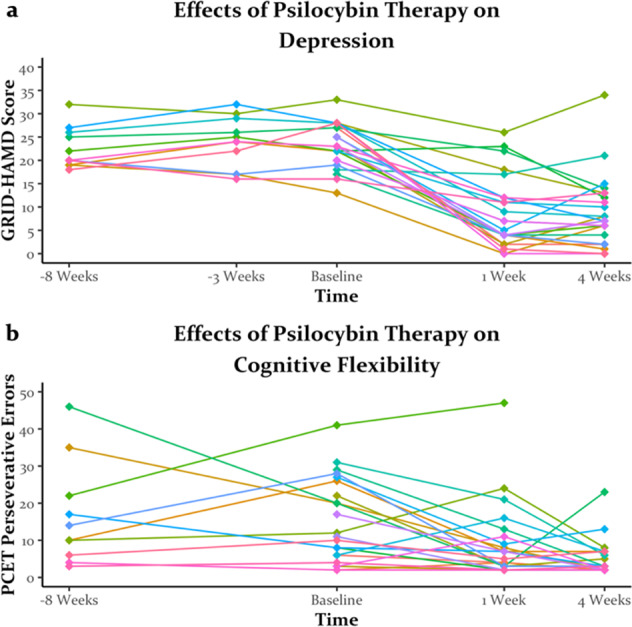
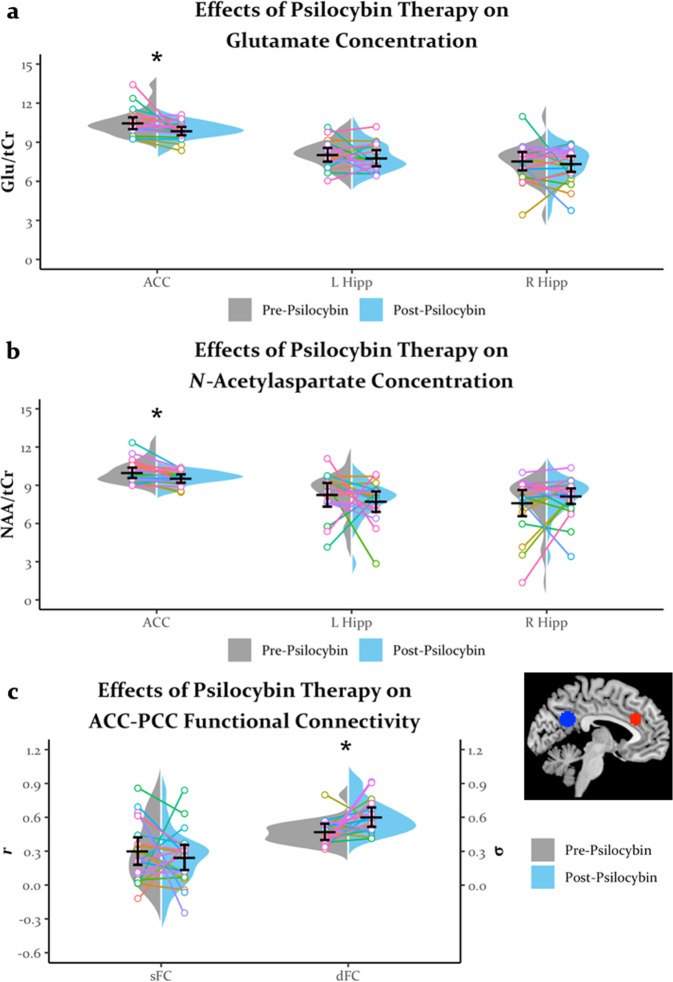
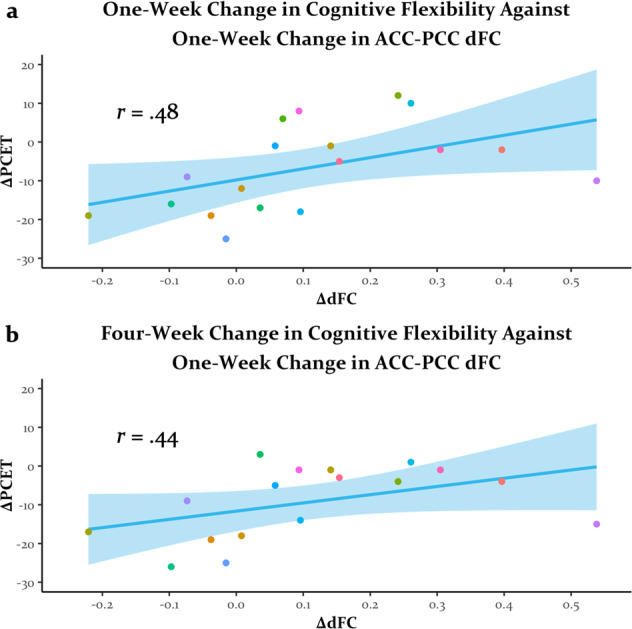
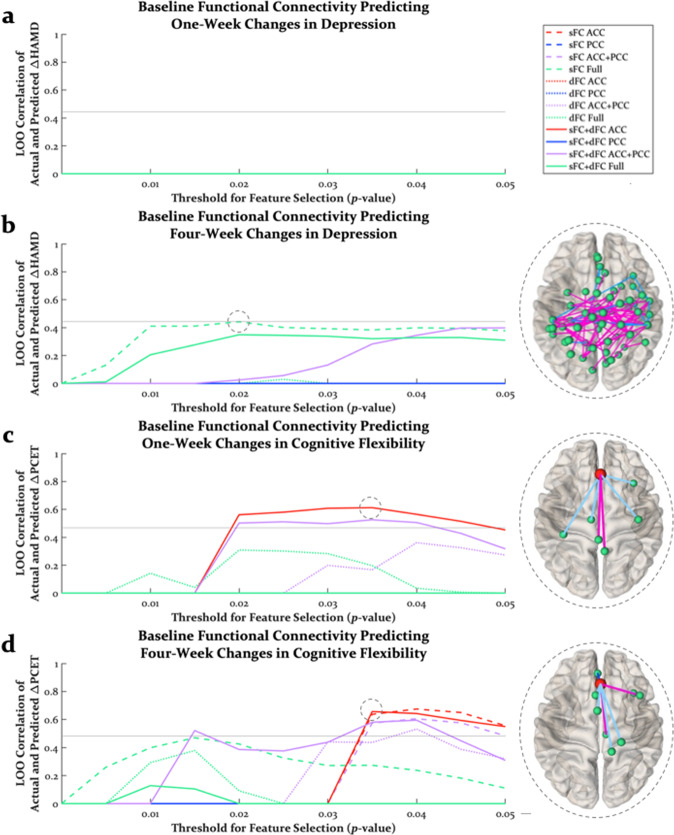
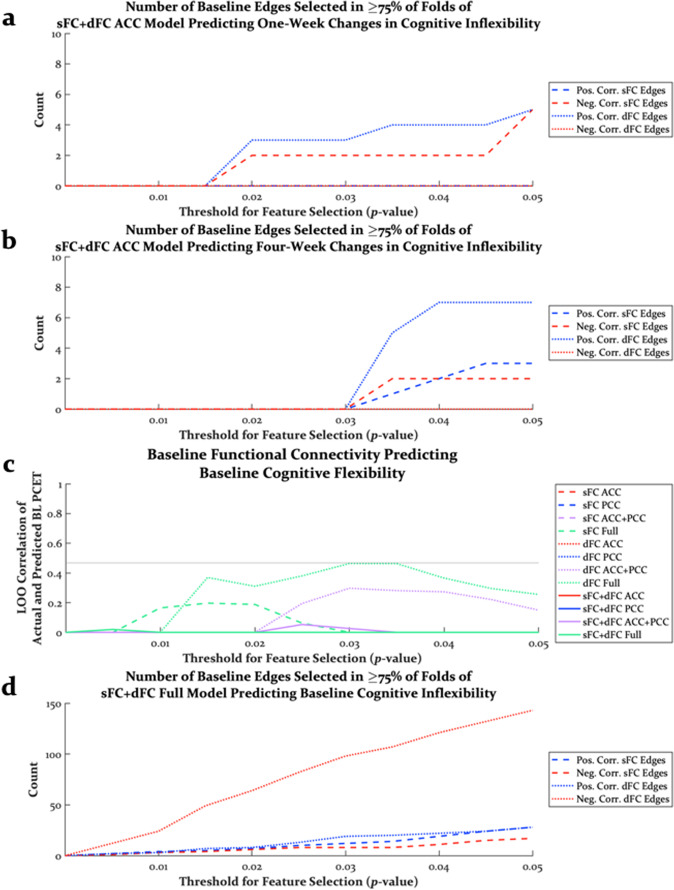
Psilocybin has shown promise for the treatment of mood disorders, which are often accompanied by cognitive dysfunction including cognitive rigidity. Recent studies have proposed neuropsychoplastogenic effects as mechanisms underlying the enduring therapeutic effects of psilocybin. In an open-label study of 24 patients with major depressive disorder, we tested the enduring effects of psilocybin therapy on cognitive flexibility (perseverative errors on a set-shifting task), neural flexibility (dynamics of functional connectivity or dFC via functional magnetic resonance imaging), and neurometabolite concentrations (via magnetic resonance spectroscopy) in brain regions supporting cognitive flexibility and implicated in acute psilocybin effects (e.g., the anterior cingulate cortex, or ACC). Psilocybin therapy increased cognitive flexibility for at least 4 weeks post-treatment, though these improvements were not correlated with the previously reported antidepressant effects. One week after psilocybin therapy, glutamate and N-acetylaspartate concentrations were decreased in the ACC, and dFC was increased between the ACC and the posterior cingulate cortex (PCC). Surprisingly, greater increases in dFC between the ACC and PCC were associated with less improvement in cognitive flexibility after psilocybin therapy. Connectome-based predictive modeling demonstrated that baseline dFC emanating from the ACC predicted improvements in cognitive flexibility. In these models, greater baseline dFC was associated with better baseline cognitive flexibility but less improvement in cognitive flexibility. These findings suggest a nuanced relationship between cognitive and neural flexibility. Whereas some enduring increases in neural dynamics may allow for shifting out of a maladaptively rigid state, larger persisting increases in neural dynamics may be of less benefit to psilocybin therapy.
Overview
The claims and statistics of this paper haven’t been checked yet.
Free: it reads the open-access text and checks the first 5 claims that cite a source we can check. Create a free account to check every claim.
Integrity signals
Registry
Cites
Statistics
Figures
Verification
Claims the paper makes
The claims and statistics of this paper haven’t been checked yet.
Free: it reads the open-access text and checks the first 5 claims that cite a source we can check. Create a free account to check every claim.
Claims other papers make about this one
Each is checked against this paper’s own text: does it say what the citing paper says it does?
In the citing paper
“Indeed, in an open-label clinical trial, psilocybin improved cognitive flexibility in patients with MDD [132].”
From Beyond the serotonin deficit hypothesis: Communicating a neuroplasticity framework of major depressive disorder (2024) · cites this paper as [132]
Self-check
Percentages, sums and reported differences re-computed from the paper’s own numbers.
The self-check needs the paper’s full text.
Citations
Cites
Power, J. D., Barnes, K. A., Snyder, A. Z., Schlaggar, B. L., & Petersen, S. E. (2012) · NeuroImage · doi:10.1016/j.neuroimage.2011.10.018 · Cited by 7,429 · cited 1×
“Nuisance parameters consisted of linear trend, the first 5 principal components of voxels containing cerebrospinal fluid and the first 5 principal components of voxels containing white matter signal (both identified using masks derived from segmented, co-registered, and normalized T1-weighted structural images; [81]),…”
MethodA component based noise correction method (CompCor) for BOLD and perfusion based fMRI
Behzadi, Y., Restom, K., Liau, J., & Liu, T. T. (2007) · NeuroImage · doi:10.1016/j.neuroimage.2007.04.042 · Cited by 4,502 · cited 1×
“Nuisance parameters consisted of linear trend, the first 5 principal components of voxels containing cerebrospinal fluid and the first 5 principal components of voxels containing white matter signal (both identified using masks derived from segmented, co-registered, and normalized T1-weighted structural images; [81]),…”
MethodFunctional Network Organization of the Human Brain
Power, J. D., Cohen, A. L., Nelson, S. M., Wig, G. S., Barnes, K. A., Church, J. A., Vogel, A. C., Laumann, T. O., Miezin, F. M., Schlaggar, B. L., et al. (2011) · Neuron · doi:10.1016/j.neuron.2011.09.006 · Cited by 4,124 · cited 1×
“Finally, these data were parcellated by averaging the BOLD signal at each TR across voxels within a 10-mm sphere around each of the 264 vertices of the Power atlas [84], producing 264 timeseries of nodes.”
MethodA simple objective technique for measuring flexibility in thinking
Berg, E. A. (1948) · The Journal of General Psychology · doi:10.1080/00221309.1948.9918159 · Cited by 2,255
Griffiths, R. R., Johnson, M. W., Carducci, M. A., Umbricht, A., Richards, W. A., Richards, B. D., Cosimano, M. P., & Klinedinst, M. A. (2016) · Journal of Psychopharmacology · doi:10.1177/0269881116675513 · Cited by 2,201 · cited 10×
“Although a lack of correlation between improvements in cognitive flexibility and improvements in depression might suggest that cognitive flexibility is not mechanistically related to antidepressant effects of psychedelic therapy, the GRID-HAMD assesses different features of current depression (e.g., affect and appetit…”
BackgroundMethodInfluentialSelf-citationCognitive impairment in depression: a systematic review and meta-analysis
Rock, P. L., Roiser, J. P., Riedel, W. J., & Blackwell, A. D. (2014) · Psychological Medicine · doi:10.1017/s0033291713002535 · Cited by 2,161 · cited 1×
“Nevertheless, many patients remain treatment-refractory for cognitive deficits [28, 29], necessitating research on novel treatments.”
BackgroundSatterthwaite, T. D., Elliott, M. A., Gerraty, R. T., Ruparel, K., Loughead, J., Calkins, M. E., Eickhoff, S. B., Hakonarson, H., Gur, R. C., Gur, R. E., et al. (2013) · NeuroImage · doi:10.1016/j.neuroimage.2012.08.052 · Cited by 1,881
Snyder, H. R. (2013) · Psychological Bulletin · doi:10.1037/a0028727 · Cited by 1,667
Automatic quantitation of localized in vivo1H spectra with LCModel
Provencher, S. W. (2001) · NMR in Biomedicine · doi:10.1002/nbm.698 · Cited by 1,634
Carhart-Harris, R. L., Bolstridge, M., Rucker, J., Day, C. M. J., Erritzoe, D., Kaelen, M., Bloomfield, M., Rickard, J. A., Forbes, B., Feilding, A., et al. (2016) · The Lancet Psychiatry · doi:10.1016/s2215-0366(16)30065-7 · Cited by 1,540 · cited 1×
“, lasting weeks to months after the acute effects [2, 3] and at least as effective as a SSRI [7]).”
Background
Cited by
Items 301–400 of 411
Lyon, A. (2023) · Oxford University Press eBooks · doi:10.1093/oso/9780198843757.003.0004
What Is Psychedelic Experience?
Lyon, A. (2023) · Oxford University Press eBooks · doi:10.1093/oso/9780198843757.003.0002
(2023) · Oxford University Press eBooks · doi:10.1093/oso/9780198843757.002.0005
Lyon, A. (2023) · Oxford University Press eBooks · doi:10.1093/oso/9780198843757.003.0003
Traitements psychédéliques et soins en addictologie
Dauré, C., & Mallet, L. (2023) · Elsevier eBooks · doi:10.1016/b978-2-294-77934-3.00069-x
A Neurocognitive Framework for Psychedelics as Learning OpportunitiesPreprint
Mattek, S. (2024) · PsyArXiv (OSF Preprints) · doi:10.31234/osf.io/jpck8
Mattu, J., & Sullivan, J. A. (2024) · Oxford University Press eBooks · doi:10.1093/oso/9780192898371.003.0007
Psychedelic enhancement of flexible learning weeks after a single dosePreprint
Brouns, E. J., Ekins, T. G., & Ahmed, O. J. (2024) · bioRxiv (Cold Spring Harbor Laboratory) · doi:10.1101/2024.12.17.629035
Quah, S. K. L., Glick, C., Roseman, L., Pasquini, L., Carhart-Harris, R. L., & Saggar, M. (2025) · bioRxiv (Cold Spring Harbor Laboratory) · doi:10.1101/2025.03.05.641592
Exploring psilocybin’s role in mental health and palliative medicine: a path to improved well-being
Umbacia, M. A., León, M., Quintero, J.-M., Castro, L.-M., Páez, V., Dodd, S., & Bustos, R. (2025) · Expert Opinion on Emerging Drugs · doi:10.1080/14728214.2025.2488786
Lasch, A., Schweikert, T., Dora, E., Kolb, T., Schurig, H. L., & Walther, A. (2025) · Nervenheilkunde · doi:10.1055/a-2517-1621
Sevander, S. S., & Rissanen, M. (2025) · Health, environment and sustainable development: interdisciplinary approach · doi:10.59476/hesdia.v0i1.700
Mason, N. L., Mallaroni, P.-A., Szabo, A., & Ramaekers, J. G. (2025) · PsyArXiv (OSF Preprints) · doi:10.31234/osf.io/g49mp_v1
The Potential of Psychedelics in the Treatment of Eating Disorders
Gukasyan, N., Hilbert, S. N., & Guarda, Á. S. (2025) · Oxford University Press eBooks · doi:10.1093/9780197675212.003.0027
Psychedelic-Assisted Therapy for Anorexia Nervosa
Stefańska, O., & Matuszewski, M. (2024) · Journal of Student Research · doi:10.47611/jsrhs.v13i4.6611
Magic mushrooms may one day treat anorexia, but not just yet
Rossell, S. L., & Finkelstein, C. (2024) · The Conversation · doi:10.64628/aa.u75743v43
Ballentine, G., & Friedman, S. F. (2022) · The Conversation · doi:10.64628/aai.txkhqrcfy
Psilocybin-occasioned Mystical-Type Experiences and Mental Wellness
Uduwawela, R. (2025) · Open Access Victoria University of Wellington | Te Herenga Waka (Figshare) · doi:10.26686/wgtn.30006970
Electrodynamics of the Psychedelic ExperiencePreprint
Hunt, T. (2025) · Preprints.org · doi:10.20944/preprints202509.1813.v1
Neurocomputational evidence of sustained Self-Other mergence after psychedelicsPreprint
Mallaroni, P., Mason, N. L., Preller, K. H., Razi, A., Ereira, S., & Ramaekers, J. G. (2025) · medRxiv · doi:10.1101/2025.10.07.25337510
Glannon, W. (2025) · The MIT Press eBooks · doi:10.7551/mitpress/15173.003.0011
Roseby, W., & Moar, C. O. (2025) · Psychoactives · doi:10.3390/psychoactives4040041
Neurocognitive Dynamics, Cognitive Flexibility, and Constraints on Thought
Burrell, J., Zamani, A., & Christoff, K. (2025) · Oxford University Press eBooks · doi:10.1093/oxfordhb/9780197677131.013.18
Effinger, D. P. (2023) · Carolina Digital Repository (University of North Carolina at Chapel Hill) · doi:10.17615/5hmb-3772
Ramos, L. I. N. P. (2022) · Portuguese National Funding Agency for Science, Research and Technology (RCAAP Project by FCT) · doi:10.34626/erq0-ba03
Andersson, J., & Elvander Lewis, K. (2025) · DiVA (Stockholm University)
Skol Niklasson, E. (2023) · Digitala vetenskapliga arkivet (Diva) (Karlstad University)
Pędzich, B. D. (2024) · VUBIR (Vrije Universiteit Brussel)
Lindecrantz, L., & Villman, N. (2023) · University Library of Skövde (University of Skövde)
Neuroimaging corelates of classical psychedelics effects: A systematic review
Dost, D. (2023) · HAL
Meccia, J. (2023) · eScholarship@McGill (McGill) · doi:10.82308/31606
Bodin, A., & Berger, K. (2025) · University Library of Skövde (University of Skövde)
Changing the depressed mind : Psilocybin’s effects on resting-state neural activity and connectivity
Olsson, O. (2025) · University Library of Skövde (University of Skövde)
Therapeutic Potential of Medicinal Mushrooms on Alzheimer’s Disease
Albahttiti, A. T. I., Akubardia, N., Tasnim, D., & Hamzeh, L. (2025) · Nutritional neurosciences · doi:10.1007/978-981-95-2774-8_8
Hurevich, M. (2025) · Portuguese National Funding Agency for Science, Research and Technology (RCAAP Project by FCT)
Chen, Q., Chen, P., Wei, T., Chamyuang, S., & Chen, B.-X. (2025) · Creative Science · doi:10.55674/cs.v18i1.264689
Gordon, A. R., Carrithers, B. M., Pagni, B. A., Kettner, H., MRes, A. M., Nayak, S. M., Weiss, B., Carhart-Harris, R. L., Roberts, D. E., Erritzøe, D., et al. (2025) · Psychedelic Medicine · doi:10.1177/28314425251382930
Mass spectrometry approaches for monitoring therapeutic response in major depressive disorder
Romani, S. A. S., Silva, M. L. D., Ravaglia, G. B., Ferreira, P. C., Carvalho, C. D. D. A., Pereira, T. F. D., & Sussulini, A. (2025) · Bioanalysis · doi:10.1080/17576180.2025.2608564
Doyle, Z., Chisamore, N., Kaczmarek, E. S., Johnson, D. E., Brudner, R. M., Weiglein, G., Blainey, M. G., Bawks, J., Riva-Cambrin, J., Sethi, R., et al. (2026) · General Hospital Psychiatry · doi:10.1016/j.genhosppsych.2026.01.001
Chwyl, C., Spata, A., Lucas, W., & Luoma, J. B. (2026) · BMC Psychology · doi:10.1186/s40359-025-03921-4
Vidigal, D. C., Ferreira, M. F. M. D. P., & de Faria, R. S. (2026) · Research Society and Development · doi:10.33448/rsd-v15i1.50263
High hopes? Precision psychedelic addiction medicine
Zafar, R. R., Kleine, P., Kurtin, D. L., Wall, M. B., & Erritzøe, D. (2026) · Frontiers in Psychiatry · doi:10.3389/fpsyt.2025.1681795
Pohořalá, V. (2026) · heiDOK (Heidelberg University) · doi:10.11588/heidok.00038014
Shnayder, S., Agin-Liebes, G., Hubert, T., Ching, T. H. W., Hokanson, J., Pittenger, C., Kelmendi, B., & Adams, T. G. (2026) · Frontiers in Psychiatry · doi:10.3389/fpsyt.2026.1799543
Vargas, M. C. C. (2025) · Universidad Peruana Cayetano Heredia Institutional Repository
The Effects of Psychedelic-Assisted Therapy on Illness and Death Anxiety
Amaev, A. (2024) · TSpace (University of Toronto)
Hallucinogens for Mood and Anxiety Disorders: A Critical Review of Psychedelic-Assisted Therapies
Chlebek, G. (2026) · ThinkIR: The University of Louisville's Institutional Repository (University of Louisville)
Zhang, X., 朱蓉蓉, Haider, A., Guo, Q., Wang, D., & Zhang, X.-Y. (2026) · Journal of Affective Disorders · doi:10.1016/j.jad.2026.121787
Sustained Effects of Low-to-Moderate Doses of Psilocybin on Brain ConnectivityPreprint
Bhagavan, C., Dandash, O., Carter, O. L., Bryson, A., & Kanaan, R. (2026) · medRxiv · doi:10.64898/2026.04.17.26351147
Severance, T. (2026) · Digital Commons at National Lewis University (National Lewis University)
The Phenomenology of Psychedelic Experiences
Pavăl, D. (2026) · SpringerBriefs in religious studies · doi:10.1007/978-3-032-20214-7_2
Cluck, M., Purcell, A. B., Kazan, Z., Robinson, J. O., McGuire, A. L., & Neitzke‐Spruill, L. (2026) · Psychedelics · doi:10.1016/j.psyche.2026.100020
Exploring new avenues: Psychedelic‐assisted therapy for young people
Vamvakopoulou, I. A., Nicholls, D., Nutt, D. J., & Simplicio, M. C. D. (2026) · British Journal of Clinical Pharmacology · doi:10.1002/bcp.70579
Panorama do uso terapêutico da psilocibina
Pereira, M. L., & Marcourakis, T. (2022) · doi:10.11606/003103909
Psicoterapia assistida por psilocibina no tratamento da depressão
Marcello, G. Z. M., & Marcourakis, T. (2022) · doi:10.11606/003103379
Conn, K., Wong, N., Sunnetci, S., Siyabi, A. A., McCoy, K., Huang, K., Greaves, E., Milton, L. K., Kuhlmann, L., Maguire, S., et al. (2026) · bioRxiv (Cold Spring Harbor Laboratory) · doi:10.64898/2026.05.14.725265
Speech markers of psychological change following a psychedelic 5-MeO-DMT retreat
Kuc, J., McAlpine, R. G., Sellers, A., Blackburne, G., Lametti, D. R., & Skipper, J. I. (2026) · Journal of Psychopharmacology · doi:10.1177/02698811261443690
Thulasingam, M., & Vellapandian, C. (2026) · Current Drug Therapy · doi:10.2174/0115748855435564251207185418
Psühhedeelse taipamisega seotud arvutused ajus
Kaup, K. (2026) · DSpace repository (University of Tartu)
Can Childhood be Used as a Model to Understand the Effects of Psychedelics?
Hurwitz, E. S., Dean, J. G., & Walker, C. M. (2026) · Topics in Cognitive Science · doi:10.1111/tops.70058
Wu, C. (2026) · Frontiers in Psychology · doi:10.3389/fpsyg.2026.1781779
Case Reports in Psychopharmacology, volume IV
Stuhec, M., & Ciano, P. D. (2026) · Frontiers research topics · doi:10.3389/978-2-8325-8059-2
Forster, C., Gohil, C., Burgher, B., Kuzovkin, I., van Es, M. W. J., Woolrich, M. W., Vidaurre, D., van den Heuvel, M. P., Higgins, C., & Cocchi, L. (2026) · bioRxiv (Cold Spring Harbor Laboratory) · doi:10.64898/2026.05.27.728312
Khan, M., Malik, M. O., Sajjad, S., Uzair, M., Shah, I., & Bhatti, M. I. (2026) · Genetics and Molecular Research · doi:10.4238/e91xh631
Infanto-Juvenil, R. D. P. (2026) · Revista de Psiquiatría Infanto-Juvenil · doi:10.31766/revpsij.v43s1
Modlin, N. L., Elek, Z., Maggio, C., Agrawal, M., Lepow, L., Rucker, J., Stubley, J., & Guss, J. R. (2026) · Psychodynamic Psychiatry · doi:10.1521/pdps.2026.54.2.338
Calder, A. E., Diehl, V. J., Lietz, M. P., Yousefi, P., Friedli, N., Coviello, F., Rouaud, A., Beichmann, K., Eckert, A., & Hasler, G. (2026) · Neuropsychopharmacology · doi:10.1038/s41386-026-02454-7
Basch, R., Cohen, M., & Peled‐Avron, L. (2026) · medRxiv · doi:10.64898/2026.06.18.26355974
dos Santos, J. C. C., Bolan, S. J., da Silva, G. L., Viana, G. L., Rico, E. P., & Gonçalves, C. L. (2026) · Journal of Psychiatric Research · doi:10.1016/j.jpsychires.2026.06.035
Parallel Claustral Networks for Behavioral Control in Health and Disease
Citri, A., Wulff, A. B., Faig, C. A., Atilgan, H., Negishi, K., Brown, S. P., Mathur, B. N., Augustine, G. J., & Shaham, Y. (2026) · Journal of Neuroscience · doi:10.1523/jneurosci.1083-26.2026
Liu, C. J., Ho, E. M., Enos, A. S., Baublyte, U. B., Luna, I. M., Kosche, A. R., & Sohal, V. S. (2026) · bioRxiv (Cold Spring Harbor Laboratory) · doi:10.64898/2026.07.05.736652
Aicher, H., Dornbierer, J., Caflisch, L., Suay, D., Mueller, M., Landolt, H., Quednow, B. B., Scheidegger, M., & Dornbierer, D. (2026) · Psychopharmacology · doi:10.1007/s00213-026-07118-4
Averill, L. A., & Neitzke‐Spruill, L. (2026) · FOCUS The Journal of Lifelong Learning in Psychiatry · doi:10.1176/appi.focus.20260006
Psilocybin asymmetrically modulates outcome-based choice and cortical processing under uncertaintyPreprint
Jacobs, D. S., Pacheco, A. T., Olson, R. J., Langdon, A., & Moghaddam, B. (2026) · eLife · doi:10.64898/2026.07.16.733837
McConnell, P. A., Raffety, J., Li, A., Steinberg, E., Rahim, S., Valtierra, C., Gazzaley, A. H., Carhart-Harris, R. L., & Pasquini, L. (2026) · Translational Psychiatry · doi:10.1038/s41398-026-04349-z
Molecules, meaning, and physiology: disentangling the active ingredients of psychedelic therapeutics
Kuypers, K. P. C. (2026) · Frontiers in Neuroscience · doi:10.3389/fnins.2026.1892474
Neurobiologie der Psychedelika
Schmitz, C., & Adolphi, H. (2026) · Elsevier eBooks · doi:10.1016/b978-3-437-21293-2.00004-6
Feasibility and tolerability of psilocybin for phantom limb pain
Dean, J. G., Hurwitz, E. S., Furnish, T. J., Castellanos, J. P., McKinty, A., Farrell, B., Barrows, D., Peck, S. K., Trim, J., Samadhi, E., et al. (2026) · Journal of Pain · doi:10.1016/j.jpain.2026.106404
Thakur, A., Jain, P., Sharma, M. K., Chauhan, N. S., Khatoon, N., Sahu, D., Ajazuddin, & Tamrakar, S. (2026) · Current Behavioral Neuroscience Reports · doi:10.1007/s40473-026-00331-7
Spata, A., Sturges, J. W., & Earleywine, M. (2026) · Journal of Psychoactive Drugs · doi:10.1080/02791072.2026.2710057
Todesco, S., Allan, Z., Liu, M. Y. M., & Schütz, C. G. (2026) · Progress in Neuro-Psychopharmacology and Biological Psychiatry · doi:10.1016/j.pnpbp.2026.111888
Kelly, C., Cooley, B. J., Zeng, L., Hurzeler, T. P., Manning, V., McNally, G. P., Watt, J., Haber, P., & Morley, K. C. (2026) · Neuroscience & Biobehavioral Reviews · doi:10.1016/j.neubiorev.2026.106911
Psilocibina e neuroplasticidade: novas perspectivas terapêuticas para depressão resistente
Castro, L. A., Júnior, A. L. A. S., Simões, G. G. C., de Souza, V. R. S., Pereira, L. L. M. D., Lacerda, A. L. D. S., & da Silva, C. L. (2026) · Vértices · doi:10.19180/1809-2667.v28n22026.23658
Fletcher, K., Freestone, J., Ezard, N., Knock, E., & Siefried, K. J. (2026) · Current Addiction Reports · doi:10.1007/s40429-026-00783-7
Seillier, A., Dannan, G. I. E., & Seillier, L. (2026) · Progress in Neuro-Psychopharmacology and Biological Psychiatry · doi:10.1016/j.pnpbp.2026.111924
Asim, M., Soares, J. A. G., & Tucciarone, J. (2026) · Translational Psychiatry · doi:10.1038/s41398-026-04455-y
Psychedelics and suicidality: A double-edged sword - risks, mechanisms, and moving forward
Mallevays, M., & Berkovitch, L. (2026) · European Neuropsychopharmacology · doi:10.1016/j.euroneuro.2026.113878
Stadler, F., Saelens, J., Henter, I. D., Rieser, N. M., Greenwald, M. S., Ballard, E. D., Preller, K. H., Zarate, C. A., & Kraus, C. (2026) · Frontiers in Psychiatry · doi:10.3389/fpsyt.2026.1843186
Iudica, M. A. (2026) · Repositorio Institucional UCA (Pontificia Universidad Católica Argentina)
Psychedelics Restructure the Global Workspace of ConsciousnessPreprint
Yousefi, P., Shinozuka, K., Vizeli, P., Holze, F., Becker, A., Müller, F., Liechti, M. E., Hasler, G., Rodríguez, C. I., Luppi, A. I., et al. (2026) · bioRxiv (Cold Spring Harbor Laboratory) · doi:10.64898/2026.09.28.755172
Pharmacotherapy and clinical considerations for alcohol use disorder
Letizia, C. (2024) · Nutrimentum et Curae
PSILOCYBIN AND IMMUNOMODULATION IN MAJOR DEPRESSIVE DISORDER: SYSTEMATIC REVIEW AND META-ANALYSIS
MAHVASH KHAN, M. O. M., Malik, M. O., Uzair, M., Farid, N., AHMED, A., khan, S., & ISMAIL, M. (2025) · TPM Testing, psychometrics, methodology in applied psychology
Holze, F., Larsen, K., Ozenne, B., Knudsen, G. M., Becker, A., Avram, M., Borgwardt, S., Liechti, M. E., Müller, F., & Fisher, P. M. (2026) · Translational Psychiatry · doi:10.1038/s41398-026-04522-4
Byrne, K., Odette, M. M., Garland, E. L., & Lewis, B. R. (2026) · Journal of Affective Disorders Reports · doi:10.1016/j.jadr.2026.101187
Liu, Y., Tan, Y., & Hashimoto, K. (2026) · European Journal of Pharmacology · doi:10.1016/j.ejphar.2026.179414
Metadata
- Authors
- Doss, M. K., Považan, M., Rosenberg, M. D., Sepeda, N. D., Davis, A. K., Finan, P. H., Smith, G. S., Pekar, J. J., Barker, P. B., Griffiths, R. R., & Barrett, F. S.
- Affiliations
- Johns Hopkins University (US)
- University of Chicago (US)
- Kennedy Krieger Institute (US)
- Corresponding author
- Doss, Manoj K.
- ORCID
- Venue
- Translational Psychiatry
- Published
- 2021-11-08
- Volume
- 11
- Issue
- 1
- Pages
- 574-574
- ISSN
- 2158-3188 (ISSN-L)
- PMC
- PMC8575795
- OpenAlex
- W3213458191
- Cited by
- 356
- References
- 101
- Citations by year
- 2026: 73 · 2025: 75 · 2024: 92 · 2023: 73 · 2022: 41 · 2021: 2
- FWCI
- 35.45
- Type
- journal article
- Language
- en
- Open access
- gold
- doi.org
- Licence
- cc-by
- creativecommons.org/licenses/by/4.0 (tdm)
- creativecommons.org/licenses/by/4.0 (vor)
- Locations
- Translational Psychiatry (publishedVersion, cc-by)
- PubMed Central (publishedVersion, cc-by)
- PubMed (publishedVersion)
- DOAJ (DOAJ: Directory of Open Access Journals) (submittedVersion, cc-by-sa)
- Funders
- U.S. Department of Health & Human Services | NIH | National Institute on Drug Abuse (T32DA007209, R01DA03889)
- Heffter Research Institute, Steven and Alexandra Cohen Foundation, Tim Ferriss, Blake Mycoskie, Matt Mullenweg, Craig Nerenberg, the Riverstyx Foundation, and Dave Morin.
- Topics
- Social Sciences › Psychology › Clinical Psychology › Psychedelics and Drug Studies
- Health Sciences › Medicine › Pharmacology (medical) › Treatment of Major Depression
- Life Sciences › Neuroscience › Neurology › Transcranial Magnetic Stimulation Studies
- Keywords
- psilocybin, major depressive disorder, cognitive flexibility, neural flexibility, perseverative errors, set-shifting, dynamic functional connectivity, anterior cingulate cortex, posterior cingulate cortex, glutamate, N-acetylaspartate, neurometabolites, connectome-based predictive modeling, cognitive rigidity, antidepressant effects
- MeSH terms
- Brain Mapping, Cognition, Major Depressive Disorder, Humans, Magnetic Resonance Imaging, Psilocybin
About these checks
Registry, retraction, Cites and statistics results are computed, not judged, with one exception: a printed reference that no index lists is read once by a model before it counts as a citation error. Claims are extracted by a model and kept only when their quote appears verbatim in the text; each cited source is then checked, with a model’s help, for whether it says what the claim relies on. Those verdicts can be wrong — read the claim’s quote and the cited source before relying on one.
Statistics and arithmetic are recomputed, not judged.
Confidence bands are shown only for fields calibrated on our annotated test set. None is calibrated yet, so no band is shown.
What counts as a claim ›How we measure confidence ›How we check this ›
Are you an author, or do you see a problem with this page? Request a review
Data sources
Bibliographic data: Semantic Scholar, OpenAlex, Crossref.
Contains information from the Semantic Scholar Academic Graph Datasets, made available under the ODC Attribution License (ODC-BY 1.0).
Semantic Scholar’s data is described in: Kinney, R., et al. (2023). The Semantic Scholar Open Data Platform. arXiv:2301.10140.
