

Psilocybin therapy increases cognitive and neural flexibility in patients with major depressive disorder
Open accessThe DOI matches its Crossref record; 101 of the 101 references it cites were found in a registry or an index.
Abstract
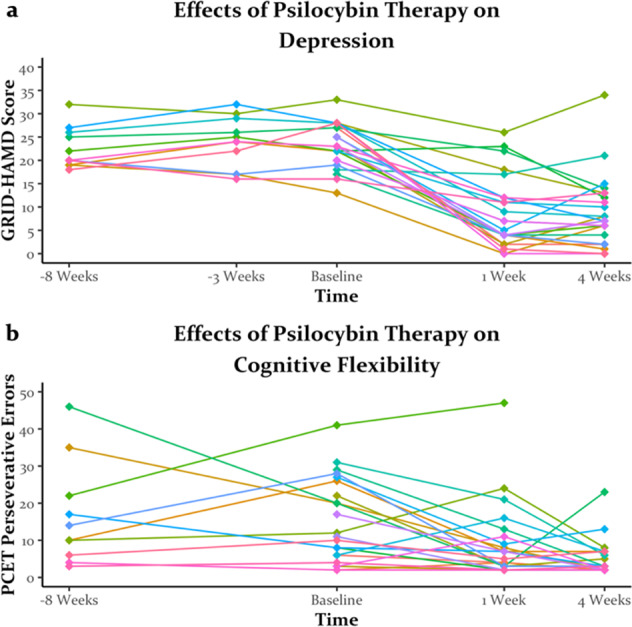
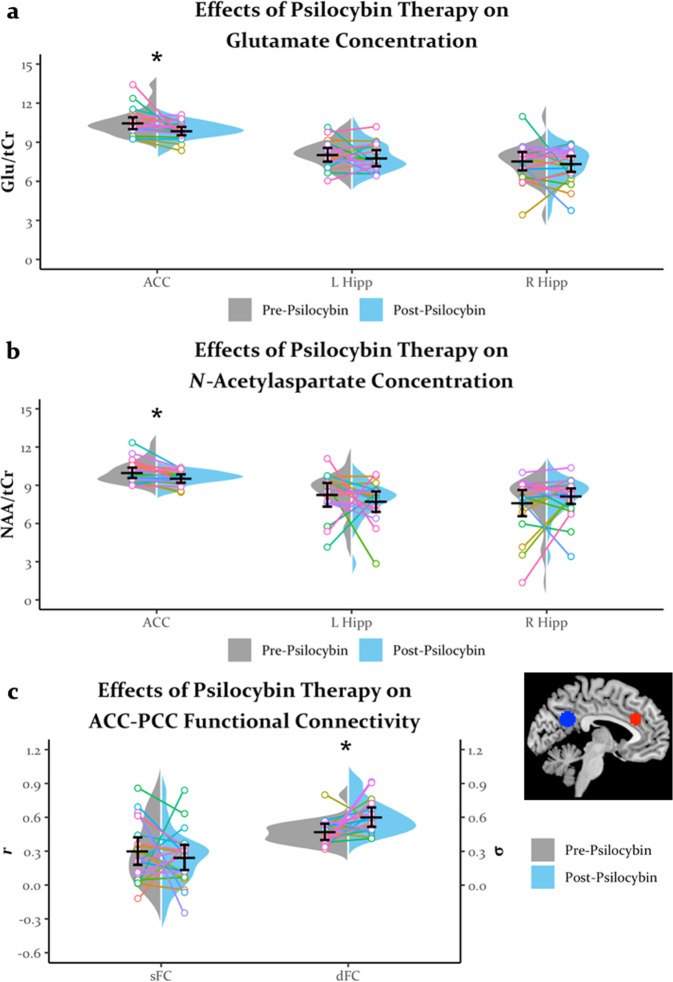
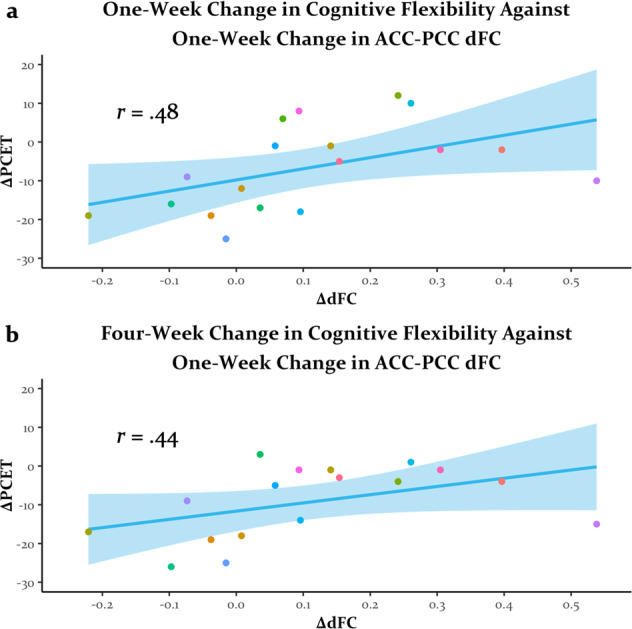
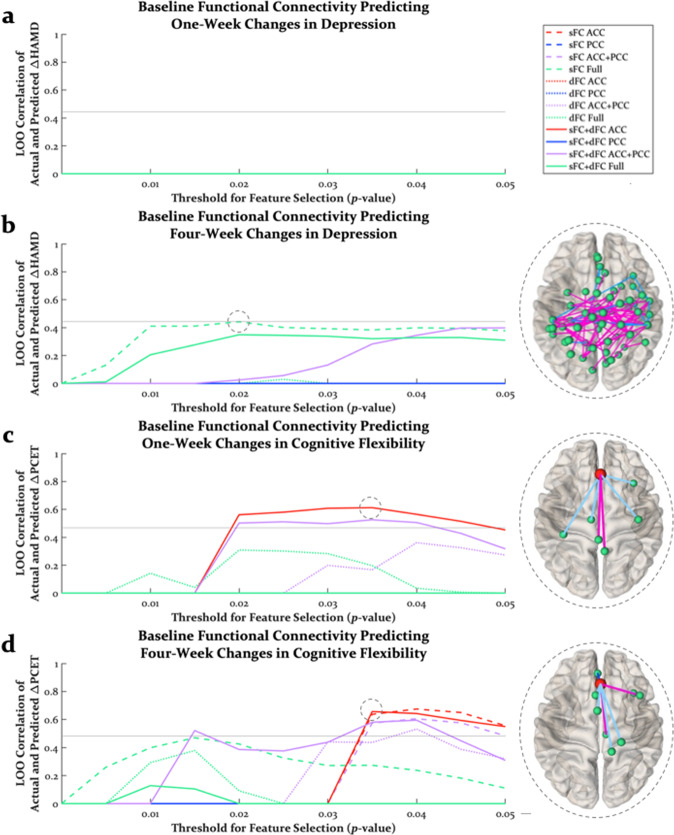
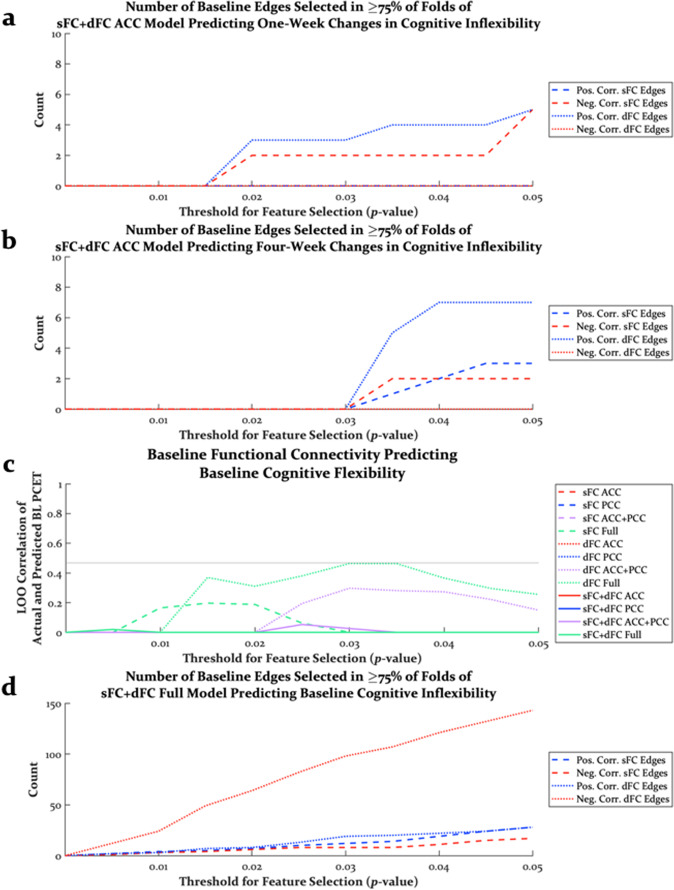
Psilocybin has shown promise for the treatment of mood disorders, which are often accompanied by cognitive dysfunction including cognitive rigidity. Recent studies have proposed neuropsychoplastogenic effects as mechanisms underlying the enduring therapeutic effects of psilocybin. In an open-label study of 24 patients with major depressive disorder, we tested the enduring effects of psilocybin therapy on cognitive flexibility (perseverative errors on a set-shifting task), neural flexibility (dynamics of functional connectivity or dFC via functional magnetic resonance imaging), and neurometabolite concentrations (via magnetic resonance spectroscopy) in brain regions supporting cognitive flexibility and implicated in acute psilocybin effects (e.g., the anterior cingulate cortex, or ACC). Psilocybin therapy increased cognitive flexibility for at least 4 weeks post-treatment, though these improvements were not correlated with the previously reported antidepressant effects. One week after psilocybin therapy, glutamate and N-acetylaspartate concentrations were decreased in the ACC, and dFC was increased between the ACC and the posterior cingulate cortex (PCC). Surprisingly, greater increases in dFC between the ACC and PCC were associated with less improvement in cognitive flexibility after psilocybin therapy. Connectome-based predictive modeling demonstrated that baseline dFC emanating from the ACC predicted improvements in cognitive flexibility. In these models, greater baseline dFC was associated with better baseline cognitive flexibility but less improvement in cognitive flexibility. These findings suggest a nuanced relationship between cognitive and neural flexibility. Whereas some enduring increases in neural dynamics may allow for shifting out of a maladaptively rigid state, larger persisting increases in neural dynamics may be of less benefit to psilocybin therapy.
Overview
The claims and statistics of this paper haven’t been checked yet.
Free: it reads the open-access text and checks the first 5 claims that cite a source we can check. Create a free account to check every claim.
Integrity signals
Registry
Cites
Statistics
Figures
Verification
Claims the paper makes
The claims and statistics of this paper haven’t been checked yet.
Free: it reads the open-access text and checks the first 5 claims that cite a source we can check. Create a free account to check every claim.
Claims other papers make about this one
Each is checked against this paper’s own text: does it say what the citing paper says it does?
In the citing paper
“Indeed, in an open-label clinical trial, psilocybin improved cognitive flexibility in patients with MDD [132].”
From Beyond the serotonin deficit hypothesis: Communicating a neuroplasticity framework of major depressive disorder (2024) · cites this paper as [132]
Self-check
Percentages, sums and reported differences re-computed from the paper’s own numbers.
The self-check needs the paper’s full text.
Citations
Cites
Power, J. D., Barnes, K. A., Snyder, A. Z., Schlaggar, B. L., & Petersen, S. E. (2012) · NeuroImage · doi:10.1016/j.neuroimage.2011.10.018 · Cited by 7,429 · cited 1×
“Nuisance parameters consisted of linear trend, the first 5 principal components of voxels containing cerebrospinal fluid and the first 5 principal components of voxels containing white matter signal (both identified using masks derived from segmented, co-registered, and normalized T1-weighted structural images; [81]),…”
MethodA component based noise correction method (CompCor) for BOLD and perfusion based fMRI
Behzadi, Y., Restom, K., Liau, J., & Liu, T. T. (2007) · NeuroImage · doi:10.1016/j.neuroimage.2007.04.042 · Cited by 4,502 · cited 1×
“Nuisance parameters consisted of linear trend, the first 5 principal components of voxels containing cerebrospinal fluid and the first 5 principal components of voxels containing white matter signal (both identified using masks derived from segmented, co-registered, and normalized T1-weighted structural images; [81]),…”
MethodFunctional Network Organization of the Human Brain
Power, J. D., Cohen, A. L., Nelson, S. M., Wig, G. S., Barnes, K. A., Church, J. A., Vogel, A. C., Laumann, T. O., Miezin, F. M., Schlaggar, B. L., et al. (2011) · Neuron · doi:10.1016/j.neuron.2011.09.006 · Cited by 4,124 · cited 1×
“Finally, these data were parcellated by averaging the BOLD signal at each TR across voxels within a 10-mm sphere around each of the 264 vertices of the Power atlas [84], producing 264 timeseries of nodes.”
MethodA simple objective technique for measuring flexibility in thinking
Berg, E. A. (1948) · The Journal of General Psychology · doi:10.1080/00221309.1948.9918159 · Cited by 2,255
Griffiths, R. R., Johnson, M. W., Carducci, M. A., Umbricht, A., Richards, W. A., Richards, B. D., Cosimano, M. P., & Klinedinst, M. A. (2016) · Journal of Psychopharmacology · doi:10.1177/0269881116675513 · Cited by 2,201 · cited 10×
“Although a lack of correlation between improvements in cognitive flexibility and improvements in depression might suggest that cognitive flexibility is not mechanistically related to antidepressant effects of psychedelic therapy, the GRID-HAMD assesses different features of current depression (e.g., affect and appetit…”
BackgroundMethodInfluentialSelf-citationCognitive impairment in depression: a systematic review and meta-analysis
Rock, P. L., Roiser, J. P., Riedel, W. J., & Blackwell, A. D. (2014) · Psychological Medicine · doi:10.1017/s0033291713002535 · Cited by 2,161 · cited 1×
“Nevertheless, many patients remain treatment-refractory for cognitive deficits [28, 29], necessitating research on novel treatments.”
BackgroundSatterthwaite, T. D., Elliott, M. A., Gerraty, R. T., Ruparel, K., Loughead, J., Calkins, M. E., Eickhoff, S. B., Hakonarson, H., Gur, R. C., Gur, R. E., et al. (2013) · NeuroImage · doi:10.1016/j.neuroimage.2012.08.052 · Cited by 1,881
Snyder, H. R. (2013) · Psychological Bulletin · doi:10.1037/a0028727 · Cited by 1,667
Automatic quantitation of localized in vivo1H spectra with LCModel
Provencher, S. W. (2001) · NMR in Biomedicine · doi:10.1002/nbm.698 · Cited by 1,634
Carhart-Harris, R. L., Bolstridge, M., Rucker, J., Day, C. M. J., Erritzoe, D., Kaelen, M., Bloomfield, M., Rickard, J. A., Forbes, B., Feilding, A., et al. (2016) · The Lancet Psychiatry · doi:10.1016/s2215-0366(16)30065-7 · Cited by 1,540 · cited 1×
“, lasting weeks to months after the acute effects [2, 3] and at least as effective as a SSRI [7]).”
Background
Cited by
Items 401–411 of 411
Savini, M. J., King, K. M., Puppel, L. P., Al-Olimat, A. K., Molnar, N. M., Schneider, E. J., Straub, S. E., Parker, J., Gottron, C. J., Bach, A. M., et al. (2026) · Psychopharmacology · doi:10.1007/s00213-026-07188-4
AbouEich, H. K., Izadi, A., Lifshitz, J., Olson, D. E., & Gurkoff, G. G. (2026) · Journal of Neurotrauma · doi:10.1177/08977151261495030
Clinical Evidence on Psilocybin and Its Representation in Media Reporting: A Systematic Review
Madden, K., Flood, B., Kashir, I., Ahmad, R., Ali, H., Petranker, R., MacKillop, J., & Adili, A. F. (2026) · JAMA Network Open · doi:10.1001/jamanetworkopen.2026.38843
Disease-modifying interventions in psychiatry
Baldes, A., Tay, E., Agustini, B., Dodd, S., & Berk, M. P. (2026) · Australian & New Zealand Journal of Psychiatry · doi:10.1177/00048674261493034
Multi-scale effects of single-dose psilocybin in the macaque brainPreprint
Wang, J., Chen, J., Sun, W., Yang, Z., Luo, C., Yang, F., Zhu, Y.-X., Wang, H., Zhang, X.-H., Masthay, J., et al. (2026) · Research Square · doi:10.21203/rs.3.rs-11081511/v1
Sayalı, C., Weisman, E., & Barrett, F. S. (2026) · medRxiv · doi:10.64898/2026.10.27.26366630
Self-citationLeclerc, A., Nalborczyk, L., Kauffmann, L., Leprince, Y., Houenou, J., Berkovitch, L., & Favre, P. (2026) · Neuroscience of Consciousness · doi:10.1093/nc/niag072
Psychedelic ontogenesis: A philosophy of psychedelic experience via Simondon, Deleuze and Guattari
Eloff, A. (2025) · Boloka Institutional Repository (North-west University)
Anchesi, I., Argento, V., Floramo, A., Astorino, M. F., Spinelli, S., Calabrò, M., & Cipriano, G. L. (2026) · International Journal of Molecular Sciences · doi:10.3390/ijms272110010
Andrew T. Gargiulo, Jiayin Hu, Isabella C. Ravaglia, Annie Hawks, Li, X., and, K. S., & Grafe, L. (2022) · doi:10.3389/fnbeh.2022.958301.s006
Supporting information 1 of Acute psilocybin increased cortical activities in rats
Liu, J., Wang, Y., Xia, K., Wu, J., Zheng, D., Cai, A., Yan, H., & Su, R. (2023) · doi:10.3389/fnins.2023.1168911.s001
Metadata
- Authors
- Doss, M. K., Považan, M., Rosenberg, M. D., Sepeda, N. D., Davis, A. K., Finan, P. H., Smith, G. S., Pekar, J. J., Barker, P. B., Griffiths, R. R., & Barrett, F. S.
- Affiliations
- Johns Hopkins University (US)
- University of Chicago (US)
- Kennedy Krieger Institute (US)
- Corresponding author
- Doss, Manoj K.
- ORCID
- Venue
- Translational Psychiatry
- Published
- 2021-11-08
- Volume
- 11
- Issue
- 1
- Pages
- 574-574
- ISSN
- 2158-3188 (ISSN-L)
- PMC
- PMC8575795
- OpenAlex
- W3213458191
- Cited by
- 356
- References
- 101
- Citations by year
- 2026: 73 · 2025: 75 · 2024: 92 · 2023: 73 · 2022: 41 · 2021: 2
- FWCI
- 35.45
- Type
- journal article
- Language
- en
- Open access
- gold
- doi.org
- Licence
- cc-by
- creativecommons.org/licenses/by/4.0 (tdm)
- creativecommons.org/licenses/by/4.0 (vor)
- Locations
- Translational Psychiatry (publishedVersion, cc-by)
- PubMed Central (publishedVersion, cc-by)
- PubMed (publishedVersion)
- DOAJ (DOAJ: Directory of Open Access Journals) (submittedVersion, cc-by-sa)
- Funders
- U.S. Department of Health & Human Services | NIH | National Institute on Drug Abuse (T32DA007209, R01DA03889)
- Heffter Research Institute, Steven and Alexandra Cohen Foundation, Tim Ferriss, Blake Mycoskie, Matt Mullenweg, Craig Nerenberg, the Riverstyx Foundation, and Dave Morin.
- Topics
- Social Sciences › Psychology › Clinical Psychology › Psychedelics and Drug Studies
- Health Sciences › Medicine › Pharmacology (medical) › Treatment of Major Depression
- Life Sciences › Neuroscience › Neurology › Transcranial Magnetic Stimulation Studies
- Keywords
- psilocybin, major depressive disorder, cognitive flexibility, neural flexibility, perseverative errors, set-shifting, dynamic functional connectivity, anterior cingulate cortex, posterior cingulate cortex, glutamate, N-acetylaspartate, neurometabolites, connectome-based predictive modeling, cognitive rigidity, antidepressant effects
- MeSH terms
- Brain Mapping, Cognition, Major Depressive Disorder, Humans, Magnetic Resonance Imaging, Psilocybin
About these checks
Registry, retraction, Cites and statistics results are computed, not judged, with one exception: a printed reference that no index lists is read once by a model before it counts as a citation error. Claims are extracted by a model and kept only when their quote appears verbatim in the text; each cited source is then checked, with a model’s help, for whether it says what the claim relies on. Those verdicts can be wrong — read the claim’s quote and the cited source before relying on one.
Statistics and arithmetic are recomputed, not judged.
Confidence bands are shown only for fields calibrated on our annotated test set. None is calibrated yet, so no band is shown.
What counts as a claim ›How we measure confidence ›How we check this ›
Are you an author, or do you see a problem with this page? Request a review
Data sources
Bibliographic data: Semantic Scholar, OpenAlex, Crossref.
Contains information from the Semantic Scholar Academic Graph Datasets, made available under the ODC Attribution License (ODC-BY 1.0).
Semantic Scholar’s data is described in: Kinney, R., et al. (2023). The Semantic Scholar Open Data Platform. arXiv:2301.10140.
