

Early immune modulation by single-agent trastuzumab as a marker of trastuzumab benefit
Open accessThe DOI matches its Crossref record; 36 of the 36 references it cites were found in a registry or an index.
Abstract
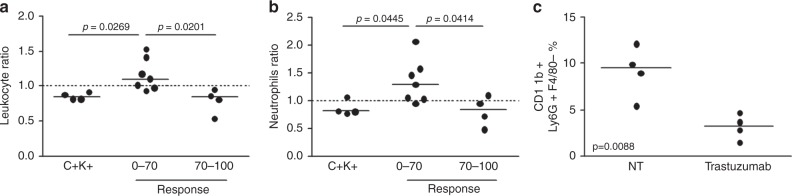
BACKGROUND: Optimising the selection of HER2-targeted regimens by identifying subsets of HER2-positive breast cancer (BC) patients who need more or less therapy remains challenging. We analysed BC samples before and after treatment with 1 cycle of trastuzumab according to the response to trastuzumab. METHODS: Gene expression profiles of pre- and post-treatment tumour samples from 17 HER2-positive BC patients were analysed on the Illumina platform. Tumour-associated immune pathways and blood counts were analysed with regard to the response to trastuzumab. HER2-positive murine models with differential responses to trastuzumab were used to reproduce and better characterise these data. RESULTS: Patients who responded to single-agent trastuzumab had basal tumour biopsies that were enriched in immune pathways, particularly the MHC-II metagene. One cycle of trastuzumab modulated the expression levels of MHC-II genes, which increased in patients who had a complete response on treatment with trastuzumab and chemotherapy. Trastuzumab increased the MHC-II-positive cell population, primarily macrophages, only in the tumour microenvironment of responsive mice. In patients who benefited from complete trastuzumab therapy and in mice that harboured responsive tumours circulating neutrophil levels declined, but this cell subset rose in nonresponsive tumours. CONCLUSIONS: Short treatment with trastuzumab induces local and systemic immunomodulation that is associated with clinical outcomes.
Overview
The claims and statistics of this paper haven’t been checked yet.
Free: it reads the open-access text and checks the first 5 claims that cite a source we can check. Create a free account to check every claim.
Integrity signals
Registry
Cites
Statistics
Figures
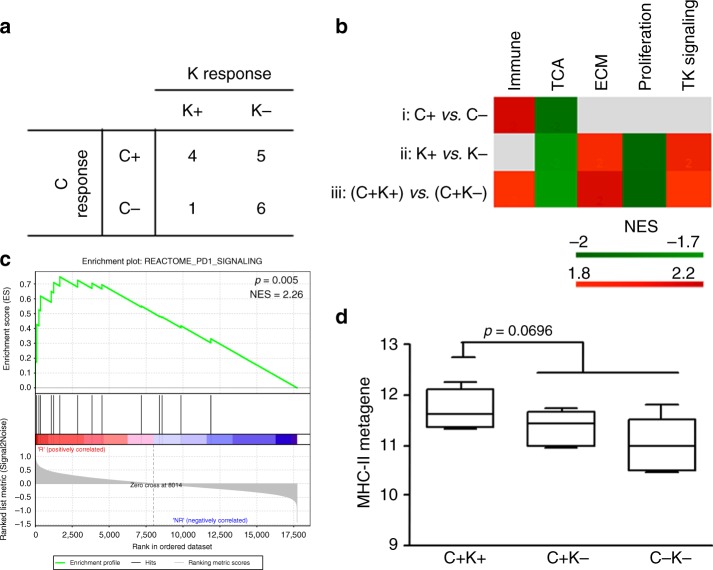
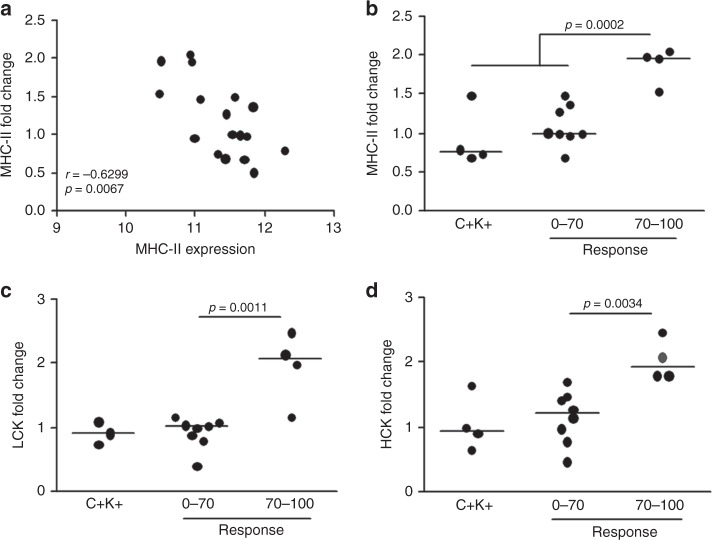
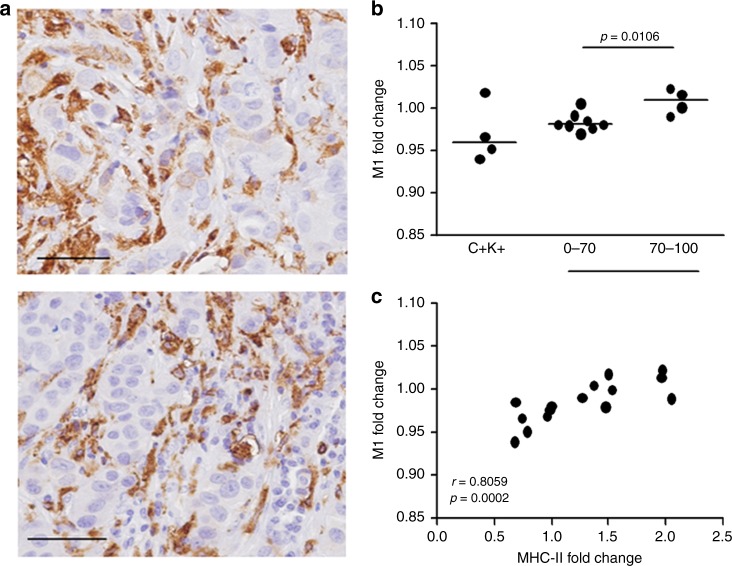
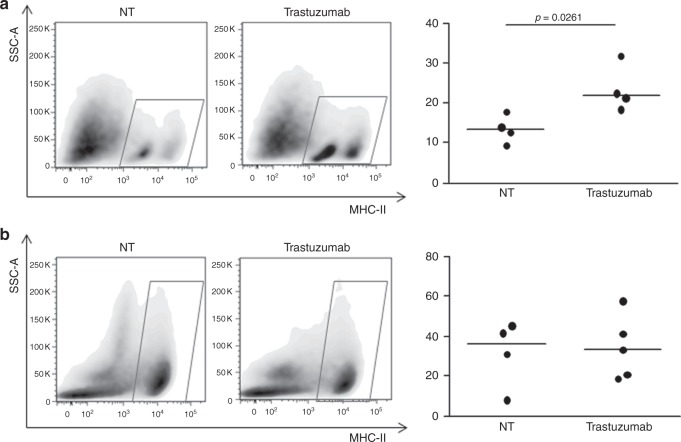
Verification
Claims the paper makes
The claims and statistics of this paper haven’t been checked yet.
Free: it reads the open-access text and checks the first 5 claims that cite a source we can check. Create a free account to check every claim.
Claims other papers make about this one
Each is checked against this paper’s own text: does it say what the citing paper says it does?
In the citing paper
“tation on MHC class I and II molecules (Kono et al., 2004; Triulzi et al., 2018), as well as MYD88 innate immune signal transduction adaptor (MYD88)-dependent immunostimulation (Stagg et al., 2011), culminating in increased antigen processing and presentation by DCs (Gall et al., 2017).”
From Immunomodulation by targeted anticancer agents (2021) · cites this paper as Triulzi et al., 2018
In the citing paper
“MHC class I and II upregulation in different HER2-overexpressing cancer cells and HER2 + BC biopsies”
From Immunomodulation by targeted anticancer agents (2021) · cites this paper as Triulzi et al., 2018
Self-check
Percentages, sums and reported differences re-computed from the paper’s own numbers.
The self-check needs the paper’s full text.
Citations
Cites
Subramanian, A., Tamayo, P., Mootha, V. K., Mukherjee, S., Ebert, B. L., Gillette, M. A., Paulovich, A., Pomeroy, S. L., Golub, T. R., Lander, E. S., et al. (2005) · Proceedings of the National Academy of Sciences · doi:10.1073/pnas.0506580102 · Cited by 53,625
Robust enumeration of cell subsets from tissue expression profiles
Newman, A. M., Liu, C. L., Green, M. R., Gentles, A. J., Feng, W., Xu, Y., Hoang, C. D., Diehn, M., & Alizadeh, A. A. (2015) · Nature Methods · doi:10.1038/nmeth.3337 · Cited by 13,224
Adjuvant Trastuzumab in HER2-Positive Breast Cancer
Slamon, D., Eiermann, W., Robert, N., Pienkowski, T., Martin, M., Press, M., Mackey, J., Glaspy, J., Chan, A., Pawlicki, M., et al. (2011) · New England Journal of Medicine · doi:10.1056/nejmoa0910383 · Cited by 2,775 · cited 1×
“Treatment with trastuzumab and chemotherapy has dramatically changed the prognosis of early and advanced HER2-positive (HER2+) BC patients.(1) More recently, the introduction and availability of other HER2-targeting agents offer clinicians the ability to provide prolonged inhibition of HER2 signalling across multiple…”
BackgroundGianni, L., Pienkowski, T., Im, Y.-H., Roman, L., Tseng, L.-M., Liu, M.-C., Lluch, A., Staroslawska, E., de la Haba-Rodriguez, J., Im, S.-A., et al. (2012) · The Lancet Oncology · doi:10.1016/s1470-2045(11)70336-9 · Cited by 2,374
Adjuvant Pertuzumab and Trastuzumab in Early HER2-Positive Breast Cancer
von Minckwitz, G., Procter, M., de Azambuja, E., Zardavas, D., Benyunes, M., Viale, G., Suter, T., Arahmani, A., Rouchet, N., Clark, E., et al. (2017) · New England Journal of Medicine · doi:10.1056/nejmoa1703643 · Cited by 1,411
Arginase: an emerging key player in the mammalian immune system
Munder, M. (2009) · British Journal of Pharmacology · doi:10.1111/j.1476-5381.2009.00291.x · Cited by 694
The therapeutic effect of anti-HER2/neu antibody depends on both innate and adaptive immunity
Park, S., Jiang, Z., Mortenson, E. D., Deng, L., Radkevich-Brown, O., Yang, X., Sattar, H., Wang, Y., Brown, N. K., Greene, M., et al. (2010) · Cancer Cell · doi:10.1016/j.ccr.2010.06.014 · Cited by 577
Arnould, L., Gelly, M., Penault-Llorca, F., Benoit, L., Bonnetain, F., Migeon, C., Cabaret, V, Fermeaux, V, Bertheau, P., Garnier, J., et al. (2006) · British Journal of Cancer · doi:10.1038/sj.bjc.6602930 · Cited by 545
Myeloid-Derived Suppressor Cells Hinder the Anti-Cancer Activity of Immune Checkpoint Inhibitors
Weber, R., Fleming, V., Hu, X., Nagibin, V., Groth, C., Altevogt, P., Utikal, J., & Umansky, V. (2018) · Frontiers in Immunology · doi:10.3389/fimmu.2018.01310 · Cited by 538
Gennari, R., Menard, S., Fagnoni, F., Ponchio, L., Scelsi, M., Tagliabue, E., Castiglioni, F., Villani, L., Magalotti, C., Gibelli, N., et al. (2004) · Clinical Cancer Research · doi:10.1158/1078-0432.ccr-04-0225 · Cited by 516
Self-citationStagg, J., Loi, S., Divisekera, U., Ngiow, S. F., Duret, H., Yagita, H., Teng, M. W., & Smyth, M. J. (2011) · Proceedings of the National Academy of Sciences · doi:10.1073/pnas.1016569108 · Cited by 496
Rody, A., Holtrich, U., Pusztai, L., Liedtke, C., Gaetje, R., Ruckhaeberle, E., Solbach, C., Hanker, L., Ahr, A., Metzler, D., et al. (2009) · Breast Cancer Research · doi:10.1186/bcr2234 · Cited by 460
Neutrophils in Cancer: Two Sides of the Same Coin
Uribe-Querol, E., & Rosales, C. (2015) · Journal of Immunology Research · doi:10.1155/2015/983698 · Cited by 422
Natural and therapy-induced immunosurveillance in breast cancer
Kroemer, G., Senovilla, L., Galluzzi, L., André, F., & Zitvogel, L. (2015) · Nature Medicine · doi:10.1038/nm.3944 · Cited by 310 · cited 1×
“tissues, supporting that its clinical activity is based on its immunostimulatory effects.(9) In this study, we analysed the gene expression profile of tumour biopsies from the TRastuzumab UPfront in HER2+ locally advanced BC (TRUP) window-of-opportunity trial(10) before and after brief exposure to trastuzumab.”
BackgroundTumor-associated macrophages in breast cancer: distinct subsets, distinct functions
Laoui, D., Movahedi, K., Van Overmeire, E., Van den Bossche, J., Schouppe, E., Mommer, C., Nikolaou, A., Morias, Y., De Baetselier, P., & Van Ginderachter, J. A. (2011) · The International Journal of Developmental Biology · doi:10.1387/ijdb.113371dl · Cited by 304
The macrophage and the apoptotic cell: an innate immune interaction viewed simplistically?
Gregory, C. D., & Devitt, A. (2004) · Immunology · doi:10.1111/j.1365-2567.2004.01959.x · Cited by 285
Neoadjuvant Trastuzumab Induces Apoptosis in Primary Breast Cancers
Mohsin, S. K., Weiss, H. L., Gutierrez, M. C., Chamness, G. C., Schiff, R., DiGiovanna, M. P., Wang, C.-X., Hilsenbeck, S. G., Osborne, C. K., Allred, D. C., et al. (2005) · Journal of Clinical Oncology · doi:10.1200/jco.2005.00.661 · Cited by 244
Shi, Y., Fan, X., Deng, H., Brezski, R. J., Rycyzyn, M., Jordan, R. E., Strohl, W. R., Zou, Q., Zhang, N., & An, Z. (2015) · The Journal of Immunology · doi:10.4049/jimmunol.1402891 · Cited by 195
Neutrophils mediate antibody-induced antitumor effects in mice
Albanesi, M., Mancardi, D. A., Jönsson, F., Iannascoli, B., Fiette, L., Di Santo, J. P., Lowell, C. A., & Bruhns, P. (2013) · Blood · doi:10.1182/blood-2013-04-497446 · Cited by 150
Targeting myeloid cells in the tumor sustaining microenvironment
Schupp, J., Krebs, F. K., Zimmer, N., Trzeciak, E., Schuppan, D., & Tuettenberg, A. (2019) · Cellular Immunology · doi:10.1016/j.cellimm.2017.10.013 · Cited by 126
Varadan, V., Gilmore, H., Miskimen, K. L. S., Tuck, D., Parsai, S., Awadallah, A., Krop, I. E., Winer, E. P., Bossuyt, V., Somlo, G., et al. (2016) · Clinical Cancer Research · doi:10.1158/1078-0432.ccr-15-2021 · Cited by 119
Ravo, M., Mutarelli, M., Ferraro, L., Grober, O. M. V., Paris, O., Tarallo, R., Vigilante, A., Cimino, D., Bortoli, M. D., Nola, E., et al. (2008) · Laboratory Investigation · doi:10.1038/labinvest.2008.11 · Cited by 86
Activated d16HER2 Homodimers and SRC Kinase Mediate Optimal Efficacy for Trastuzumab
Castagnoli, L., Iezzi, M., Ghedini, G. C., Ciravolo, V., Marzano, G., Lamolinara, A., Zappasodi, R., Gasparini, P., Campiglio, M., Amici, A., et al. (2014) · Cancer Research · doi:10.1158/0008-5472.can-14-0983 · Cited by 82
Self-citationDatta, J., Berk, E., Xu, S., Fitzpatrick, E., Rosemblit, C., Lowenfeld, L., Goodman, N. G., Lewis, D. A., Zhang, P. J., Fisher, C. S., et al. (2015) · Breast Cancer Research · doi:10.1186/s13058-015-0584-1 · Cited by 74
Effective anti-neu-initiated antitumor responses require the complex role of CD4+ T cells
Mortenson, E. D., Park, S., Jiang, Z., Wang, S., & Fu, Y.-X. (2013) · Clinical Cancer Research · doi:10.1158/1078-0432.ccr-12-2522 · Cited by 66 · cited 1×
“They act as antigen-presenting cells to CD4+ T cells, which are crucial for trastuzumab activity.(24) The similar modulation of the LCK and HCK metagenes, reflecting the infiltration of T cells and monocytes,(13) indicates that trastuzumab is active in tumours in which the entire immune system cycle is stimulated or i…”
BackgroundLoi, S., Giobbe-Hurder, A., Gombos, A., Bachelot, T., Hui, R., Curigliano, G., Campone, M., Biganzoli, L., Bonnefoi, H., Jérusalem, G., et al. (2018) · Cancer Research · doi:10.1158/1538-7445.sabcs17-gs2-06 · Cited by 49 · cited 1×
“Because the number of MDSCs modulates the activity of immune checkpoint inhibitors,(29) evaluating the function of neutrophils in the response to trastuzumab could guide the development of new combinations of trastuzumab and anti-PD-L1 drugs, a promising approach for HER2+ tumours that has been demonstrated in preclin…”
BackgroundTaxanes enhance trastuzumab-mediated ADCC on tumor cells through NKG2D-mediated NK cell recognition
Di Modica, M., Sfondrini, L., Regondi, V., Varchetta, S., Oliviero, B., Mariani, G., Bianchi, G. V., Generali, D., Balsari, A., Triulzi, T., et al. (2016) · Oncotarget · doi:10.18632/oncotarget.6353 · Cited by 47
Self-citationNoci, V. L., Tortoreto, M., Gulino, A., Storti, C., Bianchi, F., Zaffaroni, N., Tripodo, C., Tagliabue, E., Balsari, A., & Sfondrini, L. (2015) · OncoImmunology · doi:10.1080/2162402x.2015.1040214 · Cited by 46
Self-citationCastagnoli, L., Ghedini, G. C., Koschorke, A., Triulzi, T., Dugo, M., Gasparini, P., Casalini, P., Palladini, A., Iezzi, M., Lamolinara, A., et al. (2017) · Oncogene · doi:10.1038/onc.2016.338 · Cited by 45
Self-citationPlantamura, I., Casalini, P., Dugnani, E., Sasso, M., D’Ippolito, E., Tortoreto, M., Cacciatore, M., Guarnotta, C., Ghirelli, C., Barajon, I., et al. (2014) · Molecular Oncology · doi:10.1016/j.molonc.2014.03.015 · Cited by 41
Self-citationPredicting the Efficacy of HER2-Targeted Therapies: A Look at the Host
Modica, M. D., Tagliabue, E., & Triulzi, T. (2017) · Disease Markers · doi:10.1155/2017/7849108 · Cited by 39
Self-citationActivity and resistance of trastuzumab according to different clinical settings
Tagliabue, E., Campiglio, M., Pupa, S. M., Ménard, S., & Balsari, A. (2011) · Cancer Treatment Reviews · doi:10.1016/j.ctrv.2011.06.002 · Cited by 38
Self-citationVaccines against human HER2 prevent mammary carcinoma in mice transgenic for human HER2
Giovanni, C. D., Nicoletti, G., Quaglino, E., Landuzzi, L., Palladini, A., Ianzano, M. L., Dall’Ora, M., Grosso, V., Ranieri, D., Laranga, R., et al. (2014) · Breast Cancer Research · doi:10.1186/bcr3602 · Cited by 36
Self-citationPredictive Biomarkers in the Treatment of Her2-Positive Breast Cancer: An Ongoing Challenge
Triulzi, T., Bianchi, G., & Tagliabue, E. (2016) · Future Oncology · doi:10.2217/fon-2015-0025 · Cited by 35
Self-citationKoukourakis, M. I., Giatromanolaki, A. N., Bottini, A., Cappelletti, M., Zanotti, L., Allevi, G., Strina, C., Ardine, M., Milani, M., Brugnoli, G., et al. (2014) · British Journal of Cancer · doi:10.1038/bjc.2014.196 · Cited by 23
Self-citationThe HER2 World: Better Treatment Selection for Better Outcome
Tagliabue, E., Campiglio, M., Pupa, S. M., Balsari, A., & Ménard, S. (2011) · JNCI Monographs · doi:10.1093/jncimonographs/lgr041 · Cited by 8
Self-citation
Cited by
The KEYNOTE-811 trial of dual PD-1 and HER2 blockade in HER2-positive gastric cancer
Janjigian, Y. Y., Kawazoe, A., Yañez, P., Li, N., Lonardi, S., Kolesnik, O., Barajas, O., Bai, Y., Shen, L., Tang, Y., et al. (2021) · Nature · doi:10.1038/s41586-021-04161-3 · Cited by 720
Immunomodulation by targeted anticancer agents
Petroni, G., Buqué, A., Zitvogel, L., Kroemer, G., & Galluzzi, L. (2021) · Cancer Cell · doi:10.1016/j.ccell.2020.11.009 · Cited by 212
Gut Microbiota Condition the Therapeutic Efficacy of Trastuzumab in HER2-Positive Breast Cancer
Di Modica, M., Gargari, G., Regondi, V., Bonizzi, A., Arioli, S., Belmonte, B., De Cecco, L., Fasano, E., Bianchi, F., Bertolotti, A., et al. (2021) · Cancer Research · doi:10.1158/0008-5472.can-20-1659 · Cited by 184
“These modifications of the tumor immune microenvironment induced by the alteration of the gut microbiota, rather than its impact on tumor growth (39), are likely to be the reason for a reduced response to trastuzumab treatment, as tumor proliferation has never been associated with the efficacy of anti-HER2 monotherapy…”
BackgroundSelf-citationTargeting oncogene and non-oncogene addiction to inflame the tumour microenvironment
Petroni, G., Buqué, A., Coussens, L. M., & Galluzzi, L. (2022) · Nature Reviews Drug Discovery · doi:10.1038/s41573-022-00415-5 · Cited by 160
Bugide, S., Gupta, R., Green, M. R., & Wajapeyee, N. (2021) · Proceedings of the National Academy of Sciences · doi:10.1073/pnas.2102718118 · Cited by 90
Metadata
- Authors
- Triulzi, T., Regondi, V., De Cecco, L., Cappelletti, M. R., Di Modica, M., Paolini, B., Lollini, P. L., Di Cosimo, S., Sfondrini, L., Generali, D., & Tagliabue, E.
- Affiliations
- Fondazione IRCCS Istituto Nazionale dei Tumori (IT)
- Azienda Socio Sanitaria Territoriale di Cremona (IT)
- University of Bologna (IT)
- University of Milan (IT)
- University of Trieste (IT)
- Corresponding author
- Tagliabue, Elda
- ORCID
- Venue
- British Journal of Cancer
- Published
- 2018-11-27
- Volume
- 119
- Issue
- 12
- Pages
- 1487-1494
- ISSN
- 0007-0920 (ISSN-L)
- 1532-1827
- PMC
- PMC6288086
- OpenAlex
- W2900717255
- Cited by
- 94
- References
- 36
- Citations by year
- 2026: 3 · 2025: 6 · 2024: 8 · 2023: 7 · 2022: 9 · 2021: 16 · 2020: 44 · 2019: 1
- FWCI
- 5.72
- Type
- journal article
- Language
- en
- Open access
- hybrid
- doi.org
- Licence
- cc-by
- creativecommons.org/licenses/by/4.0 (tdm)
- Locations
- British Journal of Cancer (publishedVersion, cc-by)
- Europe PMC (PubMed Central) (publishedVersion, cc-by)
- PubMed Central (publishedVersion, cc-by)
- PubMed (publishedVersion)
- ArTS Archivio della ricerca di Trieste (University of Trieste https://www.units.it/) (submittedVersion, cc-by)
- Archivio Istituzionale della Ricerca (Universita Degli Studi Di Milano) (submittedVersion, other-oa)
- Archivio istituzionale della ricerca (Alma Mater Studiorum Università di Bologna) (submittedVersion, other-oa)
- Funders
- Associazione Italiana per la Ricerca sul Cancro
- Topics
- Health Sciences › Medicine › Oncology › HER2/EGFR in Cancer Research
- Health Sciences › Medicine › Oncology › Cancer Immunotherapy and Biomarkers
- Life Sciences › Biochemistry, Genetics and Molecular Biology › Cancer Research › Breast Cancer Treatment Studies
- Keywords
- trastuzumab, HER2-positive breast cancer, immunomodulation, MHC class II, tumor microenvironment, macrophages, neutrophils, treatment response prediction, gene expression profiling
- MeSH terms
- Trastuzumab, Antineoplastic Agents, Immunological, Animals, Breast Neoplasms, Female, Genes, MHC Class II, Humans, Immunologic Factors, Erb-b2 Receptor Tyrosine Kinases, Ki-67 Antigen, Mice, Tumor Microenvironment, Transcriptome
About these checks
Registry, retraction, Cites and statistics results are computed, not judged, with one exception: a printed reference that no index lists is read once by a model before it counts as a citation error. Claims are extracted by a model and kept only when their quote appears verbatim in the text; each cited source is then checked, with a model’s help, for whether it says what the claim relies on. Those verdicts can be wrong — read the claim’s quote and the cited source before relying on one.
Statistics and arithmetic are recomputed, not judged.
Confidence bands are shown only for fields calibrated on our annotated test set. None is calibrated yet, so no band is shown.
What counts as a claim ›How we measure confidence ›How we check this ›
Are you an author, or do you see a problem with this page? Request a review
Data sources
Bibliographic data: Semantic Scholar, OpenAlex, Crossref.
Contains information from the Semantic Scholar Academic Graph Datasets, made available under the ODC Attribution License (ODC-BY 1.0).
Semantic Scholar’s data is described in: Kinney, R., et al. (2023). The Semantic Scholar Open Data Platform. arXiv:2301.10140.
