

AMG-232 sensitizes high MDM2-expressing tumor cells to T-cell-mediated killing
Open accessThe DOI matches its Crossref record; 21 of the 21 references it cites were found in a registry or an index.
Abstract
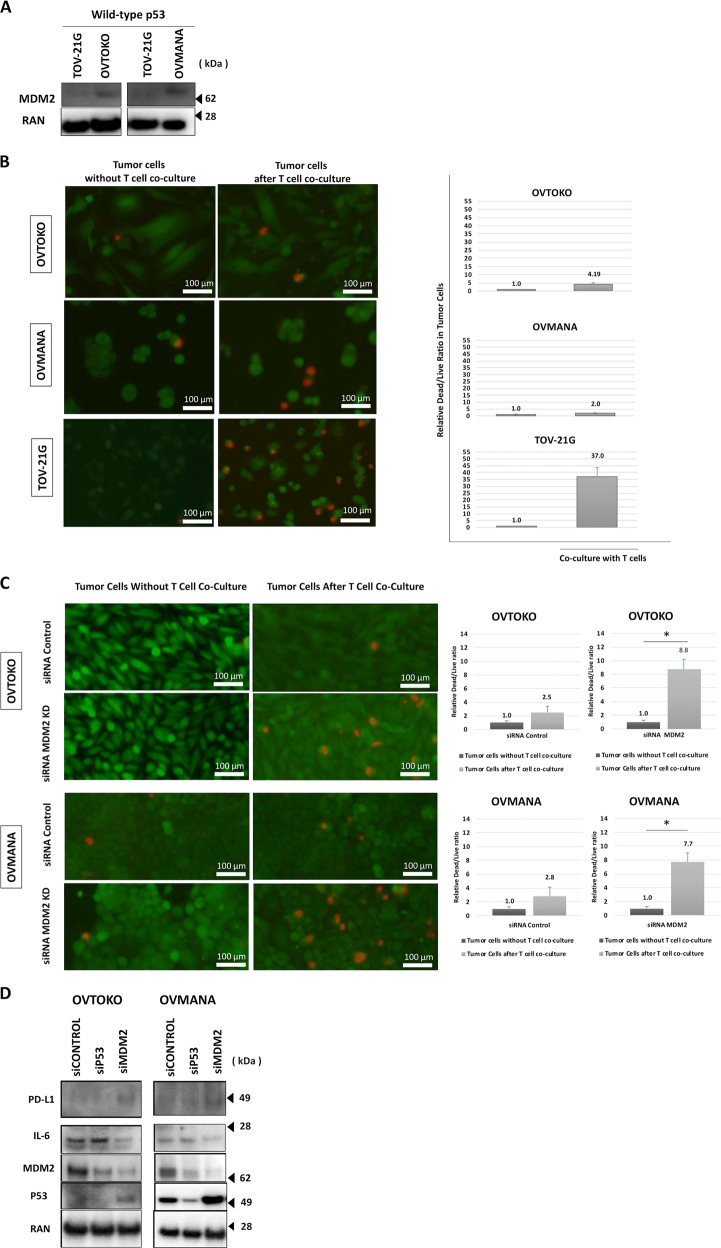
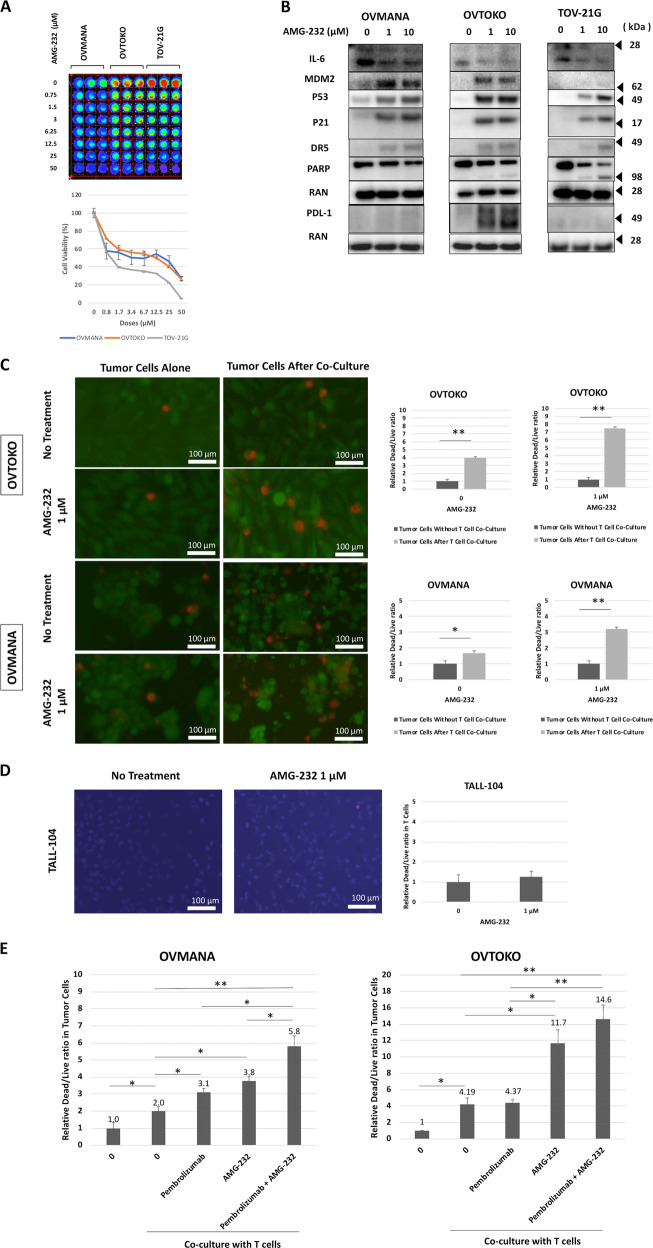
Oncogenic mouse double minute 2 homolog (MDM2) is an E3-ubiquitin ligase that facilitates proteasomal degradation of p53. MDM2 amplification occurs in cancer and has been implicated in accelerated tumor growth, known as hyper-progression, following immune-checkpoint therapy. MDM2 amplification also predicts poor response to immune-checkpoint inhibitors. We sought to evaluate the role of MDM2 in T-cell-mediated immune resistance. Ovarian clear cell carcinoma cell lines carrying wild-type p53 with low/high MDM2 expression were investigated in a T-cell co-culture system evaluating T-cell-mediated tumor killing. Targeting of MDM2 was achieved by siRNA transfection or a selective MDM2 inhibitor, AMG-232 and tumor cells were tested in the T-cell co-culture system. AMG-232 activated p53 signaling in cancer cells and relative resistance to AMG-232 was observed in high MDM2-expressing cell lines. Cell lines with high MDM2 expression were more resistant to T cell-mediated tumor killing. Targeting MDM2 by gene-silencing or pharmacological blockade with AMG-232 enhanced T-cell killing of cancer cells. AMG-232 potentiated tumor cell killing by T-cells in combination with anti-PD-1 antibody treatment, regardless of changes in PD-L1 expression. The AMG-232 was not toxic to the T-cells. MDM2 inhibition lowered expression of Interleukin-6, a pro-inflammatory pro-tumorigenic cytokine. Our data support targeting MDM2 in tumors with overexpression or amplification of MDM2 as a precision therapy approach to overcome drug resistance including hyper-progression in the context of immune checkpoint therapy.
Overview
The claims and statistics of this paper haven’t been checked yet.
Free: it reads the open-access text and checks the first 5 claims that cite a source we can check. Create a free account to check every claim.
Integrity signals
Registry
Cites
Statistics
Figures
Verification
Claims the paper makes
The claims and statistics of this paper haven’t been checked yet.
Free: it reads the open-access text and checks the first 5 claims that cite a source we can check. Create a free account to check every claim.
Claims other papers make about this one
Each is checked against this paper’s own text: does it say what the citing paper says it does?
The cited source says what the claim attributes to it.
In the citing paper
“Additional immunostimulatory effects linked to pharmacological p53 reactivation in cancer cells include (but are not limited to) (1) downregulation of immunomodulatory cytokines linked to tumor progression, such as IL6 (Sahin et al., 2020); (2) upregulation of NKALs (Textor et al., 2011); and (3) establishment of cellular senescence linked to an immunostimulatory SASP that favors the recruitment”
From Immunomodulation by targeted anticancer agents (2021) · cites this paper as Sahin et al., 2020
In the citing paper
“AMG232, in combination with immune checkpoint drugs, also enhances T-cell-mediated tumor killing.352”
From Targeting p53 pathways: mechanisms, structures, and advances in therapy (2023) · cites this paper as [352]
Self-check
Percentages, sums and reported differences re-computed from the paper’s own numbers.
The self-check needs the paper’s full text.
Citations
Cites
Primary, Adaptive, and Acquired Resistance to Cancer Immunotherapy
Sharma, P., Hu-Lieskovan, S., Wargo, J. A., & Ribas, A. (2017) · Cell · doi:10.1016/j.cell.2017.01.017 · Cited by 5,588
PD-1 + regulatory T cells amplified by PD-1 blockade promote hyperprogression of cancer
Kamada, T., Togashi, Y., Tay, C., Ha, D., Sasaki, A., Nakamura, Y., Sato, E., Fukuoka, S., Tada, Y., Tanaka, A., et al. (2019) · Proceedings of the National Academy of Sciences · doi:10.1073/pnas.1822001116 · Cited by 1,008
(2017) · doi:10.1158/1078-0432.ccr-16-3133 · Cited by 831
PDL1 Regulation by p53 via miR-34
Cortez, M. A., Ivan, C., Valdecanas, D., Wang, X., Peltier, H. J., Ye, Y., Araujo, L., Carbone, D. P., Shilo, K., Giri, D. K., et al. (2016) · JNCI: Journal of the National Cancer Institute · doi:10.1093/jnci/djv303 · Cited by 683
Emerging roles of p53 and other tumour-suppressor genes in immune regulation
Muñoz-Fontela, C., Mandinova, A., Aaronson, S. A., & Lee, S. W. (2016) · Nature Reviews Immunology · doi:10.1038/nri.2016.99 · Cited by 341
Type-Specific Cell Line Models for Type-Specific Ovarian Cancer Research
Anglesio, M. S., Wiegand, K. C., Melnyk, N., Chow, C., Salamanca, C., Prentice, L. M., Senz, J., Yang, W., Spillman, M. A., Cochrane, D. R., et al. (2013) · PLoS ONE · doi:10.1371/journal.pone.0072162 · Cited by 253
USP15 stabilizes MDM2 to mediate cancer-cell survival and inhibit antitumor T cell responses
Zou, Q., Jin, J., Hu, H., Li, H. S., Romano, S., Xiao, Y., Nakaya, M., Zhou, X., Cheng, X., Yang, P., et al. (2014) · Nature Immunology · doi:10.1038/ni.2885 · Cited by 247
Mechanisms of chemoresistance and poor prognosis in ovarian clear cell carcinoma
Itamochi, H., Kigawa, J., & Terakawa, N. (2008) · Cancer Science · doi:10.1111/j.1349-7006.2008.00747.x · Cited by 237
The role of MDM2 amplification and overexpression in therapeutic resistance of malignant tumors
Hou, H., Sun, D., & Zhang, X. (2019) · Cancer Cell International · doi:10.1186/s12935-019-0937-4 · Cited by 231
Control of signaling-mediated clearance of apoptotic cells by the tumor suppressor p53
Yoon, K. W., Byun, S., Kwon, E., Hwang, S.-Y., Chu, K., Hiraki, M., Jo, S.-H., Weins, A., Hakroush, S., Cebulla, A., et al. (2015) · Science · doi:10.1126/science.1261669 · Cited by 224
Cited by
Targeting p53 pathways: mechanisms, structures, and advances in therapy
Wang, H., Guo, M., Wei, H., & Chen, Y. (2023) · Signal Transduction and Targeted Therapy · doi:10.1038/s41392-023-01347-1 · Cited by 1,016
Tumor suppressor p53: Biology, signaling pathways, and therapeutic targeting
Hernández Borrero, L. J., & El-Deiry, W. S. (2021) · Biochimica et Biophysica Acta (BBA) - Reviews on Cancer · doi:10.1016/j.bbcan.2021.188556 · Cited by 748
Self-citationMechanisms of drug resistance in HCC
Ladd, A. D., Duarte, S., Sahin, I., & Zarrinpar, A. (2024) · Hepatology · doi:10.1097/hep.0000000000000237 · Cited by 363
Zhu, H., Gao, H., Ji, Y., Zhou, Q., Du, Z., Tian, L., Jiang, Y., Yao, K., & Zhou, Z. (2022) · Journal of Hematology & Oncology · doi:10.1186/s13045-022-01314-3 · Cited by 223
Immunomodulation by targeted anticancer agents
Petroni, G., Buqué, A., Zitvogel, L., Kroemer, G., & Galluzzi, L. (2021) · Cancer Cell · doi:10.1016/j.ccell.2020.11.009 · Cited by 212
MDM2 Inhibitors for Cancer Therapy: The Past, Present, and Future
Wang, W., Albadari, N. G., Du, Y., Fowler, J. F., Sang, H. T., Xian, W., McKeon, F., Li, W., Zhou, J., & Zhang, R. (2024) · Pharmacological Reviews · doi:10.1124/pharmrev.123.001026 · Cited by 173
Zhou, X., Singh, M., Sanz Santos, G., Guerlavais, V., Carvajal, L. A., Aivado, M., Zhan, Y., Oliveira, M. M. S., Westerberg, L. S., Annis, D. A., et al. (2021) · Cancer Discovery · doi:10.1158/2159-8290.cd-20-1741 · Cited by 169
Targeting oncogene and non-oncogene addiction to inflame the tumour microenvironment
Petroni, G., Buqué, A., Coussens, L. M., & Galluzzi, L. (2022) · Nature Reviews Drug Discovery · doi:10.1038/s41573-022-00415-5 · Cited by 160
Therapeutics targeting p53-MDM2 interaction to induce cancer cell death
Koo, N., Sharma, A. K., & Narayan, S. (2022) · International Journal of Molecular Sciences · doi:10.3390/ijms23095005 · Cited by 153
The DNA Damage Response and Inflammation in Cancer
Klapp, V., Álvarez-Abril, B., Leuzzi, G., Kroemer, G., Ciccia, A., & Galluzzi, L. (2023) · Cancer Discovery · doi:10.1158/2159-8290.cd-22-1220 · Cited by 123
Dugage, M. R., Nassif, E. F., Italiano, A., & Bahleda, R. (2021) · Frontiers in Immunology · doi:10.3389/fimmu.2021.775761 · Cited by 106
Targeting ubiquitin signaling for cancer immunotherapy
Zhou, X., & Sun, S. (2021) · Signal Transduction and Targeted Therapy · doi:10.1038/s41392-020-00421-2 · Cited by 100
MDM2: current research status and prospects of tumor treatment
Yao, Y., Zhang, Q., Li, Z., & Zhang, H. (2024) · Cancer Cell International · doi:10.1186/s12935-024-03356-8 · Cited by 83
Current Understanding on Why Ovarian Cancer Is Resistant to Immune Checkpoint Inhibitors
Pawłowska, A., Rekowska, A. K., Kuryło, W., Pańczyszyn, A., Kotarski, J., & Wertel, I. (2023) · International Journal of Molecular Sciences · doi:10.3390/ijms241310859 · Cited by 79
Hároníková, L., Bonczek, O., Zatloukalová, P., Kokas, F. Z., Kucerikova, M., Coates, P. J., Fåhræus, R., & Vojtěšek, B. (2021) · Cellular & Molecular Biology Letters · doi:10.1186/s11658-021-00293-6 · Cited by 76
Ubiquitin proteasome system in immune regulation and therapeutics
Bhat, S. A., Vasi, Z., Adhikari, R., Gudur, A., Ali, A., Jiang, L., Ferguson, R., Liang, D., & Kuchay, S. (2022) · Current Opinion in Pharmacology · doi:10.1016/j.coph.2022.102310 · Cited by 76
Liu, S., Knochelmann, H. M., Lomeli, S. H., Hong, A., Richardson, M. S., Yang, Z., Lim, R. J., Wang, Y., Dumitras, C., Krysan, K., et al. (2021) · Cell Reports Medicine · doi:10.1016/j.xcrm.2021.100411 · Cited by 67
Protein degradation: expanding the toolbox to restrain cancer drug resistance
Ming, H., Li, B., Jiang, J., Qin, S., Nice, E. C., He, W., Lang, T., & Huang, C. (2023) · Journal of Hematology & Oncology · doi:10.1186/s13045-023-01398-5 · Cited by 66
Ubiquitin–proteasome system as a target for anticancer treatment—an update
Kim, Y. J., Lee, Y., Shin, H. Y., Hwang, S., Park, J., & Song, E. J. (2023) · Archives of Pharmacal Research · doi:10.1007/s12272-023-01455-0 · Cited by 61
Gavali, S., Liu, J., Li, X., & Paolino, M. (2021) · International Journal of Molecular Sciences · doi:10.3390/ijms221910800 · Cited by 59
Potential of E3 Ubiquitin Ligases in Cancer Immunity: Opportunities and Challenges
Ye, P., Chi, X., Cha, J., Luo, S., Yang, G., Yan, X., & Yang, W. (2021) · Cells · doi:10.3390/cells10123309 · Cited by 54
MDM2- an indispensable player in tumorigenesis
Zafar, A., Khan, M. J., & Naeem, A. (2023) · Molecular Biology Reports · doi:10.1007/s11033-023-08512-3 · Cited by 43
A first-in-human phase I study of a novel MDM2/p53 inhibitor alrizomadlin in advanced solid tumors
Zhang, X., Wen, X., Peng, R., Pan, Q., Weng, D., Ma, Y., Zhang, Y., Yang, J., Men, L., Wang, H., et al. (2024) · ESMO Open · doi:10.1016/j.esmoop.2024.103636 · Cited by 41
Targeting PD-1/PD-L1 axis as new horizon for ovarian cancer therapy
Khatoon, E., Parama, D., Kumar, A., Alqahtani, M. S., Abbas, M. A. E., Girisa, S., Sethi, G., & Kunnumakkara, A. B. (2022) · Life Sciences · doi:10.1016/j.lfs.2022.120827 · Cited by 38
You, W., Zhou, Z., Li, Z., Yan, J., & Wang, Y. (2025) · Journal of Pharmaceutical Analysis · doi:10.1016/j.jpha.2025.101322 · Cited by 37
Sun, D., Qian, H., Li, J., & Xing, P. (2024) · Journal of Biomedical Science · doi:10.1186/s12929-024-01004-x · Cited by 33
Zhou, L., Huntington, K. E., Zhang, S., Carlsen, L., So, E. Y., Parker, C., Şahin, İ., Safran, H. P., Kamle, S., Lee, C.-M., et al. (2020) · Oncotarget · doi:10.18632/oncotarget.27799 · Cited by 27
Self-citationMDM2 inhibitors in cancer immunotherapy: Current status and perspective
Zeng, Q., Zeng, S., Dai, X., Ding, Y., Huang, C., Ruan, R., Xiong, J., Tang, X., & Deng, J. (2024) · Genes & Diseases · doi:10.1016/j.gendis.2024.101279 · Cited by 25
Hong, Z., Liu, F., & Zhang, Z. (2024) · Experimental Hematology and Oncology · doi:10.1186/s40164-024-00552-0 · Cited by 25
Liu, L., Xu, Z., Yu, B., Tao, L., & Cao, Y. (2021) · Evidence-based Complementary and Alternative Medicine · doi:10.1155/2021/5517143 · Cited by 23
p53: A player in the tumor microenvironment
Zhao, S., WEN, H., Wang, B., Xiong, Q., Li, L., & Cheng, A. (2025) · Oncology Research Featuring Preclinical and Clinical Cancer Therapeutics · doi:10.32604/or.2025.057317 · Cited by 22
Kono, M., Kumai, T., Hayashi, R., Yamaki, H., Komatsuda, H., Wakisaka, R., Nagato, T., Ohkuri, T., Kosaka, A., Ohara, K., et al. (2021) · Cancer Immunology Immunotherapy · doi:10.1007/s00262-021-02940-5 · Cited by 21
Mechanism underlying the immune checkpoint inhibitor-induced hyper-progressive state of cancer
Ding, P., Wen, L., Tong, F., Zhang, R., Huang, Y., & Dong, X. (2022) · Cancer Drug Resistance · doi:10.20517/cdr.2021.104 · Cited by 20
ACAP1 Deficiency Predicts Inferior Immunotherapy Response in Solid Tumors
Yi, Q., Pu, Y., Chao, F., Bian, P., & Lv, L. (2022) · Cancers · doi:10.3390/cancers14235951 · Cited by 19
Hároníková, L., Zatloukalová, P., Kucerikova, M., Friedlová, N., Tylichová, Z., Kokas, F. Z., Hupp, T. R., Coates, P. J., & Vojtěšek, B. (2024) · Cellular & Molecular Biology Letters · doi:10.1186/s11658-024-00637-y · Cited by 18
Ingelshed, K., Melssen, M. M., Kannan, P., Chandramohan, A., Partridge, A. W., Jiang, L., Wermeling, F., Lane, D. P., Nestor, M., & Spiegelberg, D. (2024) · iScience · doi:10.1016/j.isci.2024.109862 · Cited by 17
Strategies to sensitize cancer cells to immunotherapy
George, A., Şahin, İ., Carneiro, B. A., Dizon, D. S., Safran, H. P., & El‐Deiry, W. S. (2021) · Human Vaccines & Immunotherapeutics · doi:10.1080/21645515.2021.1891817 · Cited by 17
Self-citationWang, M., Zhang, Z., Li, Z., Zhu, Y., & Xu, C. (2023) · Frontiers in Immunology · doi:10.3389/fimmu.2023.1226057 · Cited by 17
Lü, Z., Yang, S., Luo, X., Shi, Y., Lee, J.-S., Deva, S., Liu, T., Chao, Y., Zhang, Y., Huang, R., et al. (2022) · Gastric Cancer · doi:10.1007/s10120-022-01308-7 · Cited by 17
Targeting MDM2-p53 interaction for breast cancer therapy
YOUSUF, A., & Khan, N. U. (2025) · Oncology Research Featuring Preclinical and Clinical Cancer Therapeutics · doi:10.32604/or.2025.058956 · Cited by 17
Zheng, J., Miao, F., Wang, Z., Ma, Y., Lin, Z., Chen, Y., Kong, X., Wang, Y., Zhuang, A., Wu, T., et al. (2023) · Life Sciences · doi:10.1016/j.lfs.2023.121832 · Cited by 17
Sulejmani, O., Grunewald, L., Andersch, L., Schwiebert, S., Klaus, A., Winkler, A., Astrahantseff, K., Eggert, A., Henssen, A. G., Schulte, J. H., et al. (2021) · Cancers · doi:10.3390/cancers13215489 · Cited by 16
Ghotaslou, A., Samii, A., Boustani, H., Ghalesardi, O. K., & Shahidi, M. (2022) · Reports of Biochemistry and Molecular Biology · doi:10.52547/rbmb.11.1.111 · Cited by 15
Zhou, L., Huntington, K. E., Zhang, S., Carlsen, L., So, E. Y., Parker, C., Şahin, İ., Safran, H. P., Kamle, S., Lee, C. M., et al. (2020) · bioRxiv (Cold Spring Harbor Laboratory) · doi:10.1101/2020.08.02.230839 · Cited by 13
Self-citationThe role of E3 ubiquitin ligases and deubiquitinases in bladder cancer development and immunotherapy
Wang, X., Zhang, Y., Wu, Y., Cheng, H., & Wang, X. (2023) · Frontiers in Immunology · doi:10.3389/fimmu.2023.1202633 · Cited by 13
Biomarkers for response to immune checkpoint inhibitors in gastrointestinal cancers
Li, M., Kaili, D., & Shi, L. (2022) · World Journal of Gastrointestinal Oncology · doi:10.4251/wjgo.v14.i1.19 · Cited by 12
Gong, Y., Chen, L., Wang, H., Zheng, D., Li, F., Wu, C., Li, Y., Deng, Y., He, Z., & Yu, C. (2025) · Journal of Experimental & Clinical Cancer Research · doi:10.1186/s13046-025-03400-z · Cited by 12
Zhang, G. (2025) · American Journal of Cancer Research · doi:10.62347/brto3272 · Cited by 12
Hyperprogressive disease: A distinct pattern of progression to immune checkpoint inhibitors
Toki, M. I., Syrigos, N., & Syrigos, K. (2020) · International Journal of Cancer · doi:10.1002/ijc.33429 · Cited by 11
Negri, M., Amatrudo, F., Provvisiero, D. P., Patalano, R., Trinchese, G., Cimmino, F., de Angelis, C., Simeoli, C., Auriemma, R. S., Mollica, M. P., et al. (2025) · Cancer Drug Resistance · doi:10.20517/cdr.2024.193 · Cited by 10
Treatment for ovarian clear cell carcinoma with combined inhibition of WEE1 and ATR
Chien, W., Tyner, J. W., Gery, S., Zheng, Y., Li, L., Pillai, M. S. G., Nam, C., Bhowmick, N. A., Lin, D., & Koeffler, H. P. (2023) · Journal of Ovarian Research · doi:10.1186/s13048-023-01160-y · Cited by 10
Emerging Roles of Non-proteolytic Ubiquitination in Tumorigenesis
Yin, X., Liu, Q., Liu, F., Tian, X., Yan, T., Han, J., & Jiang, S. (2022) · Frontiers in Cell and Developmental Biology · doi:10.3389/fcell.2022.944460 · Cited by 10
Punyamurtula, U., Brown, T. W., Zhang, S., George, A., & El‐Deiry, W. S. (2023) · PubMed Central · Cited by 9
Self-citationMDM2 inhibitors in sarcomas: results and next steps
Tortorelli, I., Napolitano, A., Zhou, Y., Huang, P. H., & Jones, R. L. (2025) · Current Opinion in Oncology · doi:10.1097/cco.0000000000001146 · Cited by 8
Impact of Reactive Oxygen and Nitrogen Species Produced by Plasma on Mdm2–p53 Complex
Attri, P., Kurita, H., Koga, K., & Shiratani, M. (2021) · International Journal of Molecular Sciences · doi:10.3390/ijms22179585 · Cited by 8
Liu, S., Knochelmann, H. M., Lomeli, S. H., Hong, A., Richardson, M., Yang, Z., Lim, R., Wang, Y., Dumitras, C., Krysan, K., et al. (2021) · immuneACCESS · doi:10.21417/sl2021crm · Cited by 7
Qiao, K., Wu, L., Yang, L., Liu, M., Jiang, C., Chen, Y., Zhang, Z., Yu, J., Wei, D., & Xu, Y. (2026) · Experimental Hematology and Oncology · doi:10.1186/s40164-026-00754-8 · Cited by 7
Luo, D., Wang, H., Liu, J., Chen, X., Xu, Y., Liang, Y., Wang, G., Zheng, J., Chen, Y., Wang, X., et al. (2025) · Cancer Letters · doi:10.1016/j.canlet.2025.217500 · Cited by 6
Şahin, İ., George, A., Zhang, S., Huntington, K. E., Ordulu, Z., Zhou, L., & El‐Deiry, W. S. (2021) · Oncotarget · doi:10.18632/oncotarget.28086 · Cited by 5
Self-citationHu, B., Lin, D., Liu, Z., Chen, R., Liu, J., Wu, Y., & Wang, T. (2024) · European journal of medical research · doi:10.1186/s40001-024-02000-5 · Cited by 4
Chemoradiation Reprograms Tumor Cells and the Immune Microenvironment in Cervical Cancer
Sandoval, T. A., Li, Y., Muhammad, N., Desai, T. P., Jayasinghe, R. G., Zeeshan, S., Jayachandran, K., Inkman, M. J., Waters, M. R., Msengi, E. N. S., et al. (2026) · Cancer Research · doi:10.1158/0008-5472.can-25-3776 · Cited by 3
Post-translational modifications in ovarian cancer: implications for immunotherapy: a mini-review
Sun, L., Guo, Y., Duan, C.-C., Chen, C., & Xiao, L. (2025) · Journal of Ovarian Research · doi:10.1186/s13048-025-01812-1 · Cited by 3
Oraibi, A. I., Dawood, A. H., Debbabi, N., Almukram, A. M. A., Almaary, K. S., Dabiellil, F., Ghédira, L. C., & Kilani, S. (2025) · Open Chemistry · doi:10.1515/chem-2025-0142 · Cited by 2
Recent Advancements on the Anti-Tumor Small Molecule Inhibitors Targeting the p53-MDM2 Interaction
丁, 涵. (2023) · Advances in Clinical Medicine · doi:10.12677/acm.2023.1381881 · Cited by 2
Hu, Q., Chen, Y., Zhou, Q., Deng, S., Mu, B., & Tang, J. (2024) · Journal of Cancer · doi:10.7150/jca.93066 · Cited by 2
Li, L., Li, R., Zhan, W., Zhuo, Z., Zhang, J., Li, Q., Mu, S., Chen, W., Li, L., & He, S. (2025) · The FASEB Journal · doi:10.1096/fj.202501953r · Cited by 1
Knipper, K., Bruns, C. J., Popp, F., Schmidt, T., Grothey, B., Quaas, A., & Lyu, S. I. (2025) · BMC Cancer · doi:10.1186/s12885-025-15367-3 · Cited by 1
Nieznanska, A., Statkiewicz, M., Sandowska-Markiewicz, Z., Unrug-Bielawska, K., Majewska, A., Kocik-Krol, J., Czepiel, M., Gałuszka-Bulaga, A., Mikuła, M., Ostrowski, J., et al. (2025) · Biomedicine & Pharmacotherapy · doi:10.1016/j.biopha.2025.118868 · Cited by 1
Current and Future Landscape of Hepatocellular Carcinoma Treatment
Zerehpoosh, S., Tanaka, Y., Al‐Busafi, S. A., Aghayeva, G., Rouabhia, S., Pan, Q., & Eslam, M. (2026) · Oncology Research Featuring Preclinical and Clinical Cancer Therapeutics · doi:10.32604/or.2026.076937 · Cited by 1
Essentiality-driven prediction of anticancer drug responses in preclinical and clinical contexts
Cui, H., Du, X., Guo, H., Liao, Z., Wang, B., Lian, X., Zhang, J.-Y., Xing, L., Zhang, D., Ye, A., et al. (2026) · iScience · doi:10.1016/j.isci.2026.116980
Chien, W., Tyner, J. W., Gery, S., Zheng, Y., Li, L.-Y., Gopinatha Pillai, M. S., Nam, C., Bhowmick, N. A., Lin, D.-C., & Koeffler, H. P. (2023) · Figshare · doi:10.6084/m9.figshare.22679565
Martinkova, L., Zatloukalová, P., Kucerikova, M., Friedlová, N., Tylichová, Z., Zavadil-Kokas, F., Hupp, T. R., Coates, P. J., & Vojtesek, B. (2024) · Figshare · doi:10.6084/m9.figshare.26952316
Mallard, H. J. (2023) · DigitalCommons@UNMC
GÜNGÖRDÜ, Ş. (2025) · Bilecik Şeyh Edebali University Institutional Repository
Zhao, W., Zhang, P., Li, L., Yang, J., Cheng, J., Zhou, W., Zhang, Y., Dong, L., Ding, F., Ji, J., et al. (2026) · Cell Death Discovery · doi:10.1038/s41420-026-03284-8
El‐Deiry, W. S., Ikeda, S., Magidi, S., Bresson, C., Abdel‐Razeq, H., Joshua, A., Hernando‐Calvo, A., Oberoi, A., Hu, Z., Meißner, T., et al. (2026) · Oncotarget · doi:10.18632/oncotarget.28920
Self-citation
Metadata
- Authors
- Sahin, I., Zhang, S., Navaraj, A., Zhou, L., Dizon, D., Safran, H., & El-Deiry, W. S.
- Affiliations
- Brown University (US)
- Venue
- Cell Death Discovery
- Published
- 2020-07-06
- Volume
- 6
- Issue
- 1
- Pages
- 57-57
- ISSN
- 2058-7716 (ISSN-L)
- PMC
- PMC7338458
- OpenAlex
- W3040650435
- Cited by
- 66
- References
- 21
- Citations by year
- 2026: 1 · 2025: 9 · 2024: 11 · 2023: 15 · 2022: 11 · 2021: 14 · 2020: 5
- FWCI
- 4.15
- Type
- journal article
- Language
- en
- Update notices
- correction (2020-08-07)
- Open access
- gold
- doi.org
- Licence
- cc-by
- creativecommons.org/licenses/by/4.0 (tdm)
- creativecommons.org/licenses/by/4.0 (vor)
- Locations
- Cell Death Discovery (publishedVersion, cc-by)
- PubMed Central (publishedVersion, cc-by)
- PubMed (publishedVersion)
- Funders
- Brown University
- University of British Columbia
- Topics
- Health Sciences › Medicine › Oncology › Cancer-related Molecular Pathways
- Health Sciences › Medicine › Oncology › Cancer Immunotherapy and Biomarkers
- Life Sciences › Immunology and Microbiology › Immunology › Immunotherapy and Immune Responses
- Keywords
- MDM2, MDM2 inhibitors, p53 pathway, T cell-mediated tumor killing, ovarian clear cell carcinoma, immune checkpoint therapy, anti-PD-1, interleukin-6, tumor immune resistance, MDM2 amplification
About these checks
Registry, retraction, Cites and statistics results are computed, not judged, with one exception: a printed reference that no index lists is read once by a model before it counts as a citation error. Claims are extracted by a model and kept only when their quote appears verbatim in the text; each cited source is then checked, with a model’s help, for whether it says what the claim relies on. Those verdicts can be wrong — read the claim’s quote and the cited source before relying on one.
Statistics and arithmetic are recomputed, not judged.
Confidence bands are shown only for fields calibrated on our annotated test set. None is calibrated yet, so no band is shown.
What counts as a claim ›How we measure confidence ›How we check this ›
Are you an author, or do you see a problem with this page? Request a review
Data sources
Bibliographic data: Semantic Scholar, OpenAlex, Crossref.
Contains information from the Semantic Scholar Academic Graph Datasets, made available under the ODC Attribution License (ODC-BY 1.0).
Semantic Scholar’s data is described in: Kinney, R., et al. (2023). The Semantic Scholar Open Data Platform. arXiv:2301.10140.
