

The DOI matches its Crossref record; 81 of the 81 references it cites were found in a registry or an index.
Transcriptional response to stress is pre-wired by promoter and enhancer architecture
Open accessAbstract
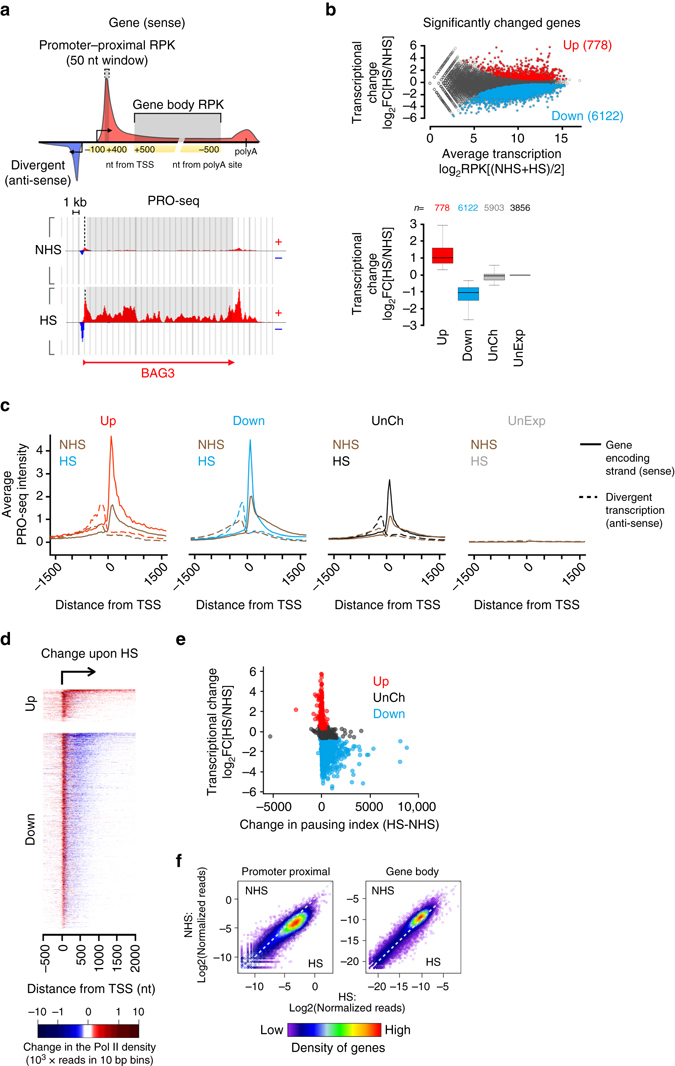
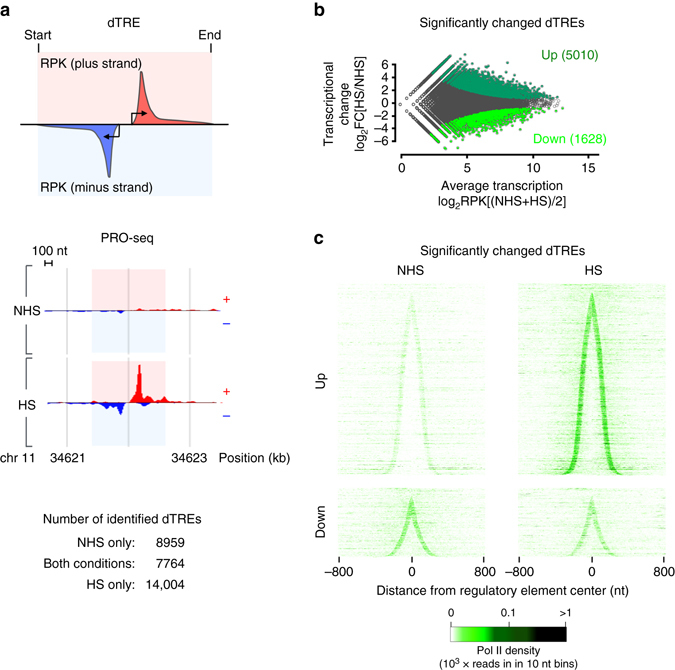
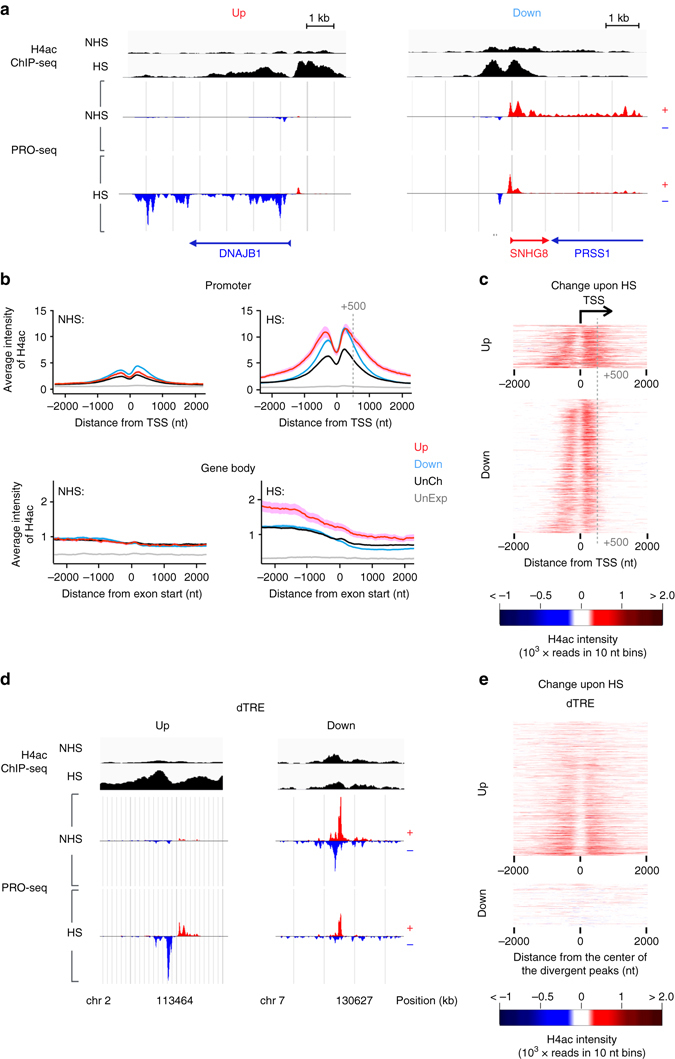
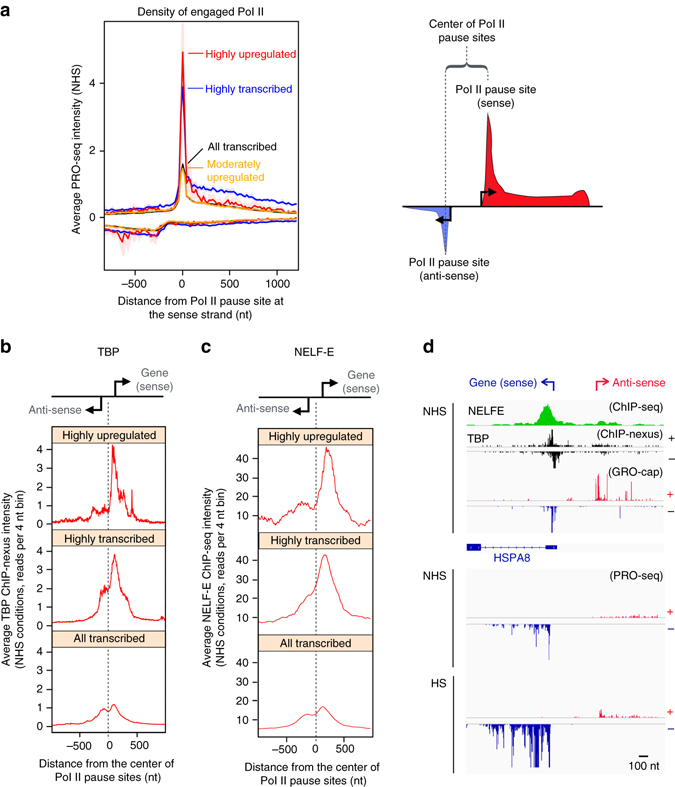
Programs of gene expression are executed by a battery of transcription factors that coordinate divergent transcription from a pair of tightly linked core initiation regions of promoters and enhancers. Here, to investigate how divergent transcription is reprogrammed upon stress, we measured nascent RNA synthesis at nucleotide-resolution, and profiled histone H4 acetylation in human cells. Our results globally show that the release of promoter-proximal paused RNA polymerase into elongation functions as a critical switch at which a gene’s response to stress is determined. Highly transcribed and highly inducible genes display strong transcriptional directionality and selective assembly of general transcription factors on the core sense promoter. Heat-induced transcription at enhancers, instead, correlates with prior binding of cell-type, sequence-specific transcription factors. Activated Heat Shock Factor 1 (HSF1) binds to transcription-primed promoters and enhancers, and CTCF-occupied, non-transcribed chromatin. These results reveal chromatin architectural features that orient transcription at divergent regulatory elements and prime transcriptional responses genome-wide.
Overview
The claims and statistics of this paper haven’t been checked yet.
Run the check — free, no account needed. It reads the open-access text and checks the sources it cites.
Integrity signals
Registry
Cites
Statistics
Figures
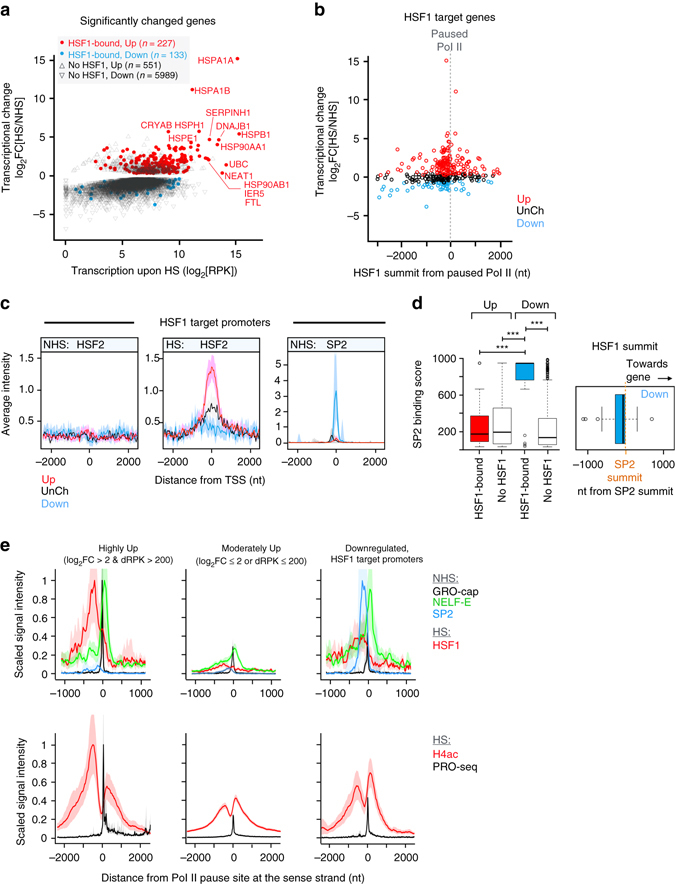
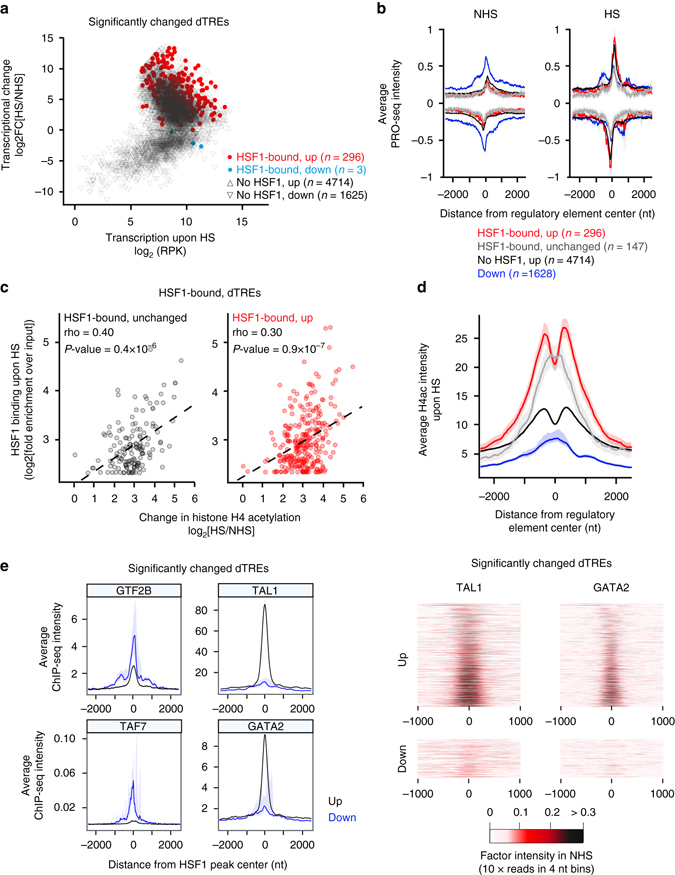
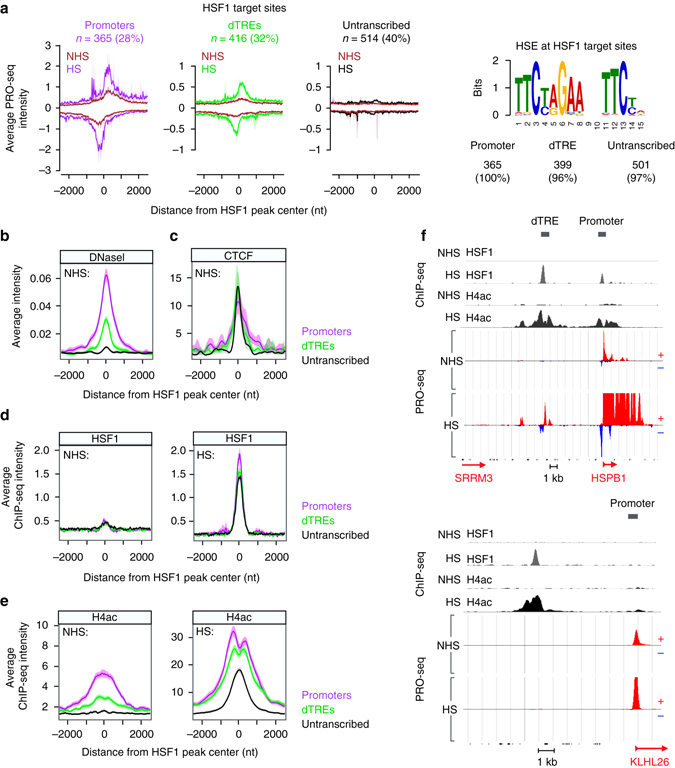
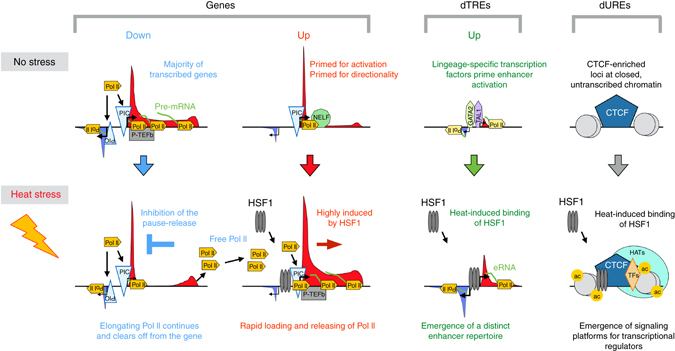
Verification
Claims the paper makes
The claims and statistics of this paper haven’t been checked yet.
Run the check — free, no account needed. It reads the open-access text and checks the sources it cites.
Claims other papers make about this one
Each is checked against this paper’s own text: does it say what the citing paper says it does?
The source backs part of the claim, not all of it — or backs it for a different population, condition or comparison.
In the citing paper
“But even this generality is complicated by the fact that the capacity of an expressed TF to interact with an enhancer may depend on the chromatin state of the region in which the enhancer resides100, which is in turn a function not only of a cell’s present state but also its developmental history.”
From Towards a comprehensive catalogue of validated and target-linked human enhancers (2020) · cites this paper as [100]
Experimental — accuracy not yet measured
Self-check
Percentages, sums and reported differences re-computed from the paper’s own numbers.
The self-check needs the paper’s full text.
Citations
Cites
1 retracted
Genomic organization of human transcription initiation complexes
Venters, B. J., & Pugh, B. F. (2013) · Nature · doi:10.1038/nature12535 · Cited by 79
RetractedModerated estimation of fold change and dispersion for RNA-seq data with DESeq2
Love, M. I., Huber, W., & Anders, S. (2014) · Genome Biology · doi:10.1186/s13059-014-0550-8 · Cited by 95,106
Cutadapt removes adapter sequences from high-throughput sequencing reads
Martin, M. (2011) · EMBnet.journal · doi:10.14806/ej.17.1.200 · Cited by 33,889
BEDTools: a flexible suite of utilities for comparing genomic features
Quinlan, A. R., & Hall, I. M. (2010) · Bioinformatics · doi:10.1093/bioinformatics/btq033 · Cited by 27,437
Ultrafast and memory-efficient alignment of short DNA sequences to the human genome.
Langmead, B., Trapnell, C., Pop, M., & Salzberg, S. L. (2009) · Genome Biology · doi:10.1186/gb-2009-10-3-r25 · Cited by 21,849
Heintzman, N. D., Stuart, R. K., Hon, G., Fu, Y., Ching, C. W., Hawkins, R. D., Barrera, L. O., Van Calcar, S., Qu, C., Ching, K. A., et al. (2007) · Nature Genetics · doi:10.1038/ng1966 · Cited by 3,398
Mapping and analysis of chromatin state dynamics in nine human cell types
Ernst, J., Kheradpour, P., Mikkelsen, T. S., Shoresh, N., Ward, L. D., Epstein, C. B., Zhang, X., Wang, L., Issner, R., Coyne, M., et al. (2011) · Nature · doi:10.1038/nature09906 · Cited by 2,898
An atlas of active enhancers across human cell types and tissues
The FANTOM Consortium, Andersson, R., Gebhard, C., Miguel-Escalada, I., Hoof, I., Bornholdt, J., Boyd, M., Chen, Y., Zhao, X., Schmidl, C., et al. (2014) · Nature · doi:10.1038/nature12787 · Cited by 2,550
Histone modifications at human enhancers reflect global cell-type-specific gene expression
Heintzman, N. D., Hon, G. C., Hawkins, R. D., Kheradpour, P., Stark, A., Harp, L. F., Ye, Z., Lee, L. K., Stuart, R. K., Ching, C. W., et al. (2009) · Nature · doi:10.1038/nature07829 · Cited by 2,533
Widespread transcription at neuronal activity-regulated enhancers
Kim, T.-K., Hemberg, M., Gray, J. M., Costa, A. M., Bear, D. M., Wu, J., Harmin, D. A., Laptewicz, M., Barbara-Haley, K., Kuersten, S., et al. (2010) · Nature · doi:10.1038/nature09033 · Cited by 2,450
Cited by
Sorted by citations
Towards a comprehensive catalogue of validated and target-linked human enhancers
Gasperini, M., Tome, J. M., & Shendure, J. (2020) · Nature Reviews Genetics · doi:10.1038/s41576-019-0209-0 · Cited by 396
Molecular mechanisms driving transcriptional stress responses
Vihervaara, A., Duarte, F. M., & Lis, J. T. (2018) · Nature Reviews Genetics · doi:10.1038/s41576-018-0001-6 · Cited by 283
Self-citationNascent RNA analyses: tracking transcription and its regulation
Wissink, E. M., Vihervaara, A., Tippens, N. D., & Lis, J. T. (2019) · Nature Reviews Genetics · doi:10.1038/s41576-019-0159-6 · Cited by 258
Self-citationRoles of heat shock factor 1 beyond the heat shock response
Barna, J., Csermely, P., & Vellai, T. (2018) · Cellular and Molecular Life Sciences · doi:10.1007/s00018-018-2836-6 · Cited by 214
Mechanisms tailoring the expression of heat shock proteins to proteostasis challenges
Boopathy, L. R. A., Jacob‐Tomas, S., Alecki, C., & Vera, M. (2022) · Journal of Biological Chemistry · doi:10.1016/j.jbc.2022.101796 · Cited by 183
Metadata
- Authors
- Vihervaara, A., Mahat, D. B., Guertin, M. J., Chu, T., Danko, C. G., Lis, J. T., & Sistonen, L.
- Affiliations
- Åbo Akademi University (FI)
- Cornell University (US)
- University of Virginia (US)
- Corresponding author
- Lis, John T.
- Sistonen, Lea
- ORCID
- Venue
- Nature Communications
- Published
- 2017-08-15
- Volume
- 8
- Issue
- 1
- Pages
- 255-255
- ISSN
- 2041-1723 (ISSN-L)
- PMC
- PMC5557961
- OpenAlex
- W2743018412
- Cited by
- 164
- References
- 81
- Citations by year
- 2026: 13 · 2025: 19 · 2024: 9 · 2023: 14 · 2022: 24 · 2021: 29 · 2020: 25 · 2019: 15 · 2018: 14 · 2017: 1
- FWCI
- 6.15
- Type
- journal article
- Language
- en
- Open access
- gold
- doi.org
- Locations
- Nature Communications (publishedVersion, cc-by)
- PubMed Central (publishedVersion, cc-by)
- PubMed (publishedVersion)
- RePEc: Research Papers in Economics (submittedVersion)
- DOAJ (DOAJ: Directory of Open Access Journals) (submittedVersion, cc-by-sa)
- Åbo Akademi University Research Portal (submittedVersion)
- Funders
- Magnus Ehrnroothin Säätiö
- Sigrid Juséliuksen Säätiö
- Åbo Akademi
- National Institutes of Health (GM25232)
- National Institute of General Medical Sciences (R01GM025232)
- Topics
- Life Sciences › Biochemistry, Genetics and Molecular Biology › Molecular Biology › Genomics and Chromatin Dynamics
- Life Sciences › Biochemistry, Genetics and Molecular Biology › Molecular Biology › Chromatin Remodeling and Cancer
- Life Sciences › Biochemistry, Genetics and Molecular Biology › Molecular Biology › Heat shock proteins research
- Keywords
- divergent transcription, promoter architecture, enhancer architecture, histone H4 acetylation, RNA polymerase pausing, heat shock factor 1, CTCF, chromatin organization, transcriptional reprogramming, heat shock response
- MeSH terms
- Acetylation, Cell Line, Enhancer Elements, Genetic, Gene Expression Regulation, Heat-Shock Proteins, Humans, Promoter Regions, Genetic, Stress, Physiological, Transcription Factors, Transcription, Genetic, Heat-Shock Response
About these checks
Registry, retraction, Cites and statistics results are computed, not judged, with one exception: a printed reference that no index lists is read once by a model before it counts as a citation error. Claims are extracted by a model and kept only when their quote appears verbatim in the text; each cited source is then checked, with a model’s help, for whether it says what the claim relies on. Those verdicts can be wrong — read the claim’s quote and the cited source before relying on one.
Statistics and arithmetic are recomputed, not judged.
Confidence bands are shown only for fields calibrated on our annotated test set. None is calibrated yet, so no band is shown.
What counts as a claim ›How we measure confidence ›How we check this ›
Are you an author, or do you see a problem with this page? Request a review
