

The DOI matches its Crossref record; 75 of the 75 references it cites were found in a registry or an index.
Neurons along the auditory pathway exhibit a hierarchical organization of prediction error
Open accessAbstract
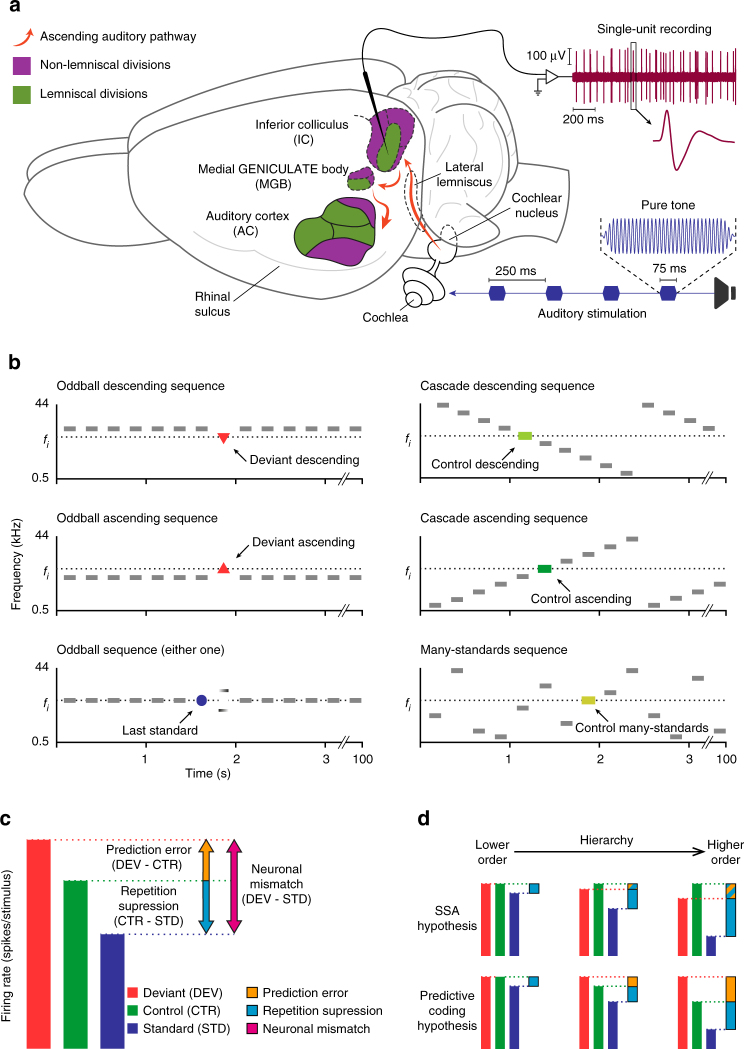
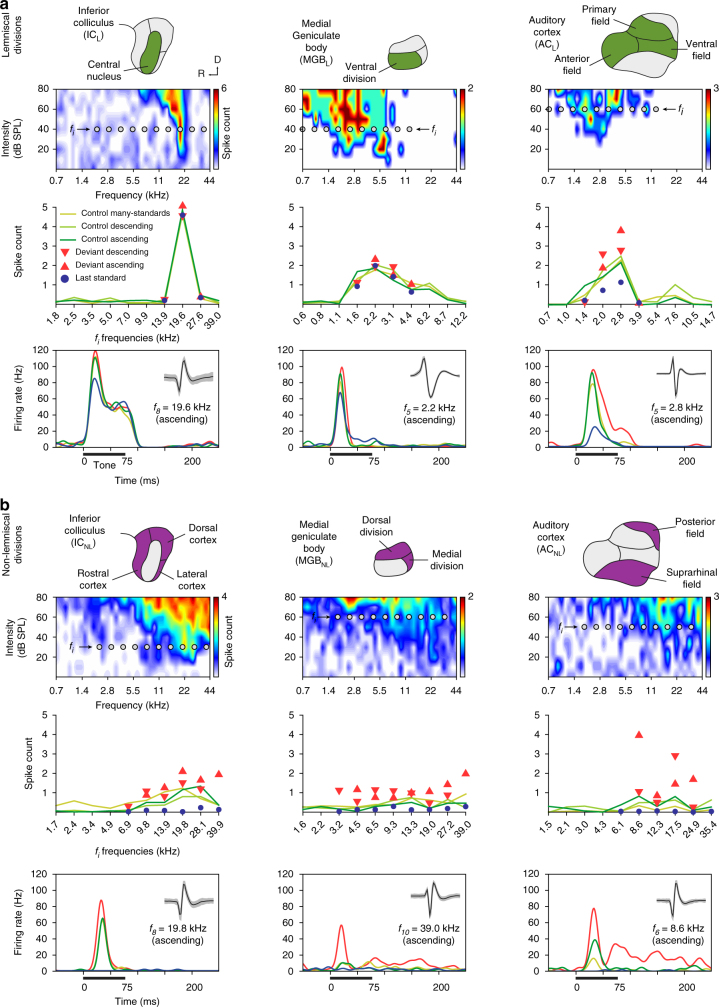
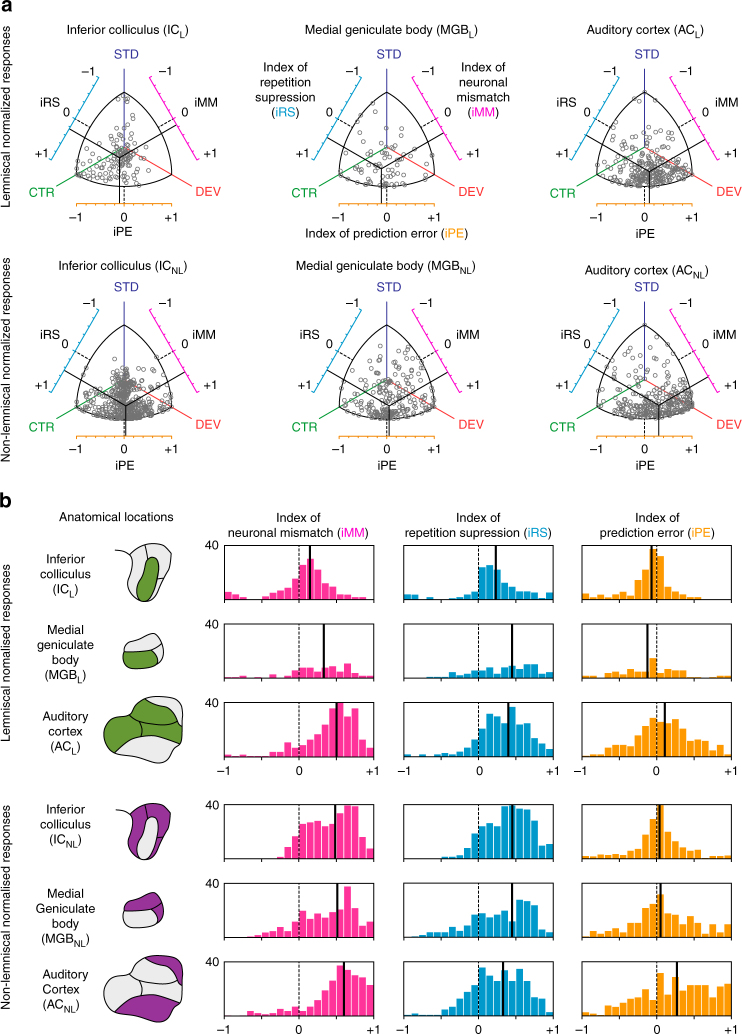
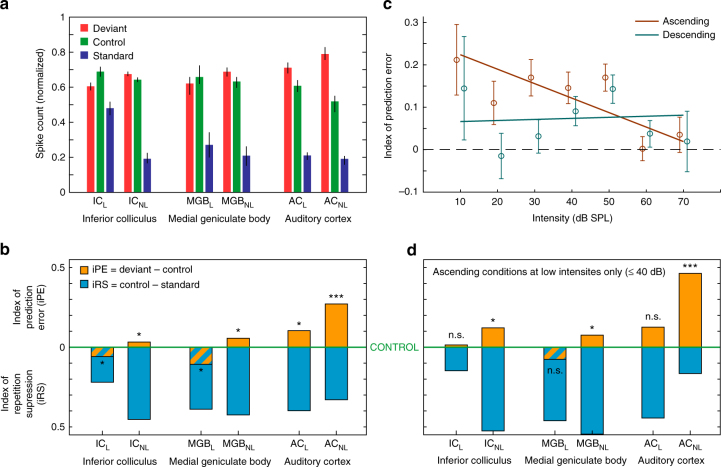
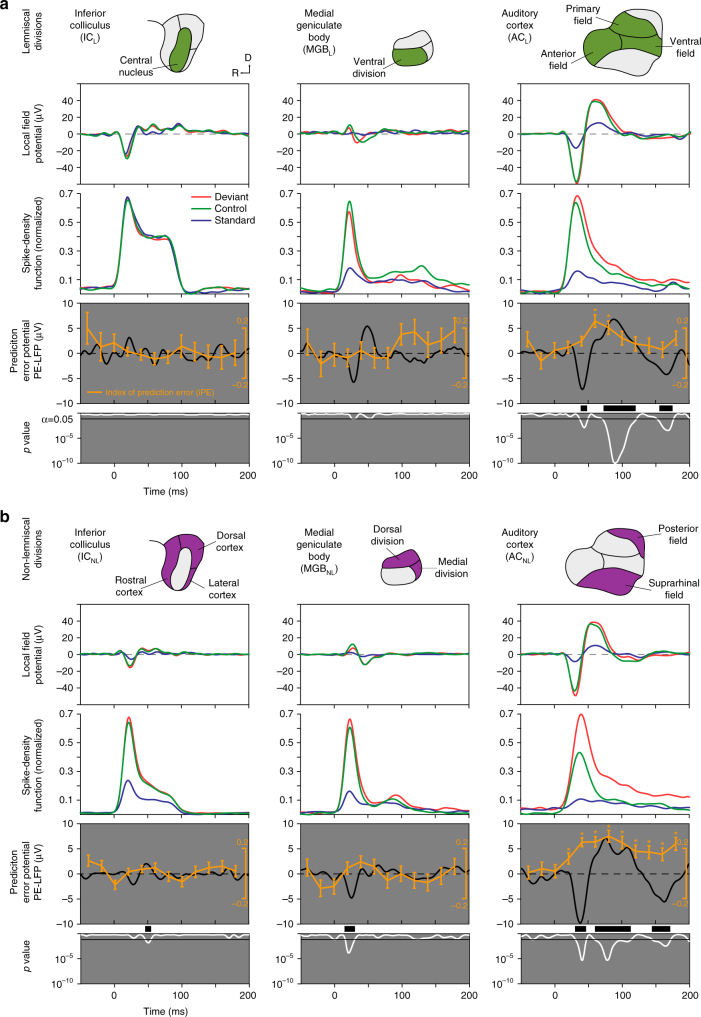
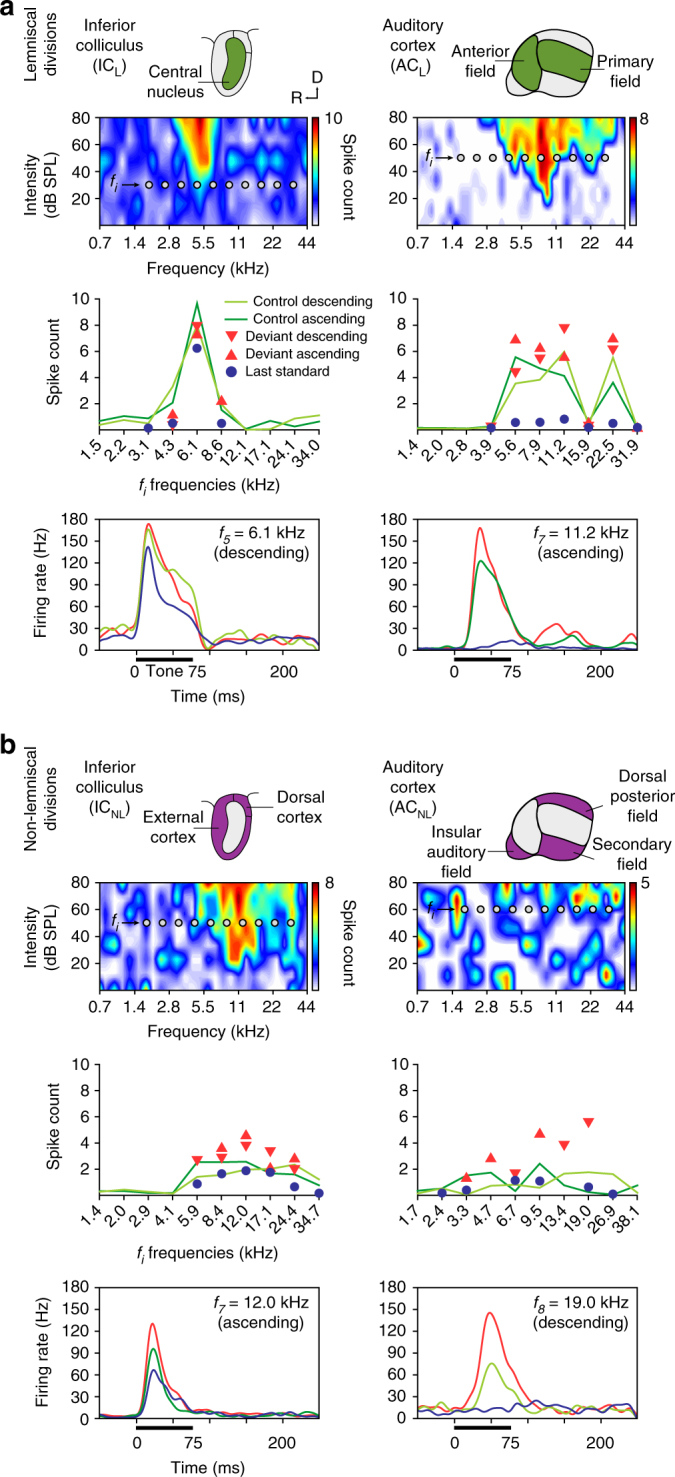
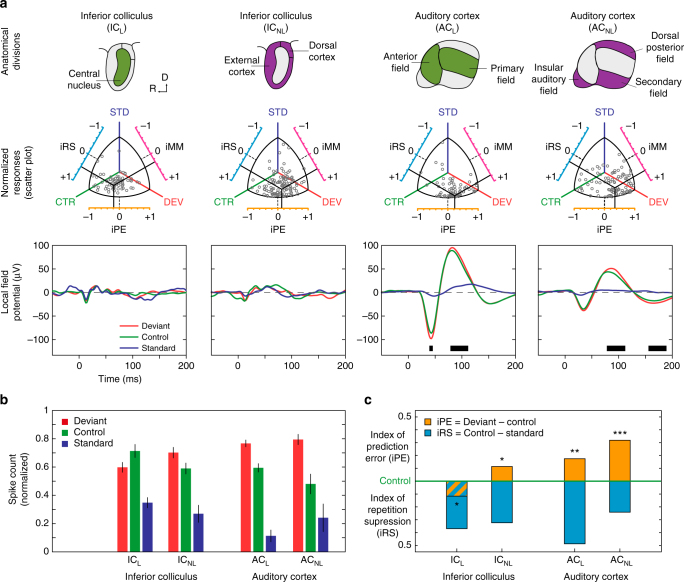
Perception is characterized by a reciprocal exchange of predictions and prediction error signals between neural regions. However, the relationship between such sensory mismatch responses and hierarchical predictive processing has not yet been demonstrated at the neuronal level in the auditory pathway. We recorded single-neuron activity from different auditory centers in anaesthetized rats and awake mice while animals were played a sequence of sounds, designed to separate the responses due to prediction error from those due to adaptation effects. Here we report that prediction error is organized hierarchically along the central auditory pathway. These prediction error signals are detectable in subcortical regions and increase as the signals move towards auditory cortex, which in turn demonstrates a large-scale mismatch potential. Finally, the predictive activity of single auditory neurons underlies automatic deviance detection at subcortical levels of processing. These results demonstrate that prediction error is a fundamental component of singly auditory neuron responses.
Overview
The claims and statistics of this paper haven’t been checked yet.
Run the check — free, no account needed. It reads the open-access text and checks the sources it cites.
Integrity signals
Registry
Cites
Statistics
Figures
Verification
Claims the paper makes
The claims and statistics of this paper haven’t been checked yet.
Run the check — free, no account needed. It reads the open-access text and checks the sources it cites.
Claims other papers make about this one
Each is checked against this paper’s own text: does it say what the citing paper says it does?
The cited source says what the claim attributes to it.
In the citing paper
“Several paradigms shown in this article have been already used for investigations of MMN in non-human animals (49–51).”
From A Predictive Coding Perspective on Mismatch Negativity Impairment in Schizophrenia (2020) · cites this paper as [51]
Self-check
Percentages, sums and reported differences re-computed from the paper’s own numbers.
The self-check needs the paper’s full text.
Citations
Cites
The Rat Brain in Stereotaxic Coordinates
Paxinos, G., & Watson, C. (1983) · Elsevier eBooks · doi:10.1016/c2009-0-63235-9 · Cited by 28,585
The Mouse Brain in Stereotaxic Coordinates
Paxinos, G. (2001) · Cited by 12,859
Paxinos, G. (1985) · Cited by 3,715
The mismatch negativity (MMN) in basic research of central auditory processing: A review
Näätänen, R., Paavilainen, P., Rinne, T., & Alho, K. (2007) · Clinical Neurophysiology · doi:10.1016/j.clinph.2007.04.026 · Cited by 2,644
Canonical Microcircuits for Predictive Coding
Bastos, A. M., Usrey, W. M., Adams, R. A., Mangun, G. R., Fries, P., & Friston, K. J. (2012) · Neuron · doi:10.1016/j.neuron.2012.10.038 · Cited by 2,421
The free-energy principle: a rough guide to the brain?
Friston, K. (2009) · Trends in Cognitive Sciences · doi:10.1016/j.tics.2009.04.005 · Cited by 1,831
Synaptic depression and cortical gain control
Abbott, L. F., Varela, J. A., Sen, K., & Nelson, S. B. (1997) · Science · doi:10.1126/science.275.5297.221 · Cited by 1,690
The mismatch negativity: a review of underlying mechanisms
Garrido, M. I., Kilner, J. M., Stephan, K. E., & Friston, K. J. (2009) · Clinical Neurophysiology · doi:10.1016/j.clinph.2008.11.029 · Cited by 1,441
Processing of low-probability sounds by cortical neurons
Ulanovsky, N., Las, L., & Nelken, I. (2003) · Nature Neuroscience · doi:10.1038/nn1032 · Cited by 1,049
Cortical feedback improves discrimination between figure and background by V1, V2 and V3 neurons
Hupé, J. M., James, A. C., Payne, B. R., Lomber, S. G., Girard, P., & Bullier, J. (1998) · Nature · doi:10.1038/29537 · Cited by 864
Cited by
Sorted by citations
How Do Expectations Shape Perception?
de Lange, F. P., Heilbron, M., & Kok, P. (2018) · Trends in Cognitive Sciences · doi:10.1016/j.tics.2018.06.002 · Cited by 975
Carbajal, G. V., & Malmierca, M. S. (2018) · Trends in Hearing · doi:10.1177/2331216518784822 · Cited by 241
Self-citationEvolving perspectives on the sources of the frequency-following response
Coffey, E. B. J., Nicol, T., White-Schwoch, T., Chandrasekaran, B., Krizman, J., Skoe, E., Zatorre, R. J., & Kraus, N. (2019) · Nature Communications · doi:10.1038/s41467-019-13003-w · Cited by 207
Making Sense of Mismatch Negativity
Fitzgerald, K. S., & Todd, J. (2020) · Frontiers in Psychiatry · doi:10.3389/fpsyt.2020.00468 · Cited by 233
Principles of large-scale neural interactions
Vinck, M. A., Uran, C., Spyropoulos, G., Onorato, I., Broggini, A. C., Schneider, M., & Canales‐Johnson, A. (2023) · Neuron · doi:10.1016/j.neuron.2023.03.015 · Cited by 170
Metadata
- Authors
- Parras, G. G., Nieto-Diego, J., Carbajal, G. V., Valdés-Baizabal, C., Escera, C., & Malmierca, M. S.
- Affiliations
- Instituto de Investigación Biomédica de Salamanca (ES)
- Institut de Recerca Sant Joan de Déu (ES)
- Universidad de Salamanca (ES)
- Corresponding author
- Malmierca, Manuel S.
- Venue
- Nature Communications
- Published
- 2017-12-15
- Volume
- 8
- Issue
- 1
- Pages
- 2148-2148
- ISSN
- 2041-1723 (ISSN-L)
- PMC
- PMC5732270
- OpenAlex
- W2774201964
- Cited by
- 344
- References
- 75
- Citations by year
- 2026: 38 · 2025: 33 · 2024: 55 · 2023: 60 · 2022: 39 · 2021: 29 · 2020: 50 · 2019: 25 · 2018: 14
- FWCI
- 13.96
- Type
- journal article
- Language
- en
- Open access
- gold
- doi.org
- Locations
- Nature Communications (publishedVersion, cc-by)
- PubMed Central (publishedVersion, cc-by)
- PubMed (publishedVersion)
- Gredos (University of Salamanca) (publishedVersion, cc-by)
- Hispana (publishedVersion, cc-by)
- RePEc: Research Papers in Economics (submittedVersion)
- Dipòsit Digital de la Universitat de Barcelona (Universitat de Barcelona) (submittedVersion, cc-by)
- DOAJ (DOAJ: Directory of Open Access Journals) (submittedVersion)
- DOAJ (DOAJ: Directory of Open Access Journals) (submittedVersion, cc-by-sa)
- Funders
- Generalitat de Catalunya (SGR 2014, SGR2014-177)
- Junta de Castilla y León
- European Social Fund (2007–2013)
- Topics
- Life Sciences › Neuroscience › Cognitive Neuroscience › Neuroscience and Music Perception
- Life Sciences › Neuroscience › Sensory Systems › Hearing, Cochlea, Tinnitus, Genetics
- Life Sciences › Neuroscience › Cognitive Neuroscience › Embodied and Extended Cognition
- Keywords
- prediction error, auditory pathway, single-unit activity, auditory cortex, subcortical auditory processing, mismatch response, deviance detection, sensory prediction, auditory adaptation
About these checks
Registry, retraction, Cites and statistics results are computed, not judged, with one exception: a printed reference that no index lists is read once by a model before it counts as a citation error. Claims are extracted by a model and kept only when their quote appears verbatim in the text; each cited source is then checked, with a model’s help, for whether it says what the claim relies on. Those verdicts can be wrong — read the claim’s quote and the cited source before relying on one.
Statistics and arithmetic are recomputed, not judged.
Confidence bands are shown only for fields calibrated on our annotated test set. None is calibrated yet, so no band is shown.
What counts as a claim ›How we measure confidence ›How we check this ›
Are you an author, or do you see a problem with this page? Request a review
