

The DOI matches its Crossref record; 70 of the 70 references it cites were found in a registry or an index.
CA1 and CA3 differentially support spontaneous retrieval of episodic contexts within human hippocampal subfields
Open accessPublished version of a preprint
Abstract
The hippocampus plays a critical role in spatial and episodic memory. Mechanistic models predict that hippocampal subfields have computational specializations that differentially support memory. However, there is little empirical evidence suggesting differences between the subfields, particularly in humans. To clarify how hippocampal subfields support human spatial and episodic memory, we developed a virtual reality paradigm where participants passively navigated through houses (spatial contexts) across a series of videos (episodic contexts). We then used multivariate analyses of high-resolution fMRI data to identify neural representations of contextual information during recollection. Multi-voxel pattern similarity analyses revealed that CA1 represented objects that shared an episodic context as more similar than those from different episodic contexts. CA23DG showed the opposite pattern, differentiating between objects encountered in the same episodic context. The complementary characteristics of these subfields explain how we can parse our experiences into cohesive episodes while retaining the specific details that support vivid recollection.
Overview
The claims and statistics of this paper haven’t been checked yet.
Run the check — free, no account needed. It reads the open-access text and checks the sources it cites.
Integrity signals
Registry
Cites
Statistics
Figures
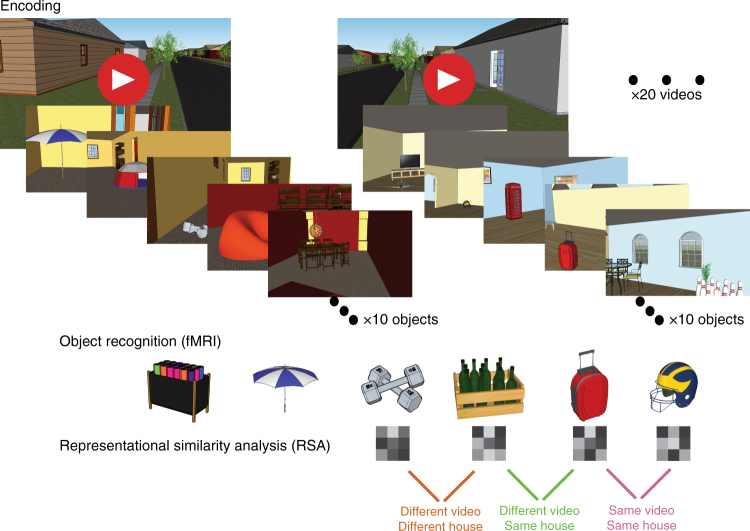
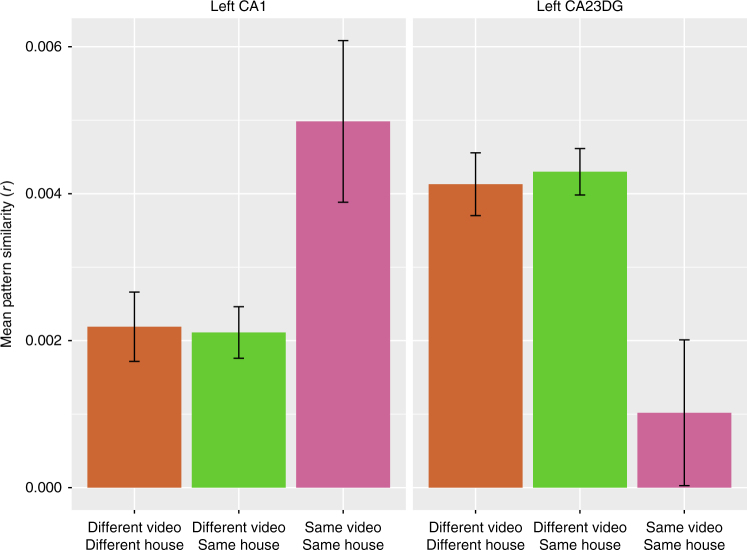
Verification
Claims the paper makes
The claims and statistics of this paper haven’t been checked yet.
Run the check — free, no account needed. It reads the open-access text and checks the sources it cites.
Claims other papers make about this one
Each is checked against this paper’s own text: does it say what the citing paper says it does?
In the citing paper
“Recent human imaging studies shed light on the distinct but complementary characteristics of CA1 and CA3 in episodic memory (Copara et al., 2014; Dimsdale-Zucker et al., 2018).”
From The medial prefrontal cortex - hippocampus circuit that integrates information of object, place and time to construct episodic memory in rodents: Behavioral, anatomical and neurochemical properties (2020) · cites this paper as Dimsdale-Zucker et al., 2018
Self-check
Percentages, sums and reported differences re-computed from the paper’s own numbers.
The self-check needs the paper’s full text.
Citations
Cites
Fitting Linear Mixed-Effects Models Using lme4
Bates, D., Mächler, M., Bolker, B., & Walker, S. (2015) · Journal of Statistical Software · doi:10.18637/jss.v067.i01 · Cited by 86,835
Random effects structure for confirmatory hypothesis testing: Keep it maximal
Barr, D. J., Levy, R., Scheepers, C., & Tily, H. J. (2013) · Journal of Memory and Language · doi:10.1016/j.jml.2012.11.001 · Cited by 10,328
Power, J. D., Barnes, K. A., Snyder, A. Z., Schlaggar, B. L., & Petersen, S. E. (2012) · NeuroImage · doi:10.1016/j.neuroimage.2011.10.018 · Cited by 7,429
The Nature of Recollection and Familiarity: A Review of 30 Years of Research
Yonelinas, A. P. (2002) · Journal of Memory and Language · doi:10.1006/jmla.2002.2864 · Cited by 3,840
Self-citationRepresentational similarity analysis-connecting the branches of systems neuroscience
Kriegeskorte, N. (2008) · Frontiers in Systems Neuroscience · doi:10.3389/neuro.06.004.2008 · Cited by 3,355
Simple memory: a theory for archicortex
Marr, D. (1971) · Philosophical Transactions of the Royal Society of London. B, Biological Sciences · doi:10.1098/rstb.1971.0078 · Cited by 2,771
The Medial Temporal Lobe and Recognition Memory
Eichenbaum, H., Yonelinas, A. P., & Ranganath, C. (2007) · Annual Review of Neuroscience · doi:10.1146/annurev.neuro.30.051606.094328 · Cited by 2,580
Self-citationThe human hippocampus and spatial and episodic memory
Burgess, N., Maguire, E. A., & O'Keefe, J. (2002) · Neuron · doi:10.1016/s0896-6273(02)00830-9 · Cited by 2,401
Evaluating significance in linear mixed-effects models in R
Luke, S. G. (2017) · Behavior Research Methods · doi:10.3758/s13428-016-0809-y · Cited by 1,704
Meta-analysis of experiments with matched groups or repeated measures designs
Dunlap, W. P., Cortina, J. M., Vaslow, J. B., & Burke, M. J. (1996) · Psychological Methods · doi:10.1037/1082-989x.1.2.170 · Cited by 1,693
Research works printed but not linked: 1
- Bates, D. lme4: Mixed-effects Modeling with R (Springer, Madison, WI, 2010).
Cited by
Sorted by citations
Roddy, D. W., Farrell, C., Doolin, K., Roman, E., Tozzi, L., Frodl, T., O’Keane, V., & O’Hanlon, E. (2019) · Biological Psychiatry · doi:10.1016/j.biopsych.2018.08.021 · Cited by 287
Space, time, and episodic memory: The hippocampus is all over the cognitive map
Ekstrom, A. D., & Ranganath, C. (2017) · Hippocampus · doi:10.1002/hipo.22750 · Cited by 278
Self-citationInhibitory stabilization and cortical computation
Sadeh, S., & Clopath, C. (2020) · Nature reviews. Neuroscience · doi:10.1038/s41583-020-00390-z · Cited by 191
Chao, O. Y., de Souza Silva, M. A., Yang, Y.-M., & Huston, J. P. (2020) · Neuroscience & Biobehavioral Reviews · doi:10.1016/j.neubiorev.2020.04.007 · Cited by 158
Nonmonotonic Plasticity: How Memory Retrieval Drives Learning
Ritvo, V. J. H., Turk‐Browne, N. B., & Norman, K. A. (2019) · Trends in Cognitive Sciences · doi:10.1016/j.tics.2019.06.007 · Cited by 154
Metadata
- Authors
- Dimsdale-Zucker, H. R., Ritchey, M., Ekstrom, A. D., Yonelinas, A. P., & Ranganath, C.
- Affiliations
- University of California, Davis (US)
- Boston College (US)
- Corresponding author
- Dimsdale-Zucker, Halle R.
- Venue
- Nature Communications
- Published
- 2018-01-18
- Volume
- 9
- Issue
- 1
- Pages
- 294-294
- ISSN
- 2041-1723 (ISSN-L)
- PMC
- PMC5773497
- OpenAlex
- W2953335281
- Cited by
- 205
- References
- 70
- Citations by year
- 2026: 20 · 2025: 23 · 2024: 34 · 2023: 24 · 2022: 22 · 2021: 27 · 2020: 19 · 2019: 14 · 2018: 21
- FWCI
- 12.06
- Type
- journal article
- Language
- en
- Open access
- gold
- doi.org
- Locations
- Nature Communications (publishedVersion, cc-by)
- bioRxiv (Cold Spring Harbor Laboratory) (acceptedVersion, cc-by-nc-nd)
- Europe PMC (PubMed Central) (publishedVersion, cc-by)
- PubMed Central (publishedVersion, cc-by)
- PubMed (publishedVersion)
- RePEc: Research Papers in Economics (submittedVersion)
- DOAJ (DOAJ: Directory of Open Access Journals) (submittedVersion)
- DOAJ (DOAJ: Directory of Open Access Journals) (submittedVersion, cc-by-sa)
- eScholarship (California Digital Library) (submittedVersion)
- Funders
- National Science Foundation (1650042)
- University of California, Davis
- National Institute of Mental Health (K99MH103401, R00MH103401)
- Topics
- Life Sciences › Neuroscience › Cognitive Neuroscience › Memory and Neural Mechanisms
- Life Sciences › Neuroscience › Cognitive Neuroscience › Memory Processes and Influences
- Social Sciences › Psychology › Experimental and Cognitive Psychology › Spatial Cognition and Navigation
- Keywords
- hippocampal subfields, CA1, CA3, episodic memory, spatial memory, recollection, contextual memory, virtual reality navigation, multivariate pattern analysis, human hippocampus
- MeSH terms
- Brain Mapping, Female, Humans, Magnetic Resonance Imaging, Male, Mental Recall, Space Perception, Young Adult, CA1 Region, Hippocampal, CA3 Region, Hippocampal, Memory, Episodic
About these checks
Registry, retraction, Cites and statistics results are computed, not judged, with one exception: a printed reference that no index lists is read once by a model before it counts as a citation error. Claims are extracted by a model and kept only when their quote appears verbatim in the text; each cited source is then checked, with a model’s help, for whether it says what the claim relies on. Those verdicts can be wrong — read the claim’s quote and the cited source before relying on one.
Statistics and arithmetic are recomputed, not judged.
Confidence bands are shown only for fields calibrated on our annotated test set. None is calibrated yet, so no band is shown.
What counts as a claim ›How we measure confidence ›How we check this ›
Are you an author, or do you see a problem with this page? Request a review
