

Targeting repair pathways with small molecules increases precise genome editing in pluripotent stem cells
Open accessPublished version of a preprint
The DOI matches its Crossref record; 49 of the 49 references it cites were found in a registry or an index.
Abstract
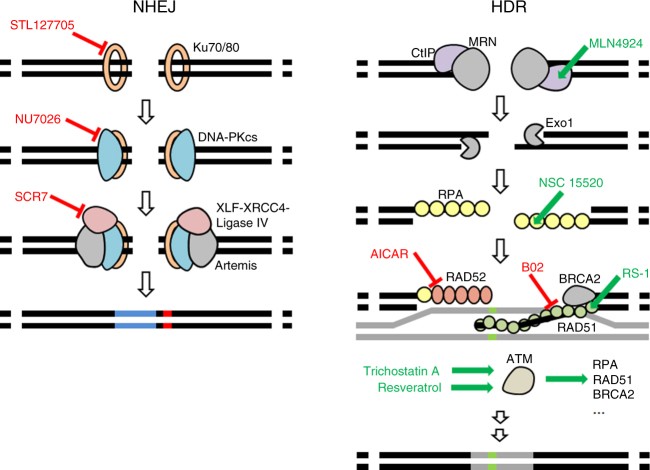
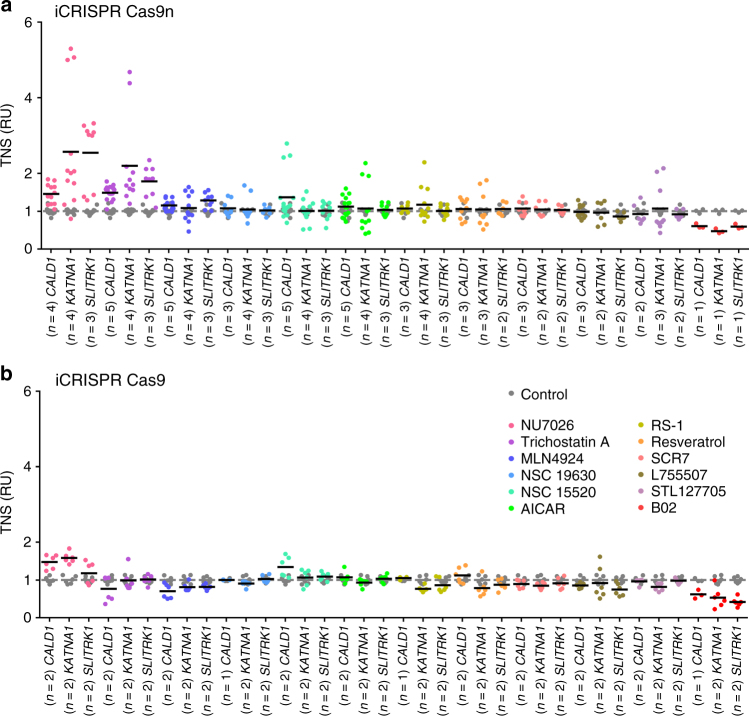
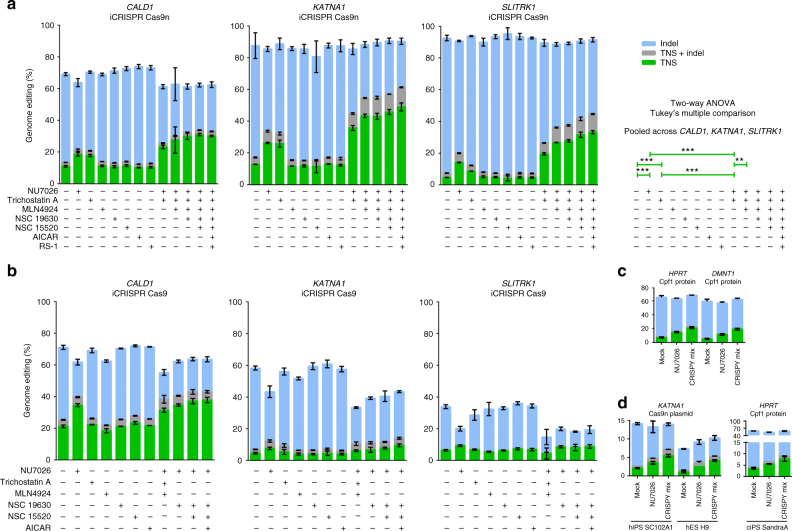
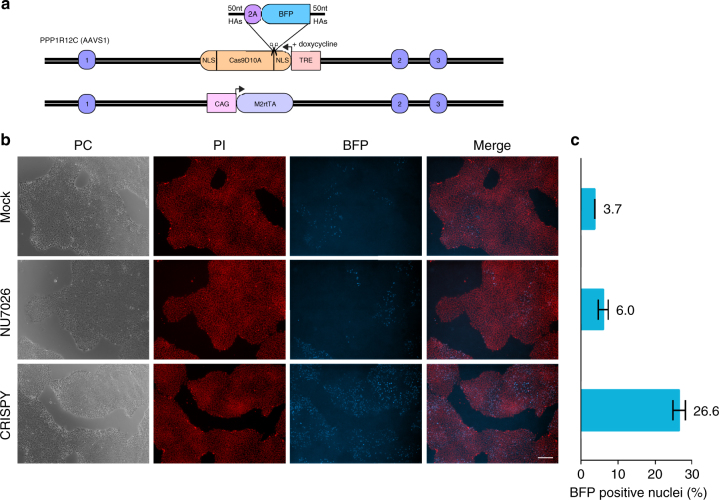
A now frequently used method to edit mammalian genomes uses the nucleases CRISPR/Cas9 and CRISPR/Cpf1 or the nickase CRISPR/Cas9n to introduce double-strand breaks which are then repaired by homology-directed repair using DNA donor molecules carrying desired mutations. Using a mixture of small molecules, the “CRISPY” mix, we achieve a 2.8- to 7.2-fold increase in precise genome editing with Cas9n, resulting in the introduction of the intended nucleotide substitutions in almost 50% of chromosomes or of gene encoding a blue fluorescent protein in 27% of cells, to our knowledge the highest editing efficiency in human induced pluripotent stem cells described to date. Furthermore, the CRISPY mix improves precise genome editing with Cpf1 2.3- to 4.0-fold, allowing almost 20% of chromosomes to be edited. The components of the CRISPY mix do not always increase the editing efficiency in the immortalized or primary cell lines tested, suggesting that employed repair pathways are cell-type specific.
Overview
The claims and statistics of this paper haven’t been checked yet.
Free: it reads the open-access text and checks the first 5 claims that cite a source we can check. Create a free account to check every claim.
Integrity signals
Registry
Cites
Statistics
Figures
Verification
Claims the paper makes
The claims and statistics of this paper haven’t been checked yet.
Free: it reads the open-access text and checks the first 5 claims that cite a source we can check. Create a free account to check every claim.
Claims other papers make about this one
Each is checked against this paper’s own text: does it say what the citing paper says it does?
In the citing paper
“The cell lines used were tested for the proper expression of pluripotency markers SOX2, OCT4, TRA-1-60 and SSEA, quantitative PCR confirmed the doxycycline-inducible Cas9n and digital PCR was used to exclude off-target integration49.”
From Inferring and perturbing cell fate regulomes in human brain organoids (2023) · cites this paper as [49]
Self-check
Percentages, sums and reported differences re-computed from the paper’s own numbers.
The self-check needs the paper’s full text.
Citations
Cites
Discovering Statistics Using SPSS
Field, A. P., & Miles, J. N. V. (2000) · Medical Entomology and Zoology · Cited by 28,294
Genome engineering using the CRISPR-Cas9 system
Ran, F. A., Hsu, P. D., Wright, J., Agarwala, V., Scott, D. A., & Zhang, F. (2013) · Nature Protocols · doi:10.1038/nprot.2013.143 · Cited by 11,133
Experimental Design and Data Analysis for Biologists
Quinn, G. P., & Keough, M. J. (2002) · doi:10.1017/cbo9780511806384 · Cited by 10,674
Cpf1 Is a Single RNA-Guided Endonuclease of a Class 2 CRISPR-Cas System
Zetsche, B., Gootenberg, J. S., Abudayyeh, O. O., Slaymaker, I. M., Makarova, K. S., Essletzbichler, P., Volz, S. E., Joung, J., van der Oost, J., Regev, A., et al. (2015) · Cell · doi:10.1016/j.cell.2015.09.038 · Cited by 4,761
O'Brien, J., Wilson, I., Orton, T., & Pognan, F. (2000) · European Journal of Biochemistry · doi:10.1046/j.1432-1327.2000.01606.x · Cited by 3,446
High-Frequency off-Target Mutagenesis Induced by CRISPR-Cas Nucleases in Human Cells
Fu, Y., Foden, J. A., Khayter, C., Maeder, M. L., Reyon, D., Joung, J. K., & Sander, J. D. (2013) · Nature Biotechnology · doi:10.1038/nbt.2623 · Cited by 3,292
The complete genome sequence of a Neanderthal from the Altai Mountains
Prüfer, K., Racimo, F., Patterson, N., Jay, F., Sankararaman, S., Sawyer, S., Heinze, A., Renaud, G., Sudmant, P. H., de Filippo, C., et al. (2014) · Nature · doi:10.1038/nature12886 · Cited by 2,254
Illumina Sequencing Library Preparation for Highly Multiplexed Target Capture and Sequencing
Meyer, M., & Kircher, M. (2010) · Cold Spring Harbor Protocols · doi:10.1101/pdb.prot5448 · Cited by 2,231
Autologous Induced Stem-Cell–Derived Retinal Cells for Macular Degeneration
Mandai, M., Watanabe, A., Kurimoto, Y., Hirami, Y., Morinaga, C., Daimon, T., Fujihara, M., Akimaru, H., Sakai, N., Shibata, Y., et al. (2017) · New England Journal of Medicine · doi:10.1056/nejmoa1608368 · Cited by 1,509
The ChEMBL bioactivity database: an update
Bento, A. P., Gaulton, A., Hersey, A., Bellis, L. J., Chambers, J., Davies, M., Krüger, F. A., Light, Y., Mak, L., McGlinchey, S., et al. (2014) · Nucleic Acids Research · doi:10.1093/nar/gkt1031 · Cited by 1,492
Research works printed but not linked: 1
- Zar, J. H. Biostatistical Analysis. (Prentice Hall: 1999).
Cited by
Items 101–180 of 180
Efficient site-specific integration in CHO-K1 cells using CRISPR/Cas9-modified donors
Kheirandish, M. H., Rahmani, B., Jaliani, H. Z., Barkhordari, F., Mazlomi, M. A., & Davami, F. (2023) · Molecular Biology Reports · doi:10.1007/s11033-023-08529-8 · Cited by 10
“Despite direct HDR-enhancing manipulations using NHEJ inhibiting or HDR stimulating molecules [7, 8], donor design approaches do not evoke any potential toxicity for cells.”
BackgroundGoolab, S., & Scholefield, J. (2024) · Frontiers in Genome Editing · doi:10.3389/fgeed.2024.1464531 · Cited by 10
High Homology-Directed Repair Using Mitosis Phase and Nucleus Localizing Signal
Han, J. P., Chang, Y. J., Song, D. W., Choi, B. S., Koo, O. J., Yi, S. Y., Park, T. S., & Yeom, S. C. (2020) · International Journal of Molecular Sciences · doi:10.3390/ijms21113747 · Cited by 10
“There have been many studies to improve SSTR efficiencies, such as 3′-end phosphorothioate or methyl-CpG modification of ssODNs [3,4], HR-promoting or NHEJ-blocking small molecules [5], and the use of overlapping single-guide RNAs (sgRNAs) [6].”
BackgroundThomsen, E. A., Skipper, K. A., Andersen, S., Haslund, D., Skov, T. W., & Mikkelsen, J. G. (2022) · Molecular Therapy — Nucleic Acids · doi:10.1016/j.omtn.2022.08.005 · Cited by 10
“These data demonstrate strong excision capacity and argue that events of indel formation occur alongside transposon excision after delivery of the sgRNA expression cassette and hyPBExc+ protein in LVNPs. Simultaneous HDR-dependent knockin and Cas9 switch-off after IDLV delivery of the sgRNA cassette, donor sequence, a…”
MethodInfluentialFeng, Y.-L., Liu, S., Chen, R.-D., Sun, X., Xiao, J., Xiang, J.-F., & Xie, A. (2023) · Nucleic Acids Research · doi:10.1093/nar/gkad116 · Cited by 11
CRISPR/Cas9 Genome Editing in the Diamondback Moth: Current Progress, Challenges, and Prospects
Asad, M., Chang, Y., Liao, J., & Yang, G. (2025) · International Journal of Molecular Sciences · doi:10.3390/ijms26041515 · Cited by 12
“Inhibiting DNA-PK , Ku70/80 , and LIG4 significantly enhances the HDR-mediated repair mechanism in various organisms, including humans, mice, and insects ( B. mori ) [94–101].”
The effect of histone deacetylase inhibitors on the efficiency of the CRISPR/Cas9 system
Bjornson, Y. M., Huang, C. Y., Rollins, J. L., Castañeda, G. A. L., Kaur, N., Yamamoto, E., & Johnston, J. M. (2023) · Biochemistry and Biophysics Reports · doi:10.1016/j.bbrep.2023.101513 · Cited by 10
“Small molecules have been successfully implemented to either directly suppress NHEJ activity or to directly enhance HDR activity [6,8 – 11].”
Hamaker, N. K., & Lee, K. H. (2023) · Biotechnology and Bioengineering · doi:10.1002/bit.28393 · Cited by 10
“Small molecule treatment has proven to be an effective approach for increasing the frequency of desired genome editing outcomes by manipulating repair pathway activity (Riesenberg & Maricic, 2018).”
BackgroundPérez-Bermejo, J. A., Efagene, O., Matern, W. M., Holden, J. K., Kabir, S., Chew, G. M., Andreoletti, G., Catton, E., Ennis, C. L., Garcia, A., et al. (2024) · Nature Communications · doi:10.1038/s41467-024-46816-5 · Cited by 9
Chirco, K. R., Martinez, C., & Lamba, D. A. (2023) · Vision Research · doi:10.1016/j.visres.2023.108257 · Cited by 10
The Promises and Pitfalls of CRISPR-Mediated Base Editing in Stem Cells
Wong, P. K., Zamberi, N. N. M., Syafruddin, S. E., Cheah, F., Azmi, N., Law, J. X., & Chua, E. W. (2023) · The CRISPR Journal · doi:10.1089/crispr.2023.0013 · Cited by 9
“42 Besides, the toxicity of both NHEJ inhibitors and HDR enhancers must be thoroughly investigated.”
Macak, D., Kanis, P., & Riesenberg, S. (2025) · Nature Communications · doi:10.1038/s41467-025-67243-0 · Cited by 7
“HDR can be reduced by inhibiting the central HR protein RAD51 with B02 21,26 , NHEJ can be blocked by inhibiting DNA-PKcs with e.g. M3814 or AZD7648 27,28 , and MMEJ can be blocked by inhibiting Pol θ , the protein encoded by POLQ , with ART558 29 or by inhibiting PARP1 with rucaparib 12 .”
Self-citationTrionfini, P., Ciampi, O., Todeschini, M., Ascanelli, C., Longaretti, L., Perico, L., Remuzzi, G., Benigni, A., & Tomasoni, S. (2019) · The CRISPR Journal · doi:10.1089/crispr.2018.0048 · Cited by 8
“Several attempts have been made to improve HDR rates, searching for compounds or genes that increase HDR frequency 20,22,34,35 or inhibit NHEJ.”
Molecular approaches improving our understanding of Brettanomyces physiology
Varela, C., & Borneman, A. R. (2022) · FEMS Yeast Research · doi:10.1093/femsyr/foac028 · Cited by 7
Nidhi, F., & Tomatsu, S. (2025) · International Journal of Molecular Sciences · doi:10.3390/ijms26146616 · Cited by 7
“This could involve IDLVs encoding dominant-negative NHEJ proteins, shRNAs against key NHEJ factors (e.g., Lig4, DNA-PKcs) [29,60], or delivering proteins/mRNAs for HDR-promoting factors like Rad51 variants [29,61–63].”
MDM2 antagonists promote CRISPR/Cas9-mediated precise genome editing in sheep primary cells
Li, Y., Lian, D., Wang, J., Zhao, Y., Li, Y., Liu, G., Wu, S., Deng, S., Du, X., & Lian, Z. (2023) · Molecular Therapy — Nucleic Acids · doi:10.1016/j.omtn.2022.12.020 · Cited by 6
“Similarly, NU7441, an inhibitor of DNA-PKcs that plays a critical role in initiating the NHEJ pathway, improved the HDR efficiency by 2- to 4-fold in human induced pluripotent stem cells (iPSCs) and HEK293T cells.(20,22) Unfortunately, in our study, SCR7 only slightly increased the HDR efficiency by 14.”
BackgroundLu, M., & Billerbeck, S. (2024) · Microbial Biotechnology · doi:10.1111/1751-7915.14398 · Cited by 7
“MLN4942 very minimally enhanced precise genome editing by 1.1 to 1.3-fold, but it was shown to work additive in combination with other small molecules when mixed (Riesenberg & Maricic, 2018) (see Point 5).”
BackgroundMethodInfluentialA p21 reporter iPSC line for evaluating CRISPR-Cas9 and vector-induced stress responses
Sun, Y.-D., Li, G., Zhang, F., Cheng, T., Zhang, J., & Zhang, X. (2024) · Stem Cells · doi:10.1093/stmcls/sxae056 · Cited by 6
“33-35 Except for the DNA-PK inhibitor M3814 and the DNA ligase IV inhibitor Scr7, most DNA repair mediators were found to prompt an increase in p21 activation, among which, Mirin and other HDR-promoting molecules elicited moderate levels of p21 expression (20%~40%).”
Harnessing CRISPR technology for next-generation microphysiological systems
Song, S., Kang, H. W., Kang, M., Chung, S. H., Choi, N., Kim, H. N., & Sung, Y. J. (2025) · TrAC Trends in Analytical Chemistry · doi:10.1016/j.trac.2025.118164 · Cited by 6
Suchý, T., Kaczmarek, I., Maričić, T., Zieschang, C., Schöneberg, T., Thor, D., & Liebscher, I. (2021) · Adipocyte · doi:10.1080/21623945.2021.1990480 · Cited by 6
“Knock-out was induced as previously described [51].”
Progress in germline stem cell transplantation in mammals and the potential usage
Zhang, W., Nie, R., Cai, Y., Xie, W., & Zou, K. (2022) · Reproductive Biology and Endocrinology · doi:10.1186/s12958-022-00930-5 · Cited by 5
Dsouza, R., Jain, M., & Khattar, E. (2025) · Molecular Biology Reports · doi:10.1007/s11033-025-10434-1 · Cited by 5
“Some studies showed DNA replication stress-activated CtIP an HDR factor and improved HDR efficiency in stem cells; however, it decreased HDR in cancer cell lines, primary cell lines, and CD4 + T cells [39].”
CRISPR-Cpf1 system and its applications in animal genome editing
Han, Y., Jia, Z., Xu, K., Li, Y., Lu, S., & Guan, L. (2024) · Molecular Genetics and Genomics · doi:10.1007/s00438-024-02166-x · Cited by 6
“Riesenberg et al. (Riesenberg and Maricic 2018 ) utilized a mixture of small molecules (NU7026, Trichostatin A, MLN4924, and NSC 15,520), termed “CRISPY,” which enabled Cpf1 to achieve 2.3 to 4.0 times more precise genome editing.”
InfluentialCRISPR-Cas Gene Perturbation and Editing in Human Induced Pluripotent Stem Cells
van Essen, M. J., Riepsaame, J., & Jacob, J. (2021) · The CRISPR Journal · doi:10.1089/crispr.2021.0063 · Cited by 5
How to Shift the Equilibrium of DNA Break Repair in Favor of Homologous Recombination
Averina, O. A., Kuznetsova, S. A., Permyakov, O. A., & Владимирович, С. П. (2024) · Molecular Biology · doi:10.1134/s0026893324700201 · Cited by 4
“The data agree with the results obtained with pluripotent stem cells, where another DNA-PK inhibitor, NU7026, increased the efficiency of donor oligonucleotide incorporation by a factor of approximately 1.6 [79].”
InfluentialRahmani, B., Kheirandish, M. H., Ghanbari, S., Raz, A., Shamsi, F., & Davami, F. (2023) · Scientific Reports · doi:10.1038/s41598-023-29863-8 · Cited by 4
“Eight clones in non-treated control (115, 20, 25, 32, 38, 19, 9, 18), five clones in Nocodazole (125, 38, 40, 65, 28), six clones in B02 (57, 52, 65, 56, 41, 19), and nine clones in double-treated (77, 56, 48, 14, 8, 42, 20, 71 and 86) groups demonstrated mono-allelic integration of landing pad cassette by presenting…”
BackgroundViral genome editing methods and applications in the CRISPR era
Shin, K., & Kim, E. T. (2026) · Journal of Virology · doi:10.1128/jvi.02048-25 · Cited by 3
“Several small molecules that inhibit NHEJ have been used to enhance HDR. DNA-PKcs inhibitors such as NU7026 (an ATP-competitive inhibitor) and M3814 (peposertib) increase HDR efficiency by approximately 2-fold to 4-fold in systems such as iPSCs, HEK293, K562, and T cells (115, 137–139).”
Assumpção, D. D. C., Vinokour, E. S., Mills, M. M., Liang, S., Mills, C. E., da Costa, A. C., Kennedy, N. W., & Tullman‐Ercek, D. (2026) · New Biotechnology · doi:10.1016/j.nbt.2026.03.005 · Cited by 3
Cho, E., Lee, J., Kim, J., Choi, J., Kang, M., & Song, J. (2026) · Journal of Biological Engineering · doi:10.1186/s13036-026-00673-6 · Cited by 3
A transient reporter for editing enrichment (TREE) in human cells
Standage-Beier, K., Tekel, S. J., Brookhouser, N., Schwarz, G., Nguyen, T., Wang, X., & Brafman, D. A. (2020) · Nucleic Acids Research · doi:10.1093/nar/gkaa027 · Cited by 3
Murakami, Y., & Kobayashi, T. (2022) · genesis · doi:10.1002/dvg.23465 · Cited by 4
Guo, N., Li, S., Liu, B., Chen, P., Li, J., Zhao, Y.-L., Zhao, Y.-N., Tang, J., & Zhang, W. (2022) · Anti-Cancer Drugs · doi:10.1097/cad.0000000000001290 · Cited by 3
DCHS1 Modulates Forebrain Proportions in Modern Humans via a Glycosylation ChangePreprint
Pravatà, V. M., Forero, A., Martin, A. C. A., Berto, G., Heymann, T., Fast, L., Mann, M., Riesenberg, S., & Cappello, S. (2025) · bioRxiv (Cold Spring Harbor Laboratory) · doi:10.1101/2025.05.14.654031 · Cited by 3
Self-citationLineage Recording in Human Brain Organoids with iTracer
Gentile, E., Maynard, A., He, Z., & Treutlein, B. (2025) · Methods in molecular biology · doi:10.1007/978-1-0716-4310-5_5 · Cited by 2
Search-and-remove genome editing allows selection of cells by DNA sequence
Fast, L., Omar, M., Kanis, P., Schaffer, T., Chowdhury, D. T., Rakava, E., Pääbo, S., & Riesenberg, S. (2025) · Nature Communications · doi:10.1038/s41467-025-66896-1 · Cited by 2
“Furthermore, we modi fi ed iCRISPR 409B2 to carry a reverse transcriptase adjacent to Cas9H840A 35 (iPrime) as described in Riesenberg and Maricic 2018 94 .”
Self-citationPratumkaew, P., Wattanapanitch, M., Viprakasit, V., Kheolamai, P., & Issaragrisil, S. (2026) · Stem Cell Research & Therapy · doi:10.1186/s13287-026-05057-7 · Cited by 2
“Moreover, the small molecule NU7026, an inhibitor of the DNA‒ protein kinase catalytic subunit (DNA-PKcs), has been shown to increase precise genome editing in pluripotent stem cells [43].”
Promotion or inhibition? This is a question in gene editing
Tsai, L., Han, R., Yang, D., Chen, Y., Zhang, J., & Xu, J. (2025) · Molecular Therapy · doi:10.1016/j.ymthe.2025.01.014 · Cited by 2
Džafo, E., Hafezi, M., Attianese, G. M. P. G., Reichenbach, P., Grillet, S., Garcia, H., Cribioli, E., Voize, C., Tissot-Renaud, S., de Silly, R. V., et al. (2025) · Cytotherapy · doi:10.1016/j.jcyt.2025.02.001 · Cited by 2
Luo, X., Weidinger, E., Burghardt, T., Höhn, M., & Wagner, E. (2025) · International Journal of Molecular Sciences · doi:10.3390/ijms26094361 · Cited by 3
“For instance, NU7026 increased the targeted gene fragment insertion efficiency by 3-fold in HEK293 cells, 4-fold in K562 cells, 3-fold in CD4 + T cells, and 1.7-fold in CD34 + progenitor cells [48].”
InfluentialCRISPR Technology - Recent Advances
Chen, Y. (2022) · IntechOpen eBooks · doi:10.5772/intechopen.102156 · Cited by 2
Maximizing the Efficacy of CRISPR/Cas Homology-Directed Repair Gene Targeting
Elton, T. S., Hossain, M. I., Carvajal‐Moreno, J., Wang, X., Skaggs, D. J., & Yalowich, J. C. (2022) · IntechOpen eBooks · doi:10.5772/intechopen.109051 · Cited by 2
An efficient evaluation system for factors affecting the genome editing efficiency in mouse
Sakai, Y., Okabe, Y., Itai, G., & Shiozawa, S. (2023) · EXPERIMENTAL ANIMALS · doi:10.1538/expanim.23-0045 · Cited by 2
Phage-encoded single-guide RNAs subvert CRISPR-Cas9 immunityPreprint
Feussner, M., Migur, A., Li, J., Riesenberg, S., Birkholz, N., Mayo-Muñoz, D., Wakelin, H., Brown, C., Weinberg, Z., Pinilla‐Redondo, R., et al. (2026) · bioRxiv (Cold Spring Harbor Laboratory) · doi:10.64898/2026.06.01.729453 · Cited by 3
Self-citationSaxena, S., Kabra, M., Abdeen, A. A., Tabima, D. M., Sinha, D., Rawding, P. A., Zhu, M., Xie, R., Kulkarni, T., Hanstad, G. M., et al. (2026) · Nature Communications · doi:10.1038/s41467-026-76350-5 · Cited by 2
“For example, perturbing DNA repair regulators, such as 53BP1 28 , DNA-PKcs inhibitors 29 – 31 , and RPA70 dsDNA binding inhibitor 32 can bias these repair pathways 33,34 and improve editing precision, whereas modulating key DNA damage response genes, including POLQ 35,36 , RAD18 35,37 , MRE11 32,33…”
CRISPR genome editing using a combined positive and negative selection system
Sharma, I., Hall, K., & Moonah, S. N. (2025) · PLoS ONE · doi:10.1371/journal.pone.0321881 · Cited by 1
“Several molecules enhance HDR efficiency, including RS-1 [40,41] (RAD51 activator), L755507 [42,43] (a β 3-adrenergic receptor agonist), Scr7 [44] (DNA ligase IV inhibitor), and DNA-dependent protein kinase (DNA-PK) inhibitors (NU7026 and NU7441) [45,46].”
Therapeutic Gene Editing: DNA Repair Pathways, Emerging Editors, and Clinical Progress
Tsai, L., Xiong, Y., Liu, D., Yang, D., Zhang, J., Xu, J., Han, R., & Chen, Y. (2026) · iNew Medicine · doi:10.1002/inm3.70018 · Cited by 1
Yuan, B., Tian, Y., Lin, W.-B., Bi, C., Zhang, Y., Jin, Y., Maatouk, B. I., Khashab, N. M., & Li, M. (2026) · Nature Communications · doi:10.1038/s41467-026-73901-8 · Cited by 1
“In addition to the simple chemical modi fi cations of ssODNs compared in this study, several orthogonal strategies for enhancing HDR have been proposed, including 2 ′ O-methyl-RNA::TEG modi fi ed ssODN 8 , Cas9 – ssODN tethering 90 , and the use of small molecule HDR enhancers 91 – 93 .”
Gridina, M. M. (2019) · Vavilov Journal of Genetics and Breeding · doi:10.18699/vj18.446 · Cited by 2
CRISPR/CAS9-Mediated Gene Editing in Herda Equine
Hawkes, J. R. (2020) · Digital Commons - USU (Utah State University) · doi:10.26076/b469-3b19 · Cited by 3
“Other ways to increase 29 HDR events in cells include small molecule inhibitors of NHEJ, which are shown to increase point mutation generation by up to 4-fold in some cell lines (Riesenberg & Maricic, 2018).”
BackgroundNordor, A. V., Aryee, M. J., & Siwo, G. (2018) · bioRxiv (Cold Spring Harbor Laboratory) · doi:10.1101/399311 · Cited by 1
“For 142 example, some of the small molecules identified by our approach have been shown 143 to influence CRISPR/Cas9 editing efficiency through their effects on distinct 144 DNA repair processes: while trichostatin – an HDACi – enhances targeted nucleotide 145 substitutions in CRISPR/Cas9 edited cells [13], L755507 en…”
BackgroundInferring and perturbing cell fate regulomes in human cerebral organoids
Fleck, J. S., Jansen, S. M. J., Wollny, D., Seimiya, M., Zenk, F. L., Santel, M., He, Z., Camp, J. G., & Treutlein, B. (2021) · Zenodo (CERN European Organization for Nuclear Research) · doi:10.5281/zenodo.5242912 · Cited by 2
Lou, D., Kirrmaier, D., Krause, M., Li, S., Gubicza, K., Herbst, K., Meurer, M., Yerlici, V. T., Wagih, O. M., Steinmetz, L. M., et al. (2025) · bioRxiv (Cold Spring Harbor Laboratory) · doi:10.64898/2025.12.02.690677 · Cited by 1
A bulk cell heterozygous knock-in strategy for targeted protein degradationPreprint
Liu, B., Qi, C., & Kanie, T. (2026) · bioRxiv (Cold Spring Harbor Laboratory) · doi:10.64898/2026.05.19.726384 · Cited by 1
Enhancing CRISPR deletion via pharmacological delay of DNA-PKPreprint
Bosch, N., Medová, M., Esposito, R., Pulido-Quetglas, C., Zimmer, Y., & Johnson, R. (2020) · bioRxiv (Cold Spring Harbor Laboratory) · doi:10.1101/2020.02.12.945907
“The two principal strategies to boost efficiency are: (1) direct stimulation of homology directed repair (HDR) (Riesenberg and Maricic 2018; Yeh et al. 2019; Song et al. 2016; Lin et al. 2014); (2) suppression of the competing NHEJ pathway at early stages through inhibition of Ku70/80 complex (Fattah et al. 2008; Ries…”
BackgroundInfluentialLamas‐Toranzo, I. (2021) · LA Referencia (Red Federada de Repositorios Institucionales de Publicaciones Científicas)
Modulating the activity of CRISPR/Cas9 genome editing by small molecules
Chen, S. (2021) · University of Groningen research database (University of Groningen / Centre for Information Technology) · doi:10.33612/diss.183126910
Suh, Y. (2020) · Faculty Opinions – Post-Publication Peer Review of the Biomedical Literature · doi:10.3410/f.736464519.793579914
DNA Repair Pathways in the Context of Therapeutic Genome Editing
Wimberger, S., Akrap, N., & Taheri‐Ghahfarokhi, A. (2022) · Wiley eBooks · doi:10.1002/9781119671404.ch13
A 53BP1 Inhibitory Compound Enhances CRISPR Efficiency for Generating Knock-In MicePreprint
Rientjes, J., Lou, J., Gunzburg, M., Doak, B. C., Norris, J., Foley, C., Dishman, S. N., Cholensky, S., Truman, D., Kelly, E., et al. (2020) · SSRN Electronic Journal · doi:10.2139/ssrn.3526272
Improved gene targeting in vivo using EoHR, a small molecule inhibitor of 53BP1Preprint
Spencer, S. J., O’Donoghue, F., Ristovski, A., Glaser, A., Maniam, S., Mohsenipour, M., Soch, A., Deans, A. J., & Headey, S. J. (2024) · bioRxiv (Cold Spring Harbor Laboratory) · doi:10.1101/2024.05.30.596757
Genome Editing of Mammalian Cells Through RNA Transcript-Mediated Homologous Recombination Repair
Wang, Y., Liu, M., Liu, H., Wang, H., Dong, N., Liu, H., Shao, H., & Zhang, W. (2024) · Human Gene Therapy · doi:10.1089/hum.2024.025
Advances in DNA damage repair mechanisms in stem cells and their applications
Wei, D., Chang, Y. H., Yang, Y., Chen, X., Jin, S., Huang, K., Jiapaer, Z., & Wang, X. (2025) · Cell Cycle · doi:10.1080/15384101.2025.2576514
“Notably, the FA pathway regulates stem cell HR via the BRCA2-RAD51 complex [149,150], and tissue-specific expression differences of its components cause cell-dependent efficacy of repair interventions [146,151].”
Das, R., Pandey, P., Tripathi, B., Maurya, B., Mukherjee, A., & Mutsuddi, M. (2025) · bioRxiv (Cold Spring Harbor Laboratory) · doi:10.64898/2025.11.30.691381
Warming makes 20 boreal species grow earlier but not always tallerPreprint
Song, Y., Zhu, K., Chen, Y., Stefański, A., Bermúdez, R., Montgomery, R., & Reich, P. B. (2025) · bioRxiv (Cold Spring Harbor Laboratory) · doi:10.64898/2025.11.30.691420
Bashir, S., Dang, T., Rossius, J., Wolf, J., & Kühn, R. (2020) · Figshare · doi:10.6084/m9.figshare.13142170
Bashir, S., Dang, T., Rossius, J., Wolf, J., & Kühn, R. (2020) · Figshare · doi:10.6084/m9.figshare.13142179
Bashir, S., Dang, T., Rossius, J., Wolf, J., & Kühn, R. (2020) · Figshare · doi:10.6084/m9.figshare.13142161
Hermantara, R., Richmond, L., Taqi, A. F., Chilaka, S., Jeantet, V., Guerrini, I., West, K. L., & West, A. G. (2024) · Figshare · doi:10.6084/m9.figshare.26698220
Génotoxicité des systèmes CRISPR-Cas9.
Cullot, G. (2019) · theses.fr (ABES) · doi:10.70675/cb1809e4zaafbz4fc1z89e9zeb0e5fd69275
Mechanisms of precocious ageing in a human progeroid syndrome
Molina, C. F. (2021) · theses.fr (ABES) · doi:10.70675/f78c9fa2z621cz48b6zbf00z1133c36b723a
Cas9-PALB2 fusion protein enhances CRISPR/Cas9 mediated gene knock-in efficiency
Meng, D., Zhang, Y., Zou, S., Wang, J., Tian, C., Gao, T., Liu, J., Yuan, X., Chen, S., Qiao, Y., et al. (2026) · Journal of Bioscience and Bioengineering · doi:10.1016/j.jbiosc.2026.05.004
CRISPR Gene Tagging for Illuminating Endogenous Protein Dynamics
Afifi, N., Colussi, D. J., & Pérez, Ó. C. (2026) · International Journal of Molecular Sciences · doi:10.3390/ijms27125584
“One major class targets the catalytic subunit of DNA-dependent protein kinase (DNA-PKcs), an early and essential component of the NHEJ machinery [83].”
Liu, X., Li, X., Yang, Y., Zheng, Y., Huang, W., Niu, J., Sun, H., Xue, M., Ao, Q., Xu, Y., et al. (2026) · Materials Today Bio · doi:10.1016/j.mtbio.2026.103410
“In pursuit of these solutions, various molecular ligands, including antibodies, peptides, and small molecules, have been explored [10,11].”
Chen, C.-D., Saber, W. A., Iglesias, I., Kim, K. V., Lewis, B., Srinivasan, G., Chen, C., Hirsh, R., Guardado, R., Polanco, T. J., et al. (2026) · Stem Cell Research · doi:10.1016/j.scr.2026.104073
“We found NU7026 (20 µM) and Alt-R HDR enhancer V1 enhanced editing rates in most cases, which is consistent with a report that DNA-PK inhibitors tend to increase precise genome-editing efficiency in different cell lines (Riesenberg & Maricic, 2018).”
Recent Advances in CRISPR/Cas Technologies for Biological Discovery, Therapeutics, and Diagnostics
Kim, M., Do, H. S., Jang, H. Y., Lee, K. E., & Lee, S. J. (2026) · Biomolecules · doi:10.3390/biom16091268 · Cited by 2
“To overcome this limitation, recent studies have explored pharmacological modulation of DNA repair pathways to promote HDR over NHEJ and improve genome-editing precision [29–31].”
InfluentialChen, X., Qin, S., Yang, C., Xing, Z., Liu, C., Zhang, X., Wu, X., Li, X., Gong, Y., & Liu, Z. (2026) · Cell Proliferation · doi:10.1111/cpr.70285
“Modulation of DNA repair pathway activity represents another major strategy to promote HDR. Inhibition of NHEJ-associated factors, including Ku70/80, DNA-PKcs, DNA ligase IV and DNA polymerase θ, has been shown to bias repair outcomes toward homologous recombination [16, 21, 50–52].”
Metadata
- Authors
- Riesenberg, S., & Maricic, T.
- Affiliations
- Max Planck Institute for Evolutionary Anthropology (DE)
- Corresponding author
- Riesenberg, Stephan
- ORCID
- Riesenberg, Stephan
- Venue
- Nature Communications
- Published
- 2018-06-04
- Volume
- 9
- Issue
- 1
- Pages
- 2164-2164
- ISSN
- 2041-1723 (ISSN-L)
- PMC
- PMC5986859
- OpenAlex
- W2950124537
- Cited by
- 174
- References
- 49
- Citations by year
- 2026: 11 · 2025: 25 · 2024: 17 · 2023: 16 · 2022: 23 · 2021: 27 · 2020: 33 · 2019: 20 · 2018: 2
- FWCI
- 7.29
- Type
- journal article
- Language
- en
- Open access
- gold
- doi.org
- Licence
- cc-by
- creativecommons.org/licenses/by/4.0 (tdm)
- creativecommons.org/licenses/by/4.0 (vor)
- Locations
- Nature Communications (publishedVersion, cc-by)
- bioRxiv (Cold Spring Harbor Laboratory) (acceptedVersion, cc-by-nc-nd)
- Europe PMC (PubMed Central) (publishedVersion, cc-by)
- PubMed Central (publishedVersion, cc-by)
- PubMed (publishedVersion)
- RePEc: Research Papers in Economics (submittedVersion)
- DOAJ (DOAJ: Directory of Open Access Journals) (submittedVersion)
- DOAJ (DOAJ: Directory of Open Access Journals) (submittedVersion, cc-by-sa)
- MPG.PuRe (Max Planck Society) (submittedVersion, other-oa)
- Funders
- Max-Planck-Gesellschaft
- NOMIS Stiftung
- Topics
- Life Sciences › Biochemistry, Genetics and Molecular Biology › Molecular Biology › CRISPR and Genetic Engineering
- Life Sciences › Biochemistry, Genetics and Molecular Biology › Molecular Biology › RNA regulation and disease
- Life Sciences › Biochemistry, Genetics and Molecular Biology › Molecular Biology › DNA Repair Mechanisms
- Keywords
- CRISPR/Cas9 nickase, CRISPR/Cas12a, homology-directed repair, precise genome editing, induced pluripotent stem cells, editing efficiency, DNA double-strand break repair
- MeSH terms
- Gene Editing, Animals, Cell Line, DNA Repair, Humans, Models, Genetic, Mutation, K562 Cells, Pluripotent Stem Cells, DNA Breaks, Double-Stranded, Small Molecule Libraries, Induced Pluripotent Stem Cells, HEK293 Cells, CRISPR-Cas Systems
About these checks
Registry, retraction, Cites and statistics results are computed, not judged, with one exception: a printed reference that no index lists is read once by a model before it counts as a citation error. Claims are extracted by a model and kept only when their quote appears verbatim in the text; each cited source is then checked, with a model’s help, for whether it says what the claim relies on. Those verdicts can be wrong — read the claim’s quote and the cited source before relying on one.
Statistics and arithmetic are recomputed, not judged.
Confidence bands are shown only for fields calibrated on our annotated test set. None is calibrated yet, so no band is shown.
What counts as a claim ›How we measure confidence ›How we check this ›
Are you an author, or do you see a problem with this page? Request a review
Data sources
Bibliographic data: Semantic Scholar, OpenAlex, Crossref.
Contains information from the Semantic Scholar Academic Graph Datasets, made available under the ODC Attribution License (ODC-BY 1.0).
Semantic Scholar’s data is described in: Kinney, R., et al. (2023). The Semantic Scholar Open Data Platform. arXiv:2301.10140.
