

Targeting repair pathways with small molecules increases precise genome editing in pluripotent stem cells
Open accessPublished version of a preprint
The DOI matches its Crossref record; 49 of the 49 references it cites were found in a registry or an index.
Abstract
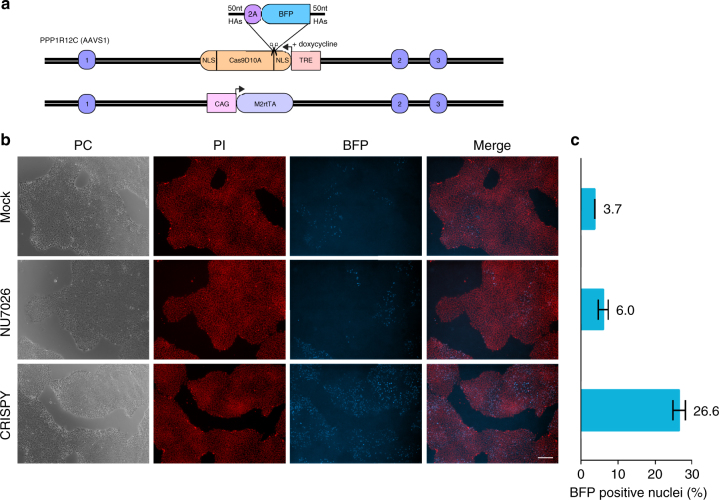
A now frequently used method to edit mammalian genomes uses the nucleases CRISPR/Cas9 and CRISPR/Cpf1 or the nickase CRISPR/Cas9n to introduce double-strand breaks which are then repaired by homology-directed repair using DNA donor molecules carrying desired mutations. Using a mixture of small molecules, the “CRISPY” mix, we achieve a 2.8- to 7.2-fold increase in precise genome editing with Cas9n, resulting in the introduction of the intended nucleotide substitutions in almost 50% of chromosomes or of gene encoding a blue fluorescent protein in 27% of cells, to our knowledge the highest editing efficiency in human induced pluripotent stem cells described to date. Furthermore, the CRISPY mix improves precise genome editing with Cpf1 2.3- to 4.0-fold, allowing almost 20% of chromosomes to be edited. The components of the CRISPY mix do not always increase the editing efficiency in the immortalized or primary cell lines tested, suggesting that employed repair pathways are cell-type specific.
Overview
The claims and statistics of this paper haven’t been checked yet.
Free: it reads the open-access text and checks the first 5 claims that cite a source we can check. Create a free account to check every claim.
Integrity signals
Registry
Cites
Statistics
Figures
Verification
Claims the paper makes
The claims and statistics of this paper haven’t been checked yet.
Free: it reads the open-access text and checks the first 5 claims that cite a source we can check. Create a free account to check every claim.
Claims other papers make about this one
Each is checked against this paper’s own text: does it say what the citing paper says it does?
In the citing paper
“The cell lines used were tested for the proper expression of pluripotency markers SOX2, OCT4, TRA-1-60 and SSEA, quantitative PCR confirmed the doxycycline-inducible Cas9n and digital PCR was used to exclude off-target integration49.”
From Inferring and perturbing cell fate regulomes in human brain organoids (2023) · cites this paper as [49]
Self-check
Percentages, sums and reported differences re-computed from the paper’s own numbers.
The self-check needs the paper’s full text.
Citations
Cites
Discovering Statistics Using SPSS
Field, A. P., & Miles, J. N. V. (2000) · Medical Entomology and Zoology · Cited by 28,294
Genome engineering using the CRISPR-Cas9 system
Ran, F. A., Hsu, P. D., Wright, J., Agarwala, V., Scott, D. A., & Zhang, F. (2013) · Nature Protocols · doi:10.1038/nprot.2013.143 · Cited by 11,133
Experimental Design and Data Analysis for Biologists
Quinn, G. P., & Keough, M. J. (2002) · doi:10.1017/cbo9780511806384 · Cited by 10,674
Cpf1 Is a Single RNA-Guided Endonuclease of a Class 2 CRISPR-Cas System
Zetsche, B., Gootenberg, J. S., Abudayyeh, O. O., Slaymaker, I. M., Makarova, K. S., Essletzbichler, P., Volz, S. E., Joung, J., van der Oost, J., Regev, A., et al. (2015) · Cell · doi:10.1016/j.cell.2015.09.038 · Cited by 4,761
O'Brien, J., Wilson, I., Orton, T., & Pognan, F. (2000) · European Journal of Biochemistry · doi:10.1046/j.1432-1327.2000.01606.x · Cited by 3,446
High-Frequency off-Target Mutagenesis Induced by CRISPR-Cas Nucleases in Human Cells
Fu, Y., Foden, J. A., Khayter, C., Maeder, M. L., Reyon, D., Joung, J. K., & Sander, J. D. (2013) · Nature Biotechnology · doi:10.1038/nbt.2623 · Cited by 3,292
The complete genome sequence of a Neanderthal from the Altai Mountains
Prüfer, K., Racimo, F., Patterson, N., Jay, F., Sankararaman, S., Sawyer, S., Heinze, A., Renaud, G., Sudmant, P. H., de Filippo, C., et al. (2014) · Nature · doi:10.1038/nature12886 · Cited by 2,254
Illumina Sequencing Library Preparation for Highly Multiplexed Target Capture and Sequencing
Meyer, M., & Kircher, M. (2010) · Cold Spring Harbor Protocols · doi:10.1101/pdb.prot5448 · Cited by 2,231
Autologous Induced Stem-Cell–Derived Retinal Cells for Macular Degeneration
Mandai, M., Watanabe, A., Kurimoto, Y., Hirami, Y., Morinaga, C., Daimon, T., Fujihara, M., Akimaru, H., Sakai, N., Shibata, Y., et al. (2017) · New England Journal of Medicine · doi:10.1056/nejmoa1608368 · Cited by 1,509
The ChEMBL bioactivity database: an update
Bento, A. P., Gaulton, A., Hersey, A., Bellis, L. J., Chambers, J., Davies, M., Krüger, F. A., Light, Y., Mak, L., McGlinchey, S., et al. (2014) · Nucleic Acids Research · doi:10.1093/nar/gkt1031 · Cited by 1,492
Research works printed but not linked: 1
- Zar, J. H. Biostatistical Analysis. (Prentice Hall: 1999).
Cited by
Ahmar, S., Gill, R. A., Jung, K.-H., Faheem, A., Qasim, M. U., Mubeen, M., & Zhou, W. (2020) · International Journal of Molecular Sciences · doi:10.3390/ijms21072590 · Cited by 596
“CRISPR class II has a type V effector named Cpf1, which can be designed with highly specific CRISPR RNA to cleave corresponding DNA sequences [108,109].”
BackgroundDNA Repair Pathway Choices in CRISPR-Cas9-Mediated Genome Editing
Xue, C., & Greene, E. C. (2021) · Trends in Genetics · doi:10.1016/j.tig.2021.02.008 · Cited by 431
Advances in genome editing through control of DNA repair pathways
Yeh, C. D., Richardson, C. D., & Corn, J. E. (2019) · Nature Cell Biology · doi:10.1038/s41556-019-0425-z · Cited by 405
Inferring and perturbing cell fate regulomes in human brain organoids
Fleck, J. S., Jansen, S. M. J., Wollny, D., Zenk, F., Seimiya, M., Jain, A., Okamoto, R., Santel, M., He, Z., Camp, J. G., et al. (2023) · Nature · doi:10.1038/s41586-022-05279-8 · Cited by 315
“The cell lines used were tested for the proper expression of pluripotency markers SOX2, OCT4, TRA-1-60 and SSEA, quantitative PCR confirmed the doxycycline-inducible Cas9n and digital PCR was used to exclude off-target integration 49 .”
Yang, H., Ren, S., Yu, S., Pan, H., Li, T., Ge, S., Zhang, J., & Xia, N. (2020) · International Journal of Molecular Sciences · doi:10.3390/ijms21186461 · Cited by 237
“6-fold(15–24%) Zebrafish embryos Ybx1 S82A GC [83] NS iPSC CTNB1/PRDM14 mNeoGreen KI [97]”
BackgroundInfluentialCRISPR-based genome editing through the lens of DNA repair
Nambiar, T. S., Baudrier, L., Billon, P., & Ciccia, A. (2022) · Molecular Cell · doi:10.1016/j.molcel.2021.12.026 · Cited by 208
Lineage recording in human cerebral organoids
He, Z., Maynard, A., Jain, A., Gerber, T., Petri, R., Lin, H.-C., Santel, M., Ly, K., Dupré, J.-S., Sidow, L., et al. (2022) · Nature Methods · doi:10.1038/s41592-021-01344-8 · Cited by 207
Self-citationCRISPR Cpf1 proteins: structure, function and implications for genome editing
Safari, F., Zare, K., Negahdaripour, M., Barekati-Mowahed, M., & Ghasemi, Y. (2019) · Cell & Bioscience · doi:10.1186/s13578-019-0298-7 · Cited by 193
“[62] have utilized a mixture of small molecules, called the “CRISPY” mix.”
BackgroundMethodFu, Y.-W., Dai, X.-Y., Wang, W.-T., Yang, Z.-X., Zhao, J.-J., Zhang, J.-P., Wen, W., Zhang, F., Oberg, K. C., Zhang, L., et al. (2021) · Nucleic Acids Research · doi:10.1093/nar/gkaa1251 · Cited by 180
“These data suggest that M3814 and TSA may be a universal combination for enhancing HDR in a variety of cell types and targets.”
MethodInfluentialSchober, K., Müller, T. R., Gökmen, F., Grassmann, S., Effenberger, M., Poltorak, M., Stemberger, C., Schumann, K., Roth, T. L., Marson, A., et al. (2019) · Nature Biomedical Engineering · doi:10.1038/s41551-019-0409-0 · Cited by 178
Klaus, J., Kanton, S., Kyrousi, C., Ayo-Martin, A. C., Di Giaimo, R., Riesenberg, S., O’Neill, A. C., Camp, J. G., Tocco, C., Santel, M., et al. (2019) · Nature Medicine · doi:10.1038/s41591-019-0371-0 · Cited by 169
Self-citationWimberger, S., Akrap, N., Firth, M. A., Brengdahl, J., Engberg, S., Schwinn, M. K., Slater, M. R., Lundin, A., Hsieh, P.-P., Li, S., et al. (2023) · Nature Communications · doi:10.1038/s41467-023-40344-4 · Cited by 149
“For example, DNA-PK inhibitors have been shown to decrease NHEJ and therefore enhance HDR 25 – 27 .”
Stimulation of CRISPR-mediated homology-directed repair by an engineered RAD18 variant
Nambiar, T. S., Billon, P., Diedenhofen, G., Hayward, S. B., Taglialatela, A., Cai, K., Huang, J.-W., Leuzzi, G., Cuella-Martin, R., Palacios, A., et al. (2019) · Nature Communications · doi:10.1038/s41467-019-11105-z · Cited by 129
A Revolution toward Gene-Editing Technology and Its Application to Crop Improvement
Ahmar, S., Saeed, S., Khan, M. H. U., Khan, S. U., Mora-Poblete, F., Kamran, M. A., Faheem, A., Maqsood, A., Rauf, M., Saleem, S., et al. (2020) · International Journal of Molecular Sciences · doi:10.3390/ijms21165665 · Cited by 145
Optimized design parameters for CRISPR Cas9 and Cas12a homology-directed repair
Schubert, M. S., Thommandru, B., Woodley, J., Turk, R., Yan, S., Kurgan, G., McNeill, M. S., & Rettig, G. R. (2021) · Scientific Reports · doi:10.1038/s41598-021-98965-y · Cited by 123
Simultaneous precise editing of multiple genes in human cells
Riesenberg, S., Chintalapati, M., Macak, D., Kanis, P., Maricic, T., & Pääbo, S. (2019) · Nucleic Acids Research · doi:10.1093/nar/gkz669 · Cited by 122
“Indeed, several small molecule inhibitors of DNA-PK have been described to moderately increase HDR (17,25).”
BackgroundMethodInfluentialSelf-citationOff-target effects in CRISPR-Cas genome editing for human therapeutics: Progress and challenges
Kalter, N., Fuster‐García, C., Silva, A., Ronco-Díaz, V., Roncelli, S., Turchiano, G., Gorodkin, J., Cathomen, T., Benabdellah, K., Lee, C. M., et al. (2025) · Molecular Therapy — Nucleic Acids · doi:10.1016/j.omtn.2025.102636 · Cited by 134
Global detection of DNA repair outcomes induced by CRISPR–Cas9
Liu, M., Zhang, W., Xin, C., Yin, J., Shang, Y., Chen, A., Li, J., Meng, F., & Hu, J. (2021) · Nucleic Acids Research · doi:10.1093/nar/gkab686 · Cited by 127
“In contrast, inhibitors for CtIP or RAD52 suppress HR and promote single-stranded oligonucleotide-mediated editing (22).”
BackgroundCas9-induced large deletions and small indels are controlled in a convergent fashion
Kosicki, M., Allen, F., Steward, F., Tomberg, K., Pan, Y., & Bradley, A. (2022) · Nature Communications · doi:10.1038/s41467-022-30480-8 · Cited by 115
Improving homology-directed repair efficiency in human stem cells
Skarnes, W. C., Pellegrino, E., & McDonough, J. A. (2019) · Methods · doi:10.1016/j.ymeth.2019.06.016 · Cited by 103
Improved gRNA secondary structures allow editing of target sites resistant to CRISPR-Cas9 cleavage
Riesenberg, S., Helmbrecht, N., Kanis, P., Maricic, T., & Pääbo, S. (2022) · Nature Communications · doi:10.1038/s41467-022-28137-7 · Cited by 109
Self-citationApplications and explorations of CRISPR/Cas9 in CAR T-cell therapy
Li, C., Mei, H., & Hu, Y. (2020) · Briefings in Functional Genomics · doi:10.1093/bfgp/elz042 · Cited by 104
“Attempts to increase HR frequencies using HR enhancers or NHEJ inhibitors are currently ongoing and may further promote precise gene engineering [79, 80].”
MethodEfficient high-precision homology-directed repair-dependent genome editing by HDRobust
Riesenberg, S., Kanis, P., Macak, D., Wollny, D., Düsterhöft, D., Kowalewski, J., Helmbrecht, N., Maricic, T., & Pääbo, S. (2023) · Nature Methods · doi:10.1038/s41592-023-01949-1 · Cited by 87
Self-citationCullot, G., Aird, E. J., Schlapansky, M. F., Yeh, C. D., van de Venn, L., Vykhlyantseva, I., Kreutzer, S., Mailänder, D., Lewków, B., Klermund, J., et al. (2024) · Nature Biotechnology · doi:10.1038/s41587-024-02488-6 · Cited by 94
“These on-target effects were previously associated with less selective DNA-PKcs inhibitors, suggesting that DNA-PKcs inhibition as a general class may be prone to such outcomes in human cells 12–15 .”
Recent advances in CRISPR/Cas9-mediated knock-ins in mammalian cells
Banan, M. (2019) · Journal of Biotechnology · doi:10.1016/j.jbiotec.2019.11.010 · Cited by 85
Fate and state transitions during human blood vessel organoid development
Nikolova, M. T., He, Z., Seimiya, M., Jonsson, G., Cao, W., Okuda, R., Wimmer, R. A., Okamoto, R., Nikoloff, J. M., Dittrich, P. S., et al. (2025) · Cell · doi:10.1016/j.cell.2025.03.037 · Cited by 69
Li, Z., Wang, J., Xu, J.-P., Wang, J., & Yang, X. F. (2023) · Military Medical Research · doi:10.1186/s40779-023-00447-x · Cited by 93
“Its clinical application is hampered by the need for additional DNA templates and HDR-promoting chemical agents with potential cytotoxicity, such as SCR7 [64], azidothymidine, trifluridine [71], NU7026, and NU7441 [72].”
Background5′-Modifications improve potency and efficacy of DNA donors for precision genome editing
Ghanta, K. S., Chen, Z., Mir, A., Dokshin, G. A., Krishnamurthy, P. M., Yoon, Y., Gallant, J., Xu, P., Zhang, X.-O., Ozturk, A. R., et al. (2021) · eLife · doi:10.7554/elife.72216 · Cited by 79
CRISPR nuclease off-target activity and mitigation strategies
Wienert, B., & Cromer, M. K. (2022) · Frontiers in Genome Editing · doi:10.3389/fgeed.2022.1050507 · Cited by 78
“…nonhomologous end joining (NHEJ)-mediators such as 53BP1 orDNAdependent protein kinase catalytic subunit can decrease indels and increase precise genome editing outcomes through homologydirected repair (Robert et al., 2015; Canny et al., 2018; Riesenberg and Maricic, 2018; Riesenberg et al., 2019).”
BackgroundA transient reporter for editing enrichment (TREE) in human cells
Standage-Beier, K., Tekel, S. J., Brookhouser, N., Schwarz, G., Nguyen, T., Wang, X., & Brafman, D. A. (2019) · Nucleic Acids Research · doi:10.1093/nar/gkz713 · Cited by 65
“In the future, we can utilize TREE in the context of highthroughput screening to identify small molecules to further enhance base editing efficiency in a manner similar to that which has been previously achieved with CRISPRmediated HDR approaches (34,35).”
MethodKostyushev, D. S., Kostyusheva, A. P., Brezgin, S. A., Zarifyan, D., Utkina, A., Goptar, I. A., & Chulanov, V. (2019) · Scientific Reports · doi:10.1038/s41598-019-38526-6 · Cited by 65
Current Strategies for Increasing Knock-In Efficiency in CRISPR/Cas9-Based Approaches
Leal, A., Herreno-Pachón, A., Benincore-Flórez, E., Karunathilaka, A., & Tomatsu, S. (2024) · International Journal of Molecular Sciences · doi:10.3390/ijms25052456 · Cited by 58
“Even though these molecules can enhance the HDR between 1.7-to 10-fold [99–101, 104 ], their effect seems cell-dependent”
BackgroundInfluentialImproving Precise CRISPR Genome Editing by Small Molecules: Is there a Magic Potion?
Bischoff, N., Wimberger, S., Maresca, M., & Brakebusch, C. (2020) · Cells · doi:10.3390/cells9051318 · Cited by 56
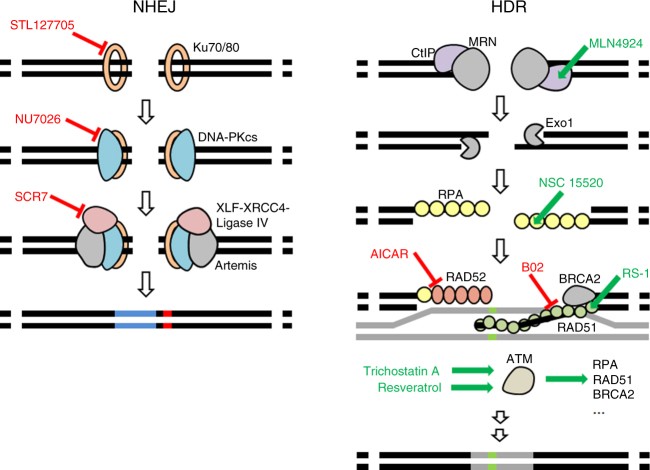
“5 μM), inhibiting neddylation of CtIP, and NSC15520 (5 μM), an inhibitor of the protein-protein interaction between the cell cycle checkpoint control proteins p53 or Rad9 and RPA70, in genome editing applications with Cas9 nickases increased KI efficiencies further [46].”
BackgroundMora‐Bermúdez, F., Kanis, P., Macak, D., Peters, J., Naumann, R., Sarov, M., Winkler, S., Oegema, C. E., Haffner, C., Xing, L., et al. (2022) · Science Advances · doi:10.1126/sciadv.abn7702 · Cited by 60
Self-citationSynergistic gene editing in human iPS cells via cell cycle and DNA repair modulation
Maurissen, T. L., & Woltjen, K. (2020) · Nature Communications · doi:10.1038/s41467-020-16643-5 · Cited by 53
Shams, F., Bayat, H., Mohammadian, O., Mahboudi, S., Vahidnezhad, H., Soosanabadi, M., & Rahimpour, A. (2022) · BioImpacts · doi:10.34172/bi.2022.23871 · Cited by 51
Sweeney, C. L., Pavel-Dinu, M., Choi, U., Brault, J., Liu, T., Koontz, S. M., Li, L., Theobald, N., Lee, J., Bello, E. A., et al. (2021) · Gene Therapy · doi:10.1038/s41434-021-00251-z · Cited by 52
Small molecules for mesenchymal stem cell fate determination
Cheng, Y., Dong, J., & Bian, Q. (2019) · World Journal of Stem Cells · doi:10.4252/wjsc.v11.i12.1084 · Cited by 51
Modeling Psychiatric Disorder Biology with Stem Cells
Das, D., Feuer, K., Wahbeh, M., & Avramopoulos, D. (2020) · Current Psychiatry Reports · doi:10.1007/s11920-020-01148-1 · Cited by 48
Kagita, A., Lung, M. S. Y., Xu, H., Kita, Y., Sasakawa, N., Iguchi, T., Ono, M., Wang, X. H., Gee, P., & Hotta, A. (2021) · Stem Cell Reports · doi:10.1016/j.stemcr.2021.02.013 · Cited by 50
“Several studies have been previously reported to achieve successful ssODN-mediated HDR in iPSCs by utilizing cell-cycle regulators (Lin et al., 2014; Yang et al., 2016), chemical inhibitors to suppress NHEJ (Ma et al., 2018; Riesenberg and Maricic, 2018; Yu et al., 2015), sib selection (Miyaoka et al., 2014, 2016), op…”
BackgroundInfluentialNew advances in CRISPR/Cas-mediated precise gene-editing techniques
Richardson, C., Kelsh, R. N., & Richardson, R. J. (2023) · Disease Models & Mechanisms · doi:10.1242/dmm.049874 · Cited by 57
“For example, RS-1 and SCR7 were effective in some cases yet had small or negative effects on PGE efficiency in others (Zhang et al., 2018; Riesenberg and Maricic, 2018).”
InfluentialModulation of DNA double-strand break repair as a strategy to improve precise genome editing
Ray, U., & Raghavan, S. C. (2020) · Oncogene · doi:10.1038/s41388-020-01445-2 · Cited by 49
Haider, S., & Mussolino, C. (2025) · International Journal of Molecular Sciences · doi:10.3390/ijms26094067 · Cited by 51
Technologies and Computational Analysis Strategies for CRISPR Applications
Clement, K., Hsu, J. Y., Canver, M. C., Joung, J. K., & Pinello, L. (2020) · Molecular Cell · doi:10.1016/j.molcel.2020.06.012 · Cited by 51
“…DNA templates can be provided to take advantage of HDR pathways to introduce precise genomic edits, albeit at lower efficiencies (though recent studies suggest that efficiency may be enhanced with small molecules [Riesenberg and Maricic, 2018; Song et al., 2016; Vartak and Raghavan, 2015]).”
BackgroundSingh, S., Chaudhary, R., Deshmukh, R. K., & Tiwari, S. (2022) · Plant Molecular Biology · doi:10.1007/s11103-022-01321-5 · Cited by 46
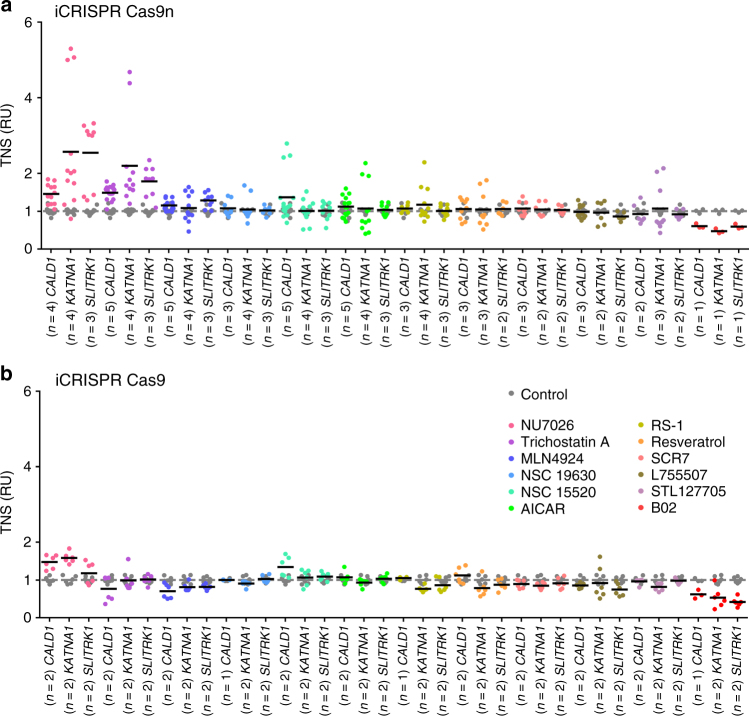
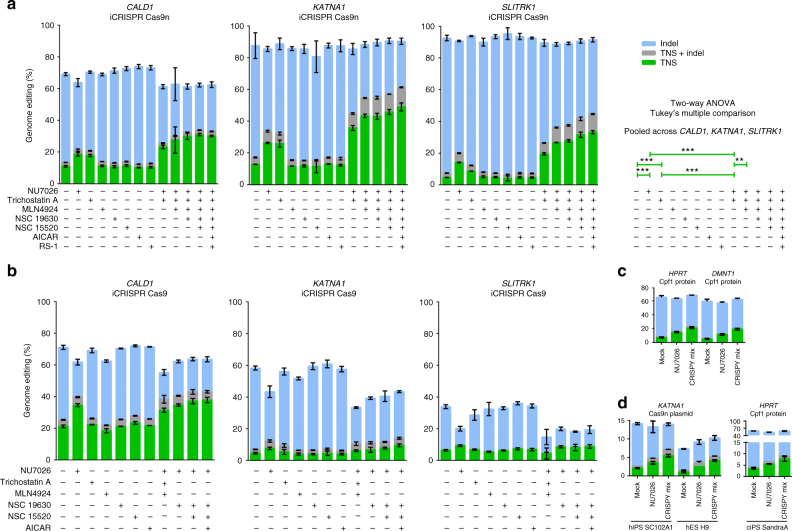
“…A—0.01 µM, NU7026—20 µM, MLN4924— 0.5 µM and NSC 15,520—5 µM) was investigated on multiple loci (CALD1, KATNA1, SLITRK1) to introduce targeted nucleotide substitution in iPSCs and achieved up to 7.2 fold higher efficiency as compared to without small molecules control (Riesenberg and Maricic 2018).”
MethodInfluentialPaving the way towards precise and safe CRISPR genome editing
Śledziński, P., Dabrowska, M., Nowaczyk, M., & Olejniczak, M. (2021) · Biotechnology Advances · doi:10.1016/j.biotechadv.2021.107737 · Cited by 45
Zhang, W., Chen, Y., Yang, J., Zhang, J., Yu, J., Wang, M., Zhao, X., Wei, K., Wan, X., Xu, X., et al. (2020) · eLife · doi:10.7554/elife.56008 · Cited by 41
“or promoting HR have been shown to improve knock-in efficiency (Riesenberg and Maricic, 2018).”
BackgroundMethodInfluentialTherapeutic gene editing in haematological disorders with CRISPR /Cas9
Jensen, T. I., Axelgaard, E., & Bak, R. O. (2019) · British Journal of Haematology · doi:10.1111/bjh.15851 · Cited by 43
“Several studies have focused on this particular challenge, attempting to increase the efficiency of HR by shifting the equilibrium between the two repair pathways towards HR using either HR enhancers or NHEJ inhibitors (Maruyama et al, 2015; Song et al, 2016; Riesenberg & Maricic, 2018).”
CRISPR–Cas9 gene editing induced complex on-target outcomes in human cells
Wen, W., & Zhang, X. (2022) · Experimental Hematology · doi:10.1016/j.exphem.2022.03.002 · Cited by 42
Increasing CRISPR/Cas9-mediated homology-directed DNA repair by histone deacetylase inhibitors
Li, G., Zhang, X., Wang, H., Liu, D., Li, Z., Wu, Z., & Yang, H. (2020) · The International Journal of Biochemistry & Cell Biology · doi:10.1016/j.biocel.2020.105790 · Cited by 39
Modulating CRISPR/Cas9 genome-editing activity by small molecules
Chen, S., Chen, D., Liu, B., & Haisma, H. J. (2021) · Drug Discovery Today · doi:10.1016/j.drudis.2021.11.018 · Cited by 32
Advantages and Limitations of Gene Therapy and Gene Editing for Friedreich’s Ataxia
Sivakumar, A., & Cherqui, S. (2022) · Frontiers in Genome Editing · doi:10.3389/fgeed.2022.903139 · Cited by 40
Multiparametric and accurate functional analysis of genetic sequence variants using CRISPR-Select
Niu, Y., Azevedo, C. A. F., Li, X., Kamali, E., Nielsen, O. H., Sørensen, C. S., & Frödin, M. (2022) · Nature Genetics · doi:10.1038/s41588-022-01224-7 · Cited by 33
RS‐1 enhances CRISPR‐mediated targeted knock‐in in bovine embryos
Lamas‐Toranzo, I., Martínez‐Moro, Á., Callaghan, E., de la Blanca, M. G. M., Sánchez, J. M., Lonergan, P., & Bermejo‐Álvarez, P. (2020) · Molecular Reproduction and Development · doi:10.1002/mrd.23341 · Cited by 29
“Unfortunately, the effects of these inhibitors have been shown to be cell‐type dependent, which has led to the development of complex combinations that are still inefficient in some cell types (Riesenberg & Maricic, 2018).”
BackgroundEvolution of CRISPR towards accurate and efficient mammal genome engineering
Ryu, S.-M., Hur, J. W., & Kim, K. (2019) · BMB Reports · doi:10.5483/bmbrep.2019.52.8.149 · Cited by 29
“Also, the related small molecules affected key molecules of major DNA repair mechanisms (58).”
BackgroundApproaches to Enhance Precise CRISPR/Cas9-Mediated Genome Editing
Denes, C. E., Cole, A. J., Aksoy, Y. A., Li, G., Neely, G. G., & Hesselson, D. (2021) · International Journal of Molecular Sciences · doi:10.3390/ijms22168571 · Cited by 32
“Although there are no reports testing the effects of this inhibitor on HDR efficiency, a study testing STL127685 (a 4-fluorophenyl analog of STL127705) showed no effect on CRISPR efficiency [29].”
BackgroundInfluentialKöcher, T., Bischof, J., Haas, S. A., March, O. P., Liemberger, B., Hainzl, S., Illmer, J., Hoog, A., Muigg, K., Binder, H., et al. (2021) · Molecular Therapy — Nucleic Acids · doi:10.1016/j.omtn.2021.05.015 · Cited by 28
Combining single-cell tracking and omics improves blood stem cell fate regulator identification
Wehling, A., Loeffler, D., Zhang, Y., Kull, T., Donato, C., Szczerba, B. M., Ortega, G. C., Lee, M., Moor, A. E., Göttgens, B., et al. (2022) · Blood · doi:10.1182/blood.2022016880 · Cited by 32
A Cas9–transcription factor fusion protein enhances homology-directed repair efficiency
Li, G., Wang, H., Zhang, X., Wu, Z., & Yang, H. (2021) · Journal of Biological Chemistry · doi:10.1016/j.jbc.2021.100525 · Cited by 28
“Previously reported small-molecule enhancers usually have a marginal or nonidentical effect to promote HDR (15, 16).”
BackgroundMaganti, H. B., Bailey, A. J.-M., Kirkham, A. M., Shorr, R., Pineault, N., & Allan, D. (2021) · Stem Cells Translational Medicine · doi:10.1002/sctm.20-0520 · Cited by 28
Nakayama, T., Grainger, R. M., & Cha, S. (2020) · genesis · doi:10.1002/dvg.23366 · Cited by 25
“Several reports including our own (S. W. C., Aslan et al., 2017) showed that some low molecular weight compounds increased efficiency of HDR in CRISPR/Cas9 genome editing (e.g., Aksoy et al., 2019; Li et al., 2017; Riesenberg & Maricic, 2018; Song et al., 2016).”
BackgroundMethodOrthotopic T-Cell Receptor Replacement—An “Enabler” for TCR-Based Therapies
Schober, K., Müller, T. R., & Busch, D. H. (2020) · Cells · doi:10.3390/cells9061367 · Cited by 25
“Small molecules that act as inhibitors of NHEJ or enhancers of HDR were also reported to lead to higher insertion efficiencies in T cells [95]; however, in the published report, overall insertion efficiencies in T cells were rather modest and, in our hands, such molecules did not lead to improved editing efficiencies…”
BackgroundChemogenetic System Demonstrates That Cas9 Longevity Impacts Genome Editing Outcomes
Sreekanth, V., Zhou, Q., Kokkonda, P., Bermudez-Cabrera, H. C., Lim, D., Law, B. K., Holmes, B. R., Chaudhary, S. K., Pergu, R., Leger, B. S., et al. (2020) · ACS Central Science · doi:10.1021/acscentsci.0c00129 · Cited by 25
“To therefore improve the frequency of HDR, various approaches have been reported, including using small-molecule inhibitors of NHEJ, 40 − 43 though such approaches can have severe adverse e ff ects.”
Dony, L., Krontira, A. C., Kaspar, L., Ahmad, R., Demirel, I. S., Grochowicz, M., Schäfer, T., Begum, F., Sportelli, V., Raimundo, C., et al. (2025) · Science Advances · doi:10.1126/sciadv.adn8631 · Cited by 23
Methodologies and Challenges for CRISPR/Cas9 Mediated Genome Editing of the Mammalian Brain
Nishizono, H., Yasuda, R., & Laviv, T. (2020) · Frontiers in Genome Editing · doi:10.3389/fgeed.2020.602970 · Cited by 26
“In addition, several small molecules have been reported to increase the efficiency of HDR in genome editing of fertilized eggs (Chu et al., 2015; Riesenberg and Maricic, 2018; Zhang et al., 2020).”
BackgroundLineage recording reveals dynamics of cerebral organoid regionalizationPreprint
He, Z., Gerber, T., Maynard, A., Jain, A., Petri, R., Santel, M., Ly, K. C. H., Sidow, L., Sanchís-Calleja, F., Riesenberg, S., et al. (2020) · bioRxiv (Cold Spring Harbor Laboratory) · doi:10.1101/2020.06.19.162032 · Cited by 24
Self-citationTang, N., Zhang, Y., Shen, Z., Yao, Y., & Nair, V. (2021) · The CRISPR Journal · doi:10.1089/crispr.2021.0017 · Cited by 24
NHEJ inhibitor SCR7 and its different forms: Promising CRISPR tools for genome engineering
Ray, U., Vartak, S. V., & Raghavan, S. C. (2020) · Gene · doi:10.1016/j.gene.2020.144997 · Cited by 23
Small molecule inhibition of ATM kinase increases CRISPR-Cas9 1-bp insertion frequency
Bermudez-Cabrera, H. C., Culbertson, S. J., Barkal, S. A., Holmes, B., Shen, M. W., Zhang, S., Gifford, D. K., & Sherwood, R. I. (2021) · Nature Communications · doi:10.1038/s41467-021-25415-8 · Cited by 22
Tissue Specific DNA Repair Outcomes Shape the Landscape of Genome Editing
Meyenberg, M., da Silva, J. F., & Loizou, J. I. (2021) · Frontiers in Genetics · doi:10.3389/fgene.2021.728520 · Cited by 23
Antony, J. S., Haque, A. K. M. A., Lamsfus‐Calle, A., Daniel-Moreno, A., Mezger, M., & Kormann, M. (2018) · Advances in Cell and Gene Therapy · doi:10.1002/acg2.10 · Cited by 21
“However, studies with small-molecule inhibitors showed high level of variance in different cell lines.(81) These data clearly demand the substantial improvement on compound screening and further validation in target”
BackgroundRapid genome editing by CRISPR-Cas9-POLD3 fusion
Reint, G., Li, Z., Labun, K., Keskitalo, S., Soppa, I., Mamia, K., Tölö, E., Szymanska, M., Meza‐Zepeda, L. A., Lorenz, S., et al. (2021) · eLife · doi:10.7554/elife.75415 · Cited by 21
Studying the mechanisms of neurodegeneration: C. elegans advantages and opportunities
Torres, A. K., Mira, R. G., Pinto, C., & Inestrosa, N. C. (2025) · Frontiers in Cellular Neuroscience · doi:10.3389/fncel.2025.1559151 · Cited by 19
“HDR is less efficient and effective than NHEJ, nevertheless, studies are trying to improve the efficiency of this technique (Riesenberg et al., 2023; Riesenberg and Maricic, 2018; Robert et al., 2015).”
Robust genome editing via modRNA-based Cas9 or base editor in human pluripotent stem cells
Haideri, T., Howells, A. R., Jiang, Y., Yang, J., Bao, X., & Lian, X. L. (2022) · Cell Reports Methods · doi:10.1016/j.crmeth.2022.100290 · Cited by 22
“Development of new transfection reagents and/or inclusion of small molecules targeting DNA repair pathways may further improve modRNA-based gene-editing performance (Riesenberg and Maricic, 2018).”
BackgroundCRISPR/Cas-Based Gene Editing Tools for Large DNA Fragment Integration
Yang, S., Hu, G., Wang, J., & Song, J. (2024) · ACS Synthetic Biology · doi:10.1021/acssynbio.4c00632 · Cited by 19
Towards clinical application of tissue engineering for erectile penile regeneration
Andrew, T. W., Kanapathy, M., Murugesan, L., Muneer, A., Kalaskar, D. M., & Atala, A. (2019) · Nature Reviews Urology · doi:10.1038/s41585-019-0246-7 · Cited by 17
Kato, S., Fukazawa, T., & Kubo, T. (2021) · Biochemical and Biophysical Research Communications · doi:10.1016/j.bbrc.2020.11.038 · Cited by 17
Examination of the Cell Cycle Dependence of Cytosine and Adenine Base Editors
Burnett, C. A., Wong, A. T., Vasquez, C. A., McHugh, C. A., Yeo, G. W.-M., & Komor, A. C. (2022) · Frontiers in Genome Editing · doi:10.3389/fgeed.2022.923718 · Cited by 17
Yu, J., Xiang, X., Huang, J., Liang, X., Pan, X., Dong, Z., Petersen, T. S., Qu, K., Yang, L. M., Zhao, X., et al. (2019) · Nucleic Acids Research · doi:10.1093/nar/gkz1233 · Cited by 17
Applications of Functional Genomics for Drug Discovery
Kabadi, A. M., McDonnell, E., Frank, C. L., & Drowley, L. (2020) · SLAS DISCOVERY · doi:10.1177/2472555220902092 · Cited by 17
Inhibitors of DNA double-strand break repair at the crossroads of cancer therapy and genome editing
Ray, U., & Raghavan, S. C. (2020) · Biochemical Pharmacology · doi:10.1016/j.bcp.2020.114195 · Cited by 16
Advances and Obstacles in Homology-Mediated Gene Editing of Hematopoietic Stem Cells
Salisbury-Ruf, C. T., & Larochelle, A. (2021) · Journal of Clinical Medicine · doi:10.3390/jcm10030513 · Cited by 15
“The type II CRISPR/Cas9 system derived from Streptococcus pyogenes (SpCas9) is currently the most widely used tool for genome editing in hematopoietic and other cellular sources.”
BackgroundResultInfluentialBosshard, S., Duroy, P., & Mermod, N. (2019) · DNA repair · doi:10.1016/j.dnarep.2019.102691 · Cited by 16
Adaptation of Human Testicular Niche Cells for Pluripotent Stem Cell and Testis Development Research
Pryzhkova, M. V., & Jordan, P. W. (2020) · Tissue Engineering and Regenerative Medicine · doi:10.1007/s13770-020-00240-0 · Cited by 16
Li, W., Liu, S., Fang, X., Zou, J., Jiang, Q., Min, X., Zhu, X., Cao, Y., Gao, X., Han, W., et al. (2025) · Nature Communications · doi:10.1038/s41467-025-67239-w · Cited by 14
Enhancement of CRISPR-Cas9 induced precise gene editing by targeting histone H2A-K15 ubiquitination
Bashir, S., Dang, T., Rossius, J., Wolf, J., & Kühn, R. (2020) · BMC Biotechnology · doi:10.1186/s12896-020-00650-x · Cited by 15
“Previous studies for HDR stimulation did not actively target DNA damage ubiquitination but either used Cas9 fusion proteins [4, 5, 12], targeted enzymes at earlier or later stages of DSB repair [10, 11, 28], confined Cas9 activity to the S/G2 cell cycle phases [6–9] or suppressed NHEJ by interfering with 53BP1 binding…”
BackgroundDisease modeling and stem cell immunoengineering in regenerative medicine using CRISPR/Cas9 systems
Antao, A. M., Karapurkar, J. K., Lee, D. R., Kim, K.-S., & Ramakrishna, S. (2020) · Computational and Structural Biotechnology Journal · doi:10.1016/j.csbj.2020.11.026 · Cited by 14
“The efficiency of HDR has been improved utilizing single-stranded donors [253,254] and small molecules [14,16], varying the lengths of homologous arms [255], or using modified double-stranded donors [256].”
BackgroundYiğider, E., Taşpınar, M. S., & Ağar, G. (2023) · Planta · doi:10.1007/s00425-023-04199-9 · Cited by 15
“Accordingly, many scientists have tried strategies to develop the HDR repair mechanism process and/or suppress the NHEJ pathway by targeting essential components for more effective HDR-mediated precise genome editing (Riesenberg and Maricic 2018; Jayavaradhan et al.”
BackgroundEnhancing CRISPR deletion via pharmacological delay of DNA-PKcs
Bosch-Guiteras, N., Uroda, T., Guillen-Ramirez, H., Riedo, R., Gazdhar, A., Esposito, R., Pulido-Quetglas, C., Zimmer, Y., Medová, M., & Johnson, R. (2021) · Genome Research · doi:10.1101/gr.265736.120 · Cited by 13
“A fourth possibility is that DSBs are repaired via HDR using the sister’s chromatid as a template, which can be retargeted by the CRISPR complex.”
BackgroundMethodInfluentialPugliano, C. M., Berger, M. P., Ray, R. M., Sapkos, K., Wu, B., Laird, A., Ye, Y., Thomson, D., DeGottardi, M. Q., Khan, I., et al. (2024) · Molecular Therapy — Methods & Clinical Development · doi:10.1016/j.omtm.2024.101297 · Cited by 13
“26,27 29 – 31 We previously described ef fi cient rAAV6-based HDR editing in primary T cells as a potential therapeutic strategy for XHIM.”
Prime Editing: Mechanistic Insights and DNA Repair Modulation
Mentani, A., Maresca, M., & Shiriaeva, A. (2025) · Cells · doi:10.3390/cells14040277 · Cited by 15
“Other groups later demonstrated a 1.2–2.5-fold HDR improvement with NU7026 and Cas9 [146,153,165].”
InfluentialCRISPR-Cas9 based genome editing for defective gene correction in humans and other mammals
Karapurkar, J. K., Antao, A. M., Kim, K.-S., & Ramakrishna, S. (2021) · Progress in molecular biology and translational science · doi:10.1016/bs.pmbts.2021.01.018 · Cited by 14
Lee, A. B. C., Tan, M. H., & Chai, C. L. L. (2022) · Drug Discovery Today · doi:10.1016/j.drudis.2022.06.006 · Cited by 13
Riesenberg, S., Kanis, P., Karlić, R., & Maričić, T. (2025) · Nature Communications · doi:10.1038/s41467-025-59947-0 · Cited by 12
“It is tempting to speculate that sticky ends generated for Cas12a compared to blunt ends generated by Cas9 in fl uenceDSB repair sub-pathways 24,60 resulting in a drastically reduced tendency for large-scale repair for Cas12a.”
Self-citationA Molecular Glue Approach to Control the Half-Life of CRISPR-Based Technologies
Sreekanth, V., Jan, M., Zhao, K. T., Lim, D., Siriwongsup, S., Davis, J. R., McConkey, M. E., Kovalcik, V., Barkal, S., Law, B. K., et al. (2025) · Journal of the American Chemical Society · doi:10.1021/jacs.5c06230 · Cited by 12
Tekel, S. J., Brookhouser, N., Standage-Beier, K., Wang, X., & Brafman, D. A. (2021) · Nature Protocols · doi:10.1038/s41596-021-00552-y · Cited by 12
Vlassis, A., Jensen, T. L., Mohr, M., Jędrzejczyk, D., Meng, X., Kovács, G. E., Morera-Gómez, M., Barghetti, A., Abad, S. M., Baumgartner, R. F., et al. (2023) · iScience · doi:10.1016/j.isci.2023.108287 · Cited by 11
“25,26 Use of anionic nanoparticles for RNP and HDRT delivery showed improved insertion efficiencies in a wide range of cells, 27 whileadding enhancers of the HDR-dependent DNA repair, or inhibitors of the non-homologous end-joining (NHEJ) repair, or a combination of these, increases gene integration…”
BackgroundHermantara, R., Richmond, L., Taqi, A. F., Chilaka, S., Jeantet, V., Guerrini, I., West, K. L., & West, A. G. (2024) · Journal of Biomedical Science · doi:10.1186/s12929-024-01020-x · Cited by 11
“In CRISPR–Cas9 genetic editing experiment, B02 treatment reduces HR outcomes from single stranded oligonucleotide donor template [8].”
BackgroundMethodInfluentialLi, W., Chan, C., Zeng, C., Turk, R., Behlke, M. A., Cheng, X., & Dong, Y. (2020) · Bioconjugate Chemistry · doi:10.1021/acs.bioconjchem.0c00062 · Cited by 11
Valproic Acid Thermally Destabilizes and Inhibits SpyCas9 Activity
Cheng, X. (2020) · Molecular Therapy · doi:10.1016/j.ymthe.2020.08.014 · Cited by 11
“Because HDACis can activate DNA damage/ repair system, which is involved in CRISPR-Cas9-mediated DNA strand break and repair, the effect of HDACis on CRISPR-Cas9 system is intensively investigated.(20) Takayama et al.”
Background
Metadata
- Authors
- Riesenberg, S., & Maricic, T.
- Affiliations
- Max Planck Institute for Evolutionary Anthropology (DE)
- Corresponding author
- Riesenberg, Stephan
- ORCID
- Riesenberg, Stephan
- Venue
- Nature Communications
- Published
- 2018-06-04
- Volume
- 9
- Issue
- 1
- Pages
- 2164-2164
- ISSN
- 2041-1723 (ISSN-L)
- PMC
- PMC5986859
- OpenAlex
- W2950124537
- Cited by
- 174
- References
- 49
- Citations by year
- 2026: 11 · 2025: 25 · 2024: 17 · 2023: 16 · 2022: 23 · 2021: 27 · 2020: 33 · 2019: 20 · 2018: 2
- FWCI
- 7.29
- Type
- journal article
- Language
- en
- Open access
- gold
- doi.org
- Licence
- cc-by
- creativecommons.org/licenses/by/4.0 (tdm)
- creativecommons.org/licenses/by/4.0 (vor)
- Locations
- Nature Communications (publishedVersion, cc-by)
- bioRxiv (Cold Spring Harbor Laboratory) (acceptedVersion, cc-by-nc-nd)
- Europe PMC (PubMed Central) (publishedVersion, cc-by)
- PubMed Central (publishedVersion, cc-by)
- PubMed (publishedVersion)
- RePEc: Research Papers in Economics (submittedVersion)
- DOAJ (DOAJ: Directory of Open Access Journals) (submittedVersion)
- DOAJ (DOAJ: Directory of Open Access Journals) (submittedVersion, cc-by-sa)
- MPG.PuRe (Max Planck Society) (submittedVersion, other-oa)
- Funders
- Max-Planck-Gesellschaft
- NOMIS Stiftung
- Topics
- Life Sciences › Biochemistry, Genetics and Molecular Biology › Molecular Biology › CRISPR and Genetic Engineering
- Life Sciences › Biochemistry, Genetics and Molecular Biology › Molecular Biology › RNA regulation and disease
- Life Sciences › Biochemistry, Genetics and Molecular Biology › Molecular Biology › DNA Repair Mechanisms
- Keywords
- CRISPR/Cas9 nickase, CRISPR/Cas12a, homology-directed repair, precise genome editing, induced pluripotent stem cells, editing efficiency, DNA double-strand break repair
- MeSH terms
- Gene Editing, Animals, Cell Line, DNA Repair, Humans, Models, Genetic, Mutation, K562 Cells, Pluripotent Stem Cells, DNA Breaks, Double-Stranded, Small Molecule Libraries, Induced Pluripotent Stem Cells, HEK293 Cells, CRISPR-Cas Systems
About these checks
Registry, retraction, Cites and statistics results are computed, not judged, with one exception: a printed reference that no index lists is read once by a model before it counts as a citation error. Claims are extracted by a model and kept only when their quote appears verbatim in the text; each cited source is then checked, with a model’s help, for whether it says what the claim relies on. Those verdicts can be wrong — read the claim’s quote and the cited source before relying on one.
Statistics and arithmetic are recomputed, not judged.
Confidence bands are shown only for fields calibrated on our annotated test set. None is calibrated yet, so no band is shown.
What counts as a claim ›How we measure confidence ›How we check this ›
Are you an author, or do you see a problem with this page? Request a review
Data sources
Bibliographic data: Semantic Scholar, OpenAlex, Crossref.
Contains information from the Semantic Scholar Academic Graph Datasets, made available under the ODC Attribution License (ODC-BY 1.0).
Semantic Scholar’s data is described in: Kinney, R., et al. (2023). The Semantic Scholar Open Data Platform. arXiv:2301.10140.
