

Targeting repair pathways with small molecules increases precise genome editing in pluripotent stem cells
Open accessPublished version of a preprint
The DOI matches its Crossref record; 49 of the 49 references it cites were found in a registry or an index.
Abstract
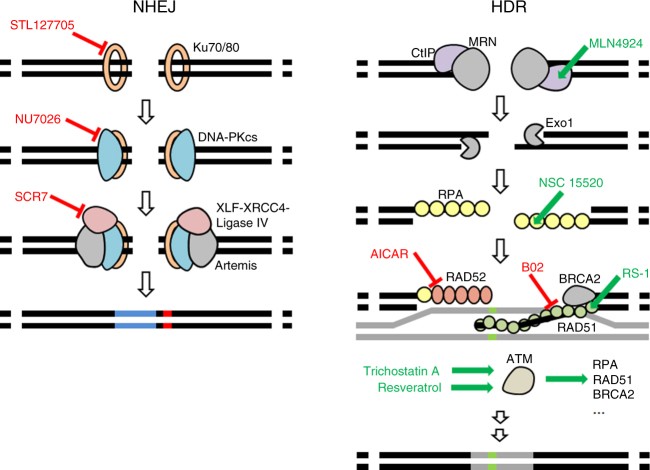
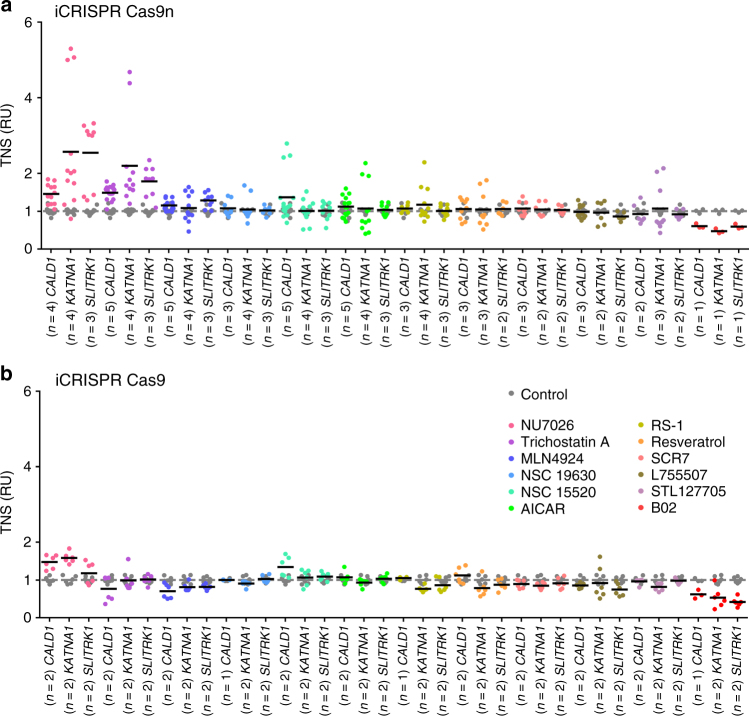
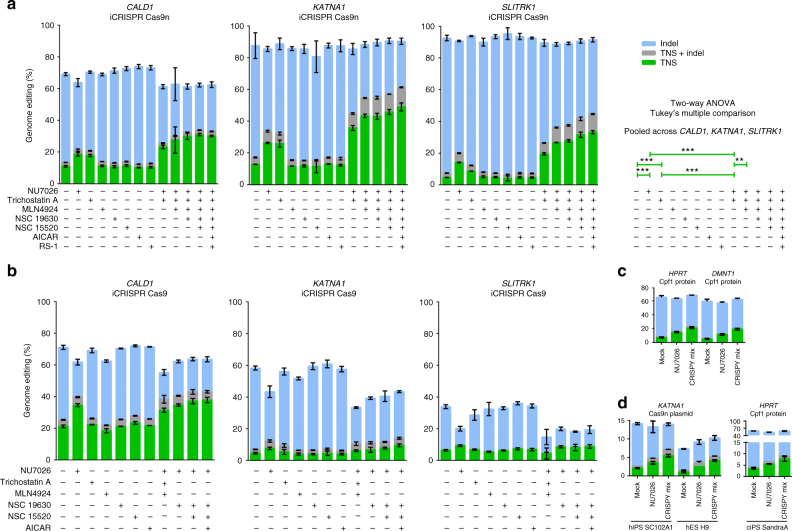
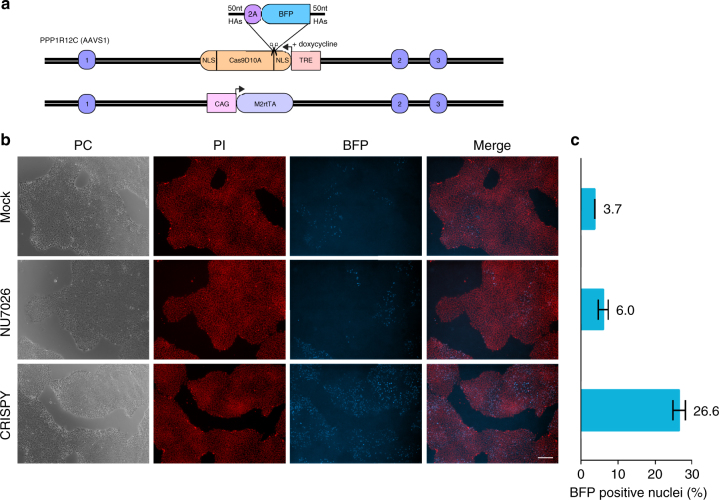
A now frequently used method to edit mammalian genomes uses the nucleases CRISPR/Cas9 and CRISPR/Cpf1 or the nickase CRISPR/Cas9n to introduce double-strand breaks which are then repaired by homology-directed repair using DNA donor molecules carrying desired mutations. Using a mixture of small molecules, the “CRISPY” mix, we achieve a 2.8- to 7.2-fold increase in precise genome editing with Cas9n, resulting in the introduction of the intended nucleotide substitutions in almost 50% of chromosomes or of gene encoding a blue fluorescent protein in 27% of cells, to our knowledge the highest editing efficiency in human induced pluripotent stem cells described to date. Furthermore, the CRISPY mix improves precise genome editing with Cpf1 2.3- to 4.0-fold, allowing almost 20% of chromosomes to be edited. The components of the CRISPY mix do not always increase the editing efficiency in the immortalized or primary cell lines tested, suggesting that employed repair pathways are cell-type specific.
Overview
The claims and statistics of this paper haven’t been checked yet.
Free: it reads the open-access text and checks the first 5 claims that cite a source we can check. Create a free account to check every claim.
Integrity signals
Registry
Cites
Statistics
Figures
Verification
Claims the paper makes
The claims and statistics of this paper haven’t been checked yet.
Free: it reads the open-access text and checks the first 5 claims that cite a source we can check. Create a free account to check every claim.
Claims other papers make about this one
Each is checked against this paper’s own text: does it say what the citing paper says it does?
In the citing paper
“The cell lines used were tested for the proper expression of pluripotency markers SOX2, OCT4, TRA-1-60 and SSEA, quantitative PCR confirmed the doxycycline-inducible Cas9n and digital PCR was used to exclude off-target integration49.”
From Inferring and perturbing cell fate regulomes in human brain organoids (2023) · cites this paper as [49]
Self-check
Percentages, sums and reported differences re-computed from the paper’s own numbers.
The self-check needs the paper’s full text.
Citations
Cites
Discovering Statistics Using SPSS
Field, A. P., & Miles, J. N. V. (2000) · Medical Entomology and Zoology · Cited by 28,294
Genome engineering using the CRISPR-Cas9 system
Ran, F. A., Hsu, P. D., Wright, J., Agarwala, V., Scott, D. A., & Zhang, F. (2013) · Nature Protocols · doi:10.1038/nprot.2013.143 · Cited by 11,133
Experimental Design and Data Analysis for Biologists
Quinn, G. P., & Keough, M. J. (2002) · doi:10.1017/cbo9780511806384 · Cited by 10,674
Cpf1 Is a Single RNA-Guided Endonuclease of a Class 2 CRISPR-Cas System
Zetsche, B., Gootenberg, J. S., Abudayyeh, O. O., Slaymaker, I. M., Makarova, K. S., Essletzbichler, P., Volz, S. E., Joung, J., van der Oost, J., Regev, A., et al. (2015) · Cell · doi:10.1016/j.cell.2015.09.038 · Cited by 4,761
O'Brien, J., Wilson, I., Orton, T., & Pognan, F. (2000) · European Journal of Biochemistry · doi:10.1046/j.1432-1327.2000.01606.x · Cited by 3,446
High-Frequency off-Target Mutagenesis Induced by CRISPR-Cas Nucleases in Human Cells
Fu, Y., Foden, J. A., Khayter, C., Maeder, M. L., Reyon, D., Joung, J. K., & Sander, J. D. (2013) · Nature Biotechnology · doi:10.1038/nbt.2623 · Cited by 3,292
The complete genome sequence of a Neanderthal from the Altai Mountains
Prüfer, K., Racimo, F., Patterson, N., Jay, F., Sankararaman, S., Sawyer, S., Heinze, A., Renaud, G., Sudmant, P. H., de Filippo, C., et al. (2014) · Nature · doi:10.1038/nature12886 · Cited by 2,254
Illumina Sequencing Library Preparation for Highly Multiplexed Target Capture and Sequencing
Meyer, M., & Kircher, M. (2010) · Cold Spring Harbor Protocols · doi:10.1101/pdb.prot5448 · Cited by 2,231
Autologous Induced Stem-Cell–Derived Retinal Cells for Macular Degeneration
Mandai, M., Watanabe, A., Kurimoto, Y., Hirami, Y., Morinaga, C., Daimon, T., Fujihara, M., Akimaru, H., Sakai, N., Shibata, Y., et al. (2017) · New England Journal of Medicine · doi:10.1056/nejmoa1608368 · Cited by 1,509
The ChEMBL bioactivity database: an update
Bento, A. P., Gaulton, A., Hersey, A., Bellis, L. J., Chambers, J., Davies, M., Krüger, F. A., Light, Y., Mak, L., McGlinchey, S., et al. (2014) · Nucleic Acids Research · doi:10.1093/nar/gkt1031 · Cited by 1,492
Regulation of DNA double-strand break repair pathway choice
Shrivastav, M., De Haro, L. P., & Nickoloff, J. A. (2008) · Cell Research · doi:10.1038/cr.2007.111 · Cited by 1,329
Chu, V. T., Weber, T., Wefers, B., Wurst, W., Sander, S., Rajewsky, K., & Kühn, R. (2015) · Nature Biotechnology · doi:10.1038/nbt.3198 · Cited by 1,210
Enhanced homology-directed human genome engineering by controlled timing of CRISPR/Cas9 delivery
Lin, S., Staahl, B. T., Alla, R. K., & Doudna, J. A. (2014) · eLife · doi:10.7554/elife.04766 · Cited by 1,189
In vivo genome editing via CRISPR/Cas9 mediated homology-independent targeted integration
Suzuki, K., Tsunekawa, Y., Hernandez-Benitez, R., Wu, J., Zhu, J., Kim, E. J., Hatanaka, F., Yamamoto, M., Araoka, T., Li, Z., et al. (2016) · Nature · doi:10.1038/nature20565 · Cited by 1,150
Maruyama, T., Dougan, S. K., Truttmann, M. C., Bilate, A. M., Ingram, J. R., & Ploegh, H. L. (2015) · Nature Biotechnology · doi:10.1038/nbt.3190 · Cited by 1,137
The promise of induced pluripotent stem cells in research and therapy
Robinton, D. A., & Daley, G. Q. (2012) · Nature · doi:10.1038/nature10761 · Cited by 1,111
Double indexing overcomes inaccuracies in multiplex sequencing on the Illumina platform
Kircher, M., Sawyer, S., & Meyer, M. (2012) · Nucleic Acids Research · doi:10.1093/nar/gkr771 · Cited by 1,106
Efficient genome modification by CRISPR-Cas9 nickase with minimal off-target effects
Shen, B., Zhang, W., Zhang, J., Zhou, J., Wang, J., Chen, L., Wang, L., Hodgkins, A., Iyer, V., Huang, X., et al. (2014) · Nature Methods · doi:10.1038/nmeth.2857 · Cited by 769
Genome-wide analysis reveals specificities of Cpf1 endonucleases in human cells
Kim, D., Kim, J., Hur, J. K., Been, K. W., Yoon, S.-H., & Kim, J.-S. (2016) · Nature Biotechnology · doi:10.1038/nbt.3609 · Cited by 731
Book Review: Discovering Statistics Using SPSS
Field, A., & Gaitanou, C. (2005) · PsyPag Quarterly · doi:10.53841/bpspag.2005.1.56.31 · Cited by 679
Genome-wide specificities of CRISPR-Cas Cpf1 nucleases in human cells
Kleinstiver, B. P., Tsai, S. Q., Prew, M. S., Nguyen, N. T., Welch, M. M., Lopez, J. M., McCaw, Z. R., Aryee, M. J., & Joung, J. K. (2016) · Nature Biotechnology · doi:10.1038/nbt.3620 · Cited by 670 · cited 1×
“Overall, there was a clear treatment effect (F(12, 24)= 32.”
BackgroundGonzález, F., Zhu, Z., Shi, Z.-D., Lelli, K., Verma, N., Li, Q. V., & Huangfu, D. (2014) · Cell Stem Cell · doi:10.1016/j.stem.2014.05.018 · Cited by 503
Zhang, J.-P., Li, X.-L., Li, G.-H., Chen, W., Arakaki, C., Botimer, G. D., Baylink, D., Zhang, L., Wen, W., Fu, Y.-W., et al. (2017) · Genome Biology · doi:10.1186/s13059-017-1164-8 · Cited by 478
Analyzing CRISPR genome-editing experiments with CRISPResso
Pinello, L., Canver, M. C., Hoban, M. D., Orkin, S. H., Kohn, D. B., Bauer, D. E., & Yuan, G.-C. (2016) · Nature Biotechnology · doi:10.1038/nbt.3583 · Cited by 459
Small molecules enhance CRISPR genome editing in pluripotent stem cells
Yu, C., Liu, Y., Ma, T., Liu, K., Xu, S., Zhang, Y., Liu, H., La Russa, M., Xie, M., Ding, S., et al. (2015) · Cell stem cell · doi:10.1016/j.stem.2015.01.003 · Cited by 455
RS-1 enhances CRISPR/Cas9- and TALEN-mediated knock-in efficiency
Song, J., Yang, D., Xu, J., Zhu, T., Chen, Y. E., & Zhang, J. (2016) · Nature Communications · doi:10.1038/ncomms10548 · Cited by 422
Unraveling CRISPR-Cas9 genome engineering parameters via a library-on-library approach
Chari, R., Mali, P., Moosburner, M., & Church, G. M. (2015) · Nature Methods · doi:10.1038/nmeth.3473 · Cited by 401
An Enhanced Monomeric Blue Fluorescent Protein with the High Chemical Stability of the Chromophore
Subach, O. M., Cranfill, P. J., Davidson, M. W., & Verkhusha, V. V. (2011) · PLoS ONE · doi:10.1371/journal.pone.0028674 · Cited by 352
DNA-Damage Response in Tissue-Specific and Cancer Stem Cells
Blanpain, C., Mohrin, M., Sotiropoulou, P. A., & Passegué, E. (2011) · Cell Stem Cell · doi:10.1016/j.stem.2010.12.012 · Cited by 348
ISCN 2016: An International System for Human Cytogenomic Nomenclature (2016)
(2016) · KARGER eBooks · doi:10.1159/isbn.978-3-318-05979-3 · Cited by 345
A Mouse Geneticist’s Practical Guide to CRISPR Applications
Singh, P., Schimenti, J. C., & Bolcun-Filas, E. (2015) · Genetics · doi:10.1534/genetics.114.169771 · Cited by 305
Mora-Bermúdez, F., Badsha, F., Kanton, S., Camp, J. G., Vernot, B., Köhler, K., Voigt, B., Okita, K., Maricic, T., He, Z., et al. (2016) · eLife · doi:10.7554/elife.18683 · Cited by 291
Pinder, J., Salsman, J., & Dellaire, G. (2015) · Nucleic Acids Research · doi:10.1093/nar/gkv993 · Cited by 279
leeHom: adaptor trimming and merging for Illumina sequencing reads
Renaud, G., Stenzel, U., & Kelso, J. (2014) · Nucleic Acids Research · doi:10.1093/nar/gku699 · Cited by 274
Pharmacological inhibition of DNA-PK stimulates Cas9-mediated genome editing
Robert, F., Barbeau, M., Éthier, S., Dostie, J., & Pelletier, J. (2015) · Genome Medicine · doi:10.1186/s13073-015-0215-6 · Cited by 255 · cited 1×
“Overall, there was a clear treatment effect (F(12, 24)= 32.”
BackgroundYang, D., Scavuzzo, M. A., Chmielowiec, J., Sharp, R., Bajic, A., & Borowiak, M. (2016) · Scientific Reports · doi:10.1038/srep21264 · Cited by 200
A Backup DNA Repair Pathway Moves to the Forefront
Nussenzweig, A., & Nussenzweig, M. C. (2007) · Cell · doi:10.1016/j.cell.2007.10.005 · Cited by 191
Bothmer, A., Phadke, T., Barrera, L. A., Margulies, C. M., Lee, C. S., Buquicchio, F., Moss, S., Abdulkerim, H. S., Selleck, W., Jayaram, H., et al. (2017) · Nature Communications · doi:10.1038/ncomms13905 · Cited by 187
Alternative pathways of non-homologous end joining (NHEJ) in genomic instability and cancer
Dueva, R., & Iliakis, G. E. (2013) · Translational Cancer Research · doi:10.21037/1152 · Cited by 151
Grimme, J. M., Honda, M., Wright, R., Okuno, Y., Rothenberg, E., Mazin, A. V., Ha, T., & Spies, M. (2010) · Nucleic Acids Research · doi:10.1093/nar/gkp1249 · Cited by 140
The role of DNA repair in the pluripotency and differentiation of human stem cells
Rocha, C. R. R., Lerner, L. K., Okamoto, O. K., Marchetto, M. C., & Menck, C. F. M. (2013) · Mutation Research/Reviews in Mutation Research · doi:10.1016/j.mrrev.2012.09.001 · Cited by 92
SCR7 is neither a selective nor a potent inhibitor of human DNA ligase IV
Greco, G. E., Matsumoto, Y., Brooks, R. C., Lu, Z., Lieber, M. R., & Tomkinson, A. E. (2016) · DNA Repair · doi:10.1016/j.dnarep.2016.04.004 · Cited by 72
REPAIRtoire--a database of DNA repair pathways
Milanowska, K., Krwawicz, J., Papaj, G., Kosiński, J., Poleszak, K., Lesiak, J., Osinska, E., Rother, K., & Bujnicki, J. M. (2010) · Nucleic Acids Research · doi:10.1093/nar/gkq1087 · Cited by 67
Jimeno, S., Fernández-Ávila, M. J., Cruz-García, A., Cepeda-García, C., Gómez-Cabello, D., & Huertas, P. (2015) · Nucleic Acids Research · doi:10.1093/nar/gku1384 · Cited by 62
Wang, K., Tang, X., Liu, Y., Xie, Z., Zou, X., Li, M., Yuan, H., Ouyang, H., Jiao, H., & Pang, D. (2016) · Molecular Therapy — Nucleic Acids · doi:10.1038/mtna.2016.101 · Cited by 53
Glanzer, J. G., Liu, S., & Oakley, G. G. (2011) · Bioorganic & Medicinal Chemistry · doi:10.1016/j.bmc.2011.03.012 · Cited by 50
Lee, J. (2007) · Cancer Research and Treatment · doi:10.4143/crt.2007.39.3.125 · Cited by 36
Glanzer, J. G., Carnes, K. A., Soto, P., Liu, S., Parkhurst, L. J., & Oakley, G. G. (2012) · Nucleic Acids Research · doi:10.1093/nar/gks1291 · Cited by 34
Gómez-Cabello, D., Checa-Rodríguez, C., Abad, M., Serrano, M., & Huertas, P. (2017) · Stem Cell Reports · doi:10.1016/j.stemcr.2016.12.009 · Cited by 11
Research works printed but not linked: 1
- Zar, J. H. Biostatistical Analysis. (Prentice Hall: 1999).
Cited by
Ahmar, S., Gill, R. A., Jung, K.-H., Faheem, A., Qasim, M. U., Mubeen, M., & Zhou, W. (2020) · International Journal of Molecular Sciences · doi:10.3390/ijms21072590 · Cited by 596
“CRISPR class II has a type V effector named Cpf1, which can be designed with highly specific CRISPR RNA to cleave corresponding DNA sequences [108,109].”
BackgroundDNA Repair Pathway Choices in CRISPR-Cas9-Mediated Genome Editing
Xue, C., & Greene, E. C. (2021) · Trends in Genetics · doi:10.1016/j.tig.2021.02.008 · Cited by 431
Advances in genome editing through control of DNA repair pathways
Yeh, C. D., Richardson, C. D., & Corn, J. E. (2019) · Nature Cell Biology · doi:10.1038/s41556-019-0425-z · Cited by 405
Inferring and perturbing cell fate regulomes in human brain organoids
Fleck, J. S., Jansen, S. M. J., Wollny, D., Zenk, F., Seimiya, M., Jain, A., Okamoto, R., Santel, M., He, Z., Camp, J. G., et al. (2023) · Nature · doi:10.1038/s41586-022-05279-8 · Cited by 315
“The cell lines used were tested for the proper expression of pluripotency markers SOX2, OCT4, TRA-1-60 and SSEA, quantitative PCR confirmed the doxycycline-inducible Cas9n and digital PCR was used to exclude off-target integration 49 .”
Yang, H., Ren, S., Yu, S., Pan, H., Li, T., Ge, S., Zhang, J., & Xia, N. (2020) · International Journal of Molecular Sciences · doi:10.3390/ijms21186461 · Cited by 237
“6-fold(15–24%) Zebrafish embryos Ybx1 S82A GC [83] NS iPSC CTNB1/PRDM14 mNeoGreen KI [97]”
BackgroundInfluential
Metadata
- Authors
- Riesenberg, S., & Maricic, T.
- Affiliations
- Max Planck Institute for Evolutionary Anthropology (DE)
- Corresponding author
- Riesenberg, Stephan
- ORCID
- Riesenberg, Stephan
- Venue
- Nature Communications
- Published
- 2018-06-04
- Volume
- 9
- Issue
- 1
- Pages
- 2164-2164
- ISSN
- 2041-1723 (ISSN-L)
- PMC
- PMC5986859
- OpenAlex
- W2950124537
- Cited by
- 174
- References
- 49
- Citations by year
- 2026: 11 · 2025: 25 · 2024: 17 · 2023: 16 · 2022: 23 · 2021: 27 · 2020: 33 · 2019: 20 · 2018: 2
- FWCI
- 7.29
- Type
- journal article
- Language
- en
- Open access
- gold
- doi.org
- Licence
- cc-by
- creativecommons.org/licenses/by/4.0 (tdm)
- creativecommons.org/licenses/by/4.0 (vor)
- Locations
- Nature Communications (publishedVersion, cc-by)
- bioRxiv (Cold Spring Harbor Laboratory) (acceptedVersion, cc-by-nc-nd)
- Europe PMC (PubMed Central) (publishedVersion, cc-by)
- PubMed Central (publishedVersion, cc-by)
- PubMed (publishedVersion)
- RePEc: Research Papers in Economics (submittedVersion)
- DOAJ (DOAJ: Directory of Open Access Journals) (submittedVersion)
- DOAJ (DOAJ: Directory of Open Access Journals) (submittedVersion, cc-by-sa)
- MPG.PuRe (Max Planck Society) (submittedVersion, other-oa)
- Funders
- Max-Planck-Gesellschaft
- NOMIS Stiftung
- Topics
- Life Sciences › Biochemistry, Genetics and Molecular Biology › Molecular Biology › CRISPR and Genetic Engineering
- Life Sciences › Biochemistry, Genetics and Molecular Biology › Molecular Biology › RNA regulation and disease
- Life Sciences › Biochemistry, Genetics and Molecular Biology › Molecular Biology › DNA Repair Mechanisms
- Keywords
- CRISPR/Cas9 nickase, CRISPR/Cas12a, homology-directed repair, precise genome editing, induced pluripotent stem cells, editing efficiency, DNA double-strand break repair
- MeSH terms
- Gene Editing, Animals, Cell Line, DNA Repair, Humans, Models, Genetic, Mutation, K562 Cells, Pluripotent Stem Cells, DNA Breaks, Double-Stranded, Small Molecule Libraries, Induced Pluripotent Stem Cells, HEK293 Cells, CRISPR-Cas Systems
About these checks
Registry, retraction, Cites and statistics results are computed, not judged, with one exception: a printed reference that no index lists is read once by a model before it counts as a citation error. Claims are extracted by a model and kept only when their quote appears verbatim in the text; each cited source is then checked, with a model’s help, for whether it says what the claim relies on. Those verdicts can be wrong — read the claim’s quote and the cited source before relying on one.
Statistics and arithmetic are recomputed, not judged.
Confidence bands are shown only for fields calibrated on our annotated test set. None is calibrated yet, so no band is shown.
What counts as a claim ›How we measure confidence ›How we check this ›
Are you an author, or do you see a problem with this page? Request a review
Data sources
Bibliographic data: Semantic Scholar, OpenAlex, Crossref.
Contains information from the Semantic Scholar Academic Graph Datasets, made available under the ODC Attribution License (ODC-BY 1.0).
Semantic Scholar’s data is described in: Kinney, R., et al. (2023). The Semantic Scholar Open Data Platform. arXiv:2301.10140.
