

A critical view on transgenerational epigenetic inheritance in humans
Open accessThe DOI matches its Crossref record; 23 of the 23 references it cites were found in a registry or an index; 18 of the 41 sources its claims cite were checked for support.
Abstract
Transgenerational epigenetic inheritance refers to the transmission of epigenetic information through the germline. While it has been observed in plants, nematodes and fruit flies, its occurrence in mammals—and humans in particular—is the matter of controversial debate, mostly because the study of transgenerational epigenetic inheritance is confounded by genetic, ecological and cultural inheritance. In this comment, I discuss the phenomenon of transgenerational epigenetic inheritance and the difficulty of providing conclusive proof for it in experimental and observational studies.
Overview
CoChat Summary
TL;DR
Transgenerational epigenetic inheritance is well documented in plants, nematodes and fruit flies, but in mammals—and humans especially—claims are confounded by genetic, ecological and cultural inheritance. Horsthemke argues that apparent cases of inherited epimutations are usually secondary epimutations caused by nearby genetic variants, and that conclusive proof in humans is not yet available.
Key findings
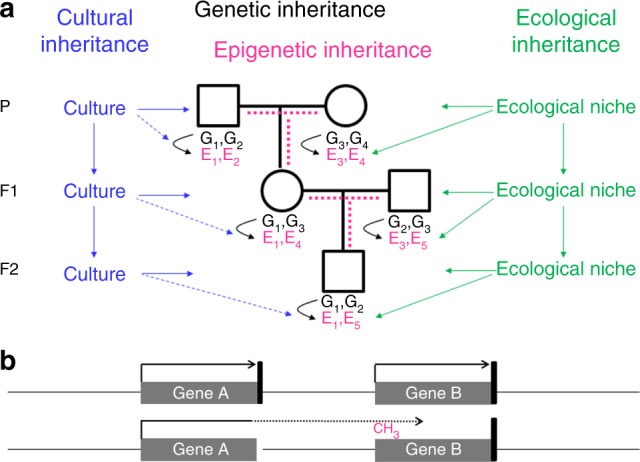
- Reported co-segregation of abnormal DNA methylation ("epimutations") with rare disease across generations is typically a *secondary* epimutation: a mutation in a neighbouring gene removes a transcription termination signal, causing read-through transcription that methylates and silences the gene under investigation; if the mutated gene is expressed in the germline, the epimutation also appears in germ cells and can be mistaken for transgenerational inheritance.
- Most mouse and rat studies of transgenerational responses (endocrine disruptors, high fat diet, obesity, diabetes, undernourishment, trauma) are technically sound but "the majority still await independent confirmation"; work on endocrine disruptors and high fat diet effects on the sperm methylome has been challenged by others.
- Human epidemiological links between grandparental food supply and grandchild health, and an indirect study of Prader–Willi syndrome imprinting defects, await independent replication; most familial segregation of abnormal methylation has turned out to be caused by an underlying genetic variant.
- The Dutch hunger winter increase in cardiovascular and metabolic disease in F1 adults is attributed to direct in utero exposure ("fetal programming"/intergenerational inheritance), not germline epigenetic transmission.
- Almost all experimental mouse models and human observations concern deleterious traits (congenital malformations, anxiety, glucose intolerance, obesity, cardiovascular disease, cancer, premature death), with hepatic wound healing as an exception—suggesting possible reporting bias and casting doubt on an adaptive role.
Methods
- This is a comment/perspective piece, not an empirical study: the author states "In this comment, I discuss the phenomenon of transgenerational epigenetic inheritance and the difficulty of providing conclusive proof for it in experimental and observational studies."
- It synthesizes published experimental (mouse/rat) and human epidemiological and molecular literature, and proposes a "roadmap" for proving transgenerational epigenetic inheritance: rule out genetic, ecological and cultural inheritance (inbred strains, controlled environments, F3 or F2 generations, IVF, embryo transfer, foster mothers); identify the responsible epigenetic factor in purified germ cells; and demonstrate causality by removing or adding the factor.
- No new data, sample, or statistical analysis is reported.
Limitations
- Stated by the paper: in humans it is impossible to rule out ecological and cultural inheritance, though genetic effects "should and can be excluded"; even after whole-genome sequencing, "if you don't find anything, you still cannot be 100% sure that a genetic variant does not exist."
- Stated by the paper: germ cell preparations may be contaminated with somatic cells or somatic DNA, and female germ cells are scarce or unavailable; manipulating DNA methylation and histone modifications is difficult, and such experiments "can hardly be done in humans"—so the proposed proof may currently be "too much to ask for."
- Evident from the text: the argument is explicitly an opinion piece ("in my opinion," "For now, I remain skeptical") without primary data, and its conclusions rest on the author's reading of a literature that the paper itself notes is largely unreplicated.
Model-written summary. Check it against the paper before relying on it.
Integrity signals
Registry
Cites
Statistics
Figures
Verification
Claims the paper makes
14 Valid · 1 Not valid · 9 Not checked · 22 Own results and interpretations
The cited sources support only part of this claim — read each source’s verdict below.
In the paper
“While most of published studies are technically sound, the majority still await independent confirmation; studies on transgenerational effects of endocrine disruptors and of high fat diet on the DNA methylome have recently been challenged by others10,11.”
§ A critical view on transgenerational epigenetic inheritance in humans > Evidence for transgenerational epigenetic inheritance
What the sources say
- Supportedcites [10] Iqbal K Deleterious effects of endocrine disruptors are corrected in the mammalian germline by epigenome reprogramming Genome Biol. 2015 16 59 10.1186/s13059-015-0619-z 25853433 PMC4376074 source
The Results section (‘Testing for transgenerational inheritance of aberrant imprinting’; page unavailable) says the authors’ findings do not support transgenerational inheritance of endocrine-disruptor-triggered epigenetic aberrations. The Conclusions likewise report that DNA-methylation changes in exposed germ cells were not found in the next generation. This supports the endocrine-disruptor part attributed to this paper; the high-fat-diet part is associated with the sentence’s other citation. (LLM, conf=0.91)
- Partly supportedcites [11] Shea JM Genetic and epigenetic variation, but not diet, shape the sperm methylome Dev. Cell 2015 35 750 758 10.1016/j.devcel.2015.11.024 26702833 PMC4691283 sourceExperimental — accuracy not yet measured
The Discussion (page unavailable) reports no consistent effect of high-fat diet on the mouse sperm methylome, supporting the claim that dietary methylation effects have been challenged. Our copy does not address endocrine disruptors, and the Results caution that differences in strain and regimen mean its findings do not necessarily dispute a prior dietary report. (LLM, conf=0.88)
plain- Asserted: passes — The authors put it forward as true.
- Checkable: passes — It can be checked against evidence.
- Load-bearing: passes — The paper’s conclusions depend on it.
- Based: passes — The paper gives a reason why it holds.
- Supported
Every source the paper cites for this claim was checked and supports it.
In the paper
“Wei et al.8, for example, found that streptozotocin-induced prediabetes in male mice affected DNA methylation patterns in sperm as well as pancreatic islets of F1 and F2 offspring.”
§ A critical view on transgenerational epigenetic inheritance in humans > Evidence for transgenerational epigenetic inheritance
What the sources say
- Supportedcites [8] Wei Y Paternally induced transgenerational inheritance of susceptibility to diabetes in mammals Proc. Natl. Acad. Sci. USA 2014 111 1873 1878 10.1073/pnas.1321195111 24449870 PMC3918818 source
The Significance/Results section 'Paternal Prediabetes Alters Overall Methylation Patterns in Sperm' states that global cytosine methylation profiles were altered in sperm of prediabetic males (thousands of differentially methylated genes overlapping with islets), and 'Paternal Prediabetes Affects Overall Methylation Patterns in Pancreatic Islets of Offspring' reports MeDIP-Seq changes in F1 islets (Pik3r1, Pik3ca, Ptpn1). The F2 section (p. Fig. 5 B,C) shows the same islet regions and genes methylated in F2 offspring, so both F1 and F2 islet methylation are covered. One wording nuance: the prediabetes model (Methods) was HFD-fed males given a subdiabetogenic dose of STZ (100 mg/kg), and Fig. 6 shows STZ alone did not alter sperm methylation, so the effect is attributed to the prediabetic physiology rather than STZ itself. (LLM, conf=0.86)
plainstates a cause- Asserted: passes — The authors put it forward as true.
- Checkable: passes — It can be checked against evidence.
- Load-bearing: unclear — It is unclear whether the paper’s conclusions depend on it.
- Based: passes — The paper gives a reason why it holds.
- Supported
Every source the paper cites for this claim was checked and supports it.
In the paper
“Gapp et al.9 found that traumatic stress in early life altered behavioral and metabolic processes in the progeny and that injection of sperm RNAs from traumatized males into fertilized wild-type oocytes reproduced the alterations in the resulting offspring.”
§ A critical view on transgenerational epigenetic inheritance in humans > Evidence for transgenerational epigenetic inheritance
What the sources say
- Supportedcites [9] Gapp K Implication of sperm RNAs in transgenerational inheritance of the effects of early trauma in mice Nat. Neurosci. 2014 17 667 669 10.1038/nn.3695 24728267 PMC4333222 source
The Abstract states that sperm RNAs from males exposed to early-life traumatic stress were injected into fertilized wild-type oocytes and reproduced behavioral and metabolic alterations in the resulting offspring. The Methods section, “RNAs injection in fertilized oocytes,” describes the injection procedure. (LLM, conf=0.95)
plainstates a cause- Asserted: passes — The authors put it forward as true.
- Checkable: passes — It can be checked against evidence.
- Load-bearing: unclear — It is unclear whether the paper’s conclusions depend on it.
- Based: passes — The paper gives a reason why it holds.
- Supported
Every source the paper cites for this claim was checked and supports it.
In the paper
“Further, the chromatin is extensively reshaped during germ cell differentiation as well as during the development of totipotent cells after fertilization, even though some loci appear to escape epigenetic reprogramming in the germline3.”
§ A critical view on transgenerational epigenetic inheritance in humans > Defining transgenerational epigenetic inheritance
What the sources say
- Supportedcites [3] Tang WW A unique gene regulatory network resets the human germline epigenome for development Cell 2015 161 1453 1467 10.1016/j.cell.2015.04.053 26046444 PMC4459712 source
The section “DNA Demethylation Escapees as Candidates for Transgenerational Epigenetic Inheritance” (p. 12) identifies regions that evade genome-wide DNA demethylation in human primordial germ cells. The Discussion (p. 14) likewise reports loci that remain methylated despite extensive germline reprogramming. (LLM, conf=0.94)
hedged- Asserted: passes — The authors put it forward as true.
- Checkable: passes — It can be checked against evidence.
- Load-bearing: unclear — It is unclear whether the paper’s conclusions depend on it.
- Based: passes — The paper gives a reason why it holds.
- Supported
The sources with a verdict support this claim; the rest weren’t checked yet, have no full text we could read, or their verdicts aren’t rated yet.
In the paper
“In the past 10 years, numerous reports on transgenerational responses to environmental or metabolic factors in mice and rats have been published (for a comprehensive review, see refs. 4–7).”
§ A critical view on transgenerational epigenetic inheritance in humans > Evidence for transgenerational epigenetic inheritance
What the sources say
- Supportedcites [4] Chen Q Yan W Duan E Epigenetic inheritance of acquired traits through sperm RNAs and sperm RNA modifications Nat. Rev. Genet. 2016 17 733 743 10.1038/nrg.2016.106 27694809 PMC5441558 source
The 'Acquired inheritance through sperm' section describes findings from independent laboratories on inherited responses to diet, stress and other environmental exposures, including examples in mice and rats. Its references list numerous relevant reports from 2010–2016, supporting the citing sentence's broad description of the preceding decade. (LLM, conf=0.90)
- Supportedcites [5] Heard E Martienssen RA Transgenerational epigenetic inheritance: myths and mechanisms Cell 2014 157 95 109 10.1016/j.cell.2014.02.045 24679529 PMC4020004 source
The review’s “Implications for human health” section describes numerous recent rodent studies of inherited responses to dietary and metabolic conditions. Its “Epigenetic variation and the adaptive inheritance of acquired traits” section also discusses a 2005 report of multigenerational effects after fungicide exposure in rats. The review cautions that reported effects are not necessarily evidence of true transgenerational epigenetic inheritance, but the citing sentence claims only that such reports were published. (LLM, conf=0.91)
- Not checked — no full text of the sourcecites [6] Miska EA Ferguson-Smith AC Transgenerational inheritance: models and mechanisms of non-DNA sequence-based inheritance Science 2016 354 59 63 10.1126/science.aaf4945 27846492 source
- Supportedcites [7] Illum LRH Bak ST Lund S Nielsen AL DNA methylation in epigenetic inheritance of metabolic diseases through the male germ line J. Mol. Endocrinol. 2018 60 R39 R56 10.1530/JME-17-0189 29203518 source
The section on rodent studies (page not provided) describes several studies of inherited responses to dietary and metabolic exposures in rats and mice, including reports from 2010, 2011 and 2016. It also discusses transmission across multiple generations, supporting the citing sentence’s broad description of recent reports. (LLM, conf=0.90)
plain- Asserted: passes — The authors put it forward as true.
- Checkable: passes — It can be checked against evidence.
- Load-bearing: unclear — It is unclear whether the paper’s conclusions depend on it.
- Based: passes — The paper gives a reason why it holds.
- Supported
20 more claims · 4 with their cited sources checked
Create a free account to see all 46 claims and to verify the 3 references still open.
- Probably not a substantial claim. 14
- It may state two separate claims as one. 11
Claims other papers make about this one
Each is checked against this paper’s own text: does it say what the citing paper says it does?
The cited source says what the claim attributes to it.
In the citing paper
“Although a controversial subject in mammalian biology, studies indicate that this direct epigenetic inheritance occurs in some animal models.41,42”
From The role of epigenetics in psychological resilience (2021) · cites this paper as [42]
The check wasn’t confident either way, so it gives no verdict — never disputed.
In the citing paper
“Historically, these terms have been ambiguously defined (247, 251, 252).”
From Epigenetic Modifications in Stress Response Genes Associated With Childhood Trauma (2019) · cites this paper as [252]
Experimental — accuracy not yet measured
Citations
Cites
Landon, M., Saam, J., Brown, K. L., Moyes, K., Evans, B., & Wenstrup, R. (2015) · Oncology · doi:10.1159/000430097 · Cited by 1,939
Transgenerational epigenetic inheritance: myths and mechanisms
Heard, E., & Martienssen, R. A. (2014) · Cell · doi:10.1016/j.cell.2014.02.045 · Cited by 1,864
Implication of sperm RNAs in transgenerational inheritance of the effects of early trauma in mice
Gapp, K., Jawaid, A., Sarkies, P., Bohacek, J., Pelczar, P., Prados, J., Farinelli, L., Miska, E., & Mansuy, I. M. (2014) · Nature Neuroscience · doi:10.1038/nn.3695 · Cited by 1,306
Editing DNA Methylation in the Mammalian Genome
Liu, X. S., Wu, H., Ji, X., Stelzer, Y., Wu, X., Czauderna, S., Shu, J., Dadon, D., Young, R. A., & Jaenisch, R. (2016) · Cell · doi:10.1016/j.cell.2016.08.056 · Cited by 1,224
Beyond DNA: integrating inclusive inheritance into an extended theory of evolution
Danchin, É., Charmantier, A., Champagne, F. A., Mesoudi, A., Pujol, B., & Blanchet, S. (2011) · Nature Reviews Genetics · doi:10.1038/nrg3028 · Cited by 860
Ligtenberg, M. J. L., Kuiper, R. P., Chan, T. L., Goossens, M., Hebeda, K. M., Voorendt, M., Lee, T. Y. H., Bodmer, D., Hoenselaar, E., Hendriks-Cornelissen, S. J. B., et al. (2009) · Nature Genetics · doi:10.1038/ng.283 · Cited by 818
A Unique Gene Regulatory Network Resets the Human Germline Epigenome for Development
Tang, W. W. C., Dietmann, S., Irie, N., Leitch, H. G., Floros, V. I., Bradshaw, C. R., Hackett, J. A., Chinnery, P. F., & Surani, M. A. (2015) · Cell · doi:10.1016/j.cell.2015.04.053 · Cited by 670
Epigenetic inheritance of acquired traits through sperm RNAs and sperm RNA modifications
Chen, Q., Yan, W., & Duan, E. (2016) · Nature Reviews Genetics · doi:10.1038/nrg.2016.106 · Cited by 576
Tufarelli, C., Stanley, J. A. S., Garrick, D., Sharpe, J. A., Ayyub, H., Wood, W. G., & Higgs, D. R. (2003) · Nature Genetics · doi:10.1038/ng1157 · Cited by 547
Transgenerational response to nutrition, early life circumstances and longevity
Kaati, G., Bygren, L. O., Pembrey, M., & Sjöström, M. (2007) · European Journal of Human Genetics · doi:10.1038/sj.ejhg.5201832 · Cited by 500
Cited by
Deconstructing a Syndrome: Genomic Insights Into PCOS Causal Mechanisms and Classification
Dapas, M., & Dunaif, A. (2022) · Endocrine Reviews · doi:10.1210/endrev/bnac001 · Cited by 300
Epigenetic Modifications in Stress Response Genes Associated With Childhood Trauma
Jiang, S., Postovit, L., Cattaneo, A., Binder, E. B., & Aitchison, K. J. (2019) · Frontiers in Psychiatry · doi:10.3389/fpsyt.2019.00808 · Cited by 288
The future of rodent models in depression research
Gururajan, A., Reif, A., Cryan, J. F., & Slattery, D. A. (2019) · Nature Reviews Neuroscience · doi:10.1038/s41583-019-0221-6 · Cited by 269
Genetic impacts on DNA methylation: research findings and future perspectives
Villicaña, S., & Bell, J. T. (2021) · Genome Biology · doi:10.1186/s13059-021-02347-6 · Cited by 242
“Therefore, so far, there is no robust evidence in humans to indicate that DNA methylation heritability may be attributed to non-genetic effects, such as evidence for transgenerational epigenetic inheritance as reported in other species [12].”
BackgroundMetabolic regulation of kisspeptin — the link between energy balance and reproduction
Navarro, V. M. (2020) · Nature Reviews Endocrinology · doi:10.1038/s41574-020-0363-7 · Cited by 240
Transgenerational inheritance of acquired epigenetic signatures at CpG islands in mice
Takahashi, Y., Morales Valencia, M., Yu, Y., Ouchi, Y., Takahashi, K., Shokhirev, M. N., Lande, K., Williams, A. E., Fresia, C., Kurita, M., et al. (2023) · Cell · doi:10.1016/j.cell.2022.12.047 · Cited by 217
Phthalate exposure and long-term epigenomic consequences: a review
Dutta, S., Haggerty, D. K., Rappolee, D. A., & Ruden, D. M. (2020) · Frontiers in Genetics · doi:10.3389/fgene.2020.00405 · Cited by 212
Conservation and the Genomics of Populations
Allendorf, F. W., Funk, W. C., Aitken, S. N., Byrne, M., Luikart, G., & Antunes, A. (2022) · doi:10.1093/oso/9780198856566.001.0001 · Cited by 207
Breton, C. V., Landon, R., Kahn, L. G., Enlow, M. B., Peterson, A. K., Bastain, T., Braun, J., Comstock, S. S., Duarte, C. S., Hipwell, A., et al. (2021) · Communications Biology · doi:10.1038/s42003-021-02316-6 · Cited by 165
Schiele, M. A., Gottschalk, M. G., & Domschke, K. (2020) · Clinical Psychology Review · doi:10.1016/j.cpr.2020.101830 · Cited by 156
Ethical implications of epigenetics in the era of personalized medicine
Santaló, J., & Berdasco, M. (2022) · Clinical Epigenetics · doi:10.1186/s13148-022-01263-1 · Cited by 155
Population Genomics: Advancing Understanding of Nature
Luikart, G., Kardos, M. D., Hand, B. K., Rajora, O. P., Aitken, S. N., & Hohenlohe, P. A. (2018) · Population genomics · doi:10.1007/13836_2018_60 · Cited by 156
Sources of epigenetic variation and their applications in natural populations
Angers, B., Perez, M., Menicucci, T. D. A., & Leung, C. (2020) · Evolutionary Applications · doi:10.1111/eva.12946 · Cited by 120
The role of epigenetics in psychological resilience
Smeeth, D., Beck, S., Karam, E. G., & Pluess, M. (2021) · The Lancet Psychiatry · doi:10.1016/s2215-0366(20)30515-0 · Cited by 108
Jönsson, B., & Jönsson, N. (2019) · Aquatic Biology · doi:10.3354/ab00707 · Cited by 113
Stress resets ancestral heritable small RNA responses
Houri-Zeevi, L., Teichman, G., Gingold, H., & Rechavi, O. (2021) · eLife · doi:10.7554/elife.65797 · Cited by 93
Precision medicine in distinct heart failure phenotypes: Focus on clinical epigenetics
Napoli, C., Benincasa, G., Donatelli, F., & Ambrosio, G. (2020) · American Heart Journal · doi:10.1016/j.ahj.2020.03.007 · Cited by 88
Embryo responses to stress induced by assisted reproductive technologies
Ramos‐Ibeas, P., Heras, S., Gómez‐Redondo, I., Planells, B., Fernández‐González, R., Pericuesta, E., Laguna‐Barraza, R., Pérez‐Cerezales, S., & Gutiérrez‐Adán, A. (2019) · Molecular Reproduction and Development · doi:10.1002/mrd.23119 · Cited by 95
Candler, T., Kühnen, P., Prentice, A. M., & Silver, M. (2019) · Frontiers in Neuroendocrinology · doi:10.1016/j.yfrne.2019.100773 · Cited by 83
LncRNAs as Chromatin Regulators in Cancer: From Molecular Function to Clinical Potential
Begolli, R., Sideris, N., & Giakountis, A. (2019) · Cancers · doi:10.3390/cancers11101524 · Cited by 103
Kaliman, P. (2018) · Current Opinion in Psychology · doi:10.1016/j.copsyc.2018.11.010 · Cited by 97
Present and future challenges for the investigation of transgenerational epigenetic inheritance
Fallet, M., Blanc, M., Criscio, M. D., Antczak, P., Engwall, M., Guerrero‐Bosagna, C., Rüegg, J., & Keiter, S. H. (2023) · Environment International · doi:10.1016/j.envint.2023.107776 · Cited by 121
Gestational Diabetes Mellitus and Developmental Programming
Chu, A. H. Y., & Godfrey, K. M. (2020) · Annals of Nutrition and Metabolism · doi:10.1159/000509902 · Cited by 96
Earhart, M. L., Blanchard, T. S., Harman, A. A., & Schulte, P. M. (2022) · Biological Bulletin · doi:10.1086/722115 · Cited by 95
Roy, S., Kumar, V., Bossier, P., Norouzitallab, P., & Vanrompay, D. C. G. (2019) · Frontiers in Immunology · doi:10.3389/fimmu.2019.02745 · Cited by 80
Environmental Impact on Male (In)Fertility via Epigenetic Route
Cescon, M., Chianese, R., & Tavares, R. S. (2020) · Journal of Clinical Medicine · doi:10.3390/jcm9082520 · Cited by 77
C. elegans aversive olfactory learning generates diverse intergenerational effects
Pereira, A. G., Gracida, X., Kagias, K., & Zhang, Y. (2020) · Journal of Neurogenetics · doi:10.1080/01677063.2020.1819265 · Cited by 77
The role of epigenetics in the development of obesity
Obri, A., Serra, D., Herrero, L., & Mera, P. (2020) · Biochemical Pharmacology · doi:10.1016/j.bcp.2020.113973 · Cited by 92
The missing heritability of familial colorectal cancer
Schubert, S. A., Morreau, H. M., de Miranda, N. F. C. C., & van Wezel, T. (2019) · Mutagenesis · doi:10.1093/mutage/gez027 · Cited by 75
Mechanisms of chromatin-based epigenetic inheritance
Du, W., Shi, G., Shan, C., Li, Z., Zhu, B., Jia, S., Li, Q., & Zhang, Z. (2022) · Science China Life Sciences · doi:10.1007/s11427-022-2120-1 · Cited by 54
Evidence for germline non-genetic inheritance of human phenotypes and diseases
Senaldi, L., & Smith-Raska, M. (2020) · Clinical Epigenetics · doi:10.1186/s13148-020-00929-y · Cited by 63
Impact of Historic Migrations and Evolutionary Processes on Human Immunity
Domínguez‐Andrés, J., & Netea, M. G. (2019) · Trends in Immunology · doi:10.1016/j.it.2019.10.001 · Cited by 63
“It's Never Too Early”: Preconception Care and Postgenomic Models of Life
Pentecost, M., & Meloni, M. (2020) · Frontiers in Sociology · doi:10.3389/fsoc.2020.00021 · Cited by 57
Braz, C. U., Taylor, T., Namous, H., Townsend, J. A., Crenshaw, T. D., & Khatib, H. (2022) · PNAS Nexus · doi:10.1093/pnasnexus/pgac040 · Cited by 58
Transgenerational epigenetic inheritance of traumatic experience in mammals
Švorcová, J. (2023) · Genes · doi:10.3390/genes14010120 · Cited by 47
Insights into the multifactorial causation of obesity by integrated genetic and epigenetic analysis
Diels, S., Berghe, W. V., & Hul, W. V. (2020) · Obesity Reviews · doi:10.1111/obr.13019 · Cited by 50
The Hidden Impact of Gestational Diabetes: Unveiling Offspring Complications and Long-Term Effects
Bekai, E. A., Beaini, C. E., Kalout, K., Safieddine, O., Semaan, S., Sahyoun, F., Ghadieh, H. E., Azar, S. T., Kanaan, A., & Harb, F. (2025) · Life · doi:10.3390/life15030440 · Cited by 77
The Transmission of Intergenerational Epigenetic Information by Sperm microRNAs
Lee, G. S., & Conine, C. C. (2022) · Epigenomes · doi:10.3390/epigenomes6020012 · Cited by 50
Feiner, N., Radersma, R., Vasquez, L. J., Ringnér, M., Nystedt, B., Raine, A., Tobi, E. W., Heijmans, B. T., & Uller, T. (2022) · iScience · doi:10.1016/j.isci.2022.104303 · Cited by 53
Progress, Challenges, and Surprises in Annotating the Human Genome
Zerbino, D. R., Frankish, A., & Flicek, P. (2020) · Annual Review of Genomics and Human Genetics · doi:10.1146/annurev-genom-121119-083418 · Cited by 51
Perinatal Nutritional and Metabolic Pathways: Early Origins of Chronic Lung Diseases
Kuiper-Makris, C., Selle, J., Nüsken, E., Dötsch, J., & Alcazar, M. A. A. (2021) · Frontiers in Medicine · doi:10.3389/fmed.2021.667315 · Cited by 47
Wellband, K. W., Roth, D. H., Linnansaari, T., Curry, R. A., & Bernatchez, L. (2021) · G3 Genes Genomes Genetics · doi:10.1093/g3journal/jkab353 · Cited by 51
Epigenetics and individuality: from concepts to causality across timescales
Webster, A. K., & Phillips, P. C. (2025) · Nature Reviews Genetics · doi:10.1038/s41576-024-00804-z · Cited by 51
Casier, K., Boivin, A., Carré, C., & Teysset, L. (2019) · Cells · doi:10.3390/cells8091108 · Cited by 41
A Review on Epigenetic Inheritance of Experiences in Humans
Ghai, M., & Kader, F. (2021) · Biochemical Genetics · doi:10.1007/s10528-021-10155-7 · Cited by 45
Epigenetics of alcohol-related liver diseases
Habash, N. W., Sehrawat, T. S., Shah, V. H., & Cao, S. (2022) · JHEP Reports · doi:10.1016/j.jhepr.2022.100466 · Cited by 41
Leitão, E., Persio, S. D., Laurentino, S., Wöste, M., Dugas, M., Kliesch, S., Neuhaus, N., & Horsthemke, B. (2020) · Clinical Epigenetics · doi:10.1186/s13148-020-00854-0 · Cited by 42
Self-citationToward a Framework for Assessing Privacy Risks in Multi-Omic Research and Databases
Dupras, C., & Bunnik, E. M. (2021) · The American Journal of Bioethics · doi:10.1080/15265161.2020.1863516 · Cited by 43
Knock-On Effects of Environmental Influences during Embryonic Development of Ectothermic Vertebrates
Jönsson, B., Jönsson, N., & Hansen, M. M. (2022) · The Quarterly Review of Biology · doi:10.1086/720081 · Cited by 44
Are the Effects of DES Over? A Tragic Lesson from the Past
Zamora-León, S. P. (2021) · International Journal of Environmental Research and Public Health · doi:10.3390/ijerph181910309 · Cited by 37
Transgenerational hormesis: What do parents sacrifice for their offspring?
Agathokleous, E., Guedes, R. N. C., Calabrese, E. J., Fotopoulos, V., & Azevedo, R. A. (2022) · Current Opinion in Environmental Science & Health · doi:10.1016/j.coesh.2022.100380 · Cited by 42
Impact of parental exercise on epigenetic modifications inherited by offspring: A systematic review
Axsom, J., & Libonati, J. R. (2019) · Physiological Reports · doi:10.14814/phy2.14287 · Cited by 39
Mulligan, C. J., Quinn, E. B., Hamadmad, D., Dutton, C. L., Nevell, L., Binder, A. M., Panter-Brick, C., & Dajani, R. (2025) · Scientific Reports · doi:10.1038/s41598-025-89818-z · Cited by 36
“The study of epigenetic inheritance in humans is complicated because of the difficulty of conducting multigenerational, experimentation studies as well as the importance of cultural and environmental factors 4 .”
Germ cell-mediated mechanisms of epigenetic inheritance
Lempradl, A. M. (2019) · Seminars in Cell and Developmental Biology · doi:10.1016/j.semcdb.2019.07.012 · Cited by 40
Lux, V., Non, A. L., Pexman, P. M., Stadler, W., Weber, L. A. E., & Krüger, M. (2021) · Frontiers in Systems Neuroscience · doi:10.3389/fnsys.2021.672740 · Cited by 51
Array-Based Epigenetic Aging Indices May Be Racially Biased
Philibert, R. A., Beach, S. R. H., Lei, M., Gibbons, F. X., Gerrard, M., Simons, R. L., & Dogan, M. V. (2020) · Genes · doi:10.3390/genes11060685 · Cited by 35
Carleial, S., Nätt, D., Unternäehrer, E., Elbert, T. R., Robjant, K., Wilker, S., Vukojević, V., Kolassa, I., Rukundo-Zeller, A. C., & Koebach, A. (2021) · Scientific Reports · doi:10.1038/s41598-021-98067-9 · Cited by 38
The inheritance of cardiovascular disease risk
Hanson, M. A. (2019) · Acta Paediatrica · doi:10.1111/apa.14813 · Cited by 36
Słupecka‐Ziemilska, M., Wychowański, P., & Puzianowska‐Kuźnicka, M. (2020) · Nutrients · doi:10.3390/nu12092792 · Cited by 46
Benchmarking DNA methylation assays in a reef‐building coral
Dixon, G., & Matz, M. V. (2020) · Molecular Ecology Resources · doi:10.1111/1755-0998.13282 · Cited by 30
Allinson, J. P., Afzal, S., Çolak, Y., Jarvis, D., Backman, H., van den Berge, M., Boezen, H. M., Breyer, M.-K., Breyer-Kohansal, R., Brusselle, G., et al. (2021) · The Lancet Respiratory Medicine · doi:10.1016/s2213-2600(21)00313-1 · Cited by 36
Moler, E. R. V., Abakir, A., Eleftheriou, M., Johnson, J. S., Krutovsky, K. V., Lewis, L. C., Ruzov, A. S., Whipple, A. V., & Rajora, O. P. (2018) · Population genomics · doi:10.1007/13836_2018_59 · Cited by 40
Taylor, H., Fernandes, B., & Wraight, S. (2021) · Cambridge Archaeological Journal · doi:10.1017/s0959774321000329 · Cited by 41
Hanevik, H. I., & Hessen, D. O. (2022) · Human Reproduction Update · doi:10.1093/humupd/dmac014 · Cited by 48
García‐Domínguez, X., Marco‐Jiménez, F., Peñaranda, D. S., Diretto, G., García‐Carpintero, V., Cañizares, J., & Vicente, J. S. (2020) · Scientific Reports · doi:10.1038/s41598-020-68195-9 · Cited by 35
da Cruz, R. S., Chen, E. Y., Smith, M., Bates, J., & de Assis, S. (2020) · Frontiers in Nutrition · doi:10.3389/fnut.2020.00093 · Cited by 38
Fungal Priming: Prepare or Perish
Harish, E., & Osherov, N. (2022) · Journal of Fungi · doi:10.3390/jof8050448 · Cited by 34
de Pette, M. V., Dimond, A., Galvão, A. M., Millership, S. J., To, W., Prodani, C., McNamara, G. I., Bruno, L., Sardini, A., Webster, Z., et al. (2022) · Nature Communications · doi:10.1038/s41467-022-30022-2 · Cited by 34
Pierron, F., Daffe, G., Daramy, F., Héroin, D., Barré, A., Bouchez, O., Clérendeau, C., Romero‐Ramirez, A., & Nikolski, M. (2023) · Journal of Hazardous Materials · doi:10.1016/j.jhazmat.2023.131579 · Cited by 29
Heavy Metals in Umbilical Cord Blood: Effects on Epigenetics and Child Development
Dutta, S., & Ruden, D. M. (2024) · Cells · doi:10.3390/cells13211775 · Cited by 35
Gombeau, K., Bonzom, J., Cavalié, I., Camilleri, V., Orjollet, D., Dubourg, N., Beaugelin-Seiller, K., Bourdineaud, J., Lengagne, T., Armant, O., et al. (2020) · Journal of Environmental Radioactivity · doi:10.1016/j.jenvrad.2020.106429 · Cited by 32
Gut microbiome metagenomics to understand how xenobiotics impact human health
Mesnage, R., Antoniou, M. N., Tsoukalas, D., Goulielmos, G. N., & Tsatsakis, A. M. (2018) · Current Opinion in Toxicology · doi:10.1016/j.cotox.2019.02.002 · Cited by 34
de Almeida-Faria, J., Duque-Guimaraes, D. E., Ong, T. P., Pantaleão, L. C., Carpenter, A. A. M., Loche, E., Kusinski, L. C., Ashmore, T. J., Antrobus, R., Bushell, M., et al. (2021) · Diabetologia · doi:10.1007/s00125-020-05357-4 · Cited by 28
Watkins, S., Iles‐Caven, Y., Pembrey, M. E., Golding, J., & Suderman, M. J. (2022) · European Journal of Human Genetics · doi:10.1038/s41431-022-01081-2 · Cited by 26
Transgenerational epigenetic inheritance: a critical perspective
Bird, A. P. (2024) · Frontiers in Epigenetics and Epigenomics · doi:10.3389/freae.2024.1434253 · Cited by 41
VTRNA2-1: Genetic Variation, Heritable Methylation and Disease Association
Dugué, P., Yu, C., McKay, T., Wong, E. M., Joo, J. E., Tsimiklis, H., Hammet, F., Mahmoodi, M. S., Theys, D., kConFab, et al. (2021) · International Journal of Molecular Sciences · doi:10.3390/ijms22052535 · Cited by 25
Svoboda, L. K., Ishikawa, T., & Dolinoy, D. C. (2022) · Environmental Epigenetics · doi:10.1093/eep/dvac017 · Cited by 27
“However, the prevalence of this phenomenon and its relevance to health, in particular human health, is the subject of significant debate and ongoing study [72, 73].”
BackgroundMaternal Malnutrition and Elevated Disease Risk in Offspring
Thornburg, K. L. R., & Valent, A. M. (2024) · Nutrients · doi:10.3390/nu16162614 · Cited by 44
Allinson, J. P., Afzal, S., Çolak, Y., Jarvis, D., Bäckman, H., van den Berge, M., Boezen, H. M., Breyer, M., Breyer, M., Brusselle, G., et al. (2022) · NORA - Norwegian Open Research Archives · Cited by 26
Lizárraga, D., & García-Gasca, A. (2021) · Epigenomes · doi:10.3390/epigenomes5020013 · Cited by 29
Epigenetic Echoes: Bridging Nature, Nurture, and Healing Across Generations
Banushi, B., Collova, J. R., & Milroy, H. (2025) · International Journal of Molecular Sciences · doi:10.3390/ijms26073075 · Cited by 33
NRF2 loss recapitulates heritable impacts of paternal cigarette smoke exposure
Murphy, P. J., Guo, J., Jenkins, T. G., James, E. R., Hoidal, J. R., Huecksteadt, T. P., Broberg, D. S., Hotaling, J. M., Alonso, D., Carrell, D. T., et al. (2020) · PLoS Genetics · doi:10.1371/journal.pgen.1008756 · Cited by 24
Epigenetic inheritance of acquired traits through DNA methylation
Zhang, Y., & Sirard, M. (2021) · Animal Frontiers · doi:10.1093/af/vfab052 · Cited by 29
Géranton, S. M. (2019) · Philosophical Transactions of the Royal Society B Biological Sciences · doi:10.1098/rstb.2019.0283 · Cited by 30
Age-associated sperm DNA methylation patterns do not directly persist trans-generationally
Jenkins, T. G., James, E. R., Aston, K. I., Salas‐Huetos, A., Pastuszak, A. W., Smith, K. R., Hanson, H. A., Hotaling, J. M., & Carrell, D. T. (2019) · Epigenetics & Chromatin · doi:10.1186/s13072-019-0323-4 · Cited by 25
The social construction of the social epigenome and the larger biological context
Deichmann, U. (2020) · Epigenetics & Chromatin · doi:10.1186/s13072-020-00360-w · Cited by 27
Champroux, A., Tang, Y., Dickson, D. A., Meng, A., Harrington, A. N., Liaw, L., Marzi, M. J., Nicassio, F., Schlaeger, T. M., & Feig, L. A. (2024) · Epigenetics · doi:10.1080/15592294.2024.2346694 · Cited by 26
Anisman, H., Doubad, D., Asokumar, A., & Matheson, K. (2024) · Neuroscience & Biobehavioral Reviews · doi:10.1016/j.neubiorev.2024.105859 · Cited by 32
Abbas, A., Witte, T., Patterson, W. L., Fahrmann, J. F., Guo, K., Hur, J., Hardman, W. E., & Georgel, P. T. (2021) · Frontiers in Cell and Developmental Biology · doi:10.3389/fcell.2021.682593 · Cited by 27
Animal models of male reproductive ageing to study testosterone production and spermatogenesis
Carrageta, D. F., Guerra‐Carvalho, B., Spadella, M. A., Yeste, M., Oliveira, P. F., & Alves, M. G. (2022) · Reviews in Endocrine and Metabolic Disorders · doi:10.1007/s11154-022-09726-9 · Cited by 22
Auboeuf, D. (2020) · Life · doi:10.3390/life10020007 · Cited by 23
Liu, Y., Weyrich, L. S., & Llamas, B. (2019) · Molecular Biology and Evolution · doi:10.1093/molbev/msz231 · Cited by 22
The many faces of cancer evolution
Ciriello, G., & Magnani, L. (2021) · iScience · doi:10.1016/j.isci.2021.102403 · Cited by 22
Hesam-Shariati, S., Overs, B. J., Roberts, G. M. P., Toma, C., Watkeys, O. J., Green, M. J., Pierce, K. D., Edenberg, H. J., Wilcox, H. C., Stapp, E. K., et al. (2022) · Translational Psychiatry · doi:10.1038/s41398-022-02079-6 · Cited by 23
Epigenetic mechanisms linking early-life adversities and mental health
Cánepa, E. T., & Berardino, B. G. (2024) · Biochemical Journal · doi:10.1042/bcj20230306 · Cited by 25
Transgenerational inheritance of cold temperature response in Drosophila
Karunakar, P., Bhalla, A., & Sharma, A. (2019) · FEBS Letters · doi:10.1002/1873-3468.13343 · Cited by 19
The RNA Revolution in the Central Molecular Biology Dogma Evolution
Haseltine, W. A., & Patarca, R. (2024) · International Journal of Molecular Sciences · doi:10.3390/ijms252312695 · Cited by 32
Transgenerational Effects of Prenatal Ethanol Exposure in Prepubescent Mice
Bottom, R. T., Kozanian, O. O., Rohac, D. J., Erickson, M. A., & Huffman, K. J. (2022) · Frontiers in Cell and Developmental Biology · doi:10.3389/fcell.2022.812429 · Cited by 20
A critical appraisal of clinical epigenetics
Horsthemke, B. (2022) · Clinical Epigenetics · doi:10.1186/s13148-022-01315-6 · Cited by 24
Self-citationPierron, F., Héroin, D., Daffe, G., Daramy, F., Barré, A., Bouchez, O., Romero‐Ramirez, A., Gonzalez, P., & Nikolski, M. (2022) · Environmental Epigenetics · doi:10.1093/eep/dvac022 · Cited by 18
Metadata
- Authors
- Horsthemke, B.
- Affiliations
- Essen University Hospital (DE)
- Corresponding author
- Horsthemke, Bernhard
- ORCID
- Horsthemke, Bernhard
- Venue
- Nature Communications
- Published
- 2018-07-30
- Volume
- 9
- Issue
- 1
- Pages
- 2973-2973
- ISSN
- 2041-1723 (ISSN-L)
- PMC
- PMC6065375
- OpenAlex
- W2884974825
- Semantic Scholar
- f8abde990a4267705895c337b70baf7b96c6d374
- Cited by
- 349
- References
- 23
- Citations by year
- 2026: 30 · 2025: 38 · 2024: 40 · 2023: 29 · 2022: 76 · 2021: 45 · 2020: 49 · 2019: 38 · 2018: 4
- FWCI
- 12.09
- Type
- journal article
- Language
- en
- Open access
- gold
- doi.org
- Licence
- cc-by
- creativecommons.org/licenses/by/4.0 (tdm)
- creativecommons.org/licenses/by/4.0 (vor)
- Locations
- Nature Communications (publishedVersion, cc-by)
- Europe PMC (PubMed Central) (publishedVersion, other-oa)
- PubMed Central (publishedVersion, cc-by)
- PubMed (publishedVersion)
- RePEc: Research Papers in Economics (submittedVersion)
- DOAJ (DOAJ: Directory of Open Access Journals) (submittedVersion)
- DOAJ (DOAJ: Directory of Open Access Journals) (submittedVersion, cc-by-sa)
- Funders
- Deutsche Forschungsgemeinschaft
- Topics
- Life Sciences › Biochemistry, Genetics and Molecular Biology › Molecular Biology › Epigenetics and DNA Methylation
- Health Sciences › Medicine › Pediatrics, Perinatology and Child Health › Birth, Development, and Health
- Life Sciences › Biochemistry, Genetics and Molecular Biology › Genetics › Genetic Syndromes and Imprinting
- Keywords
- transgenerational epigenetic inheritance, germline transmission, epigenetic information, ecological inheritance, cultural transmission
- MeSH terms
- Animals, Culture, Drosophila, Ecology, Biological Evolution, Germ Cells, Humans, Models, Genetic, Mutation, Nematoda, Phenotype, Plants, DNA Methylation, Proteome, Databases, Genetic, Inheritance Patterns, Proteomics, Epigenesis, Genetic, Gene-Environment Interaction
About these checks
Registry, retraction, Cites and statistics results are computed, not judged, with one exception: a printed reference that no index lists is read once by a model before it counts as a citation error. Claims are extracted by a model and kept only when their quote appears verbatim in the text; each cited source is then checked, with a model’s help, for whether it says what the claim relies on. Those verdicts can be wrong — read the claim’s quote and the cited source before relying on one.
The claim verdicts this report counts are experimental: their accuracy is not yet measured.
A language model drew the claims from the paper on 2026-10-10, under version 3 of the claim definition (model deepseek-v4.1-flash, prompt extract-v3).
A second model labelled each claim on 2026-10-10 (model jev-1.13-20260917, definition revision gold-guideline-v0.2).
Cited sources are checked with a language model’s help (gpt-6-sol and qwen3.8-omni-flash).
Statistics and arithmetic are recomputed, not judged.
Confidence bands are shown only for fields calibrated on our annotated test set. None is calibrated yet, so no band is shown.
What counts as a claim ›How we measure confidence ›How we check this ›
Are you an author, or do you see a problem with this page? Request a review
Data sources
Bibliographic data: Semantic Scholar, OpenAlex, Crossref.
Contains information from the Semantic Scholar Academic Graph Datasets, made available under the ODC Attribution License (ODC-BY 1.0).
Semantic Scholar’s data is described in: Kinney, R., et al. (2023). The Semantic Scholar Open Data Platform. arXiv:2301.10140.
