

TGF-β-associated extracellular matrix genes link cancer-associated fibroblasts to immune evasion and immunotherapy failure
Open accessThe DOI matches its Crossref record; 48 of the 48 references it cites were found in a registry or an index.
Abstract
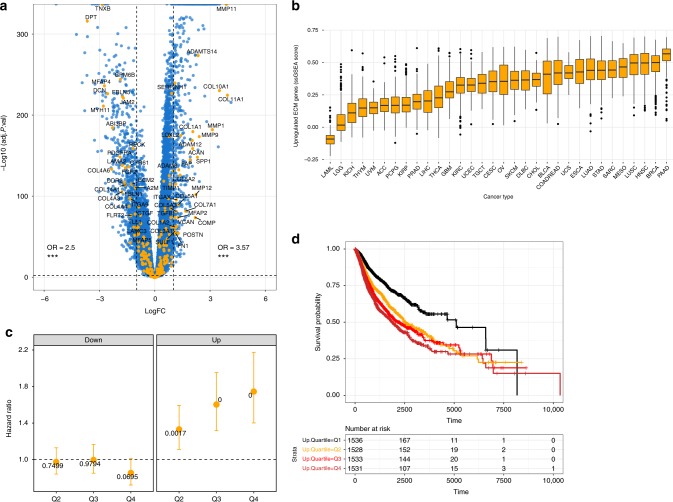
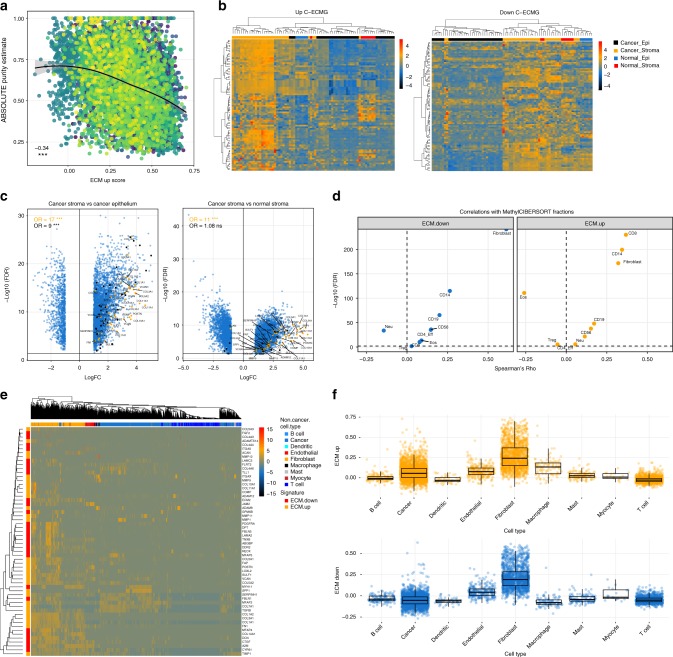
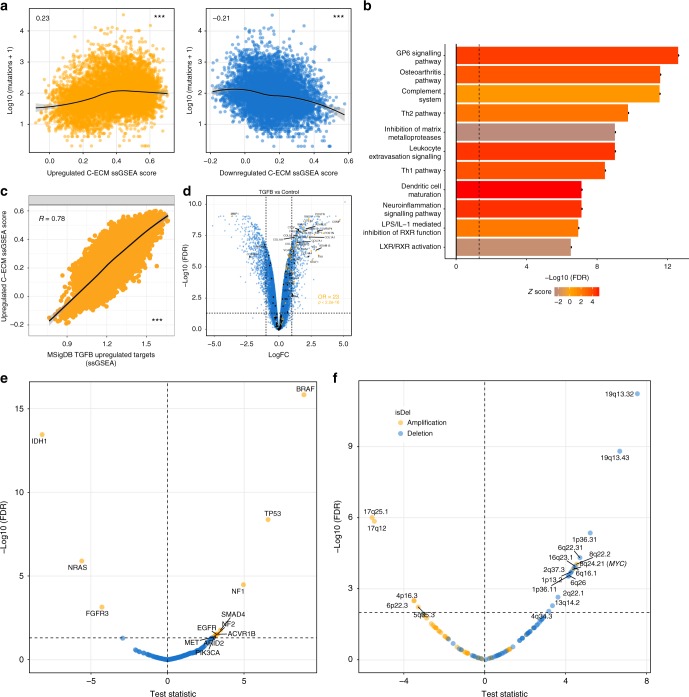
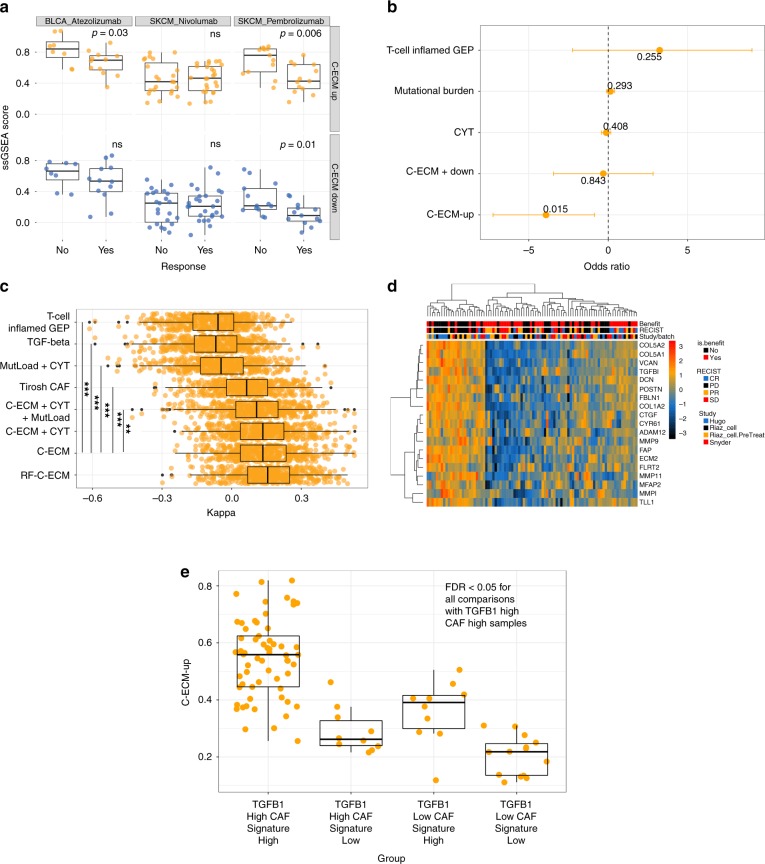
The extracellular matrix (ECM) is a key determinant of cancer progression and prognosis. Here we report findings from one of the largest pan-cancer analyses of ECM gene dysregulation in cancer. We define a distinct set of ECM genes upregulated in cancer (C-ECM) and linked to worse prognosis. We found that the C-ECM transcriptional programme dysregulation is correlated with the activation of TGF-β signalling in cancer-associated fibroblasts and is linked to immunosuppression in otherwise immunologically active tumours. Cancers that activate this programme carry distinct genomic profiles, such as BRAF, SMAD4 and TP53 mutations and MYC amplification. Finally, we show that this signature is a predictor of the failure of PD-1 blockade and outperforms previously-proposed biomarkers. Thus, our findings identify a distinct transcriptional pattern of ECM genes in operation across cancers that may be potentially targeted, pending preclinical validation, using TGF-β blockade to enhance responses to immune-checkpoint blockade.
Overview
The claims and statistics of this paper haven’t been checked yet.
Free: it reads the open-access text and checks the first 5 claims that cite a source we can check. Create a free account to check every claim.
Integrity signals
Registry
Cites
Statistics
Figures
Verification
Claims the paper makes
The claims and statistics of this paper haven’t been checked yet.
Free: it reads the open-access text and checks the first 5 claims that cite a source we can check. Create a free account to check every claim.
Claims other papers make about this one
Each is checked against this paper’s own text: does it say what the citing paper says it does?
In the citing paper
“genetic signatures linked to TGFb signaling and stromal remodeling are associated with poor disease outcome and immunotherapy failure across multiple human cancers”
From Immunomodulation by targeted anticancer agents (2021) · cites this paper as Chakravarthy et al., 2018
In the citing paper
“This signature was enriched in immunologically “hot” tumors across different cancer types within TCGA (Chakravarthy et al., 2018).”
From Hallmarks of response, resistance, and toxicity to immune checkpoint blockade (2021) · cites this paper as Chakravarthy et al., 2018
In the citing paper
“CAF-derived transforming growth factor beta (TGFβ) signaling in the tumor microenvironment was associated with dysregulation of the ECM genes resulting in a distinct signature that correlated with higher CD8+ T cells and M1:M2 macrophage ratio.”
From Hallmarks of response, resistance, and toxicity to immune checkpoint blockade (2021) · cites this paper as Chakravarthy et al., 2018
Self-check
Percentages, sums and reported differences re-computed from the paper’s own numbers.
The self-check needs the paper’s full text.
Citations
Cites
Hallmarks of Cancer: The Next Generation
Hanahan, D., & Weinberg, R. A. (2011) · Cell · doi:10.1016/j.cell.2011.02.013 · Cited by 66,590
GSVA: gene set variation analysis for microarray and RNA-Seq data
Hänzelmann, S., Castelo, R., & Guinney, J. (2013) · BMC Bioinformatics · doi:10.1186/1471-2105-14-7 · Cited by 15,440
Robust enumeration of cell subsets from tissue expression profiles
Newman, A. M., Liu, C. L., Green, M. R., Gentles, A. J., Feng, W., Xu, Y., Hoang, C. D., Diehn, M., & Alizadeh, A. A. (2015) · Nature Methods · doi:10.1038/nmeth.3337 · Cited by 13,224
Mismatch repair deficiency predicts response of solid tumors to PD-1 blockade
Le, D. T., Durham, J. N., Smith, K. N., Wang, H., Bartlett, B. R., Aulakh, L. K., Lu, S., Kemberling, H., Wilt, C., Luber, B. S., et al. (2017) · Science · doi:10.1126/science.aan6733 · Cited by 6,645
PD-1 blockade induces responses by inhibiting adaptive immune resistance
Tumeh, P. C., Harview, C. L., Yearley, J. H., Shintaku, I. P., Taylor, E. J. M., Robert, L., Chmielowski, B., Spasic, M., Henry, G., Ciobanu, V., et al. (2014) · Nature · doi:10.1038/nature13954 · Cited by 6,609
voom: precision weights unlock linear model analysis tools for RNA-seq read counts
Law, C. W., Chen, Y., Shi, W., & Smyth, G. K. (2014) · Genome Biology · doi:10.1186/gb-2014-15-2-r29 · Cited by 6,155
Charoentong, P., Finotello, F., Angelova, M., Mayer, C., Efremova, M., Rieder, D., Hackl, H., & Trajanoski, Z. (2017) · Cell Reports · doi:10.1016/j.celrep.2016.12.019 · Cited by 5,041
Dissecting the multicellular ecosystem of metastatic melanoma by single-cell RNA-seq
Tirosh, I., Izar, B., Prakadan, S. M., Wadsworth, M. H., Treacy, D., Trombetta, J. J., Rotem, A., Rodman, C., Lian, C., Murphy, G., et al. (2016) · Science · doi:10.1126/science.aad0501 · Cited by 4,944
Genetic Basis for Clinical Response to CTLA-4 Blockade in Melanoma
Snyder, A., Makarov, V., Merghoub, T., Yuan, J., Zaretsky, J. M., Desrichard, A., Walsh, L. A., Postow, M. A., Wong, P., Ho, T. S., et al. (2014) · New England Journal of Medicine · doi:10.1056/nejmoa1406498 · Cited by 4,286
Systematic RNA interference reveals that oncogenic KRAS-driven cancers require TBK1
Barbie, D. A., Tamayo, P., Boehm, J. S., Kim, S. Y., Moody, S. E., Dunn, I. F., Schinzel, A. C., Sandy, P., Meylan, E., Scholl, C., et al. (2009) · Nature · doi:10.1038/nature08460 · Cited by 3,890
Cited by
Items 401–500 of 733
Han, B., Fang, T., Zhang, Y., Zhang, Y., Gao, J., & Xue, Y. (2022) · Frontiers in Oncology · doi:10.3389/fonc.2022.920599 · Cited by 13
Triggering immunogenic death of cancer cells by nanoparticles overcomes immunotherapy resistance
Mei, T., Ye, T., Huang, D., Xie, Y., Xue, Y., Zhou, D., Wang, W., & Chen, J. (2024) · Cellular Oncology · doi:10.1007/s13402-024-01009-6 · Cited by 12
Cytokine-driven cancer immune evasion mechanisms
Arenas, E. J. (2025) · International review of cytology · doi:10.1016/bs.ircmb.2025.01.004 · Cited by 12
Galsky, M. D., Bajorin, D. F., Tomita, Y., Ye, D., Agerbæk, M., Enting, D., Peer, A., Milowsky, M. I., Kobayashi, K., Grimm, M., et al. (2025) · Nature Medicine · doi:10.1038/s41591-025-03802-8 · Cited by 12
“…example, CD8 T cell infiltration and several gene expression signatures (GES)) have been associated with a higher likelihood of response to PD-1–PD-L1 blockade 6–12 , while gene signatures reflecting the presence of pro-tumorigenic stroma have been linked to a lower likelihood of response 6,8,13 .”
Du, F., Dong, D., Zhang, X., & Jia, J. (2021) · Technology in Cancer Research & Treatment · doi:10.1177/15330338211052142 · Cited by 12
Molecular Characterization of Cancer Associated Fibroblasts in Prostate Cancer
Vitale, G., Caraglia, M., Jung, V., Kamradt, J., Gentilini, D., Martino, M. T. D., Dicitore, A., Abate, M., Tagliaferri, P., Itro, A., et al. (2022) · Cancers · doi:10.3390/cancers14122943 · Cited by 12
Tian, Q., Gao, H., Ma, Y., Zhu, L., Yan, Z., Shen, Y., & Wang, B. (2022) · Frontiers in Immunology · doi:10.3389/fimmu.2022.871742 · Cited by 12
Ning, Y., Lin, K., Fang, J., Ding, Y., Zhang, Z., Chen, X., Zhao, Q., Wang, H., & Wang, F. (2023) · Computational and Structural Biotechnology Journal · doi:10.1016/j.csbj.2023.04.016 · Cited by 13
“Other TEM-related gene sets, including “antitumor cytokines”, “EMT signature”, “angiogenesis”, “endothelium”, “TGF− ß-associated ECM”, were also collected from previous studies [23,26].”
Teng, S., Ge, J., Yang, Y., Cui, Z., Min, L., Li, W., Yang, G., Liu, K., & Wu, J. (2024) · Medical Oncology · doi:10.1007/s12032-024-02444-z · Cited by 12
“Scientists found that overexpressed TGF-β promotes epithelial-mesenchymal transition (EMT) and excessive deposition of extracellular matrix (ECM) [27, 28], leading to immune dysfunction and cancers, especially CRC [29].”
Yap, T. A., Araújo, D. V., Wood, D. L., Denis, J.-F., Gruosso, T., Tremblay, G., O'Connor‐McCourt, M. D., Ghosh, R., Sinclair, S., Nadler, P. I., et al. (2020) · Poster presentations · doi:10.1136/lba2019.10 · Cited by 12
“TGF-beta signaling is highly immunosuppressive in the tumor microenvironment and has been associated with immune checkpoint inhibitor resistance.(1-4) TGF-beta1 and beta3 are most closely associated with cancer progression whereas TGF-beta2 is required for normal cardiac function and hematopoiesis.”
BackgroundSeo, M.-K., Kang, H., & Kim, S. (2022) · Scientific Reports · doi:10.1038/s41598-022-10182-3 · Cited by 12
Li, X., Li, L., Zhou, K., Zhang, H., Maalim, A. A., Chen, X., He, X., Ding, X., Xu, C., & Wang, Y. (2022) · Journal of Clinical Medicine · doi:10.3390/jcm11195863 · Cited by 12
Decoding osteosarcoma from heterogeneity to precision therapy
Xu, Y., Bai, Y., Yang, F., Yang, B., Huang, Z., Su, L., & Peng, K. (2025) · Discover Oncology · doi:10.1007/s12672-025-04256-7 · Cited by 12
“These tumors are enriched in fibroblasts, exhibit high expression of extracellular matrix (ECM) components, and display elevated TGF-β signaling, which promotes immunosuppression and therapeutic resistance [139].”
Tang, J., Chen, Z., Qian, K., Huang, S., He, Y., Yin, S., He, X., Ye, B., ZHUANG, Y., Meng, H., et al. (2026) · Nature Cell Biology · doi:10.1038/s41556-025-01838-z · Cited by 11
“Cancer-associated fibroblasts can modify ECM proteins to produce stiff and intricate fibre organization, thus increasing invasion potential and may even hinder drug delivery 58 .”
Zhao, Q., Huang, R., Wang, C., Hu, J., Nie, R. C., Jian, R., Wang, Y., Wang, D., Liang, C., Chen, Y., et al. (2026) · Cancer Cell · doi:10.1016/j.ccell.2026.01.015 · Cited by 11
Wang, T., & Xu, H. (2022) · Exploration of Medicine · doi:10.37349/emed.2022.00076 · Cited by 11
“Myofibroblasts-containing tumors often have low levels of lymphocytes [45], due to the exclusion of T cells [46].”
BackgroundXiao, L., Li, Q., Huang, Y., Fan, Z., Qin, W., Liu, B., & Yuan, X. (2022) · Frontiers in Cell and Developmental Biology · doi:10.3389/fcell.2022.835043 · Cited by 11
“Pancancer analysis has revealed that transforming growth factor (TGF)-β-associated ECM genes are reliable predictors of immunotherapy response (Chakravarthy et al., 2018).”
BackgroundSMAD4 regulates the progression of cholangiocarcinoma by modulating the expression of STING1
Shi, A., Zhao, L., Sheng, G., Zhang, G., Tang, Y., Li, K., & Zhang, Z. (2023) · Journal of Cellular and Molecular Medicine · doi:10.1111/jcmm.17857 · Cited by 11
Chi, C., Lao, Y., Ahmed, A. H. R., He, S., Merghoub, T., Leong, K. W., & Wang, S. (2024) · Lab on a Chip · doi:10.1039/d3lc00662j · Cited by 12
Multiple cytokine analysis of aqueous humor in uveitis with or without secondary glaucoma
Xiao, J., Zhao, C., Cheng, G., Song, H., Zhang, Y., & Zhang, M. (2024) · BMC Ophthalmology · doi:10.1186/s12886-024-03691-4 · Cited by 11
“Furthermore, TGF-β1 and TGF-β2 might stimulate the synthesis of ECM within the anterior chamber and simultaneously hinder the breakdown of pre-existing ECM [17, 18].”
BackgroundParallels between the extracellular matrix roles in developmental biology and cancer biology
Yuzhalin, A. E. (2021) · Seminars in Cell and Developmental Biology · doi:10.1016/j.semcdb.2021.09.010 · Cited by 11
Transcriptome Analysis of Liver Cancer Cell Huh-7 Treated With Metformin
Li, C., Liu, Z., Liu, S., Zhang, G.-T., Li, J., Chen, C., & Luo, D. (2022) · Frontiers in Pharmacology · doi:10.3389/fphar.2022.822023 · Cited by 11
Du, Z., Liu, Q., Wang, M., Gao, Y., Li, Q., Yang, Y., Lu, T., Bao, L., Pang, Y., Wang, H., et al. (2024) · Journal of Hazardous Materials · doi:10.1016/j.jhazmat.2024.136873 · Cited by 10
Lim, D. H., Noh, Y., Son, B. K., Kim, D., Min, K., Chae, S. W., Kim, H., Kwon, M. J., Pyo, J., & Byun, Y. (2025) · Scientific Reports · doi:10.1038/s41598-025-05645-2 · Cited by 10
Rajneesh, Tiwari, R., Singh, V. K., Kumar, A., Mehrotra, S., Gautam, V., Neville, J. F., Bansal, V., Pathak, R., Singh, A. K., et al. (2025) · Biology · doi:10.3390/biology14091109 · Cited by 10
“CAFs marked by α -smooth muscle actin ( α SMA) and fibroblast activation protein (FAP) remodel the ECM, secrete pro-angiogenic factors, and recruit immunosuppressive cells, linking their overexpression to therapy resistance and reduced survival [108–112].”
Shi, X., Deng, W., Pan, Y., Chen, Y., Wang, Y., & Wu, J. (2025) · Frontiers in Immunology · doi:10.3389/fimmu.2025.1691980 · Cited by 10
Wang, M., Shi, J., Xu, K., Yu, L., Yin, X., Wang, J., Zhu, L., Yang, X., Qian, J., Wang, W., et al. (2025) · Advanced Science · doi:10.1002/advs.202514332 · Cited by 11
Zhao, H., Tian, H., Nuerbieke, T., Ma, K., Li, W., Niu, X., Li, J., Ashby, C. R., Chen, Z., Zhou, T., et al. (2026) · Cancer Letters · doi:10.1016/j.canlet.2026.218690 · Cited by 10
Fan, Z., Liu, Y., Li, C., Jiang, Y., Wang, N., Wang, M.-D., Li, C., Diao, Y., Qiu, W., Xin, Z., et al. (2023) · iScience · doi:10.1016/j.isci.2023.108701 · Cited by 10
“…revealed a crosslink between up-/down-autophagy signature and The up-autophagy and down-autophagy scores werefurther segregated into quartiles (Q1–Q4)to investigate their prognostication, referring to the previous studies 11,12 to ensure the sample size is evenly distributed across groups.”
MethodTargets in the Tumour Matrisome to Promote Cancer Therapy Response
Jalil, S. M. A., Henry, J. C., & Cameron, A. J. M. (2024) · Cancers · doi:10.3390/cancers16101847 · Cited by 10
“…normal and malignant tissue across multiple solid tumour TCGA datasets and defined a conserved gene expression signature associated with malignancy [25]; notably, the cancer-associated ECM signature (C-ECM) is not only associated with disease prognosis but also predicts immune evasion and…”
BackgroundPirrotta, S., Masatti, L., Bortolato, A., Corrà, A., Pedrini, F., Aere, M., Esposito, G., Martini, P. G. V., Risso, D., Romualdi, C., et al. (2024) · NAR Genomics and Bioinformatics · doi:10.1093/nargab/lqae138 · Cited by 11
From darkness to light: Targeting CAFs as a new potential strategy for cancer treatment
Tian, H., Wang, W., Liang, S., Ding, J., & Hua, D. (2024) · International Immunopharmacology · doi:10.1016/j.intimp.2024.113482 · Cited by 11
The Importance of Cancer-Associated Fibroblasts in the Pathogenesis of Head and Neck Cancers
Raudenská, M., Svobodová, M., Gumulec, J., Falk, M., & Masařík, M. (2020) · Klinicka onkologie · doi:10.14735/amko202039 · Cited by 10
Zhang, Q., Liu, F., Qin, L., Liao, Z., Song, J., Liang, H., Chen, X., Zhang, Z., & Zhang, B. (2021) · BMC Gastroenterology · doi:10.1186/s12876-021-01869-4 · Cited by 10
Peng, M., Xu, C., Xiong, W., Yi, L., & Wang, Y. (2021) · Frontiers in Oncology · doi:10.3389/fonc.2021.684242 · Cited by 10
“TGF-b–associated extracellular matrix genes link cancer-associated fibroblasts to immune evasion and immunotherapy failure (45).”
BackgroundWang, X., Li, L., Yang, Y., Fan, L., Ma, Y., & Mao, F. (2022) · Frontiers in Oncology · doi:10.3389/fonc.2022.832715 · Cited by 10
Ding, M., Chen, H., Guimarães, C. F., Reis, R. L., Wu, L., Zhang, F., Lv, Y., Wang, T., Zhou, Q., Shi, J., et al. (2024) · Advanced Functional Materials · doi:10.1002/adfm.202315551 · Cited by 10
Re-engineering Artificial Neoplastic Milieus: Taking Lessons from Mechano- and Topobiology
Leal‐Egaña, A., Balland, M., & Boccaccini, A. R. (2019) · Trends in biotechnology · doi:10.1016/j.tibtech.2019.08.003 · Cited by 10
Küçükköse, E., Baars, M. J. D., Amini, M., Schraa, S. J., Floor, E., Bol, G. M., Rinkes, I. H. M. B., Roodhart, J. M. L., Koopman, M., Laoukili, J., et al. (2023) · British Journal of Cancer · doi:10.1038/s41416-023-02500-x · Cited by 9
Dong, L., Li, Y., Song, X., Sun, C., & Song, X. (2024) · BMC Cancer · doi:10.1186/s12885-024-12907-1 · Cited by 9
Kalfeist, L., Ledys, F., Petit, S., Poirrier, C., Mohammed, S. K., Galland, L., Dérangère, V., Ilie, A., Rageot, D., Aucagne, R., et al. (2025) · Journal of Clinical Investigation · doi:10.1172/jci184422 · Cited by 9
Khalil, M., & Tsao, M. (2025) · Cancers · doi:10.3390/cancers17132199 · Cited by 10
“In colorectal cancer samples, high TGF-β signalling signatures in the stroma were linked to a lack of response to anti-PD-L1 therapy [195], and dual blockade of TGF-β and PD-1/PD-L1 in early clinical investigations showed promise in converting non-T cell-inflamed tumours into inflamed phenotypes…”
Mechanisms related to carbon nanotubes genotoxicity in human cell lines of respiratory origin
Fatkhutdinova, L. M., Gabidinova, G. F., Daminova, A. G., Dimiev, A. M., Khamidullin, T., Валерьевна, В. Е., Cokou, A. E. E., Validov, S. Z., & Timerbulatova, G. A. (2023) · Toxicology and Applied Pharmacology · doi:10.1016/j.taap.2023.116784 · Cited by 9
Differential induction of T-cell tolerance by tumour fibroblast subsets
Chua, Z. M. X., Tajebe, F., Abuwarwar, M. H., & Fletcher, A. L. (2024) · Current Opinion in Immunology · doi:10.1016/j.coi.2023.102410 · Cited by 9
Gui, J., Yang, L., Liu, J., Li, Y., Zou, M., Sun, C., Huang, L., Zhu, X., & Huang, K. (2024) · Heliyon · doi:10.1016/j.heliyon.2024.e24236 · Cited by 8
“Activated TGF-β could lead to the formation of EMT and CAFs, and simultaneously cause the dysregulation of genes in the ECM, which ultimately affects the efficacy of immunotherapy [51,52].”
BackgroundPandey, S. S., Joshi, S., Tripathi, P., Gupta, A. R., & Yadav, J. S. (2025) · Biochimica et Biophysica Acta (BBA) - Molecular Basis of Disease · doi:10.1016/j.bbadis.2025.167956 · Cited by 8
Lv, Y., Duan, T., Song, J., Liu, S., Zhou, Z., Ba, Y., Weng, S., Zuo, A., Xu, H., Luo, P., et al. (2026) · 癌症:英文版 · doi:10.34133/cancomm.0002 · Cited by 8
“To degrade the ECM, CAFs secrete matrix metalloproteinases (MMPs) and urokinase-type plasminogen activators (uPAs) [ 90 ] (Fig.”
Nidogen-2 (NID2) is a Key Factor in Collagen Causing Poor Response to Immunotherapy in Melanoma
Sha, Y., Mao, A.-Q., Liu, Y., Li, J.-P., Gong, Y.-T., Xiao, D., Huang, J., Gao, Y., Wu, M.-Y., & Shen, H. (2023) · Pharmacogenomics and Personalized Medicine · doi:10.2147/pgpm.s399886 · Cited by 8
“Increasingly, studies have shown that ECM is one of the major hurdles to obtaining successful cancer immunotherapy.(17,18) The ECM is a non-cellular three-dimensional macromolecular network consisting of collagen, proteoglycans (PGs)/glycosaminoglycans (GAGs), elastin, fibronectin (FN), laminin, and several other glyc…”
BackgroundZhou, Y., Liu, M., Huang, X., Liu, Z., Sun, Y. T., Wang, M., Huang, T., Wang, X., Chen, L., & Jiang, X. (2024) · Frontiers in Oncology · doi:10.3389/fonc.2023.1307924 · Cited by 8
Dankó, B., Heß, J., Unger, K., Samaga, D., Walz, C., Walch, A. K., Sun, N., Baumeister, P., Zeng, P. Y., Walter, F., et al. (2024) · npj Precision Oncology · doi:10.1038/s41698-024-00602-0 · Cited by 9
Didecyldimethylammonium chloride-induced lung fibrosis may be associated with phospholipidosis
Jung, W., Yang, M., Kang, M.-S., Lim, J., Choi, H., Lee, J. A., Yoon, K., Kim, J., & Park, E. (2024) · Toxicology and Applied Pharmacology · doi:10.1016/j.taap.2024.117211 · Cited by 8
Tzaban, S., Stern, O., Zisman, E., Eisenberg, G., Klein, S., Frankenburg, S., & Lotem, M. (2025) · Frontiers in Immunology · doi:10.3389/fimmu.2024.1490035 · Cited by 9
Alabi, F. A., Okpalanwaka, I. F., Oyegbesan, A., Okoyeocha, E. O. M., Oladejo, M., & Imodoye, S. O. (2025) · MedComm – Oncology · doi:10.1002/mog2.70027 · Cited by 9
Zhang, G., Xiao, Y., Zhang, X., Fan, W., Zhao, Y., Wu, Y., Wang, H., & Li, J. (2022) · Frontiers in Oncology · doi:10.3389/fonc.2022.978050 · Cited by 8
Ding, J., Zhou, H., Huang, Y.-F., Peng, J., Huang, H., Hao, Y., Zong, Z., & Ning, Z. (2022) · Biomolecules · doi:10.3390/biom12121877 · Cited by 8
“After normal cells suffer damage, the development, invasion, and metastasis of cancerous cells fail to occur without support from the ECM [30].”
BackgroundInfluentialZhang, S., Yang, H., Zhao, Y., Li, Y., Zhao, X., Wang, H., Ji, T., & Nie, G. (2023) · Chinese Science Bulletin (Chinese Version) · doi:10.1360/tb-2023-0588 · Cited by 8
Combination Immunotherapy Strategies in Breast Cancer
Chun, B., Page, D. B., & McArthur, H. L. (2019) · Current Breast Cancer Reports · doi:10.1007/s12609-019-00333-3 · Cited by 9
A Novel TAF-Related Signature Based on ECM Remodeling Genes Predicts Glioma Prognosis
Wang, L.-J., Lv, P., & Lou, Y. (2022) · Frontiers in Oncology · doi:10.3389/fonc.2022.862723 · Cited by 8
Fibrotic tumors tune metabolism for immune evasion
Perricone, M. D., & Lyssiotis, C. A. (2024) · Nature Cancer · doi:10.1038/s43018-024-00758-5 · Cited by 8
Hildebrand, K. M., Hildebrand, K., Arcila, C. S., Marritt, K., Rajwani, J., Assadzadeh, G. E., Dufour, A., Jirik, F. R., & Monument, M. J. (2025) · OncoImmunology · doi:10.1080/2162402x.2025.2534912 · Cited by 7
Targeted therapy for liver cancer: Current status and future directions
Wang, Q. (2025) · Bioimpacts · doi:10.34172/bi.32630 · Cited by 7
“80 Myofibroblastic CAFs release fibrosis-associated chemicals and ECM components that promote angiogenesis and tumor invasion.”
Shen, X., Chen, Z.-C., Wang, X., Wang, X., Xie, S., Zheng, X., Yang, L., & Lu, L. (2024) · Heliyon · doi:10.1016/j.heliyon.2024.e31320 · Cited by 7
“For instance, Anuradha et al. developed a 20-micro-RNA signature for predicting HCC metastasis [19], Yoshihara K et al. developed a ESTIMATE score to enable tumour purity and stromal, immune cell estimation [20] and Ankur Chakravarthy et al. developed C-ECM score to predicate PD-1 response [21].”
BackgroundSu, R., Sun, X., Luo, Y., Gu, L., Wang, F., Dong, A., Yamamoto, M., Tsukamoto, T., Nomura, S., Zhao, Z., et al. (2024) · Gastric Cancer · doi:10.1007/s10120-024-01572-9 · Cited by 7
“For instance, CAFs secrete IL-6 and βig-h3, which reduce the infiltration of CD8 + T cells in TME and attenuate the killing effect of cytotoxic T lymphocytes (CTL) cells [41, 42], in addition to their role in remodeling the extracellular matrix (ECM),which acts as a physical barrier [43, 44].”
Zhao, Z., Cutmore, L. C., Baleeiro, R. B., Hartlebury, J., Brown, N. F., Chard, L. S., Lemoine, N. R., Wang, Y., & Marshall, J. F. (2025) · Cancers · doi:10.3390/cancers17091534 · Cited by 7
Yan, Y., Xing, S., Liu, J. C., Yan, X., Guan, Y., Jiang, Z., Zhang, W., & Li, X. (2025) · Experimental Eye Research · doi:10.1016/j.exer.2025.110438 · Cited by 7
Identification of DDX60 as a Regulator of MHC-I Class Molecules in Colorectal Cancer
Geng, N., Hu, T., & He, C. (2022) · Biomedicines · doi:10.3390/biomedicines10123092 · Cited by 7
PDGF gene expression and p53 alterations contribute to the biology of diffuse astrocytic gliomas
Kumar, M., Meode, M., Blough, M. D., Cairncross, G. J., & Bose, P. (2023) · npj Genomic Medicine · doi:10.1038/s41525-023-00351-2 · Cited by 7
Self-citationGenomics-based immuno-oncology: bridging the gap between immunology and tumor biology
DiNatale, R. G., Hakimi, A. A., & Chan, T. A.-T. (2020) · Human Molecular Genetics · doi:10.1093/hmg/ddaa203 · Cited by 7
Li, X., Wang, Y., Wu, W., Xiang, J., Qi, L., Wang, N., Wang, M., & Yu, H. (2022) · Journal of Oncology · doi:10.1155/2022/4966820 · Cited by 7
“Moreover, a pan-cancer analysis found that upregulated ECM genes are tightly related to the transformation from immunoactive M1 to immunosuppressive M2 macrophages [17].”
Wang, Q., Zhao, Y., Wang, F., & Tan, G. (2023) · Frontiers in Genetics · doi:10.3389/fgene.2023.1111816 · Cited by 7
“HNSCC dataset source and processing We summarized 31 CAFs genes from Kürten, C. H. L. et al. (Kürten et al., 2021) single-cell RNA sequencing research and Chakravarthy, A.et al. (Chakravarthy et al., 2018) bulk-RNA sequencing research.”
MethodPan-cancer analyses of senescence-related genes in extracellular matrix characterization in cancer
Yan, B., Liao, P., Shi, L., & Lei, P. (2023) · Discover Oncology · doi:10.1007/s12672-023-00828-7 · Cited by 7
“High expression of these genes was associated with an unfavorable prognosis in pan-cancer analyses [10].”
BackgroundRoelands, J. P., Hendrickx, W., Mall, R., Saad, M., Halliwill, K., Zoppoli, G., Curigliano, G., Rinchai, D., Decock, J. V., Delogu, L. G., et al. (2019) · bioRxiv (Cold Spring Harbor Laboratory) · doi:10.1101/546069 · Cited by 8
“In fact, when samples of the entire cohort were segregated according to representative enabling and disabling pathways (i.e., proliferation and TGF-ß signaling, respectively), the prognostic role of ICR was restricted to proliferation high/TGF-ß signaling low tumors ( Figure 6 ).”
BackgroundInfluentialYuan, S., Zhu, W., Wang, Y., & Yu, L. (2025) · Journal of Inflammation Research · doi:10.2147/jir.s539571 · Cited by 6
“26 TGFβ also promotes the stability of the fibrotic phenotype in fibroblasts by modulating their epigenetic changes, including DNA methylation and histone acetylation.”
Goodin, D. A., Chau, E. P., Zheng, J., O’Connell, C., Tiwari, A., Xu, Y., Niravath, P. A., Chen, S., Godin, B., & Frieboes, H. B. (2024) · Cancer Research Communications · doi:10.1158/2767-9764.crc-24-0263 · Cited by 6
Fu, S., Xu, J., Wang, C., Zhang, C., Li, C., Xie, W., Wang, G., Zhu, X., Xu, Y., Wen, Y., et al. (2024) · Heliyon · doi:10.1016/j.heliyon.2024.e39491 · Cited by 6
Dai, Y., Dong, C., Wang, Z., Zhou, Y., Wang, Y., Hao, Y., Chen, P., Liang, C., & Li, G. (2025) · Frontiers in Immunology · doi:10.3389/fimmu.2024.1482291 · Cited by 6
Vaitkus, Ž., Vitkauskienė, A., Labanauskas, L., Vaitkus, J., Lozovskis, P., Vaitkus, S., & Janulaitytė, I. (2025) · Cells · doi:10.3390/cells14090654 · Cited by 6
“The differentiation of nasal fibroblasts into myofibroblasts, as well as ECM production and tissue remodeling, is well established by TGF-β , a potent cytokine that induces fibrosis that is widely secreted by eosinophils and fibroblasts [18–21].”
Targeting E3 ubiquitin ligases: a new frontier in idiopathic pulmonary fibrosis treatment
Zhang, K., Yuan, H., & Shi, L. (2025) · Frontiers in Immunology · doi:10.3389/fimmu.2025.1618424 · Cited by 7
Recent advances in nanoparticles targeting TGF-β signaling for cancer treatment
Li, Z., Ji, X., Cong, X., Gao, Y., & Gao, J. (2026) · Theranostics · doi:10.7150/thno.126517 · Cited by 7
“The activation of the SMAD pathway, mediated via TβRII and TβRI, primarily drives the expression of proteins responsible for collagen deposition and matrix formation [19].”
Cancer-associated fibroblasts: enablers of tumor drug resistance
Chen, Y., Xi, W., Lai, X., Xiang, L., Zeng, A., & Song, L. (2026) · Journal of Translational Medicine · doi:10.1186/s12967-025-07643-4 · Cited by 6
“…the activation of TGF-β signaling in CAFs caused aberrant upregulation of C-ECM genes, a distinct set of ECM genes in cancers led to the production of cancer-associated ECM and the formation of immunosuppressive TME, which rendered insensitivity to PD-1 blockade therapy in numerous tumors [93].”
Do, K. V., Tran, A. V., Pham, A. D., Mac, T. T., Pham, T. L., & Do, H. N. (2026) · Frontiers in Oncology · doi:10.3389/fonc.2026.1754311 · Cited by 6
Zhang, Z., Rong, W., & Chen, L. (2026) · Journal of Nanobiotechnology · doi:10.1186/s12951-026-04567-z · Cited by 6
Ding, S.-Y., Yang, Y., Liu, C., Quan, X.-Y., Zhao, Z., & Jin, C. H. (2024) · Molecular Diversity · doi:10.1007/s11030-024-10973-y · Cited by 6
Neutrophil extracellular trap genes predict immunotherapy response in gastric cancer
Sun, N., Jiang, J., Chen, B., Chen, Y., Wu, H., Wang, H., & Chen, J. (2024) · Heliyon · doi:10.1016/j.heliyon.2024.e37357 · Cited by 6
Novel protein-based prognostic signature linked to immunotherapeutic efficiency in ovarian cancer
Chen, S., Wang, L.-Y., Lin, Y.-S., & Chen, C.-Y. (2024) · Journal of Ovarian Research · doi:10.1186/s13048-024-01518-w · Cited by 6
“The higher degree of these immunosuppressive cells may hinder the effects of cytotoxic T cells and mitigate the prognostic benefits of infiltrating immune cells, resulting in poor outcomes in the high-risk group [43].”
Fu, Y., Tu, W., He, Y., Du, Q., Xue, W., Zhang, X., Xu, Z., Li, Z., Wang, L., & Gao, D. (2025) · Journal of Colloid and Interface Science · doi:10.1016/j.jcis.2025.138244 · Cited by 6
Okubo, S., Mezawa, Y., Wang, Z., Acar, A., Ito, Y., Takano, A., Miyagi, Y., Yokose, T., Yamashita, T., Daigo, Y., et al. (2025) · Molecular Oncology · doi:10.1002/1878-0261.70074 · Cited by 6
SPTAN1 Expression Predicts Treatment and Survival Outcomes in Colorectal Cancer
Schrecker, C., Behrens, S., Schönherr, R., Ackermann, A., Pauli, D., Plotz, G., Zeuzem, S., & Brieger, A. (2021) · Cancers · doi:10.3390/cancers13143638 · Cited by 6
Resistance to Immunotherapy: Mechanisms and Means for Overcoming
Salkeni, M. A., Shin, J. Y., & Gulley, J. L. (2021) · Advances in experimental medicine and biology · doi:10.1007/978-3-030-79308-1_2 · Cited by 6
Systematic pan-cancer analysis of the potential tumor diagnosis and prognosis biomarker P4HA3
Wu, Y., Zhang, B., Nong, J., Alarcón, R., Guo, W., Liu, Y., Zhao, S., & Wei, R. (2023) · Frontiers in Genetics · doi:10.3389/fgene.2023.1045061 · Cited by 6
Zhu, Z., Liu, H., Fu, H., Luo, Y., Chen, B., Wu, X., Sun, A., Zhang, F.-X., & Wang, T. (2024) · Scientific Reports · doi:10.1038/s41598-024-75538-3 · Cited by 5
Impact of Mechanical and Architectural Signals in the Tumor Microenvironment on Melanoma
Khan, Z. M., Rossello‐Martinez, A., & Mak, M. (2025) · Advanced Healthcare Materials · doi:10.1002/adhm.202501759 · Cited by 5
Heiserman, J. P., & Akhurst, R. J. (2025) · Cells · doi:10.3390/cells14191518 · Cited by 5
Next-generation CAR-T cells design: leveraging tumor features for enhanced efficacy
Lei, Y., Liu, N., Qin, D., Liu, M., & Wang, Y. (2025) · Molecular Cancer · doi:10.1186/s12943-025-02515-3 · Cited by 6
“Moreover, TGF-β signaling contributes to the formation of an acidic TME by promoting glycolysis in cancer cells and CAFs, facilitating metabolic coupling between cancer and stromal cells [66, 67].”
Local gene editing of fibroblasts in tumors reveals a new cancer-associated fibroblast state
Kuhn, N. F., Zaleta-Linares, I., Hu, K. H., Courau, T., Davidson, B. R., Tam, T., Chu, C.-W., Kinet, M., Rosenblum, M. D., Combes, A. J., et al. (2026) · The Journal of Experimental Medicine · doi:10.1084/jem.20251228 · Cited by 5
Farah, H. S., Polatova, D., Rizaev, J., Mhdy, F. A., Muhammad, F. A., Maharana, L., Bainsal, N., & Singh, R. (2026) · Critical Reviews in Oncology/Hematology · doi:10.1016/j.critrevonc.2026.105353 · Cited by 6
Wang, R., Zhang, Z., Du, J., Chen, J., Teng, Y., Wang, Q., Wu, Z., Yang, T., & Jiang, H. (2026) · International Journal of Nanomedicine · doi:10.2147/ijn.s603425 · Cited by 6
Monette, A., Morou, A., Al-Banna, N., Rousseau, L., Lattouf, J., Rahmati, S., Tokár, T., Routy, J., Cailhier, J., Kaufmann, D., et al. (2019) · Journal of Clinical Investigation · doi:10.1172/jci125301 · Cited by 5
Normalizing the Tumor Microenvironment for Radiosensitization
Martin, J. D., & Jain, R. K. (2020) · Cancer drug discovery and develogment/Cancer drug discovery and development · doi:10.1007/978-3-030-49701-9_12 · Cited by 5
Yang, Y., Shi, L., Zhang, J., Zheng, Y., Wu, G., Sun, J., Liu, M., Chen, Z., Wang, Y., Ji, R., et al. (2022) · Frontiers in Oncology · doi:10.3389/fonc.2022.926404 · Cited by 5
Metadata
- Authors
- Chakravarthy, A., Khan, L., Bensler, N. P., Bose, P., & De Carvalho, D. D.
- Affiliations
- University Health Network (CA)
- University of Calgary (CA)
- Corresponding author
- Bose, Pinaki
- Venue
- Nature Communications
- Published
- 2018-11-08
- Volume
- 9
- Issue
- 1
- Pages
- 4692-4692
- ISSN
- 2041-1723 (ISSN-L)
- PMC
- PMC6224529
- OpenAlex
- W2899204048
- Cited by
- 656
- References
- 48
- Citations by year
- 2026: 65 · 2025: 96 · 2024: 123 · 2023: 107 · 2022: 86 · 2021: 89 · 2020: 66 · 2019: 24
- FWCI
- 16.01
- Type
- journal article
- Language
- en
- Open access
- gold
- doi.org
- Licence
- cc-by
- creativecommons.org/licenses/by/4.0 (tdm)
- creativecommons.org/licenses/by/4.0 (vor)
- Locations
- Nature Communications (publishedVersion, cc-by)
- Europe PMC (PubMed Central) (publishedVersion, other-oa)
- PubMed Central (publishedVersion, cc-by)
- PubMed (publishedVersion)
- RePEc: Research Papers in Economics (submittedVersion)
- DOAJ (DOAJ: Directory of Open Access Journals) (submittedVersion, cc-by-sa)
- DOAJ (DOAJ: Directory of Open Access Journals) (submittedVersion)
- Funders
- University of Calgary
- Cancer Research Society
- Princess Margaret Cancer Foundation (950-231346)
- J.P. Bickell Foundation
- Canadian Institutes of Health Research (148430_1, 201512MSH-360794-228629, 148430, 201512MSH‐)
- Canadian Cancer Society Research Institute
- Natural Sciences and Engineering Research Council of Canada (489073)
- Topics
- Life Sciences › Biochemistry, Genetics and Molecular Biology › Molecular Biology › TGF-β signaling in diseases
- Health Sciences › Medicine › Oncology › Cancer Immunotherapy and Biomarkers
- Health Sciences › Medicine › Oncology › Cancer Cells and Metastasis
- Keywords
- extracellular matrix genes, cancer-associated fibroblasts, TGF-beta signaling, immune evasion, immunotherapy resistance, anti-PD-1 therapy, prognostic signature, pan-cancer analysis, immunosuppression, TGF-beta blockade, BRAF mutation, SMAD4 mutation, TP53 mutation, MYC amplification, immune checkpoint molecules
- MeSH terms
- Cancer-Associated Fibroblasts, Extracellular Matrix, Humans, Immunotherapy, Prognosis, Transcription, Genetic, Gene Expression Regulation, Neoplastic, Transforming Growth Factor beta, Stromal Cells, Immune Evasion, Programmed Cell Death 1 Receptor, Carcinogenesis
About these checks
Registry, retraction, Cites and statistics results are computed, not judged, with one exception: a printed reference that no index lists is read once by a model before it counts as a citation error. Claims are extracted by a model and kept only when their quote appears verbatim in the text; each cited source is then checked, with a model’s help, for whether it says what the claim relies on. Those verdicts can be wrong — read the claim’s quote and the cited source before relying on one.
Statistics and arithmetic are recomputed, not judged.
Confidence bands are shown only for fields calibrated on our annotated test set. None is calibrated yet, so no band is shown.
What counts as a claim ›How we measure confidence ›How we check this ›
Are you an author, or do you see a problem with this page? Request a review
Data sources
Bibliographic data: Semantic Scholar, OpenAlex, Crossref.
Contains information from the Semantic Scholar Academic Graph Datasets, made available under the ODC Attribution License (ODC-BY 1.0).
Semantic Scholar’s data is described in: Kinney, R., et al. (2023). The Semantic Scholar Open Data Platform. arXiv:2301.10140.
