

TGF-β-associated extracellular matrix genes link cancer-associated fibroblasts to immune evasion and immunotherapy failure
Open accessThe DOI matches its Crossref record; 48 of the 48 references it cites were found in a registry or an index.
Abstract
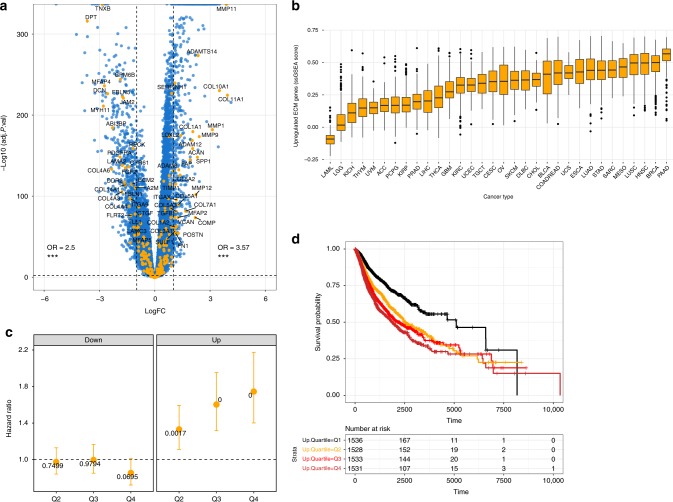
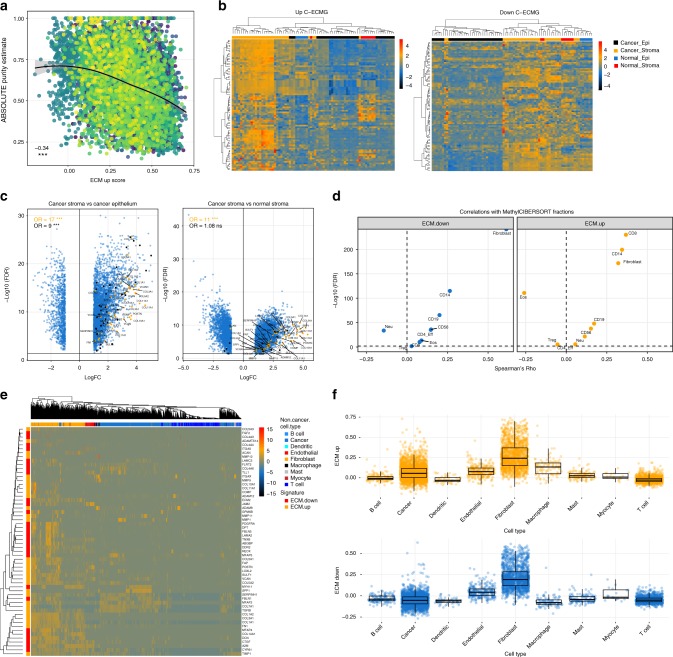
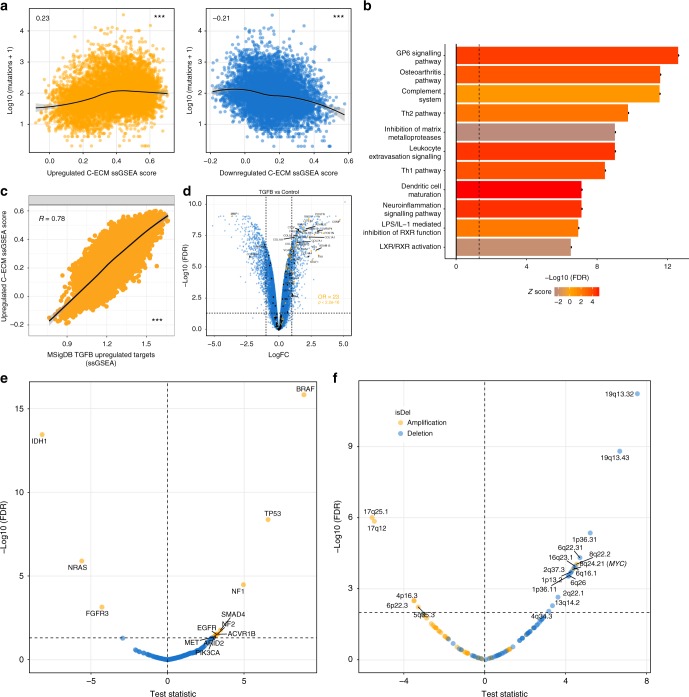
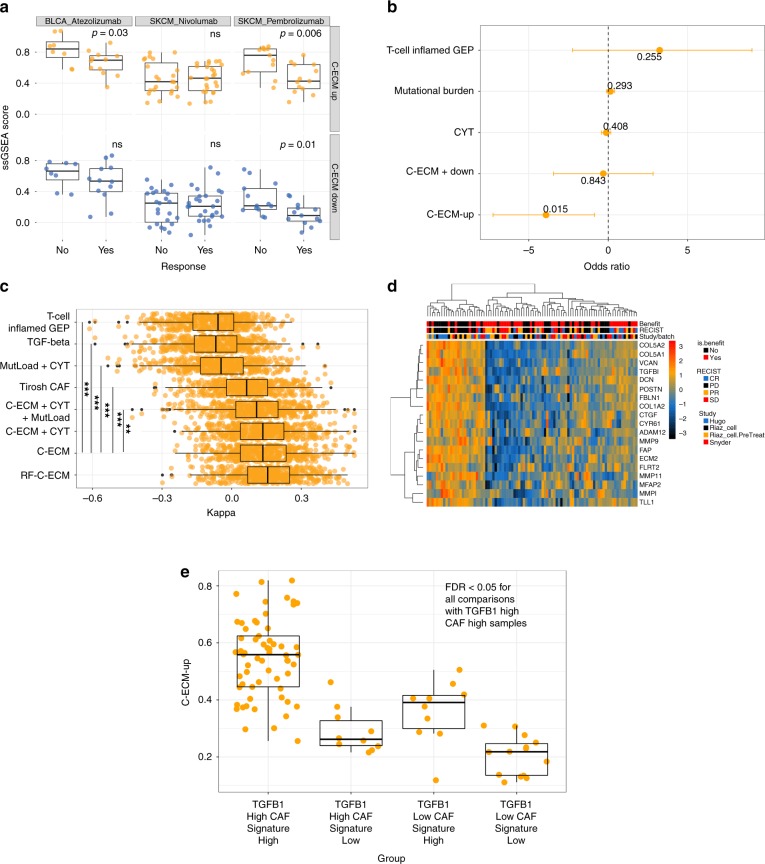
The extracellular matrix (ECM) is a key determinant of cancer progression and prognosis. Here we report findings from one of the largest pan-cancer analyses of ECM gene dysregulation in cancer. We define a distinct set of ECM genes upregulated in cancer (C-ECM) and linked to worse prognosis. We found that the C-ECM transcriptional programme dysregulation is correlated with the activation of TGF-β signalling in cancer-associated fibroblasts and is linked to immunosuppression in otherwise immunologically active tumours. Cancers that activate this programme carry distinct genomic profiles, such as BRAF, SMAD4 and TP53 mutations and MYC amplification. Finally, we show that this signature is a predictor of the failure of PD-1 blockade and outperforms previously-proposed biomarkers. Thus, our findings identify a distinct transcriptional pattern of ECM genes in operation across cancers that may be potentially targeted, pending preclinical validation, using TGF-β blockade to enhance responses to immune-checkpoint blockade.
Overview
The claims and statistics of this paper haven’t been checked yet.
Free: it reads the open-access text and checks the first 5 claims that cite a source we can check. Create a free account to check every claim.
Integrity signals
Registry
Cites
Statistics
Figures
Verification
Claims the paper makes
The claims and statistics of this paper haven’t been checked yet.
Free: it reads the open-access text and checks the first 5 claims that cite a source we can check. Create a free account to check every claim.
Claims other papers make about this one
Each is checked against this paper’s own text: does it say what the citing paper says it does?
In the citing paper
“genetic signatures linked to TGFb signaling and stromal remodeling are associated with poor disease outcome and immunotherapy failure across multiple human cancers”
From Immunomodulation by targeted anticancer agents (2021) · cites this paper as Chakravarthy et al., 2018
In the citing paper
“This signature was enriched in immunologically “hot” tumors across different cancer types within TCGA (Chakravarthy et al., 2018).”
From Hallmarks of response, resistance, and toxicity to immune checkpoint blockade (2021) · cites this paper as Chakravarthy et al., 2018
In the citing paper
“CAF-derived transforming growth factor beta (TGFβ) signaling in the tumor microenvironment was associated with dysregulation of the ECM genes resulting in a distinct signature that correlated with higher CD8+ T cells and M1:M2 macrophage ratio.”
From Hallmarks of response, resistance, and toxicity to immune checkpoint blockade (2021) · cites this paper as Chakravarthy et al., 2018
Self-check
Percentages, sums and reported differences re-computed from the paper’s own numbers.
The self-check needs the paper’s full text.
Citations
Cites
Hallmarks of Cancer: The Next Generation
Hanahan, D., & Weinberg, R. A. (2011) · Cell · doi:10.1016/j.cell.2011.02.013 · Cited by 66,590
GSVA: gene set variation analysis for microarray and RNA-Seq data
Hänzelmann, S., Castelo, R., & Guinney, J. (2013) · BMC Bioinformatics · doi:10.1186/1471-2105-14-7 · Cited by 15,440
Robust enumeration of cell subsets from tissue expression profiles
Newman, A. M., Liu, C. L., Green, M. R., Gentles, A. J., Feng, W., Xu, Y., Hoang, C. D., Diehn, M., & Alizadeh, A. A. (2015) · Nature Methods · doi:10.1038/nmeth.3337 · Cited by 13,224
Mismatch repair deficiency predicts response of solid tumors to PD-1 blockade
Le, D. T., Durham, J. N., Smith, K. N., Wang, H., Bartlett, B. R., Aulakh, L. K., Lu, S., Kemberling, H., Wilt, C., Luber, B. S., et al. (2017) · Science · doi:10.1126/science.aan6733 · Cited by 6,645
PD-1 blockade induces responses by inhibiting adaptive immune resistance
Tumeh, P. C., Harview, C. L., Yearley, J. H., Shintaku, I. P., Taylor, E. J. M., Robert, L., Chmielowski, B., Spasic, M., Henry, G., Ciobanu, V., et al. (2014) · Nature · doi:10.1038/nature13954 · Cited by 6,609
voom: precision weights unlock linear model analysis tools for RNA-seq read counts
Law, C. W., Chen, Y., Shi, W., & Smyth, G. K. (2014) · Genome Biology · doi:10.1186/gb-2014-15-2-r29 · Cited by 6,155
Charoentong, P., Finotello, F., Angelova, M., Mayer, C., Efremova, M., Rieder, D., Hackl, H., & Trajanoski, Z. (2017) · Cell Reports · doi:10.1016/j.celrep.2016.12.019 · Cited by 5,041
Dissecting the multicellular ecosystem of metastatic melanoma by single-cell RNA-seq
Tirosh, I., Izar, B., Prakadan, S. M., Wadsworth, M. H., Treacy, D., Trombetta, J. J., Rotem, A., Rodman, C., Lian, C., Murphy, G., et al. (2016) · Science · doi:10.1126/science.aad0501 · Cited by 4,944
Genetic Basis for Clinical Response to CTLA-4 Blockade in Melanoma
Snyder, A., Makarov, V., Merghoub, T., Yuan, J., Zaretsky, J. M., Desrichard, A., Walsh, L. A., Postow, M. A., Wong, P., Ho, T. S., et al. (2014) · New England Journal of Medicine · doi:10.1056/nejmoa1406498 · Cited by 4,286
Systematic RNA interference reveals that oncogenic KRAS-driven cancers require TBK1
Barbie, D. A., Tamayo, P., Boehm, J. S., Kim, S. Y., Moody, S. E., Dunn, I. F., Schinzel, A. C., Sandy, P., Meylan, E., Scholl, C., et al. (2009) · Nature · doi:10.1038/nature08460 · Cited by 3,890
Cited by
Items 201–300 of 733
Vienot, A., Pallandre, J., Renaude, E., Viot, J., Bouard, A., Spehner, L., Kroemer, M., Abdeljaoued, S., van der Woning, B., de Haard, H., et al. (2022) · OncoImmunology · doi:10.1080/2162402x.2022.2144669 · Cited by 40
“Pan-cancer analyses also established the presence of a TGF-β1-associated stromal signature correlated with immunotherapy failure and independent of tumor types.(12) Bulk RNA-sequencing (RNAseq) analyses contributed to deciphering molecular pathways involved in TGF-β1 mediated immunosuppression.”
BackgroundMinini, M., & Fouassier, L. (2023) · Current Oncology · doi:10.3390/curroncol30040319 · Cited by 40
“Indeed, CAFs communicate with tumor-infiltrating immune cells to drive an immunosuppressive microenvironment [6,8,32].”
BackgroundMechanisms of Resistance to Checkpoint Blockade Therapy
Shi, H., Lan, J., & Yang, J. (2020) · Advances in experimental medicine and biology · doi:10.1007/978-981-15-3266-5_5 · Cited by 40
Liu, J., Huang, Z., Chen, H., Qin, S., Chen, Y., Jiang, J., Zhang, Z., Luo, M., Ye, Q., Xie, N., et al. (2021) · Oncogene · doi:10.1038/s41388-021-01713-9 · Cited by 40
“A recent study highlighted the contribution of stromal gene expression signature in CRC diagnosis and prognosis [40], however, it remains unclear how epithelial cancer cells”
BackgroundWillumsen, N., Jensen, C., Green, G. A., Nissen, N. I., Neely, J., Nelson, D. M., Pedersen, R. S., Frederiksen, P., Chen, I. M., Boisen, M. K., et al. (2022) · Cellular and Molecular Life Sciences · doi:10.1007/s00018-022-04226-0 · Cited by 40
Song, J., Wei, R., Huo, S., Liu, C., & Liu, X. (2022) · Frontiers in Immunology · doi:10.3389/fimmu.2022.960570 · Cited by 40
Zhou, Y., Zhu, G., Lu, X., Zheng, K. I., Wang, Q.-W., Chen, J.-N., Zhang, Q., Yan, F., & Li, X. (2020) · Cancer Immunology Immunotherapy · doi:10.1007/s00262-020-02525-8 · Cited by 39
Li, Z., Shi, H., Xie, H., Yang, Y., Zheng, Y., Chen, H., & Gao, Y. (2022) · Chemical Engineering Journal · doi:10.1016/j.cej.2022.135712 · Cited by 39
Wang, Q., Shen, X., Chen, G., & Du, J. (2023) · International Journal of Cancer · doi:10.1002/ijc.34464 · Cited by 38
“TGF-β-associated ECM genes link CAFs to immune evasion and immunotherapy failure.(74)”
BackgroundSubstrate Stiffness Modulates TGF-β Activation and ECM-Associated Gene Expression in Fibroblasts
Verma, B. K., Chatterjee, A., Kondaiah, P., & Gundiah, N. (2023) · Bioengineering · doi:10.3390/bioengineering10090998 · Cited by 38
“also investigated the correlations between ECM genes upregulated in cancer and TGF-β signaling in cancer-associated fibroblasts [20].”
BackgroundLiu, Y., Okesola, B. O., de la Peña, D. O., Li, W., Lin, M., Trabulo, S. M. D., Tatari, M. N., Lawlor, R. T., Scarpa, A., Wang, W., et al. (2024) · Advanced Healthcare Materials · doi:10.1002/adhm.202301941 · Cited by 39
Mechanotransduction for therapeutic approaches: Cellular aging and rejuvenation
Han, H.-M., Kim, S.-Y., & Kim, D. (2025) · APL Bioengineering · doi:10.1063/5.0263236 · Cited by 39
Mellone, M., Piotrowska, K., Venturi, G., James, L., Bzura, A., Lopez, M. A., James, S., Wang, C., Ellis, M. J., Hanley, C. J., et al. (2022) · Cancer Research · doi:10.1158/0008-5472.can-22-0435 · Cited by 39
“Consistent with this, myoCAF-rich cancers contain low levels of infiltrating T cells (8, 10, 14) and functional studies in murine models have confirmed that myoCAF promote resistance to different types of immunotherapy (8, 13, 14), in part by promotingT-cell exclusion from tumors.”
BackgroundJiao, R., Lin, X., Zhang, Q., Zhang, Y., Qin, W., Yang, Q., Xu, C. S., Chen, F., & Zhang, K. (2023) · Progress in Materials Science · doi:10.1016/j.pmatsci.2023.101230 · Cited by 38
Sun, S., Xu, L., Zhang, X., Pang, L., Long, Z., Deng, C., Zhu, J., Zhou, S., Wan, L., Pang, B., et al. (2021) · Cancers · doi:10.3390/cancers13071639 · Cited by 38
“Patients with progressive disease were defined as “non-responders” [18,30].”
BackgroundInfluentialLabadie, B. W., Balar, A. V., & Luke, J. J. (2021) · Cancers · doi:10.3390/cancers13215415 · Cited by 37
Revisiting the Tenascins: Exploitable as Cancer Targets?
Tucker, R. P., & Degen, M. (2022) · Frontiers in Oncology · doi:10.3389/fonc.2022.908247 · Cited by 37
Stouten, I., van Montfoort, N., & Hawinkels, L. J. A. C. (2023) · International Journal of Molecular Sciences · doi:10.3390/ijms24108707 · Cited by 38
“To understand ECM remodelling, a pan-cancer analysis has been executed that compares genomic and cellular alterations across cancer types between malignant and normal tissue [81].”
BackgroundAhuja, S., & Zaheer, S. (2023) · Cell Biology International · doi:10.1002/cbin.12097 · Cited by 37
“Chakravarthy et al. studied the pan ‐ cancer role of ECM dysregulation; their study revealed the existence of cancer ‐ associated ECM genes (C ‐ ECM) program that is associated with immunotherapy failure.”
BackgroundSaid, S. S., & Ibrahim, W. N. (2024) · Biomedicines · doi:10.3390/biomedicines12020369 · Cited by 36
“TGF-β also modulates the phenotype of tumor-associated macrophages (TAMs) toward the immunosuppressive M2-like phenotype [25].”
BackgroundAi, J., Li, H., Zhang, M., Liu, J., Liu, L., & Sun, C. (2025) · International Journal of Biological Sciences · doi:10.7150/ijbs.121356 · Cited by 38
“TGF-β significantly promotes the synthesis and deposition of ECM by activating CAFs, positioning it as a potential therapeutic target for inhibiting stromal matrix production [61].”
InfluentialThe extracellular matrix in inflammation and cancer
Zhang, W., Xiang, Y., Lu, C., Wang, F., Ren, H., Wu, H., & Yan, M. (2026) · Molecular Biomedicine · doi:10.1186/s43556-026-00415-6 · Cited by 40
Immuno-Oncology Biomarkers for Personalized Immunotherapy in Breast Cancer
Vafaizadeh, V., & Barekati, Z. (2020) · Frontiers in Cell and Developmental Biology · doi:10.3389/fcell.2020.00162 · Cited by 36
“ECM dysregulation is often linked to the presence of cancerassociated fibroblasts (CAFs) expressing activated TGFβ signaling (Chakravarthy et al., 2018).”
BackgroundCRISPR screens identify tumor‐promoting genes conferring melanoma cell plasticity and resistance
Gautron, A., Bachelot, L., Aubry, M., Leclerc, D., Quéméner, A. M., Corre, S., Rambow, F., Paris, A., Tardif, N., Leclair, H. M., et al. (2021) · EMBO Molecular Medicine · doi:10.15252/emmm.202013466 · Cited by 37
“Recently, conditional deletion of Smad7, a negative regulator of TGF-b/SMAD pathway, led to sustained melanoma growth and at the same time promoted metastasis formation (Tuncer et al, 2019), confirming that TGF-b/SMAD pathway is a promising target for melanoma (Javelaud et al, 2007).”
BackgroundInfluentialYang, C., Cao, F., Huang, S., & Zheng, Y. (2021) · Frontiers in Immunology · doi:10.3389/fimmu.2021.717505 · Cited by 37
“In recent years, the interaction between the tumor microenvironment (TME) and tumors has become an important aspect of tumor biology research, because it is closely related to the exploration of tumor pathogenesis and the sensitivity of immunotherapy (11, 12).”
BackgroundTargeting Versican as a Potential Immunotherapeutic Strategy in the Treatment of Cancer
Hirani, P., Gauthier, V., Allen, C. E., Wight, T. N., & Pearce, O. M. T. (2021) · Frontiers in Oncology · doi:10.3389/fonc.2021.712807 · Cited by 36
Yang, Z., Xue, F. S., Li, M., Zhu, X., Lu, X., Wang, C., Xu, E., Wang, X., Zhang, L., Heng, Y., et al. (2021) · Frontiers in Oncology · doi:10.3389/fonc.2021.753330 · Cited by 39
“A pancancer analysis showed that ECM deposition induced by TGF-b signalling could predict failure of PD-1 blockade (21).”
BackgroundZhu, X., Fang, H., Gladysz, K., Barbour, J. A., & Wong, J. W. H. (2021) · European Journal of Cancer · doi:10.1016/j.ejca.2021.08.003 · Cited by 35
Brennen, W. N., Thorek, D. L. J., Jiang, W., Krueger, T. E. G., Antony, L., Denmeade, S. R., & Isaacs, J. T. (2020) · Immunotherapy · doi:10.2217/imt-2020-0066 · Cited by 36
Moreira, A., Poulet, A., Masliah‐Planchon, J., Lecerf, C., Vacher, S., Chérif, L. L., Dupain, C., Marret, G., Girard, E., Syx, L., et al. (2021) · ESMO Open · doi:10.1016/j.esmoop.2021.100178 · Cited by 36
Hanley, C. J., & Thomas, G. J. (2021) · Oncotarget · doi:10.18632/oncotarget.27936 · Cited by 35
“MyCAF gene signatures are upregulated in patients that failed to respond to immunotherapy [19, 20, 25, 26].”
BackgroundPhenotypic and spatial heterogeneity of CD8+ tumour infiltrating lymphocytes
Sun, Y., Yinwang, E., Wang, S., Wang, Z., Wang, F., Xue, Y., Zhang, W., Zhao, S., Mou, H., Chen, S., et al. (2024) · Molecular Cancer · doi:10.1186/s12943-024-02104-w · Cited by 34
“Transcriptomic analyses have established the inverse correlations between myoCAF-associated signatures and abundance of CD8 + T cells as well as immunotherapy efficacy [219, 227–229].”
BackgroundCombinatorial Immunotherapies for Metastatic Colorectal Cancer
Janssen, E., Subtil, B., Ortiz, F. D. L. J., Verheul, H. M. W., & Tauriello, D. V. F. (2020) · Cancers · doi:10.3390/cancers12071875 · Cited by 34
Liu, Z., Liu, L., Lu, T., Wang, L., Li, Z., Jiao, D., & Han, X. (2021) · Journal of Oncology · doi:10.1155/2021/6664386 · Cited by 34
High-dimensional analysis of the adenosine pathway in high-grade serous ovarian cancer
Barèche, Y., Pommey, S., Carneiro, M., Buisseret, L., Cousineau, I., Thébault, P., Chrobák, P., Communal, L., Allard, D., Robson, S. C., et al. (2021) · Journal for ImmunoTherapy of Cancer · doi:10.1136/jitc-2020-001965 · Cited by 34
Bête Noire of Chemotherapy and Targeted Therapy: CAF-Mediated Resistance
De, P. K., Aske, J. C., Sulaiman, R. A., & Dey, N. (2022) · Cancers · doi:10.3390/cancers14061519 · Cited by 34
Pellegata, N. S., Berriel Diaz, M., Rohm, M., & Herzig, S. (2022) · Cancer and Metastasis Reviews · doi:10.1007/s10555-022-10058-y · Cited by 33
He, J. N., Gao, Y., Jing, L., Yang, H., & Liu, S. (2025) · Frontiers in Oncology · doi:10.3389/fonc.2025.1489701 · Cited by 33
Gene Expression Classifier Reveals Prognostic Osteosarcoma Microenvironment Molecular Subtypes
Song, Y., Xu, Y., Deng, C., Zhu, X., Fu, J., Chen, H., Lu, J., Xu, H., Song, G., Tang, Q., et al. (2021) · Frontiers in Immunology · doi:10.3389/fimmu.2021.623762 · Cited by 32
“Furthermore, interactions of neoplastic cells with a diverse collection of immune and/or stromal cells along with extracellular matrix remodeling may influence tumor metastasis and therapeutic effects (45).”
BackgroundNeutrophils: Musketeers against immunotherapy
Zahid, K. R., Raza, U., Tumbath, S., Jiang, L., Xu, W., & Huang, X. (2022) · Frontiers in Oncology · doi:10.3389/fonc.2022.975981 · Cited by 32
Qayoom, H., Alkhanani, M., Almilaibary, A., Alsagaby, S. A., & Mir, M. A. (2023) · Saudi Journal of Biological Sciences · doi:10.1016/j.sjbs.2023.103705 · Cited by 32
Shen, Y., Zou, Y., Bie, B., & Lv, Y. (2023) · Advanced Healthcare Materials · doi:10.1002/adhm.202301080 · Cited by 32
Katagata, M., Okayama, H., Nakajima, S., Saito, K., Sato, T., Sakuma, M., Fukai, S., Endo, E., Sakamoto, W., Saito, M., et al. (2023) · Cancers · doi:10.3390/cancers15204943 · Cited by 32
Tomlinson, J. L., Li, B., Yang, J., Loeuillard, E. J., Stumpf, H. E., Kuipers, H., Watkins, R. D., Carlson, D. M., Willhite, J., O’Brien, D. R., et al. (2024) · Journal of Hepatology · doi:10.1016/j.jhep.2024.02.008 · Cited by 33
Chen, Y., Jiang, Q., Xing, X., Liu, X., Zhao, Q., Zhang, Q., Chen, J., Ma, C., Liu, X., Lu, Y., et al. (2025) · Advanced Science · doi:10.1002/advs.202504032 · Cited by 32
TGFβ: Signaling Blockade for Cancer Immunotherapy
Chen, S., Mamaï, O., & Akhurst, R. J. (2021) · Annual Review of Cancer Biology · doi:10.1146/annurev-cancerbio-070620-103554 · Cited by 31
“…with the effects of TGF β inhibition in stimulating CD8 + T cell recruitment from the stroma to the tumor parenchyma, which has been observed in several tumor types (Chakravarthy et al. 2018, Mariathasan et al. 2018, Tauriello et al. 2018, Dodagatta-Marri et al. 2019, Gunderson et al. 2020).”
BackgroundVeerman, R. E., Akpinar, G. G., Offens, A., Steiner, L., Larssen, P., Lundqvist, A., Karlsson, M. C. I., & Gabrielsson, S. (2023) · Cancer Immunology Research · doi:10.1158/2326-6066.cir-22-0540 · Cited by 31
Strategies for Overcoming Immune Evasion in Bladder Cancer
Shin, J., Park, J. Y., Kim, S. W., Lee, J., Choi, W. S., & Kim, H. S. (2024) · International Journal of Molecular Sciences · doi:10.3390/ijms25063105 · Cited by 30
Jiang, J., Xu, C., Han, D., Lu, Y., Yang, F., Wang, J., Yan, X., Mu, X., Zhang, J., Jia, C., et al. (2024) · Biomarker Research · doi:10.1186/s40364-024-00656-z · Cited by 30
“Additionally, TGF-β is one of the most important mediators in ECM remodeling [21].”
BackgroundChen, P., Li, X., Ma, W., Han, L., Li, M., Yang, X., & Li, S.-Y. (2020) · OncoTargets and Therapy · doi:10.2147/ott.s245896 · Cited by 30
Extracellular matrix modulates T cell clearance of malignant cells in vitro
Robertson, C., Sebastian, A., Hinckley, A., Rios‐Arce, N. D., Hynes, W. F., Edwards, S. A., He, W., Hum, N. R., Wheeler, E. K., Loots, G. G., et al. (2022) · Biomaterials · doi:10.1016/j.biomaterials.2022.121378 · Cited by 30
Lei, M., Jiang, J., Wang, M., Wu, W., Zhang, J., Liu, W., Zhou, W., Lai, Y., Jiang, T., Widelitz, R. B., et al. (2023) · npj Regenerative Medicine · doi:10.1038/s41536-023-00340-0 · Cited by 30
A novel high-risk subpopulation identified by CTSL and ZBTB7B in gastric cancer
Cui, K., Yao, S., Liu, B., Sun, S., Gong, L., Li, Q., Fei, B., & Huang, Z. (2022) · British Journal of Cancer · doi:10.1038/s41416-022-01936-x · Cited by 29
“Besides, cancer-associated ECM genes are associated with the activation of the TGF-β signalling in CAFs [31].”
BackgroundInfluentialLian, G., Wan, Y., Mak, T. S., Wang, Q., Zhang, J., Chen, J., Wang, Z., Li, M., Tang, P. M., Huang, X., et al. (2022) · Biomaterials · doi:10.1016/j.biomaterials.2022.121730 · Cited by 29
Devi, S., Singh, S. D., Joga, R., Patil, S. Y., Devi, V. M., Dushantrao, S. C., Dwivedi, F., Kumar, G., Jindal, D. K., Singh, C., et al. (2024) · European Journal of Pharmaceutics and Biopharmaceutics · doi:10.1016/j.ejpb.2024.114323 · Cited by 29
Wang, Y., Li, X., Gang, Q., Huang, Y., Liu, M., Zhang, H., Shen, S., Yao, Q., & Zhang, J. (2024) · BMC Cancer · doi:10.1186/s12885-024-12459-4 · Cited by 28
Cancer Physical Hallmarks as New Targets for Improved Immunotherapy
Guo, H., Zhang, T., Yu, Y., & Xu, F. (2021) · Trends in Cell Biology · doi:10.1016/j.tcb.2021.03.011 · Cited by 28
Biophysical and mechanobiological considerations for T-cell-based immunotherapy
Zhuang, C., Gould, J. E., Enninful, A., Shao, S., & Mak, M. (2023) · Trends in Pharmacological Sciences · doi:10.1016/j.tips.2023.03.007 · Cited by 28
Ye, Y., Zhang, S., Jiang, Y., Huang, Y., Wang, G., Zhang, M., Gui, Z., Wu, Y., Bian, G., Li, P., et al. (2023) · Scientific Reports · doi:10.1038/s41598-023-48653-w · Cited by 27
Hirani, P., McDermott, J. R., Rajeeve, V., Cutillas, P. R., Jones, J. L., Pennington, D. J., Wight, T. N., Santamaria, S., Alonge, K. M., & Pearce, O. M. T. (2024) · Cancer Research Communications · doi:10.1158/2767-9764.crc-23-0548 · Cited by 27
Liu, Y.-T., Liu, H., Ren, J., Zhang, W., Wang, X., Yu, Z., Fu, Q.-Y., Xiong, X., Jia, J., Liu, B., et al. (2025) · Cell Reports Medicine · doi:10.1016/j.xcrm.2025.102024 · Cited by 27
Modelling TGFβR and Hh pathway regulation of prognostic matrisome molecules in ovarian cancer
Delaine‐Smith, R. M., Maniati, E., Malacrida, B., Nichols, S. J., Roozitalab, R., Jones, R. R., Lecker, L. S. M., Pearce, O. M. T., Knight, M. M., & Balkwill, F. R. (2021) · iScience · doi:10.1016/j.isci.2021.102674 · Cited by 27
Yang, Y., Ahn, J., Edwards, N. J., Benický, J., Rozeboom, A. M., Davidson, B. J., Karamboulas, C., Nixon, K. C. J., Ailles, L., & Goldman, R. (2022) · Cancers · doi:10.3390/cancers14225553 · Cited by 27
Afshar, K., Sanaei, M., Ravari, M. S., Pourbagheri‐Sigaroodi, A., & Bashash, D. (2023) · Cell Biochemistry and Function · doi:10.1002/cbf.3846 · Cited by 27
“163 The presence of this specific subgroup of CAFs in cancer tissues can distinguish malignant tissue from a normal one, predict the efficacy of anti ‐ PD1 therapy, and is linked to a negative prognosis in various solid tumor types.”
BackgroundExploiting Canonical TGFβ Signaling in Cancer Treatment
Liu, Q., Chen, G., Moore, J., Guix, I., Placantonakis, D., & Barcellos-Hoff, M. H. (2022) · Molecular Cancer Therapeutics · doi:10.1158/1535-7163.mct-20-0891 · Cited by 27
“Another study based on a pan-cancer extracellular matrix dysregulation gene signature, revealed that a higher TGFb-driven signature identifies a poor prognosis phenotype with cancer-associated fibroblast activation (88).”
BackgroundOncogenic effects of ECM remodeling in obesity and breast cancer
Hawes, M. L., Moody, M. A., McCauley, C. R., Huddleston, A. G., Solanky, M., Khosravi, D. H., Patel, A. R., Lynch, R. M., Alahari, S. K., Bunnell, B. A., et al. (2025) · Oncogene · doi:10.1038/s41388-025-03521-x · Cited by 27
“RNA-seq data from malignant and normal tissue reveal that the ECM signature of CAFs overlaps with that from malignant tissue, and this expression pro fi le is activated with TGF β signaling [101].”
Marwitz, S., Ballesteros‐Merino, C., Jensen, S. M., Reck, M., Kügler, C., Perner, S., Drömann, D., Goldmann, T., & Fox, B. A. (2021) · Journal for ImmunoTherapy of Cancer · doi:10.1136/jitc-2020-001469 · Cited by 26
Emerging technologies provide insights on cancer extracellular matrix biology and therapeutics
Cruz‐Acuña, R., Vunjak‐Novakovic, G., Burdick, J. A., & Rustgi, A. K. (2021) · iScience · doi:10.1016/j.isci.2021.102475 · Cited by 26
“…in an attempt to understand the dynamic reciprocal feedback between the ECM and tumor cells that both change in space and time (Laklai & et al., 2016; Fernández-Sánchez & et al., 2015; Gan & et al., 2018; Liu et al., 2018; Chen & et al., 2019; Stephan & et al., 2015; Chakravarthy et al., 2018).”
BackgroundAdvances and Hurdles in CAR T Cell Immune Therapy for Solid Tumors
Boccalatte, F. E., Mina, R., Aroldi, A., Leone, S., Suryadevara, C. M., Placantonakis, D. G., & Bruno, B. (2022) · Cancers · doi:10.3390/cancers14205108 · Cited by 26
“This factor acts both on the tumor stroma, where it enhances matrix deposition and shields tumor cells from immune surveillance [27], and on T cells, where it inhibits effector functions and skews their phenotype towards immune tolerance [28].”
BackgroundZ-DNA enhances immunotherapy by triggering death of inflammatory cancer-associated fibroblasts
Herbert, A. G., & Balachandran, S. (2022) · Journal for ImmunoTherapy of Cancer · doi:10.1136/jitc-2022-005704 · Cited by 27
Xie, L., Liu, M., Cai, M., Huang, W., Guo, Y., Liang, L., Cai, W., Liu, J., Liang, W., Tan, Y., et al. (2023) · Biomedicine & Pharmacotherapy · doi:10.1016/j.biopha.2023.114254 · Cited by 26
Comprehensive characterization of TGFB1 across hematological malignancies
Wang, C., Zhang, Z., Zhang, Y., Zheng, L., Liu, Y., Yan, A., Zhang, Y.-C., Chang, Q.-H., Sha, S., & Xu, Z. (2023) · Scientific Reports · doi:10.1038/s41598-023-46552-8 · Cited by 26
“As TGF-β signaling has been reported to be involved in the TME 18,19 , we continued to explore the correlations between TGFB1 expression and 29 TME signature scores across hematological malignancies.”
BackgroundCoschi, C. H., & Juergens, R. A. (2023) · Current Oncology · doi:10.3390/curroncol31010001 · Cited by 26
“Cancer-associated fibroblasts, which reside within the TME, promote tumorigenesis by initiating remodeling of the extra-cellular matrix or by secreting certain cyto-and chemokines [25].”
BackgroundBiotics as novel therapeutics in targeting signs of skin ageing via the gut-skin axis
Millman, J. F., Kondrashina, A. V., Walsh, C., Busca, K., Karawugodage, A., Park, J., Sirisena, S., Martin, F., Felice, V. D., & Lane, J. A. (2024) · Ageing Research Reviews · doi:10.1016/j.arr.2024.102518 · Cited by 26
Molecular phenotypes and spatial archetypes: A new framework for cancer-associated fibroblasts
Liu, Y., Chen, X., Dai, Y., Jia, Y., Kieffer, Y., Xie, L., Zhou, Z., Tyler, L. A., Kim, A. C., Biffi, G., et al. (2026) · Cancer Cell · doi:10.1016/j.ccell.2026.06.001 · Cited by 26
Hu, Q., Xu, M., Feng, J., Xie, H., Li, J., He, Y., Tang, G., & Guo, B. (2022) · Nanoscale · doi:10.1039/d2nr04235e · Cited by 25
Do Tumor Mechanical Stresses Promote Cancer Immune Escape?
Onwudiwe, K. C., Najera, J., Siri, S., & Datta, M. (2022) · Cells · doi:10.3390/cells11233840 · Cited by 25
Enhancing personalized immune checkpoint therapy by immune archetyping and pharmacological targeting
Cerella, C., Dicato, M. A., & Diederich, M. F. (2023) · Pharmacological Research · doi:10.1016/j.phrs.2023.106914 · Cited by 25
SMARCD3 is a potential prognostic marker and therapeutic target in CAFs
Ming, J., Wang, H., Chen, H., & Han, Y. P. (2020) · Aging · doi:10.18632/aging.104102 · Cited by 25
Hodkinson, B. P., Schäffer, M., Brody, J., Jurczak, W. J., Carpio, C. D. C., Ben‐Yehuda, D., Avivi, I. M., Forslund, A., Özcan, M., Alvarez, J. D., et al. (2020) · Translational Oncology · doi:10.1016/j.tranon.2020.100977 · Cited by 25
Xia, J., Shi, Y., & Chen, X. (2024) · Scientific Reports · doi:10.1038/s41598-024-72020-y · Cited by 25
Zhang, X., Wu, X., Sun, Y., Chu, Y., Liu, F., & Chen, C. (2022) · Cellular Oncology · doi:10.1007/s13402-022-00759-5 · Cited by 24
Seyhan, A. A., & Carini, C. (2022) · International Journal of Molecular Sciences · doi:10.3390/ijms24010041 · Cited by 24
Fejza, A., Carobolante, G., Poletto, E., Camicia, L., Schinello, G., Siena, E. D., Ricci, G., Mongiat, M., & Andreuzzi, E. (2023) · Frontiers in Immunology · doi:10.3389/fimmu.2023.1270981 · Cited by 24
Lee, S.-A., Cho, G.-J., Kim, D., & Kim, D. (2024) · Frontiers in Cell and Developmental Biology · doi:10.3389/fcell.2024.1335636 · Cited by 24
Mechanism and application prospect of magnesium-based materials in cancer treatment
Ma, Y., Wang, Y., Song, S., Yu, X., Xu, C., Wan, L., Yao, F., Yang, K., Witte, F., & Yang, S. (2025) · Journal of Magnesium and Alloys · doi:10.1016/j.jma.2025.02.010 · Cited by 25
Strait, A. A., & Wang, X. (2020) · Molecular Carcinogenesis · doi:10.1002/mc.23196 · Cited by 25
“immune checkpoint blockade.(95) This TGFβ signaling program functions as a better predictor of anti‐PD‐1 therapeutic failure than other”
BackgroundWang, T., Chen, Z., Wang, W., Wang, H., & Li, S. (2025) · Frontiers in Immunology · doi:10.3389/fimmu.2025.1556386 · Cited by 23
Kanoda, R., Nakajima, S., Okayama, H., Kaneta, A., Chida, S., Matsumoto, T., Saito, K., Kikuchi, T., Maruyama, Y., Suzuki, H., et al. (2025) · Scientific Reports · doi:10.1038/s41598-025-03924-6 · Cited by 24
Kwon, S. M., Lee, Y., Min, S., Woo, H. G., Wang, H.-J., & Yoon, G. (2020) · iScience · doi:10.1016/j.isci.2020.101247 · Cited by 23
Cancer-associated fibroblasts: Versatile mediators in remodeling the tumor microenvironment
Zhang, Q., Wang, Y., & Liu, F. (2022) · Cellular Signalling · doi:10.1016/j.cellsig.2022.110567 · Cited by 23
Wietecha, M. S., Lauenstein, D., Cangkrama, M., Seiler, S., Jin, J., Goppelt, A., Claassen, M., Levesque, M. P., Dummer, R., & Werner, S. (2023) · Matrix Biology · doi:10.1016/j.matbio.2023.03.003 · Cited by 23
Du, Y., Zhao, Y., Li, J., Wang, J., You, S., Zhang, Y., Zhang, L., Yang, J., Alinejad‐Rokny, H., Cheng, S., et al. (2025) · Advanced Science · doi:10.1002/advs.202415756 · Cited by 23
O’Neill, A., Zakaria, N., Egan, H., Corry, S. M., Bull, C., Leonard, N. A., O'Meara, C., Howard, L., Walsh, A., Reidy, E., et al. (2025) · Journal for ImmunoTherapy of Cancer · doi:10.1136/jitc-2025-012491 · Cited by 22
Computational pathology in ovarian cancer
Oršulić, S., John, J., Walts, A. E., & Gertych, A. (2022) · Frontiers in Oncology · doi:10.3389/fonc.2022.924945 · Cited by 23
Zhong, M., Duan, X., Nijiati, M., Qi, H., Xu, D., Cai, D., Li, C., Huang, Z.-P., Zhu, Q., Gao, F., et al. (2022) · Journal of Translational Medicine · doi:10.1186/s12967-022-03788-8 · Cited by 23
Tenascin-X as a causal gene for classical-like Ehlers-Danlos syndrome
Okuda‐Ashitaka, E., & Matsumoto, K. (2023) · Frontiers in Genetics · doi:10.3389/fgene.2023.1107787 · Cited by 22
“In another study using the TCGA database for ECM gene dysregulation in cancer, 58 out of 249 ECM genes were identified as cancer-associated ECM genes and TNXB was found to be the most significantly downregulated among those genes in cancers (Chakravarthy et al., 2018).”
MethodYang, W., Yi, J., Zhu, R., Guo, Y., Zhang, K., Cao, Y., Li, X., Zhang, J., Zhang, Z., Li, Y., et al. (2023) · Theranostics · doi:10.7150/thno.83912 · Cited by 22
Jiang, P., Fan, J., Zhang, C., Bai, M., Sun, Q., Chen, Q., Mao, W., Tang, B., Lan, H., Zhou, Y., et al. (2023) · International Journal of Biological Sciences · doi:10.7150/ijbs.84781 · Cited by 22
“Cu: copper; PCD: programmed cell death; TCA: tricarboxylic acid; CRC: colorectal cancer; TME: tumor microenvironment; DMEM: Dulbecco’s modified eagle’s medium; FBS: fetal bovine serum; MSigDB: Molecular Signatures Database; GO: Gene ontology; GSEA: gene set enrichment analysis; GSVA: gene set variation analysis; KEGG:…”
InfluentialRuocco, M. R., Gisonna, A., Acampora, V., D'Agostino, A. G., Carrese, B., Santoro, J., Venuta, A., Nasso, R., Rocco, N., Russo, D., et al. (2024) · International Journal of Molecular Sciences · doi:10.3390/ijms25116224 · Cited by 22
“The CAF secretome exerts an immunomodulatory action by regulating immune cell recruitment and functions within tumors [44–46] as well as CAFs contributing to construct an ECM that acts as physical barrier precluding the infiltration of immune cells into tumors [47–49].”
Background
Metadata
- Authors
- Chakravarthy, A., Khan, L., Bensler, N. P., Bose, P., & De Carvalho, D. D.
- Affiliations
- University Health Network (CA)
- University of Calgary (CA)
- Corresponding author
- Bose, Pinaki
- Venue
- Nature Communications
- Published
- 2018-11-08
- Volume
- 9
- Issue
- 1
- Pages
- 4692-4692
- ISSN
- 2041-1723 (ISSN-L)
- PMC
- PMC6224529
- OpenAlex
- W2899204048
- Cited by
- 656
- References
- 48
- Citations by year
- 2026: 65 · 2025: 96 · 2024: 123 · 2023: 107 · 2022: 86 · 2021: 89 · 2020: 66 · 2019: 24
- FWCI
- 16.01
- Type
- journal article
- Language
- en
- Open access
- gold
- doi.org
- Licence
- cc-by
- creativecommons.org/licenses/by/4.0 (tdm)
- creativecommons.org/licenses/by/4.0 (vor)
- Locations
- Nature Communications (publishedVersion, cc-by)
- Europe PMC (PubMed Central) (publishedVersion, other-oa)
- PubMed Central (publishedVersion, cc-by)
- PubMed (publishedVersion)
- RePEc: Research Papers in Economics (submittedVersion)
- DOAJ (DOAJ: Directory of Open Access Journals) (submittedVersion, cc-by-sa)
- DOAJ (DOAJ: Directory of Open Access Journals) (submittedVersion)
- Funders
- University of Calgary
- Cancer Research Society
- Princess Margaret Cancer Foundation (950-231346)
- J.P. Bickell Foundation
- Canadian Institutes of Health Research (148430_1, 201512MSH-360794-228629, 148430, 201512MSH‐)
- Canadian Cancer Society Research Institute
- Natural Sciences and Engineering Research Council of Canada (489073)
- Topics
- Life Sciences › Biochemistry, Genetics and Molecular Biology › Molecular Biology › TGF-β signaling in diseases
- Health Sciences › Medicine › Oncology › Cancer Immunotherapy and Biomarkers
- Health Sciences › Medicine › Oncology › Cancer Cells and Metastasis
- Keywords
- extracellular matrix genes, cancer-associated fibroblasts, TGF-beta signaling, immune evasion, immunotherapy resistance, anti-PD-1 therapy, prognostic signature, pan-cancer analysis, immunosuppression, TGF-beta blockade, BRAF mutation, SMAD4 mutation, TP53 mutation, MYC amplification, immune checkpoint molecules
- MeSH terms
- Cancer-Associated Fibroblasts, Extracellular Matrix, Humans, Immunotherapy, Prognosis, Transcription, Genetic, Gene Expression Regulation, Neoplastic, Transforming Growth Factor beta, Stromal Cells, Immune Evasion, Programmed Cell Death 1 Receptor, Carcinogenesis
About these checks
Registry, retraction, Cites and statistics results are computed, not judged, with one exception: a printed reference that no index lists is read once by a model before it counts as a citation error. Claims are extracted by a model and kept only when their quote appears verbatim in the text; each cited source is then checked, with a model’s help, for whether it says what the claim relies on. Those verdicts can be wrong — read the claim’s quote and the cited source before relying on one.
Statistics and arithmetic are recomputed, not judged.
Confidence bands are shown only for fields calibrated on our annotated test set. None is calibrated yet, so no band is shown.
What counts as a claim ›How we measure confidence ›How we check this ›
Are you an author, or do you see a problem with this page? Request a review
Data sources
Bibliographic data: Semantic Scholar, OpenAlex, Crossref.
Contains information from the Semantic Scholar Academic Graph Datasets, made available under the ODC Attribution License (ODC-BY 1.0).
Semantic Scholar’s data is described in: Kinney, R., et al. (2023). The Semantic Scholar Open Data Platform. arXiv:2301.10140.
