

Defining human cardiac transcription factor hierarchies using integrated single-cell heterogeneity analysis
Open accessThe DOI matches its Crossref record; 55 of the 55 references it cites were found in a registry or an index.
Abstract
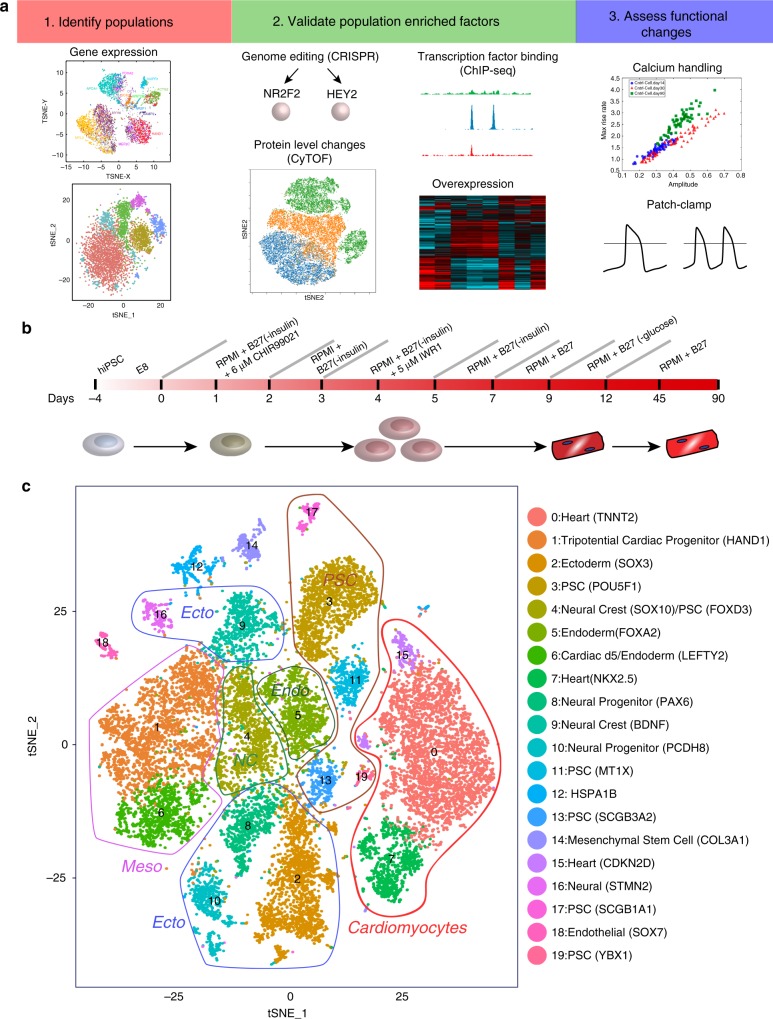
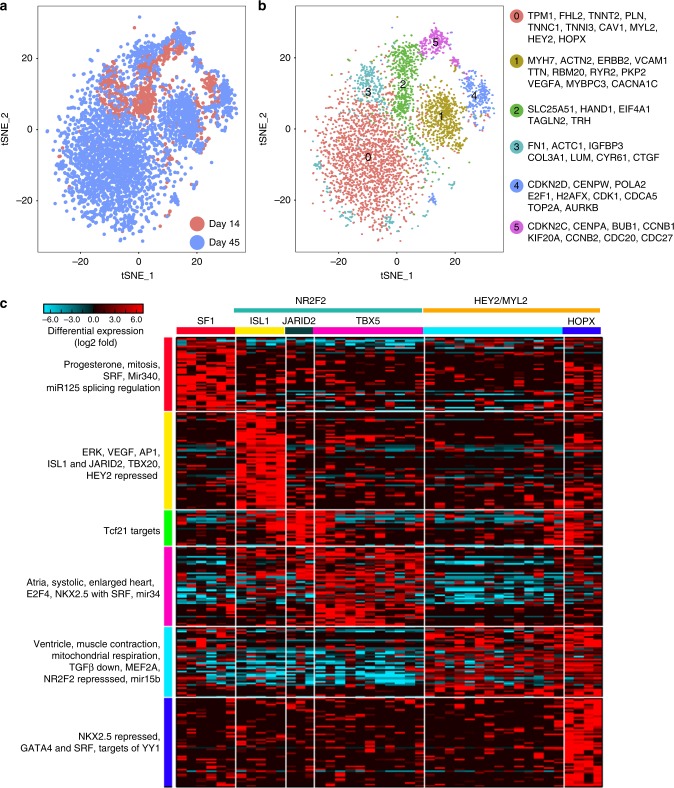
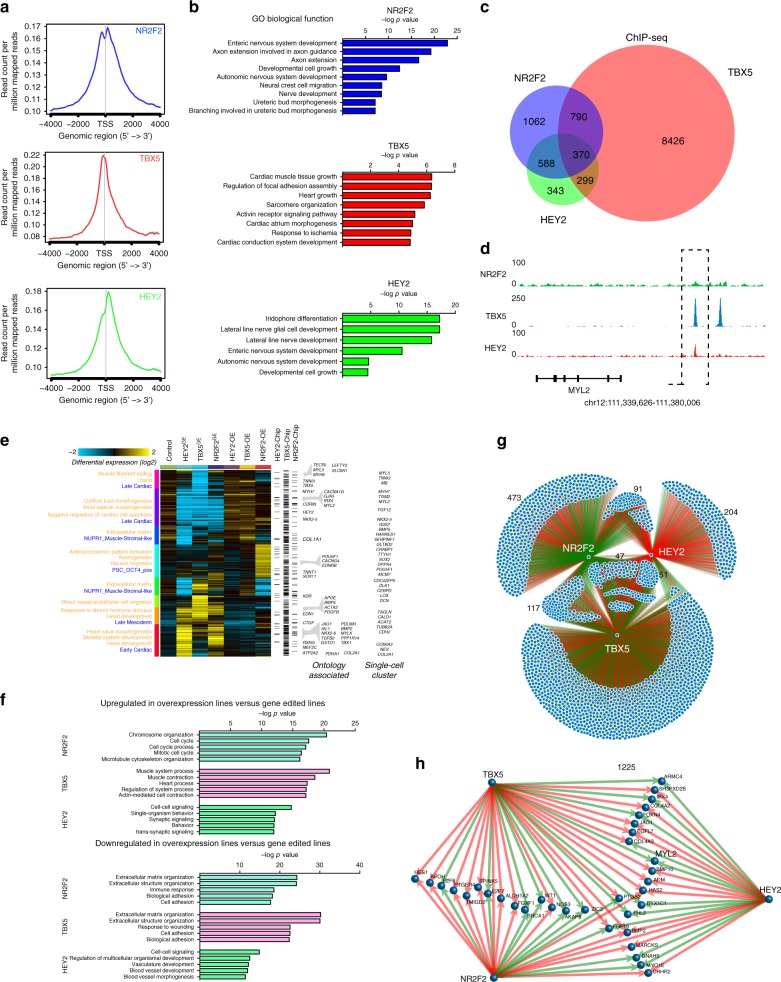
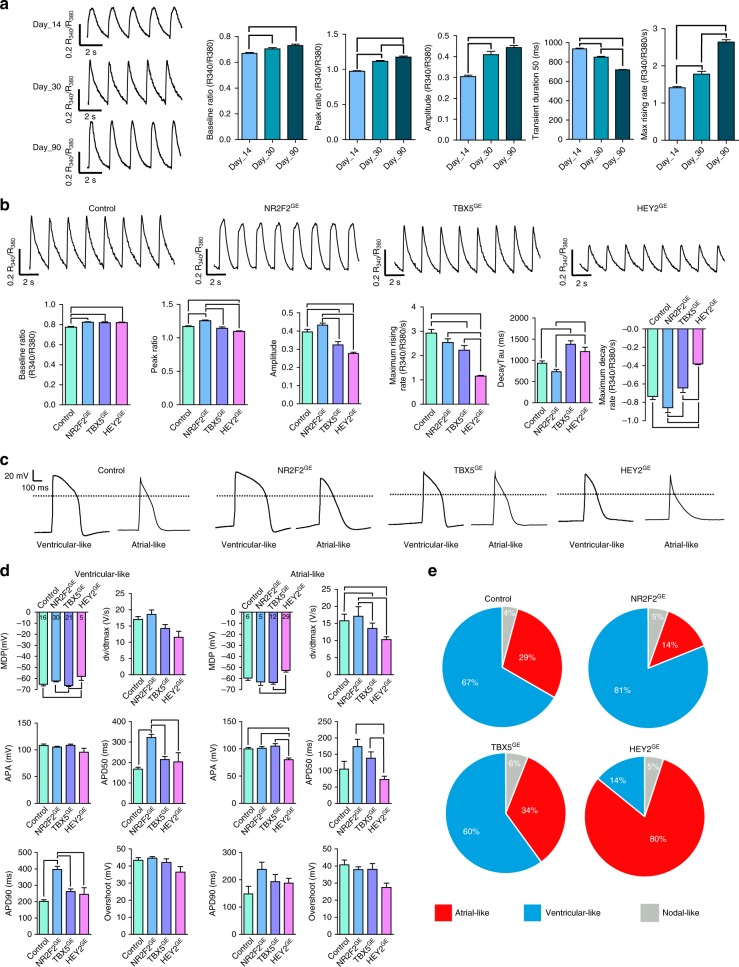
Human induced pluripotent stem cell-derived cardiomyocytes (hiPSC-CMs) have become a powerful tool for human disease modeling and therapeutic testing. However, their use remains limited by their immaturity and heterogeneity. To characterize the source of this heterogeneity, we applied complementary single-cell RNA-seq and bulk RNA-seq technologies over time during hiPSC cardiac differentiation and in the adult heart. Using integrated transcriptomic and splicing analysis, more than half a dozen distinct single-cell populations were observed, several of which were coincident at a single time-point, day 30 of differentiation. To dissect the role of distinct cardiac transcriptional regulators associated with each cell population, we systematically tested the effect of a gain or loss of three transcription factors (NR2F2, TBX5, and HEY2), using CRISPR genome editing and ChIP-seq, in conjunction with patch clamp, calcium imaging, and CyTOF analysis. These targets, data, and integrative genomics analysis methods provide a powerful platform for understanding in vitro cellular heterogeneity.
Overview
The claims and statistics of this paper haven’t been checked yet.
Free: it reads the open-access text and checks the first 5 claims that cite a source we can check. Create a free account to check every claim.
Integrity signals
Registry
Cites
Statistics
Figures
Verification
Claims the paper makes
The claims and statistics of this paper haven’t been checked yet.
Free: it reads the open-access text and checks the first 5 claims that cite a source we can check. Create a free account to check every claim.
Claims other papers make about this one
Each is checked against this paper’s own text: does it say what the citing paper says it does?
The check wasn’t confident either way, so it gives no verdict — never disputed.
In the citing paper
“iPSC-derived cardiomyocytes express a myriad of MMPs including 1–3, 10, 11, 14–16 and 1938, as do hiPSC-derived smooth muscle cells, which were present, albeit more rarely in the hChaMP.”
From In situ expansion, differentiation, and electromechanical coupling of human cardiac muscle in a 3D bioprinted, chambered organoid (2020) · cites this paper as [38]
Experimental — accuracy not yet measuredThe check wasn’t confident either way, so it gives no verdict — never disputed.
In the citing paper
“which will engage at least integrins α1β1 and α2β1, which are highly expressed in iPSC-derived cardiomyocytes38.”
From In situ expansion, differentiation, and electromechanical coupling of human cardiac muscle in a 3D bioprinted, chambered organoid (2020) · cites this paper as [38]
Experimental — accuracy not yet measured
Self-check
Percentages, sums and reported differences re-computed from the paper’s own numbers.
The self-check needs the paper’s full text.
Citations
Cites
STAR: ultrafast universal RNA-seq aligner
Dobin, A., Davis, C. A., Schlesinger, F., Drenkow, J., Zaleski, C., Jha, S., Batut, P., Chaisson, M., & Gingeras, T. R. (2013) · Bioinformatics · doi:10.1093/bioinformatics/bts635 · Cited by 51,709
Model-based Analysis of ChIP-Seq (MACS)
Zhang, Y., Liu, T., Meyer, C. A., Eeckhoute, J., Johnson, D. S., Bernstein, B. E., Nusbaum, C., Myers, R. M., Brown, M., Li, W., et al. (2008) · Genome Biology · doi:10.1186/gb-2008-9-9-r137 · Cited by 18,386
Kim, D., Pertea, G., Trapnell, C., Pimentel, H., Kelley, R., & Salzberg, S. L. (2013) · Genome Biology · doi:10.1186/gb-2013-14-4-r36 · Cited by 12,668
Near-optimal probabilistic RNA-seq quantification
Bray, N. L., Pimentel, H., Melsted, P., & Pachter, L. (2016) · Nature Biotechnology · doi:10.1038/nbt.3519 · Cited by 9,723
Trapnell, C., Cacchiarelli, D., Grimsby, J., Pokharel, P., Li, S., Morse, M., Lennon, N. J., Livak, K. J., Mikkelsen, T. S., & Rinn, J. L. (2014) · Nature Biotechnology · doi:10.1038/nbt.2859 · Cited by 7,314
GREAT improves functional interpretation of cis-regulatory regions
McLean, C. Y., Bristor, D., Hiller, M., Clarke, S. L., Schaar, B. T., Lowe, C. B., Wenger, A. M., & Bejerano, G. (2010) · Nature Biotechnology · doi:10.1038/nbt.1630 · Cited by 4,502
A more efficient method to generate integration-free human iPS cells
Okita, K., Matsumura, Y., Sato, Y., Okada, A., Morizane, A., Okamoto, S., Hong, H., Nakagawa, M., Tanabe, K., Tezuka, K.-I., et al. (2011) · Nature Methods · doi:10.1038/nmeth.1591 · Cited by 2,061
Lian, X., Hsiao, C., Wilson, G., Zhu, K., Hazeltine, L. B., Azarin, S. M., Raval, K. K., Zhang, J., Kamp, T. J., & Palecek, S. P. (2012) · Proceedings of the National Academy of Sciences · doi:10.1073/pnas.1200250109 · Cited by 1,717
Chemically defined generation of human cardiomyocytes
Burridge, P. W., Matsa, E., Shukla, P., Lin, Z. C., Churko, J. M., Ebert, A. D., Lan, F., Diecke, S., Huber, B., Mordwinkin, N. M., et al. (2014) · Nature Methods · doi:10.1038/nmeth.2999 · Cited by 1,606
Self-citationAmir, E.-A. D., Davis, K. L., Tadmor, M. D., Simonds, E. F., Levine, J. H., Bendall, S. C., Shenfeld, D. K., Krishnaswamy, S., Nolan, G. P., & Pe'er, D. (2013) · Nature Biotechnology · doi:10.1038/nbt.2594 · Cited by 1,550
Self-citation
Cited by
Cardiomyocyte maturation: advances in knowledge and implications for regenerative medicine
Karbassi, E., Fenix, A., Marchiano, S., Muraoka, N., Nakamura, K., Yang, X., & Murry, C. E. (2020) · Nature Reviews Cardiology · doi:10.1038/s41569-019-0331-x · Cited by 755
Wang, L., Yu, P., Zhou, B., Song, J., Li, Z., Zhang, M., Guo, G., Wang, Y., Chen, X., Han, L., et al. (2020) · Nature Cell Biology · doi:10.1038/s41556-019-0446-7 · Cited by 407
Kupfer, M. E., Lin, W.-H., Ravikumar, V., Qiu, K., Wang, L., Gao, L., Bhuiyan, D. B., Lenz, M., Ai, J., Mahutga, R. R., et al. (2020) · Circulation Research · doi:10.1161/circresaha.119.316155 · Cited by 329
Human iPSC-Derived Cardiomyocytes Are Susceptible to SARS-CoV-2 Infection
Sharma, A., Garcia, G., Wang, Y., Plummer, J. T., Morizono, K., Arumugaswami, V., & Svendsen, C. N. (2020) · Cell Reports Medicine · doi:10.1016/j.xcrm.2020.100052 · Cited by 318
“HiPSC-CMs express ACE2, which increases in expression over 90 days of differentiation.(17) The hiPSC-CMs are also responsive to inotropic drugs such as norepinephrine, and beating rates can be controlled via electrical stimulation.”
Self-citationSingle-cell RNA sequencing in cardiovascular development, disease and medicine
Paik, D. T., Cho, S., Tian, L., Chang, H. Y., & Wu, J. C. (2020) · Nature Reviews Cardiology · doi:10.1038/s41569-020-0359-y · Cited by 307
Self-citationA transcription factor atlas of directed differentiation
Joung, J., Ma, S., Tay, T., Geiger-Schuller, K. R., Kirchgatterer, P. C., Verdine, V. K., Guo, B., Arias-Garcia, M. A., Allen, W. E., Singh, A., et al. (2023) · Cell · doi:10.1016/j.cell.2022.11.026 · Cited by 219
Paik, D. T., Chandy, M., & Wu, J. C. (2020) · Pharmacological Reviews · doi:10.1124/pr.116.013003 · Cited by 216
“Such efforts are currently under development to model changes in hemodynamics and response to vascular inflammation or drug treatments using iPSC-derived vascular cells (Collado et al., 2017).”
BackgroundSelf-citationA comprehensive survey of regulatory network inference methods using single cell RNA sequencing data
Nguyen, H., Tran, D., Tran, B., Pehlivan, B., & Nguyen, T. (2021) · Briefings in Bioinformatics · doi:10.1093/bib/bbaa190 · Cited by 177
Silva, A. C., Matthys, O. B., Joy, D. A., Kauss, M. A., Natarajan, V., Lai, M. H., Turaga, D., Blair, A. P., Alexanian, M., Bruneau, B. G., et al. (2021) · Cell Stem Cell · doi:10.1016/j.stem.2021.11.007 · Cited by 167
Zhang, J. Z., Termglinchan, V., Shao, N.-Y., Itzhaki, I., Liu, C., Ma, N., Tian, L., Wang, V. Y., Chang, A. C. Y., Guo, H., et al. (2019) · Cell Stem Cell · doi:10.1016/j.stem.2019.02.015 · Cited by 127
“, 2015), was low in the G−R+ subpopulation and TBX1+ hiPSC-CMs were scarce (Churko et al., 2018) (Figure S2F-G).”
Self-citationSingle-cell transcriptomics for the assessment of cardiac disease
Miranda, A. M. A., Janbandhu, V., Maatz, H., Kanemaru, K., Cranley, J., Teichmann, S. A., Hübner, N., Schneider, M. D., Harvey, R. P., & Noseda, M. (2023) · Nature Reviews Cardiology · doi:10.1038/s41569-022-00805-7 · Cited by 117
Modeling Human TBX5 Haploinsufficiency Predicts Regulatory Networks for Congenital Heart Disease
Kathiriya, I. S., Rao, K. S., Iacono, G., Devine, W. P., Blair, A. P., Hota, S. K., Lai, M. H., Garay, B. I., Thomas, R., Gong, H. Z., et al. (2021) · Developmental Cell · doi:10.1016/j.devcel.2020.11.020 · Cited by 116
“Patch clamp analysis of cardiomyocytes, which were predominantly ventricular in this differentiation method, revealed lengthened action potential duration (APD) in TBX5in/del cells (Figure S1H, I), consistent with previous findings (Karakikes et al., 2017; Churko et al., 2018).”
ResultCell atlas of the foetal human heart and implications for autoimmune-mediated congenital heart block
Suryawanshi, H., Clancy, R., Morozov, P., Halushka, M. K., Buyon, J. P., & Tuschl, T. (2020) · Cardiovascular Research · doi:10.1093/cvr/cvz257 · Cited by 113
Chan, B. Y. H., Roczkowsky, A., Cho, W. J., Poirier, M., Sergi, C. M., Keschrumrus, V., Churko, J. M., Granzier, H. L. M., & Schulz, R. (2020) · Cardiovascular Research · doi:10.1093/cvr/cvaa017 · Cited by 113
“hESC-derived cardiomyocytes (hESC-CMs) were differentiated using a monolayer method as previously described.(31) In brief, Matrigel-coated 15 cm culture plates (Corning, Corning, NY, USA) were seeded with hESCs at 1.”
MethodSelf-citationAmeen, M., Sundaram, L., Shen, M., Banerjee, A., Kundu, S., Nair, S., Shcherbina, A., Gu, M., Wilson, K. D., Varadarajan, A., et al. (2022) · Cell · doi:10.1016/j.cell.2022.11.028 · Cited by 129
Self-citationMaturation strategies and limitations of induced pluripotent stem cell-derived cardiomyocytes
Wu, P., Deng, G., Sai, X., Guo, H., Huang, H., & Zhu, P. (2021) · Bioscience Reports · doi:10.1042/bsr20200833 · Cited by 112
Review of Single-Cell RNA Sequencing in the Heart
Yamada, S., & Nomura, S. (2020) · International Journal of Molecular Sciences · doi:10.3390/ijms21218345 · Cited by 103
“Other studies of scRNA-seq performed using Chromium, IFC, or FACS identified temporal and spatial gene expression changes and their key factors such as ISL1, NR2F2, TBX5, and HEY2 during cardiac differentiation [30,33,34].”
BackgroundMethodXu, X., Jin, K., Bais, A. S., Zhu, W., Yagi, H., Feinstein, T. N., Nguyen, P. K., Criscione, J. D., Liu, X., Beutner, G., et al. (2022) · Cell stem cell · doi:10.1016/j.stem.2022.03.003 · Cited by 103
Kolanowski, T. J., Busek, M., Schubert, M., Dmitrieva, A., Binnewerg, B., Pöche, J., Fisher, K., Schmieder, F., Grünzner, S., Hansen, S., et al. (2020) · Acta Biomaterialia · doi:10.1016/j.actbio.2019.11.044 · Cited by 71
Biological and Medical Importance of Cellular Heterogeneity Deciphered by Single-Cell RNA Sequencing
Gupta, R. K., & Kuźnicki, J. (2020) · Cells · doi:10.3390/cells9081751 · Cited by 81
“A recent scRNA-seq study on human induced pluripotent stem cell-derived cardiomyocytes (hiPSC-CMs) provided a powerful understanding of in vitro cellular heterogeneity (Table 1) [47].”
BackgroundFeng, W. H., Schriever, H. C., Jiang, S., Bais, A. S., Wu, H., Kostka, D., & Li, G. (2022) · Communications Biology · doi:10.1038/s42003-022-03346-4 · Cited by 73
Self-citationVenkatasubramanian, M., Chetal, K., Schnell, D., Atluri, G., & Salomonis, N. (2020) · Bioinformatics · doi:10.1093/bioinformatics/btaa201 · Cited by 71
Self-citationKrane, M., Dreßen, M., Santamaria, G., My, I., Schneider, C. M., Dorn, T., Laue, S., Mastantuono, E., Berutti, R., Rawat, H., et al. (2021) · Circulation · doi:10.1161/circulationaha.121.056198 · Cited by 69
Progress and applications of mass cytometry in sketching immune landscapes
Zhang, T., Warden, A. R., Li, Y., & Ding, X. (2020) · Clinical and Translational Medicine · doi:10.1002/ctm2.206 · Cited by 69
Wilson, K. D., Ameen, M., Guo, H., Abilez, O. J., Tian, L., Mumbach, M. R., Diecke, S., Qin, X., Liu, Y., Yang, H., et al. (2020) · Developmental Cell · doi:10.1016/j.devcel.2020.07.006 · Cited by 62
“Additional ChIP-seq data sets were included from GSE85628 (Ang et al., 2016) Med1 hESC-CMs Day 32 (SRR4032212); GSE81585 (Churko et al., 2018) TBX5 hiPSC-CMs; GSE107785 (Lee et al., 2018) H3K27ac hESC-CMs Day 9; and H3K27ac Left Ventricle (GSM908951) (NIH Roadmap Epigenomics Mapping Consortium).”
Self-citationGrancharova, T., Gerbin, K. A., Rosenberg, A. B., Roco, C. M., Arakaki, J. E., DeLizo, C. M., Dinh, S. Q., Donovan-Maiye, R. M., Hirano, M., Nelson, A. M., et al. (2021) · Scientific Reports · doi:10.1038/s41598-021-94732-1 · Cited by 61
Impaired Human Cardiac Cell Development due to NOTCH1 Deficiency
Ye, S., Wang, C., Xu, Z., Lin, H. P., Wan, X., Yu, Y., Adhicary, S., Zhang, J. Z., Zhou, Y., Liu, C., et al. (2022) · Circulation Research · doi:10.1161/circresaha.122.321398 · Cited by 64
Self-citationGerbin, K. A., Grancharova, T., Donovan-Maiye, R. M., Hendershott, M. C., Anderson, H. G., Brown, J. M., Chen, J., Dinh, S. Q., Gehring, J. L., Johnson, G. R., et al. (2021) · Cell Systems · doi:10.1016/j.cels.2021.05.001 · Cited by 59
Dunn, K. K., Reichardt, I. M., Simmons, A. D., Jin, G., Floy, M. E., Hoon, K. M., & Palecek, S. P. (2019) · Biotechnology Journal · doi:10.1002/biot.201800725 · Cited by 58
Multimodal Charting of Molecular and Functional Cell States via in situ Electro-Seq
Li, Q., Lin, Z., Liu, R., Tang, X., Huang, J., He, Y., Sui, X., Tian, W., Shen, H., Zhou, H., et al. (2022) · Cell · doi:10.1016/j.cell.2023.03.023 · Cited by 58
Single-Cell RNA Sequencing of the Cardiovascular System: New Looks for Old Diseases
Chaudhry, F., Isherwood, J., Bawa, T. S., Patel, D. A., Gurdziel, K., Lanfear, D. E., Ruden, D. M., & Levy, P. D. (2019) · Frontiers in Cardiovascular Medicine · doi:10.3389/fcvm.2019.00173 · Cited by 60
“(76) Human iPSCs 10,376 10x chromium Identification of the transcriptional regulatory network”
BackgroundMethodLin, Z., Garbern, J. C., Liu, R., Li, Q., Juncosa, E. M., Elwell, H., Sokol, M. K., Aoyama, J., Deumer, U.-S., Hsiao, E., et al. (2023) · Science Advances · doi:10.1126/sciadv.ade8513 · Cited by 54
“For example, CMs expressed genes encoding troponin ( TNNT2 ), myosin heavy chain 7 ( MYH7 ), and actin alpha cardiac muscle 1 ( ACTC1 ) ( 48 ); ECs expressed genes encoding EC adhesion molecule ( ESAM ) and platelet EC adhesion molecule 1 ( PECAM1 ) ( 49 ); FB-like cells expressed collagen-related…”
Yang, H., Yang, Y., Kiskin, F. N., Shen, M., & Zhang, J. Z. (2023) · Stem Cell Research & Therapy · doi:10.1186/s13287-023-03470-w · Cited by 58
“In summary, long-term culture can lead to a certain degree of hiPSC-CM maturation, but it is time-consuming and not all hiPSC-CMs that have been cultured long-term reach the mature state [61].”
BackgroundIdentification of Functional Variant Enhancers Associated With Atrial Fibrillation
van Ouwerkerk, A. F., Bosada, F. M., Liu, J., Zhang, J., van Duijvenboden, K., Chaffin, M. D., Tucker, N. R., Pijnappels, D. A., Ellinor, P. T., Barnett, P., et al. (2020) · Circulation Research · doi:10.1161/circresaha.119.316006 · Cited by 48
Christidi, E., Huang, H., Shafaattalab, S., Maillet, A., Lin, E. C., Huang, K., Laksman, Z., Davis, M. K., Tibbits, G. F., & Brunham, L. R. (2020) · Scientific Reports · doi:10.1038/s41598-020-65979-x · Cited by 50
Lambourne, L., Mattioli, K., Santoso, C., Sheynkman, G., Inukai, S., Kaundal, B., Berenson, A., Spirohn-Fitzgerald, K., Bhattacharjee, A., Rothman, E., et al. (2025) · Molecular Cell · doi:10.1016/j.molcel.2025.03.004 · Cited by 42
Self-citationRuan, H., Liao, Y., Ren, Z., Mao, L., Yao, F., Yu, P., Ye, Y., Zhang, Z., Li, S., Xu, H., et al. (2019) · BMC Biology · doi:10.1186/s12915-019-0709-6 · Cited by 46
Stem Cells in Cardiovascular Medicine: Historical Overview and Future Prospects
Samak, M., & Hinkel, R. (2019) · Cells · doi:10.3390/cells8121530 · Cited by 47
“cell-transcriptomic analyses have proven to be a powerful tool to understand the transcriptional roadmap of in vitro CM differentiation, and therefore enable a better design of differentiation and maturation protocols [130,131].”
MethodDeep learning in spatial transcriptomics: Learning from the next next-generation sequencing
Heydari, A. A., & Sindi, S. S. (2023) · Biophysics Reviews · doi:10.1063/5.0091135 · Cited by 44
mRNA Metabolism in Cardiac Development and Disease: Life After Transcription
Gao, C., & Wang, Y. (2019) · Physiological Reviews · doi:10.1152/physrev.00007.2019 · Cited by 52
“Large-scale gene editing tools and whole transcriptome sequencing make it feasible to perform a comprehensive analysis for all RBP proteins in the human genome (37, 100).”
BackgroundDeep Learning in Spatial Transcriptomics: Learning From the Next Next-Generation Sequencing
Heydari, A. A., & Sindi, S. S. (2022) · doi:10.1101/2022.02.28.482392 · Cited by 44
Luecke, L. B., Waas, M., Littrell, J., Wojtkiewicz, M. S., Castro, C., Burkovetskaya, M. E., Schuette, E. N., Buchberger, A. R., Churko, J. M., Chalise, U., et al. (2023) · Nature Cardiovascular Research · doi:10.1038/s44161-022-00200-y · Cited by 44
Self-citationBiendarra-Tiegs, S. M., Li, X., Ye, D., Brandt, E. B., Ackerman, M. J., & Nelson, T. J. (2019) · Stem Cells and Development · doi:10.1089/scd.2019.0030 · Cited by 43
“Although the first published scRNA-seq study of human pluripotent stem cell-derived cardiomyocytes did not report any examination of cardiomyocyte subtypes [35], a recent study also examined atrial- and ventricular-associated gene expression and electrophysiology [19].”
BackgroundResultInfluentialShe, P., Gao, B., Li, D., Wu, C., Zhu, X., He, Y., Mo, F., Qi, Y., Jin, D., Chen, Y., et al. (2025) · Nature Communications · doi:10.1038/s41467-024-55557-4 · Cited by 48
A single cell transcriptional roadmap of human pacemaker cell differentiation
Wiesinger, A., Li, J., Fokkert, L., Bakker, P., Verkerk, A. O., Christoffels, V. M., Boink, G. J. J., & Devalla, H. D. (2022) · eLife · doi:10.7554/elife.76781 · Cited by 45
Genomic enhancers in cardiac development and disease
Anene-Nzelu, C. G., Lee, C. J. M., Tan, W. L. W., Dashi, A., & Foo, R. (2021) · Nature Reviews Cardiology · doi:10.1038/s41569-021-00597-2 · Cited by 43
Acoustic Fabrication of Living Cardiomyocyte-based Hybrid Biorobots
Wang, J., Soto, F., Ma, P., Ahmed, R., Yang, H., Chen, S., Wang, J., Liu, C., Akin, D., Fu, K. X., et al. (2022) · ACS Nano · doi:10.1021/acsnano.2c01908 · Cited by 42
Self-citationCardiomyogenesis Modeling Using Pluripotent Stem Cells: The Role of Microenvironmental Signaling
Leitolis, A., Robert, A. W., Pereira, I. T., Correa, A., & Stimamiglio, M. A. (2019) · Frontiers in Cell and Developmental Biology · doi:10.3389/fcell.2019.00164 · Cited by 46
Subtype-specific cardiomyocytes for precision medicine: Where are we now?
Zhao, M., Shao, N., & Garg, V. (2020) · Stem Cells · doi:10.1002/stem.3178 · Cited by 41
Tachycardia-induced metabolic rewiring as a driver of contractile dysfunction
Tu, C., Caudal, A., Liu, Y., Gorgodze, N., Zhang, H., Lam, C. K., Dai, Y., Zhang, A., Wnorowski, A. N., Wu, M. A., et al. (2023) · Nature Biomedical Engineering · doi:10.1038/s41551-023-01134-x · Cited by 44
Self-citationRecent advances in single-cell ultra-trace analysis
Wei, X., Lu, Y. B., Zhang, X., Chen, M., & Wang, J. (2020) · TrAC Trends in Analytical Chemistry · doi:10.1016/j.trac.2020.115886 · Cited by 36
Lam, C. K., & Wu, J. C. (2021) · Arteriosclerosis Thrombosis and Vascular Biology · doi:10.1161/atvbaha.120.314695 · Cited by 38
Self-citationSingle-cell and spatial transcriptomics: Advances in heart development and disease applications
Long, X., Yuan, X., & Du, J. (2023) · Computational and Structural Biotechnology Journal · doi:10.1016/j.csbj.2023.04.007 · Cited by 45
“The transcription factors NR2F2 and HEY2 regulated the expression of the atrial-like gene and ventricular-like gene expression profiles, respectively [68].”
BackgroundMulti‐omic analyses and network biology in cardiovascular disease
Reitz, C. J., Kuzmanov, U., & Gramolini, A. O. (2023) · PROTEOMICS · doi:10.1002/pmic.202200289 · Cited by 42
Addressing Variability and Heterogeneity of Induced Pluripotent Stem Cell-Derived Cardiomyocytes
Biendarra‐Tiegs, S. M., Secreto, F. J., & Nelson, T. J. (2019) · Advances in experimental medicine and biology · doi:10.1007/5584_2019_350 · Cited by 39
Heart regeneration using pluripotent stem cells
Kadota, S., Tanaka, Y., & Shiba, Y. (2020) · Journal of Cardiology · doi:10.1016/j.jjcc.2020.03.013 · Cited by 39
Ni, X., Xu, K., Zhao, Y., Li, J., Wang, L., Yu, F., & Li, G. (2020) · Biochemical and Biophysical Research Communications · doi:10.1016/j.bbrc.2020.11.076 · Cited by 35
Lin, H. P., McBride, K. L., Garg, V., & Zhao, M. (2021) · Frontiers in Cell and Developmental Biology · doi:10.3389/fcell.2021.630069 · Cited by 37
Cell surface markers for immunophenotyping human pluripotent stem cell-derived cardiomyocytes
Boheler, K. R., & Poon, E. N.-Y. (2021) · Pflügers Archiv - European Journal of Physiology · doi:10.1007/s00424-021-02549-8 · Cited by 36
Biendarra‐Tiegs, S. M., Clemens, D. J., Secreto, F. J., & Nelson, T. J. (2020) · Stem Cells and Development · doi:10.1089/scd.2019.0098 · Cited by 30
Shen, J., Xu, Y., Zhang, S., Lyu, S., Huo, Y., Zhu, Y., Tang, K., Mou, J., Li, X., Hoyle, D. L., et al. (2021) · Science Advances · doi:10.1126/sciadv.abi9787 · Cited by 29
Selvakumar, D., Reyes, L., & Chong, J. J. H. (2022) · Current Cardiology Reports · doi:10.1007/s11886-022-01666-9 · Cited by 30
Jiang, C., Goyal, Y., Jain, N., Wang, Q., Truitt, R., Coté, A., Emert, B. L., Mellis, I. A., Kiani, K., Yang, W., et al. (2022) · Genome biology · doi:10.1186/s13059-022-02654-6 · Cited by 26
“…cell transcriptome profiling has revealed considerable variability in the expression states of both human pluripotent stem cells and the cells that result from their directed differentiation into cardiomyocytes (Friedman et al. 2018; Churko et al. 2018; Narsinh et al. 2011; Hough et al. 2014).”
BackgroundDissecting the Heterogeneity of Human Thoracic Aortic Aneurysms Using Single-Cell Transcriptomics
Mizrak, D., Feng, H., & Yang, B. (2022) · Arteriosclerosis Thrombosis and Vascular Biology · doi:10.1161/atvbaha.122.317484 · Cited by 30
Esmaeili, H., Patino-Guerrero, A., Nelson, R. A., Karamanova, N., Fisher, T. M., Zhu, W., Perreault, F., Migrino, R. Q., & Nikkhah, M. (2024) · ACS Biomaterials Science & Engineering · doi:10.1021/acsbiomaterials.3c01256 · Cited by 29
Mononen, M., Leung, C. Y., Xu, J., & Chien, K. R. (2020) · Stem Cells · doi:10.1002/stem.3236 · Cited by 31
“cardiomyocyte differentiation protocols also generate nonmyogenic cell types.(12,13) However, the transient differentiation dynamics of myogenic and nonmyogenic lineages is not fully described.”
Background1-deoxysphingolipids bind to COUP-TF to modulate lymphatic and cardiac cell development
Wang, T., Wang, Z., de Fabritus, L., Tao, J., Saied, E. M., Lee, H., Ramazanov, B. R., Jackson, B., Burkhardt, D. B., Parker, M., et al. (2021) · Developmental Cell · doi:10.1016/j.devcel.2021.10.018 · Cited by 26
Ashwood, C., Waas, M., Weerasekera, R., & Gundry, R. L. (2020) · Journal of Molecular and Cellular Cardiology · doi:10.1016/j.yjmcc.2019.12.012 · Cited by 25
Single-Cell RNA Sequencing (scRNA-seq) in Cardiac Tissue: Applications and Limitations
Wang, M., Gu, M., Liu, L., Liu, Y., & Tian, L. (2021) · Vascular Health and Risk Management · doi:10.2147/vhrm.s288090 · Cited by 25
Ai, L., Binek, A., Zhemkov, V., Cho, J. H., Haghani, A., Kreimer, S. D., Israely, E., Arzt, M., Chazarin, B., Sundararaman, N., et al. (2025) · Molecular & Cellular Proteomics · doi:10.1016/j.mcpro.2025.100910 · Cited by 30
“Consistent with earlier single-cell transcriptomic studies (30), we observed heterogeneity at Day21 iCMs manifested both in levels of structural proteins involved in muscle contraction as well as in metabolic pathways such as glycolysis.”
Self-citationSchmid, C., Abi‐Gerges, N., Leitner, M. G., Zellner, D., & Rast, G. F. (2021) · Cells · doi:10.3390/cells10123370 · Cited by 23
“However, one study [35] reported expression related to atrial and ventricular cardiomyocytes.”
BackgroundMubarak, G., & Zahir, F. (2022) · Journal of Personalized Medicine · doi:10.3390/jpm12020199 · Cited by 23
Corin: A Key Mediator in Sodium Homeostasis, Vascular Remodeling, and Heart Failure
Zhang, X., Gu, X., Zhang, Y., Dong, N., & Wu, Q. (2022) · Biology · doi:10.3390/biology11050717 · Cited by 34
Zhang, F., Qiu, H., Dong, X., Zhang, X., Wang, C., Li, X., Zhang, X., Na, J., Zhou, J., & Wang, C. (2022) · Life Medicine · doi:10.1093/lifemedi/lnac002 · Cited by 25
Current and future perspectives of single-cell multi-omics technologies in cardiovascular research
Tan, W. L. W., Seow, W. Q., Zhang, A., Rhee, S., Wong, W. H., Greenleaf, W. J., & Wu, J. C. (2023) · Nature Cardiovascular Research · doi:10.1038/s44161-022-00205-7 · Cited by 23
Self-citationKannan, S., Miyamoto, M., Zhu, R., Lynott, M. R., Guo, J., Chen, E. Z., Colas, A. R., Lin, B. L., & Kwon, C. (2023) · Cell Reports · doi:10.1016/j.celrep.2023.112330 · Cited by 24
Developmental co-emergence of cardiac and gut tissues modeled by human iPSC-derived organoidsPreprint
Silva, A. C., Rubio, O., Joy, D. A., Kauss, M. A., Natarajan, V., Lai, M. H., Turaga, D., Blair, A. P., Alexanian, M., Bruneau, B. G., et al. (2020) · bioRxiv (Cold Spring Harbor Laboratory) · doi:10.1101/2020.04.30.071472 · Cited by 21
Erdős, E., & Bálint, B. L. (2020) · International Journal of Molecular Sciences · doi:10.3390/ijms21061910 · Cited by 19
Insights into Endothelin Receptors in Pulmonary Hypertension
Liu, R., Yuan, T., Wang, R., Gong, D., Wang, S., Du, G., & Fang, L. (2023) · International Journal of Molecular Sciences · doi:10.3390/ijms241210206 · Cited by 21
“Altered epigenetic histone acetylation modifications are a widespread feature in PH, and by defining interaction networks and hierarchies, bioinformatics approaches can help to identify potentially successful transcription factor targets [120].”
BackgroundIhara, D., Watanabe, Y., Seya, D., Arai, Y., Isomoto, Y., Nakano, A., Kubo, A., Ogura, T., Kawamura, T., & Nakagawa, O. (2020) · Developmental Biology · doi:10.1016/j.ydbio.2020.02.001 · Cited by 18
Cardiac Transcription Factors and Regulatory Networks
Grunert, M., Dorn, C., & Sperling, S. (2024) · Advances in experimental medicine and biology · doi:10.1007/978-3-031-44087-8_16 · Cited by 20
Martin, K. E., Ravisankar, P., Beerens, M., MacRae, C. A., & Waxman, J. S. (2023) · eLife · doi:10.7554/elife.77408 · Cited by 18
van Walree, E. S., Dombrowsky, G., Jansen, I. E., Mirkov, M. U., Zwart, R., Ilgun, A., Guo, D., Clur, S. B., Amin, A. S., Savage, J. E., et al. (2020) · Genetics in Medicine · doi:10.1038/s41436-020-00939-4 · Cited by 22
Iwanski, J. B., Kazmouz, S. G., Li, S., Stansfield, B. N., Salem, T. T., Perez‐Miller, S., Kazui, T., Jena, L., Uhrlaub, J. L., Lick, S. D., et al. (2021) · Stem Cell Reports · doi:10.1016/j.stemcr.2021.08.018 · Cited by 16
“Single-cell RNA-seq (10X Chromium system: 10X Genomics, Pleasanton, CA) data, obtained from a previously published dataset (Churko et al., 2018), were analyzed for ACEI/ARB and”
Self-citationTang, Z., Alrumaihi, F., Alwanian, W. M., Alharbi, H. O., Allemailem, K. S., Alissa, M., Alasmari, O., Almousa, S., Ainsworth, T., & Chen, X. (2025) · Current Problems in Cardiology · doi:10.1016/j.cpcardiol.2025.103005 · Cited by 18
Holman, A. R., Tran, S., Destici, E., Farah, E. N., Li, T., Nelson, A. C., Engler, A. J., & Neil, C. (2024) · Cell Genomics · doi:10.1016/j.xgen.2024.100680 · Cited by 19
“58–67 Recent computational advancements have enabled the integration of single-cell transcriptomic and cis -regulatory modalities, thus aiding in the reconstruction of GRNs, which direct gene programs critical for cell function, 68–71 and revealing how TFs govern dynamic cell states and transitions…”
Yifan, C., Fan, Y., & Pu, J. (2020) · Journal of Molecular and Cellular Cardiology · doi:10.1016/j.yjmcc.2020.03.005 · Cited by 16
Floy, M. E., Dunn, K. K., Mateyka, T. D., Reichardt, I. M., Steinberg, A. B., & Palecek, S. P. (2021) · Journal of Molecular and Cellular Cardiology · doi:10.1016/j.yjmcc.2021.09.009 · Cited by 15
Transcription Factors – the Essence of Heart Regeneration: A Potential Novel Therapeutic Strategy
Marzoog, B. A. (2022) · Current Molecular Medicine · doi:10.2174/1566524022666220216123650 · Cited by 14
Seya, D., Ihara, D., Shirai, M., Kawamura, T., Watanabe, Y., & Nakagawa, O. (2021) · Development Growth & Differentiation · doi:10.1111/dgd.12707 · Cited by 13
Characterization of iCell cardiomyocytes using single-cell RNA-sequencing methods
Schmid, C., Wohnhaas, C. T., Hildebrandt, T., Baum, P., & Rast, G. F. (2020) · Journal of Pharmacological and Toxicological Methods · doi:10.1016/j.vascn.2020.106915 · Cited by 16
“In contrast, one study (Churko et al., 2018) reported atrial and ventricular related gene expression.”
ResultZhang, F., Qiu, H., Dong, X., Wang, C., Na, J., Zhou, J., & Wang, C. (2020) · Journal of Molecular Histology · doi:10.1007/s10735-020-09926-0 · Cited by 15
Rong, W., & Zhou, Y. (2025) · Frontiers in Cell and Developmental Biology · doi:10.3389/fcell.2025.1710474 · Cited by 17
Advances in application of single-cell RNA sequencing in cardiovascular research
Hu, Y., Zhang, Y., Liu, Y., Gao, Y., San, T., Li, X., Song, S., Yan, B., & Zhao, Z. (2022) · Frontiers in Cardiovascular Medicine · doi:10.3389/fcvm.2022.905151 · Cited by 14
“(62) revealed that NR2F2 and HEY2 promote atrial and ventricularlike effects, respectively.”
BackgroundKelly, M. I., Albahrani, M., Castro, C., Poon, E. N.-Y., Yan, B., Littrell, J., Waas, M., Boheler, K. R., & Gundry, R. L. (2021) · Pflügers Archiv - European Journal of Physiology · doi:10.1007/s00424-021-02554-x · Cited by 13
Leonard, R. J., Zhao, Y., Eliason, S. L., Zimmerman, K., Batz, A., Hatcher, C. J., Weiss, R. M., Sweat, M., Li, X., & Amendt, B. A. (2025) · Nature Communications · doi:10.1038/s41467-025-62208-9 · Cited by 14
“5D) 69 .”
Tsukamoto, T., Sogo, T., Ueyama, T., Nakao, S., Harada, Y., Ihara, D., Akagi, Y., Kida, Y. S., Hasegawa, K., Nagamune, T., et al. (2019) · Biotechnology Journal · doi:10.1002/biot.201900052 · Cited by 15
Watanabe, Y., Seya, D., Ihara, D., Ishii, S., Uemoto, T., Kubo, A., Arai, Y., Isomoto, Y., Nakano, A., Abe, T., et al. (2020) · Journal of Biological Chemistry · doi:10.1074/jbc.ra120.015003 · Cited by 12
Cardiac differentiation roadmap for analysis of plasticity and balanced lineage commitment
Snabel, R. R., Cofiño-Fabrés, C., Baltissen, M., Schwach, V., Passier, R., & Veenstra, G. J. C. (2025) · Stem Cell Reports · doi:10.1016/j.stemcr.2025.102422 · Cited by 10
Venkateshappa, R., Hunter, D. V., Muralidharan, P., Nagalingam, R. S., Huen, G., Faizi, S., Luthra, S., Lin, E. C., Cheng, Y. M., Hughes, J., et al. (2023) · Cardiovascular Research · doi:10.1093/cvr/cvad155 · Cited by 11
Metadata
- Authors
- Churko, J. M., Garg, P., Treutlein, B., Venkatasubramanian, M., Wu, H., Lee, J., Wessells, Q. N., Chen, S.-Y., Chen, W.-Y., Chetal, K., Mantalas, G., Neff, N., Jabart, E., Sharma, A., Nolan, G. P., Salomonis, N., & Wu, J. C.
- Affiliations
- University of Arizona (US)
- Stanford Medicine (US)
- Stanford University (US)
- Cincinnati Children's Hospital Medical Center (US)
- Corresponding author
- Churko, Jared M.
- Salomonis, Nathan
- Wu, Joseph C.
- ORCID
- Venue
- Nature Communications
- Published
- 2018-11-21
- Volume
- 9
- Issue
- 1
- Pages
- 4906-4906
- ISSN
- 2041-1723 (ISSN-L)
- PMC
- PMC6249224
- OpenAlex
- W2901182248
- Cited by
- 207
- References
- 54
- Citations by year
- 2026: 18 · 2025: 20 · 2024: 30 · 2023: 28 · 2022: 34 · 2021: 24 · 2020: 36 · 2019: 17
- FWCI
- 6.84
- Type
- journal article
- Language
- en
- Open access
- gold
- doi.org
- Licence
- cc-by
- creativecommons.org/licenses/by/4.0 (tdm)
- creativecommons.org/licenses/by/4.0 (vor)
- Locations
- Nature Communications (publishedVersion, cc-by)
- Europe PMC (PubMed Central) (publishedVersion, cc-by)
- PubMed Central (publishedVersion, cc-by)
- PubMed (publishedVersion)
- RePEc: Research Papers in Economics (submittedVersion)
- DOAJ (DOAJ: Directory of Open Access Journals) (submittedVersion, cc-by-sa)
- DOAJ (DOAJ: Directory of Open Access Journals) (submittedVersion)
- eScholarship (California Digital Library) (submittedVersion)
- eScholarship (California Digital Library) (submittedVersion, cc-by)
- Funders
- National Institutes of Health (TRAN4-09884, NIH-R01)
- National Heart, Lung, and Blood Institute (R01HL123968, K99HL128906, R01HL128170, R00HL128906, R01HL141371, R01HL141851, R01HL130020)
- Topics
- Life Sciences › Biochemistry, Genetics and Molecular Biology › Molecular Biology › Pluripotent Stem Cells Research
- Life Sciences › Biochemistry, Genetics and Molecular Biology › Molecular Biology › Single-cell and spatial transcriptomics
- Life Sciences › Biochemistry, Genetics and Molecular Biology › Molecular Biology › Congenital heart defects research
- Keywords
- human induced pluripotent stem cell-derived cardiomyocytes, cardiac differentiation, cellular heterogeneity, NR2F2, TBX5, Hey2, single-cell RNA sequencing, cardiomyocyte maturation, ChIP-seq, calcium imaging, mass cytometry
- MeSH terms
- Action Potentials, Cell Differentiation, Humans, Repressor Proteins, Sequence Analysis, RNA, Genetic Heterogeneity, Calcium Signaling, T-Box Domain Proteins, Myocytes, Cardiac, Basic Helix-Loop-Helix Proteins, COUP Transcription Factor II, Induced Pluripotent Stem Cells, Single-Cell Analysis, Transcriptome
About these checks
Registry, retraction, Cites and statistics results are computed, not judged, with one exception: a printed reference that no index lists is read once by a model before it counts as a citation error. Claims are extracted by a model and kept only when their quote appears verbatim in the text; each cited source is then checked, with a model’s help, for whether it says what the claim relies on. Those verdicts can be wrong — read the claim’s quote and the cited source before relying on one.
Statistics and arithmetic are recomputed, not judged.
Confidence bands are shown only for fields calibrated on our annotated test set. None is calibrated yet, so no band is shown.
What counts as a claim ›How we measure confidence ›How we check this ›
Are you an author, or do you see a problem with this page? Request a review
Data sources
Bibliographic data: Semantic Scholar, OpenAlex, Crossref.
Contains information from the Semantic Scholar Academic Graph Datasets, made available under the ODC Attribution License (ODC-BY 1.0).
Semantic Scholar’s data is described in: Kinney, R., et al. (2023). The Semantic Scholar Open Data Platform. arXiv:2301.10140.
