

Defining human cardiac transcription factor hierarchies using integrated single-cell heterogeneity analysis
Open accessThe DOI matches its Crossref record; 55 of the 55 references it cites were found in a registry or an index.
Abstract
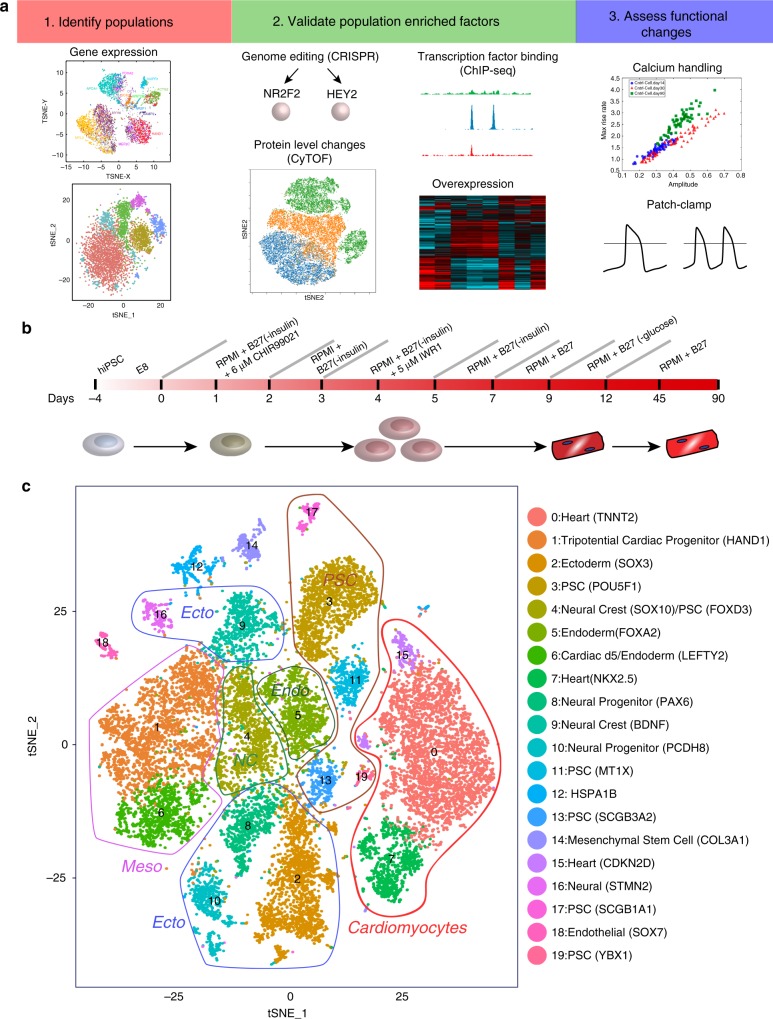
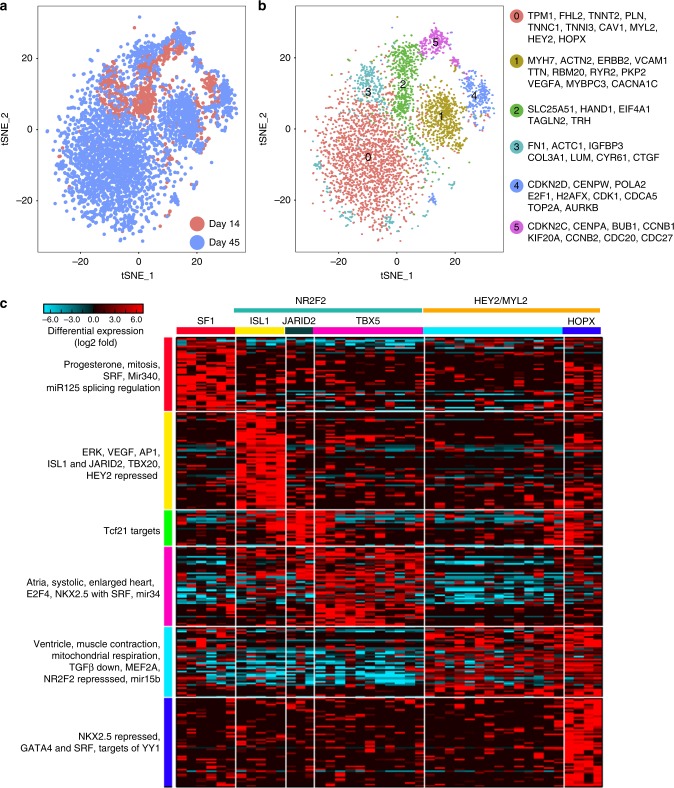
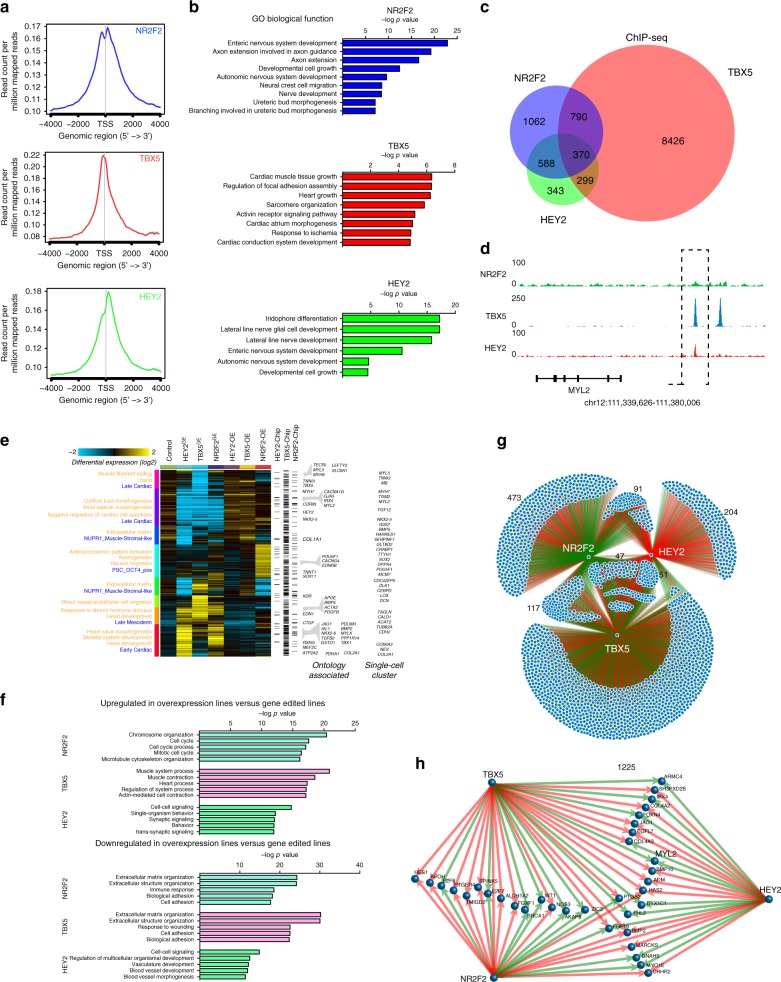
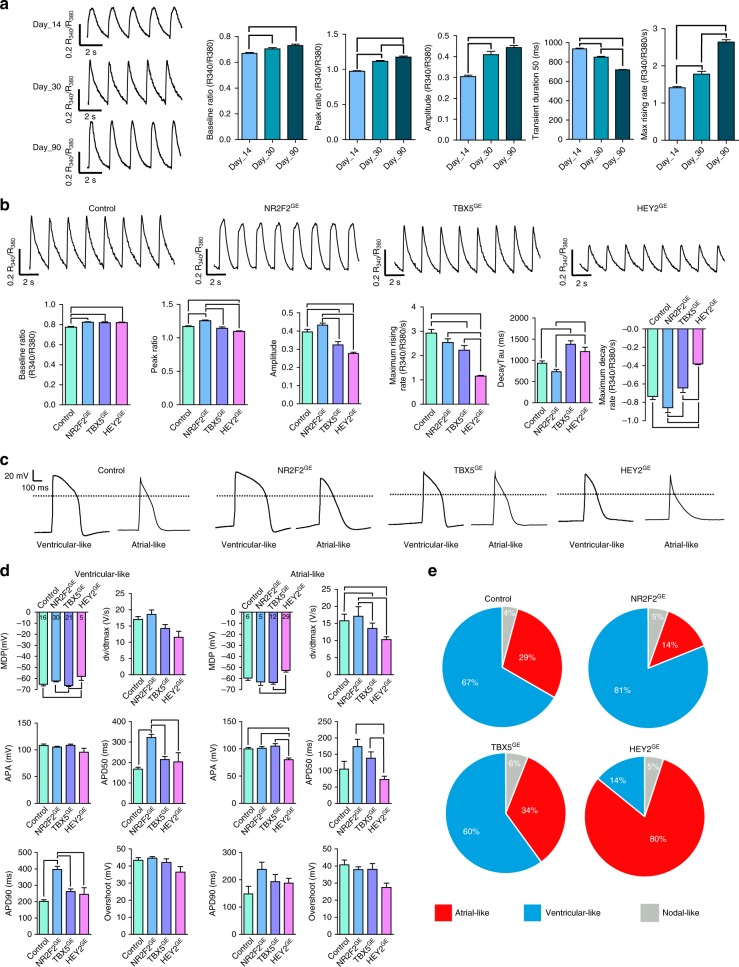
Human induced pluripotent stem cell-derived cardiomyocytes (hiPSC-CMs) have become a powerful tool for human disease modeling and therapeutic testing. However, their use remains limited by their immaturity and heterogeneity. To characterize the source of this heterogeneity, we applied complementary single-cell RNA-seq and bulk RNA-seq technologies over time during hiPSC cardiac differentiation and in the adult heart. Using integrated transcriptomic and splicing analysis, more than half a dozen distinct single-cell populations were observed, several of which were coincident at a single time-point, day 30 of differentiation. To dissect the role of distinct cardiac transcriptional regulators associated with each cell population, we systematically tested the effect of a gain or loss of three transcription factors (NR2F2, TBX5, and HEY2), using CRISPR genome editing and ChIP-seq, in conjunction with patch clamp, calcium imaging, and CyTOF analysis. These targets, data, and integrative genomics analysis methods provide a powerful platform for understanding in vitro cellular heterogeneity.
Overview
The claims and statistics of this paper haven’t been checked yet.
Free: it reads the open-access text and checks the first 5 claims that cite a source we can check. Create a free account to check every claim.
Integrity signals
Registry
Cites
Statistics
Figures
Verification
Claims the paper makes
The claims and statistics of this paper haven’t been checked yet.
Free: it reads the open-access text and checks the first 5 claims that cite a source we can check. Create a free account to check every claim.
Claims other papers make about this one
Each is checked against this paper’s own text: does it say what the citing paper says it does?
The check wasn’t confident either way, so it gives no verdict — never disputed.
In the citing paper
“iPSC-derived cardiomyocytes express a myriad of MMPs including 1–3, 10, 11, 14–16 and 1938, as do hiPSC-derived smooth muscle cells, which were present, albeit more rarely in the hChaMP.”
From In situ expansion, differentiation, and electromechanical coupling of human cardiac muscle in a 3D bioprinted, chambered organoid (2020) · cites this paper as [38]
Experimental — accuracy not yet measuredThe check wasn’t confident either way, so it gives no verdict — never disputed.
In the citing paper
“which will engage at least integrins α1β1 and α2β1, which are highly expressed in iPSC-derived cardiomyocytes38.”
From In situ expansion, differentiation, and electromechanical coupling of human cardiac muscle in a 3D bioprinted, chambered organoid (2020) · cites this paper as [38]
Experimental — accuracy not yet measured
Self-check
Percentages, sums and reported differences re-computed from the paper’s own numbers.
The self-check needs the paper’s full text.
Citations
Cites
STAR: ultrafast universal RNA-seq aligner
Dobin, A., Davis, C. A., Schlesinger, F., Drenkow, J., Zaleski, C., Jha, S., Batut, P., Chaisson, M., & Gingeras, T. R. (2013) · Bioinformatics · doi:10.1093/bioinformatics/bts635 · Cited by 51,709
Model-based Analysis of ChIP-Seq (MACS)
Zhang, Y., Liu, T., Meyer, C. A., Eeckhoute, J., Johnson, D. S., Bernstein, B. E., Nusbaum, C., Myers, R. M., Brown, M., Li, W., et al. (2008) · Genome Biology · doi:10.1186/gb-2008-9-9-r137 · Cited by 18,386
Kim, D., Pertea, G., Trapnell, C., Pimentel, H., Kelley, R., & Salzberg, S. L. (2013) · Genome Biology · doi:10.1186/gb-2013-14-4-r36 · Cited by 12,668
Near-optimal probabilistic RNA-seq quantification
Bray, N. L., Pimentel, H., Melsted, P., & Pachter, L. (2016) · Nature Biotechnology · doi:10.1038/nbt.3519 · Cited by 9,723
Trapnell, C., Cacchiarelli, D., Grimsby, J., Pokharel, P., Li, S., Morse, M., Lennon, N. J., Livak, K. J., Mikkelsen, T. S., & Rinn, J. L. (2014) · Nature Biotechnology · doi:10.1038/nbt.2859 · Cited by 7,314
GREAT improves functional interpretation of cis-regulatory regions
McLean, C. Y., Bristor, D., Hiller, M., Clarke, S. L., Schaar, B. T., Lowe, C. B., Wenger, A. M., & Bejerano, G. (2010) · Nature Biotechnology · doi:10.1038/nbt.1630 · Cited by 4,502
A more efficient method to generate integration-free human iPS cells
Okita, K., Matsumura, Y., Sato, Y., Okada, A., Morizane, A., Okamoto, S., Hong, H., Nakagawa, M., Tanabe, K., Tezuka, K.-I., et al. (2011) · Nature Methods · doi:10.1038/nmeth.1591 · Cited by 2,061
Lian, X., Hsiao, C., Wilson, G., Zhu, K., Hazeltine, L. B., Azarin, S. M., Raval, K. K., Zhang, J., Kamp, T. J., & Palecek, S. P. (2012) · Proceedings of the National Academy of Sciences · doi:10.1073/pnas.1200250109 · Cited by 1,717
Chemically defined generation of human cardiomyocytes
Burridge, P. W., Matsa, E., Shukla, P., Lin, Z. C., Churko, J. M., Ebert, A. D., Lan, F., Diecke, S., Huber, B., Mordwinkin, N. M., et al. (2014) · Nature Methods · doi:10.1038/nmeth.2999 · Cited by 1,606
Self-citationAmir, E.-A. D., Davis, K. L., Tadmor, M. D., Simonds, E. F., Levine, J. H., Bendall, S. C., Shenfeld, D. K., Krishnaswamy, S., Nolan, G. P., & Pe'er, D. (2013) · Nature Biotechnology · doi:10.1038/nbt.2594 · Cited by 1,550
Self-citation
Cited by
Items 101–200 of 212
Venkateshappa, R., Hunter, D. V., Muralidharan, P., Nagalingam, R. S., Huen, G., Faizi, S., Luthra, S., Lin, E. C., Cheng, Y. M., Hughes, J., et al. (2023) · Cardiovascular Research · doi:10.1093/cvr/cvad155 · Cited by 11
Ziegler, N., Bader, E., Epanchintsev, A., Margerie, D., Kannt, A., & Schmoll, D. (2020) · Journal of Biological Chemistry · doi:10.1074/jbc.ra120.013990 · Cited by 13
Single-cell transcriptomes in the heart: when every epigenome counts
Gromova, T., Gehred, N., & Vondriska, T. M. (2022) · Cardiovascular Research · doi:10.1093/cvr/cvac040 · Cited by 12
George, M. P., Gladwin, M. T., & Graham, B. B. (2020) · American Journal of Respiratory Cell and Molecular Biology · doi:10.1165/rcmb.2020-0099tr · Cited by 12
“In the future, bioinformatic methods will be useful to identify which transcription factors are most likely to be successful, by defining interaction networks and hierarchies (69).”
MethodAdvanced technologies for single-cell in situ protein profiling
Zhou, W. J., Ni, X., Xie, C., Fan, Q., & Liu, D. (2021) · Science China Chemistry · doi:10.1007/s11426-021-1110-7 · Cited by 10
Deciphering Cardiac Biology and Disease by Single-Cell Transcriptomic Profiling
Wang, L., Hu, S., & Zhou, B. (2022) · Biomolecules · doi:10.3390/biom12040566 · Cited by 14
“In addition, manipulating the expression of these specific regulators made it possible to modify the cellular composition of the hiPSC-CMs [40].”
BackgroundMethodInfluentialThe HH-GLI2-CKS1B network regulates the proliferation-to-maturation transition of cardiomyocytes
Waldron, C. J., Kelly, L. A., Stan, N., Kawakami, Y., Abrahante, J. E., Magli, A., Ogle, B. M., & Singh, B. N. (2024) · Stem Cells Translational Medicine · doi:10.1093/stcltm/szae032 · Cited by 11
Zaragoza, M. V., Bui, T.-A., Widyastuti, H. P., Mehrabi, M., Cang, Z., Sha, Y., Grosberg, A., & Nie, Q. H. (2024) · Cells · doi:10.3390/cells13171479 · Cited by 9
“One exception was ECTO, identified as a main cell type in only two [30,33] of seven studies.”
BackgroundMethodInfluentialSingle-cell protein expression of hiPSC-derived cardiomyocytes using Single-Cell Westerns
Jabart, E., Molho, J., Sin, K., Stansfield, B. N., Kazmouz, S. G., Ventro, D., Gardner, K., Wu, J. C., & Churko, J. M. (2020) · Journal of Molecular and Cellular Cardiology · doi:10.1016/j.yjmcc.2020.09.012 · Cited by 8
“In addition, bulk RNA-seq showed decreased expression of MYL2 in both HEY2GE and TBX5GE lines [19].”
BackgroundMethodInfluentialSelf-citationCOUP-TFII is a modulator of cell-type-specific genetic programs based on genomic localization maps
Erdős, E., & Bálint, B. L. (2019) · Journal of Biotechnology · doi:10.1016/j.jbiotec.2019.05.305 · Cited by 9
Modeling drug-induced mitochondrial toxicity with human primary cardiomyocytes
Tang, X., Liu, H., Rao, R., Huang, Y., Dong, M., Xu, M., Feng, S., Shi, X., Wang, L., Wang, Z., et al. (2023) · Science China Life Sciences · doi:10.1007/s11427-023-2369-3 · Cited by 13
“…exist between these two models, including, but not restricted to, cell morphology (Musunuru et al., 2018; Song and Dorn, 2015), electrophysiology (Churko et al., 2018; Molina et al., 2018; Musunuru et al., 2018), gene expression (Li et al., 2020b; Ronaldson-Bouchard et al., 2018), maturation…”
Ameen, M., Sundaram, L., Shen, M.-C., Banerjee, A., Kundu, S., Nair, S., Shcherbina, A., Gu, M., Wilson, K. D., Varadarajan, A., et al. (2022) · bioRxiv · doi:10.1101/2022.06.29.498132 · Cited by 98
“Once again, the scATAC-seq derived gene accessibility scores of marker genes were found to be highly specific for the relevant cell types, confirming our cell type annotations (Paik et al. 2018; Friedman et al. 2018; Churko et al. 2018) (Figure 4c, SFigure 11, Table S15).”
BackgroundSelf-citationLi, X., Wu, Y., Ren, X., Wang, Y., Xu, Y., Zhao, X., Yang, J., Li, J., Zhang, F., Xiao, M., et al. (2023) · Chemical Engineering Journal · doi:10.1016/j.cej.2023.144635 · Cited by 9
Benzoni, P., Dalt, L. D., Elia, N., Popolizio, V., Cospito, A., Giannetti, F., Dell’Era, P., OLESEN, M. S., Bucchi, A., Baruscotti, M., et al. (2023) · Frontiers in Physiology · doi:10.3389/fphys.2023.1250951 · Cited by 8
Single-cell RNA Sequencing: In-depth Decoding of Heart Biology and Cardiovascular Diseases
Chen, Z., Liang, W., Duru, F., & Chen, L. (2020) · Current Genomics · doi:10.2174/1389202921999200604123914 · Cited by 10
“Moreover, transcription factor NR2F2 promoted an earlier atrial-like gene signature while HEY2 promoted a more mature ventricular-like gene expression feature in hiPSC-CMs [93].”
BackgroundBaksh, S. S., Pratt, R. E., Gomez, J., Dzau, V. J., & Hodgkinson, C. P. (2022) · Journal of Biological Chemistry · doi:10.1016/j.jbc.2022.102053 · Cited by 8
“(20) provided an averaged mRNA read count (ten technical replicates) of a single human iPS cell line at various time points during cardiomyocyte differentiation.”
BackgroundWang, J., Morgan, W. F., Saini, A. S., Liu, T., Lough, J., & Han, L. (2022) · Frontiers in Cell and Developmental Biology · doi:10.3389/fcell.2022.895162 · Cited by 9
“are known to be specifically related to different stages of cardiomyocyte maturation in vivo, demonstrated dynamics of maturation in vitro (Figure 4C) (Churko et al., 2018).”
BackgroundResultKoakutsu, M., Miki, K., Naka, Y., Sasaki, M., Wakimizu, T., Napier, S. C., Okubo, C., Narita, M., Nishikawa, M., Hata, R., et al. (2024) · Communications Biology · doi:10.1038/s42003-024-05809-2 · Cited by 8
“To determine whether CD151 high VCMs express higher levels of other ventricular-related genes, we analyzed the expression of eight ventricular marker genes expressed in human ventricular tissues 26 .”
Iwanski, J. B., Pappas, C. T., Mayfield, R. M., Farman, G. P., Ahrens‐Nicklas, R. C., Churko, J. M., & Gregorio, C. C. (2024) · npj Regenerative Medicine · doi:10.1038/s41536-024-00366-y · Cited by 7
“In brief, iPSC lines were dif-ferentiatedintocardiomyocytesusingamonolayer,smallmoleculebiphasic Wnt-basedapproach,aspreviouslydescribed 22 .”
BackgroundResultSelf-citationZhang, W., Xue, M., Jin, H., Yang, J., Wu, H., Qiu, B., Jiang, Y., Xu, F., Lin, B., Kong, W., et al. (2025) · Acta Biomaterialia · doi:10.1016/j.actbio.2025.06.005 · Cited by 10
Self-citationKumar, A., He, S., & Mali, P. (2023) · APL Bioengineering · doi:10.1063/5.0137458 · Cited by 8
APLNR marks a cardiac progenitor derived with human induced pluripotent stem cells
Lam, Y., Chan, C.-H., Geng, L., Wong, N., Keung, W., & Cheung, Y. (2023) · Heliyon · doi:10.1016/j.heliyon.2023.e18243 · Cited by 6
Watanabe, Y., Wang, Y., Tanaka, Y., Iwase, A., Kawamura, T., Saga, Y., Yashiro, K., Kurihara, H., & Nakagawa, O. (2023) · Proceedings of the National Academy of Sciences · doi:10.1073/pnas.2307658120 · Cited by 8
“Hey2 is critical for transcriptional repression of atrial and atrioventricular canal genes in the embryonic ventricle, and the lack of HEY2 significantly increases the number of atrial - like cells during cardiomyocyte differentiation from human iPS cells (37).”
BackgroundEsmaeili, H., Zhang, Y., Ravi, K., Neff, K., Zhu, W., Migrino, R. Q., Park, J. G., & Nikkhah, M. (2025) · Biomaterials · doi:10.1016/j.biomaterials.2025.123275 · Cited by 8
Heart Enhancers: Development and Disease Control at a Distance
Yuan, X., Scott, I. C., & Wilson, M. D. (2021) · Frontiers in Genetics · doi:10.3389/fgene.2021.642975 · Cited by 10
Muñoz, J. J. A. M., Dariolli, R., da Silva, C. M., Neri, E. A., Valadão, I. C., Turaça, L. T., Lima, V. M., de Carvalho, M. L. P., Rodrigues, M. V., Sobie, E. A., et al. (2022) · Stem Cell Research & Therapy · doi:10.1186/s13287-022-03138-x · Cited by 7
“A growing body of evidence suggests that differentiated hiPSC-CMs are immature despite molecular, morphological, metabolic, and functional similarities with adult cardiomyocytes [4, 5].”
BackgroundJung, Y., Kim, J., Jang, H., Kim, G., & Kwon, Y. (2023) · Korean Circulation Journal · doi:10.4070/kcj.2022.0295 · Cited by 8
Identification of SALL4 Expressing Islet-1+ Cardiovascular Progenitor Cell Clones
Monteon, A., Hughes, L., Camberos, V., & Kearns‐Jonker, M. (2023) · International Journal of Molecular Sciences · doi:10.3390/ijms24021780 · Cited by 7
Okuno, S., Higo, S., Kondo, T., Shiba, M., Kameda, S., Inoue, H., Tabata, T., Ogawa, S., Morishita, Y., Sun, C., et al. (2023) · Scientific Reports · doi:10.1038/s41598-023-48084-7 · Cited by 6
Single Cell Approaches to Understand the Earliest Steps in Heart Development
Lescroart, F., & Zaffran, S. (2022) · Current Cardiology Reports · doi:10.1007/s11886-022-01681-w · Cited by 10
Gmach, P., Bathe‐Peters, M., Telugu, N. S., Lohse, M. J., & Annibale, P. (2022) · International Journal of Molecular Sciences · doi:10.3390/ijms231810405 · Cited by 5
Liew, L. C., Poh, B. M., An, Ö., Ho, B. X., Lim, C. Y. Y., Pang, J. K. S., Beh, L. Y., Yang, H. H., & Soh, B.-S. (2023) · Stem Cell Research & Therapy · doi:10.1186/s13287-023-03610-2 · Cited by 7
“In addition, SIRPA + /JAK2 + CMs exhibited high expression levels of ventricular-associated genes previously reported [44–46], including MYL2, HEY2, IRX4 and DLK1, comparable to ventricular CMs generated from reporter line and adult human ventricle samples (Additional file 10: Fig.”
BackgroundAgostinho, S. P., Branco, M. A., Nogueira, D. E. S., Diogo, M. M., Cabral, J. M. S., Fred, A. L. N., & Rodrigues, C. A. V. (2024) · Scientific Reports · doi:10.1038/s41598-024-52970-z · Cited by 6
“Furthermore, recent results from single-cell RNA-seq also revealed the presence of endoderm-like cells arising around day 5 of the differentiation 23,24 .”
Pharmacologically inducing regenerative cardiac cells by small molecule drugsPreprint
Zhou, W. X., He, K., Wang, C., Wang, P., Wang, D., Wang, B., Geng, H., Lian, H., Ma, T., Nie, Y., et al. (2024) · eLife · doi:10.7554/elife.93405 · Cited by 6
Buonaiuto, G., Desideri, F., Setti, A., Palma, A., D’Angelo, A., Storari, G., Santini, T., Laneve, P., Trisciuoglio, D., & Ballarino, M. (2025) · Nature Communications · doi:10.1038/s41467-025-62754-2 · Cited by 9
“Finally, the authors showed relevance to human disease by reporting the dysregulation of HSCHARME in cardiomyopathy patients and the involvement of HSCHARME in regulating a subset of diseased-associated genes.”
An, N., Yang, F., Zhang, G., Jiang, Y., Liu, H., Gao, Y., Li, Y., Ji, P., Shang, H., & Xing, Y. (2024) · Molecular Medicine · doi:10.1186/s10020-024-00999-1 · Cited by 6
Forte, E., McLellan, M. A., Skelly, D. A., & Rosenthal, N. A. (2021) · International Journal of Molecular Sciences · doi:10.3390/ijms22042071 · Cited by 5
Beyond the Heartbeat: Single-Cell Omics Redefining Cardiovascular Research
Seeler, S., Arnarsson, K., Dreßen, M., Krane, M., & Doppler, S. A. (2024) · Current Cardiology Reports · doi:10.1007/s11886-024-02117-3 · Cited by 5
Dissecting cardiovascular disease-associated noncoding genetic variants using human iPSC models
Dababneh, S., Babini, H., Jiménez-Sábado, V., Teves, S. S., Kim, K.-H., & Tibbits, G. F. (2025) · Stem Cell Reports · doi:10.1016/j.stemcr.2025.102467 · Cited by 6
Transcriptional Profiling of Single Cardiomyocytes in Health and Disease
Zhou, B., & Wang, L. (2020) · Current Cardiology Reports · doi:10.1007/s11886-020-01346-6 · Cited by 4
Activation of AMPK promotes cardiac differentiation by stimulating the autophagy pathway
Kolahdouzmohammadi, M., Pahlavan, S., Sotoodehnejadnematalahi, F., Tahamtani, Y., & Totonchi, M. (2023) · Journal of Cell Communication and Signaling · doi:10.1007/s12079-023-00744-z · Cited by 4
“Cluster 9 with high levels of VWF, cluster 11 with high expression of ACTA2, and cluster 12 with high expression of ISL1 were annotated as endothelial cells, smooth muscle cells, and cardiac progenitor cells, respectively (Chen et al. 2014; Churko et al. 2018) (Fig.”
BackgroundCallaghan, N. I., Durland, L. J., Chen, W., Kuzmanov, U., Miranda, M. Z., Mirzaei, Z., Ireland, R. G., Wang, E. Y., Wagner, K. T., Kim, M. M., et al. (2022) · bioRxiv (Cold Spring Harbor Laboratory) · doi:10.1101/2022.10.10.507929 · Cited by 4
Self-citationConserved roles of GATA4 and its target gene TBX2 in regulation of human cardiogenesis
Graham, N., Kirilenko, P., Patrushev, I., Fowler, E. D., Kille, P., Gilchrist, M. J., Owens, N. D. L., & Latinkic, B. (2026) · Biology Open · doi:10.1242/bio.062553 · Cited by 4
Regulation of atrial and ventricular cardiomyocyte identity
Guo, S., Liu, Y., Ryan, A., Serrano, A. L. L., Deschênes, I., Jang, J., & Li, D. (2025) · Journal of Molecular and Cellular Cardiology · doi:10.1016/j.yjmcc.2025.08.010 · Cited by 3
Zhu, M., Liang, H., Zhang, Z., Jiang, H., Pu, J., Hang, X., Zhou, Q., Xiang, J., & He, X. (2023) · Frontiers of Medicine · doi:10.1007/s11684-023-0987-9 · Cited by 5
Aberrant extracellular matrix and cardiac development in models lacking the PR-DUB component ASXL3Preprint
McGrath, B., Tsan, Y.-C., Salvi, S., Ghali, N., Martin, D. M., Hannibal, M., Keegan, C., Helms, A. S., Srivastava, A., & Bielas, S. L. (2022) · bioRxiv (Cold Spring Harbor Laboratory) · doi:10.1101/2022.07.14.500124 · Cited by 3
Bolesani, E., Bornhorst, D., Iyer, L. M., Zawada, D. M., Friese, N., Morgan, M. A., Lange, L., Gonzalez, D. M., Schrode, N., Leffler, A., et al. (2024) · Cardiovascular Research · doi:10.1093/cvr/cvae118 · Cited by 3
A novel paradigm for single-cell annotation in stem cell research
Atkeson, T., Wilson, S. B., Ruiz-Morales, E. R., Little, M. H., Vento‐Tormo, R., Neavin, D. R., & Powell, J. E. (2025) · Stem Cell Reports · doi:10.1016/j.stemcr.2025.102707 · Cited by 3
Haydar, S., Bednarz, R., Laurette, P., Sobitov, I., Pedrosa, N. D. I., Videm, P., Lueneburg, T., Kuß, S., Lahm, H. W., Dreßen, M., et al. (2026) · Nature Communications · doi:10.1038/s41467-025-67220-7 · Cited by 4
“This includes ADRA1A, CCN2, HEY2 , and TBX5 ; the latter two being key transcription factors known to drive chamber-speci fi c gene expression 41 (Fig.”
Callaghan, N. I., Durland, L. J., CHEN, W., Kuzmanov, U., Miranda, M. Z., Ding, Y., Mirzaei, Z., Ireland, R. G., Reitz, C. J., Gorman, R. A., et al. (2026) · Nature Communications · doi:10.1038/s41467-026-70550-9 · Cited by 12
“Several previous studies have examined the transcriptomes of maturing PSC-CMs 15,18,21,22,69 – 71 or native myocardium 15,23,72,73 , but most maturation protocols have been characterized only relative to freshly-differentiated PSC-CMs or time-matched existing high-performing controls.”
Self-citationShad, M., Shah, F. S., Zulqarnain, M., Usman, M., Haider, Z., & Azhar, J. (2021) · NUST Journal of Natural Sciences · doi:10.53992/njns.v5i2.47 · Cited by 3
“Cardiac transcription factors directly regulate many cardiac genes and play a leading vital role in the upregulation of hypertrophied myocardium (Churko et al., 2018).”
BackgroundPharmacologically inducing regenerative cardiac cells by small molecule drugs
Zhou, W. X., He, K., Wang, C., Wang, P., Wang, D., Wang, B., Geng, H., Lian, H., Ma, T., Nie, Y., et al. (2024) · eLife · doi:10.7554/elife.93405.3 · Cited by 2
Intra- and intercellular signaling pathways associated with drug-induced cardiac pathophysiology
Guo, F., Hall, A. R., Tape, C. J., Ling, S., & Pointon, A. (2021) · Trends in Pharmacological Sciences · doi:10.1016/j.tips.2021.05.004 · Cited by 2
Analysing Genetic Programs of Cell Differentiation to Study Cardiac Cell Diversification
Wu, Z., Shen, S., Sun, Y., Werner, T., Bradford, S. T., & Palpant, N. J. (2022) · Springer eBooks · doi:10.1007/978-3-030-86140-7_8 · Cited by 1
Long, X., Wei, J., Fang, Q., Yuan, X. H., & Du, J. (2024) · Functional & Integrative Genomics · doi:10.1007/s10142-024-01290-6 · Cited by 2
“…in cellular developmental processes and functional properties has been thoroughly investigated in recent years through numerous studies that have analyzed gene expression patterns during heart development (Sahara et al. 2019; Litvinukova et al. 2020; Churko et al. 2018; Carter and Zhao 2020).”
OneSC: a computational platform for recapitulating cell state transitions
Peng, D., & Cahan, P. (2024) · Bioinformatics · doi:10.1093/bioinformatics/btae703 · Cited by 2
Bertacchi, M., Theiß, S., Ahmed, A., Eibl, M., Loubat, A., Maharaux, G., Phromkrasae, W., Chakrabandhu, K., Camgöz, A., Antonaci, M., et al. (2025) · Communications Biology · doi:10.1038/s42003-025-07985-1 · Cited by 2
“Since their expression patterns, targets, and functions partially overlap 32,127 , the high homology poses a major challenge for Ab development and speci fi city.”
Advancing Cardiovascular Medicine: Innovative Therapeutic Pathways with Single-Cell Technologies
Ji, J., Lindberg, E. L., & Reichart, D. (2025) · Current Treatment Options in Cardiovascular Medicine · doi:10.1007/s11936-025-01100-7 · Cited by 1
“…cells for personalized studies, animal mod - els, including mice, rats, zebrafish, and pigs, providing insights into disease mechanisms in vivo [13, 14, 76, 77], or patient biofluids, such as blood samples from individuals The additional integration of transcriptome profiling helps to further…”
Thakur, A., & Kishore, R. (2025) · Life · doi:10.3390/life15091400 · Cited by 1
“These findings align with single-cell studies demonstrating that cardiac neuronal populations express neurodevelopmental transcription factors during embryogenesis, suggesting persistent molecular crosstalk [5].”
Forbes, C. A., Shaw, N. C., Chen, K. G., Hedges, M. G., Er, T., Hool, L. C., Ward, M., Poulton, C. J., Baynam, G. S., Lassmann, T., et al. (2026) · Human Genomics · doi:10.1186/s40246-025-00907-6 · Cited by 2
“5, P300, among others) [14–16].”
Hughes, L., Baio, J., Hasaniya, N. W. M. A., Bailey, L. L., Kim, J., Yanez, D., Austin, E., Vega, R., Rivera-Morales, P., Camberos, V., et al. (2026) · Frontiers in Cardiovascular Medicine · doi:10.3389/fcvm.2025.1671367 · Cited by 1
Essential role of NONO-HOXA1-Wnt axis in cardiomyocyte differentiation
Feng, Z., Gao, Y., Gao, H., Sun, S., Na, W., Huang, X., Li, S., Tan, C., Min, S., Lu, Y., et al. (2026) · Nature Communications · doi:10.1038/s41467-026-68760-2 · Cited by 2
“Differentiation of hPSCs into CMs generates cultures containing multiple lineage intermediates alongside the predominant CM population 22 .”
Deep immune-phenotyping of HLA-homozygous iPS-cardiomyocytes by spectral flow cytometry
Maeding, N., Kundully, D. S., Steinhuber, A., Kriedemann, N., Hernandez-Bautista, C. A., Martins, S., Hochmann, S., Martin, W., Mayr, W. R., Jungbauer, C., et al. (2026) · Frontiers in Immunology · doi:10.3389/fimmu.2026.1736994 · Cited by 1
Chang, X., Gu, M., & Tchieu, J. H. (2022) · Cells · doi:10.3390/cells11030460 · Cited by 1
Bergès, C., Laffargue, F., Dauphin, C., Postma, A. V., Thambo, J., & Rooryck, C. (2025) · European Journal of Human Genetics · doi:10.1038/s41431-025-01880-3 · Cited by 1
“HEY2 plays a particularly key role in cardiac embryogenesis [7 – 9].”
Pei, J., van den Dungen, N. A. M., Asselbergs, F. W., Mokrý, M., & Harakaľová, M. (2022) · Methods in molecular biology · doi:10.1007/978-1-0716-2140-0_6 · Cited by 2
Modeling human TBX5 haploinsufficiency predicts regulatory networks for congenital heart diseasePreprint
Kathiriya, I. S., Rao, K. S., Iacono, G., Devine, W. P., Blair, A. P., Hota, S. K., Lai, M. H., Garay, B. I., Thomas, R., Gong, H. Z., et al. (2019) · bioRxiv (Cold Spring Harbor Laboratory) · doi:10.1101/835603 · Cited by 3
Feeney, A. K., Simmons, A. D., Bayne, E. F., Zhu, Y., Pentes, M. R., Cobra, P. F., Zhang, J., Kamp, T. J., Ge, Y., & Palecek, S. P. (2026) · bioRxiv (Cold Spring Harbor Laboratory) · doi:10.64898/2026.01.08.698025 · Cited by 1
A Proteomic Perspective on Cardiomyocyte Maturation
Muraoka, N., Sun, B., & Murry, C. E. (2019) · Circulation Research · doi:10.1161/circresaha.119.316039
Single-cell RNA sequencing in cardiovascular science
Aghagolzadeh, P., & Pedrazzini, T. (2021) · Elsevier eBooks · doi:10.1016/b978-0-12-822258-4.00014-6
Crestani, T. (2020) · Digital Library of Theses and Dissertations (Universidade de São Paulo) · doi:10.11606/t.5.2020.tde-23062021-114831
Christidi, E. (2021) · cIRcle (University of British Columbia) · doi:10.14288/1.0402336
Maturing Engineered Heart Tissues for Titin-Based Disease Modeling
Keschrumrus, V. (2021) · UA Campus Repository (The University of Arizona)
Multimodal Charting of Molecular and Functional Cell States via in situ Electro-SeqPreprint
Li, Q., Lin, Z., Liu, R., Tang, X., Huang, J., He, Y., Sui, X., Tian, W., Zhou, H., Sheng, H., et al. (2022) · SSRN Electronic Journal · doi:10.2139/ssrn.4173435
Schoger, E. (2022) · eDiss (Georg-August-Universität Göttingen) · doi:10.53846/goediss-9564
Pan, Z., & Liang, P. (2023) · Handbook of experimental pharmacology · doi:10.1007/164_2023_663 · Cited by 2
Lee, H. K., & Cho, H. (2023) · International Journal of Heart Failure · doi:10.36628/ijhf.2023.0048
Multifaceted Role of Induced Pluripotent Stem Cells in Preclinical Cardiac Regeneration Research
Derish, I., & Cecere, R. (2023) · Springer eBooks · doi:10.1007/978-981-99-0846-2_33-1
Bertacchi, M., Theiß, S., Ahmed, A., Eibl, M., Loubat, A., Maharaux, G., Phromkrasae, W., Chakrabandhu, K., Camgöz, A., Schaaf, C. P., et al. (2024) · bioRxiv (Cold Spring Harbor Laboratory) · doi:10.1101/2023.12.31.573551
“Since their expression patterns and functions partially overlap and both TFs control the same as well as different genes 79 , the high homology poses a major challenge for antibody development and specificity.”
BackgroundPharmacologically inducing regenerative cardiac cells by small molecule drugsPreprint
Zhou, W. X., He, K., Wang, C., Wang, P., Wang, D., Wang, B., Geng, H., Lian, H., Ma, T., Nie, Y., et al. (2024) · eLife · doi:10.7554/elife.93405.1
Liew, L. C., Poh, B. M., An, Ö., Ho, B. X., Lim, C. Y. Y., Pang, J. K. S., Beh, L. Y., Yang, H. H., & Soh, B.-S. (2023) · Figshare · doi:10.6084/m9.figshare.24804337
Prostaglandin E2 Induces YAP1 and Agrin Through EP4 in Neonatally-Derived Islet-1+ Stem Cells
Hughes, L., Lopez, L. V., & Kearns‐Jonker, M. (2024) · Stem Cells and Development · doi:10.1089/scd.2024.0069
Multifaceted Role of Induced Pluripotent Stem Cells in Preclinical Cardiac Regeneration Research
Derish, I., & Cecere, R. (2024) · Springer eBooks · doi:10.1007/978-981-99-7119-0_33
Haydar, S., Bednarz, R., Laurette, P., Pedrosa, N. D. I., Videm, P., Lueneburg, T., Kuss, S., Lahm, H., Dreßen, M., Krane, M., et al. (2024) · Research Square · doi:10.21203/rs.3.rs-1897221/v2
Myocardial Endoglin Regulates Cardiomyocyte Proliferation and Cardiac RegenerationPreprint
Sorensen, D. W., Tan, P. M., Garay, B. I., Solinsky, J., Yücel, D., Zhang, M. J., Galvin, C., Elsenpeter, H., Mikkila, J. L., Jerdee, K., et al. (2024) · bioRxiv (Cold Spring Harbor Laboratory) · doi:10.1101/2024.09.27.615380 · Cited by 1
Pharmacologically inducing regenerative cardiac cells by small molecule drugsPreprint
Zhou, W. X., He, K., Wang, C., Wang, P., Wang, D., Wang, B., Geng, H., Lian, H., Ma, T., Nie, Y., et al. (2024) · eLife · doi:10.7554/elife.93405.2
Odz4 upregulates SAN ‐specific genes to promote differentiation into cardiac pacemaker‐like cells
Dong, A., Yoshizumi, M., & Kokubo, H. (2024) · FEBS Letters · doi:10.1002/1873-3468.15036
Lin, Q., Zhang, D., Gruber, P. J., Tam, P. K. H., Lui, V. C., Wu, Z., Hong, H., Chien, K. R., Sham, P. C., & Tang, C. S.-M. (2025) · Human Genetics and Genomics Advances · doi:10.1016/j.xhgg.2025.100414
“48 EFNB2 belongs to the ephrin family of transmembrane proteins that have been implicated in cardiac development and TOF.”
Monteiro, L. M., Pitrez, P. R., Correia-Santos, S., Dark, N., Santinha, D. R., Aveleira, C. A., Townsend, M., Taylor, J., Nissan, X., Sardão, V. A., et al. (2025) · bioRxiv (Cold Spring Harbor Laboratory) · doi:10.1101/2025.06.27.661680
Refate identifies chemical compounds to target trans-regulatory networks for cellular conversionPreprint
Xiao, D., Sahadevan, S., Mangala, M. M., Kim, H. J., Fredericks, A., Huang, H., Jothi, R., Tam, P., Gonzalez-Cordero, A., Zyner, K. G., et al. (2025) · bioRxiv (Cold Spring Harbor Laboratory) · doi:10.1101/2025.07.09.664003 · Cited by 2
Liew, L. C., Poh, B. M., An, Ö., Ho, B. X., Lim, C. Y. Y., Pang, J. K. S., Beh, L. Y., Yang, H. H., & Soh, B.-S. (2024) · Figshare · doi:10.6084/m9.figshare.26653582
Liew, L. C., Poh, B. M., An, Ö., Ho, B. X., Lim, C. Y. Y., Pang, J. K. S., Beh, L. Y., Yang, H. H., & Soh, B.-S. (2024) · Figshare · doi:10.6084/m9.figshare.26653597
Liew, L. C., Poh, B. M., An, Ö., Ho, B. X., Lim, C. Y. Y., Pang, J. K. S., Beh, L. Y., Yang, H. H., & Soh, B.-S. (2024) · Figshare · doi:10.6084/m9.figshare.24804817
Liew, L. C., Poh, B. M., An, Ö., Ho, B. X., Lim, C. Y. Y., Pang, J. K. S., Beh, L. Y., Yang, H. H., & Soh, B.-S. (2024) · Figshare · doi:10.6084/m9.figshare.26653585
Jiang, C., Goyal, Y., Jain, N., Wang, Q., Truitt, R., Coté, A., Emert, B. L., Mellis, I. A., Kiani, K., Yang, W., et al. (2022) · Figshare · doi:10.6084/m9.figshare.19522664
Muñoz, J. J. A. M., Dariolli, R., da Silva, C. M., Neri, E. A., Valadão, I. C., Turaça, L. T., Lima, V. M., de Carvalho, M. L. P., Velho, M., Sobie, E. A., et al. (2022) · Figshare · doi:10.6084/m9.figshare.20887089
Liew, L. C., Poh, B. M., An, Ö., Ho, B. X., Lim, C. Y. Y., Pang, J. K. S., Beh, L. Y., Yang, H. H., & Soh, B.-S. (2024) · Figshare · doi:10.6084/m9.figshare.26653600
Jiang, C., Goyal, Y., Jain, N., Wang, Q., Truitt, R., Coté, A., Emert, B. L., Mellis, I. A., Kiani, K., Yang, W., et al. (2022) · Figshare · doi:10.6084/m9.figshare.19522655
Liew, L. C., Poh, B. M., An, Ö., Ho, B. X., Lim, C. Y. Y., Pang, J. K. S., Beh, L. Y., Yang, H. H., & Soh, B.-S. (2024) · Figshare · doi:10.6084/m9.figshare.26653594
Liew, L. C., Poh, B. M., An, Ö., Ho, B. X., Lim, C. Y. Y., Pang, J. K. S., Beh, L. Y., Yang, H. H., & Soh, B.-S. (2024) · Figshare · doi:10.6084/m9.figshare.26653603
Metadata
- Authors
- Churko, J. M., Garg, P., Treutlein, B., Venkatasubramanian, M., Wu, H., Lee, J., Wessells, Q. N., Chen, S.-Y., Chen, W.-Y., Chetal, K., Mantalas, G., Neff, N., Jabart, E., Sharma, A., Nolan, G. P., Salomonis, N., & Wu, J. C.
- Affiliations
- University of Arizona (US)
- Stanford Medicine (US)
- Stanford University (US)
- Cincinnati Children's Hospital Medical Center (US)
- Corresponding author
- Churko, Jared M.
- Salomonis, Nathan
- Wu, Joseph C.
- ORCID
- Venue
- Nature Communications
- Published
- 2018-11-21
- Volume
- 9
- Issue
- 1
- Pages
- 4906-4906
- ISSN
- 2041-1723 (ISSN-L)
- PMC
- PMC6249224
- OpenAlex
- W2901182248
- Cited by
- 207
- References
- 54
- Citations by year
- 2026: 18 · 2025: 20 · 2024: 30 · 2023: 28 · 2022: 34 · 2021: 24 · 2020: 36 · 2019: 17
- FWCI
- 6.84
- Type
- journal article
- Language
- en
- Open access
- gold
- doi.org
- Licence
- cc-by
- creativecommons.org/licenses/by/4.0 (tdm)
- creativecommons.org/licenses/by/4.0 (vor)
- Locations
- Nature Communications (publishedVersion, cc-by)
- Europe PMC (PubMed Central) (publishedVersion, cc-by)
- PubMed Central (publishedVersion, cc-by)
- PubMed (publishedVersion)
- RePEc: Research Papers in Economics (submittedVersion)
- DOAJ (DOAJ: Directory of Open Access Journals) (submittedVersion, cc-by-sa)
- DOAJ (DOAJ: Directory of Open Access Journals) (submittedVersion)
- eScholarship (California Digital Library) (submittedVersion)
- eScholarship (California Digital Library) (submittedVersion, cc-by)
- Funders
- National Institutes of Health (TRAN4-09884, NIH-R01)
- National Heart, Lung, and Blood Institute (R01HL123968, K99HL128906, R01HL128170, R00HL128906, R01HL141371, R01HL141851, R01HL130020)
- Topics
- Life Sciences › Biochemistry, Genetics and Molecular Biology › Molecular Biology › Pluripotent Stem Cells Research
- Life Sciences › Biochemistry, Genetics and Molecular Biology › Molecular Biology › Single-cell and spatial transcriptomics
- Life Sciences › Biochemistry, Genetics and Molecular Biology › Molecular Biology › Congenital heart defects research
- Keywords
- human induced pluripotent stem cell-derived cardiomyocytes, cardiac differentiation, cellular heterogeneity, NR2F2, TBX5, Hey2, single-cell RNA sequencing, cardiomyocyte maturation, ChIP-seq, calcium imaging, mass cytometry
- MeSH terms
- Action Potentials, Cell Differentiation, Humans, Repressor Proteins, Sequence Analysis, RNA, Genetic Heterogeneity, Calcium Signaling, T-Box Domain Proteins, Myocytes, Cardiac, Basic Helix-Loop-Helix Proteins, COUP Transcription Factor II, Induced Pluripotent Stem Cells, Single-Cell Analysis, Transcriptome
About these checks
Registry, retraction, Cites and statistics results are computed, not judged, with one exception: a printed reference that no index lists is read once by a model before it counts as a citation error. Claims are extracted by a model and kept only when their quote appears verbatim in the text; each cited source is then checked, with a model’s help, for whether it says what the claim relies on. Those verdicts can be wrong — read the claim’s quote and the cited source before relying on one.
Statistics and arithmetic are recomputed, not judged.
Confidence bands are shown only for fields calibrated on our annotated test set. None is calibrated yet, so no band is shown.
What counts as a claim ›How we measure confidence ›How we check this ›
Are you an author, or do you see a problem with this page? Request a review
Data sources
Bibliographic data: Semantic Scholar, OpenAlex, Crossref.
Contains information from the Semantic Scholar Academic Graph Datasets, made available under the ODC Attribution License (ODC-BY 1.0).
Semantic Scholar’s data is described in: Kinney, R., et al. (2023). The Semantic Scholar Open Data Platform. arXiv:2301.10140.
