

Challenges hindering memristive neuromorphic hardware from going mainstream
Open accessThe DOI matches its Crossref record; 17 of the 17 references it cites were found in a registry or an index.
Abstract
Memristive devices have elicited intense research in the past decade thanks to their inherent low voltage operation, multi-bit storage and cost-effective manufacturability. Nonetheless, several outstanding performance and manufacturability challenges have prevented the widespread industry adoption of redox-based memristive matrices. Here, we discuss these challenges in terms of key metrics and propose a roadmap towards realizing competitive memristive-based neuromorphic processing systems.
Overview
The claims and statistics of this paper haven’t been checked yet.
Free: it reads the open-access text and checks the first 5 claims that cite a source we can check. Create a free account to check every claim.
Integrity signals
Registry
Cites
Statistics
Figures
Verification
Claims the paper makes
The claims and statistics of this paper haven’t been checked yet.
Free: it reads the open-access text and checks the first 5 claims that cite a source we can check. Create a free account to check every claim.
Claims other papers make about this one
Each is checked against this paper’s own text: does it say what the citing paper says it does?
The source backs part of the claim, not all of it — or backs it for a different population, condition or comparison.
In the citing paper
“To emulate the complexity and ultra-low power consumption of biological neural networks, hardware platforms for ANNs must achieve an ultra-high integration density (>1 Terabyte per cm2) and low energy consumption (<10 fJ per operation)35.”
From Hardware implementation of memristor-based artificial neural networks (2024) · cites this paper as [35]
Experimental — accuracy not yet measured
Self-check
Percentages, sums and reported differences re-computed from the paper’s own numbers.
The self-check needs the paper’s full text.
Citations
Cites
Neuromorphic computing with multi-memristive synapses
Boybat, I., Le Gallo, M., Nandakumar, S. R., Moraitis, T., Parnell, T., Tuma, T., Rajendran, B., Leblebici, Y., Sebastian, A., & Eleftheriou, E. (2018) · Nature Communications · doi:10.1038/s41467-018-04933-y · Cited by 899
Memristor crossbar arrays with 6-nm half-pitch and 2-nm critical dimension
Pi, S., Li, C., Jiang, H., Xia, W., Xin, H., Yang, J. J., & Xia, Q. (2019) · Nature Nanotechnology · doi:10.1038/s41565-018-0302-0 · Cited by 539 · cited 1×
“1g) and its extreme scalability, down to ~2 nm for an estimated density of >0.7Tb/cm 2 9 (Fig.”
BackgroundHigh‐Speed and Low‐Energy Nitride Memristors
Choi, B. J., Torrezan, A. C., Strachan, J. P., Kotula, P. G., Lohn, A. J., Marinella, M. J., Li, Z., Williams, R. S., & Yang, J. J. (2016) · Advanced Functional Materials · doi:10.1002/adfm.201600680 · Cited by 356
Multibit memory operation of metal-oxide bi-layer memristors
Stathopoulos, S., Khiat, A., Trapatseli, M., Cortese, S., Serb, A., Valov, I., & Prodromakis, T. (2017) · Scientific Reports · doi:10.1038/s41598-017-17785-1 · Cited by 312
Self-citationDesign implications of memristor-based RRAM cross-point structures
Xu, C., Dong, X., Jouppi, N. P., & Xie, Y. (2011) · 2011 Design, Automation & Test in Europe · doi:10.1109/date.2011.5763125 · Cited by 232 · cited 1×
“However, high speed programming requirements can increase the circuitry footprint, thus straying away from the ideal density 11 .”
BackgroundMemristor Crossbars with 4.5 Terabits-per-Inch-Square Density and Two Nanometer Dimension
Pi, S., Li, C., Jiang, H., Xia, W., Xin, H. L., Yang, J. J., & Xia, Q. (2018) · arXiv (Cornell University) · doi:10.48550/arxiv.1804.09848 · Cited by 154 · cited 1×
“1g) and its extreme scalability, down to ~2 nm for an estimated density of >0.7Tb/cm 2 9 (Fig.”
BackgroundVariability of resistive switching memories and its impact on crossbar array performance
Chen, A., & Lin, M.-R. (2011) · 2011 International Reliability Physics Symposium · doi:10.1109/irps.2011.5784590 · Cited by 152 · cited 2×
“The choice of materials plays a critical role 5 (Fig.”
BackgroundRealization of vertical resistive memory (VRRAM) using cost effective 3D process
Baek, I. G., Park, C. J., Ju, H., Seong, D. J., Ahn, H. S., Kim, J. H., Yang, M. K., Song, S. H., Kim, E. M., Park, S. O., et al. (2011) · 2011 International Electron Devices Meeting · doi:10.1109/iedm.2011.6131654 · Cited by 140 · cited 1×
“The number of masks is independent of the number of layers, similar to the three-dimensional fl ash technology 10 .”
Background8-Layers 3D vertical RRAM with excellent scalability towards storage class memory applications
Luo, Q., Xu, X., Gong, T., Lv, H., Dong, D., Ma, H., Yuan, P., Gao, J., Liu, J., Yu, Z., et al. (2017) · 2017 IEEE International Electron Devices Meeting (IEDM) · doi:10.1109/iedm.2017.8268315 · Cited by 97 · cited 1×
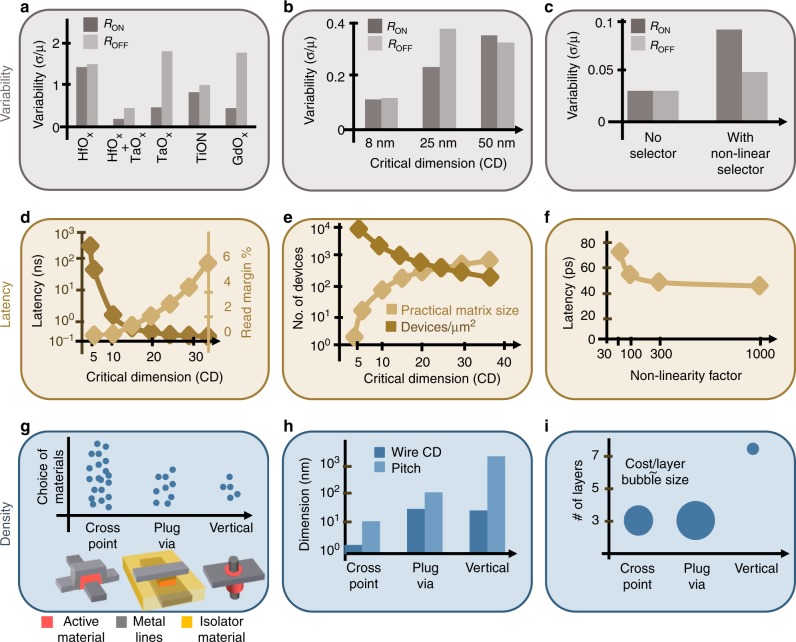
“…is heavily in fl uenced by a the choice of active material and of the material stack (e.g., single material HfO x vs. bilayer HfO x + TaO x ) 5,12 ; b the device scaling as determined by the smallest feature dimension (also known as critical dimension or CD); 6 and c the presence of a series…”
BackgroundCross point arrays of 8 nm × 8 nm memristive devices fabricated with nanoimprint lithography
Pi, S., Lin, P., & Xia, Q. (2013) · Journal of Vacuum Science & Technology B, Nanotechnology and Microelectronics: Materials, Processing, Measurement, and Phenomena · doi:10.1116/1.4827021 · Cited by 81
Cited by
Items 101–136 of 136
Efficient and Realistic Brain Simulation: A Review and Design Guide for Memristor‐Based Approaches
Landsmeer, L. P. L., Siddiqi, M. A., Abunahla, H., Negrello, M., Hamdioui, S., & Strydis, C. (2025) · Advanced Materials Technologies · doi:10.1002/admt.202401587 · Cited by 3
Memory-efficient training with streaming dimensionality reductionPreprint
Huang, S., Hoskins, B. D., Daniels, M. W., Stiles, M. D., & Adam, G. C. (2020) · arXiv (Cornell University) · doi:10.48550/arxiv.2004.12041 · Cited by 5
“These hardware resources include traditional central processing units (CPUs), graphical/tensor processing units (GPUs/TPUs), as well as data communication buses such as peripheral connection interconnect express (PCIe) buses.”
BackgroundInfluentialSelf-citationPalhares, J. H. Q., Garg, N., Mouny, P.-A., Beilliard, Y., Sandrini, J., Arnaud, F., Anghel, L., Alibart, F., Drouin, D., & Galy, P. (2024) · Research Square · doi:10.21203/rs.3.rs-4306732/v1 · Cited by 2
Biologically-informed excitatory and inhibitory ratio for robust spiking neural network training
Kilgore, J. A., Kopsick, J. D., Ascoli, G. A., & Adam, G. C. (2025) · Scientific Reports · doi:10.1038/s41598-025-03408-7 · Cited by 4
“(2 ) Memristive devices have an inherent level of noise, during both reading and writing, which needs to be addressed when designing and analyzing algorithms 11,12 .”
Self-citationXu, Z., Pan, Y., Wang, J., Lv, B., Wang, Z., Zou, J., Feng, Z., Guo, W., Wang, J., Zhu, Y., et al. (2025) · ACS Applied Electronic Materials · doi:10.1021/acsaelm.5c01133 · Cited by 1
Human mimetic sensory-interfaced neuromorphic devices and their training mechanism
Sawant, J. K., Ghode, S. B., Patil, C. S., Kim, J., Mannan, A., Noman, M., Hwang, H., Saqib, Q. M., & Bae, J. (2026) · International Journal of Extreme Manufacturing · doi:10.1088/2631-7990/ae3400 · Cited by 3
Liu, X., Liu, B., & Guan, G. (2026) · Neurocomputing · doi:10.1016/j.neucom.2026.132867 · Cited by 1
Ta Phase Engineering for Defect-Controlled Reliable Switching in Ultrathin TaO x Memristors
Lee, D. H., Yang, S., Lee, W., Kisslinger, K., Xiao, T., & Nam, C. (2026) · ACS Applied Materials & Interfaces · doi:10.1021/acsami.6c04830 · Cited by 1
Aguirre, F. L., Piros, E., Kaiser, N., Vogel, T., Petzold, S., Gehrunger, J., Oster, T., Hofmann, K., Hochberger, C., Suñé, J., et al. (2023) · APL Machine Learning · doi:10.1063/5.0143926 · Cited by 3
Le, M., & Truong, S. N. (2023) · Micromachines · doi:10.3390/mi14111990 · Cited by 1
“Although the memristor crossbar has many advantages, the implementation of neural computing using memristor crossbar faces many challenges, caused by non-ideal device parameters, for example, programming variation, state-stuck devices, conductance drift, and device variability [19,20].”
BackgroundSPICE Modeling of Memristive Devices-Based Neural Networks
Aguirre, F. L., Suñé, J., & Miranda, E. A. (2023) · IEEE International Conference on Microelectronics (MIEL) · doi:10.1109/miel58498.2023.10315949 · Cited by 1
Variability Tolerance Analysis of Memristive Wave Cellular Automata
Chatzinikolaou, T. P., Chatzipaschalis, I. K., Stavroulakis, E., Tsipas, E., Fyrigos, I.-A., Rubio, A., & Sirakoulis, G. C. (2024) · IEEE International Symposium on Circuits and Systems proceedings · doi:10.1109/iscas58744.2024.10558112 · Cited by 1
“However, this novel nanoscale electronic component usually exhibits some varying effects that should be taken seriously into consideration, so to avoid defects in the corresponding circuit design [16].”
BackgroundOptical light scattering to improve image classification via wavelength division multiplexing
He, J., Liu, H., Cao, H., Meng, Y., Li, Y., Kang, J., Wang, L., & Li, Y. (2024) · Optics Communications · doi:10.1016/j.optcom.2024.131302 · Cited by 1
Real-time visual data processing using neuromorphic systems
Ghoshal, N., & Tripathy, B. K. (2025) · Elsevier eBooks · doi:10.1016/b978-0-443-21480-6.00003-1 · Cited by 4
МУЛЬТИМОДАЛЬНЫЕ НЕЙРОМОРФНЫЕ МОДУЛИ НА ОСНОВЕ МНОГОУРОВНЕВОЙ МЕМРИСТОРНОЙ ЛОГИКИ
Андреева, Н., Luchinin, V. V., & Ryndin, E. A. (2020) · ELECTRONICS Science Technology Business · doi:10.22184/1992-4178.2020.200.9.72.82 · Cited by 3
Potential and Pitfalls of Multi-valued Logic Circuits for Hardware Security
Hossain, T., Ahsan, S. M. M., & Hoque, T. (2023) · IEEE Dallas Circuits and Systems Conference (DCAS) · doi:10.1109/dcas57389.2023.10130261 · Cited by 1
“Memristors also face fabrication challenges due to material composition, electrode geometry, and thickness of the oxide layer, requiring atomic layer deposition [32].”
BackgroundRebooting Neuromorphic Hardware Design -- A Complexity Engineering ApproachPreprint
Ganesh, N. (2020) · arXiv (Cornell University) · doi:10.48550/arxiv.2005.00522 · Cited by 1
“have hindered their progress with respect to scalability and stackability [19].”
BackgroundMetal oxide memristors for neuromorphic electronics
Ng, T. S. E. (2021) · DR-NTU (Nanyang Technological University) · doi:10.32657/10356/155068 · Cited by 2
Cheung, S. S., Liang, D., Yuan, Y., Peng, Y., Hu, Y., Kurczveil, G., & Beausoleil, R. G. (2023) · Research Square · doi:10.21203/rs.3.rs-3098943/v1 · Cited by 2
Low-Rank Gradient Descent for Memory-Efficient Training of Deep In-Memory Arrays
Huang, S., Hoskins, B. D., Daniels, M. W., Stiles, M. D., & Adam, G. C. (2023) · ACM Journal on Emerging Technologies in Computing Systems · doi:10.1145/3577214 · Cited by 11
Self-citationEmulation of Learning Behavior in the Hippocampus: From Memristive Learning to Behavioral Tests
Kaernbach, C., Bartsch, T., Brütt, M., Hanert, A., Diederich, N., & Ziegler, M. (2023) · Springer series on bio- and neurosystems · doi:10.1007/978-3-031-36705-2_17 · Cited by 1
Exploring amorphous Ge-As-Se-Te as an active layer candidate in memristive devices
Correr, W., Chouinard, C., Messaddeq, S. H., & Messaddeq, Y. (2023) · Materials Today Electronics · doi:10.1016/j.mtelec.2023.100064
BITLITE: Light Bit-wise Operative Vector Matrix Multiplication for Low-Resolution Platforms
Tran, V., Chen, D., Genov, R., Azghadi, M. R., & Amirsoleimani, A. (2024) · IEEE International Symposium on Circuits and Systems proceedings · doi:10.1109/iscas58744.2024.10558615 · Cited by 1
A neuroinspired journey: Tracing the evolution and objectives of neuromorphic systems
Kakkar, M. K. (2025) · Elsevier eBooks · doi:10.1016/b978-0-443-21480-6.00009-2 · Cited by 1
Invited Paper: Circuit and Architecture Design with Emerging Computing Paradigms
Ullah, S., Sahoo, S. S., Li, C., Li, C., Liu, L., Pereira, T. S., Wen, B., Yin, X., Darjani, A., Kavand, N., et al. (2025) · doi:10.1109/iccad66269.2025.11240725
“However, RRAM-based ACAM implementations face significant reliability challenges due to device non-idealities, such as conductance drift, variations[27].”
Enhancing Efficiency in Continuous-Time Ising Machine Through Direct Current Comparison
Wu, R., & Liu, P. (2025) · IEEE Transactions on Circuits & Systems II Express Briefs · doi:10.1109/tcsii.2025.3615850
“The programming time and energy required for a single RRAM are estimated to be 100 ps and 10 fJ [16], respectively.”
Optical Scattering System for Image Classification Based on On-Chip Optical Waveguides
Wang, S., Zhong, H., & Li, Y. (2025) · Photonics Global Conference · doi:10.1109/pgc68487.2025.11319483
Maity, S., Mandal, A., Pradhan, P., Ghosh, A., Topwal, D., Patra, B. K., & Som, T. (2026) · Small Science · doi:10.1002/smsc.202500424 · Cited by 1
Wang, Y., Xu, C., Song, J., Wu, W., Guo, F., Liu, H., Zhang, Z., Liu, J., & Xu, T. (2026) · Applied Physics Letters · doi:10.1063/5.0322237
Palhares, J. H. Q. (2024) · theses.fr (ABES) · doi:10.70675/48a36fbcze95ez430dzbd4bz985b904d48d3
Quasi‐digital memristor with self‐rectifying and synaptic functions in crossbar array architectures
Liu, T., Wang, Q., Liu, Q., Li, J., Xia, Z., Yang, H., Mao, Z., Gou, S., Li, Z., Zhu, C., et al. (2026) · FlexMat. · doi:10.1002/flm2.70073
Diao, Z., Tsukamoto, T., Tohei, T., & Sakai, A. (2026) · IEEE Electron Devices Technology & Manufacturing Conference (EDTM) · doi:10.1109/edtm65772.2026.11496861
“Considering the current non-idealities in materials and device fabrication processes [3], data-driven approaches can design lightweight and efficient memristor array architectures tailored to specific AI tasks.”
Zhou, H., Li, Z., Lai, X., Sun, D., & Chen, C. (2026) · ACS Applied Electronic Materials · doi:10.1021/acsaelm.6c00575
Wide-Temperature-Range Stable Memristor PUF Using WS 2 /Graphene Heterostructure
Cao, Y., Su, Y., Huang, Z., Liu, T., Wan, X., Liu, Y., & Zhang, H. (2026) · IEEE Electron Device Letters · doi:10.1109/led.2026.3703953
“However, their resistive switching and entropy generation often degrade severely under high / low temperatures, humidity, or mechanical stress [5], [6], [7], [8].”
Enhancing Robustness of Content-Addressable Memories for In-Memory Search
Liu, L., Pereira, T. S., Sharifi, M. M., Ren, P., Wen, B., Li, C., Ni, K., Niemier, M., & Hu, X. S. (2026) · IEEE VLSI Test Symposium (VTS) · doi:10.1109/vts69484.2026.11563370 · Cited by 1
“In RRAM devices, stochastic filament formation and dissolution cause conductance variation and drift, which can blur resistance levels and create soft search boundaries in ACAM designs [14], [15].”
Biologically inspired memristive neuron capable of on-chip learning
Olalla, N. J., Ip, A. L. C., Baumann, M., Dober, M., Leuthold, J., & Aceituno, P. V. (2026) · Neuromorphic Computing and Engineering · doi:10.1088/2634-4386/ae9640
“Furthermore, the inherent non-idealities of memristors, like device-to-device variability and asymmetric, history-dependent weight updates, exacerbates the complexity of its integration [12, 13].”
Metadata
- Authors
- Adam, G. C., Khiat, A., & Prodromakis, T.
- Affiliations
- George Washington University (US)
- University of Southampton (GB)
- Corresponding author
- Prodromakis, Themis
- Venue
- Nature Communications
- Published
- 2018-12-10
- Volume
- 9
- Issue
- 1
- Pages
- 5267-5267
- ISSN
- 2041-1723 (ISSN-L)
- PMC
- PMC6288140
- OpenAlex
- W2903012893
- Cited by
- 136
- References
- 16
- Citations by year
- 2026: 13 · 2025: 27 · 2024: 14 · 2023: 25 · 2022: 14 · 2021: 15 · 2020: 18 · 2019: 10
- FWCI
- 4.10
- Type
- journal article
- Language
- en
- Open access
- gold
- doi.org
- Licence
- cc-by
- creativecommons.org/licenses/by/4.0 (tdm)
- creativecommons.org/licenses/by/4.0 (vor)
- Locations
- Nature Communications (publishedVersion, cc-by)
- Europe PMC (PubMed Central) (publishedVersion, other-oa)
- PubMed Central (publishedVersion, cc-by)
- PubMed (publishedVersion)
- ePrints Soton (University of Southampton) (acceptedVersion)
- RePEc: Research Papers in Economics (submittedVersion)
- DOAJ (DOAJ: Directory of Open Access Journals) (submittedVersion)
- DOAJ (DOAJ: Directory of Open Access Journals) (submittedVersion, cc-by-sa)
- Funders
- Royal Society
- Engineering and Physical Sciences Research Council (EP/R024642/1, EP/R024642)
- Topics
- Physical Sciences › Engineering › Electrical and Electronic Engineering › Advanced Memory and Neural Computing
- Physical Sciences › Engineering › Electrical and Electronic Engineering › Ferroelectric and Negative Capacitance Devices
- Physical Sciences › Mathematics › Theoretical Computer Science › DNA and Biological Computing
- Keywords
- memristors, neuromorphic hardware, multi-bit storage, low-voltage operation, manufacturability, technology roadmap, industrial adoption
About these checks
Registry, retraction, Cites and statistics results are computed, not judged, with one exception: a printed reference that no index lists is read once by a model before it counts as a citation error. Claims are extracted by a model and kept only when their quote appears verbatim in the text; each cited source is then checked, with a model’s help, for whether it says what the claim relies on. Those verdicts can be wrong — read the claim’s quote and the cited source before relying on one.
Statistics and arithmetic are recomputed, not judged.
Confidence bands are shown only for fields calibrated on our annotated test set. None is calibrated yet, so no band is shown.
What counts as a claim ›How we measure confidence ›How we check this ›
Are you an author, or do you see a problem with this page? Request a review
Data sources
Bibliographic data: Semantic Scholar, OpenAlex, Crossref.
Contains information from the Semantic Scholar Academic Graph Datasets, made available under the ODC Attribution License (ODC-BY 1.0).
Semantic Scholar’s data is described in: Kinney, R., et al. (2023). The Semantic Scholar Open Data Platform. arXiv:2301.10140.
