

Challenges hindering memristive neuromorphic hardware from going mainstream
Open accessThe DOI matches its Crossref record; 17 of the 17 references it cites were found in a registry or an index.
Abstract
Memristive devices have elicited intense research in the past decade thanks to their inherent low voltage operation, multi-bit storage and cost-effective manufacturability. Nonetheless, several outstanding performance and manufacturability challenges have prevented the widespread industry adoption of redox-based memristive matrices. Here, we discuss these challenges in terms of key metrics and propose a roadmap towards realizing competitive memristive-based neuromorphic processing systems.
Overview
The claims and statistics of this paper haven’t been checked yet.
Free: it reads the open-access text and checks the first 5 claims that cite a source we can check. Create a free account to check every claim.
Integrity signals
Registry
Cites
Statistics
Figures
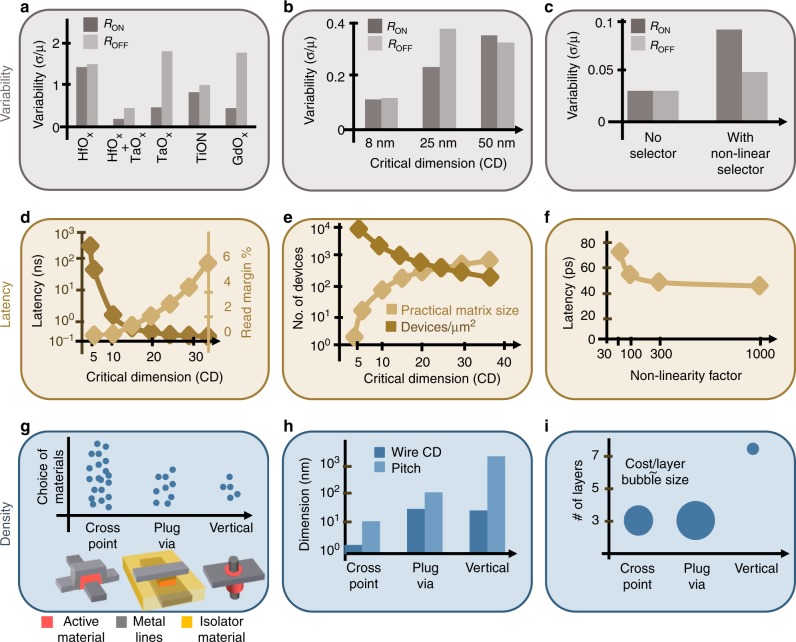
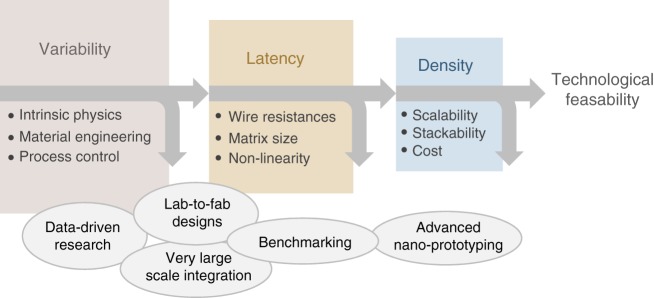
Verification
Claims the paper makes
The claims and statistics of this paper haven’t been checked yet.
Free: it reads the open-access text and checks the first 5 claims that cite a source we can check. Create a free account to check every claim.
Claims other papers make about this one
Each is checked against this paper’s own text: does it say what the citing paper says it does?
The source backs part of the claim, not all of it — or backs it for a different population, condition or comparison.
In the citing paper
“To emulate the complexity and ultra-low power consumption of biological neural networks, hardware platforms for ANNs must achieve an ultra-high integration density (>1 Terabyte per cm2) and low energy consumption (<10 fJ per operation)35.”
From Hardware implementation of memristor-based artificial neural networks (2024) · cites this paper as [35]
Experimental — accuracy not yet measured
Self-check
Percentages, sums and reported differences re-computed from the paper’s own numbers.
The self-check needs the paper’s full text.
Citations
Cites
Neuromorphic computing with multi-memristive synapses
Boybat, I., Le Gallo, M., Nandakumar, S. R., Moraitis, T., Parnell, T., Tuma, T., Rajendran, B., Leblebici, Y., Sebastian, A., & Eleftheriou, E. (2018) · Nature Communications · doi:10.1038/s41467-018-04933-y · Cited by 899
Memristor crossbar arrays with 6-nm half-pitch and 2-nm critical dimension
Pi, S., Li, C., Jiang, H., Xia, W., Xin, H., Yang, J. J., & Xia, Q. (2019) · Nature Nanotechnology · doi:10.1038/s41565-018-0302-0 · Cited by 539 · cited 1×
“1g) and its extreme scalability, down to ~2 nm for an estimated density of >0.7Tb/cm 2 9 (Fig.”
BackgroundHigh‐Speed and Low‐Energy Nitride Memristors
Choi, B. J., Torrezan, A. C., Strachan, J. P., Kotula, P. G., Lohn, A. J., Marinella, M. J., Li, Z., Williams, R. S., & Yang, J. J. (2016) · Advanced Functional Materials · doi:10.1002/adfm.201600680 · Cited by 356
Multibit memory operation of metal-oxide bi-layer memristors
Stathopoulos, S., Khiat, A., Trapatseli, M., Cortese, S., Serb, A., Valov, I., & Prodromakis, T. (2017) · Scientific Reports · doi:10.1038/s41598-017-17785-1 · Cited by 312
Self-citationDesign implications of memristor-based RRAM cross-point structures
Xu, C., Dong, X., Jouppi, N. P., & Xie, Y. (2011) · 2011 Design, Automation & Test in Europe · doi:10.1109/date.2011.5763125 · Cited by 232 · cited 1×
“However, high speed programming requirements can increase the circuitry footprint, thus straying away from the ideal density 11 .”
BackgroundMemristor Crossbars with 4.5 Terabits-per-Inch-Square Density and Two Nanometer Dimension
Pi, S., Li, C., Jiang, H., Xia, W., Xin, H. L., Yang, J. J., & Xia, Q. (2018) · arXiv (Cornell University) · doi:10.48550/arxiv.1804.09848 · Cited by 154 · cited 1×
“1g) and its extreme scalability, down to ~2 nm for an estimated density of >0.7Tb/cm 2 9 (Fig.”
BackgroundVariability of resistive switching memories and its impact on crossbar array performance
Chen, A., & Lin, M.-R. (2011) · 2011 International Reliability Physics Symposium · doi:10.1109/irps.2011.5784590 · Cited by 152 · cited 2×
“The choice of materials plays a critical role 5 (Fig.”
BackgroundRealization of vertical resistive memory (VRRAM) using cost effective 3D process
Baek, I. G., Park, C. J., Ju, H., Seong, D. J., Ahn, H. S., Kim, J. H., Yang, M. K., Song, S. H., Kim, E. M., Park, S. O., et al. (2011) · 2011 International Electron Devices Meeting · doi:10.1109/iedm.2011.6131654 · Cited by 140 · cited 1×
“The number of masks is independent of the number of layers, similar to the three-dimensional fl ash technology 10 .”
Background8-Layers 3D vertical RRAM with excellent scalability towards storage class memory applications
Luo, Q., Xu, X., Gong, T., Lv, H., Dong, D., Ma, H., Yuan, P., Gao, J., Liu, J., Yu, Z., et al. (2017) · 2017 IEEE International Electron Devices Meeting (IEDM) · doi:10.1109/iedm.2017.8268315 · Cited by 97 · cited 1×
“…is heavily in fl uenced by a the choice of active material and of the material stack (e.g., single material HfO x vs. bilayer HfO x + TaO x ) 5,12 ; b the device scaling as determined by the smallest feature dimension (also known as critical dimension or CD); 6 and c the presence of a series…”
BackgroundCross point arrays of 8 nm × 8 nm memristive devices fabricated with nanoimprint lithography
Pi, S., Lin, P., & Xia, Q. (2013) · Journal of Vacuum Science & Technology B, Nanotechnology and Microelectronics: Materials, Processing, Measurement, and Phenomena · doi:10.1116/1.4827021 · Cited by 81
Liang, J., Yeh, S., Wong, S. S., & Wong, H.-S. P. (2013) · ACM Journal on Emerging Technologies in Computing Systems · doi:10.1145/2422094.2422103 · Cited by 71
Goux, L., Fantini, A., Kar, G., Chen, Y.-Y., Jossart, N., Degraeve, R., Clima, S., Govoreanu, B., Lorenzo, G., Pourtois, G., et al. (2012) · 2012 Symposium on VLSI Technology (VLSIT) · doi:10.1109/vlsit.2012.6242510 · Cited by 67
Ultra high density 3D via RRAM in pure 28nm CMOS process
Hsieh, M.-C., Liao, Y., Chin, Y.-W., Lien, C., Chang, T.-S., Chih, Y.-D., Natarajan, S., Tsai, M., King, Y., & Lin, C. J. (2013) · Technical digest - International Electron Devices Meeting/Technical digest · doi:10.1109/iedm.2013.6724600 · Cited by 65
Cross-point memory design challenges and survey of selector device characteristics
Peng, X., Madler, R., Chen, P.-Y., & Yu, S. (2017) · Journal of Computational Electronics · doi:10.1007/s10825-017-1062-z · Cited by 56
Zhang, L., Govoreanu, B., Redolfi, A., Crotti, D., Hody, H., Paraschiv, V., Cosemans, S., Adelmann, C., Witters, T., Clima, S., et al. (2014) · Technical digest - International Electron Devices Meeting/Technical digest · doi:10.1109/iedm.2014.7047000 · Cited by 36
Nanoelectronic neurocomputing: Status and prospects
Ceze, L., Hasler, J., Likharev, K. K., Seo, J.-S., Sherwood, T., Strukov, D. B., Xie, Y., & Yu, S. (2016) · Conference digest · doi:10.1109/drc.2016.7548506 · Cited by 15
Zhang, L., Redolfi, A., Crotti, D., Adelmann, C., Clima, S., Chen, Y. Y., Opsomer, K., Subhechha, S., Wouters, D. J., Groeseneken, G., et al. (2014) · Cited by 2
Cited by
Hardware implementation of memristor-based artificial neural networks
Aguirre, F., Sebastian, A., Le Gallo, M., Song, W., Wang, T., Yang, J. J., Lu, W., Chang, M.-F., Ielmini, D., Yang, Y., et al. (2024) · Nature Communications · doi:10.1038/s41467-024-45670-9 · Cited by 564
Semiconductor Quantum Dots for Memories and Neuromorphic Computing Systems
Lv, Z., Wang, Y., Chen, J., Wang, J., Zhou, Y., & Han, S.-T. (2020) · Chemical Reviews · doi:10.1021/acs.chemrev.9b00730 · Cited by 364
Large-Area Soft e-Skin: The Challenges Beyond Sensor Designs
Dahiya, R., Yogeswaran, N., Liu, F., Manjakkal, L., Burdet, E., Hayward, V., & Jörntell, H. (2019) · Proceedings of the IEEE · doi:10.1109/jproc.2019.2941366 · Cited by 309
“Recently, two-terminal memristive devices have gained attention as the state of their internal resistance could indicate the history of the voltage across and/or current through them [97]–[99].”
MXene‐ZnO Memristor for Multimodal In‐Sensor Computing
Wang, Y., Gong, Y., Yang, L., Xiong, Z., Lv, Z., Xing, X., Zhou, Y., Zhang, B., Su, C., Liao, Q., et al. (2021) · Advanced Functional Materials · doi:10.1002/adfm.202100144 · Cited by 257
Amirsoleimani, A., Alibart, F., Yon, V., Xu, J., Pazhouhandeh, M. R., Ecoffey, S., Beilliard, Y., Genov, R., & Drouin, D. (2020) · Advanced Intelligent Systems · doi:10.1002/aisy.202000115 · Cited by 216
Metadata
- Authors
- Adam, G. C., Khiat, A., & Prodromakis, T.
- Affiliations
- George Washington University (US)
- University of Southampton (GB)
- Corresponding author
- Prodromakis, Themis
- Venue
- Nature Communications
- Published
- 2018-12-10
- Volume
- 9
- Issue
- 1
- Pages
- 5267-5267
- ISSN
- 2041-1723 (ISSN-L)
- PMC
- PMC6288140
- OpenAlex
- W2903012893
- Cited by
- 136
- References
- 16
- Citations by year
- 2026: 13 · 2025: 27 · 2024: 14 · 2023: 25 · 2022: 14 · 2021: 15 · 2020: 18 · 2019: 10
- FWCI
- 4.10
- Type
- journal article
- Language
- en
- Open access
- gold
- doi.org
- Licence
- cc-by
- creativecommons.org/licenses/by/4.0 (tdm)
- creativecommons.org/licenses/by/4.0 (vor)
- Locations
- Nature Communications (publishedVersion, cc-by)
- Europe PMC (PubMed Central) (publishedVersion, other-oa)
- PubMed Central (publishedVersion, cc-by)
- PubMed (publishedVersion)
- ePrints Soton (University of Southampton) (acceptedVersion)
- RePEc: Research Papers in Economics (submittedVersion)
- DOAJ (DOAJ: Directory of Open Access Journals) (submittedVersion)
- DOAJ (DOAJ: Directory of Open Access Journals) (submittedVersion, cc-by-sa)
- Funders
- Royal Society
- Engineering and Physical Sciences Research Council (EP/R024642/1, EP/R024642)
- Topics
- Physical Sciences › Engineering › Electrical and Electronic Engineering › Advanced Memory and Neural Computing
- Physical Sciences › Engineering › Electrical and Electronic Engineering › Ferroelectric and Negative Capacitance Devices
- Physical Sciences › Mathematics › Theoretical Computer Science › DNA and Biological Computing
- Keywords
- memristors, neuromorphic hardware, multi-bit storage, low-voltage operation, manufacturability, technology roadmap, industrial adoption
About these checks
Registry, retraction, Cites and statistics results are computed, not judged, with one exception: a printed reference that no index lists is read once by a model before it counts as a citation error. Claims are extracted by a model and kept only when their quote appears verbatim in the text; each cited source is then checked, with a model’s help, for whether it says what the claim relies on. Those verdicts can be wrong — read the claim’s quote and the cited source before relying on one.
Statistics and arithmetic are recomputed, not judged.
Confidence bands are shown only for fields calibrated on our annotated test set. None is calibrated yet, so no band is shown.
What counts as a claim ›How we measure confidence ›How we check this ›
Are you an author, or do you see a problem with this page? Request a review
Data sources
Bibliographic data: Semantic Scholar, OpenAlex, Crossref.
Contains information from the Semantic Scholar Academic Graph Datasets, made available under the ODC Attribution License (ODC-BY 1.0).
Semantic Scholar’s data is described in: Kinney, R., et al. (2023). The Semantic Scholar Open Data Platform. arXiv:2301.10140.
