

Influence of fake news in Twitter during the 2016 US presidential election
Open accessThe DOI matches its Crossref record; 44 of the 44 references it cites were found in a registry or an index.
Abstract
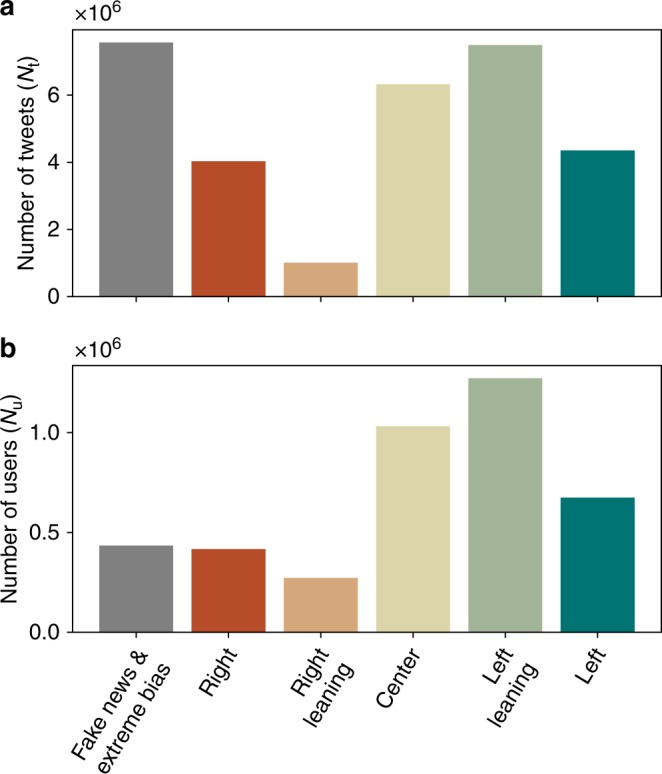
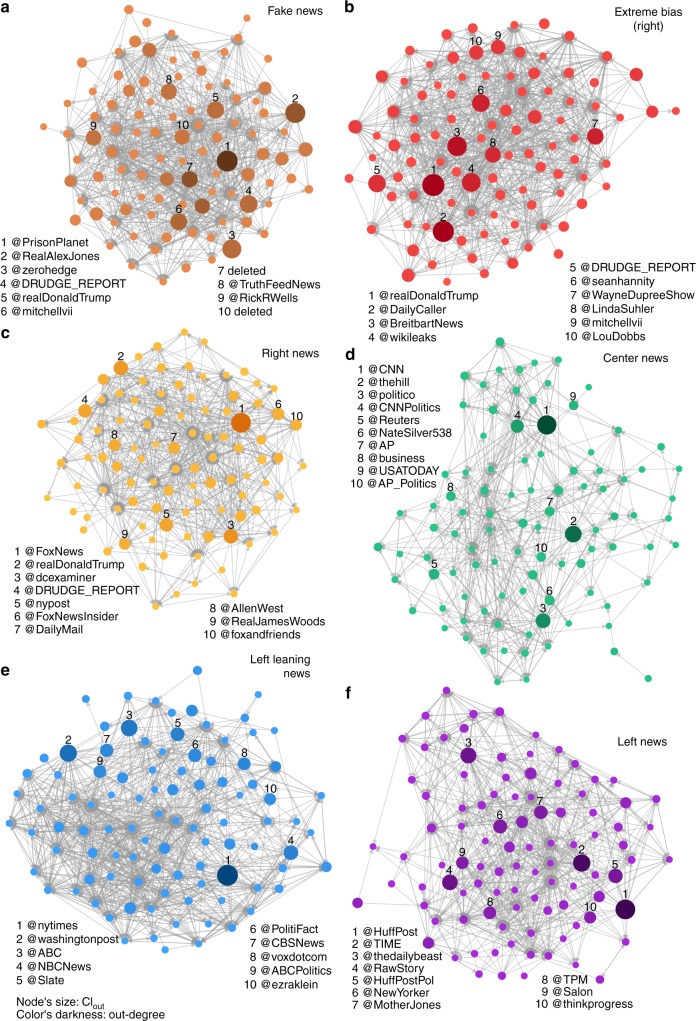
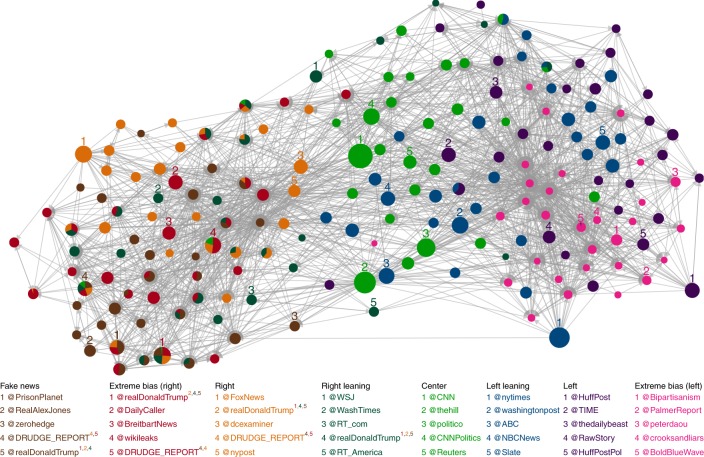
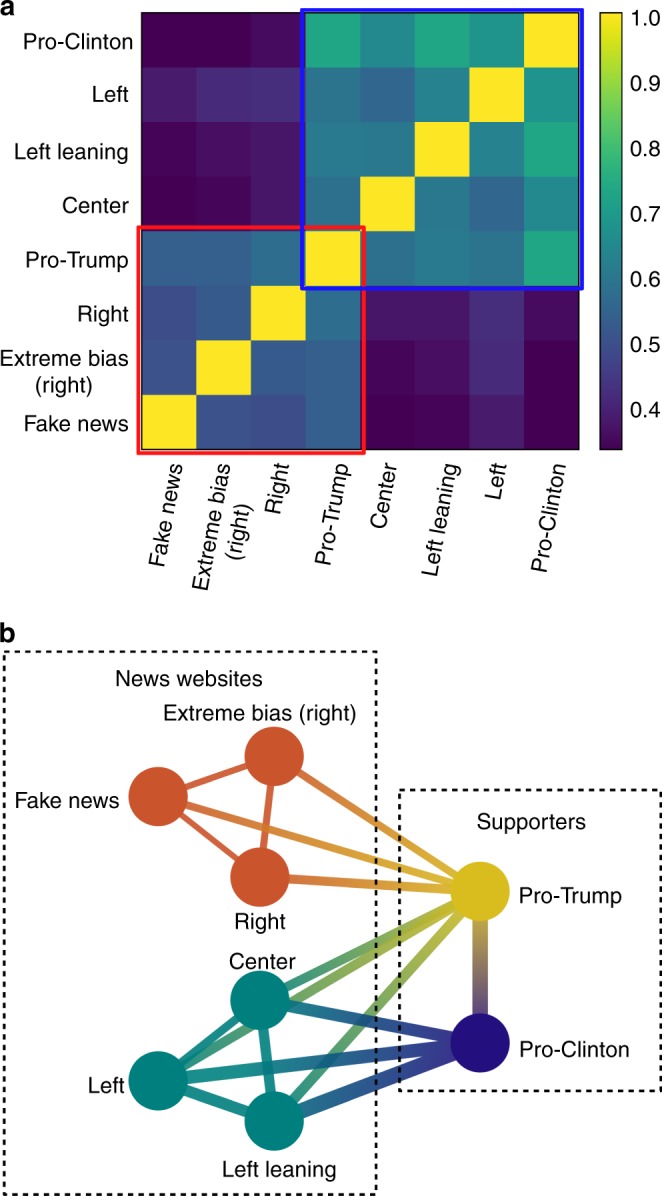
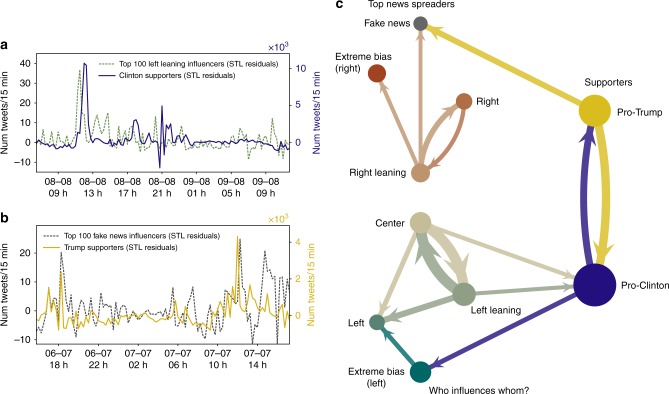
The dynamics and influence of fake news on Twitter during the 2016 US presidential election remains to be clarified. Here, we use a dataset of 171 million tweets in the five months preceding the election day to identify 30 million tweets, from 2.2 million users, which contain a link to news outlets. Based on a classification of news outlets curated by www.opensources.co , we find that 25% of these tweets spread either fake or extremely biased news. We characterize the networks of information flow to find the most influential spreaders of fake and traditional news and use causal modeling to uncover how fake news influenced the presidential election. We find that, while top influencers spreading traditional center and left leaning news largely influence the activity of Clinton supporters, this causality is reversed for the fake news: the activity of Trump supporters influences the dynamics of the top fake news spreaders.
Overview
The claims and statistics of this paper haven’t been checked yet.
Free: it reads the open-access text and checks the first 5 claims that cite a source we can check. Create a free account to check every claim.
Integrity signals
Registry
Cites
Statistics
Figures
Verification
Claims the paper makes
The claims and statistics of this paper haven’t been checked yet.
Free: it reads the open-access text and checks the first 5 claims that cite a source we can check. Create a free account to check every claim.
Claims other papers make about this one
Each is checked against this paper’s own text: does it say what the citing paper says it does?
The cited source says what the claim attributes to it.
In the citing paper
“Real and present concerns exist over the role of mis- and disinformation in public discourse (116–118), the emergence of echo chambers (119) and deepening political polarization (120, 121), in particular around big societal issues like climate change (122).”
From The benefits and dangers of anthropomorphic conversational agents (2025) · cites this paper as [117]
Self-check
Percentages, sums and reported differences re-computed from the paper’s own numbers.
The self-check needs the paper’s full text.
Citations
Cites
1 retracted
Limited individual attention and online virality of low-quality information
Qiu, X., F. M. Oliveira, D., Sahami Shirazi, A., Flammini, A., & Menczer, F. (2017) · Nature Human Behaviour · doi:10.1038/s41562-017-0132 · Cited by 180
RetractedControlling the False Discovery Rate: A Practical and Powerful Approach to Multiple Testing
Benjamini, Y., & Hochberg, Y. (1995) · Journal of the Royal Statistical Society Series B: Statistical Methodology · doi:10.1111/j.2517-6161.1995.tb02031.x · Cited by 109,482
Investigating causal relations by econometric models and cross-spectral methods
Granger, C. W. J. (1969) · Econometrica · doi:10.2307/1912791 · Cited by 22,989
The spread of true and false news online
Vosoughi, S., Roy, D., & Aral, S. (2018) · Science · doi:10.1126/science.aap9559 · Cited by 8,847
Causation, Prediction, and Search
Spirtes, P., Glymour, C., & Scheines, R. (2001) · doi:10.7551/mitpress/1754.001.0001 · Cited by 4,521
A New Status Index Derived from Sociometric Analysis
Katz, L. (1953) · Psychometrika · doi:10.1007/bf02289026 · Cited by 3,866
Exposure to ideologically diverse news and opinion on Facebook
Bakshy, E., Messing, S., & Adamic, L. A. (2015) · Science · doi:10.1126/science.aaa1160 · Cited by 3,245
The spreading of misinformation online
Del Vicario, M., Bessi, A., Zollo, F., Petroni, F., Scala, A., Caldarelli, G., Stanley, H. E., & Quattrociocchi, W. (2016) · Proceedings of the National Academy of Sciences · doi:10.1073/pnas.1517441113 · Cited by 2,407
Confirmation, disconfirmation, and information in hypothesis testing
Klayman, J., & Ha, Y.-W. (1987) · Psychological Review · doi:10.1037/0033-295x.94.2.211 · Cited by 2,094
Ferrara, E., Varol, O., Davis, C., Menczer, F., & Flammini, A. (2016) · Communications of the ACM · doi:10.1145/2818717 · Cited by 1,973
Influence maximization in complex networks through optimal percolation
Morone, F., & Makse, H. A. (2015) · Nature · doi:10.1038/nature14604 · Cited by 1,230
Self-citationThe spread of low-credibility content by social bots
Shao, C., Ciampaglia, G. L., Varol, O., Yang, K.-C., Flammini, A., & Menczer, F. (2018) · Nature Communications · doi:10.1038/s41467-018-06930-7 · Cited by 1,125
Social bots distort the 2016 U.S. Presidential election online discussion
Bessi, A., & Ferrara, E. (2016) · First Monday · doi:10.5210/fm.v21i11.7090 · Cited by 993
Online Human-Bot Interactions: Detection, Estimation, and Characterization
Varol, O., Ferrara, E., Davis, C., Menczer, F., & Flammini, A. (2017) · Proceedings of the International AAAI Conference on Web and Social Media · doi:10.1609/icwsm.v11i1.14871 · Cited by 981
Detecting and quantifying causal associations in large nonlinear time series datasets
Runge, J., Nowack, P., Kretschmer, M., Flaxman, S., & Sejdinovic, D. (2019) · Science Advances · doi:10.1126/sciadv.aau4996 · Cited by 979
Velocity and Hierarchical Spread of Epidemic Outbreaks in Scale-Free Networks
Barthélemy, M., Barrat, A., Pastor-Satorras, R., & Vespignani, A. (2004) · Physical Review Letters · doi:10.1103/physrevlett.92.178701 · Cited by 719
Modelling dynamical processes in complex socio-technical systems
Vespignani, A. (2012) · Nature Physics · doi:10.1038/nphys2160 · Cited by 652
Science vs Conspiracy: Collective Narratives in the Age of Misinformation
Bessi, A., Coletto, M., Davidescu, G. A., Scala, A., Caldarelli, G., & Quattrociocchi, W. (2015) · PLOS ONE · doi:10.1371/journal.pone.0118093 · Cited by 645
Social Media and Fake News in the 2016 Election
Allcott, H., & Gentzkow, M. (2017) · National Bureau of Economic Research · doi:10.3386/w23089 · Cited by 608
Approximate Asymptotic Distribution Functions for Unit-Root and Cointegration Tests
MacKinnon, J. G. (1994) · Journal of Business & Economic Statistics · doi:10.1080/07350015.1994.10510005 · Cited by 468
Seven Months with the Devils: A Long-Term Study of Content Polluters on Twitter
Lee, K., Eoff, B., & Caverlee, J. (2021) · Proceedings of the International AAAI Conference on Web and Social Media · doi:10.1609/icwsm.v5i1.14106 · Cited by 452
Hoaxy: A Platform for Tracking Online Misinformation
Shao, C., Ciampaglia, G. L., Flammini, A., & Menczer, F. (2016) · Proceedings of the 25th International Conference Companion on World Wide Web - WWW '16 Companion · doi:10.1145/2872518.2890098 · Cited by 389
The structure of online diffusion networks
Goel, S., Watts, D. J., & Goldstein, D. G. (2012) · Proceedings of the 13th ACM Conference on Electronic Commerce · doi:10.1145/2229012.2229058 · Cited by 385
Kernel-based Conditional Independence Test and Application in Causal Discovery
Zhang, K., Peters, J., Janzing, D., & Schölkopf, B. (2012) · arXiv (Cornell University) · doi:10.48550/arxiv.1202.3775 · Cited by 346
Escaping the Curse of Dimensionality in Estimating Multivariate Transfer Entropy
Runge, J., Heitzig, J., Petoukhov, V., & Kurths, J. (2012) · Physical Review Letters · doi:10.1103/physrevlett.108.258701 · Cited by 345
Identifying causal gateways and mediators in complex spatio-temporal systems
Runge, J., Petoukhov, V., Donges, J. F., Hlinka, J., Jajcay, N., Vejmelka, M., Hartman, D., Marwan, N., Paluš, M., & Kurths, J. (2015) · Nature Communications · doi:10.1038/ncomms9502 · Cited by 329
Disinformation on the Web: Impact, Characteristics, and Detection of Wikipedia Hoaxes
Kumar, S., West, R., & Leskovec, J. (2016) · Proceedings of the 25th International Conference on World Wide Web · doi:10.1145/2872427.2883085 · Cited by 310
Anatomy of news consumption on Facebook
Schmidt, A. L., Zollo, F., Del Vicario, M., Bessi, A., Scala, A., Caldarelli, G., Stanley, H. E., & Quattrociocchi, W. (2017) · Proceedings of the National Academy of Sciences · doi:10.1073/pnas.1617052114 · Cited by 305
Political Fact-Checking on Twitter: When Do Corrections Have an Effect?
Margolin, D. B., Hannak, A., & Weber, I. (2018) · Political Communication · doi:10.1080/10584609.2017.1334018 · Cited by 285
Users Polarization on Facebook and Youtube
Bessi, A., Zollo, F., Del Vicario, M., Puliga, M., Scala, A., Caldarelli, G., Uzzi, B., & Quattrociocchi, W. (2016) · PLOS ONE · doi:10.1371/journal.pone.0159641 · Cited by 285
Anatomy of an online misinformation network
Shao, C., Hui, P.-M., Wang, L., Jiang, X., Flammini, A., Menczer, F., & Ciampaglia, G. L. (2018) · PLOS ONE · doi:10.1371/journal.pone.0196087 · Cited by 278
Collective attention in the age of (mis)information
Mocanu, D., Rossi, L., Zhang, Q., Karsai, M., & Quattrociocchi, W. (2015) · Computers in Human Behavior · doi:10.1016/j.chb.2015.01.024 · Cited by 242
Mapping social dynamics on Facebook: The Brexit debate
Del Vicario, M., Zollo, F., Caldarelli, G., Scala, A., & Quattrociocchi, W. (2017) · Social Networks · doi:10.1016/j.socnet.2017.02.002 · Cited by 233
Modeling confirmation bias and polarization
Del Vicario, M., Scala, A., Caldarelli, G., Stanley, H. E., & Quattrociocchi, W. (2017) · Scientific Reports · doi:10.1038/srep40391 · Cited by 222
Morone, F., Min, B., Bo, L., Mari, R., & Makse, H. A. (2016) · Scientific Reports · doi:10.1038/srep30062 · Cited by 209
Self-citationApproximate Kernel-Based Conditional Independence Tests for Fast Non-Parametric Causal Discovery
Strobl, E. V., Zhang, K., & Visweswaran, S. (2019) · Journal of Causal Inference · doi:10.1515/jci-2018-0017 · Cited by 158
Bovet, A., Morone, F., & Makse, H. A. (2018) · Scientific Reports · doi:10.1038/s41598-018-26951-y · Cited by 126
Self-citationTrend of Narratives in the Age of Misinformation
Bessi, A., Zollo, F., Del Vicario, M., Scala, A., Caldarelli, G., & Quattrociocchi, W. (2015) · PLOS ONE · doi:10.1371/journal.pone.0134641 · Cited by 123
On Granger causality and the effect of interventions in time series
Eichler, M., & Didelez, V. (2009) · Lifetime Data Analysis · doi:10.1007/s10985-009-9143-3 · Cited by 123
Homophily and polarization in the age of misinformation
Bessi, A., Petroni, F., Vicario, M. D., Zollo, F., Anagnostopoulos, A., Scala, A., Caldarelli, G., & Quattrociocchi, W. (2016) · The European Physical Journal Special Topics · doi:10.1140/epjst/e2015-50319-0 · Cited by 114
Viral Misinformation: The Role of Homophily and Polarization
Bessi, A., Petroni, F., Del Vicario, M., Zollo, F., Anagnostopoulos, A., Scala, A., Caldarelli, G., & Quattrociocchi, W. (2015) · Proceedings of the 24th International Conference on World Wide Web · doi:10.1145/2740908.2745939 · Cited by 97
Teng, X., Pei, S., Morone, F., & Makse, H. A. (2016) · Scientific Reports · doi:10.1038/srep36043 · Cited by 69
Self-citationVicario, M. D., Gaito, S., Quattrociocchi, W., Zignani, M., & Zollo, F. (2017) · IMT Institutional Repository (IMT School for Advanced Studies Lucca) · doi:10.48550/arxiv.1702.06016 · Cited by 34
Explaining opinion polarisation with opinion copulas
Askitas, N. (2017) · PLoS ONE · doi:10.1371/journal.pone.0183277 · Cited by 7
Research works printed but not linked: 2
- Howell L Digital wildfires in a hyperconnected world WEF Rep. 2013 3 15 94
- Cleveland RB Cleveland WS McRae JE Terpenning I STL: a seasonal-trend decomposition procedure based on loess J. Off. Stat. 1990 6 3 73
Cited by
The COVID-19 social media infodemic
Cinelli, M., Quattrociocchi, W., Galeazzi, A., Valensise, C. M., Brugnoli, E., Schmidt, A. L., Zola, P., Zollo, F., & Scala, A. (2020) · Scientific Reports · doi:10.1038/s41598-020-73510-5 · Cited by 2,313
“While most of the studies on misinformation diffusion focus on a single platform [22, 24, 14], the dynamics behind information consumption might be particular to the environment in which they spread on.”
BackgroundThe echo chamber effect on social media
Cinelli, M., De Francisci Morales, G., Galeazzi, A., Quattrociocchi, W., & Starnini, M. (2021) · Proceedings of the National Academy of Sciences · doi:10.1073/pnas.2023301118 · Cited by 2,092
Fake news, disinformation and misinformation in social media: a review
Aïmeur, E., Amri, S., & Brassard, G. (2023) · Social Network Analysis and Mining · doi:10.1007/s13278-023-01028-5 · Cited by 772
Meel, P., & Vishwakarma, D. K. (2020) · Expert Systems with Applications · doi:10.1016/j.eswa.2019.112986 · Cited by 505
Pulido, C. M., Villarejo-Carballido, B., Redondo-Sama, G., & Gómez, A. (2020) · International Sociology · doi:10.1177/0268580920914755 · Cited by 448
Metadata
- Authors
- Bovet, A., & Makse, H. A.
- Affiliations
- City College of New York (US)
- Corresponding author
- Makse, Hernán A.
- Venue
- Nature Communications
- Published
- 2019-01-02
- Volume
- 10
- Issue
- 1
- Pages
- 7-7
- ISSN
- 2041-1723 (ISSN-L)
- PMC
- PMC6315042
- OpenAlex
- W2792307011
- Cited by
- 701
- References
- 40
- Citations by year
- 2026: 38 · 2025: 106 · 2024: 114 · 2023: 105 · 2022: 109 · 2021: 114 · 2020: 86 · 2019: 28
- FWCI
- 130.25
- Type
- journal article
- Language
- en
- Open access
- gold
- doi.org
- Licence
- cc-by
- creativecommons.org/licenses/by/4.0 (tdm)
- creativecommons.org/licenses/by/4.0 (vor)
- Locations
- Nature Communications (publishedVersion, cc-by)
- Europe PMC (PubMed Central) (publishedVersion, other-oa)
- PubMed Central (publishedVersion, cc-by)
- PubMed (publishedVersion)
- Repository of the University of Namur (publishedVersion, cc-by)
- arXiv (Cornell University) (submittedVersion)
- RePEc: Research Papers in Economics (submittedVersion)
- DOAJ (DOAJ: Directory of Open Access Journals) (submittedVersion)
- DOAJ (DOAJ: Directory of Open Access Journals) (submittedVersion, cc-by-sa)
- arXiv (Cornell University) (cc-by)
- Funders
- National Science Foundation
- Schweizerischer Nationalfonds zur Förderung der Wissenschaftlichen Forschung (165158)
- Topics
- Social Sciences › Sociology and Political Science › Misinformation and Its Impacts
- Physical Sciences › Physics and Astronomy › Statistical and Nonlinear Physics › Complex Network Analysis Techniques
- Social Sciences › Communication › Social Media and Politics
- Keywords
- fake news, 2016 US presidential election, Twitter, information dissemination, influential spreaders, election influence, Trump supporters, social media misinformation
About these checks
Registry, retraction, Cites and statistics results are computed, not judged, with one exception: a printed reference that no index lists is read once by a model before it counts as a citation error. Claims are extracted by a model and kept only when their quote appears verbatim in the text; each cited source is then checked, with a model’s help, for whether it says what the claim relies on. Those verdicts can be wrong — read the claim’s quote and the cited source before relying on one.
Statistics and arithmetic are recomputed, not judged.
Confidence bands are shown only for fields calibrated on our annotated test set. None is calibrated yet, so no band is shown.
What counts as a claim ›How we measure confidence ›How we check this ›
Are you an author, or do you see a problem with this page? Request a review
Data sources
Bibliographic data: Semantic Scholar, OpenAlex, Crossref.
Contains information from the Semantic Scholar Academic Graph Datasets, made available under the ODC Attribution License (ODC-BY 1.0).
Semantic Scholar’s data is described in: Kinney, R., et al. (2023). The Semantic Scholar Open Data Platform. arXiv:2301.10140.
