

Influence of fake news in Twitter during the 2016 US presidential election
Open accessThe DOI matches its Crossref record; 44 of the 44 references it cites were found in a registry or an index.
Abstract
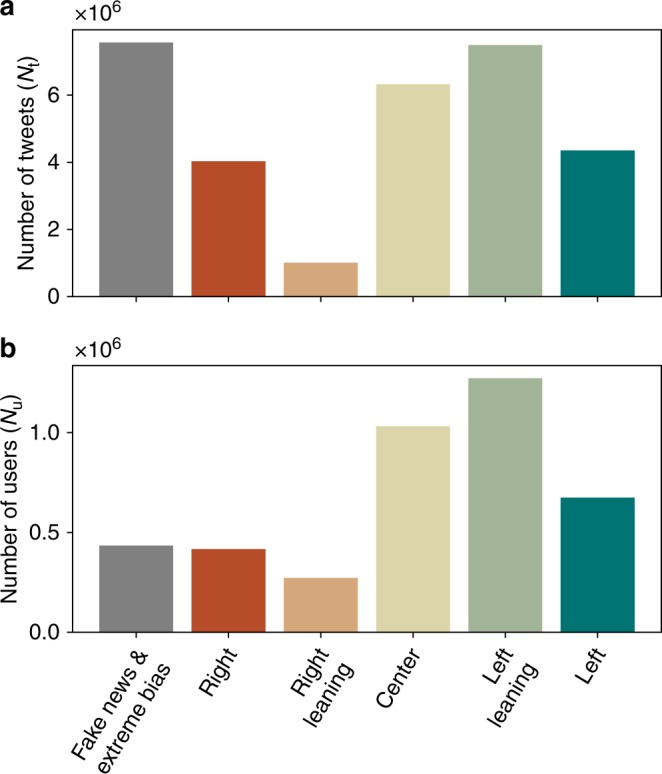
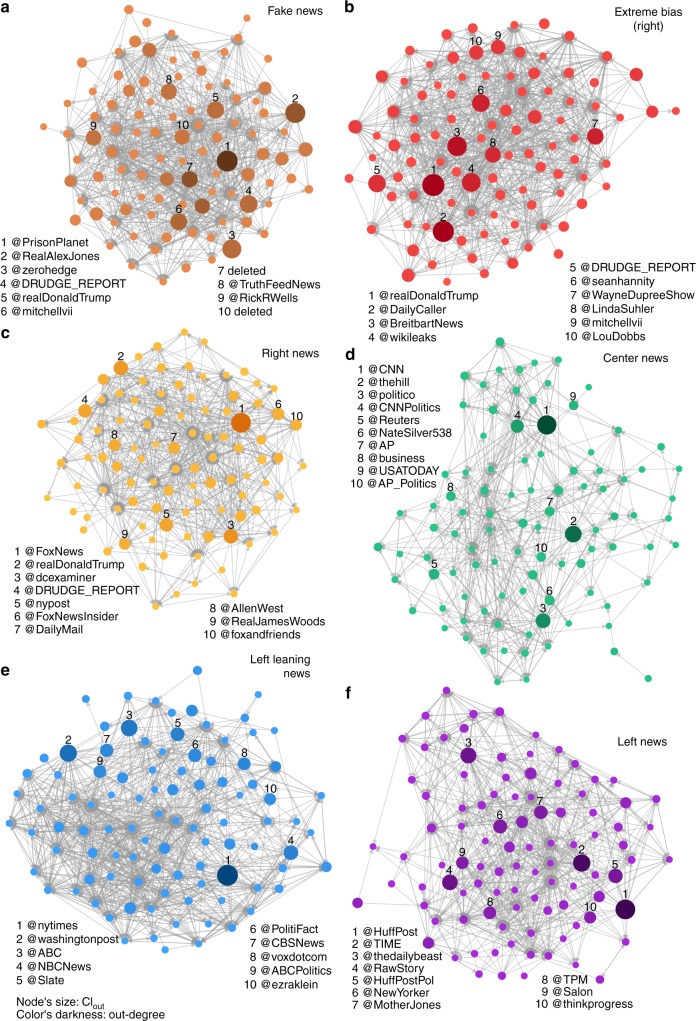
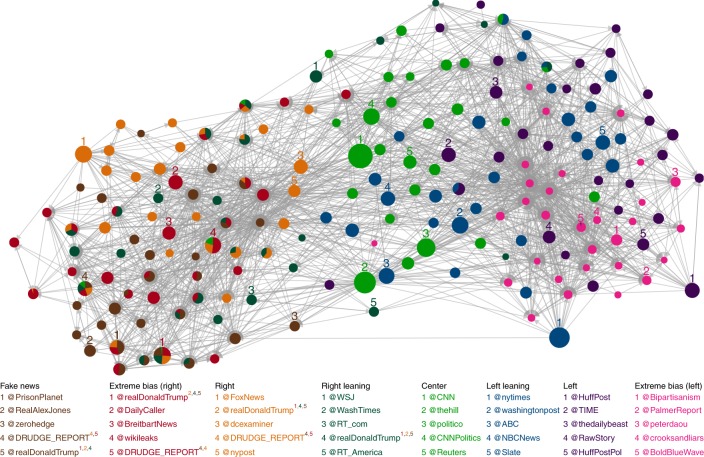
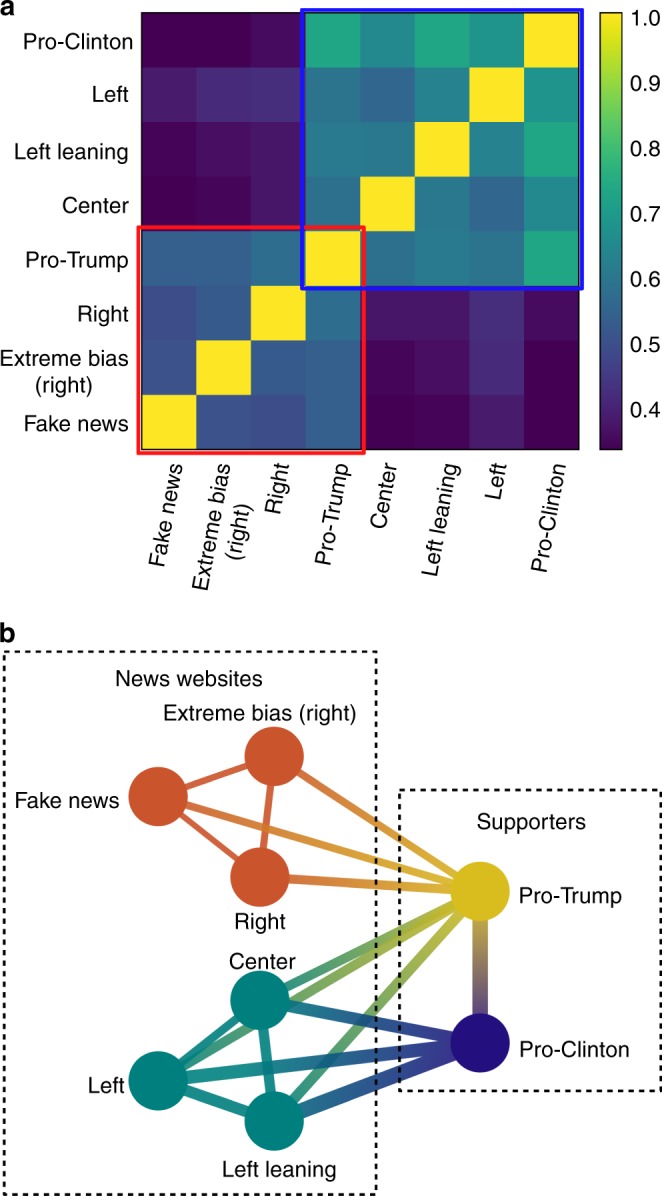
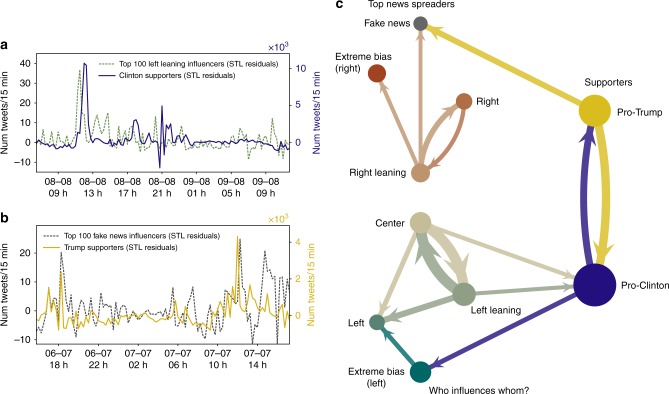
The dynamics and influence of fake news on Twitter during the 2016 US presidential election remains to be clarified. Here, we use a dataset of 171 million tweets in the five months preceding the election day to identify 30 million tweets, from 2.2 million users, which contain a link to news outlets. Based on a classification of news outlets curated by www.opensources.co , we find that 25% of these tweets spread either fake or extremely biased news. We characterize the networks of information flow to find the most influential spreaders of fake and traditional news and use causal modeling to uncover how fake news influenced the presidential election. We find that, while top influencers spreading traditional center and left leaning news largely influence the activity of Clinton supporters, this causality is reversed for the fake news: the activity of Trump supporters influences the dynamics of the top fake news spreaders.
Overview
The claims and statistics of this paper haven’t been checked yet.
Free: it reads the open-access text and checks the first 5 claims that cite a source we can check. Create a free account to check every claim.
Integrity signals
Registry
Cites
Statistics
Figures
Verification
Claims the paper makes
The claims and statistics of this paper haven’t been checked yet.
Free: it reads the open-access text and checks the first 5 claims that cite a source we can check. Create a free account to check every claim.
Claims other papers make about this one
Each is checked against this paper’s own text: does it say what the citing paper says it does?
The cited source says what the claim attributes to it.
In the citing paper
“Real and present concerns exist over the role of mis- and disinformation in public discourse (116–118), the emergence of echo chambers (119) and deepening political polarization (120, 121), in particular around big societal issues like climate change (122).”
From The benefits and dangers of anthropomorphic conversational agents (2025) · cites this paper as [117]
Self-check
Percentages, sums and reported differences re-computed from the paper’s own numbers.
The self-check needs the paper’s full text.
Citations
Cites
1 retracted
Limited individual attention and online virality of low-quality information
Qiu, X., F. M. Oliveira, D., Sahami Shirazi, A., Flammini, A., & Menczer, F. (2017) · Nature Human Behaviour · doi:10.1038/s41562-017-0132 · Cited by 180
RetractedControlling the False Discovery Rate: A Practical and Powerful Approach to Multiple Testing
Benjamini, Y., & Hochberg, Y. (1995) · Journal of the Royal Statistical Society Series B: Statistical Methodology · doi:10.1111/j.2517-6161.1995.tb02031.x · Cited by 109,482
Investigating causal relations by econometric models and cross-spectral methods
Granger, C. W. J. (1969) · Econometrica · doi:10.2307/1912791 · Cited by 22,989
The spread of true and false news online
Vosoughi, S., Roy, D., & Aral, S. (2018) · Science · doi:10.1126/science.aap9559 · Cited by 8,847
Causation, Prediction, and Search
Spirtes, P., Glymour, C., & Scheines, R. (2001) · doi:10.7551/mitpress/1754.001.0001 · Cited by 4,521
A New Status Index Derived from Sociometric Analysis
Katz, L. (1953) · Psychometrika · doi:10.1007/bf02289026 · Cited by 3,866
Exposure to ideologically diverse news and opinion on Facebook
Bakshy, E., Messing, S., & Adamic, L. A. (2015) · Science · doi:10.1126/science.aaa1160 · Cited by 3,245
The spreading of misinformation online
Del Vicario, M., Bessi, A., Zollo, F., Petroni, F., Scala, A., Caldarelli, G., Stanley, H. E., & Quattrociocchi, W. (2016) · Proceedings of the National Academy of Sciences · doi:10.1073/pnas.1517441113 · Cited by 2,407
Confirmation, disconfirmation, and information in hypothesis testing
Klayman, J., & Ha, Y.-W. (1987) · Psychological Review · doi:10.1037/0033-295x.94.2.211 · Cited by 2,094
Ferrara, E., Varol, O., Davis, C., Menczer, F., & Flammini, A. (2016) · Communications of the ACM · doi:10.1145/2818717 · Cited by 1,973
Research works printed but not linked: 2
- Howell L Digital wildfires in a hyperconnected world WEF Rep. 2013 3 15 94
- Cleveland RB Cleveland WS McRae JE Terpenning I STL: a seasonal-trend decomposition procedure based on loess J. Off. Stat. 1990 6 3 73
Cited by
The COVID-19 social media infodemic
Cinelli, M., Quattrociocchi, W., Galeazzi, A., Valensise, C. M., Brugnoli, E., Schmidt, A. L., Zola, P., Zollo, F., & Scala, A. (2020) · Scientific Reports · doi:10.1038/s41598-020-73510-5 · Cited by 2,313
“While most of the studies on misinformation diffusion focus on a single platform [22, 24, 14], the dynamics behind information consumption might be particular to the environment in which they spread on.”
BackgroundThe echo chamber effect on social media
Cinelli, M., De Francisci Morales, G., Galeazzi, A., Quattrociocchi, W., & Starnini, M. (2021) · Proceedings of the National Academy of Sciences · doi:10.1073/pnas.2023301118 · Cited by 2,092
Fake news, disinformation and misinformation in social media: a review
Aïmeur, E., Amri, S., & Brassard, G. (2023) · Social Network Analysis and Mining · doi:10.1007/s13278-023-01028-5 · Cited by 772
Meel, P., & Vishwakarma, D. K. (2020) · Expert Systems with Applications · doi:10.1016/j.eswa.2019.112986 · Cited by 505
Pulido, C. M., Villarejo-Carballido, B., Redondo-Sama, G., & Gómez, A. (2020) · International Sociology · doi:10.1177/0268580920914755 · Cited by 448
Online misinformation about climate change
Treen, K. M. D., Williams, H. T. P., & O'Neill, S. J. (2020) · WIREs Climate Change · doi:10.1002/wcc.665 · Cited by 441
An ensemble machine learning approach through effective feature extraction to classify fake news
Hakak, S., Alazab, M., Khan, S., Gadekallu, T. R., Maddikunta, P. K. R., & Khan, W. Z. (2021) · Future Generation Computer Systems · doi:10.1016/j.future.2020.11.022 · Cited by 425
Fake news detection on social media using geometric deep learning
Monti, F., Frasca, F., Eynard, D., Mannion, D., & Bronstein, M. M. (2019) · arXiv · doi:10.48550/arxiv.1902.06673 · Cited by 392
“The extensive spread of fake news before the United States 2016 presidential elections [3] and the Brexit vote in United Kingdom has become the centerpiece of the controversy surrounding these political events and allegations of public opinion manipulation.”
BackgroundGrowing polarization around climate change on social media
Falkenberg, M., Galeazzi, A., Torricelli, M., Di Marco, N., Larosa, F., Sas, M., Mekacher, A., Pearce, W., Zollo, F., Quattrociocchi, W., et al. (2022) · Nature Climate Change · doi:10.1038/s41558-022-01527-x · Cited by 367
An exploratory study of COVID-19 misinformation on Twitter
Shahi, G. K., Dirkson, A., & Majchrzak, T. A. (2021) · Online Social Networks and Media · doi:10.1016/j.osnem.2020.100104 · Cited by 352
A systematic review of worldwide causal and correlational evidence on digital media and democracy
Lorenz-Spreen, P., Oswald, L., Lewandowsky, S., & Hertwig, R. (2022) · Nature Human Behaviour · doi:10.1038/s41562-022-01460-1 · Cited by 348
Long-term effectiveness of inoculation against misinformation: Three longitudinal experiments.
Maertens, R., Roozenbeek, J., Basol, M., & van der Linden, S. (2021) · Journal of Experimental Psychology: Applied · doi:10.1037/xap0000315 · Cited by 321
Muric, G., Wu, Y., & Ferrara, E. (2021) · JMIR Public Health and Surveillance · doi:10.2196/30642 · Cited by 320
Using Behavioral Science to help fight the Coronavirus
Lunn, P. D., Belton, C. A., Lavin, C., McGowan, F. P., Timmons, S., & Robertson, D. A. (2020) · Journal of Behavioral Public Administration · doi:10.30636/jbpa.31.147 · Cited by 296
Online misinformation is linked to early COVID-19 vaccination hesitancy and refusal
Pierri, F., Perry, B. L., DeVerna, M. R., Yang, K.-C., Flammini, A., Menczer, F., & Bryden, J. (2022) · Scientific Reports · doi:10.1038/s41598-022-10070-w · Cited by 264
Multimodal fake news detection via progressive fusion networks
Jing, J., Wu, H., Sun, J., Fang, X., & Zhang, H. (2023) · Information Processing & Management · doi:10.1016/j.ipm.2022.103120 · Cited by 243
Bots and Misinformation Spread on Social Media: Implications for COVID-19
Himelein-Wachowiak, M., Giorgi, S., Devoto, A., Rahman, M., Ungar, L., Schwartz, H. A., Epstein, D. H., Leggio, L., & Curtis, B. (2021) · Journal of Medical Internet Research · doi:10.2196/26933 · Cited by 228
Hardware Implementation of Neuromorphic Computing Using Large‐Scale Memristor Crossbar Arrays
Li, Y., & Ang, K.-W. (2021) · Advanced Intelligent Systems · doi:10.1002/aisy.202000137 · Cited by 220
Fake news detection: A survey of graph neural network methods
Phan, H. T., Nguyên, N. T., & Hwang, D. (2023) · Applied Soft Computing · doi:10.1016/j.asoc.2023.110235 · Cited by 213
Hierarchical Propagation Networks for Fake News Detection: Investigation and Exploitation
Shu, K., Mahudeswaran, D., Wang, S., & Liu, H. (2020) · Proceedings of the International AAAI Conference on Web and Social Media · doi:10.1609/icwsm.v14i1.7329 · Cited by 208
The COVID-19 Infodemic: Twitter versus Facebook
Yang, K.-C., Pierri, F., Hui, P.-M., Axelrod, D., Torres-Lugo, C., Bryden, J., & Menczer, F. (2021) · Big Data & Society · doi:10.1177/20539517211013861 · Cited by 206
Combating disinformation in a social media age
Shu, K., Bhattacharjee, A., Alatawi, F., Nazer, T. H., Ding, K., Karami, M., & Liu, H. (2020) · WIREs Data Mining and Knowledge Discovery · doi:10.1002/widm.1385 · Cited by 198
“Bovet and Makse (2019) found that confirmation bias and social influence is the main reason for echo chambers where users with similar beliefs share disinformation about a specific topic. However, users who are exposed to disinformation is a small fraction of the general public (Grinberg, Joseph, Friedland, Swire-Thom…”
BackgroundInfluentialSocial Media Polarization and Echo Chambers in the Context of COVID-19: Case Study
Jiang, J., Ren, X., & Ferrara, E. (2021) · JMIRx Med · doi:10.2196/29570 · Cited by 200
Design and analysis of a large-scale COVID-19 tweets dataset
Lamsal, R. (2021) · Applied Intelligence · doi:10.1007/s10489-020-02029-z · Cited by 193
MuMiN: A Large-Scale Multilingual Multimodal Fact-Checked Misinformation Social Network Dataset
Nielsen, D. S., & McConville, R. (2022) · International ACM SIGIR Conference on Research and Development in Information Retrieval (SIGIR) · doi:10.1145/3477495.3531744 · Cited by 188
Propaganda and Misinformation on Facebook and Twitter during the Russian Invasion of Ukraine
Pierri, F., Luceri, L., Jindal, N., & Ferrara, E. (2023) · ACM Web Science Conference (WebSci) · doi:10.1145/3578503.3583597 · Cited by 181
All the news That’s fit to click: the economics of clickbait media
Munger, K. (2020) · Political Communication · doi:10.1080/10584609.2019.1687626 · Cited by 175
“Bovet and Makse (2019) use this to their advantage to track the networks through which mainstream and zero-credibility news spread during the election.”
Conspiracy theories and social media platforms
Cinelli, M., Etta, G., Avalle, M., Quattrociocchi, A., Marco, N. D., Valensise, C. M., Galeazzi, A., & Quattrociocchi, W. (2022) · Current Opinion in Psychology · doi:10.1016/j.copsyc.2022.101407 · Cited by 176
Characterizing social media manipulation in the 2020 U.S. presidential election
Ferrara, E., Chang, H., Chen, E., Muric, G., & Patel, J. (2020) · First Monday · doi:10.5210/fm.v25i11.11431 · Cited by 171
RTbust: Exploiting Temporal Patterns for Botnet Detection on Twitter
Mazza, M., Cresci, S., Avvenuti, M., Quattrociocchi, W., & Tesconi, M. (2019) · Proceedings of the 10th ACM Conference on Web Science · doi:10.1145/3292522.3326015 · Cited by 163
Localizing Failure Root Causes in a Microservice through Causality Inference
Meng, Y., Zhang, S., Sun, Y., Zhang, R., Hu, Z., Zhang, Y., Jia, C., Wang, Z., & Pei, D. (2020) · 2020 IEEE/ACM 28th International Symposium on Quality of Service (IWQoS) · doi:10.1109/iwqos49365.2020.9213058 · Cited by 161
Botometer 101: social bot practicum for computational social scientists
Yang, K.-C., Ferrara, E., & Menczer, F. (2022) · Journal of Computational Social Science · doi:10.1007/s42001-022-00177-5 · Cited by 159
The effect of flow on swimming bacteria controls the initial colonization of curved surfaces
Secchi, E., Vitale, A., Miño, G. L., Kantsler, V., Eberl, L., Rusconi, R., & Stocker, R. (2020) · Nature Communications · doi:10.1038/s41467-020-16620-y · Cited by 160
Multimodal fake news detection on social media: a survey of deep learning techniques
Comito, C., Caroprese, L., & Zumpano, E. (2023) · Social Network Analysis and Mining · doi:10.1007/s13278-023-01104-w · Cited by 157
Prevalence of Low-Credibility Information on Twitter During the COVID-19 OutbreakPreprint
Yang, K.-C., Torres-Lugo, C., & Menczer, F. (2020) · arXiv (Cornell University) · doi:10.48550/arxiv.2004.14484 · Cited by 153
Text-mining-based Fake News Detection Using Ensemble Methods
Reddy, H., Raj, N., Gala, M., & Annappa, B. (2020) · Machine Intelligence Research · doi:10.1007/s11633-019-1216-5 · Cited by 150
Effects of Disinformation Using Deepfake: The Protective Effect of Media Literacy Education
Hwang, Y., Ryu, J. Y., & Jeong, S.-H. (2021) · Cyberpsychology, Behavior, and Social Networking · doi:10.1089/cyber.2020.0174 · Cited by 148
Uncovering Coordinated Networks on Social Media: Methods and Case Studies
Pacheco, D., Hui, P.-M., Torres-Lugo, C., Truong, B. T., Flammini, A., & Menczer, F. (2021) · Proceedings of the International AAAI Conference on Web and Social Media · doi:10.1609/icwsm.v15i1.18075 · Cited by 140
Misinformation exploits outrage to spread online
McLoughlin, K. L., Brady, W. J., Goolsbee, A., Kaiser, B., Klonick, K., & Crockett, M. J. (2024) · Science · doi:10.1126/science.adl2829 · Cited by 144
Multimodal Multi-image Fake News Detection
Giachanou, A., Zhang, G., & Rosso, P. (2020) · IEEE International Conference on Data Science and Advanced Analytics (DSAA) · doi:10.1109/dsaa49011.2020.00091 · Cited by 138
A review on g-C 3 N 4 incorporated with organics for enhanced photocatalytic water splitting
Liang, J., Yang, X., Wang, Y., He, P., Fu, H., Zhao, Y., Zou, Q., & An, X. (2021) · Journal of Materials Chemistry A · doi:10.1039/d1ta00890k · Cited by 131
Cai, M., Luo, H., Meng, X., Cui, Y., & Wang, W. (2022) · Information Processing & Management · doi:10.1016/j.ipm.2022.103197 · Cited by 128
Self-regeneration of supported transition metals by a high entropy-driven principle
Hou, S., Ma, X., Yuan, S., Bao, J., Zhang, Q., Chen, M., Zhang, P., & Dai, S. (2021) · Nature Communications · doi:10.1038/s41467-021-26160-8 · Cited by 119
Ilie, V.-I., Truică, C., Apostol, E., & Paschke, A. (2021) · IEEE Access · doi:10.1109/access.2021.3132502 · Cited by 116
Flamino, J., Galeazzi, A., Feldman, S., Macy, M. W., Cross, B., Zhou, Z., Serafino, M., Bovet, A., Makse, H. A., & Szymanski, B. K. (2023) · Nature Human Behaviour · doi:10.1038/s41562-023-01550-8 · Cited by 113
“that is deeper than at any time since the American Civil War [1, 2, 3].”
BackgroundSelf-citationFake news detection: Taxonomy and comparative study
Farhangian, F., Cruz, R. M. O., & Cavalcanti, G. D. C. (2023) · Information Fusion · doi:10.1016/j.inffus.2023.102140 · Cited by 115
Jahanbakhsh, F., Zhang, A. X., Berinsky, A. J., Pennycook, G., Rand, D. G., & Karger, D. R. (2021) · Proceedings of the ACM on Human-Computer Interaction · doi:10.1145/3449092 · Cited by 112
“Researchers have focused on defining the problem space of misinformation [77, 78] and determining how it has changed the societal and political arena [11, 62].”
BackgroundIt’s All in the Embedding! Fake News Detection Using Document Embeddings
Truică, C., & Apostol, E. (2023) · Mathematics · doi:10.3390/math11030508 · Cited by 112
The benefits and dangers of anthropomorphic conversational agents
Peter, S., Riemer, K., & West, J. D. (2025) · Proceedings of the National Academy of Sciences · doi:10.1073/pnas.2415898122 · Cited by 110
Calvillo, D. P., Garcia, R. J. B., Bertrand, K., & Mayers, T. (2021) · Personality and Individual Differences · doi:10.1016/j.paid.2021.110666 · Cited by 110
DEAP-FAKED: Knowledge Graph based Approach for Fake News Detection
Mayank, M., Sharma, S., & Sharma, R. R. (2022) · IEEE/ACM International Conference on Advances in Social Networks Analysis and Mining (ASONAM) · doi:10.1109/asonam55673.2022.10068653 · Cited by 110
Zhu, X., Sun, Z., Wang, Z., Wang, H., Lin, N., & Shan, C. (2023) · Journal of Energy Storage · doi:10.1016/j.est.2023.107768 · Cited by 109
Red Bots Do It Better:Comparative Analysis of Social Bot Partisan Behavior
Luceri, L., Deb, A., Badawy, A., & Ferrara, E. (2019) · Companion Proceedings of The 2019 World Wide Web Conference · doi:10.1145/3308560.3316735 · Cited by 108
Unveiling Coordinated Groups Behind White Helmets Disinformation
Pacheco, D. F., Flammini, A., & Menczer, F. (2020) · International World Wide Web Conference (WWW) · doi:10.1145/3366424.3385775 · Cited by 106
The role of bot squads in the political propaganda on Twitter
Caldarelli, G., De Nicola, R., Del Vigna, F., Petrocchi, M., & Saracco, F. (2020) · Communications Physics · doi:10.1038/s42005-020-0340-4 · Cited by 106
Game-on: graph attention network based multimodal fusion for fake news detection
Dhawan, M., Sharma, S., Kadam, A., Sharma, R., & Kumaraguru, P. (2024) · Social Network Analysis and Mining · doi:10.1007/s13278-024-01271-4 · Cited by 105
Maertens, R., Götz, F. M., Golino, H. F., Roozenbeek, J., Schneider, C. R., Kyrychenko, Y., Kerr, J. R., Stieger, S., McClanahan, W. P., Drabot, K., et al. (2023) · Behavior Research Methods · doi:10.3758/s13428-023-02124-2 · Cited by 104
Media and Policy Making in the Digital Age
Grossman, E. (2022) · Annual Review of Political Science · doi:10.1146/annurev-polisci-051120-103422 · Cited by 104
Social Bots and Their Coordination During Online Campaigns: A Survey
Khaund, T., Kirdemir, B., Agarwal, N. K., Liu, H., & Morstatter, F. (2021) · IEEE Transactions on Computational Social Systems · doi:10.1109/tcss.2021.3103515 · Cited by 100
Fighting post-truth using natural language processing: A review and open challenges
Saquete, E., Tomás, D., Moreda, P., Martínez-Barco, P., & Palomar, M. (2020) · Expert Systems with Applications · doi:10.1016/j.eswa.2019.112943 · Cited by 100
The Liar’s Dividend: Can Politicians Claim Misinformation to Evade Accountability?
Schiff, K. J., Schiff, D. S., & Bueno, N. S. (2024) · American Political Science Review · doi:10.1017/s0003055423001454 · Cited by 102
Missing Counter-Evidence Renders NLP Fact-Checking Unrealistic for Misinformation
Glockner, M., Hou, Y., & Gurevych, I. (2022) · Conference on Empirical Methods in Natural Language Processing (EMNLP) · doi:10.18653/v1/2022.emnlp-main.397 · Cited by 97
Testing human ability to detect ‘deepfake’ images of human faces
Bray, S. D., Johnson, S. D., & Kleinberg, B. (2023) · Journal of Cybersecurity · doi:10.1093/cybsec/tyad011 · Cited by 96
Miró-Llinares, F., & Aguerri, J. C. (2023) · European Journal of Criminology · doi:10.1177/1477370821994059 · Cited by 95
Investigating Italian disinformation spreading on Twitter in the context of 2019 European elections
Pierri, F., Artoni, A., & Ceri, S. (2020) · PLOS ONE · doi:10.1371/journal.pone.0227821 · Cited by 93
Public Discourse and Social Network Echo Chambers Driven by Socio-Cognitive Biases
Wang, X., Sirianni, A. D., Tang, S., Zheng, Z., & Fu, F. (2020) · Physical Review X · doi:10.1103/physrevx.10.041042 · Cited by 93
Pulido Rodríguez, C., Villarejo Carballido, B., Redondo-Sama, G., Guo, M., Ramis, M., & Flecha, R. (2020) · International and Multidisciplinary Journal of Social Sciences · doi:10.17583/rimcis.2020.5386 · Cited by 93
Comparing information diffusion mechanisms by matching on cascade size
Juul, J. L., & Ugander, J. (2021) · Proceedings of the National Academy of Sciences · doi:10.1073/pnas.2100786118 · Cited by 93
Shin, S. Y., & Lee, J. (2022) · Digital Journalism · doi:10.1080/21670811.2022.2026797 · Cited by 94
Polarized information ecosystems can reorganize social networks via information cascades
Tokita, C. K., Guess, A. M., & Tarnita, C. E. (2021) · Proceedings of the National Academy of Sciences · doi:10.1073/pnas.2102147118 · Cited by 92
“Theobservational data from Twitter matched our model’s prediction that users in low-correlation information ecosystems will lose cross-ideology social ties at a higher rate (Fig.”
BackgroundInfluentialA short review on susceptibility to falling for fake political news
Sindermann, C., Cooper, A., & Montag, C. (2020) · Current Opinion in Psychology · doi:10.1016/j.copsyc.2020.03.014 · Cited by 92
Synchronized Action Framework for Detection of Coordination on Social Media
Magelinski, T., Ng, L. H. X., & Carley, K. M. (2022) · Journal of Online Trust and Safety · doi:10.54501/jots.v1i2.30 · Cited by 91
A temporal ensembling based semi-supervised ConvNet for the detection of fake news articles
Meel, P., & Vishwakarma, D. K. (2021) · Expert Systems with Applications · doi:10.1016/j.eswa.2021.115002 · Cited by 92
What happened? The Spread of Fake News Publisher Content During the 2016 U.S. Presidential Election
Budak, C. (2019) · International World Wide Web Conference (WWW) · doi:10.1145/3308558.3313721 · Cited by 91
One Year of COVID-19 Vaccine Misinformation on Twitter: Longitudinal Study
Pierri, F., DeVerna, M., Yang, K.-C., Axelrod, D., Bryden, J., & Menczer, F. (2023) · Journal of Medical Internet Research · doi:10.2196/42227 · Cited by 91
Modeling the spread of fake news on Twitter
Murayama, T., Wakamiya, S., Aramaki, E., & Kobayashi, R. (2021) · PLoS ONE · doi:10.1371/journal.pone.0250419 · Cited by 90
Legitimating falsehood in social media: A discourse analysis of political fake news
Igwebuike, E. E., & Chimuanya, L. (2020) · Discourse & Communication · doi:10.1177/1750481320961659 · Cited by 90
Perils and Challenges of Social Media and Election Manipulation Analysis: The 2018 US Midterms
Deb, A., Luceri, L., Badaway, A., & Ferrara, E. (2019) · International World Wide Web Conference (WWW) · doi:10.1145/3308560.3316486 · Cited by 90
Fake News Detection on Social Media: A Systematic Survey
Elhadad, M. K., Li, K. F., & Gebali, F. (2019) · IEEE Pacific Rim Conference on Communications, Computers and Signal Processing (PACRIM) · doi:10.1109/pacrim47961.2019.8985062 · Cited by 90
Preserving integrity in online social networks
Halevy, A. Y., Canton-Ferrer, C., Ma, H., Özertem, U., Pantel, P., Saeidi, M., Silvestri, F., & Stoyanov, V. (2022) · Communications of the ACM · doi:10.1145/3462671 · Cited by 89
MisRoBÆRTa: Transformers versus Misinformation
Truică, C., & Apostol, E. (2022) · Mathematics · doi:10.3390/math10040569 · Cited by 88
Evolution of bot and human behavior during elections
Luceri, L., Deb, A., Giordano, S., & Ferrara, E. (2019) · First Monday · doi:10.5210/fm.v24i9.10213 · Cited by 85
Carrasco-Farré, C. (2022) · Humanities and Social Sciences Communications · doi:10.1057/s41599-022-01174-9 · Cited by 84
“For example, Bovet and Makse (2019) use Media Bias Fact Check to classify tweets according to their crowdsourced classification instead of manually classifying tweet by tweet.”
MethodIdentifying and characterizing superspreaders of low-credibility content on Twitter
DeVerna, M., Aiyappa, R., Pacheco, D. F., Bryden, J., & Menczer, F. (2024) · PLoS ONE · doi:10.1371/journal.pone.0302201 · Cited by 85
Exposure to social engagement metrics increases vulnerability to misinformation
Avram, M., Micallef, N., Patil, S., & Menczer, F. (2020) · Harvard Kennedy School Misinformation Review · doi:10.37016/mr-2020-033 · Cited by 83
Deep Ensemble Fake News Detection Model Using Sequential Deep Learning Technique
Ali, A., Ghaleb, F. A. A., Al‐rimy, B. A. S., Alsolami, F. J., & Khan, A. I. (2022) · Sensors · doi:10.3390/s22186970 · Cited by 83
Shahid, W., Jamshidi, B., Hakak, S., Isah, H., Khan, W. Z., Khan, M. K., & Choo, K. R. (2022) · IEEE Transactions on Computational Social Systems · doi:10.1109/tcss.2022.3177359 · Cited by 82
#COVID-19 on Twitter: Bots, Conspiracies, and Social Media Activism
Ferrara, E. (2020) · Europe PMC (PubMed Central) · Cited by 84
Who falls for rumor? Influence of personality traits on false rumor belief
Lai, K., Xiong, X., Jiang, X., Sun, M., & He, L. (2019) · Personality and Individual Differences · doi:10.1016/j.paid.2019.109520 · Cited by 82
Topology comparison of Twitter diffusion networks effectively reveals misleading information
Pierri, F., Piccardi, C., & Ceri, S. (2020) · Scientific Reports · doi:10.1038/s41598-020-58166-5 · Cited by 81
Understanding high- and low-quality URL Sharing on COVID-19 Twitter streams
Singh, L., Bode, L., Budak, C., Kawintiranon, K., Padden, C., & Vraga, E. (2020) · Journal of Computational Social Science · doi:10.1007/s42001-020-00093-6 · Cited by 81
FibVID: Comprehensive fake news diffusion dataset during the COVID-19 period
Kim, J., Aum, J., Lee, S., Jang, Y., Park, E., & Choi, D. (2021) · Telematics and Informatics · doi:10.1016/j.tele.2021.101688 · Cited by 79
Emotions explain differences in the diffusion of true vs. false social media rumors
Pröllochs, N., Bär, D., & Feuerriegel, S. (2021) · Scientific Reports · doi:10.1038/s41598-021-01813-2 · Cited by 77
“(4) We added non-linear regressors (i.”
Jiang, J., Ren, X., & Ferrara, E. (2023) · Proceedings of the International AAAI Conference on Web and Social Media · doi:10.1609/icwsm.v17i1.22160 · Cited by 77
SEMI-FND: Stacked ensemble based multimodal inferencing framework for faster fake news detection
Singh, P., Srivastava, R., Rana, K. P. S., & Kumar, V. (2022) · Expert Systems with Applications · doi:10.1016/j.eswa.2022.119302 · Cited by 76
de Almeida, G. M., Souza, J. D. P., Mendes, N. D., Pontelli, M. C., Pinheiro, N. R., Nogueira, G. O., Cardoso, R. D. S., Paiva, I. M., Ferrari, G. D., Veras, F. P., et al. (2021) · Frontiers in Neuroscience · doi:10.3389/fnins.2021.674576 · Cited by 75
On the Detection of Disinformation Campaign Activity with Network Analysis
Vargas, L., Emami, P., & Traynor, P. (2020) · Proceedings of the 2020 ACM SIGSAC Conference on Cloud Computing Security Workshop · doi:10.1145/3411495.3421363 · Cited by 74
“heir Strategic Information Operations (SIO) campaigns [31]. Many examples of these campaigns have been discovered over the past decade. Some of these can be attributed to state-sponsored manipulation [2]. Others, however,targetspecificdemonstrations(e.g.,#BlackLivesMatter[1], #WhiteHelmets [40]) and try to masquerade…”
BackgroundRecent development and advances in Photodetectors based on two-dimensional topological insulators
Wang, B., Zhong, S., Xu, P., & Zhang, H. (2020) · Journal of Materials Chemistry C · doi:10.1039/d0tc03410j · Cited by 74
FairSNA: Algorithmic Fairness in Social Network Analysis
Saxena, A., Fletcher, G., & Pechenizkiy, M. (2024) · ACM Computing Surveys · doi:10.1145/3653711 · Cited by 74
Aghajari, Z., Baumer, E. P. S., & DiFranzo, D. J. (2023) · Proceedings of the ACM on Human-Computer Interaction · doi:10.1145/3579520 · Cited by 74
Metadata
- Authors
- Bovet, A., & Makse, H. A.
- Affiliations
- City College of New York (US)
- Corresponding author
- Makse, Hernán A.
- Venue
- Nature Communications
- Published
- 2019-01-02
- Volume
- 10
- Issue
- 1
- Pages
- 7-7
- ISSN
- 2041-1723 (ISSN-L)
- PMC
- PMC6315042
- OpenAlex
- W2792307011
- Cited by
- 701
- References
- 40
- Citations by year
- 2026: 38 · 2025: 106 · 2024: 114 · 2023: 105 · 2022: 109 · 2021: 114 · 2020: 86 · 2019: 28
- FWCI
- 130.25
- Type
- journal article
- Language
- en
- Open access
- gold
- doi.org
- Licence
- cc-by
- creativecommons.org/licenses/by/4.0 (tdm)
- creativecommons.org/licenses/by/4.0 (vor)
- Locations
- Nature Communications (publishedVersion, cc-by)
- Europe PMC (PubMed Central) (publishedVersion, other-oa)
- PubMed Central (publishedVersion, cc-by)
- PubMed (publishedVersion)
- Repository of the University of Namur (publishedVersion, cc-by)
- arXiv (Cornell University) (submittedVersion)
- RePEc: Research Papers in Economics (submittedVersion)
- DOAJ (DOAJ: Directory of Open Access Journals) (submittedVersion)
- DOAJ (DOAJ: Directory of Open Access Journals) (submittedVersion, cc-by-sa)
- arXiv (Cornell University) (cc-by)
- Funders
- National Science Foundation
- Schweizerischer Nationalfonds zur Förderung der Wissenschaftlichen Forschung (165158)
- Topics
- Social Sciences › Sociology and Political Science › Misinformation and Its Impacts
- Physical Sciences › Physics and Astronomy › Statistical and Nonlinear Physics › Complex Network Analysis Techniques
- Social Sciences › Communication › Social Media and Politics
- Keywords
- fake news, 2016 US presidential election, Twitter, information dissemination, influential spreaders, election influence, Trump supporters, social media misinformation
About these checks
Registry, retraction, Cites and statistics results are computed, not judged, with one exception: a printed reference that no index lists is read once by a model before it counts as a citation error. Claims are extracted by a model and kept only when their quote appears verbatim in the text; each cited source is then checked, with a model’s help, for whether it says what the claim relies on. Those verdicts can be wrong — read the claim’s quote and the cited source before relying on one.
Statistics and arithmetic are recomputed, not judged.
Confidence bands are shown only for fields calibrated on our annotated test set. None is calibrated yet, so no band is shown.
What counts as a claim ›How we measure confidence ›How we check this ›
Are you an author, or do you see a problem with this page? Request a review
Data sources
Bibliographic data: Semantic Scholar, OpenAlex, Crossref.
Contains information from the Semantic Scholar Academic Graph Datasets, made available under the ODC Attribution License (ODC-BY 1.0).
Semantic Scholar’s data is described in: Kinney, R., et al. (2023). The Semantic Scholar Open Data Platform. arXiv:2301.10140.
