

Most Earth-surface calcites precipitate out of isotopic equilibrium
Open accessThe DOI matches its Crossref record; 68 of the 68 references it cites were found in a registry or an index; 16 of the 49 sources its claims cite were checked for support.
Abstract
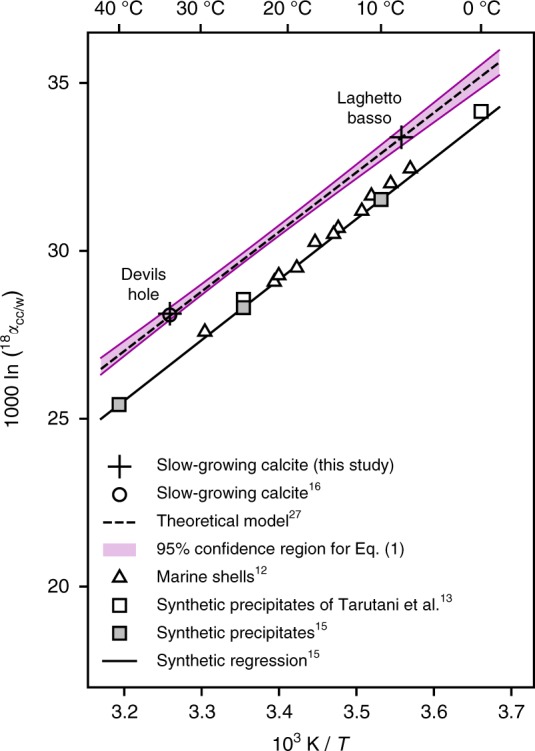
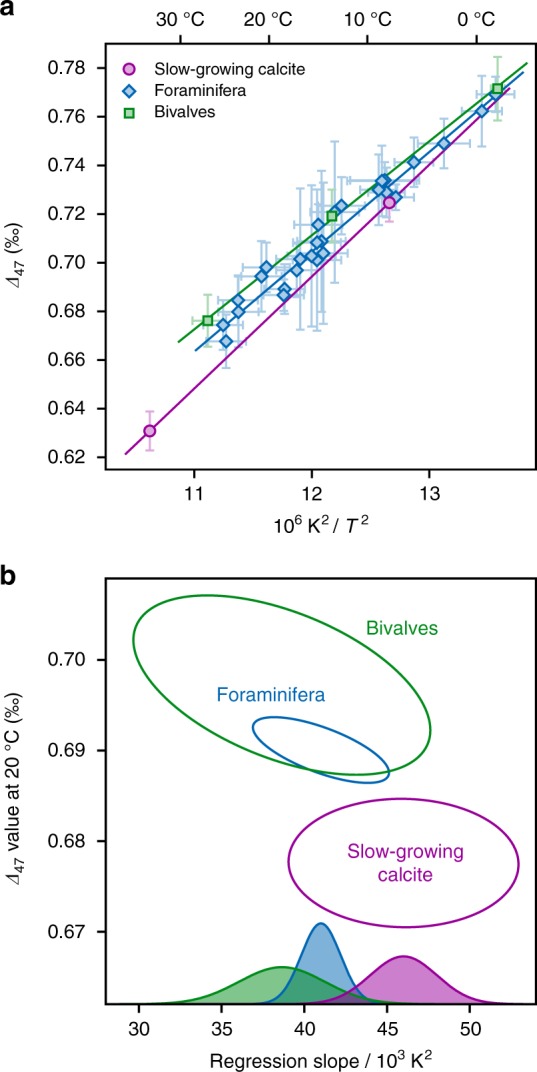
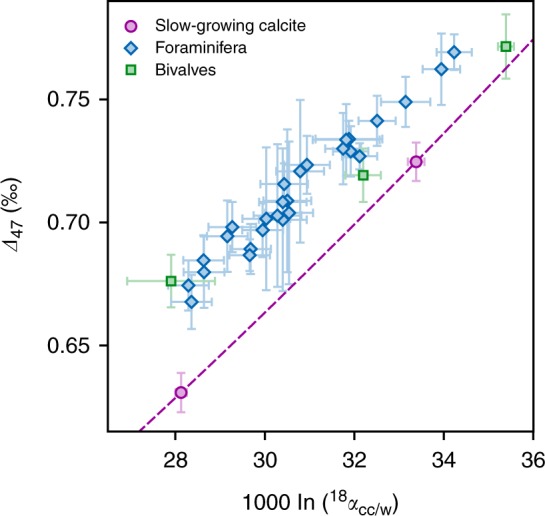
Abstract Oxygen-isotope thermometry played a critical role in the rise of modern geochemistry and remains extensively used in (bio-)geoscience. Its theoretical foundations rest on the assumption that 18 O/ 16 O partitioning among water and carbonate minerals primarily reflects thermodynamic equilibrium. However, after decades of research, there is no consensus on the true equilibrium 18 O/ 16 O fractionation between calcite and water ( 18 α cc/w ). Here, we constrain the equilibrium relations linking temperature, 18 α cc/w , and clumped isotopes ( Δ 47 ) based on the composition of extremely slow-growing calcites from Devils Hole and Laghetto Basso (Corchia Cave). Equilibrium 18 α cc/w values are systematically ~1.5‰ greater than those in biogenic and synthetic calcite traditionally considered to approach oxygen-isotope equilibrium. We further demonstrate that subtle disequilibria also affect Δ 47 in biogenic calcite. These observations provide evidence that most Earth-surface calcites fail to achieve isotopic equilibrium, highlighting the need to improve our quantitative understanding of non-equilibrium isotope fractionation effects instead of relying on phenomenological calibrations.
Overview
CoChat Summary
TL;DR
The paper argues that extremely slow-growing calcites from Devils Hole and Laghetto Basso define an equilibrium oxygen-isotope baseline that is about 1.5‰ higher than commonly used calcite-water calibrations. It also reports small but significant clumped-isotope differences in biogenic calcites, concluding that most Earth-surface calcites do not achieve complete isotopic equilibrium.
Key findings
- Calcites from Devils Hole and Laghetto Basso yield calcite/water oxygen-18 fractionation factors that are ~1.5‰ greater than predicted by the experimental calibration of Kim and O’Neil.
- The equilibrium regression line has a temperature sensitivity of 0.20‰ per K at 20 °C, described as similar to equilibrium fractionation between dissolved (bi)carbonate ions and water.
- Biogenic carbonates show Δ47 values 5–20 ppm higher than equilibrium; under a shared-slope interpretation, foraminifera and bivalves are respectively 11 ± 3 ppm and 17 ± 5 ppm above the equilibrium baseline.
- An ANCOVA found the difference between slow-growing inorganic calcite and the biogenic samples to be statistically significant (p ≤ 10−3).
Methods
- The study compared two very slow-growing inorganic calcites (Devils Hole and Laghetto Basso) with biogenic calcites from bivalves and foraminifera.
- Stable isotopes (δ13C, δ18O) were measured by mass spectrometry; clumped isotopes (Δ47) were measured after phosphoric acid digestion and CO2 purification, with multiple replicate analyses for each sample.
- Relationships between Δ47 and temperature were fit using weighted orthogonal distance regression; group comparisons used ANCOVA.
Limitations
- The paper notes that precise comparisons across laboratories are challenging because of methodological differences and standardization issues in Δ47 measurements.
- The text makes evident that the equilibrium baseline is built from very few natural slow-growing calcites—principally Devils Hole and Laghetto Basso—so the inference rests on a limited number of equilibrium-like examples.
- The authors explicitly note that oxygen-18 equilibrium and clumped-isotope equilibrium are logically independent, so one does not imply the other.
Model-written summary. Check it against the paper before relying on it.
Integrity signals
Registry
Cites
Statistics
Figures
Verification
Claims the paper makes
11 Valid · 1 Not valid · 12 Not checked · 26 Own results and interpretations
The cited sources support only part of this claim — read each source’s verdict below.
In the paper
“Carbonates formed close to isotopic equilibrium are only expected to be found in environments with very low supersaturation states, such as for example recrystallized carbonates from deep-sea sediments54, or carbonates associated with low-temperature hydrothermal alteration of young oceanic crust55.”
§ Most Earth-surface calcites precipitate out of isotopic equilibrium > Discussion
What the sources say
- Not checked — no full text of the sourcecites [54] Fantle MS DePaolo DJ Ca isotopes in carbonate sediment and pore fluid from ODP Site 807A: the Ca2+(aq)–calcite equilibrium fractionation factor and calcite recrystallization rates in Pleistocene sediments Geochim. Cosmochim. Acta 2007 71 2524 2546 10.1016/j.gca.2007.03.006 source
- Partly supportedcites [55] Coogan, L. A., Daëron, M. & Gillis, K. M. Seafloor weathering and the oxygen isotope ratio in seawater: insight from whole-rock δ18O and carbonate δ18O and ∆47 from the Troodos ophiolite. Earth Planet. Sci. Lett. 508, 41–50 (2019). sourceExperimental — accuracy not yet measured
Section 4.1 reports that eight Troodos carbonates are most simply interpreted as having grown slowly in isotopic equilibrium during low-temperature alteration of oceanic crust. It does not establish that such carbonates occur only at very low supersaturation; it also suggests that calcite formed when the crust was youngest may have grown rapidly and out of equilibrium. The deep-sea sediment example is attached to a different citation, not this source. (LLM, conf=0.84)
plainstates an association- Asserted: passes — The authors put it forward as true.
- Checkable: passes — It can be checked against evidence.
- Load-bearing: passes — The paper’s conclusions depend on it.
- Based: passes — The paper gives a reason why it holds.
The cited sources support only part of this claim — read each source’s verdict below.
In the paper
“The slope of this regression is statistically indistinguishable from those obtained by several recent Δ47 calibration studies28,38–40.”
§ Most Earth-surface calcites precipitate out of isotopic equilibrium > Results > Clumped-isotope disequilibrium in biogenic calcites
What the sources say
- Supportedcites [28] Levitt, N. P. et al. Near equilibrium 13C–18O bonding during inorganic calcite precipitation under chemo-stat conditions. Geochem. Geophys. Geosyst.10.1002/2017gc007089 (2018). source
Section 4.3 (page unavailable) reports a Δ47 regression slope of 0.0461 ± 0.0094 and calls the regression very similar to the Tripati et al. (2015) and Bonifacie et al. (2017) calibrations. It also compares the result favorably with Zaarur et al. (2013). The reported slope uncertainties support the paraphrase that these slopes are statistically indistinguishable, although the paper does not use that exact phrase. (LLM, conf=0.87)
- Not checked — no full text of the sourcecites [38] Bonifacie M Calibration of the dolomite clumped isotope thermometer from 25 to 350 °C, and implications for a universal calibration for all (Ca, Mg, Fe)CO3 carbonates Geochim. Cosmochim. Acta 2017 200 255 279 10.1016/j.gca.2016.11.028 source
- Not checked — no full text of the sourcecites [39] Kelson JR Huntington KW Schauer AJ Saenger C Lechler AR Toward a universal carbonate clumped isotope calibration: diverse synthesis and preparatory methods suggest a single temperature relationship Geochim. Cosmochim. Acta 2017 197 104 131 10.1016/j.gca.2016.10.010 source
- Partly supportedcites [40] Breitenbach, S. F. M. et al. Coupled Mg/Ca and clumped isotope analyses of foraminifera provide consistent water temperatures. Geochim. Cosmochim. Acta.10.1016/j.gca.2018.03.010 (2018). sourceExperimental — accuracy not yet measured
Section 3.1 (page not provided) says the paper’s Δ47 calibration slope is statistically indistinguishable from Kele et al.’s travertine calibration slope. It also describes calibrations from two other recent studies as very close, but does not establish that their slopes are statistically indistinguishable. (LLM, conf=0.85)
plain- Asserted: passes — The authors put it forward as true.
- Checkable: passes — It can be checked against evidence.
- Load-bearing: unclear — It is unclear whether the paper’s conclusions depend on it.
- Based: passes — The paper gives a reason why it holds.
- Supported
The cited sources support only part of this claim — read each source’s verdict below.
In the paper
“Although pH is expected to influence 18O/16O fractionation between water and rapidly-precipitating calcite, this effect decreases with slower crystallization rates27,33, and becomes negligible (≤ 0.05‰) at the very slow growth rates considered here.”
§ Most Earth-surface calcites precipitate out of isotopic equilibrium > Results > Slow-growing calcite from Laghetto Basso
What the sources say
- Partly supportedcites [27] Watkins JM Hunt JD Ryerson FJ DePaolo DJ The influence of temperature, pH, and growth rate on the δ18O composition of inorganically precipitated calcite Earth Planet. Sci. Lett. 2014 404 332 343 10.1016/j.epsl.2014.07.036 sourceExperimental — accuracy not yet measured
Section 4.2 (p. 8) says the model has one true equilibrium oxygen-isotope value regardless of pH, while higher growth rates produce kinetic fractionation; Section 3 (p. 5) describes slowly grown Devils Hole calcite as presumably near equilibrium. The paper does not establish a ≤0.05‰ effect for the stated pH difference or the specific growth rates considered by the citing authors. (LLM, conf=0.86)
- Partly supportedcites [33] Watkins JM Hunt JD A process-based model for non-equilibrium clumped isotope effects in carbonates Earth Planet. Sci. Lett. 2015 432 152 165 10.1016/j.epsl.2015.09.042 sourceExperimental — accuracy not yet measured
The Figure 2 caption (section 7 Summary; page unavailable) supports the qualitative point that growth rate changes the modeled oxygen-isotope composition and that calcite approaches equilibrium at very slow growth. Section 5.2 identifies Devils Hole as a slowly grown, near-equilibrium example. Our copy does not establish a ≤0.05‰ effect for the stated pH difference or growth rates, and it does not discuss Laghetto Basso. (LLM, conf=0.84)
plain- Asserted: passes — The authors put it forward as true.
- Checkable: passes — It can be checked against evidence.
- Load-bearing: passes — The paper’s conclusions depend on it.
- Based: passes — The paper gives a reason why it holds.
- Partly supported
The cited sources support only part of this claim — read each source’s verdict below.
In the paper
“As a result, the subaqueous calcite precipitates from a solution which is already very close to chemical and isotopic equilibrium with host rocks and the local cave atmosphere30,31.”
§ Most Earth-surface calcites precipitate out of isotopic equilibrium > Results > Slow-growing calcite from Laghetto Basso
What the sources say
- Not checked — no full text of the sourcecites [30] Drysdale RN Precise microsampling of poorly laminated speleothems for U-series dating Quat. Geochronol. 2012 14 38 47 10.1016/j.quageo.2012.06.009 source
- Partly supportedcites [31] Piccini L The environmental features of the Monte Corchia cave system (Apuan Alps, central Italy) and their effects on speleothem growth Int. J. Speleol. 2008 37 153 172 10.5038/1827-806X.37.3.2 sourceExperimental — accuracy not yet measured
The section on speleothem growth says calcite precipitation in the Galleria delle Stalattiti generally occurs close to isotopic equilibrium, and the Conclusion describes conditions favorable to such precipitation. The paper does not establish that subaqueous calcite at Laghetto Basso precipitates from water already close to both chemical and isotopic equilibrium with the host rocks and local cave atmosphere. Page numbers are unavailable in our copy. (LLM, conf=0.82)
plainstates a causeSingle case- Asserted: passes — The authors put it forward as true.
- Checkable: passes — It can be checked against evidence.
- Load-bearing: passes — The paper’s conclusions depend on it.
- Based: passes — The paper gives a reason why it holds.
The cited sources support only part of this claim — read each source’s verdict below.
In the paper
“the observation that non-equilibrium oxygen-18 effects in coccolithophores have varied drastically at geologic time scales22,57 offers a cautionary tale regarding the long-term applicability of modern calibrations for biogenic carbonates.”
§ Most Earth-surface calcites precipitate out of isotopic equilibrium > Discussion
What the sources say
- Supportedcites [22] Bolton CT Stoll HM Mendez-Vicente A Vital effects in coccolith calcite: Cenozoic climate-pCO2 drove the diversity of carbon acquisition strategies in coccolithophores? Paleoceanography 2012 27 4 10.1029/2012PA002339 source
Section 4.4 reports small oxygen-18 differences between coccolith size fractions during the PETM, contrasting with larger differences during the Plio-Pleistocene transition and last glacial maximum. The Summary and Conclusions likewise describes reduced PETM vital effects versus persistent 1.5–2‰ effects in the later intervals. This supports substantial variation across geological timescales. (LLM, conf=0.93)
- Partly supportedcites [57] Stoll HM Limited range of interspecific vital effects in coccolith stable isotopic records during the Paleocene–Eocene thermal maximum Paleoceanography 2005 20 1 10.1029/2004PA001046 sourceExperimental — accuracy not yet measured
The Introduction (§1, ¶2) reports a nearly 5‰ range of oxygen-isotope vital effects in cultured modern coccoliths, while the Abstract reports less than 0.5‰ difference between the Paleocene coccolith fractions studied. The discussion (§4.4, ¶32) says these samples suggest a smaller range of vital effects in Paleocene species than in modern ones. That supports a substantial difference across geologic time, but the claim states broad, drastic variation as an established fact rather than the paper’s more limited inference from sampled species. (LLM, conf=0.83)
plain- Asserted: passes — The authors put it forward as true.
- Checkable: passes — It can be checked against evidence.
- Load-bearing: unclear — It is unclear whether the paper’s conclusions depend on it.
- Based: passes — The paper gives a reason why it holds.
- Supported
13 more claims · 1 with their cited sources checked
Create a free account to see all 50 claims and every source verdict.
- It may state two separate claims as one. 22
- Probably not a substantial claim. 14
- The quote only partly states this claim. 1
Claims other papers make about this one
Each is checked against this paper’s own text: does it say what the citing paper says it does?
The source backs part of the claim, not all of it — or backs it for a different population, condition or comparison.
In the citing paper
“Carbonate precipitation does not always occur under these conditions, indeed there is a growing archive of published evidence suggesting that equilibrium precipitation may be the exception rather than the rule (Coplen, 2007;Daëron et al., 2019;Dietzel et al., 2009;Kluge et al., 2014a;Tremaine et al., 2011;Watkins et al., 2014).”
From Reconstructing the temperature and origin of CO2 mineralisation in CarbFix calcite using clumped, carbon and oxygen isotopes (2024) · cites this paper as Daëron et al., 2019
Experimental — accuracy not yet measuredThe source backs part of the claim, not all of it — or backs it for a different population, condition or comparison.
In the citing paper
“Instead, natural systems such as Devils Hole in Nevada USA, where carbonate growth rates are several orders of magnitude slower than laboratory experiments, appear to be a more accurate representation of equilibrium precipitation (Daëron et al., 2019).”
From Reconstructing the temperature and origin of CO2 mineralisation in CarbFix calcite using clumped, carbon and oxygen isotopes (2024) · cites this paper as Daëron et al., 2019
Experimental — accuracy not yet measuredThe source backs part of the claim, not all of it — or backs it for a different population, condition or comparison.
In the citing paper
“The Daëron et al. (2019) equation is used because the carbonate forming conditions of Devils Hole calcite are a closer match to the CarbFix pump conditions than the laboratory-derived equation of Kim and O'Neil (1997).”
From Reconstructing the temperature and origin of CO2 mineralisation in CarbFix calcite using clumped, carbon and oxygen isotopes (2024) · cites this paper as Daëron et al., 2019
Experimental — accuracy not yet measuredThe source backs part of the claim, not all of it — or backs it for a different population, condition or comparison.
In the citing paper
“The observed offset of their calibration to our new (proto-)dolomite Δ 47 temperature calibration is with 0.04 ‰ very similar to the offset between the absolute Δ 47 acid fractionations of calcite and dolomite of Müller et al. (2017a) re-evaluated with the new IUPAC parameters in our study (see Table 4).”
From Calibration of the oxygen and clumped isotope thermometers for (proto-)dolomite based on synthetic and natural carbonates (2019) · cites this paper as Daëron et al., 2019
Experimental — accuracy not yet measuredThe cited source says what the claim attributes to it.
In the citing paper
“Using CaCO 3 -H 2 O fractionation equation derived from a carbonate-forming system or experiment with growth rates that are a mismatch for samples can result in inaccurate calculations of parent water δ 18 O VSMOW on the order of 1-2‰ (Daëron et al., 2019).”
From Reconstructing the temperature and origin of CO2 mineralisation in CarbFix calcite using clumped, carbon and oxygen isotopes (2024) · cites this paper as Daëron et al., 2019
7 more claims about this paper
Create a free account to see every claim other papers make about this one.
Citations
Cites
On the Isotopic Chemistry of Carbonates and a Paleotemperature Scale
McCrea, J. M. (1950) · The Journal of Chemical Physics · doi:10.1063/1.1747785 · Cited by 3,742
Equilibrium and nonequilibrium oxygen isotope effects in synthetic carbonates
Kim, S.-T., & O'Neil, J. R. (1997) · Geochimica et Cosmochimica Acta · doi:10.1016/s0016-7037(97)00169-5 · Cited by 2,558
Oxygen Isotope Fractionation in Divalent Metal Carbonates
O'Neil, J. R., Clayton, R. N., & Mayeda, T. K. (1969) · The Journal of Chemical Physics · doi:10.1063/1.1671982 · Cited by 2,549
The thermodynamic properties of isotopic substances
Urey, H. C. (1947) · Journal of the Chemical Society (Resumed) · doi:10.1039/jr9470000562 · Cited by 2,544 · cited 1×
“(1), with crystallization temperature T in kelvin) whose slope is indistinguishable from that of the synthetic precipitates:”
BackgroundRevised Carbonate-water isotopic temperature scale
EPSTEIN, S., BUCHSBAUM, R., LOWENSTAM, H. A., & UREY, H. C. (1953) · Geological Society of America Bulletin · doi:10.1130/0016-7606(1953)64[1315:rcits]2.0.co;2 · Cited by 2,271
Stable Prenucleation Calcium Carbonate Clusters
Gebauer, D., Völkel, A., & Cölfen, H. (2008) · Science · doi:10.1126/science.1164271 · Cited by 1,673
Carbonatites : genesis and evolution
Bell, K. (1989) · Unwin Hyman eBooks · Cited by 1,271
Shackleton, N. J. (1974) · Helmholtz-Zentrum für Polar-und Meeresforschung (Alfred-Wegener-Institut) · Cited by 1,113
Hendy, C. H. (1971) · Geochimica et Cosmochimica Acta · doi:10.1016/0016-7037(71)90127-x · Cited by 1,087
13C and 18O isotopic disequilibrium in biological carbonates: I. Patterns
McConnaughey, T. (1989) · Geochimica et Cosmochimica Acta · doi:10.1016/0016-7037(89)90282-2 · Cited by 1,033
Cited by
Anderson, N. T., Kelson, J. R., Kele, S., Daëron, M., Bonifacie, M., Horita, J., Mackey, T. J., John, C. M., Kluge, T., Petschnig, P., et al. (2021) · Geophysical Research Letters · doi:10.1029/2020gl092069 · Cited by 323
“(2020) created a new calibration spanning 5°C–726°C using carbonate-based standardization and found the regression equation defined by the data was statistically indistinguishable from a series of previous calibration efforts using carbonate-based standardization (Bernasconi et al., 2018; Breitenbach et al., 2018; Daë…”
BackgroundMethodInfluentialSelf-citationA 485-million-year history of Earth’s surface temperature
Judd, E. J., Tierney, J. E., Lunt, D. J., Montañez, I. P., Huber, B. T., Wing, S. L., & Valdes, P. J. (2024) · Science · doi:10.1126/science.adk3705 · Cited by 244
Petersen, S. V., Defliese, W. F., Saenger, C., Daëron, M., Huntington, K. W., John, C. M., Kelson, J. R., Bernasconi, S. M., Colman, A. S., Kluge, T., et al. (2019) · Geochemistry, Geophysics, Geosystems · doi:10.1029/2018gc008127 · Cited by 209
“…gas standards to convert into the absolute reference frame, the existence of different T ‐ Δ 47 relationships in different types of carbonates (e.g., Daëron et al., 2019), precipitation conditions of synthetic carbonates (e.g., pH, saturation, or precipitation rate), or other details of sample…”
Self-citationDual clumped isotope thermometry resolves kinetic biases in carbonate formation temperatures
Bajnai, D., Guo, W., Spötl, C., Coplen, T. B., Methner, K., Löffler, N., Krsnik, E., Gischler, E., Hansen, M., Henkel, D., et al. (2020) · Nature Communications · doi:10.1038/s41467-020-17501-0 · Cited by 147
Self-citationA robust calibration of the clumped isotopes to temperature relationship for foraminifers
Meinicke, N., Ho, S. L., Hannisdal, B., Nürnberg, D., Tripati, A., Schiebel, R., & Meckler, A. N. (2020) · Geochimica et Cosmochimica Acta · doi:10.1016/j.gca.2019.11.022 · Cited by 121
“These potential secondary effects include pH or kinetic effects suggested for other types of marine biogenic carbonates/marine invertebrate organisms (e.g. Bajnai et al., 2018; Daeron et al., 2019; Davies and John, 2019).”
BackgroundResultInfluentialCalibration of the dual clumped isotope thermometer for carbonates
Fiebig, J., Daëron, M., Bernecker, M., Guo, W., Schneider, G., Boch, R., Bernasconi, S. M., Jautzy, J., & Dietzel, M. (2021) · Geochimica et Cosmochimica Acta · doi:10.1016/j.gca.2021.07.012 · Cited by 110
Self-citationCombined high-precision ∆48 and ∆47 analysis of carbonates
Fiebig, J., Bajnai, D., Löffler, N., Methner, K., Krsnik, E., Mulch, A., & Hofmann, S. (2019) · Chemical Geology · doi:10.1016/j.chemgeo.2019.05.019 · Cited by 97
Müller, I. A., Rodriguez-Blanco, J. D., Storck, J.-C., do Nascimento, G. S., Bontognali, T. R. R., Vasconcelos, C., Benning, L. G., & Bernasconi, S. M. (2019) · Chemical Geology · doi:10.1016/j.chemgeo.2019.07.014 · Cited by 77
Clumped isotopes in modern marine bivalves
Huyghe, D., Daëron, M., de RAFÉLIS, M., Blamart, D., Sébilo, M., Paulet, Y., & Lartaud, F. (2021) · Geochimica et Cosmochimica Acta · doi:10.1016/j.gca.2021.09.019 · Cited by 73
Self-citationGuo, W., & Zhou, C. (2019) · Geochimica et Cosmochimica Acta · doi:10.1016/j.gca.2019.07.028 · Cited by 78
Comas‐Bru, L., Harrison, S. P., Werner, M., Rehfeld, K., Scroxton, N., Veiga‐Pires, C., & SISAL working group members (2019) · Climate of the past · doi:10.5194/cp-15-1557-2019 · Cited by 88
Initiation of a stable convective hydroclimatic regime in Central America circa 9000 years BP
Winter, A., Zanchettin, D., Lachniet, M. S., Vieten, R., Pausata, F. S. R., Ljungqvist, F. C., Cheng, H., Edwards, R. L., Miller, T. E., Rubinetti, S., et al. (2020) · Nature Communications · doi:10.1038/s41467-020-14490-y · Cited by 68
North Iberian temperature and rainfall seasonality over the Younger Dryas and Holocene
Baldini, L. M., Baldini, J. U. L., McDermott, F. P., Cabal, P. A., Cueto, M., Fairchild, I. J., Hoffmann, D. L., Mattey, D. P., Müller, W., Niţă, D. C., et al. (2019) · Quaternary Science Reviews · doi:10.1016/j.quascirev.2019.105998 · Cited by 68
de Graaf, S., Vonhof, H., Weißbach, T., Wassenburg, J. A., Levy, E. J., Kluge, T., & Haug, G. H. (2020) · Rapid Communications in Mass Spectrometry · doi:10.1002/rcm.8837 · Cited by 56
Penultimate deglaciation Asian monsoon response to North Atlantic circulation collapse
Wassenburg, J. A., Vonhof, H., Cheng, H., Martínez‐García, A., Ebner, P.-R., Li, X., Zhang, H., Sha, L., Tian, Y., Edwards, R. L., et al. (2021) · Nature Geoscience · doi:10.1038/s41561-021-00851-9 · Cited by 62
Temperature Dependence of Clumped Isotopes (∆ 47 ) in Aragonite
de Winter, N. J., Witbaard, R., Kocken, I. J., Müller, I. A., Guo, J., Goudsmit, B., & Ziegler, M. (2022) · Geophysical Research Letters · doi:10.1029/2022gl099479 · Cited by 52
“, 2013), varying mineralization rates (Daëron et al., 2019), different acid digestion temperatures and different carbonate mineralogies (e.”
Wostbrock, J. A. G., Brand, U., Coplen, T. B., Swart, P. K., Carlson, S. J., Brearley, A. J., & Sharp, Z. D. (2020) · Geochimica et Cosmochimica Acta · doi:10.1016/j.gca.2020.07.045 · Cited by 53
Self-citationFernandez, A., Korte, C., Ullmann, C. V., Looser, N., Wohlwend, S., & Bernasconi, S. M. (2021) · Geochimica et Cosmochimica Acta · doi:10.1016/j.gca.2020.10.005 · Cited by 50
Temperature dependence of clumped isotopes (∆47) in aragonite
Winter, N. J. D., Witbaard, R., Kocken, I. J., Müller, I. A., Guo, J., Goudsmit, B., & Ziegler, M. (2022) · doi:10.1002/essoar.10511492.2 · Cited by 51
Clumped isotope temperature calibration for calcite: Bridging theory and experimentation
Jautzy, J. J., Savard, M. M., Dhillon, R. S., Bernasconi, S. M., & Smirnoff, A. (2020) · Geochemical Perspectives Letters · doi:10.7185/geochemlet.2021 · Cited by 50
Baldini, J. U. L., Lechleitner, F. A., Breitenbach, S. F. M., van Hunen, J., Baldini, L. M., Wynn, P., Jamieson, R. A., Ridley, H. E., Baker, A. J., Walczak, I. W., et al. (2021) · Quaternary Science Reviews · doi:10.1016/j.quascirev.2020.106784 · Cited by 60
Vickers, M. L., Fernandez, A., Hesselbo, S. P., Price, G. D., Bernasconi, S. M., Lode, S., Ullmann, C. V., Thibault, N., Hougaard, I. W., & Korte, C. (2020) · Earth and Planetary Science Letters · doi:10.1016/j.epsl.2020.116401 · Cited by 49
“Only the equations for equilibrium inorganic calcites of, Coplen, 2007; Kele et al. (2015), and Daëron (2019) yielded significantly lower δ18Osw (Fig.”
BackgroundIngalls, M., Frantz, C. M., Snell, K. E., & Trower, E. J. (2020) · Geobiology · doi:10.1111/gbi.12386 · Cited by 47
“…has demonstrated that perhaps ∆47 alteration and disequilibrium is not, in fact, unidirectional and Δ47 can be pulled to anomalously high values during fast mineral growth (Daeron et al., 2019) or the slow interconversion of CO2 and HCO3 - in the DIC-H2O-CO2 system (Guo, 2020; see Appendix S1).”
Backgroundde Winter, N. J., Dämmer, L. K., Falkenroth, M., Reichart, G., Moretti, S., Martínez‐García, A., Höche, N., Schöne, B. R., Rodiouchkina, K., Goderis, S., et al. (2021) · Geochimica et Cosmochimica Acta · doi:10.1016/j.gca.2021.06.012 · Cited by 49
Deininger, M., Hansen, M., Fohlmeister, J., Schröder‐Ritzrau, A., Burstyn, Y., & Scholz, D. (2021) · Geochimica et Cosmochimica Acta · doi:10.1016/j.gca.2021.03.026 · Cited by 43
“Coplen (2007) set off a debate questioning the temperature relationship of the oxygen isotope equilibrium fractionation factor between calcite and H2O ((18)αcalcite/H2O) derived by Kim and O'Neil (1997) (Daëron et al., 2019; Day and Henderson, 2011; Dietzel et al., 2009; Feng et al., 2012a; Feng et al., 2014; Johnston…”
BackgroundInfluentialTriple Oxygen Isotopes in Silica–Water and Carbonate–Water Systems
Wostbrock, J. A. G., & Sharp, Z. D. (2021) · Reviews in Mineralogy and Geochemistry · doi:10.2138/rmg.2021.86.11 · Cited by 50
Clumped isotope thermometry in bivalve shells: A tool for reconstructing seasonal upwelling
Caldarescu, D. E., Sadatzki, H., Andersson, C., Schäfer, P., Fortunato, H., & Meckler, A. N. (2021) · Geochimica et Cosmochimica Acta · doi:10.1016/j.gca.2020.11.019 · Cited by 43
Internal Water Facilitates Thermal Resetting of Clumped Isotopes in Biogenic Aragonite
Nooitgedacht, C. W., van der Lubbe, J. J. L., Ziegler, M., & Staudigel, P. T. (2021) · Geochemistry Geophysics Geosystems · doi:10.1029/2021gc009730 · Cited by 44
“, (2021) so that exchange between oxygen isotopes occurs only within the confines of CEF and exchange between fluid inclusions is temperature dependent, governed by the temperature-dependent fractionation factor α (e.g., Coplen, 2007; Daëron et al., 2019; Kim & O'Neil, 1997; Staudigel & Swart, 2018; Tremaine et al., 2…”
BackgroundColumbu, A., Spötl, C., Waele, J. D., Yu, T., Shen, C., & Gázquez, F. (2019) · Quaternary Science Reviews · doi:10.1016/j.quascirev.2019.07.023 · Cited by 45
Revisiting Oxygen‐18 and Clumped Isotopes in Planktic and Benthic Foraminifera
Daëron, M., & Gray, W. R. (2023) · Paleoceanography and Paleoclimatology · doi:10.1029/2023pa004660 · Cited by 39
“Using the best currently available constraints, it is clear that 18 α calibrations differ markedly between species, although 18 α sensitivity to temperature remains indistinguishable from that of inorganic calibrations such as Kim and O’Neil (1997) or Daëron et al. (2019).”
BackgroundInfluentialSelf-citationMarine temperatures underestimated for past greenhouse climate
Vickers, M. L., Bernasconi, S. M., Ullmann, C. V., Lode, S., Looser, N., Morales, L. G., Price, G. D., Wilby, P. R., Hougård, I. W., Hesselbo, S. P., et al. (2021) · Scientific Reports · doi:10.1038/s41598-021-98528-1 · Cited by 41
Triple Oxygen Isotope Variations in Earth’s Crust
Herwartz, D. (2021) · Reviews in Mineralogy and Geochemistry · doi:10.2138/rmg.2021.86.09 · Cited by 43
Lachniet, M. S., Asmerom, Y., Polyak, V. J., & Denniston, R. F. (2020) · Paleoceanography and Paleoclimatology · doi:10.1029/2019pa003785 · Cited by 44
“…value of ~−9.5‰ VPDB in the Middle Holocene corresponds to a drip water δ 18O value of −12.4‰ VSMOW at modern temperature of 8.32°C or −11.9 ‰ VSMOW with 2°C warming above modern levels using the most‐recent calcite‐water fractionation factor for slow‐growing speleothems (Daëron et al., 2019).”
BackgroundMethodInfluentialScale deposits in tunnel drainage systems – A study on fabrics and formation mechanisms
Eichinger, S., Boch, R., Leis, A., Koraimann, G., Grengg, C., Domberger, G., Nachtnebel, M., Schwab, C. G. G., & Dietzel, M. (2020) · The Science of The Total Environment · doi:10.1016/j.scitotenv.2020.137140 · Cited by 39
Thatcher, D. L., Wanamaker, A. D., Denniston, R. F., Asmerom, Y., Polyak, V. J., Fullick, D., Ummenhofer, C. C., Gillikin, D. P., & Haws, J. (2020) · The Holocene · doi:10.1177/0959683620908648 · Cited by 42
“However, some authors (e.g. Daëron et al., 2019; Deininger et al., 2012) have argued that most calcitic materials, including speleothems, are precipitation out of isotopic equilibrium.”
BackgroundMagnesium in subaqueous speleothems as a potential palaeotemperature proxy
Drysdale, R. N., Couchoud, I., Zanchetta, G., Isola, I., Regattieri, E., Hellström, J., Govin, A., Tzedakis, P. C., Ireland, T. R., Corrick, E., et al. (2020) · Nature Communications · doi:10.1038/s41467-020-18083-7 · Cited by 42
Self-citationA Combined Model for Kinetic Clumped Isotope Effects in the CaCO3‐DIC‐H2O System
Watkins, J. M., & Devriendt, L. S. (2022) · Geochemistry, Geophysics, Geosystems · doi:10.1029/2021gc010200 · Cited by 34
“Natural mineral growth, however, typically occurs under nonequilibrium conditions (Coplen, 2007; Daëron et al., 2019; Kluge et al., 2014), as does precipitation of calcite in laboratory experiments (Affek & Zaarur, 2014; Dietzel et al.”
BackgroundPaleotemperature reconstructions using speleothem fluid inclusion analyses from Hungary
Demény, A., Rinyu, L., Kern, Z., Hatvani, I. G., Czuppon, G., Surányi, G., Leél‐Őssy, S., Shen, C., & Koltai, G. (2021) · Chemical Geology · doi:10.1016/j.chemgeo.2020.120051 · Cited by 35
“The “equilibrium” samples are plotted close to the Daëron et al. (2019) curve indicating that not only are the δ2H-derived temperatures realistic, but also that the calculated 1000⋅lnα-temperature relationship can be used to filter the samples to obtain more reliable clumped isotope data for…”
BackgroundMethodInfluentialHuyghe, D., Emmanuel, L., de RAFÉLIS, M., Renard, M., Ropert, M., Labourdette, N., & Lartaud, F. (2020) · Estuarine Coastal and Shelf Science · doi:10.1016/j.ecss.2020.106777 · Cited by 35
Self-citationTermination 1 Millennial‐Scale Rainfall Events Over the Sunda Shelf
Buckingham, F., Carolin, S., Partin, J. W., Adkins, J. F., Cobb, K. M., Day, C., Ding, Q., He, C., Liu, Z., Otto‐Bliesner, B. L., et al. (2022) · Geophysical Research Letters · doi:10.1029/2021gl096937 · Cited by 35
P/Ca in Carbonates as a Proxy for Alkalinity and Phosphate Levels
Ingalls, M., Blättler, C. L., Higgins, J. A., Magyar, J. S., Eiler, J. M., & Fischer, W. W. (2020) · Geophysical Research Letters · doi:10.1029/2020gl088804 · Cited by 35
He, S., Wang, T., Spicer, R. A., Farnsworth, A., Mulch, A., Widdowson, M., Zhang, Q., Cai, F., Valdes, P. J., Wang, C., et al. (2025) · Science Advances · doi:10.1126/sciadv.adr9417 · Cited by 45
“…calibration equations with a wider temperature range and more comprehensive sample types have been used to calculate comparison temperatures [e.g., ( 31 , 42 – 45 )], and using the Δ 47 - temperature calibration of Anderson et al. ( 46 ) for this study yields nominally cooler temperatures (fig.”
InfluentialUchikawa, J., Chen, S., Eiler, J. M., Adkins, J. F., & Zeebe, R. E. (2021) · Geochimica et Cosmochimica Acta · doi:10.1016/j.gca.2021.08.014 · Cited by 28
“Most synthetic and natural CaCO3 are hence out of d 18O equilibrium, except for very rare cases (e.g., Coplen, 2007; Daëron et al., 2019).”
BackgroundResultRapid and precise measurement of carbonate clumped isotopes using laser spectroscopy
Yanay, N., Wang, Z., Dettman, D. L., Quade, J., Huntington, K. W., Schauer, A. J., Nelson, D. D., McManus, J. B., Thirumalai, K., Sakai, S., et al. (2022) · Science Advances · doi:10.1126/sciadv.abq0611 · Cited by 31
“This material was initially thought to deviate significantly from empirical clumping-temperature calibrations ( 25 ), but a recent calibration appears to have resolved the discrepancy ( 7 ).”
Curzi, M., Aldega, L., Billi, A., Boschi, C., Carminati, E., Vignaroli, G., Viola, G., & Bernasconi, S. M. (2024) · Earth-Science Reviews · doi:10.1016/j.earscirev.2024.104801 · Cited by 37
Carlson, P. E., Noronha, A. L., Banner, J. L., Jenson, J. W., Moore, M. W., Partin, J. W., Deininger, M., Breecker, D. O., & Bautista, K. K. (2020) · Geochimica et Cosmochimica Acta · doi:10.1016/j.gca.2020.06.012 · Cited by 30
Partitioning of Mg, Sr, Ba and U into a subaqueous calcite speleothem
Drysdale, R. N., Zanchetta, G., Baneschi, I., Guidi, M., Isola, I., Couchoud, I., Piccini, L., Greig, A., Wong, H. K. Y., Woodhead, J. D., et al. (2019) · Geochimica et Cosmochimica Acta · doi:10.1016/j.gca.2019.08.001 · Cited by 34
Self-citationLooser, N., Petschnig, P., Hemingway, J., Fernández, Á., Morales, L. F. G., Pérez‐Huerta, A., Vickers, M. L., Price, G. D., Schmidt, M. W., & Bernasconi, S. M. (2023) · Geochimica et Cosmochimica Acta · doi:10.1016/j.gca.2023.03.030 · Cited by 32
Holdsworth, C. M., John, C. M., Snæbjörnsdóttir, S. Ó., Johnson, G., Sigfússon, B., Leslie, R., Haszeldine, R. S., & Gilfillan, S. M. V. (2024) · Applied Geochemistry · doi:10.1016/j.apgeochem.2024.105925 · Cited by 32
Guo, Y., Deng, W., Liu, X., Kong, K., Yan, W., & Wei, G. (2021) · Marine Geology · doi:10.1016/j.margeo.2021.106513 · Cited by 31
Nooitgedacht, C. W., van der Lubbe, J. J. L., de Graaf, S., Ziegler, M., Staudigel, P. T., & Reijmer, J. J. G. (2021) · Geochimica et Cosmochimica Acta · doi:10.1016/j.gca.2020.12.008 · Cited by 29
Hill, P. S., Schauble, E. A., & Tripati, A. (2020) · Geochimica et Cosmochimica Acta · doi:10.1016/j.gca.2019.10.016 · Cited by 29
Skiba, V., & Fohlmeister, J. (2023) · Geochimica et Cosmochimica Acta · doi:10.1016/j.gca.2023.03.016 · Cited by 32
Christensen, J. N., Watkins, J. M., Devriendt, L. S., DePaolo, D. J., Conrad, M. E., Voltolini, M., Yang, W., & Dong, W. (2021) · Geochimica et Cosmochimica Acta · doi:10.1016/j.gca.2021.01.003 · Cited by 28
Dietzel, M., Purgstaller, B., Kluge, T., Leis, A., & Mavromatis, V. (2020) · Geochimica et Cosmochimica Acta · doi:10.1016/j.gca.2020.02.032 · Cited by 29
Letulle, T., Gaspard, D., Daëron, M., Arnaud-Godet, F., Vinçon-Laugier, A., Suan, G., & Lécuyer, C. (2023) · Biogeosciences · doi:10.5194/bg-20-1381-2023 · Cited by 28
“A) Plot of brachiopod inner shell layers in the Δ47 - 1000 ln α(calcite–water) space compared with the equilibrium line (blue line) defined by very slow growing abiogenic calcite (Daëron et al., 2019; Anderson et al., 2021). Red highlight, results from A. kerguelenensis (Crozet Islands) and their expected 510 geochemi…”
MethodResultInfluentialSelf-citationKendrick, M. A., Plümper, O., Zhao, J., Feng, Y., Defliese, W. F., Müller, I. A., & Ziegler, M. (2022) · Earth and Planetary Science Letters · doi:10.1016/j.epsl.2022.117474 · Cited by 33
Natural Variability in Caribbean Coral Physiology and Implications for Coral Bleaching Resilience
Chapron, L., Schoepf, V., Levas, S., Aschaffenburg, M. D., Warner, M. E., & Grottoli, A. G. (2022) · Frontiers in Marine Science · doi:10.3389/fmars.2021.811055 · Cited by 30
Daëron, M., & Vermeesch, P. (2024) · Chemical Geology · doi:10.1016/j.chemgeo.2023.121881 · Cited by 28
Self-citationEquilibrated Gas and Carbonate Standard‐Derived Dual (Δ 47 and Δ 48 ) Clumped Isotope Values
Lucarelli, J. K., Carroll, H. M., Ulrich, R. N., Elliott, B. M., Coplen, T. B., Eagle, R. A., & Tripati, A. (2023) · Geochemistry, Geophysics, Geosystems · doi:10.1029/2022gc010458 · Cited by 27
“…cave calcite sample from Fiebig et al. (2021) is from Laghetto Basso, Italy with a precipitation temperature of 7.9 ± 0.2°C. Fiebig et al. (2021) and Daëron et al. (2019) argued that this sample precipitated close to equilibrium due to long residence times of water in the lake, low calcite…”
InfluentialSelf-citationNehmé, C., Kluge, T., Verheyden, S., Nader, F. H., Charalambidou, I., Weißbach, T., Gücel, S., Cheng, H., Edwards, R. L., Satterfield, L. C., et al. (2020) · Quaternary Science Reviews · doi:10.1016/j.quascirev.2020.106663 · Cited by 26
Li, H., Liu, X., Tripati, A., Feng, S., Elliott, B. M., Whicker, C. A., Arnold, A., & Kelley, A. M. (2020) · Scientific Reports · doi:10.1038/s41598-020-73422-4 · Cited by 27
Coogan, L. A., Daëron, M., & Gillis, K. M. (2019) · Earth and Planetary Science Letters · doi:10.1016/j.epsl.2018.12.014 · Cited by 26
Self-citationGlobal reorganization of atmospheric circulation during Dansgaard–Oeschger cycles
Fohlmeister, J., Sekhon, N., Columbu, A., Vettoretti, G., Weitzel, N., Rehfeld, K., Veiga‐Pires, C., Ben‐Yami, M., Marwan, N., & Boers, N. (2023) · Proceedings of the National Academy of Sciences · doi:10.1073/pnas.2302283120 · Cited by 35
“Note that the choice of a different temperature–fractionation relationship obtained in other studies (39, 40) does not influence the results as we focus on δ 18 O changes instead of absolute temperatures and the temperature–fractionation slope is similar for all relevant studies.”
ResultColumbu, A., Spötl, C., Fohlmeister, J., Hu, H., Chiarini, V., Hellström, J., Cheng, H., Shen, C., & Waele, J. D. (2022) · Communications Earth & Environment · doi:10.1038/s43247-022-00509-3 · Cited by 27
A robust methodology for triple (∆47, ∆48, ∆49) clumped isotope analysis of carbonates
Bernecker, M., Hofmann, S., Staudigel, P. T., Davies, A., Tagliavento, M., Meijer, N., Ballian, A., & Fiebig, J. (2023) · Chemical Geology · doi:10.1016/j.chemgeo.2023.121803 · Cited by 25
Dreybrodt, W., & Fohlmeister, J. (2021) · Chemical Geology · doi:10.1016/j.chemgeo.2021.120676 · Cited by 24
Li, H., Liu, X., Arnold, A., Elliott, B. M., Flores, R., Kelley, A. M., & Tripati, A. (2021) · Earth and Planetary Science Letters · doi:10.1016/j.epsl.2021.116840 · Cited by 25
Perez-Beltran, S., Zaheer, W., Sun, Z., Defliese, W. F., Banerjee, S., & Grossman, E. L. (2023) · Science Advances · doi:10.1126/sciadv.adf1701 · Cited by 21
Voarintsoa, N. R. G., Ratovonanahary, A. L. J., Rakotovao, A. Z. M., & Bouillon, S. (2021) · The Science of The Total Environment · doi:10.1016/j.scitotenv.2021.147181 · Cited by 22
The Causes and Consequences of Ordovician Cooling
Bergmann, K., Macdonald, F. A., & Swanson‐Hysell, N. L. (2025) · Annual Review of Earth and Planetary Sciences · doi:10.1146/annurev-earth-040523-114630 · Cited by 30
Mors, R. A., Gómez, F. J., Astini, R. A., Mlewski, E. C., & Gérard, E. (2022) · Sedimentary Geology · doi:10.1016/j.sedgeo.2022.106214 · Cited by 24
Bajnai, D., Coplen, T. B., Methner, K., Löffler, N., Krsnik, E., & Fiebig, J. (2021) · Geophysical Research Letters · doi:10.1029/2021gl093257 · Cited by 19
“7°C among Earth-surface carbonates (Coplen, 2007; Daëron et al., 2019; Tripati et al., 2015; Wostbrock et al., 2020).”
BackgroundSelf-citationChamberlayne, B. K., Tyler, J., & Gillanders, B. M. (2021) · Geochemistry Geophysics Geosystems · doi:10.1029/2021gc009769 · Cited by 21
“research has investigated kinetic effects on the equilibrium oxygen isotope fractionation between organic and inorganic carbonates and water (Daëron et al., 2019; Watkins et al., 2013).”
BackgroundIsotope exchange rates in dissolved inorganic carbon between 40 °C and 90 °C
Weise, A., & Kluge, T. (2019) · Geochimica et Cosmochimica Acta · doi:10.1016/j.gca.2019.09.032 · Cited by 19
Peckover, E., Andrews, J. E., LEEDER, M. R., Rowe, P. J., Marca, A. D., Sahy, D., Noble, S. R., & Gawthorpe, R. L. (2019) · Palaeogeography Palaeoclimatology Palaeoecology · doi:10.1016/j.palaeo.2019.109252 · Cited by 21
Absolute age and temperature of belemnite rostra: Constraints on the Early Cretaceous cooling event
Wang, T., Yang, P., He, S., Hoffmann, R., Zhang, Q., Farnsworth, A., Feng, Y., Randrianaly, H. N., Xie, J., Yue, Y., et al. (2024) · Global and Planetary Change · doi:10.1016/j.gloplacha.2023.104353 · Cited by 23
Ryves, D. B., Leng, M. J., Barker, P. A., Snelling, A. M., Sloane, H. J., Arrowsmith, C., Tyler, J., Scott, D. R., Radbourne, A. D., & Anderson, N. J. (2020) · Chemical Geology · doi:10.1016/j.chemgeo.2020.119705 · Cited by 23
Local hydroclimate alters interpretation of speleothem δ18O records
Patterson, E. W., Skiba, V., Wolf, A., Griffiths, M. L., McGee, D., Bùi, T. N., Trần, M. X., Đinh, T. H., Đỗ-Trọng, Q., Goldsmith, G. R., et al. (2024) · Nature Communications · doi:10.1038/s41467-024-53422-y · Cited by 28
“We test the difference of the PCP corrected δ 18 O record when using the fractionation factor ( α calcite-water ) derived from laboratory experiments 53 against three cave-derived fractionation factors 9,54,55 .”
BackgroundMethodRates of carbon and oxygen isotope exchange between calcite and fluid at chemical equilibrium
Harrison, A. L., Schott, J., Oelkers, É. H., Maher, K., & Mavromatis, V. (2022) · Geochimica et Cosmochimica Acta · doi:10.1016/j.gca.2022.06.041 · Cited by 20
Davies, A., Davis, S., & John, C. M. (2021) · Chemical Geology · doi:10.1016/j.chemgeo.2021.120317 · Cited by 20
Thaler, C., Katz, A., Bonifacie, M., Ménez, B., & Ader, M. (2020) · Biogeosciences · doi:10.5194/bg-17-1731-2020 · Cited by 18
Sade, Z., Hegyi, S., Hansen, M., Scholz, D., & Halevy, I. (2021) · Geochimica et Cosmochimica Acta · doi:10.1016/j.gca.2021.10.008 · Cited by 18
Wang, T., Hoffmann, R., He, S., Zhang, Q., Li, G., Randrianaly, H. N., Xie, J., Yue, Y., & Ding, L. (2023) · Global and Planetary Change · doi:10.1016/j.gloplacha.2023.104220 · Cited by 17
Quandt, D., Micheuz, P., Kurz, W., Kluge, T., Boch, R., Hippler, D., Krenn, K., & Hauzenberger, C. A. (2019) · Geochemistry Geophysics Geosystems · doi:10.1029/2019gc008369 · Cited by 18
“T calibration and the oxygen isotope fractionation 18α(CaCO3‐H2O) of Daëron et al. (2019) for extremely slowly growing carbonates.”
MethodPeral, M., Bassinot, F., Daëron, M., Blamart, D., Bonnin, J., Jorissen, F. J., Kissel, C., Michel, É., Waelbroeck, C., Rebaubier, H., et al. (2022) · EarthArXiv (California Digital Library) · doi:10.1016/j.gca.2022.10.030
Self-citationWortham, B. E., Montañez, I. P., Swart, P. K., Vonhof, H., & Tabor, C. (2022) · Quaternary Science Reviews · doi:10.1016/j.quascirev.2022.107399 · Cited by 14
Testing for ocean acidification during the Early Toarcian using δ44/40Ca and δ88/86Sr
Li, Q., McArthur, J. M., THIRLWALL, M. F., Turchyn, A. V., Page, K. N., Bradbury, H. J., Weis, R., & Lowry, D. C. (2021) · Chemical Geology · doi:10.1016/j.chemgeo.2021.120228 · Cited by 16
Surić, M., Czuppon, G., Lončarić, R., Bočić, N., Lončar, N., Bajo, P., & Drysdale, R. N. (2020) · Water · doi:10.3390/w12092386 · Cited by 16
Self-citationAlberti, M., Fursich, F. T., Pandey, D. K., Andersen, N., Garbe‐Schönberg, D., Bhosale, S., Chaskar, K., & Habermann, J. M. (2021) · Journal of Palaeogeography · doi:10.1186/s42501-021-00103-2 · Cited by 20
Kniest, J. F., Davies, A., Brugger, J., Fiebig, J., Bernecker, M., Todd, J. A., Hickler, T., Voigt, S., Woodland, A., & Raddatz, J. (2024) · Communications Earth & Environment · doi:10.1038/s43247-024-01491-8 · Cited by 14
“31 ).”
Peral, M., Marchegiano, M., Verheyden, S., Goderis, S., Helden, T. V., Vanhaecke, F., Acker, T. V., Jia, X., Cheng, H., Fiebig, J., et al. (2024) · Quaternary Science Reviews · doi:10.1016/j.quascirev.2024.108564 · Cited by 17
Self-citationNehmé, C., Todisco, D., Breitenbach, S. F. M., Couchoud, I., Marchegiano, M., Peral, M., Vonhof, H., Hellström, J., Tjallingii, R., Claeys, P., et al. (2022) · Global and Planetary Change · doi:10.1016/j.gloplacha.2023.104050 · Cited by 16
Self-citationNataraj, A., Gianella, M., Prokhorov, I., Tuzson, B., Bertrand, M., Mohn, J., Faist, J., & Emmenegger, L. (2022) · Optics Express · doi:10.1364/oe.447172 · Cited by 17
Complex Biomineralization Pathways of the Belemnite Rostrum Cause Biased Paleotemperature Estimates
Hoffmann, R., Linzmeier, B. J., Kitajima, K., Nehrke, G., Dietzel, M., Jöns, N., Stevens, K., & Immenhauser, A. (2021) · Minerals · doi:10.3390/min11121406 · Cited by 14
“In the present case of biogenically induced formation, the higher apparent 10(3)ln(αcc-H2O) values of CP2 versus CP1 in Figure 4B cannot be explained by reaching isotope equilibrium conditions such as those documented in speleothems (see [33]).”
BackgroundComas‐Bru, L., Harrison, S. P., Werner, M., et al. (2019) · doi:10.5194/cp-2019-25 · Cited by 13
Dietzel, M., & Boch, R. (2024) · Geochemistry · doi:10.1016/j.chemer.2024.126206 · Cited by 15
Vickers, M. L., Jones, M. T., Longman, J., Evans, D., Ullmann, C. V., Stokke, E. W., Vickers, M., Frieling, J., Harper, D. T., Clementi, V. J., et al. (2024) · Climate of the past · doi:10.5194/cp-20-1-2024 · Cited by 18
Elevated Grand Canyon groundwater recharge during the warm Early Holocene
Lachniet, M. S., Du, X., Dee, S. G., Asmerom, Y., Polyak, V. J., & Tobin, B. W. (2023) · Nature Geoscience · doi:10.1038/s41561-023-01272-6 · Cited by 14
Structural similarity between Termination III and I
Duan, W., Cheng, H., Tan, M., Ma, Z., Chen, S., Wang, L., Wang, X., & Cui, L. (2022) · Quaternary Science Reviews · doi:10.1016/j.quascirev.2022.107808 · Cited by 13
Metadata
- Authors
- Daëron, M., Drysdale, R. N., Peral, M., Huyghe, D., Blamart, D., Coplen, T. B., Lartaud, F., & Zanchetta, G.
- Affiliations
- Centre National de la Recherche Scientifique (FR)
- United States Geological Survey (US)
- University of Pisa (IT)
- Venue
- Nature Communications
- Published
- 2019-01-25
- Volume
- 10
- Issue
- 1
- Pages
- 429-429
- ISSN
- 2041-1723 (ISSN-L)
- PMC
- PMC6347637
- OpenAlex
- W2911893008
- Cited by
- 236
- References
- 68
- Citations by year
- 2026: 16 · 2025: 32 · 2024: 42 · 2023: 27 · 2022: 31 · 2021: 43 · 2020: 28 · 2019: 16
- FWCI
- 11.89
- Type
- journal article
- Language
- en
- Open access
- gold
- doi.org
- Licence
- cc-by
- creativecommons.org/licenses/by/4.0 (tdm)
- creativecommons.org/licenses/by/4.0 (vor)
- Locations
- Nature Communications (publishedVersion, cc-by)
- Europe PMC (PubMed Central) (publishedVersion, cc-by)
- PubMed Central (publishedVersion, cc-by)
- PubMed (publishedVersion)
- HAL (submittedVersion, other-oa)
- Minerva Access (University of Melbourne) (submittedVersion, cc-by)
- HAL Portal Artxiker (Hindustan Aeronautics Limited (India)) (submittedVersion)
- HAL (submittedVersion, cc-by)
- RePEc: Research Papers in Economics (submittedVersion)
- CINECA IRIS Institutial research information system (University of Pisa) (submittedVersion, cc-by)
- DOAJ (DOAJ: Directory of Open Access Journals) (submittedVersion)
- DOAJ (DOAJ: Directory of Open Access Journals) (submittedVersion, cc-by-sa)
- VUBIR (Vrije Universiteit Brussel) (submittedVersion)
- Funders
- Agence Nationale de la Recherche (ANR-16-CE31-0020)
- Centre National de la Recherche Scientifique
- Sorbonne Université
- Australian Research Council (DP110102185, DP160102969)
- Institut national des sciences de l'Univers
- Topics
- Physical Sciences › Earth and Planetary Sciences › Atmospheric Science › Geology and Paleoclimatology Research
- Physical Sciences › Earth and Planetary Sciences › Paleontology › Paleontology and Stratigraphy of Fossils
- Physical Sciences › Earth and Planetary Sciences › Geochemistry and Petrology › Groundwater and Isotope Geochemistry
- Keywords
- calcite, oxygen isotopes, isotopic disequilibrium, clumped isotopes, Δ47, oxygen isotope thermometry, Devils Hole, biogenic calcite
About these checks
Registry, retraction, Cites and statistics results are computed, not judged, with one exception: a printed reference that no index lists is read once by a model before it counts as a citation error. Claims are extracted by a model and kept only when their quote appears verbatim in the text; each cited source is then checked, with a model’s help, for whether it says what the claim relies on. Those verdicts can be wrong — read the claim’s quote and the cited source before relying on one.
The claim verdicts this report counts are experimental: their accuracy is not yet measured.
A language model drew the claims from the paper on 2026-09-30, under version 3 of the claim definition (model deepseek-v4.1-flash, prompt extract-v3).
A second model labelled each claim on 2026-09-30 (model jev-1.13-20260917, definition revision gold-guideline-v0.2).
Cited sources are checked with a language model’s help (gpt-6-sol).
Statistics and arithmetic are recomputed, not judged.
Confidence bands are shown only for fields calibrated on our annotated test set. None is calibrated yet, so no band is shown.
What counts as a claim ›How we measure confidence ›How we check this ›
Are you an author, or do you see a problem with this page? Request a review
Data sources
Bibliographic data: Semantic Scholar, OpenAlex, Crossref.
Contains information from the Semantic Scholar Academic Graph Datasets, made available under the ODC Attribution License (ODC-BY 1.0).
Semantic Scholar’s data is described in: Kinney, R., et al. (2023). The Semantic Scholar Open Data Platform. arXiv:2301.10140.
