

Distinct representations of basic taste qualities in human gustatory cortex
Open accessThe DOI matches its Crossref record; 41 of the 41 references it cites were found in a registry or an index.
Abstract
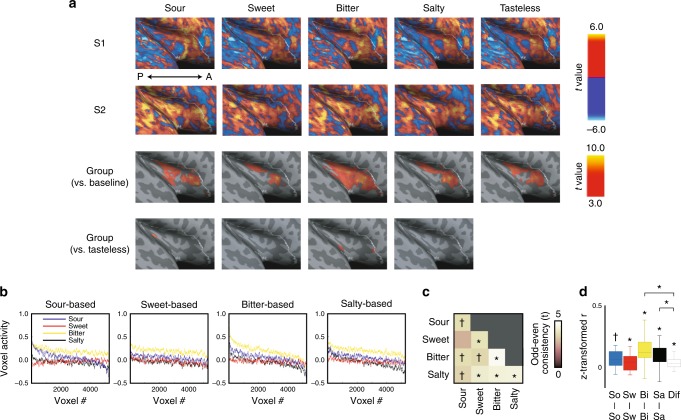
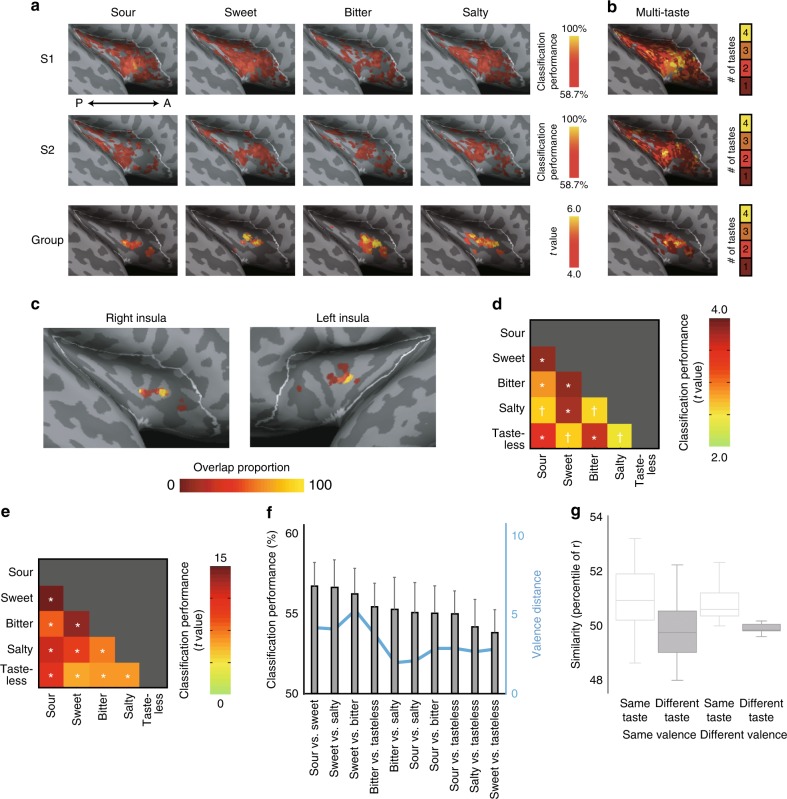
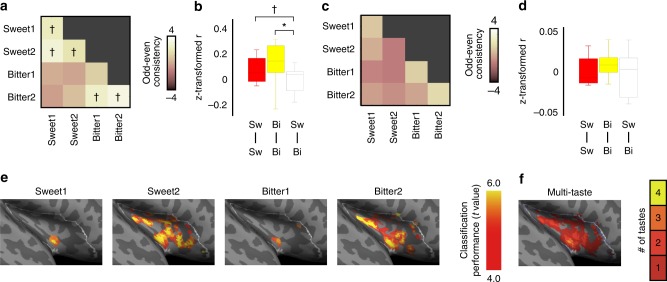
The mammalian tongue contains gustatory receptors tuned to basic taste types, providing an evolutionarily old hedonic compass for what and what not to ingest. Although representation of these distinct taste types is a defining feature of primary gustatory cortex in other animals, their identification has remained elusive in humans, leaving the demarcation of human gustatory cortex unclear. Here we used distributed multivoxel activity patterns to identify regions with patterns of activity differentially sensitive to sweet, salty, bitter, and sour taste qualities. These were found in the insula and overlying operculum, with regions in the anterior and middle insula discriminating all tastes and representing their combinatorial coding. These findings replicated at super-high 7 T field strength using different compounds of sweet and bitter taste types, suggesting taste sensation specificity rather than chemical or receptor specificity. Our results provide evidence of the human gustatory cortex in the insula.
Overview
The claims and statistics of this paper haven’t been checked yet.
Free: it reads the open-access text and checks the first 5 claims that cite a source we can check. Create a free account to check every claim.
Integrity signals
Registry
Cites
Statistics
Figures
Verification
Claims the paper makes
The claims and statistics of this paper haven’t been checked yet.
Free: it reads the open-access text and checks the first 5 claims that cite a source we can check. Create a free account to check every claim.
Self-check
Percentages, sums and reported differences re-computed from the paper’s own numbers.
The self-check needs the paper’s full text.
Citations
Cites
Cortical Surface-Based Analysis
Dale, A. M., Fischl, B., & Sereno, M. I. (1999) · NeuroImage · doi:10.1006/nimg.1998.0395 · Cited by 10,910
How do you feel — now? The anterior insula and human awareness
(Bud) Craig, A. D. (2009) · Nature Reviews Neuroscience · doi:10.1038/nrn2555 · Cited by 6,657
Distributed and overlapping representations of faces and objects in ventral temporal cortex
Haxby, J. V., Gobbini, M. I., Furey, M. L., Ishai, A., Schouten, J. L., & Pietrini, P. (2001) · Science · doi:10.1126/science.1063736 · Cited by 3,940
Information-based functional brain mapping
Kriegeskorte, N., Goebel, R., & Bandettini, P. (2006) · Proceedings of the National Academy of Sciences · doi:10.1073/pnas.0600244103 · Cited by 2,113
Self-citationValid conjunction inference with the minimum statistic
Nichols, T., Brett, M., Andersson, J., Wager, T., & Poline, J.-B. (2005) · NeuroImage · doi:10.1016/j.neuroimage.2004.12.005 · Cited by 1,880
Decoding the visual and subjective contents of the human brain
Kamitani, Y., & Tong, F. (2005) · Nature Neuroscience · doi:10.1038/nn1444 · Cited by 1,829
Berridge, K. C., & Kringelbach, M. L. (2015) · Neuron · doi:10.1016/j.neuron.2015.02.018 · Cited by 1,730
The Receptors for Mammalian Sweet and Umami Taste
Zhao, G. Q., Zhang, Y., Hoon, M. A., Chandrashekar, J., Erlenbach, I., Ryba, N. J. P., & Zuker, C. S. (2003) · Cell · doi:10.1016/s0092-8674(03)00844-4 · Cited by 1,340
The Cerebral Cortex of Man: A Clinical Study of Localization of Function
(1968) · JAMA: The Journal of the American Medical Association · doi:10.1001/jama.1968.03150020096041 · Cited by 1,214
Dissociated neural representations of intensity and valence in human olfaction
Anderson, A. K., Christoff, K., Stappen, I., Panitz, D., Ghahremani, D. G., Glover, G., Gabrieli, J. D. E., & Sobel, N. (2003) · Nature Neuroscience · doi:10.1038/nn1001 · Cited by 1,054
Self-citation
Cited by
SARS-CoV-2 is associated with changes in brain structure in UK Biobank
Douaud, G., Lee, S., Alfaro-Almagro, F., Arthofer, C., Wang, C., McCarthy, P., Lange, F., Andersson, J. L. R., Griffanti, L., Duff, E., et al. (2022) · Nature · doi:10.1038/s41586-022-04569-5 · Cited by 1,646
Shi, Y., Pu, D., Zhou, X., & Zhang, Y. (2022) · Foods · doi:10.3390/foods11213408 · Cited by 229
“Furthermore, a recent neuroimaging study showed that the human cerebral cortex had spatially distinct but overlapping cortical activations for each taste quality, with umami taste in the anterior insula overlapping with the effects of salt and sour stimuli [121].”
BackgroundThe Insular Cortex: An Interface Between Sensation, Emotion and Cognition
Zhang, R., Deng, H., & Xiao, X. (2024) · Neuroscience Bulletin · doi:10.1007/s12264-024-01211-4 · Cited by 158
Taste Quality Representation in the Human Brain
Avery, J. A., Liu, A. G., Ingeholm, J. E., Riddell, C. D., Gotts, S. J., & Martin, A. (2020) · The Journal of Neuroscience · doi:10.1523/jneurosci.1751-19.2019 · Cited by 127
“In fact, some evidence for this possibility in the human brain has recently been reported (Chikazoe et al., 2019).”
BackgroundMethodInfluentialEmotional Objectivity: Neural Representations of Emotions and Their Interaction with Cognition
Todd, R. M., Miskovic, V., Chikazoe, J., & Anderson, A. K. (2019) · Annual Review of Psychology · doi:10.1146/annurev-psych-010419-051044 · Cited by 130
Self-citationLivneh, Y., & Andermann, M. L. (2021) · Neuron · doi:10.1016/j.neuron.2021.08.036 · Cited by 98
Viewing images of foods evokes taste quality-specific activity in gustatory insular cortex
Avery, J. A., Liu, A. G., Ingeholm, J. E., Gotts, S. J., & Martin, A. D. (2020) · Proceedings of the National Academy of Sciences · doi:10.1073/pnas.2010932118 · Cited by 93
“Recent studies using multivariate pattern analysis (MVPA) applied to high-resolution functional magnetic resonance imaging (fMRI) data, however, suggest that taste quality is represented by distributed patterns of activation within tasteresponsive regions of the brain, rather than topographically (12, 17, 18).”
BackgroundConsequences of Obesity on the Sense of Taste: Taste Buds as Treatment Targets?
Rohde, K., Schamarek, I., & Blüher, M. (2020) · Diabetes & Metabolism Journal · doi:10.4093/dmj.2020.0058 · Cited by 85
Bioelectronic tongue: Current status and perspectives
Wasilewski, T., Kamysz, W., & Gębicki, J. (2019) · Biosensors and Bioelectronics · doi:10.1016/j.bios.2019.111923 · Cited by 83
Schamarek, I., Anders, L., Chakaroun, R., Kovacs, P. L., & Rohde‐Zimmermann, K. (2023) · Nutrition Journal · doi:10.1186/s12937-023-00856-7 · Cited by 77
The neuroscience of sugars in taste, gut-reward, feeding circuits, and obesity
Gutiérrez, R., Fonseca, E., & Simon, S. A. (2020) · Cellular and Molecular Life Sciences · doi:10.1007/s00018-020-03458-2 · Cited by 78
“In human fMRI experiments, primary taste responses revealed a more complex gustotopic map than in mice, with larger overlap across taste qualities and variability among subjects [96, 97].”
BackgroundSweet Taste Is Complex: Signaling Cascades and Circuits Involved in Sweet Sensation
von Molitor, E., Riedel, K., Krohn, M., Hafner, M., Rudolf, R., & Cesetti, T. (2021) · Frontiers in Human Neuroscience · doi:10.3389/fnhum.2021.667709 · Cited by 76
Recent advances in development of biosensors for taste-related analyses
Zhang, N., Wei, X., Fan, Y., Zhou, X., & Liu, Y. (2020) · TrAC Trends in Analytical Chemistry · doi:10.1016/j.trac.2020.115925 · Cited by 60
Rajan, A., Gómez-Carmona, D., & Radhakrishnan, M. (2022) · Food Engineering Reviews · doi:10.1007/s12393-022-09308-0 · Cited by 57
“[104] used fMRI to identify the tastants’ response in the insula region using multi-voxel pattern analysis (MVPA).”
MethodBiomimetic ion nanochannels for sensing umami substances
Li, M., Zhang, N., Cui, Z., Wang, W., Wang, C., Wang, D., Li, M., Lu, W., Qing, G., & Liu, Y. (2022) · Biomaterials · doi:10.1016/j.biomaterials.2022.121418 · Cited by 35
Olfactory perceptual decision-making is biased by motivational state
Shanahan, L. K., Bhutani, S., & Kahnt, T. (2021) · PLoS Biology · doi:10.1371/journal.pbio.3001374 · Cited by 33
Tastes and retronasal odours evoke a shared flavour-specific neural code in the human insula
Khorisantono, P. A., Veldhuizen, M. G., & Seubert, J. (2025) · Nature Communications · doi:10.1038/s41467-025-63803-6 · Cited by 40
“In addition to the expected presence of taste quality coding within this taste-responsive region, whichwas in line with previous MVPA studies 9,31 , we also note that this region reliably displays pattern-based encoding of taste-associated odour identity.”
From Architecture to Evolution: Multisensory Evidence of Decentralized Emotion
Kryklywy, J. H., Ehlers, M. R., Anderson, A. K., & Todd, R. M. (2020) · Trends in Cognitive Sciences · doi:10.1016/j.tics.2020.08.002 · Cited by 31
“Human neuroimaging research has identified valencesensitive gustatory modulation of insular cortices independent of primary sensory structures [19,24,41,98].”
BackgroundSelf-citationExtrinsic Factors Underlying Food Valuation in the Human Brain
Motoki, K., & Suzuki, S. (2020) · Frontiers in Behavioral Neuroscience · doi:10.3389/fnbeh.2020.00131 · Cited by 30
“By combining careful experimental designs with multivariate analyses on neuroimaging data, recent studies have elaborated on how taste and flavor information is processed in the brain (e.g., Howard et al., 2015; Chikazoe et al., 2019; Avery et al., 2020).”
MethodThe Mystery of “Metal Mouth” in Chemotherapy
Reith, A. J. M., & Spence, C. J. (2020) · Chemical Senses · doi:10.1093/chemse/bjz076 · Cited by 29
Porcu, E., Benz, K. M. C., Ball, F., Tempelmann, C., Hanke, M., & Noesselt, T. (2020) · Proceedings of the National Academy of Sciences · doi:10.1073/pnas.1916329117 · Cited by 24
“Significantly extending previous observations (20), we observed patterns narrowly, but not exclusively, tuned to specific tastes as well as patterns of more broadly tuned spheres in the left and right insula at the group level and confirmed tastespecific patterns when considering only one concentration.”
BackgroundVia, E., & Contreras‐Rodríguez, O. (2023) · Nutrients · doi:10.3390/nu15132994 · Cited by 23
“Next, the orbitofrontal region (its caudolateral parts considered the secondary cortical taste) assigns reinforcement values to food [70,71].”
BackgroundUnger, N., Haeck, M., Eickhoff, S. B., Camilleri, J. A., Dickscheid, T., Mohlberg, H., Bludau, S., Caspers, S., & Amunts, K. (2023) · Frontiers in Human Neuroscience · doi:10.3389/fnhum.2023.1087026 · Cited by 21
“In addition to its involvement in language, the FOp seems to play a role for gustatory representation, task control, and the perception of visceral stimuli (Eickhoff et al., 2006b; Higo et al., 2011; Veldhuizen et al., 2011; Chikazoe et al., 2019; Quirmbach and Limanowski, 2022) as well as executive control [(Thompson…”
BackgroundA comprehensive review of plant-derived salt substitutes: Classification, mechanism, and application
Bi, Y., Li, L., Qiao, K., Luo, J., Liu, X., Sun, B., & Zhang, Y. (2024) · Food Research International · doi:10.1016/j.foodres.2024.114880 · Cited by 21
A common neural code for representing imagined and inferred tastes
Avery, J. A., Carrington, M., & Martin, A. D. (2022) · Progress in Neurobiology · doi:10.1016/j.pneurobio.2023.102423 · Cited by 20
Yeung, A. W. K., Wong, N. S. M., & Eickhoff, S. B. (2020) · Human Brain Mapping · doi:10.1002/hbm.24957 · Cited by 19
Nakamura, Y., & Koike, S. (2021) · Frontiers in Systems Neuroscience · doi:10.3389/fnsys.2021.647143 · Cited by 23
Physiological Needs: Sensations and Predictions in the Insular Cortex
Prilutski, Y., & Livneh, Y. (2022) · Physiology · doi:10.1152/physiol.00019.2022 · Cited by 20
Sensing Senses: Optical Biosensors to Study Gustation
von Molitor, E., Riedel, K., Hafner, M., Rudolf, R., & Cesetti, T. (2020) · Sensors · doi:10.3390/s20071811 · Cited by 21
“While topographic mapping of specific taste qualities to dedicated brain regions was neglected [192], this view was challenged by experiments in mice showing that neurons coding for one taste quality are anatomically clustered [193] and by a magnetic resonance study in humans, which demonstrated that the different tas…”
BackgroundBrain activity associated with taste stimulation: A mechanism for neuroplastic change?
Dietsch, A. M., Westemeyer, R. M., & Schultz, D. H. (2023) · Brain and Behavior · doi:10.1002/brb3.2928 · Cited by 15
“These regions were largely consistent with expectations based on previous studies identifying key landmarks in the network associated with taste processing (Chikazoe et al., 2019; Small, 2010).”
ResultHuang, Y., Kakusa, B. W., Feng, A. Y., Gattas, S., Shivacharan, R. S., Lee, E. B., Parker, J. J., Kuijper, F. M., Barbosa, D. A. N., Keller, C. J., et al. (2021) · Nature Communications · doi:10.1038/s41467-021-23885-4 · Cited by 16
Against gustotopic representation in the human brain: there is no Cartesian restaurant
Avery, J. A. (2021) · Current Opinion in Physiology · doi:10.1016/j.cophys.2021.01.005 · Cited by 16
“As with the second experiment in (24), our study used 7T fMRI, combined with extremely high voxel resolution (1.”
BackgroundMethodResultInfluentialEvaluating cognitive penetrability of perception across the senses
Vetter, P., Badde, S., Ferrè, E. R., Seubert, J., & Shinn‐Cunningham, B. G. (2024) · Nature Reviews Psychology · doi:10.1038/s44159-024-00382-1 · Cited by 16
“…of taste, with changes in intensity and valence attributions owing to cognitive associations modulating taste-related activation in the orbitofrontal cortex 191–193 , and pattern coding in the primary gustatory cortex responding strictly to taste qualities along the five basic tastes 194–196 .”
Sex differences in the taste-evoked functional connectivity network
Ponticorvo, S., Prinster, A., Cantone, E., Salle, F. D., Esposito, F., & Canna, A. (2022) · Chemical Senses · doi:10.1093/chemse/bjac015 · Cited by 15
Otsubo, Y., Miyagi, M., Sekiya, H., Kano, O., & Ebihara, S. (2022) · Scientific Reports · doi:10.1038/s41598-022-18255-z · Cited by 13
Sasaki, A. T., Kawai, E., Watanabe, K., Yamano, E., Oba, C., Nakamura, K., Natsume, M., Mizuno, K., & Watanabe, Y. (2023) · Nutrients · doi:10.3390/nu16010041 · Cited by 14
“…various brain areas, especially chemosensory areas, including the insula, prefrontal region, and caudomedial and caudolateral orbitofrontal cortices [56]. fMRI studies have reported that the insular, human gustatory, and orbitofrontal cortices are central regions associated with taste [57,58].”
BackgroundImpact of five basic tastes perception on neurophysiological response: Results from brain activity
Pereira, D. R., Pereira, H. R., Silva, M. L., Pereira, P., & Ferreira, H. A. (2025) · Food Quality and Preference · doi:10.1016/j.foodqual.2025.105572 · Cited by 12
Evaluation, correction and masking methods for unpleasant tastes of drugs: A comprehensive review
Zhang, F., Lin, L., Wang, Z., & Li, H. (2025) · International Journal of Pharmaceutics · doi:10.1016/j.ijpharm.2025.126008 · Cited by 12
Park, C., & Kim, J. (2024) · Cognition · doi:10.1016/j.cognition.2024.105830 · Cited by 12
Tsumura, K., Kosugi, K., Hattori, Y., Aoki, R., Takeda, M., Chikazoe, J., Nakahara, K., & Jimura, K. (2021) · Cerebral Cortex · doi:10.1093/cercor/bhab324 · Cited by 12
“states can be decoded from neural coding by machine learning techniques that classify distributed patterns of brain activity (Kamitani and Tong 2005; Haynes and Rees 2006; Norman et al. 2006; Nishimoto et al. 2011; Loose et al. 2017; Qiao et al. 2017; Chikazoe et al. 2019; Wang et al. 2020).”
BackgroundSelf-citationLender, A., Miedl, S. F., Wilhelm, F. H., Miller, J., & Blechert, J. (2020) · Physiology & Behavior · doi:10.1016/j.physbeh.2020.113014 · Cited by 10
Budzinska, A., Teysseire, F., Flad, E., Dupont, P. J., Wölnerhanssen, B. K., Meyer‐Gerspach, A. C., Oudenhove, L. V., & Weltens, N. (2024) · Appetite · doi:10.1016/j.appet.2024.107422 · Cited by 10
Yang, T., Jiang, W., Luo, C., Hu, J., Xu, W., Zhang, P., Jin, X., Zhou, Y., Liu, R., Qian, Z., et al. (2025) · Innovative Food Science & Emerging Technologies · doi:10.1016/j.ifset.2025.104058 · Cited by 8
Constructing value signals for food rewards: determinants and the integration
Suzuki, S. (2022) · Current Opinion in Behavioral Sciences · doi:10.1016/j.cobeha.2022.101178 · Cited by 9
Implicit Measurement of Sweetness Intensity and Affective Value Based on fNIRS
Mai, J., Li, S., Zhang, J., Lin, H., Wei, Z., & Sun, Y. (2025) · Chemosensors · doi:10.3390/chemosensors13020036 · Cited by 8
The Neural Basis of Salt Perception: A Focus on Potassium Chloride as a Sodium Alternative
Iannilli, E., Fürer, R., Welge–Lüssen, A., & Hummel, T. R. (2025) · Life · doi:10.3390/life15020207 · Cited by 9
“Its multiple-site cortex devoted to gustatory functions is clear, but this does not exclude that this structure can act as a high-level hedonic function colocalized with low-level sensory representation, similar to what Anderson and colleagues [62] have theorized.”
The meltdown pathway: A multidisciplinary account of autistic meltdowns.
Soden, P. A., Bhat, A., Anderson, A. K., & Friston, K. J. (2025) · Psychological Review · doi:10.1037/rev0000543 · Cited by 9
Self-citationSchienle, A., & Wabnegger, A. (2021) · Brain Imaging and Behavior · doi:10.1007/s11682-021-00455-2 · Cited by 8
Long, T., Milbourn, C. C., Smith, A., Khin, K. L. S., Page, A. J., IDRIS, I. R., Yang, Q., Young, R. L., & Eldeghaidy, S. (2025) · Life · doi:10.3390/life15071075 · Cited by 7
“In contrast, the combinatorial coding model suggests that taste qualities are encoded by patterns of activity across a population of broadly responsive TRCs and neurons, rather than being relayed through discrete channels [28].”
Kryklywy, J. H., Ehlers, M. R., Beukers, A. O., Moore, S. R., Todd, R. M., & Anderson, A. K. (2022) · eNeuro · doi:10.1523/eneuro.0274-22.2022 · Cited by 6
“These amygdalar bi-polar valence representations are consistent with those identified in the olfactory domain (Jin et al., 2015), but have not been reported for either gustatory or visual hedonic information (Chikazoe et al., 2014, 2019).”
Self-citationXiang, Q., Zhou, W., Yang, A., Wei, Y., Xu, M., & Liu, P. (2024) · Food Chemistry · doi:10.1016/j.foodchem.2024.142565 · Cited by 5
Zhang, S., Shoaie, S., & Carpenter, G. H. (2025) · npj Science of Food · doi:10.1038/s41538-025-00643-0 · Cited by 5
“…absence of effect was probably caused by structural differences between murine and human taste buds 52 , together withinter-speciesdifferencesincentralprocessing — ratsperceiveddifferent tastes in separate brain regions, whereas humans processed multiple tastes within the same cortical area 53,54 .”
What is the Relation between Chemosensory Perception and Chemosensory Mental Imagery?
Spence, C. J. (2024) · Multisensory Research · doi:10.1163/22134808-bja10130 · Cited by 9
“Intriguingly, taste-specific representations have been discerned in human insular cortex (IC) and the overlying operculum (Chikazoe et al., 2019).”
Bitter Taste Disrupts Spatial Discrimination of Piperine-Evoked Burning Sensations: A Pilot Study
Liu, D. T., Besser, G., Bayer, K., Prem, B., Mueller, C. A., & Renner, B. (2021) · Biology · doi:10.3390/biology10090886 · Cited by 5
“While some studies provided evidence of a taste-specific activation pattern of neurons [51,52], other studies have shown otherwise [53–57].”
ResultCaloric labels do not influence taste pleasantness and neural responses to erythritol and sucrose
Budzinska, A., Byl, L., Teysseire, F., Flad, E., Dupont, P. J., Wölnerhanssen, B. K., Meyer‐Gerspach, A. C., Oudenhove, L. V., & Weltens, N. (2025) · NeuroImage · doi:10.1016/j.neuroimage.2025.121061 · Cited by 9
Yang, T., Cao, M., Qian, Z., & Jianshe, C. H. E. N. (2026) · Comprehensive Reviews in Food Science and Food Safety · doi:10.1111/1541-4337.70442 · Cited by 4
Highly sensitive flexible dielectric-response-based taste sensor for generic liquid identification
Sun, A., Wang, J., Hu, X., Wang, J., Wan, Z., Wang, Y., Zhu, R., & Wang, L. (2024) · Flexible and Printed Electronics · doi:10.1088/2058-8585/ad54d0 · Cited by 4
EEG Brain Heatmap Visualization for Sweet and Sour Tasting
Lejap, M. Y. L., Wibawa, A. D., & Mukti, P. H. (2024) · International Seminar on Intelligent Technology and Its Applications · doi:10.1109/isitia63062.2024.10668352 · Cited by 4
“This study also supports the findings of [14][24][25], which identified the CP1 and CP2 channels as nearest to the location of the insula, the main taste processing region.”
ResultKo, H.-K., Shi, J., Eidenberger, T., Shi, W., & McCabe, C. (2025) · Nutritional Neuroscience · doi:10.1080/1028415x.2025.2508772 · Cited by 7
“We also found greater neural activity in the sucralose plus modifier condition vs the sucralose alone condition in the precentral gyrus [58 2 24], p = 0.03 and for the sucrose plus modifier condition vs sucrose alone [ − 38 − 2 − 12], p = 0.04.”
InfluentialAdaptive selection drives TRPP3 loss-of-function in an Ethiopian population
Walsh, S., Izquierdo-Serra, M., Acosta, S., Edo, A., Lloret, M., Moret, R., Bosch, E., Oliva, B., Bertranpetit, J., & Fernández‐Fernández, J. M. (2020) · Scientific Reports · doi:10.1038/s41598-020-78081-z · Cited by 4
Flexible and dynamic representations of gustatory information
Ohla, K. (2021) · Current Opinion in Physiology · doi:10.1016/j.cophys.2021.01.002 · Cited by 4
Flexible Tongue Electrode Array System for In Vivo Mapping of Electrical Signals of Taste Sensation
Huang, S., Zhang, T., Li, H., Zhang, M., Liu, X., Xu, D., Wang, H., Shen, Z., Wu, Q., Tao, J., et al. (2021) · ACS Sensors · doi:10.1021/acssensors.1c01621 · Cited by 5
Sensory perception and wine assessment
Jackson, R. S. (2020) · Elsevier eBooks · doi:10.1016/b978-0-12-816118-0.00011-8 · Cited by 4
Cortical field maps across human sensory cortex
Brewer, A. A., & Barton, B. (2023) · Frontiers in Computational Neuroscience · doi:10.3389/fncom.2023.1232005 · Cited by 6
“…ordered cortical representation of these molecules’ qualities may arise from genetically predetermined neural circuits in specific regions, such as those contributing to innate ecological behaviors (Luo and Flanagan, 2007; Sosulski et al., 2011; Chikazoe et al., 2019; Olofsson and Freiherr, 2019).”
BackgroundInsula uses overlapping codes for emotion in self and othersPreprint
Xiao, J., Adkinson, J. A., Allawala, A. B., Banks, G. P., Bartoli, E., Fan, X., Mocchi, M. M., Pascuzzi, B., Pulapaka, S., Franch, M. C., et al. (2024) · bioRxiv (Cold Spring Harbor Laboratory) · doi:10.1101/2024.06.04.596966 · Cited by 6
“…and olfactory processing, as well as its role in multisensory integration, future research should consider incorporating additional sensory modalities to provide a more comprehensive understanding of how the insula processes emotions (Chikazoe et al., 2019; Gogolla, 2017; Koeppel et al., 2020).”
BackgroundCanna, A., Cantone, E., Roefs, A., Franssen, S., Prinster, A., Formisano, E., Salle, F. D., & Esposito, F. (2023) · Frontiers in Nutrition · doi:10.3389/fnut.2023.1173316 · Cited by 3
Wei, H., Xia, S., Sang, X., Kauno, J. G., Dong, Z., Zhang, Y., Nie, J., Yuan, Y., Xu, G., & Niu, W. (2025) · Chemical Engineering Journal · doi:10.1016/j.cej.2025.162682 · Cited by 4
Mantel, M., Rouby, C., Fournel, A., & Bensafi, M. (2021) · Elsevier eBooks · doi:10.1016/b978-0-12-821124-3.00003-x · Cited by 5
Amplitude of low-frequency fluctuation after taste exposure revealed by resting-state fMRI
Chen, J., Zhao, M., Huang, L., Liu, Y., Li, X., Jia, X., Ding, Q., Wang, C., & Liang, P. (2023) · Physiology & Behavior · doi:10.1016/j.physbeh.2023.114091 · Cited by 3
Valenced tactile information is evoked by neutral visual cues following emotional learning
Ehlers, M. R., Kryklywy, J. H., Beukers, A. O., Moore, S. R., Forys, B. J., Anderson, A. K., & Todd, R. M. (2024) · Imaging Neuroscience · doi:10.1162/imag_a_00320 · Cited by 4
“…is consistent with previous studies showing that stimulus value (but not sensory properties) is represented in the vmPFC/OFC in conditioning ( Chikazoe et al., 2019; Lim et al., 2013; McNamee et al., 2013), and supports theories proposing this region’s role in representing the affective…”
ResultSelf-citationYoshimoto, T., Tokunaga, K., & Chikazoe, J. (2024) · NeuroImage · doi:10.1016/j.neuroimage.2024.120911 · Cited by 6
Self-citationSudo, Y., Kamashita, R., Takamura, T., Hamatani, S., Numata, N., Matsumoto, K., Sato, Y., Hamamoto, Y., Shoji, T., Muratsubaki, T., et al. (2025) · Scientific Reports · doi:10.1038/s41598-025-03641-0 · Cited by 5
“In addition, a multi-voxel pattern analysis study using fMRI found that activity patterns distinguishing sweet, bitter, salty, and sour tastes are located in anterior to mid-dorsal insula and the overlying opercular cortex 25 .”
Kryklywy, J. H., Ehlers, M. R., Beukers, A. O., Moore, S. R., Todd, R. M., & Anderson, A. K. (2020) · bioRxiv (Cold Spring Harbor Laboratory) · doi:10.1101/2020.09.24.310383 · Cited by 3
“This is supported by recent work positing gustation an additional sensory contributor to interoceptive processing (Liman et al., 2014; Chikazoe et al., 2019), which offers another exemplar of a proximal sense with peripheral labelling of hedonic value (Liman et al.”
BackgroundSelf-citationBiologically inspired deep neural network models for visual emotion processing
Liu, P., Bo, K., Chen, Y.-J., Keil, A., Ding, M., & Fang, R. (2026) · Network Neuroscience · doi:10.1162/netn.a.596 · Cited by 2
Advanced sensors for immersive multisensory communication
Gao, Y. L., Wu, D., Hou, B., Song, J., Liao, J., Chen, Y., Li, P., & Zhou, L. (2026) · Nature Sensors · doi:10.1038/s44460-026-00061-z · Cited by 3
“Gustatory perception refers to the ability to detect and distinguish chemical stimuli in the oral cavity, encompassing five basic tastes: sweet, bitter, umami, sour and salty 62 .”
Xie, J., Shi, Q., Chai, G., Fan, W., Liu, J., Wang, S., & Zhang, Q. (2026) · Food Reviews International · doi:10.1080/87559129.2026.2664054 · Cited by 3
“[61] Olfactory information, transduced by olfactory sensory neurons in the olfactory epithelium, is relayed through the olfactory bulb to primary olfactory regions such as the piriform cortex, amygdala, and entorhinal cortex, where odor identity, memory associations, and emotional tone are encoded.”
Psychobiology of Tasting and Its Role in Food Perception
Ohla, K. (2020) · Elsevier eBooks · doi:10.1016/b978-0-12-809324-5.24144-8 · Cited by 2
SwinTaste: Bimodal Biosignals Taste Sensation Recognition via Swin Transformer
Gao, H., Zhao, S., Wang, Y., Zhang, J., Yao, W., Luo, Z., & Li, G. (2024) · International Joint Conference on Neural Networks (IJCNN) · doi:10.1109/ijcnn60899.2024.10650067 · Cited by 2
Early versus late noise differentially enhances or degrades context-dependent choice
Shen, B., Nguyen, D., Wilson, J., Glimcher, P. W., & Louie, K. (2025) · Nature Communications · doi:10.1038/s41467-025-59140-3 · Cited by 3
Aspectos Sensoriales del Umami
Sangronis, E., & Bolini, H. M. A. (2021) · Editora Blucher eBooks · doi:10.5151/9786555500950-14 · Cited by 2
Hébert-Seropian, B., Boucher, O., Citherlet, D., Robert, M., Richer, F., & Nguyen, D. K. (2025) · Brain Sciences · doi:10.3390/brainsci15060593 · Cited by 1
Brain Age in Adult Patients With Early‐Treated Phenylketonuria
Winiger, L., Muri, R., Tobias, K., Hochuli, M., Vardy, E. R. L. C., Radojewski, P., Pośpieszny, K., Trepp, R., & Everts, R. (2026) · Journal of Inherited Metabolic Disease · doi:10.1002/jimd.70158 · Cited by 1
Wang, P., Tan, Y., Fan, Z., He, S., Chen, C., Sun, Y., Hong, W., Wang, Z., Zhang, K., Fang, E. F., et al. (2026) · Biology · doi:10.3390/biology15080646 · Cited by 1
“…sweet taste, initiated by T1R2/T1R3 receptors in taste buds and relayed via the chorda tympani and thalamus to the insula and orbitofrontal cortex [27]; and the post-ingestive gut– brain axis pathway, in which intestinal glucose sensing via sodium-glucose cotransporter (SGLT) triggers vagal…”
Can umami modulate sour taste to enhance consumer liking? An EEG neurogastronomy study
Shi, W., Wei, Y., Ma, H., Wang, X., Ai, J., & Liu, Y. (2026) · International Journal of Gastronomy and Food Science · doi:10.1016/j.ijgfs.2026.101517 · Cited by 1
Neural substrates and neuroendocrine mechanisms underlying neophobia in vertebrates
Henry, M. S., Wilson, M. B., & Lattin, C. R. (2026) · Journal of Experimental Biology · doi:10.1242/jeb.252409 · Cited by 1
Coexistence of sensory qualities and value representations in human orbitofrontal cortex.
Yoshimoto, T., Okazaki, S., Sumiya, M., Takahashi, H., Nakagawa, E., Koike, T., Kitada, R., Okamoto, S., Nakata, M., Yada, T., et al. (2022) · Neurosciences research · doi:10.1016/j.neures.2022.02.004 · Cited by 1
“We adopted a leave-one-subject-out procedure (Chikazoe et al., 2019) in this analysis in the same way as in the identical object analyses in Fig.”
MethodSelf-citationElectroencephalographical correlates of cortex stage of sensory citric acid perception
Savaneuskaya, A. M. (2019) · Journal of the Belarusian State University Biology · doi:10.33581/2521-1722-2019-3-33-39
“В подобных случаях бывает трудно или невозможно идентифицировать, являются ли все регистрируемые очаги активности отражением рецепции вкуса с участием обширных областей мозга, или же диффузная активация обусловлена эффектами, параллельно вызываемыми тактильным, температурным и другими раздражителями, действующими в по…”
Ben-Abraham, T. N. (2021) · World Journal of Neuroscience · doi:10.4236/wjns.2021.113018
Overlapping Representation of Basic Tastes in the Human Gustatory CortexPreprint
Zhang, D., Wang, X., Wang, Y., Nguchu, B. A., Jiang, Z., Shi, C., & Qiu, B. (2021) · bioRxiv (Cold Spring Harbor Laboratory) · doi:10.1101/2021.10.31.466657
Brain Mechanisms of Oral Sensory Functions
Lin, C. (2021) · Wiley eBooks · doi:10.1002/9781119724247.ch5
Sangronis, E., & Bolini, H. M. A. (2021) · Editora Blucher eBooks · doi:10.5151/9786555500967-14
Avaliação da percepção gustativa de mulheres participantes de grupos de convivência
Tieppo, L. M., Branco, C. S., & Siviero, J. (2023) · Brazilian Journal of Health Review · doi:10.34119/bjhrv6n6-093
Interindividual variability in olfactory experience : an interdisciplinary approach
Mantel, M. (2021) · theses.fr (ABES) · doi:10.70675/561f3099z5ad7z42b9zb89dzd6c434955d1a · Cited by 3
Albu, T. A., Iacob, N., & Susan-Resiga, D. (2025) · International Journal of Molecular Sciences · doi:10.3390/ijms26073164
“…cortex (GC), responsible for the perception of taste, consists of the anterior insula (AI) in the insular lobe with its extending anatomically associated overlying frontal–parietal operculum (FO-PO) [20]. its extending anatomically associated overlying frontal–parietal operculum (FO-PO) [20].”
Neurobiology of Ingestive Behavior
Howe, W. M., & DiFeliceantonio, A. G. (2025) · Oxford University Press eBooks · doi:10.1093/9780197675212.003.0003
The neural basis of emotional generalization in empathyPreprint
Xiao, J., Allawala, A. B., Adkinson, J. A., Fan, X., Franch, M. C., Gates, V., Mathura, R. K., Mocchi, M. M., Myers, J., Pascuzzi, B., et al. (2025) · bioRxiv (Cold Spring Harbor Laboratory) · doi:10.1101/2025.10.18.683207 · Cited by 2
“…and olfactory processing, as well as its role in multisensory integration, future research should consider incorporating additional sensory modalities to provide a more comprehensive understanding of how the insula processes emotions (Chikazoe et al., 2019; Gogolla, 2017; Koeppel et al., 2020).”
Au-delà de la saveur : décryptage du rôle de l'insula dans les comportements alimentaires
Hébert-Seropian, B. (2025) · Archipel (Université du Québec à Montréal)
Gut-brain interactions in food reward
Burns, A. L. (2024) · VTechWorks (Virginia Tech)
Heng, Y., & Qiuming, Y. (2026) · Nutrition Clinique et Métabolisme · doi:10.1016/j.nupar.2026.103032
Metadata
- Authors
- Chikazoe, J., Lee, D. H., Kriegeskorte, N., & Anderson, A. K.
- Affiliations
- Cornell University (US)
- University of Colorado Boulder (US)
- Columbia University (US)
- Corresponding author
- Chikazoe, Junichi
- Anderson, Adam K.
- Venue
- Nature Communications
- Published
- 2019-03-05
- Volume
- 10
- Issue
- 1
- Pages
- 1048-1048
- ISSN
- 2041-1723 (ISSN-L)
- PMC
- PMC6401093
- OpenAlex
- W2918641206
- Semantic Scholar
- 4b345243942bc19a00c038e9cc8b3830ea575ae8
- Cited by
- 98
- References
- 41
- Citations by year
- 2026: 10 · 2025: 17 · 2024: 13 · 2023: 9 · 2022: 10 · 2021: 19 · 2020: 14 · 2019: 6
- FWCI
- 9.32
- Type
- journal article
- Language
- en
- Open access
- gold
- doi.org
- Licence
- cc-by
- creativecommons.org/licenses/by/4.0 (tdm)
- creativecommons.org/licenses/by/4.0 (vor)
- Locations
- Nature Communications (publishedVersion, cc-by)
- Europe PMC (PubMed Central) (publishedVersion, cc-by)
- PubMed Central (publishedVersion, cc-by)
- PubMed (publishedVersion)
- RePEc: Research Papers in Economics (submittedVersion)
- DOAJ (DOAJ: Directory of Open Access Journals) (submittedVersion)
- DOAJ (DOAJ: Directory of Open Access Journals) (submittedVersion, cc-by-sa)
- Funders
- Takeda Science Foundation
- Canadian Institutes of Health Research
- Japan Society for the Promotion of Science (17H06033, 18H05017)
- Topics
- Health Sciences › Nursing › Nutrition and Dietetics › Biochemical Analysis and Sensing Techniques
- Life Sciences › Neuroscience › Sensory Systems › Olfactory and Sensory Function Studies
- Life Sciences › Neuroscience › Cognitive Neuroscience › Tactile and Sensory Interactions
- Keywords
- gustatory cortex, basic taste, insula, operculum, sweet taste, salty taste, bitter taste, sour taste, taste coding, human brain mapping, 7T MRI
- MeSH terms
- Adult, Brain Mapping, Cerebral Cortex, Female, Humans, Magnetic Resonance Imaging, Male, Taste, Taste Buds, Taste Perception, Young Adult
About these checks
Registry, retraction, Cites and statistics results are computed, not judged, with one exception: a printed reference that no index lists is read once by a model before it counts as a citation error. Claims are extracted by a model and kept only when their quote appears verbatim in the text; each cited source is then checked, with a model’s help, for whether it says what the claim relies on. Those verdicts can be wrong — read the claim’s quote and the cited source before relying on one.
Statistics and arithmetic are recomputed, not judged.
Confidence bands are shown only for fields calibrated on our annotated test set. None is calibrated yet, so no band is shown.
What counts as a claim ›How we measure confidence ›How we check this ›
Are you an author, or do you see a problem with this page? Request a review
Data sources
Bibliographic data: Semantic Scholar, OpenAlex, Crossref.
Contains information from the Semantic Scholar Academic Graph Datasets, made available under the ODC Attribution License (ODC-BY 1.0).
Semantic Scholar’s data is described in: Kinney, R., et al. (2023). The Semantic Scholar Open Data Platform. arXiv:2301.10140.
