

Distinct representations of basic taste qualities in human gustatory cortex
Open accessThe DOI matches its Crossref record; 41 of the 41 references it cites were found in a registry or an index.
Abstract
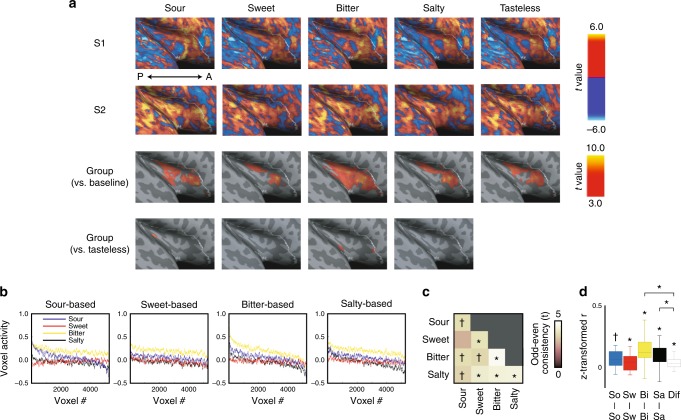
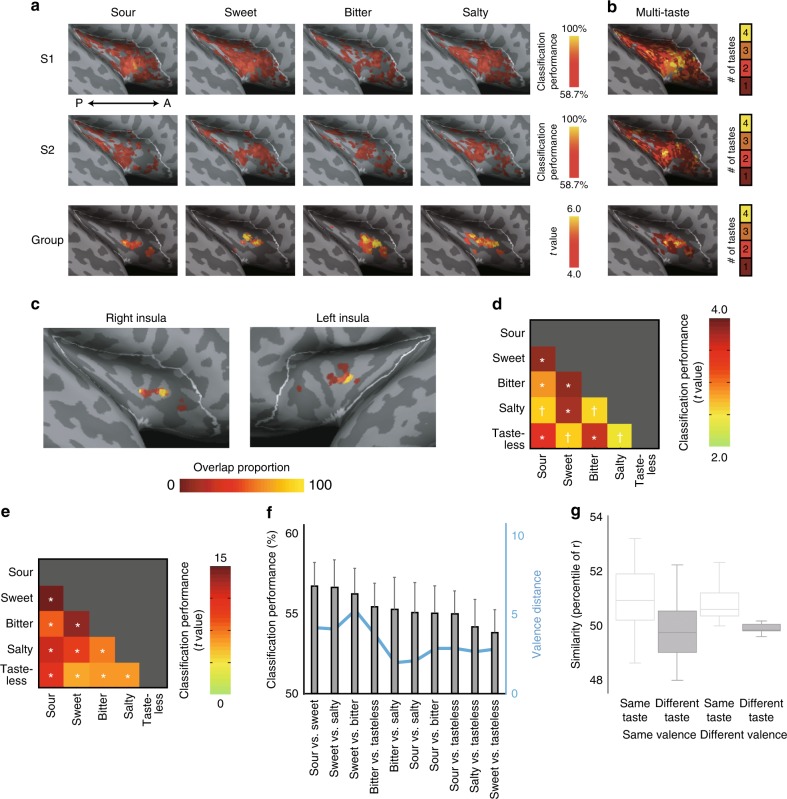
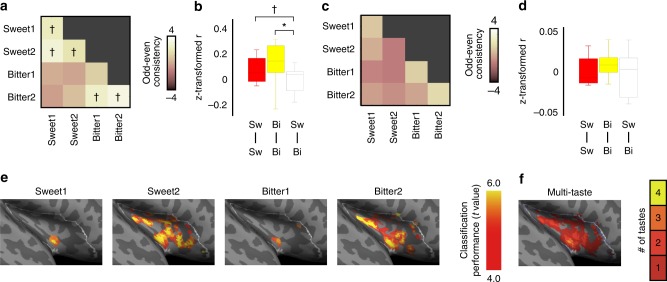
The mammalian tongue contains gustatory receptors tuned to basic taste types, providing an evolutionarily old hedonic compass for what and what not to ingest. Although representation of these distinct taste types is a defining feature of primary gustatory cortex in other animals, their identification has remained elusive in humans, leaving the demarcation of human gustatory cortex unclear. Here we used distributed multivoxel activity patterns to identify regions with patterns of activity differentially sensitive to sweet, salty, bitter, and sour taste qualities. These were found in the insula and overlying operculum, with regions in the anterior and middle insula discriminating all tastes and representing their combinatorial coding. These findings replicated at super-high 7 T field strength using different compounds of sweet and bitter taste types, suggesting taste sensation specificity rather than chemical or receptor specificity. Our results provide evidence of the human gustatory cortex in the insula.
Overview
The claims and statistics of this paper haven’t been checked yet.
Free: it reads the open-access text and checks the first 5 claims that cite a source we can check. Create a free account to check every claim.
Integrity signals
Registry
Cites
Statistics
Figures
Verification
Claims the paper makes
The claims and statistics of this paper haven’t been checked yet.
Free: it reads the open-access text and checks the first 5 claims that cite a source we can check. Create a free account to check every claim.
Self-check
Percentages, sums and reported differences re-computed from the paper’s own numbers.
The self-check needs the paper’s full text.
Citations
Cites
Cortical Surface-Based Analysis
Dale, A. M., Fischl, B., & Sereno, M. I. (1999) · NeuroImage · doi:10.1006/nimg.1998.0395 · Cited by 10,910
How do you feel — now? The anterior insula and human awareness
(Bud) Craig, A. D. (2009) · Nature Reviews Neuroscience · doi:10.1038/nrn2555 · Cited by 6,657
Distributed and overlapping representations of faces and objects in ventral temporal cortex
Haxby, J. V., Gobbini, M. I., Furey, M. L., Ishai, A., Schouten, J. L., & Pietrini, P. (2001) · Science · doi:10.1126/science.1063736 · Cited by 3,940
Information-based functional brain mapping
Kriegeskorte, N., Goebel, R., & Bandettini, P. (2006) · Proceedings of the National Academy of Sciences · doi:10.1073/pnas.0600244103 · Cited by 2,113
Self-citationValid conjunction inference with the minimum statistic
Nichols, T., Brett, M., Andersson, J., Wager, T., & Poline, J.-B. (2005) · NeuroImage · doi:10.1016/j.neuroimage.2004.12.005 · Cited by 1,880
Decoding the visual and subjective contents of the human brain
Kamitani, Y., & Tong, F. (2005) · Nature Neuroscience · doi:10.1038/nn1444 · Cited by 1,829
Berridge, K. C., & Kringelbach, M. L. (2015) · Neuron · doi:10.1016/j.neuron.2015.02.018 · Cited by 1,730
The Receptors for Mammalian Sweet and Umami Taste
Zhao, G. Q., Zhang, Y., Hoon, M. A., Chandrashekar, J., Erlenbach, I., Ryba, N. J. P., & Zuker, C. S. (2003) · Cell · doi:10.1016/s0092-8674(03)00844-4 · Cited by 1,340
The Cerebral Cortex of Man: A Clinical Study of Localization of Function
(1968) · JAMA: The Journal of the American Medical Association · doi:10.1001/jama.1968.03150020096041 · Cited by 1,214
Dissociated neural representations of intensity and valence in human olfaction
Anderson, A. K., Christoff, K., Stappen, I., Panitz, D., Ghahremani, D. G., Glover, G., Gabrieli, J. D. E., & Sobel, N. (2003) · Nature Neuroscience · doi:10.1038/nn1001 · Cited by 1,054
Self-citationPredicting the orientation of invisible stimuli from activity in human primary visual cortex
Haynes, J.-D., & Rees, G. (2005) · Nature Neuroscience · doi:10.1038/nn1445 · Cited by 867
The cells and logic for mammalian sour taste detection
Huang, A. L., Chen, X., Hoon, M. A., Chandrashekar, J., Guo, W., Tränkner, D., Ryba, N. J. P., & Zuker, C. S. (2006) · Nature · doi:10.1038/nature05084 · Cited by 808
Dissociation of Neural Representation of Intensity and Affective Valuation in Human Gustation
Small, D. M., Gregory, M. D., Mak, Y. E., Gitelman, D., Mesulam, M. M., & Parrish, T. (2003) · Neuron · doi:10.1016/s0896-6273(03)00467-7 · Cited by 788
Steiner, J. E., Glaser, D., Hawilo, M. E., & Berridge, K. C. (2001) · Neuroscience & Biobehavioral Reviews · doi:10.1016/s0149-7634(00)00051-8 · Cited by 752
The cells and peripheral representation of sodium taste in mice
Chandrashekar, J., Kuhn, C., Oka, Y., Yarmolinsky, D. A., Hummler, E., Ryba, N. J. P., & Zuker, C. S. (2010) · Nature · doi:10.1038/nature08783 · Cited by 694
In bad taste: evidence for the oral origins of moral disgust
Chapman, H. A., Kim, D. A., Susskind, J. M., & Anderson, A. K. (2009) · Science · doi:10.1126/science.1165565 · Cited by 691
Self-citationThe receptors and coding logic for bitter taste
Mueller, K. L., Hoon, M. A., Erlenbach, I., Chandrashekar, J., Zuker, C. S., & Ryba, N. J. P. (2005) · Nature · doi:10.1038/nature03352 · Cited by 524
Mirror-Symmetric Tonotopic Maps in Human Primary Auditory Cortex
Formisano, E., Kim, D.-S., Di Salle, F., van de Moortele, P.-F., Ugurbil, K., & Goebel, R. (2003) · Neuron · doi:10.1016/s0896-6273(03)00669-x · Cited by 486
Individual faces elicit distinct response patterns in human anterior temporal cortex
Kriegeskorte, N., Formisano, E., Sorger, B., & Goebel, R. (2007) · Proceedings of the National Academy of Sciences · doi:10.1073/pnas.0705654104 · Cited by 485
Self-citationComparison of multivariate classifiers and response normalizations for pattern-information fMRI
Misaki, M., Kim, Y., Bandettini, P. A., & Kriegeskorte, N. (2010) · NeuroImage · doi:10.1016/j.neuroimage.2010.05.051 · Cited by 458
Self-citationMapping human visual cortex with positron emission tomography
Fox, P. T., Mintun, M. A., Raichle, M. E., Miezin, F. M., Allman, J. M., & Van Essen, D. C. (1986) · Nature · doi:10.1038/323806a0 · Cited by 422
A Gustotopic Map of Taste Qualities in the Mammalian Brain
Chen, X., Gabitto, M., Peng, Y., Ryba, N. J. P., & Zuker, C. S. (2011) · Science · doi:10.1126/science.1204076 · Cited by 379
Turner, R. (2002) · NeuroImage · doi:10.1006/nimg.2002.1082 · Cited by 365
Tonotopic Organization in Human Auditory Cortex Revealed by Progressions of Frequency Sensitivity
Talavage, T. M., Sereno, M. I., Melcher, J. R., Ledden, P. J., Rosen, B. R., & Dale, A. M. (2004) · Journal of Neurophysiology · doi:10.1152/jn.01125.2002 · Cited by 341
Population coding of affect across stimuli, modalities and individuals
Chikazoe, J., Lee, D. H., Kriegeskorte, N., & Anderson, A. K. (2014) · Nature Neuroscience · doi:10.1038/nn.3749 · Cited by 309
Self-citationProjections of thalamic gustatory and lingual areas in the monkey, Macaca fascicularis
Pritchard, T. C., Hamilton, R. B., Morse, J. R., & Norgren, R. (1986) · Journal of Comparative Neurology · doi:10.1002/cne.902440208 · Cited by 294
Sweet and bitter taste in the brain of awake behaving animals
Peng, Y., Gillis-Smith, S., Jin, H., Tränkner, D., Ryba, N. J. P., & Zuker, C. S. (2015) · Nature · doi:10.1038/nature15763 · Cited by 244
Identification of human gustatory cortex by activation likelihood estimation
Veldhuizen, M. G., Albrecht, J., Zelano, C., Boesveldt, S., Breslin, P., & Lundström, J. N. (2011) · Human Brain Mapping · doi:10.1002/hbm.21188 · Cited by 193
Differential Spatial Representation of Taste Modalities in the Rat Gustatory Cortex
Accolla, R., Bathellier, B., Petersen, C. C. H., & Carleton, A. (2007) · The Journal of Neuroscience · doi:10.1523/jneurosci.5188-06.2007 · Cited by 191
Veldhuizen, M. G., Bender, G., Constable, R. T., & Small, D. M. (2007) · Chemical Senses · doi:10.1093/chemse/bjm025 · Cited by 190
Sanides, F. (1968) · Brain Research · doi:10.1016/0006-8993(68)90174-1 · Cited by 180
Signaling in the Chemosensory Systems: Bitter taste receptors and human bitter taste perception
Behrens, M., & Meyerhof, W. (2006) · Cellular and Molecular Life Sciences · doi:10.1007/s00018-006-6113-8 · Cited by 172
Schoenfeld, M. A., Neuer, G., Tempelmann, C., Schüßler, K., Noesselt, T., Hopf, J., & Heinze, H. –. (2004) · Neuroscience · doi:10.1016/j.neuroscience.2004.05.024 · Cited by 168
Connectivity-based parcellation reveals interhemispheric differences in the insula
András, J., Molnár, P., Bogner, P., Béresová, M., & Berényi, E. L. (2011) · Brain Topography · doi:10.1007/s10548-011-0205-y · Cited by 145
Spatio-temporal Analysis of Cortical Activity Evoked by Gustatory Stimulation in Humans
Kobayakawa, T. (1999) · Chemical Senses · doi:10.1093/chemse/24.2.201 · Cited by 145
How Are You Feeling? Revisiting the Quantification of Emotional Qualia
Kron, A., Goldstein, A., Lee, D. H.-J., Gardhouse, K., & Anderson, A. K. (2013) · Psychological Science · doi:10.1177/0956797613475456 · Cited by 108
Self-citationTaste Quality Decoding Parallels Taste Sensations
Crouzet, S. M., Busch, N. A., & Ohla, K. (2015) · Current Biology · doi:10.1016/j.cub.2015.01.057 · Cited by 105
Functional MRI Detection of Activation in the Primary Gustatory Cortices in Humans
Ogawa, H., Wakita, M., Hasegawa, K., Kobayakawa, T., Sakai, N., Hirai, T., Yamashita, Y., & Saito, S. (2005) · Chemical Senses · doi:10.1093/chemse/bji052 · Cited by 89
Ogawa, H., Ito, S.-I., & Nomura, T. (1985) · Neuroscience Research · doi:10.1016/0168-0102(85)90017-3 · Cited by 61
Modality general and modality specific coding of hedonic valence
Miskovic, V., & Anderson, A. K. (2018) · Current Opinion in Behavioral Sciences · doi:10.1016/j.cobeha.2017.12.012 · Cited by 61
Self-citationMapping Brain Activity in Response to Taste Stimulation
Small, D. M., & Faurion, A. (2015) · Wiley eBooks · doi:10.1002/9781118971758.ch35 · Cited by 10
Cited by
SARS-CoV-2 is associated with changes in brain structure in UK Biobank
Douaud, G., Lee, S., Alfaro-Almagro, F., Arthofer, C., Wang, C., McCarthy, P., Lange, F., Andersson, J. L. R., Griffanti, L., Duff, E., et al. (2022) · Nature · doi:10.1038/s41586-022-04569-5 · Cited by 1,646
Shi, Y., Pu, D., Zhou, X., & Zhang, Y. (2022) · Foods · doi:10.3390/foods11213408 · Cited by 229
“Furthermore, a recent neuroimaging study showed that the human cerebral cortex had spatially distinct but overlapping cortical activations for each taste quality, with umami taste in the anterior insula overlapping with the effects of salt and sour stimuli [121].”
BackgroundThe Insular Cortex: An Interface Between Sensation, Emotion and Cognition
Zhang, R., Deng, H., & Xiao, X. (2024) · Neuroscience Bulletin · doi:10.1007/s12264-024-01211-4 · Cited by 158
Taste Quality Representation in the Human Brain
Avery, J. A., Liu, A. G., Ingeholm, J. E., Riddell, C. D., Gotts, S. J., & Martin, A. (2020) · The Journal of Neuroscience · doi:10.1523/jneurosci.1751-19.2019 · Cited by 127
“In fact, some evidence for this possibility in the human brain has recently been reported (Chikazoe et al., 2019).”
BackgroundMethodInfluentialEmotional Objectivity: Neural Representations of Emotions and Their Interaction with Cognition
Todd, R. M., Miskovic, V., Chikazoe, J., & Anderson, A. K. (2019) · Annual Review of Psychology · doi:10.1146/annurev-psych-010419-051044 · Cited by 130
Self-citation
Metadata
- Authors
- Chikazoe, J., Lee, D. H., Kriegeskorte, N., & Anderson, A. K.
- Affiliations
- Cornell University (US)
- University of Colorado Boulder (US)
- Columbia University (US)
- Corresponding author
- Chikazoe, Junichi
- Anderson, Adam K.
- Venue
- Nature Communications
- Published
- 2019-03-05
- Volume
- 10
- Issue
- 1
- Pages
- 1048-1048
- ISSN
- 2041-1723 (ISSN-L)
- PMC
- PMC6401093
- OpenAlex
- W2918641206
- Cited by
- 98
- References
- 41
- Citations by year
- 2026: 10 · 2025: 17 · 2024: 13 · 2023: 9 · 2022: 10 · 2021: 19 · 2020: 14 · 2019: 6
- FWCI
- 9.32
- Type
- journal article
- Language
- en
- Open access
- gold
- doi.org
- Licence
- cc-by
- creativecommons.org/licenses/by/4.0 (tdm)
- creativecommons.org/licenses/by/4.0 (vor)
- Locations
- Nature Communications (publishedVersion, cc-by)
- Europe PMC (PubMed Central) (publishedVersion, cc-by)
- PubMed Central (publishedVersion, cc-by)
- PubMed (publishedVersion)
- RePEc: Research Papers in Economics (submittedVersion)
- DOAJ (DOAJ: Directory of Open Access Journals) (submittedVersion)
- DOAJ (DOAJ: Directory of Open Access Journals) (submittedVersion, cc-by-sa)
- Funders
- Takeda Science Foundation
- Canadian Institutes of Health Research
- Japan Society for the Promotion of Science (17H06033, 18H05017)
- Topics
- Health Sciences › Nursing › Nutrition and Dietetics › Biochemical Analysis and Sensing Techniques
- Life Sciences › Neuroscience › Sensory Systems › Olfactory and Sensory Function Studies
- Life Sciences › Neuroscience › Cognitive Neuroscience › Tactile and Sensory Interactions
- Keywords
- gustatory cortex, basic taste, insula, operculum, sweet taste, salty taste, bitter taste, sour taste, taste coding, human brain mapping, 7T MRI
- MeSH terms
- Adult, Brain Mapping, Cerebral Cortex, Female, Humans, Magnetic Resonance Imaging, Male, Taste, Taste Buds, Taste Perception, Young Adult
About these checks
Registry, retraction, Cites and statistics results are computed, not judged, with one exception: a printed reference that no index lists is read once by a model before it counts as a citation error. Claims are extracted by a model and kept only when their quote appears verbatim in the text; each cited source is then checked, with a model’s help, for whether it says what the claim relies on. Those verdicts can be wrong — read the claim’s quote and the cited source before relying on one.
Statistics and arithmetic are recomputed, not judged.
Confidence bands are shown only for fields calibrated on our annotated test set. None is calibrated yet, so no band is shown.
What counts as a claim ›How we measure confidence ›How we check this ›
Are you an author, or do you see a problem with this page? Request a review
Data sources
Bibliographic data: Semantic Scholar, OpenAlex, Crossref.
Contains information from the Semantic Scholar Academic Graph Datasets, made available under the ODC Attribution License (ODC-BY 1.0).
Semantic Scholar’s data is described in: Kinney, R., et al. (2023). The Semantic Scholar Open Data Platform. arXiv:2301.10140.
