

Deep brain stimulation of the internal capsule enhances human cognitive control and prefrontal cortex function
Open accessThe DOI matches its Crossref record; 71 of the 71 references it cites were found in a registry or an index.
Abstract
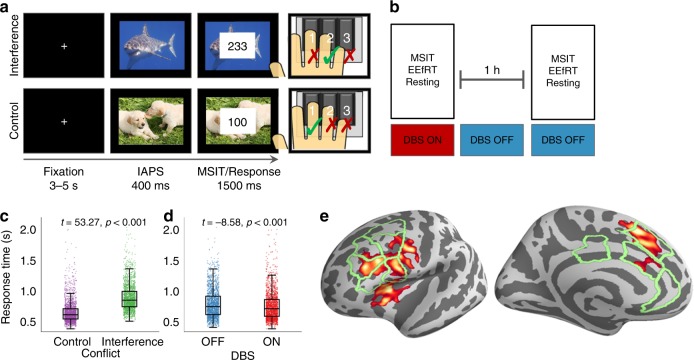
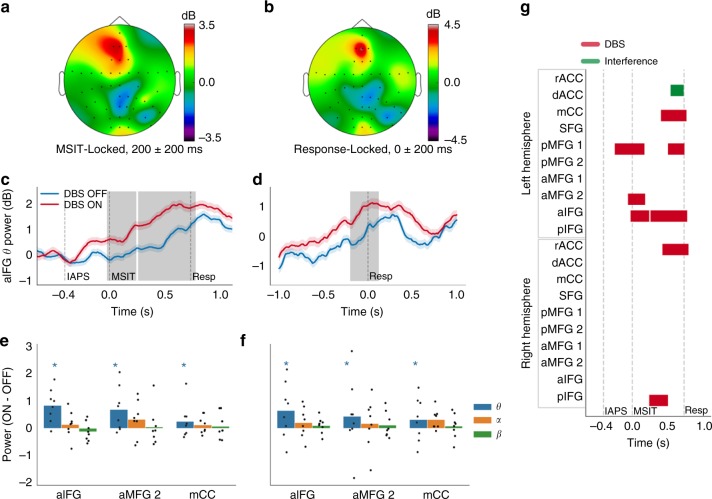
Deep brain stimulation (DBS) is a circuit-oriented treatment for mental disorders. Unfortunately, even well-conducted psychiatric DBS clinical trials have yielded inconsistent symptom relief, in part because DBS’ mechanism(s) of action are unclear. One clue to those mechanisms may lie in the efficacy of ventral internal capsule/ventral striatum (VCVS) DBS in both major depression (MDD) and obsessive-compulsive disorder (OCD). MDD and OCD both involve deficits in cognitive control. Cognitive control depends on prefrontal cortex (PFC) regions that project into the VCVS. Here, we show that VCVS DBS’ effect is explained in part by enhancement of PFC-driven cognitive control. DBS improves human subjects’ performance on a cognitive control task and increases theta (5–8Hz) oscillations in both medial and lateral PFC. The theta increase predicts subjects’ clinical outcomes. Our results suggest a possible mechanistic approach to DBS therapy, based on tuning stimulation to optimize these neurophysiologic phenomena.
Overview
The claims and statistics of this paper haven’t been checked yet.
Free: it reads the open-access text and checks the first 5 claims that cite a source we can check. Create a free account to check every claim.
Integrity signals
Registry
Cites
Statistics
Figures
Verification
Claims the paper makes
The claims and statistics of this paper haven’t been checked yet.
Free: it reads the open-access text and checks the first 5 claims that cite a source we can check. Create a free account to check every claim.
Claims other papers make about this one
Each is checked against this paper’s own text: does it say what the citing paper says it does?
The source backs part of the claim, not all of it — or backs it for a different population, condition or comparison.
In the citing paper
“DBS of the ventral capsule/ventral striatum, which modulates CSTC loops including the CN and OFC (233, 234)”
From Neural mechanisms underlying cognitive inflexibility in obsessive-compulsive disorder: a review (2026) · cites this paper as [234]
Experimental — accuracy not yet measuredThe source backs part of the claim, not all of it — or backs it for a different population, condition or comparison.
In the citing paper
“improve cognitive inflexibility in refractory OCD patients (234)”
From Neural mechanisms underlying cognitive inflexibility in obsessive-compulsive disorder: a review (2026) · cites this paper as [234]
Experimental — accuracy not yet measuredIn the citing paper
“Another recent study also indicated that ventral cognitive circuit function can be improved by ventral capsular/ventral striatal (VC/VS) DBS targeting the ALIC [132].”
From Toward a neurocircuit-based taxonomy to guide treatment of obsessive-compulsive disorder (2021) · cites this paper as [132]
In the citing paper
“Widge et al. [132] found that stimulation at this target resulted in significantly greater theta oscillations in prefrontal regions, including the IFG, during an inhibition task in patients with OCD and/or depression.”
From Toward a neurocircuit-based taxonomy to guide treatment of obsessive-compulsive disorder (2021) · cites this paper as [132]
Self-check
Percentages, sums and reported differences re-computed from the paper’s own numbers.
The self-check needs the paper’s full text.
Citations
Cites
Measuring emotion: The self-assessment manikin and the semantic differential
Bradley, M. M., & Lang, P. J. (1994) · Journal of Behavior Therapy and Experimental Psychiatry · doi:10.1016/0005-7916(94)90063-9 · Cited by 9,538
Fischl, B. (2012) · NeuroImage · doi:10.1016/j.neuroimage.2012.01.021 · Cited by 9,526
Nonparametric statistical testing of EEG- and MEG-data
Maris, E., & Oostenveld, R. (2007) · Journal of Neuroscience Methods · doi:10.1016/j.jneumeth.2007.03.024 · Cited by 8,496
Whiteford, H. A., Degenhardt, L., Rehm, J., Baxter, A. J., Ferrari, A. J., Erskine, H. E., Charlson, F. J., Norman, R. E., Flaxman, A. D., Johns, N., et al. (2013) · The Lancet · doi:10.1016/s0140-6736(13)61611-6 · Cited by 6,006
Hämäläinen, M., Hari, R., Ilmoniemi, R. J., Knuutila, J., & Lounasmaa, O. V. (1993) · Reviews of Modern Physics · doi:10.1103/revmodphys.65.413 · Cited by 4,684
MEG and EEG data analysis with MNE-Python
Gramfort, A. (2013) · Frontiers in Neuroscience · doi:10.3389/fnins.2013.00267 · Cited by 3,784
Frontal theta as a mechanism for cognitive control
Cavanagh, J. F., & Frank, M. J. (2014) · Trends in Cognitive Sciences · doi:10.1016/j.tics.2014.04.012 · Cited by 2,726
Rhythms for cognition: communication through coherence
Fries, P. (2015) · Neuron · doi:10.1016/j.neuron.2015.09.034 · Cited by 2,725
A hybrid approach to the skull stripping problem in MRI
Ségonne, F., Dale, A. M., Busa, E., Glessner, M., Salat, D., Hahn, H. K., & Fischl, B. (2004) · NeuroImage · doi:10.1016/j.neuroimage.2004.03.032 · Cited by 2,212
Which elements are excited in electrical stimulation of mammalian central nervous system: A review
Ranck, J. B. (1975) · Brain Research · doi:10.1016/0006-8993(75)90364-9 · Cited by 2,024
Cited by
Items 101–150 of 150
Neuronatomy, Prefrontal Association Cortex
Hika, B., & Khalili, Y. A. (2019) · StatPearls · Cited by 3
Challenges in deep brain stimulation for depression
Fenoy, A. J. (2020) · Brazilian Journal of Psychiatry · doi:10.1590/1516-4446-2020-0878 · Cited by 3
Hein, T. P., Gong, Z., Ivanova, M., Fedele, T., Nikulin, V. V., & Ruiz, M. H. (2022) · bioRxiv (Cold Spring Harbor Laboratory) · doi:10.1101/2022.05.24.493280 · Cited by 4
“…labels: (1) rostral and caudal ACC (Figure 3A); (2) lateral and medial OFC, which include the vmPFC according to some MEG studies (Yuan et al., 2021; Morey et al., 2016; Nopoulos et al., 2010; Figure 3B); (3) superior frontal gyrus (SFG), representing the dmPFC (Widge et al., 2019; Figure 3B).”
BackgroundMethodVaghi, M. M. S., Nørgaard, M., Shim, S., Rios, J. A. H., Bissett, P. G., Rodríguez, C. I., & Poldrack, R. A. (2025) · bioRxiv (Cold Spring Harbor Laboratory) · doi:10.1101/2025.05.21.654808 · Cited by 10
“For instance, both transcranial magnetic stimulation 74 and deep brain stimulation 35,75 are promising treatment avenues for OCD.”
Tractography-Based Deep Brain Stimulation for Obsessive-Compulsive Disorder
Meyer, G. M., & Mosley, P. E. (2024) · Biological Psychiatry · doi:10.1016/j.biopsych.2024.05.009 · Cited by 4
Identifying Relational Applications of Deep Brain Stimulation for Treatment Resistant Depression
Paz, A. W. (2023) · Review of Philosophy and Psychology · doi:10.1007/s13164-023-00681-1 · Cited by 2
“However, it has been argued that this failure may not depend on a lack of efficacy of this treatment, but rather on a limited mechanistic understanding of TRD, which makes difficult to determine when patients got an “effective dose” (Widge et al. 2019a).”
InfluentialZhou, W., Long, F., Long, F., & Zhou, R. (2024) · Biological Psychology · doi:10.1016/j.biopsycho.2024.108742 · Cited by 3
Spiliotis, K., Köhling, R., Just, W., & Starke, J. (2024) · Frontiers in Network Physiology · doi:10.3389/fnetp.2024.1399347 · Cited by 4
Neural decoding and feature selection methods for closed-loop control of avoidance behavior
Liu, J., Younk, R., Drahos, L. M., Nagrale, S. S., Yadav, S., Widge, A. S., & Shoaran, M. (2024) · Journal of Neural Engineering · doi:10.1088/1741-2552/ad8839 · Cited by 6
“There exists a main challenge for developing such closed-loop BMIs: we need a neural decoder that is capable of estimating the disorder symptom or behavior in real-time [37–39].”
BackgroundSelf-citationPrefrontal Network Mechanisms of Psychiatric Deep Brain Stimulation
Glewwe, N., Grissom, N. M., & Widge, A. S. (2025) · Journal of Neuroscience · doi:10.1523/jneurosci.1944-24.2025 · Cited by 4
Self-citationPaulk, A., Zelmann, R., Crocker, B., Widge, A., Dougherty, D., Eskandar, E., Weisholtz, D., Richardson, R., Cosgrove, G., Williams, Z. M., et al. (2021) · bioRxiv · doi:10.1101/2021.10.07.463524 · Cited by 2
Self-citationLesion network localization of functional and somatic symptomsPreprint
Milano, B. A., Palm, S. T., Burke, M. J., Drew, W., Kletenik, I., Pines, A. R., Corbetta, M., Grafman, J. H., Downar, J. H., & Siddiqi, S. (2025) · medRxiv · doi:10.1101/2025.03.06.25323494 · Cited by 2
Missey, F., Jouval-Missey, E., Silva, M. D. A. E., Arantes, A., Lubrano, C., Trajlínek, J., Klus, S., Studnička, O., Violante, I. R., Boly, M., et al. (2025) · bioRxiv (Cold Spring Harbor Laboratory) · doi:10.1101/2025.09.22.677714 · Cited by 5
“…Neisser et al., 2022), clinical avenues include targeted enhancement of memory in health and disease and, conversely, disruption of maladaptive memory encoding (e.g., post-traumatic stress), provided parameters are precisely timed and individualized (Laxton et al., 2013; Widge et al., 2019).”
Neural dynamics of cognitive control: Current tensions and future promise
Zhou, D., Cosme, D., Kang, Y., Stanoi, O. A., Lydon‐Staley, D. M., Mucha, P. J., Falk, E. B., Ochsner, K. N., & Bassett, D. S. (2026) · Neuroscience & Biobehavioral Reviews · doi:10.1016/j.neubiorev.2026.106909 · Cited by 2
Rijn, E. M. D.-V., Mensinger, M. E., Dougherty, D. D., & Widge, A. S. (2026) · Elsevier eBooks · doi:10.1016/b978-0-323-99742-3.00015-1 · Cited by 2
Self-citationChiu, J. Z.-Y., Yap, Y. H. Y., & Tan, S.-H. (2026) · The International Journal of Psychiatry in Medicine · doi:10.1177/00912174261435019 · Cited by 1
Protecting Decision-Making in the Era of Neuromodulation
Medaglia, J. D., Kuersten, A., & Hamilton, R. H. (2020) · Journal of Cognitive Enhancement · doi:10.1007/s41465-020-00171-7 · Cited by 4
Koppula, A., Jain, A., Ganguly, S., Chaitanya Srinivas, L. V., & Sridharan, K. S. (2023) · Asian Conference on Innovation in Technology (ASIANCON) · doi:10.1109/asiancon58793.2023.10270545 · Cited by 1
Mechanisms and Targeting of Deep-Brain Stimulation Therapies
Brinda, A. K., & Johnson, M. D. (2023) · Handbook of Neuroengineering · doi:10.1007/978-981-16-5540-1_133 · Cited by 2
Pre-trial predictors of conflict response efficacy in human dorsolateral prefrontal cortexPreprint
Herman, A. B., Smith, E. H., Schevon, C. A., Yates, M. J., McKhann, G. M., Botvinick, M., Hayden, B. Y., & Sheth, S. A. (2021) · bioRxiv (Cold Spring Harbor Laboratory) · doi:10.1101/2021.07.07.451322 · Cited by 1
Unraveling the therapeutic mechanism of deep-brain stimulationPreprint
van den Boom, B. J. G., Fernandez, A. E., Rasmussen, P. A., van Beest, E. H., Parthasarathy, A., Denys, D. A. J. P., & Willuhn, I. (2022) · bioRxiv (Cold Spring Harbor Laboratory) · doi:10.1101/2022.12.23.521799 · Cited by 1
Cross-species modeling and enhancement of cognitive control with striatal brain stimulationPreprint
Reimer, A. E., Rijn, E. M. D.-V., Kim, J., Mensinger, M. E., Sachse, E. M., Wald, A., Hoskins, E., Singh, K., Alpers, A., Cooper, D., et al. (2024) · bioRxiv (Cold Spring Harbor Laboratory) · doi:10.1101/2024.02.16.580680 · Cited by 1
“The stimulation related decrease in reaction time was fully explained by unique contributions from boundary separation (91%, HDI=[70,112]) and drift rate (10%, HDI=[-8,28]) with negligible effects from the interaction between these or other parameters.”
BackgroundInfluentialSelf-citationShekara, A., Ross, A., Soper, D. J., Paulk, A. C., Cash, S. S., Widge, A. S., Shear, P. K., Sheehy, J. P., & Basu, I. (2024) · bioRxiv (Cold Spring Harbor Laboratory) · doi:10.1101/2024.10.10.617540 · Cited by 1
Self-citationKim, J., & Widge, A. S. (2025) · bioRxiv (Cold Spring Harbor Laboratory) · doi:10.1101/2025.10.15.682151 · Cited by 1
Self-citationRijn, E. M. D.-V., Sachse, E. M., Buccini, M. C., Angstadt, B., Bennek, J. P., Mensinger, M. E., & Widge, A. S. (2025) · bioRxiv (Cold Spring Harbor Laboratory) · doi:10.64898/2025.12.30.697057 · Cited by 2
“Both invasive modalities such as DBS and non-invasive modalities such as transcranial magnetic stimulation (TMS) can improve cognitive control task performance, in both diagnosed patients and healthy volunteers [12,13].”
InfluentialSelf-citationmPFC axons drive cognitive control enhancement during striatal stimulationPreprint
Sachse, E. M., Rijn, E. M. D.-V., Bennek, J. P., Buccini, M. C., Mensinger, M. E., Angstadt, B., Iacobucci, F. A., Esguerra, M., & Widge, A. S. (2026) · bioRxiv (Cold Spring Harbor Laboratory) · doi:10.64898/2026.04.07.717020 · Cited by 4
Self-citationNeural mechanisms underlying cognitive inflexibility in obsessive-compulsive disorder: a review
Guo, W., Neo, P. S.-H., & McNaughton, N. (2026) · Frontiers in Psychiatry · doi:10.3389/fpsyt.2026.1795436
“…DBS of the ventral capsule/ventral striatum, which modulates CSTC loops including the CN and OFC (233, 234), has been shown to normalize hyperconnectivity (235) and improve cognitive in fl exibility in refractory OCD patients (234), with response rates up to 60% in long-term follow-ups (236).”
Probing Network Mechanisms of Brain Stimulation in the Mood Circuit
Ezzyat, Y. (2020) · Neuron · doi:10.1016/j.neuron.2020.08.008
Competing and Interfering Conflict: Insights from Decision-Making TasksPreprint
He, X., Qiu, B., Cheng, Y., Liu, T., Wang, S., & Zhang, W. (2021) · Research Square · doi:10.21203/rs.3.rs-512403/v1
“Conflict paradigms are the most common way to investigate cognitive control (Botvinick, 2001; Fröber et al., 2017; Widge et al., 2019; Hübner & Töbel, 2019).”
BackgroundCooper, D. C. (2021) · University of Minnesota Digital Conservancy (University of Minnesota)
DBS imaging methods IV: Group analyses
Treu, S., & Horn, A. (2021) · Elsevier eBooks · doi:10.1016/b978-0-12-821861-7.00003-8
Mechanisms and Targeting of Deep-Brain Stimulation Therapies
Brinda, A. K., & Johnson, M. D. (2022) · Handbook of Neuroengineering · doi:10.1007/978-981-15-2848-4_133-1
Hein, T. I. A., Gong, Z., Ivanova, M., Fedele, T., Nikulin, V. V., & Ruiz, M. H. (2022) · Research Square · doi:10.21203/rs.3.rs-1895307/v1
Neurosurgery in Obsessive Compulsive Disorder: From targets to treatment to tracts and back again
van der Vlis, T. A. M. B. (2022) · Research Publications (Maastricht University) · doi:10.26481/dis.20221006tb
Bayesian methods for optimizing deep brain stimulation to enhance cognitive controlPreprint
Nagrale, S. S., Yousefi, A., Netoff, T. I., & Widge, A. S. (2022) · bioRxiv (Cold Spring Harbor Laboratory) · doi:10.1101/2022.12.14.520473
Self-citationHaier, R. J., Colom, R., & Hunt, E. B. (2023) · Cambridge University Press eBooks · doi:10.1017/9781108569576.014
Zhao, R., He, J., Chen, J., & Nie, Y. (2024) · SSRN Electronic Journal · doi:10.2139/ssrn.4788736
Neural Decoding and Feature Selection Techniques for Closed-Loop Control of Defensive BehaviorPreprint
Liu, J., Younk, R., Drahos, L. M., Nagrale, S. S., Yadav, S., Widge, A. S., & Shoaran, M. (2024) · bioRxiv (Cold Spring Harbor Laboratory) · doi:10.1101/2024.06.06.597165
Self-citationWang, Y., Han, Z., Wang, C., Liu, J., Guo, J., Miao, P., Wei, Y., Wu, L., Wang, X., Wang, P., et al. (2024) · Computers in Biology and Medicine · doi:10.1016/j.compbiomed.2024.108712
RetractedAscenzi, B. M., Caldas, G. D. C., Frati, A., Santoro, A., & Palmieri, M. (2024) · Elsevier eBooks · doi:10.1016/b978-0-12-822404-5.00021-8
Filho, I. A. D. C., Hoexter, M. Q., Godinho, F. L. F., Iglésio, R., Studart, I., Alencar, I. C., Benigno, K. G., & Lopes, A. C. (2024) · Neurocase · doi:10.1080/13554794.2024.2441942
“This was evidenced by greater theta wave oscillations in prefrontal areas, including the IFG, observed during an inhibition task in patients with OCD and/or depression (Widge et al., 2019).”
Common but different: An ERP study of single- and multi-source interference processing in MSIT
Paluch, K., Antonova, I., Nikadon, J., Dzianok, P., Jurewicz, K., Wojciechowski, J., & Kublik, E. (2026) · NeuroImage · doi:10.1016/j.neuroimage.2026.122030 · Cited by 1
Zhang, W., Xiong, B., Shen, D., & Wang, W. (2026) · BMC Psychiatry · doi:10.1186/s12888-025-07681-8
“Anterior limb of internal capsule (ALIC) has also been investigated in individual clinical studies and randomized clinical trials (RCTs) [7–9].”
Bayesian optimization to select electrical stimulation parameters for neuromodulation
Netoff, T. I., Sanger, Z. T., Eiting, S., Farooqi, H., Dembny, K., Haag, E., & Nagrale, S. S. (2026) · Elsevier eBooks · doi:10.1016/b978-0-443-26466-5.00017-9
Implication of the locus coeruleus in effort processing : electrophysiological studies
Bornert, P. (2021) · theses.fr (ABES) · doi:10.70675/665d6bd7ze2f5z41c9z93f8z764be3c6d822
Neuronaukowe podstawy inteligencji
Haier, R. J., Kabziński, P., & Mąka, S. (2026) · Wydawnictwo Uniwersytetu Łódzkiego eBooks · doi:10.18778/8331-892-9
Wong, K. S., Nagrale, S. S., Pipia, V. L., Sachse, E. M., Rijn, E. M. D.-V., Kim, J., Eiting, S., McInnes, A. N., Palnitkar, T., Chandrasekaran, J., et al. (2026) · bioRxiv (Cold Spring Harbor Laboratory) · doi:10.64898/2026.06.08.730545 · Cited by 2
“We first evaluated behavioral performance by analyzing trial-level RTs across stimulation conditions (StimOFF, LeftStim, RightStim) and trial types (congruent, non-congruent) using gamma-distributed generalized linear mixed-effects models (GLMs), as used previously (6,28).”
InfluentialSelf-citationHamre, T. A., Kutcher, T., Hanish, R. R., Soubra, S. S., Bentley, H., Mansourian, K. A., Nitcheu, G. L. T., Belavadi, V., Chamarthi, S., Jourahmad, Z., et al. (2026) · medRxiv · doi:10.64898/2026.07.20.26357997 · Cited by 1
Cognitive state dependent enhancement of cognitive control with transcranial magnetic stimulation
McInnes, A. N., Pipia, V. L., Maynard, K. L., Kalender, G., & Widge, A. S. (2026) · Brain stimulation · doi:10.1016/j.brs.2026.103227 · Cited by 1
Self-citationZhang, W., Guo, L., Gan, H., Sang, W., Ye, Y., Tang, C., Wu, X., Zhao, D., Zhao, M., & Jiang, H. (2026) · Psychiatry and Clinical Neurosciences · doi:10.1111/pcn.70149
Metadata
- Authors
- Widge, A. S., Zorowitz, S., Basu, I., Paulk, A. C., Cash, S. S., Eskandar, E. N., Deckersbach, T., Miller, E. K., & Dougherty, D. D.
- Affiliations
- University of Minnesota (US)
- Harvard University (US)
- Albert Einstein College of Medicine (US)
- Massachusetts Institute of Technology (US)
- Corresponding author
- Widge, A. S.
- ORCID
- Venue
- Nature Communications
- Published
- 2019-04-04
- Volume
- 10
- Issue
- 1
- Pages
- 1536-1536
- ISSN
- 2041-1723 (ISSN-L)
- PMC
- PMC6449385
- OpenAlex
- W2931590275
- Semantic Scholar
- 67b7edefa6e9da27b4f9996fc8dd0a0e9ef879d2
- Cited by
- 152
- References
- 71
- Citations by year
- 2026: 15 · 2025: 13 · 2024: 23 · 2023: 22 · 2022: 12 · 2021: 38 · 2020: 17 · 2019: 11
- FWCI
- 13.07
- Type
- journal article
- Language
- en
- Open access
- gold
- doi.org
- Licence
- cc-by
- creativecommons.org/licenses/by/4.0 (tdm)
- creativecommons.org/licenses/by/4.0 (vor)
- Locations
- Nature Communications (publishedVersion, cc-by)
- Europe PMC (PubMed Central) (publishedVersion, cc-by)
- PubMed Central (publishedVersion, cc-by)
- PubMed (publishedVersion)
- DSpace@MIT (Massachusetts Institute of Technology) (submittedVersion, cc-by-nc)
- RePEc: Research Papers in Economics (submittedVersion)
- DOAJ (DOAJ: Directory of Open Access Journals) (submittedVersion)
- DOAJ (DOAJ: Directory of Open Access Journals) (submittedVersion, cc-by-sa)
- Funders
- U.S. Department of Defense (MURI N00014-16-1-2832, W911NF1420045, N000141612832)
- National Institutes of Health
- Defense Advanced Research Projects Agency (W911NF-14, W911NF-14–2–0045, 2-0045)
- Advanced Research Projects Agency
- Multidisciplinary University Research Initiative (N00014-16-1-2832)
- Office of Naval Research (MURI N00014‐16‐1‐2832, N00014-16-1–2832, N00014)
- National Institute of Mental Health (R37MH087027, R21MH109722, R03MH111320)
- National Institute of Neurological Disorders and Stroke (UH3NS100548)
- Army Research Office (W911NF)
- Topics
- Health Sciences › Medicine › Clinical Neurology › Deep Brain Stimulation and Movement Disorders
- Social Sciences › Psychology › Clinical Psychology › Obsessive-Compulsive Spectrum Disorders
- Life Sciences › Neuroscience › Neurology › Transcranial Magnetic Stimulation Studies
- Keywords
- deep brain stimulation, cognitive control, prefrontal cortex, theta oscillations, major depressive disorder, obsessive-compulsive disorder, mechanism of action, psychosurgery
- MeSH terms
- Adult, Aged, Cognition, Major Depressive Disorder, Female, Humans, Male, Middle Aged, Obsessive-Compulsive Disorder, Treatment Outcome, Prefrontal Cortex, Internal Capsule, Deep Brain Stimulation
About these checks
Registry, retraction, Cites and statistics results are computed, not judged, with one exception: a printed reference that no index lists is read once by a model before it counts as a citation error. Claims are extracted by a model and kept only when their quote appears verbatim in the text; each cited source is then checked, with a model’s help, for whether it says what the claim relies on. Those verdicts can be wrong — read the claim’s quote and the cited source before relying on one.
Statistics and arithmetic are recomputed, not judged.
Confidence bands are shown only for fields calibrated on our annotated test set. None is calibrated yet, so no band is shown.
What counts as a claim ›How we measure confidence ›How we check this ›
Are you an author, or do you see a problem with this page? Request a review
Data sources
Bibliographic data: Semantic Scholar, OpenAlex, Crossref.
Contains information from the Semantic Scholar Academic Graph Datasets, made available under the ODC Attribution License (ODC-BY 1.0).
Semantic Scholar’s data is described in: Kinney, R., et al. (2023). The Semantic Scholar Open Data Platform. arXiv:2301.10140.
