

Repeat vaccination reduces antibody affinity maturation across different influenza vaccine platforms in humans
Open accessThe DOI matches its Crossref record; 51 of the 51 references it cites were found in a registry or an index.
Abstract
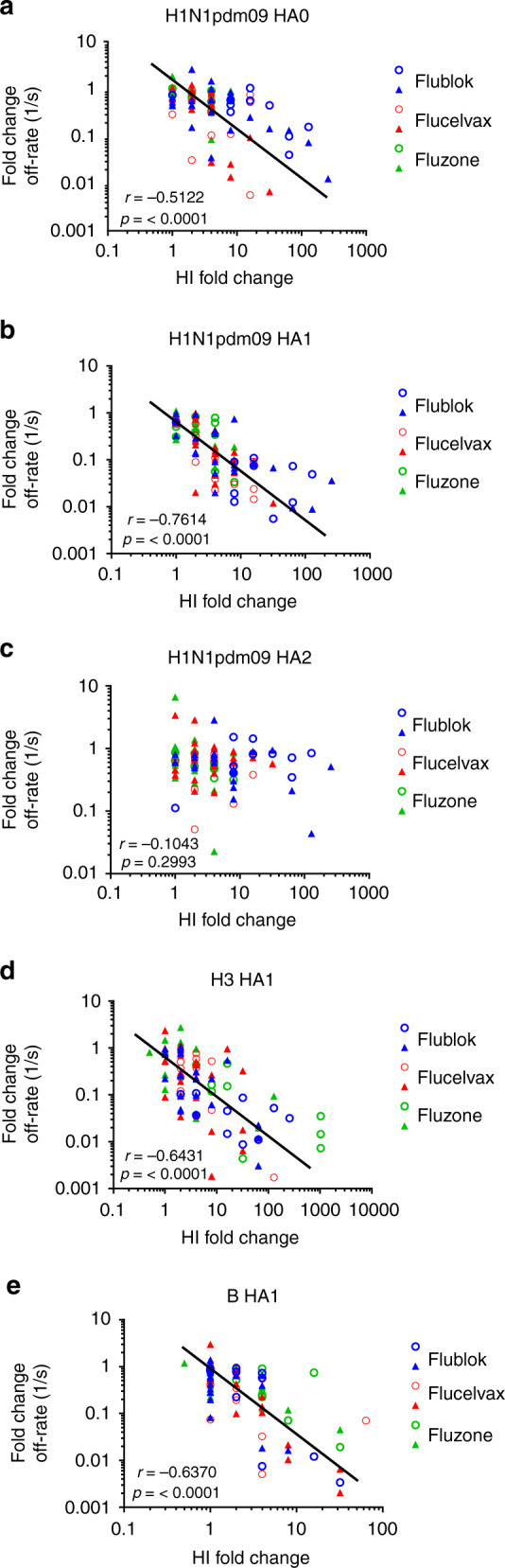
Several vaccines are approved in the United States for seasonal influenza vaccination every year. Here we compare the impact of repeat influenza vaccination on hemagglutination inhibition (HI) titers, antibody binding and affinity maturation to individual hemagglutinin (HA) domains, HA1 and HA2, across vaccine platforms. Fold change in HI and antibody binding to HA1 trends higher for H1N1pdm09 and H3N2 but not against B strains in groups vaccinated with FluBlok compared with FluCelvax and Fluzone. Antibody-affinity maturation occurs against HA1 domain of H1N1pdm09, H3N2 and B following vaccination with all vaccine platforms, but not against H1N1pdm09-HA2. Importantly, prior year vaccination of subjects receiving repeat vaccinations demonstrated reduced antibody-affinity maturation to HA1 of all three influenza virus strains irrespective of the vaccine platform. This study identifies an important impact of repeat vaccination on antibody-affinity maturation following vaccination, which may contribute to lower vaccine effectiveness of seasonal influenza vaccines in humans.
Overview
The claims and statistics of this paper haven’t been checked yet.
Free: it reads the open-access text and checks the first 5 claims that cite a source we can check. Create a free account to check every claim.
Integrity signals
Registry
Cites
Statistics
Figures


Verification
Claims the paper makes
The claims and statistics of this paper haven’t been checked yet.
Free: it reads the open-access text and checks the first 5 claims that cite a source we can check. Create a free account to check every claim.
Claims other papers make about this one
Each is checked against this paper’s own text: does it say what the citing paper says it does?
In the citing paper
“Recent work has shown adults have high H3N2 and B subtype memory due to prior exposure by vaccination or infection (Khurana et al., 2019).”
From Antibiotics-Driven Gut Microbiome Perturbation Alters Immunity to Vaccines in Humans (2019) · cites this paper as Khurana et al., 2019
Self-check
Percentages, sums and reported differences re-computed from the paper’s own numbers.
The self-check needs the paper’s full text.
Citations
Cites
1 retracted
Khurana, S., Verma, S., Verma, N., Crevar, C. J., Carter, D. M., Manischewitz, J., King, L. R., Ross, T. M., & Golding, H. (2010) · PLoS ONE · doi:10.1371/journal.pone.0011548 · Cited by 96
RetractedVictora, G. D., & Nussenzweig, M. C. (2012) · Annual Review of Immunology · doi:10.1146/annurev-immunol-020711-075032 · Cited by 1,878
Wiley, D. C., Wilson, I. A., & Skehel, J. J. (1981) · Nature · doi:10.1038/289373a0 · Cited by 1,615
Antibody Recognition of a Highly Conserved Influenza Virus Epitope
Ekiert, D. C., Bhabha, G., Elsliger, M.-A., Friesen, R. H. E., Jongeneelen, M., Throsby, M., Goudsmit, J., & Wilson, I. A. (2009) · Science · doi:10.1126/science.1171491 · Cited by 1,326
Throsby, M., van den Brink, E., Jongeneelen, M., Poon, L. L. M., Alard, P., Cornelissen, L., Bakker, A., Cox, F., van Deventer, E., Guan, Y., et al. (2008) · PLoS ONE · doi:10.1371/journal.pone.0003942 · Cited by 737
Zost, S. J., Parkhouse, K., Gumina, M. E., Kim, K., Diaz Perez, S., Wilson, P. C., Treanor, J. J., Sant, A. J., Cobey, S., & Hensley, S. E. (2017) · Proceedings of the National Academy of Sciences · doi:10.1073/pnas.1712377114 · Cited by 563
Self-citationVictora, G. D., Dominguez-Sola, D., Holmes, A. B., Deroubaix, S., Dalla-Favera, R., & Nussenzweig, M. C. (2012) · Blood · doi:10.1182/blood-2012-03-415380 · Cited by 411
High affinity germinal center B cells are actively selected into the plasma cell compartment
Phan, T. G., Paus, D., Chan, T. D., Turner, M. L., Nutt, S. L., Basten, A., & Brink, R. (2006) · The Journal of Experimental Medicine · doi:10.1084/jem.20061254 · Cited by 404
Khurana, S., Verma, N., Yewdell, J. W., Hilbert, A. K., Castellino, F., Lattanzi, M., Del Giudice, G., Rappuoli, R., & Golding, H. (2011) · Science Translational Medicine · doi:10.1126/scitranslmed.3002336 · Cited by 356
Ohmit, S. E., Thompson, M. G., Petrie, J. G., Thaker, S. N., Jackson, M. L., Belongia, E. A., Zimmerman, R. K., Gaglani, M., Lamerato, L., Spencer, S. M., et al. (2014) · Clinical Infectious Diseases · doi:10.1093/cid/cit736 · Cited by 343
Cited by
Antibiotics-Driven Gut Microbiome Perturbation Alters Immunity to Vaccines in Humans
Hagan, T., Cortese, M., Rouphael, N., Boudreau, C., Linde, C., Maddur, M. S., Das, J., Wang, H., Guthmiller, J., Zheng, N.-Y., et al. (2019) · Cell · doi:10.1016/j.cell.2019.08.010 · Cited by 572
“Recent work has shown adults have high H3N2 and B subtype memory due to prior exposure by vaccination or infection (Khurana et al., 2019).”
BackgroundSelf-citationTrombetta, C. M., Kistner, O., Montomoli, E., Viviani, S., & Marchi, S. (2022) · Vaccines · doi:10.3390/vaccines10050714 · Cited by 164
Who and when to vaccinate against influenza
Buchy, P., & Badur, S. (2020) · International Journal of Infectious Diseases · doi:10.1016/j.ijid.2020.02.040 · Cited by 122
Challenges of Making Effective Influenza Vaccines
Gouma, S., Anderson, E. M., & Hensley, S. E. (2020) · Annual Review of Virology · doi:10.1146/annurev-virology-010320-044746 · Cited by 106
“2A H3N2 viral strain and samples from the same cohort were unable to detect these differences (88).”
BackgroundRyu, S., & Cowling, B. J. (2020) · Cold Spring Harbor Perspectives in Medicine · doi:10.1101/cshperspect.a038356 · Cited by 141
“fusion of changes in antibody titer following vaccination versus infection (Chen et al. 2018; Khurana et al. 2019).”
BackgroundInfluential
Metadata
- Authors
- Khurana, S., Hahn, M., Coyle, E. M., King, L. R., Lin, T.-L., Treanor, J., Sant, A., & Golding, H.
- Affiliations
- Center for Biologics Evaluation and Research (US)
- University of Rochester Medicine (US)
- Corresponding author
- Khurana, Surender
- Venue
- Nature Communications
- Published
- 2019-07-26
- Volume
- 10
- Issue
- 1
- Pages
- 3338-3338
- ISSN
- 2041-1723 (ISSN-L)
- PMC
- PMC6659679
- OpenAlex
- W2966564986
- Cited by
- 101
- References
- 51
- Citations by year
- 2026: 10 · 2025: 10 · 2024: 12 · 2023: 14 · 2022: 19 · 2021: 19 · 2020: 11 · 2019: 5
- FWCI
- 10.47
- Type
- journal article
- Language
- en
- Open access
- gold
- doi.org
- Licence
- cc-by
- creativecommons.org/licenses/by/4.0 (tdm)
- creativecommons.org/licenses/by/4.0 (vor)
- Locations
- Nature Communications (publishedVersion, cc-by)
- PubMed Central (publishedVersion, cc-by)
- PubMed (publishedVersion)
- RePEc: Research Papers in Economics (submittedVersion)
- DOAJ (DOAJ: Directory of Open Access Journals) (submittedVersion, cc-by-sa)
- DOAJ (DOAJ: Directory of Open Access Journals) (submittedVersion)
- Funders
- U.S. Department of Health & Human Services | NIH | National Institute of Allergy and Infectious Diseases (CEIRS Contract No. HHSN272201400005C)
- Topics
- Health Sciences › Medicine › Epidemiology › Influenza Virus Research Studies
- Life Sciences › Biochemistry, Genetics and Molecular Biology › Molecular Biology › vaccines and immunoinformatics approaches
- Health Sciences › Medicine › Epidemiology › Respiratory viral infections research
- Keywords
- affinity maturation, hemagglutination inhibition, Fluzone, H1N1pdm09, H3N2, influenza B, vaccine effectiveness
- MeSH terms
- Adolescent, Adult, Antibodies, Viral, Antibody Affinity, Child, Child, Preschool, Female, Hemagglutination Inhibition Tests, Humans, Infant, Influenza, Human, Influenza Vaccines, Male, Middle Aged, Vaccination, Hemagglutinin Glycoproteins, Influenza Virus, Influenza A Virus, H1N1 Subtype, Influenza A Virus, H3N2 Subtype, Young Adult
About these checks
Registry, retraction, Cites and statistics results are computed, not judged, with one exception: a printed reference that no index lists is read once by a model before it counts as a citation error. Claims are extracted by a model and kept only when their quote appears verbatim in the text; each cited source is then checked, with a model’s help, for whether it says what the claim relies on. Those verdicts can be wrong — read the claim’s quote and the cited source before relying on one.
Statistics and arithmetic are recomputed, not judged.
Confidence bands are shown only for fields calibrated on our annotated test set. None is calibrated yet, so no band is shown.
What counts as a claim ›How we measure confidence ›How we check this ›
Are you an author, or do you see a problem with this page? Request a review
How to cite
Cite CoChat for the checks on this page, and the paper for its own findings.
- This page
- CoChat. (2026). Citation check: Repeat vaccination reduces antibody affinity maturation across different influenza vaccine platforms in humans. https://app.cochat.ai/papers/10.1038/s41467-019-11296-5
- The paper
- Khurana, S., Hahn, M., Coyle, E. M., King, L. R., Lin, T.-L., Treanor, J., Sant, A., & Golding, H. (2019). Repeat vaccination reduces antibody affinity maturation across different influenza vaccine platforms in humans. Nature Communications. https://doi.org/10.1038/s41467-019-11296-5
Data sources
Bibliographic data: Semantic Scholar, OpenAlex, Crossref.
Contains information from the Semantic Scholar Academic Graph Datasets, made available under the ODC Attribution License (ODC-BY 1.0).
Semantic Scholar’s data is described in: Kinney, R., et al. (2023). The Semantic Scholar Open Data Platform. arXiv:2301.10140.
