

Metabolic landscape of the tumor microenvironment at single cell resolution
Open accessThe DOI matches its Crossref record; 67 of the 67 references it cites were found in a registry or an index.
Abstract
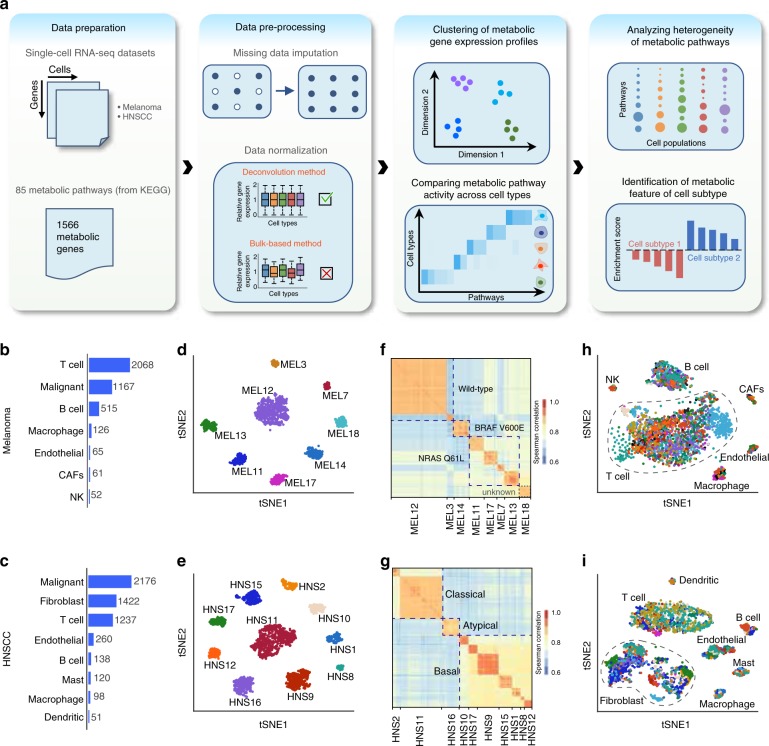
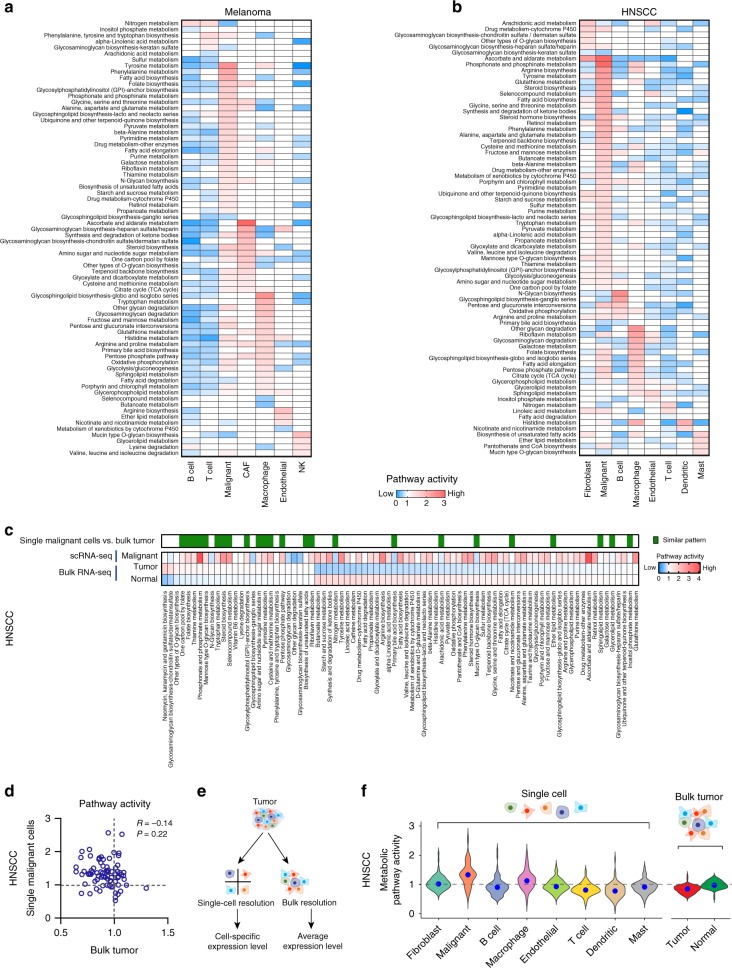
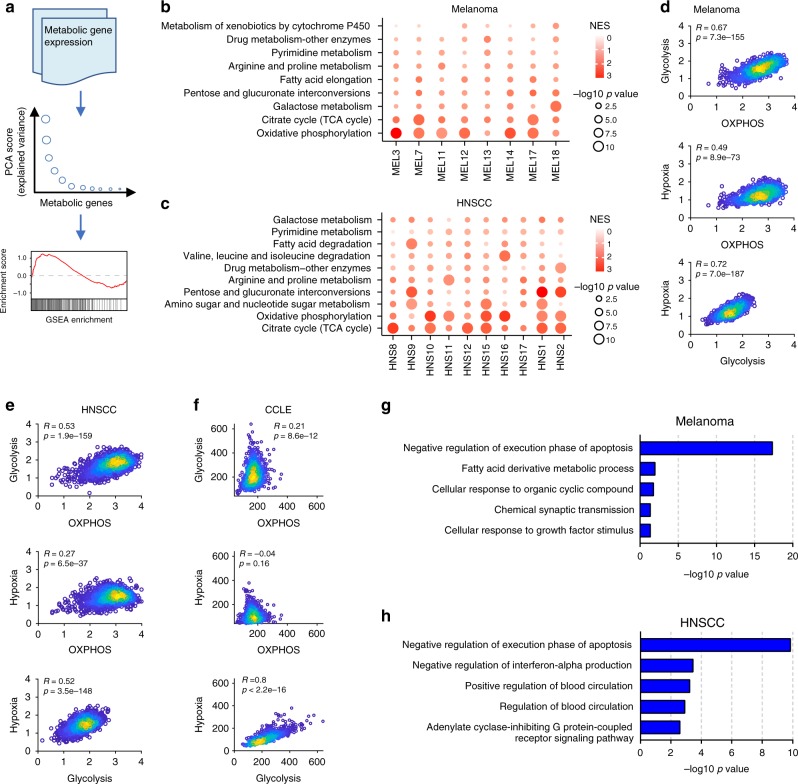
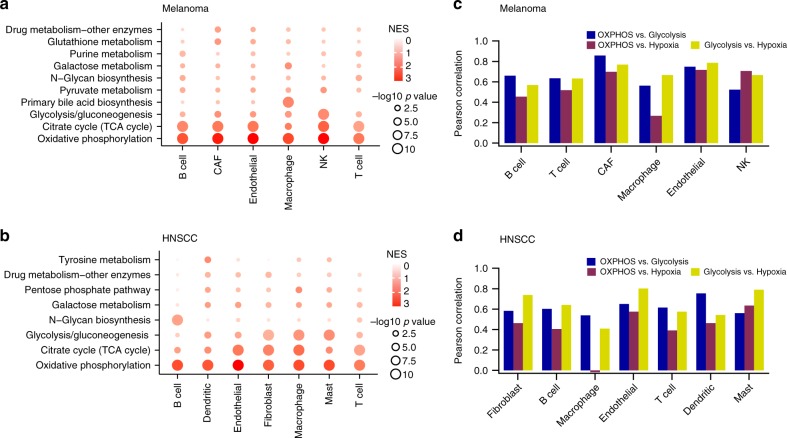
The tumor milieu consists of numerous cell types each existing in a different environment. However, a characterization of metabolic heterogeneity at single-cell resolution is not established. Here, we develop a computational pipeline to study metabolic programs in single cells. In two representative human cancers, melanoma and head and neck, we apply this algorithm to define the intratumor metabolic landscape. We report an overall discordance between analyses of single cells and those of bulk tumors with higher metabolic activity in malignant cells than previously appreciated. Variation in mitochondrial programs is found to be the major contributor to metabolic heterogeneity. Surprisingly, the expression of both glycolytic and mitochondrial programs strongly correlates with hypoxia in all cell types. Immune and stromal cells could also be distinguished by their metabolic features. Taken together this analysis establishes a computational framework for characterizing metabolism using single cell expression data and defines principles of the tumor microenvironment.
Overview
The claims and statistics of this paper haven’t been checked yet.
Free: it reads the open-access text and checks the first 5 claims that cite a source we can check. Create a free account to check every claim.
Integrity signals
Registry
Cites
Statistics
Figures
Verification
Claims the paper makes
The claims and statistics of this paper haven’t been checked yet.
Free: it reads the open-access text and checks the first 5 claims that cite a source we can check. Create a free account to check every claim.
Claims other papers make about this one
Each is checked against this paper’s own text: does it say what the citing paper says it does?
The cited source says what the claim attributes to it.
In the citing paper
“Additionally, a significant correlation has been found between glycolysis, mitochondrial metabolism and local oxygen concentrations in a study conducted on human melanoma and head and neck cancers [236].”
From Tumor microenvironment signaling and therapeutics in cancer progression (2023) · cites this paper as [236]
Self-check
Percentages, sums and reported differences re-computed from the paper’s own numbers.
The self-check needs the paper’s full text.
Citations
Cites
Moderated estimation of fold change and dispersion for RNA-seq data with DESeq2
Love, M. I., Huber, W., & Anders, S. (2014) · Genome Biology · doi:10.1186/s13059-014-0550-8 · Cited by 95,106
Hallmarks of Cancer: The Next Generation
Hanahan, D., & Weinberg, R. A. (2011) · Cell · doi:10.1016/j.cell.2011.02.013 · Cited by 66,590
Subramanian, A., Tamayo, P., Mootha, V. K., Mukherjee, S., Ebert, B. L., Gillette, M. A., Paulovich, A., Pomeroy, S. L., Golub, T. R., Lander, E. S., et al. (2005) · Proceedings of the National Academy of Sciences · doi:10.1073/pnas.0506580102 · Cited by 53,625
Robinson, M. D., McCarthy, D. J., & Smyth, G. K. (2010) · Bioinformatics · doi:10.1093/bioinformatics/btp616 · Cited by 41,364
(2008) · Journal of Machine Learning Research · Cited by 33,051
Differential expression analysis for sequence count data
Anders, S., & Huber, W. (2010) · Genome Biology · doi:10.1186/gb-2010-11-10-r106 · Cited by 15,581
The cancer genome atlas pan-cancer analysis project
The Cancer Genome Atlas Research Network, Weinstein, J. N., Collisson, E. A., Mills, G. B., Shaw, K. R. M., Ozenberger, B. A., Ellrott, K., Shmulevich, I., Sander, C., & Stuart, J. M. (2013) · Nature Genetics · doi:10.1038/ng.2764 · Cited by 9,092
The Cancer Cell Line Encyclopedia enables predictive modelling of anticancer drug sensitivity
Barretina, J., Caponigro, G., Stransky, N., Venkatesan, K., Margolin, A. A., Kim, S., Wilson, C. J., Lehár, J., Kryukov, G. V., Sonkin, D., et al. (2012) · Nature · doi:10.1038/nature11003 · Cited by 7,950
The emerging hallmarks of cancer metabolism
Pavlova, N. N., & Thompson, C. B. (2016) · Cell Metabolism · doi:10.1016/j.cmet.2015.12.006 · Cited by 5,926
Regulatory T Cells and Immune Tolerance
Sakaguchi, S., Yamaguchi, T., Nomura, T., & Ono, M. (2008) · Cell · doi:10.1016/j.cell.2008.05.009 · Cited by 5,325
Cited by
Items 201–300 of 533
Metabolic heterogeneity in tumor microenvironment – A novel landmark for immunotherapy
Chen, C., Han, P., & Qing, Y. (2024) · Autoimmunity Reviews · doi:10.1016/j.autrev.2024.103579 · Cited by 17
Identification of potential biomarkers for lung adenocarcinoma
Sayeeram, D., Katte, T. V., Bhatia, S., Kumar, A. J., Kumar, A., Jayashree, G., Rachana, D. S., Reddy, H. V. N., Rasalkar, A. A., Malempati, R., et al. (2020) · Heliyon · doi:10.1016/j.heliyon.2020.e05452 · Cited by 17
“Many of these genes are involved in the regulation of cell cycle, metabolism and energy pathways (Figure 7B) which are shown to have significant importance in the context of cancer [30, 31].”
BackgroundZipper, L., Batchu, S., Kaya, N. H., Antonello, Z. A., & Reiff, T. (2022) · Metabolites · doi:10.3390/metabo12040315 · Cited by 20
“was used with the input and deconvolutionnormalized values [92].”
BackgroundMethodOffermans, K., Reitsam, N. G., Simons, C. C. J. M., Grosser, B., Zimmermann, J., Grabsch, H. I., Märkl, B., & van den Brandt, P. A. (2024) · Cancer & Metabolism · doi:10.1186/s40170-024-00349-z · Cited by 17
“Due to this close metabolic cross-talk between tumour and surrounding cells [40–42], it is conceivable that a Warburg-high subtype in the tumour centre could be to some part causally relevant for a lack of desmoplasia and/or intervening inflammatory infiltrate in SARIFA-positive cancers.”
BackgroundTerao, T., Machida, Y., Hirata, K., Kuzume, A., Tabata, R., Tsushima, T., Miura, D., Narita, K., Takeuchi, M., Tateishi, U., et al. (2021) · Clinical Nuclear Medicine · doi:10.1097/rlu.0000000000003773 · Cited by 17
“Another explanation for the possibility that the MH-SUVmax lesion may contain a more heterogeneous population could be the degree of glycolysis in single cells.(27) For example, patients with MM with lower hexokinase-2 expression, a glycolytic enzyme, showed false-negative (18)F-FDG PET and better prognosis.”
BackgroundS100A4-dependent glycolysis promotes lymphatic vessel sprouting in tumor
Li, A., Zhu, L., Lei, N., Wan, J., Duan, X., Liu, S., Cheng, Y., Wang, M., Gu, Z., Zhang, H., et al. (2022) · Angiogenesis · doi:10.1007/s10456-022-09845-6 · Cited by 19
“Moreover, evidence shows that glycolysis strongly correlates with melanoma hypoxia [58, 59].”
BackgroundMitochondrial inhibitors: a new horizon in breast cancer therapy
Yan, Y., Li, S., Su, L., Tang, X., Chen, X., Gu, X., Yang, G., Chi, H., & Huang, S. (2024) · Frontiers in Pharmacology · doi:10.3389/fphar.2024.1421905 · Cited by 18
“In a single-cell assessment of gene expression of tumor metabolic enzymes, mitochondrial enzymes were found to exhibit the highest variability in the same tumor (Xiao et al., 2019).”
BackgroundNew insights into the roles of lactylation in cancer
Zhu, Y. E., Liu, W., Luo, Z., Xiao, F., & Sun, B. (2024) · Frontiers in Pharmacology · doi:10.3389/fphar.2024.1412672 · Cited by 17
Russo, E., Lemaître, F., Corre, B., Chikina, A. S., Vives, F. L., & Bousso, P. (2022) · The EMBO Journal · doi:10.15252/embj.2022111528 · Cited by 19
“Metabolic genes can be analyzed by single-cell transcriptomics to provide information regarding energetic pathways in individual cells (Xiao et al , 2019).”
Shi, J., Wu, Z., Wu, X., Huangfu, L., Guo, T., Cheng, X., Han, J., Li, Z., Xing, X., & Ji, J. (2023) · iScience · doi:10.1016/j.isci.2023.106214 · Cited by 19
Wang, X., Zhou, M., & Jiang, L. (2023) · Annals of Translational Medicine · doi:10.21037/atm-22-6637 · Cited by 18
“The TME, including immune cells and stromal cells, has been shown to be closely related to immunotherapy (31,32).”
Tumour Immunotherapy and Applications of Immunological Products: A Review of Literature
Oli, A. N., Adejumo, S. A., Rowaiye, A. B., Ogidigo, J. O., Hampton‐Marcell, J., & Ibeanu, G. C. (2024) · Journal of Immunology Research · doi:10.1155/2024/8481761 · Cited by 18
“The tumor microenvironment (TME) is crucial in tumorigenesis, as nonmalignant cells in the TME accelerate uncontrolled cell proliferation [7].”
BackgroundWang, J., Han, Q., Liu, H., Luo, H., Li, L., Liu, A., & Jiang, Y. (2021) · Frontiers in Molecular Biosciences · doi:10.3389/fmolb.2021.624575 · Cited by 17
Kiesworo, K., Agius, T., MacArthur, M. R., Lambelet, M., Lyon, A., Zhang, J., Turiel, G., Fan, Z., D'Almeida, S. M., Uygun, K., et al. (2024) · iScience · doi:10.1016/j.isci.2024.111656 · Cited by 20
Metabolism in the tumor microenvironment: insights from single-cell analysis
Xiao, Z., Locasale, J. W., & Dai, Z. (2020) · OncoImmunology · doi:10.1080/2162402x.2020.1726556 · Cited by 17
“To fill this gap, we recently developed a computational framework for analyzing metabolic gene expression profiles based on scRNA-seq data, and applied this workflow to scRNA-seq datasets from two human cancers, melanoma, and head and neck.(1) Our study defines the metabolic landscape in TME from three aspects: (1) th…”
MethodBenchmarking computational methods for B-cell receptor reconstruction from single-cell RNA-seq data
Andreani, T., Slot, L. M., Gabillard, S., Strübing, C., Reimertz, C., Veeranagouda, Y., Bakker, A. M., Olfati-Saber, R., Toes, R. E. M., Scherer, H. U., et al. (2022) · NAR Genomics and Bioinformatics · doi:10.1093/nargab/lqac049 · Cited by 16
Deciphering Metabolic Adaptability of Leukemic Stem Cells
Patel, S. B., Nemkov, T. G., D’Alessandro, A., & Welner, R. S. (2022) · Frontiers in Oncology · doi:10.3389/fonc.2022.846149 · Cited by 16
“They combine global metabolic gene expression with dimensional reductionists model and clustering algorithm to determine the metabolic gene expression profile of individual cells in head and neck tumors and melanoma (100).”
MethodHan, X., Wang, B., Situ, C., Qi, Y., Zhu, H., Li, Y., & Guo, X. (2023) · PLoS Biology · doi:10.1371/journal.pbio.3002369 · Cited by 20
You, S., Han, X., Xu, Y., Sui, L., Song, K., & Yao, Q. (2024) · Cancer Medicine · doi:10.1002/cam4.7217 · Cited by 17
Tumor-Associated Macrophages—Implications for Molecular Oncology and Imaging
Kimm, M. A., Klenk, C., Alunni‐Fabbroni, M., Kästle, S., Stechele, M., Ricke, J., Eisenblätter, M., & Wildgruber, M. (2021) · Biomedicines · doi:10.3390/biomedicines9040374 · Cited by 20
“During tumor growth, the TME constantly develops further and at any time point encompasses a heterogeneous landscape [17,18].”
BackgroundZhang, S., Chen, W., Wang, Y., Wu, J., Xu, L., Yu, Y., Tian, J., Xu, R., Fang, Z., Jiang, L., et al. (2021) · Oxidative Medicine and Cellular Longevity · doi:10.1155/2021/6673828 · Cited by 15
“Inflammatory cytokines serve the role of communicators in the tumor microenvironment, which are together with immune cells in regulating the TIME and playing an important role in the occurrence and development of lung cancer [32].”
BackgroundInfluentialInterplay between Epigenetics and Cellular Metabolism in Colorectal Cancer
Zhang, X., Dong, Z., & Cui, H. (2021) · Biomolecules · doi:10.3390/biom11101406 · Cited by 14
Shen, J., Liu, T., Lv, J., & Xu, S. (2021) · Frontiers in Cell and Developmental Biology · doi:10.3389/fcell.2021.746932 · Cited by 16
Rejili, M. (2025) · Pathology - Research and Practice · doi:10.1016/j.prp.2025.156244 · Cited by 15
Zhang, Y., Sun, S., Qi, Y., Dai, Y., Hao, Y., Xin, M., Xu, R., Chen, H., Wu, X., Liu, Q., et al. (2023) · Journal of Ovarian Research · doi:10.1186/s13048-023-01270-7 · Cited by 14
“1B, C; Supplementary Figure S2A-C), which may be caused by the patient’s unique physiological environment, including location-specific characteristics and nutrient supply [25].”
BackgroundMethodYin, R., Zhai, X., Han, H., Tong, X., Li, Y., & Deng, K. (2022) · Immunity Inflammation and Disease · doi:10.1002/iid3.608 · Cited by 14
Chauhan, P. K., & Sowdhamini, R. (2023) · Frontiers in Cardiovascular Medicine · doi:10.3389/fcvm.2023.1110119 · Cited by 14
Abecunas, C., Kidd, A. D., Jiang, Y., Zong, H., & Fallahi‐Sichani, M. (2024) · Cell Reports · doi:10.1016/j.celrep.2024.114775 · Cited by 16
“We computed a score representing the activity of each of the 85 metabolic pathways for each of the cancer types (or growth media or cell culture condition) relative to all cancer types (or all growth media or all culture conditions) using a three-step procedure adapted from Xiao et al. 29 In the first step, we calcula…”
MethodInfluentialIdentification of malignant cells in single-cell transcriptomics data
Andreatta, M., Garnica, J., & Carmona, S. J. (2025) · Communications Biology · doi:10.1038/s42003-025-08695-4 · Cited by 17
“…in melanoma and HNSCC from scRNA-seq data found that the activities of glycolysis and oxidative phosphorylation correlated with hypoxia at the single-cell level, and that in general metabolic pathways in malignant cells were more active and plastic than those in non-malignant cells 106 .”
Huang, C., Zhang, M., Zheng, Q., Yu, Q., Yang, G., Ren, W., Ma, X., La, Y., Bao, P., Chu, M., et al. (2025) · Advanced Science · doi:10.1002/advs.202514862 · Cited by 16
Wang, Y.-Y., Zhen, C., Hu, W., Huang, H.-H., Li, Y.-J., Zhou, M., Li, J., Fu, Y., Zhang, P., Li, X., et al. (2023) · Communications Biology · doi:10.1038/s42003-023-04975-z · Cited by 12
Moraly, J., Kondo, T., Benzaoui, M., DuSold, J., Talluri, S., Pouzolles, M., Chien, C. D., Dardalhon, V., & Taylor, N. N. (2024) · Molecular Oncology · doi:10.1002/1878-0261.13691 · Cited by 13
“An understanding of the metabolic genes whose expression profiles are altered in tumors may promote the design of CAR T cells that are remodeled to better function within the metabolic complexity of TME [230,231].”
BackgroundGu, J.-X., Huang, K., Zhao, W.-L., Zheng, X.-M., Wu, Y., Yan, S., Huang, Y., & Hu, P. (2024) · International Journal of Molecular Medicine · doi:10.3892/ijmm.2024.5408 · Cited by 13
Yang, J., Yang, J., Luo, Y., Ran, D., Xia, R., Zheng, Q., Yao, P., & Wang, H. (2024) · Journal of Neuroimmune Pharmacology · doi:10.1007/s11481-024-10136-8 · Cited by 11
“All the analysis methods and R packages were implemented by R version 4.0.3. p value < 0.05 was considered statistically significant (Xiao et al. 2019; Wei et al. 2020). subheadings are allowed.”
InfluentialMir, R., Javid, J., Ullah, M. F., Alrdahe, S. S., Albalawi, I. A., Mustafa, S. K., Jalal, M. M., Altayar, M. A., Albalawi, A. D., Abunab, M. K., et al. (2025) · Medical Oncology · doi:10.1007/s12032-025-02945-5 · Cited by 15
“Single-cell omics technologies have enabled the characterization of metabolic programs at unprecedented resolution, revealing the metabolic diversity among individual cells within a tumor [9].”
Zhai, X., Tang, S., Meng, F., Ma, J., Li, A., Zou, X., Zhou, B., Peng, F., & Bai, J. (2023) · Biomaterials Advances · doi:10.1016/j.bioadv.2023.213650 · Cited by 10
Zhang, N., Luo, X., Huang, J., Song, H., Zhang, X., Huang, H., Zhao, S., & Wang, G. (2021) · Briefings in Bioinformatics · doi:10.1093/bib/bbab071 · Cited by 11
The need to reassess single-cell RNA sequencing datasets: more is not always better
Ascensión, A. M., Araúzo-Bravo, M. J., & Izeta, A. (2021) · F1000Research · doi:10.12688/f1000research.54864.1 · Cited by 11
“It is well known that cells under hypoxic conditions switch from aerobic to anaerobic metabolism to keep energy homeostasis within the cell.(26-28) We therefore generated a curated list of hypoxia-related genes, and managed to separate the non-hypoxic from the hypoxic groupwith the population-matching algorithm.”
Liao, H., Du, J., Wang, H., Lan, T., Peng, J., Wu, Z., Yuan, K., & Zeng, Y. (2021) · Journal of Hematology & Oncology · doi:10.1186/s13045-021-01195-y · Cited by 13
“To explore this inter-sample heterogeneity, we quantified the activity of a metabolic pathways in each subgroup using a pathway activity score algorithm as previously described [9].”
MethodYi, C. X., Sun, R., He, M., Zhang, M., Hou, X., Sun, Y., Wang, J., Xu, J., He, H., Wang, H., et al. (2022) · International Journal of Pharmaceutics · doi:10.1016/j.ijpharm.2022.121613 · Cited by 13
Liao, G., Dai, N., Xiong, T., Wang, L., Diao, X., Xu, Z., Ni, Y., Chen, D., Jiang, A., Lin, H. M., et al. (2022) · Clinical and Translational Medicine · doi:10.1002/ctm2.874 · Cited by 13
Biswas, L., Chen, J., Angelis, J. E. D., Chatzis, A., Nanchahal, J., Dustin, M. L., Ramasamy, S. K., & Kusumbe, A. P. (2021) · bioRxiv (Cold Spring Harbor Laboratory) · doi:10.1101/2021.01.20.427385 · Cited by 12
“Discussion 3D organization of functional networks, such as blood or lymphatic vessels within organs and spatial information of cells within tissues, is important to understand the biological complexity (10, 40-43).”
BackgroundWang, Z., Qian, J., Lu, X., Zhang, P., Guo, R., Lou, H., Zhang, S., Yang, J., & Fan, X. (2021) · bioRxiv (Cold Spring Harbor Laboratory) · doi:10.1101/2021.07.06.451396 · Cited by 11
“Next, we investigated the features of metabolic pathway 508 reprogramming of NPCs in different disease groups by quantifying metabolic pathway 509 activity based on a previously described pathway activity score (26).”
MethodChen, B., Kiang, K. M. Y., Liu, F., Li, C., Li, X., Weiwei, C., Fu, X., Xiao, G., Sun, J., Da, E., et al. (2025) · Advanced Science · doi:10.1002/advs.202508478 · Cited by 18
Zhong, H., Pan, R., Ouyang, Y., Xiao, T., Gu, W., Yang, H., Wang, H., Li, H., Peng, T., & Chen, P. (2026) · Molecular Cancer · doi:10.1186/s12943-026-02571-3 · Cited by 20
“B cells are effector cells that mediate humoral immunity and exert antitumor effects within the TME in various cancers [227, 228].”
Tao, T., Feng, X., Yang, Y., Liu, B., Liang, J., Chen, Z., Wang, S., Zhao, J., Yang, X., Huo, L., et al. (2026) · Nature Cell Biology · doi:10.1038/s41556-026-01905-z · Cited by 11
Sung, J., & Cheong, J. (2022) · Cells · doi:10.3390/cells11152373 · Cited by 13
“At single-cell resolution, adenocarcinoma cells exhibit complex metabolic reprogramming compared to that of other immune cells [21].”
BackgroundTargeting mitochondrial tyrosyl-tRNA synthetase YARS2 suppresses colorectal cancer progression
Fang, Q., Lin, J., Gao, L., Pan, R., & Zheng, X. (2022) · Cancer Biology & Therapy · doi:10.1080/15384047.2022.2127603 · Cited by 11
“It is now well accepted that the microenvironment changes during the process of tumor progression, and these transformed cells experienced metabolic adaptions as a response to these alternations.(15,16) Chekkulayev et al.”
BackgroundMetabolic predictors of response to immune checkpoint blockade therapy
Shorer, O., & Yizhak, K. (2023) · iScience · doi:10.1016/j.isci.2023.108188 · Cited by 11
“31 In contrast, other pathwayssuchasnucleotidesalvagepathway,hemedegradation,andpurinesynthesis,are activeonlyinspecificcelltypes(Figure1D).”
Yang, C., Guo, L., Du, J., Zhang, Q., & Zhang, L. (2024) · Biomolecules · doi:10.3390/biom14030265 · Cited by 13
“To systematically assess the metabolic characteristics of SPINK1 -high cells, we introduced a 70-pathway metabolic panel [19].”
MethodJohn, R. K., Vogel, S. P., Zia, S., Lee, K. V., Nguyen, A. T., Espin, A. T., Fenrich, K. K., Ng, C., Schmidt, E. K. A., Vavrek, R., et al. (2025) · Journal of Neuroinflammation · doi:10.1186/s12974-025-03379-6 · Cited by 12
“2F, G, E; [58]).”
InfluentialHan, F., Cao, D., Zhu, X., Shen, L., Jia Rui, W. U., Chen, Y., Xu, Y., Xu, L., Cheng, X., & Zhang, Y. (2023) · Frontiers in Oncology · doi:10.3389/fonc.2022.972434 · Cited by 10
“According to previous studies, these mechanisms are consistent with the activity of tumor cell growth and mitochondrial metabolism (23).”
BackgroundMetabolic heterogeneity in early-stage lung adenocarcinoma revealed by RNA-seq and scRNA-seq
Zhang, Y., Shi, J. T., Luo, J., Liu, C., & Zhu, L. (2023) · Clinical & Translational Oncology · doi:10.1007/s12094-023-03082-z · Cited by 10
“cules needed for cell growth, division, and survival [35, 36].”
BackgroundMetabolic cell communication within tumour microenvironment: models, methods and perspectives
Parri, M., Ippolito, L., Cirri, P., Ramazzotti, M., & Chiarugi, P. (2020) · Current Opinion in Biotechnology · doi:10.1016/j.copbio.2020.03.001 · Cited by 10
Guo, L., Zhang, X., Pan, H., Li, Y., Wang, J., Li, L., Dong, Y., Du, X., Chen, J., & Guo, F. (2021) · Bioengineered · doi:10.1080/21655979.2021.1955511 · Cited by 11
“Tumor microenvironment includes various kinds of immune cells, including T cells, B cells, and macrophage and so on to develop a tumor immune environment [74,75].”
BackgroundSingle Cell Analysis of Gastric Cancer Reveals Non-Defined Telomere Maintenance Mechanism
Sung, J., & Cheong, J. (2022) · Cells · doi:10.3390/cells11213342 · Cited by 11
“We examined 84 metabolic pathways from the Kyoto Encyclopedia of Genes and Genomes (KEGG) database to determine their activity.”
MethodHuang, Y., Wu, G., Bi, G., Cheng, L., Liang, J., Li, M., Zhang, H., Shan, G., Hu, Z., Chen, Z., et al. (2024) · eLife · doi:10.7554/elife.95988 · Cited by 10
Hegarty, C., Neto, N. G. B., Cahill, P. A., & Floudas, A. (2023) · Computational and Structural Biotechnology Journal · doi:10.1016/j.csbj.2023.08.005 · Cited by 9
“Recently, differential gene expression and pathway enrichment analysis from scRNAseq data has been utilised to assess the activity of metabolic pathways [91].”
MethodA single-cell network approach to decode metabolic regulation in gynecologic and breast cancers
Srivastava, A., & Vinod, P. K. U. (2025) · npj Systems Biology and Applications · doi:10.1038/s41540-025-00506-0 · Cited by 12
Cell and tissue reprogramming: Unlocking a new era in medical drug discovery
Sen, C. K., Friday, A. J., & Roy, S. (2025) · Pharmacological Reviews · doi:10.1016/j.pharmr.2025.100077 · Cited by 11
Single-cell characterization revealed hypoxia-induced metabolic reprogramming of gastric cancer
Kou, W., Zhao, N., Zhao, L., Yin, Z., Zhang, M.-C., Zhang, L., Song, J., Wang, Y., Qiao, C., & Li, H. (2022) · Heliyon · doi:10.1016/j.heliyon.2022.e11866 · Cited by 10
“The weighted relative pathway activity algorithm [22, 23] was used to evaluate differences in metabolic activities among cell types.”
MethodWang, Z., Yang, L., Wang, W., Zhou, H., Chen, J., Ma, Z., Wang, X., Zhang, Q., Liu, H., Chao Hui, Z. H. O. U., et al. (2023) · Cell Communication and Signaling · doi:10.1186/s12964-023-01322-x · Cited by 13
“We’ve also noticed the opposite expression patterns of FABP3 and FABP4, two fatty acid transport related genes from one family that have distinct expression pattern in different organs [48], in the Mono-like MAC from AIS/IAC or nLung.”
BackgroundDeciphering cellular plasticity in pancreatic cancer for effective treatments
Uddin, M. H., Zhang, D., Muqbil, I., El‐Rayes, B. F., Chen, H., Philip, P. A., & Azmi, A. S. (2024) · Cancer and Metastasis Reviews · doi:10.1007/s10555-023-10164-5 · Cited by 11
“Cancer cells within a single tumor can exhibit diverse characteristics, including differences in gene expression, cell surface markers, and metabolic profiles [23–28].”
Determination of IC 50 values of anticancer drugs on cells by D 2 O – single cell Raman spectroscopy
Lv, W., Fu, B., Li, M., Kang, Y., Bai, S., & Lu, C. (2022) · Chemical Communications · doi:10.1039/d1cc06857a · Cited by 9
Zhao, Q., Zhang, T., & Yang, H. (2022) · Biochemical and Biophysical Research Communications · doi:10.1016/j.bbrc.2022.03.034 · Cited by 13
Kanda, T., Wakiya, T., Ishido, K., Kimura, N., Fujita, H., Yoshizawa, T., Goto, S., Tatara, Y., Kijima, H., & Hakamada, K. (2022) · Journal of Gastroenterology · doi:10.1007/s00535-022-01898-0 · Cited by 9
“In short, cancer metabolism demonstrates different characteristics in laboratory cell culture settings than in vivo [31].”
BackgroundShirmanova, M. V., Sinyushkina, S. D., & Komarova, A. D. (2023) · Molecular Biology · doi:10.31857/s0026898423060186 · Cited by 10
Wang, W., Li, C., Dai, Y., Wu, Q., & Yu, W. (2024) · Frontiers in Molecular Biosciences · doi:10.3389/fmolb.2024.1399679 · Cited by 8
Buckenmeyer, M. J., Brooks, E. A., Taylor, M. S., Orenuga, I. K., Yang, L., Holewinski, R. J., Meyer, T. J., Galloux, M., Garmendia‐Cedillos, M., Pohida, T. J., et al. (2025) · Cancer Research · doi:10.1158/0008-5472.can-24-1954 · Cited by 10
Chen, N., Zong, Y., Chen, Y., Li, L., Yang, Y., Zhao, J., Zhao, X., Xie, X., Sun, X., Li, N., et al. (2025) · Cancer Immunology Immunotherapy · doi:10.1007/s00262-024-03928-7 · Cited by 10
“We also confirmed the high expression of OXPHOS in malignant cells using a single-cell approach, supporting previous notions that the co-up-regulation of OXPHOS and glycolysis allowed tumor cells to compete with other cells for limited resources [50].”
He, Z., Liu, S., Shi, W., Yang, Y., Wang, J., Wang, J., Yin, J., Shen, S., Zhou, D., & Li, J. (2025) · Brain Research · doi:10.1016/j.brainres.2025.149885 · Cited by 12
Age-impaired remyelination is associated with dysregulated microglial transitions
Zia, S., Traetta, M. E., Baaklini, C. S., Hammond, B. P., John, R. K., Souter, K. M., Meijns, N., Afun, L. K. A., Panda, S. P., Ibáñez, F. G., et al. (2025) · Nature Communications · doi:10.1038/s41467-025-64906-w · Cited by 10
Single Cell Metabolic Landscape of Pituitary Neuroendocrine Tumor Subgroups and Lineages
Batchu, S., Diaz, M. J., Lin, K. K., Arya, N., Patel, K., & Lucke-Wold, B. P. (2023) · OBM Neurobiology · doi:10.21926/obm.neurobiol.2301157 · Cited by 9
“was used with the inputted deconvolution normalized values [22].”
BackgroundMethodInfluentialDissecting the effect of ileal faecal diversion on the intestine using single‐cell sequencing
Ma, H., Li, X., Pan, Y., Wang, L., Han, B., Xie, H., Zheng, H., Jiang, E., Chen, J., Li, Y., et al. (2023) · Clinical and Translational Medicine · doi:10.1002/ctm2.1321 · Cited by 9
Metabolic diversity of tumor-infiltrating T cells as target for anti-immune therapeutics
Li, P., Li, F., Zhang, Y., Yu, X., & Li, J. (2023) · Cancer Immunology Immunotherapy · doi:10.1007/s00262-023-03540-1 · Cited by 10
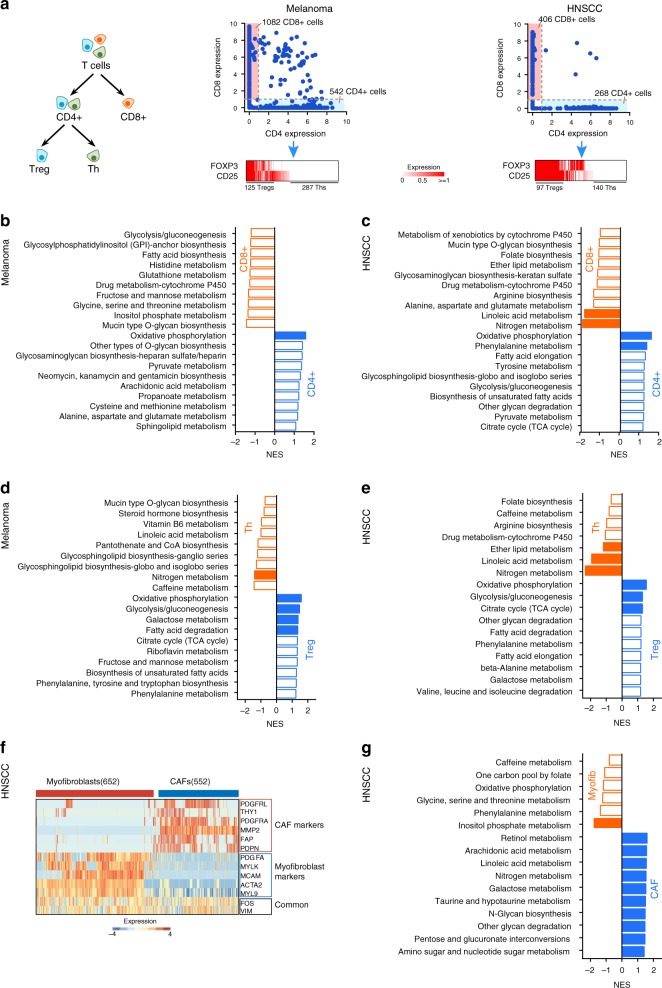
“Oxidative phosphorylation is the top enriched metabolic term in CD4 + T cells from either melanoma or HNSCC [40].”
MMP3C: anin-silicoframework to depict cancer metabolic plasticity using gene expression profiles
Chen, X., Deng, M., Wang, Z., & Huang, C. (2023) · Briefings in Bioinformatics · doi:10.1093/bib/bbad471 · Cited by 9
“Furthermore, to validate the rationale of the MMP 3 C framework, the comparison between MMP 3 C and other existing counterparts such as ssGSEA and relative gene expression [10] was also performed.”
MethodSingle-cell analysis revealing the metabolic landscape of prostate cancer
Wang, J., Ding, H.-K., Xu, H., Hu, D.-K., Hankey, W., Chen, L., Xiao, J., Liang, C.-Z., Zhao, B. Q., & Xu, L. (2024) · Asian Journal of Andrology · doi:10.4103/aja20243 · Cited by 10
“…the activity of each metabolic pathway using a scoring system to display the differential expression of certain metabolic pathways ( e.g. , the tricarboxylic acid [TCA] cycle and oxidative phosphorylation [OXPHOS]) across different cell types 8 ( Figure 2a and Supplementary Figure 3a – 3c ).”
BackgroundMethodInfluentialAscensión, A. M., Araúzo-Bravo, M. J., & Izeta, A. (2022) · F1000Research · doi:10.12688/f1000research.54864.2 · Cited by 18
Chang, C.-W., Wei, Z., Durell, S. R., Ma, L., Forgues, M., & Wang, X. W. (2022) · iScience · doi:10.1016/j.isci.2022.105244 · Cited by 8
“As metabolic heterogeneity in malignant cells may be the consequence of OXPHOS-mediated activities (Xiao et al., 2019), it is reasonable to speculate that the OXPHOS function, in turn, may be tightly linked to metabolic heterogeneity, which contributes to tumor cell plasticity, tumor cell evolution, and survival.”
Wu, J., Xu, H., Zhai, H., Yang, T., & Lin, Y. (2020) · Molecular Systems Biology · doi:10.15252/msb.20199335 · Cited by 7
“…result in non-genetic cell-to-cell variability in physiological states, including cell growth and drug resistance (Kiviet et al, 2014; Kotte et al, 2014; Charlebois et al, 2018; Rosenthal et al, 2018; Thomas et al, 2018; Farquhar et al, 2019; Kheir et al, 2019; Tonn et al, 2019; Xiao et al, 2019).”
BackgroundMultiplexed Single-cell Metabolic Profiles Organize the Spectrum of Cytotoxic Human T CellsPreprint
Hartmann, F. J., Mrdjen, D., McCaffrey, E., Glass, D. R., Greenwald, N. F., Bharadwaj, A., Khair, Z., Baranski, A., Baskar, R., Angelo, M., et al. (2020) · bioRxiv (Cold Spring Harbor Laboratory) · doi:10.1101/2020.01.17.909796 · Cited by 9
The Na + /K + ATPase Regulates Glycolysis and Modifies Immune Metabolism in TumorsPreprint
Sanderson, S. M., Xiao, Z., Wisdom, A. J., Bose, S., Liberti, M. V., Reid, M. A., Hocke, E., Gregory, S. G., Kirsch, D. G., & Locasale, J. W. (2020) · bioRxiv (Cold Spring Harbor Laboratory) · doi:10.1101/2020.03.31.018739 · Cited by 10
Rajan, S., McAloney, C. A., Vetter, T., Cam, M., Gross, A. C., Taslim, C., Wang, M., Cannon, M. V., Oles, A. R., Franz, E. M., et al. (2020) · bioRxiv · doi:10.1101/2020.11.03.367342 · Cited by 8
Cell-cell metabolite exchange creates a pro-survival metabolic environment that extends lifespanPreprint
Correia‐Melo, C., Kamrad, S., Messner, C. B., Tengölics, R., Herrera-Domínguez, L., Townsend, S., Alam, M. T., Freiwald, A., Campbell, K., Aulakh, S. K., et al. (2022) · bioRxiv (Cold Spring Harbor Laboratory) · doi:10.1101/2022.03.07.483228 · Cited by 8
Liu, P.-W., Lin, J., Hou, R., Cai, Z., Gong, Y., He, P., & Yang, J. (2024) · Computers in Biology and Medicine · doi:10.1016/j.compbiomed.2024.107926 · Cited by 7
Jiang, R., Jin, B., Sun, Y., Chen, Z., Wan, D., Feng, J., Ying, L., Peng, C., & Gu, L. (2024) · Oncology Letters · doi:10.3892/ol.2024.14772 · Cited by 9
Cui, Y., Liu, H., Zhang, L., Zhang, H., Wang, Z., Wang, J., Wang, Z., Song, L., Guo, H., Liu, L., et al. (2025) · Gut · doi:10.1136/gutjnl-2025-335014 · Cited by 12
“50 Moreover, the metabolic flux analysis of [U-13C]-fructose showed that fructose is metabolised in CAFs through both glycolysis and the TCA cycle.”
Lv, Y., Duan, T., Song, J., Liu, S., Zhou, Z., Ba, Y., Weng, S., Zuo, A., Xu, H., Luo, P., et al. (2026) · 癌症:英文版 · doi:10.34133/cancomm.0002 · Cited by 8
Meitour, Y. L., Foy, J., Guinand, M., Michon, L., Karabajakian, A., Fayette, J., Saintigny, P., & Mahtouk, K. (2024) · Oral Oncology · doi:10.1016/j.oraloncology.2023.106680 · Cited by 7
The value of intratumoral microbiota in the diagnosis and prognosis of tumors
Zhou, L., Zhang, W., Fan, S., Wang, D., & Tang, D. (2024) · Cell Biochemistry and Function · doi:10.1002/cbf.3999 · Cited by 7
“60 As an essential component of the TME, tumor microbial DNA is actively involved in this continually evolving landscape.”
BackgroundTian, Y., Liu, S., Shi, H., Li, J., Wan, X., Sun, Y., Li, H., Cao, N., Feng, Z., Zhang, T., et al. (2025) · Advanced Science · doi:10.1002/advs.202413819 · Cited by 10
Nutritional Regulation of Mammary Tumor Microenvironment
Thakkar, N., Shin, Y. B., & Sung, H. (2022) · Frontiers in Cell and Developmental Biology · doi:10.3389/fcell.2022.803280 · Cited by 7
“, 2020), also highlighting metabolic alterations (Xiao et al., 2019).”
Fang, Y., Pei, S., Huang, K., Xu, F., Xiang, G., Lan, L., & Zheng, X. (2022) · Frontiers in Cell and Developmental Biology · doi:10.3389/fcell.2022.798165 · Cited by 8
“We referred to public methods for quantifying metabolic pathways in scRNA-seq data (Xiao et al., 2019).”
MethodMesoscience in cell biology and cancer research
Qian, H., & Beltrán, A. S. (2022) · Cancer Innovation · doi:10.1002/cai2.33 · Cited by 6
“The development of single ‐ cell technology has brought us new knowledge about tumor composition [83].”
BackgroundHepatocellular carcinoma subtypes based on metabolic pathways reveals potential therapeutic targets
He, Z., Chen, Q., He, W., Cao, J., Yao, S., Huang, Q., & Zheng, Y. (2023) · Frontiers in Oncology · doi:10.3389/fonc.2023.1086604 · Cited by 10
“The single-sample gene sets enrichment analysis (ssGSEA) scores of 85 KEGG metabolic pathways was calculated for each cluster based on the gene expression level in each cell (29).”
MethodDoes each Component of Reactive Oxygen Species have a Dual Role in the Tumor Microenvironment?
Hao, S., Cai, D., Gou, S., Li, Y., Liu, L., Tang, X., Chen, Y., Zhao, Y., Shen, J., Wu, X., et al. (2023) · Current Medicinal Chemistry · doi:10.2174/0929867331666230719142202 · Cited by 11
Xie, H., Guo, W., Jiang, H., Zhang, T., Zhao, L., Hu, J., Gao, S., Song, S., Xu, J., Li, X., et al. (2024) · Advanced Science · doi:10.1002/advs.202308569 · Cited by 8
Bulk and single-cell transcriptome revealed the metabolic heterogeneity in human glioma
Xiao, Y., Zhao, M., Wang, R., Liu, L., Xiang, C., Li, T., Qian, C., Xiao, H., Liu, H., Zou, Y., et al. (2024) · Heliyon · doi:10.1016/j.heliyon.2024.e41241 · Cited by 6
“Subsequently, we took a computational pipeline as previously described [43] to characterize the glioma metabolic landscape.”
Lei, K., Zhao, Y., Li, S., Liu, J., Chen, W., Zhou, C., Zhang, Y., Tan, J., Wu, J., Zhou, Q., et al. (2025) · Frontiers in Immunology · doi:10.3389/fimmu.2025.1589563 · Cited by 8
“The weighted relative pathway activity algorithm was employed to assess the metabolic pathway activity in both high-PCD and low-PCD groups (29).”
Diao, L., He, M., Xu, B., Chen, L., Wang, Z., Yang, Y., Xia, S., Hu, S., Guo, S., & Li, D. (2023) · Molecular & Cellular Proteomics · doi:10.1016/j.mcpro.2023.100686 · Cited by 7
“An R package developed by Xiao et al. (36) was used to calculate metabolic pathway scores measuring the activity of each metabolic pathway.”
Method
Metadata
- Authors
- Xiao, Z., Dai, Z., & Locasale, J. W.
- Affiliations
- Duke University (US)
- Corresponding author
- Dai, Ziwei
- Locasale, Jason W.
- Venue
- Nature Communications
- Published
- 2019-08-21
- Volume
- 10
- Issue
- 1
- Pages
- 3763-3763
- ISSN
- 2041-1723 (ISSN-L)
- PMC
- PMC6704063
- OpenAlex
- W2969593942
- Semantic Scholar
- d37d83c927b533b71fc17df740fcbb870c05e968
- Cited by
- 524
- References
- 67
- Citations by year
- 2026: 47 · 2025: 78 · 2024: 107 · 2023: 73 · 2022: 80 · 2021: 91 · 2020: 43 · 2019: 5
- FWCI
- 17.80
- Type
- journal article
- Language
- en
- Open access
- gold
- doi.org
- Licence
- cc-by
- creativecommons.org/licenses/by/4.0 (tdm)
- creativecommons.org/licenses/by/4.0 (vor)
- Locations
- Nature Communications (publishedVersion, cc-by)
- Europe PMC (PubMed Central) (publishedVersion, cc-by)
- PubMed Central (publishedVersion, cc-by)
- PubMed (publishedVersion)
- RePEc: Research Papers in Economics (submittedVersion)
- DOAJ (DOAJ: Directory of Open Access Journals) (submittedVersion)
- DOAJ (DOAJ: Directory of Open Access Journals) (submittedVersion, cc-by-sa)
- Funders
- U.S. Department of Health & Human Services | National Institutes of Health (R01CA193256, R00CA168997)
- American Cancer Society (RSG-16-214-01-TBE)
- Topics
- Life Sciences › Biochemistry, Genetics and Molecular Biology › Cancer Research › Cancer, Hypoxia, and Metabolism
- Life Sciences › Biochemistry, Genetics and Molecular Biology › Molecular Biology › Single-cell and spatial transcriptomics
- Life Sciences › Biochemistry, Genetics and Molecular Biology › Molecular Biology › Gene expression and cancer classification
- Keywords
- tumor microenvironment, melanoma, head and neck cancer, mitochondrial metabolism, glycolysis, tumor hypoxia, tumor immune cells, tumor stromal cells
- MeSH terms
- Algorithms, Glycolysis, Humans, Melanoma, Mitochondria, Neoplasms, Gene Expression Regulation, Neoplastic, Stromal Cells, Cell Line, Tumor, Genes, Neoplasm, Tumor Microenvironment, Transcriptome, Cellular Reprogramming
About these checks
Registry, retraction, Cites and statistics results are computed, not judged, with one exception: a printed reference that no index lists is read once by a model before it counts as a citation error. Claims are extracted by a model and kept only when their quote appears verbatim in the text; each cited source is then checked, with a model’s help, for whether it says what the claim relies on. Those verdicts can be wrong — read the claim’s quote and the cited source before relying on one.
Statistics and arithmetic are recomputed, not judged.
Confidence bands are shown only for fields calibrated on our annotated test set. None is calibrated yet, so no band is shown.
What counts as a claim ›How we measure confidence ›How we check this ›
Are you an author, or do you see a problem with this page? Request a review
Data sources
Bibliographic data: Semantic Scholar, OpenAlex, Crossref.
Contains information from the Semantic Scholar Academic Graph Datasets, made available under the ODC Attribution License (ODC-BY 1.0).
Semantic Scholar’s data is described in: Kinney, R., et al. (2023). The Semantic Scholar Open Data Platform. arXiv:2301.10140.
