

Metabolic landscape of the tumor microenvironment at single cell resolution
Open accessThe DOI matches its Crossref record; 67 of the 67 references it cites were found in a registry or an index.
Abstract
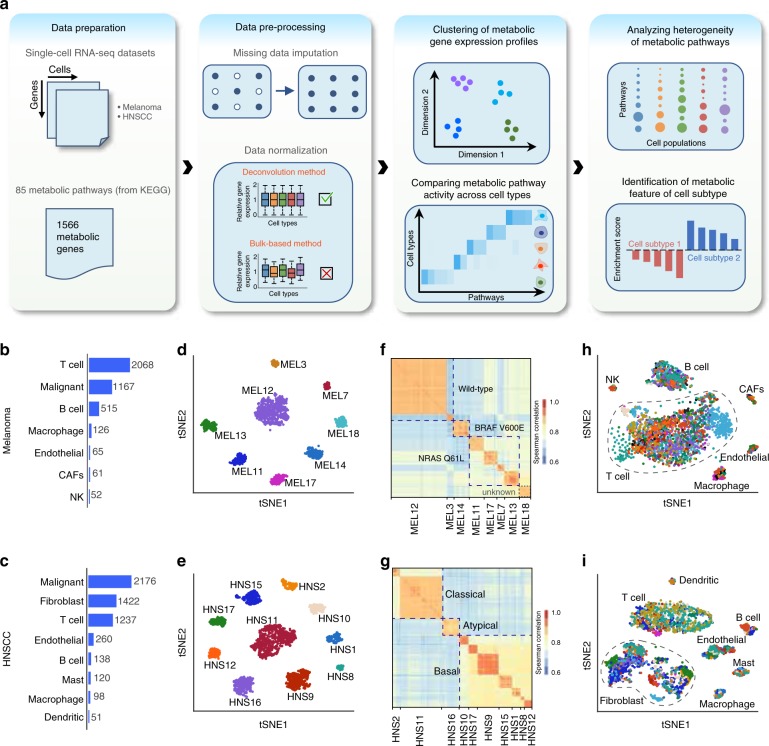
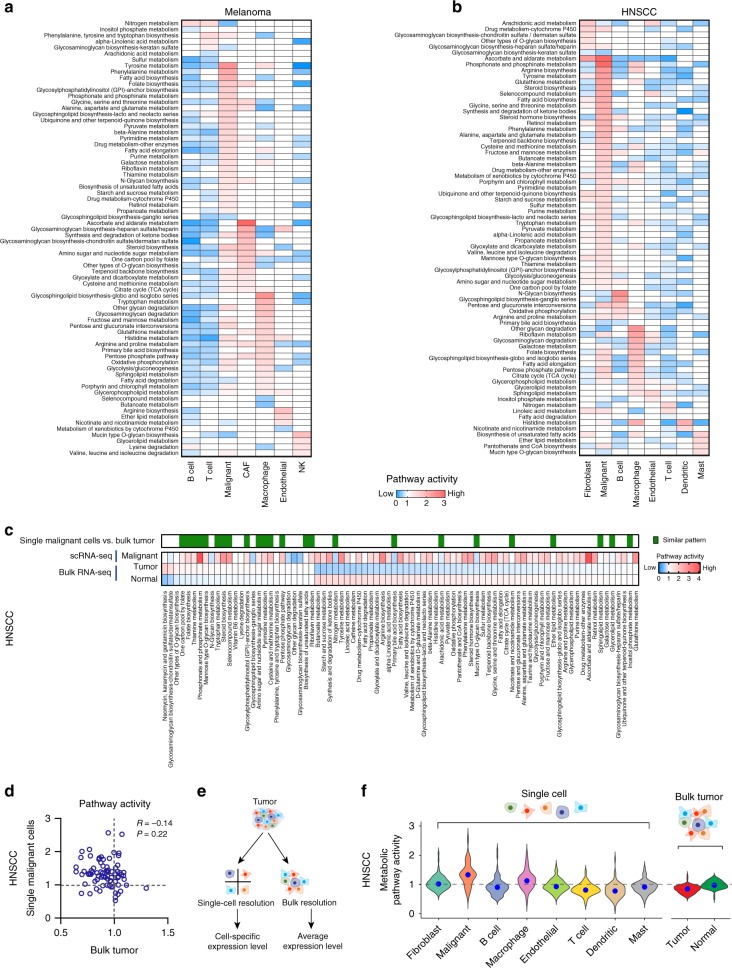
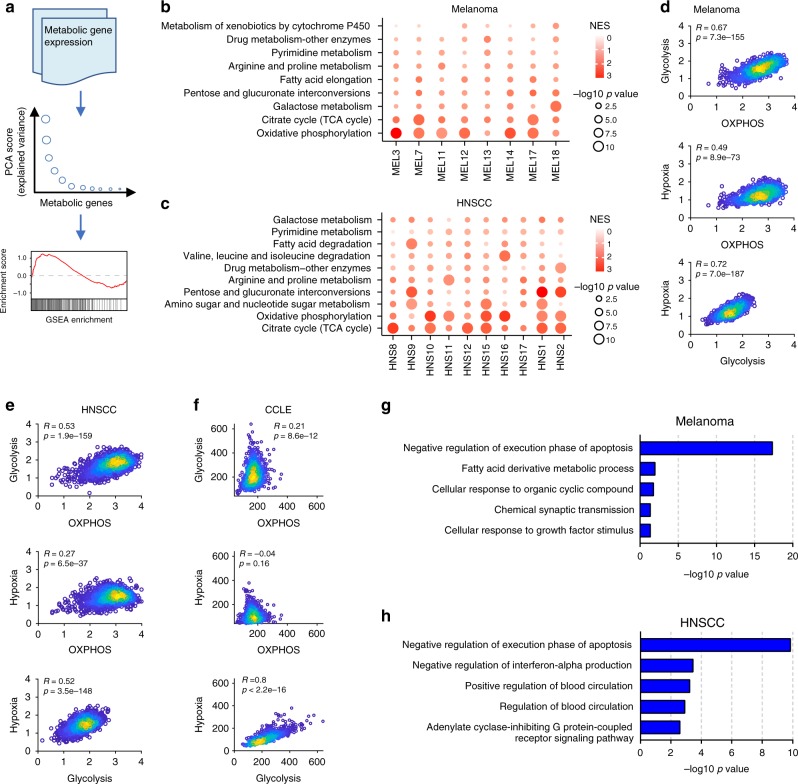
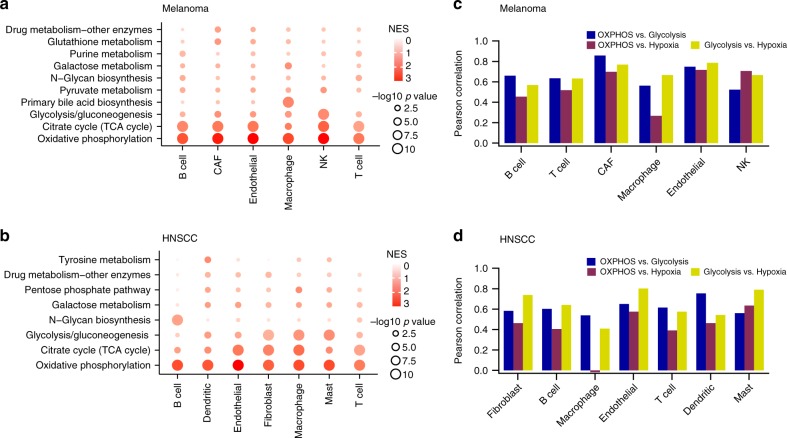
The tumor milieu consists of numerous cell types each existing in a different environment. However, a characterization of metabolic heterogeneity at single-cell resolution is not established. Here, we develop a computational pipeline to study metabolic programs in single cells. In two representative human cancers, melanoma and head and neck, we apply this algorithm to define the intratumor metabolic landscape. We report an overall discordance between analyses of single cells and those of bulk tumors with higher metabolic activity in malignant cells than previously appreciated. Variation in mitochondrial programs is found to be the major contributor to metabolic heterogeneity. Surprisingly, the expression of both glycolytic and mitochondrial programs strongly correlates with hypoxia in all cell types. Immune and stromal cells could also be distinguished by their metabolic features. Taken together this analysis establishes a computational framework for characterizing metabolism using single cell expression data and defines principles of the tumor microenvironment.
Overview
The claims and statistics of this paper haven’t been checked yet.
Free: it reads the open-access text and checks the first 5 claims that cite a source we can check. Create a free account to check every claim.
Integrity signals
Registry
Cites
Statistics
Figures
Verification
Claims the paper makes
The claims and statistics of this paper haven’t been checked yet.
Free: it reads the open-access text and checks the first 5 claims that cite a source we can check. Create a free account to check every claim.
Claims other papers make about this one
Each is checked against this paper’s own text: does it say what the citing paper says it does?
The cited source says what the claim attributes to it.
In the citing paper
“Additionally, a significant correlation has been found between glycolysis, mitochondrial metabolism and local oxygen concentrations in a study conducted on human melanoma and head and neck cancers [236].”
From Tumor microenvironment signaling and therapeutics in cancer progression (2023) · cites this paper as [236]
Self-check
Percentages, sums and reported differences re-computed from the paper’s own numbers.
The self-check needs the paper’s full text.
Citations
Cites
Moderated estimation of fold change and dispersion for RNA-seq data with DESeq2
Love, M. I., Huber, W., & Anders, S. (2014) · Genome Biology · doi:10.1186/s13059-014-0550-8 · Cited by 95,106
Hallmarks of Cancer: The Next Generation
Hanahan, D., & Weinberg, R. A. (2011) · Cell · doi:10.1016/j.cell.2011.02.013 · Cited by 66,590
Subramanian, A., Tamayo, P., Mootha, V. K., Mukherjee, S., Ebert, B. L., Gillette, M. A., Paulovich, A., Pomeroy, S. L., Golub, T. R., Lander, E. S., et al. (2005) · Proceedings of the National Academy of Sciences · doi:10.1073/pnas.0506580102 · Cited by 53,625
Robinson, M. D., McCarthy, D. J., & Smyth, G. K. (2010) · Bioinformatics · doi:10.1093/bioinformatics/btp616 · Cited by 41,364
(2008) · Journal of Machine Learning Research · Cited by 33,051
Differential expression analysis for sequence count data
Anders, S., & Huber, W. (2010) · Genome Biology · doi:10.1186/gb-2010-11-10-r106 · Cited by 15,581
The cancer genome atlas pan-cancer analysis project
The Cancer Genome Atlas Research Network, Weinstein, J. N., Collisson, E. A., Mills, G. B., Shaw, K. R. M., Ozenberger, B. A., Ellrott, K., Shmulevich, I., Sander, C., & Stuart, J. M. (2013) · Nature Genetics · doi:10.1038/ng.2764 · Cited by 9,092
The Cancer Cell Line Encyclopedia enables predictive modelling of anticancer drug sensitivity
Barretina, J., Caponigro, G., Stransky, N., Venkatesan, K., Margolin, A. A., Kim, S., Wilson, C. J., Lehár, J., Kryukov, G. V., Sonkin, D., et al. (2012) · Nature · doi:10.1038/nature11003 · Cited by 7,950
The emerging hallmarks of cancer metabolism
Pavlova, N. N., & Thompson, C. B. (2016) · Cell Metabolism · doi:10.1016/j.cmet.2015.12.006 · Cited by 5,926
Regulatory T Cells and Immune Tolerance
Sakaguchi, S., Yamaguchi, T., Nomura, T., & Ono, M. (2008) · Cell · doi:10.1016/j.cell.2008.05.009 · Cited by 5,325
Cited by
Items 501–533 of 533
Profilage métabolique et immunitaire aux différents stades de la carcinogenèse cutanée
Michon, P. (2022) · theses.fr (ABES) · doi:10.70675/f7bd5329z5d97z48e1z88bfzaeab8c7f6b1e
Dousset, L. (2022) · theses.fr (ABES) · doi:10.70675/8e81d649z2932z40cezb1cez4ec8e8df7006
Biofabrication de modèles de cancer du sein HER2-positifs par bioimpression 3D
Simoes, M. (2024) · theses.fr (ABES) · doi:10.70675/3b76e0eczc30fz440cza3bbzfc1750a015d6
Chen, R., Ding, Y., Zhao, L., Yu, Z., Zhang, J., He, Z., Cai, S., Li, G., Guo, T., Chen, W., et al. (2026) · BMC Cancer · doi:10.1186/s12885-026-16007-0
Feng, S., Ding, Z., Wang, Y., Zhu, Z., Zhong, W., Zhang, K., Zhang, Y., Chen, L., & J, Y. (2026) · Journal of Inflammation Research · doi:10.2147/jir.s571158 · Cited by 1
Yang, F., Bian, Y., Jin, Y., Tan, Y., Lao, T., Yang, J., & Chen, H. (2026) · Frontiers in Immunology · doi:10.3389/fimmu.2026.1802329
“Recent studies utilizing Non-negative Matrix Factorization (NMF) on scRNA-seq data have successfully strati-fi ed malignant cells into distinct functional programs, revealing that metabolic heterogeneity drives tumor plasticity (8, 9).”
Hu, C., Li, X., Liang, W., Li, S., Huang, X., Chen, J., Yang, K., Li, X., Zhang, Y., & Bai, J. (2026) · International Journal of Molecular Sciences · doi:10.3390/ijms27104433 · Cited by 3
“According to an existing study [69], genes with relative expression higher than threefold or lower than one-third were excluded, thus removing outliers in each transcription factor-related gene module.”
Wen, Y., Liu, S., Chen, H., Tu, M., Zhao, D., Xing, J., Zheng, W., Zhong, Y., Wang, H., & Chen, L. (2026) · Bone and Joint Research · doi:10.1302/2046-3758.156.bjr-2025-0474.r1 · Cited by 2
Monju: Multi-criteria clustering in single-cell omicsPreprint
Kaneko, T., Sakaguchi, S., Fujioka, S., Yada, Y., Kojima, R., & Naoki, H. (2026) · bioRxiv (Cold Spring Harbor Laboratory) · doi:10.64898/2026.05.28.728427
“Within gene expression-based analyses, cells can be grouped according to distinct biological aspects—for instance, by the expression of marker genes that define canonical cell types[5], by the activity of specific signaling pathways[6], or by profiles of metabolic gene expression[7].”
Yang, K., Hu, C., Zhao, H., Peng, X., Yan, Y., Wang, J., Jiang, W., Mu, D., Cao, Y., Li, X. Q., et al. (2026) · Advanced Science · doi:10.1002/advs.76250
Yu, Z., Qing, H., Wang, T., Xing, Z., Hou, Y., Ma, Y., Wang, T., Chen, S., Shi, W., Qin, L., et al. (2026) · Gut · doi:10.1136/gutjnl-2026-338277 · Cited by 2
“27 57 These findings suggest that USP20 helps maintain a cholesterol-enriched, immune-suppressive state that contributes to CD8 + T cell dysfunction, while also highlighting the heterogeneous nature of this immune-metabolic phenotype.”
Spatial Glyco-Codes Define Human Liver Pathology and ProgressionPreprint
Tian, X., Fung, A. A., Shang, X., Zhang, D., Chen, B., Zhang, L., Li, K. E. X. I. N., Zhong, M., Deng, Y., Yang, M., et al. (2026) · bioRxiv (Cold Spring Harbor Laboratory) · doi:10.64898/2026.07.08.737217
“44 Relative to protein-based clustering, glycan-based clustering exhibited a higher Calinski-Harabasz score, which measures the raw variance in the data through the ratio of the sum of between-cluster to within-cluster dispersion.”
Engineering cuproptosis with nanomedicine: Design, combination therapy, and translation in cancer
Fan, D., Liu, J., Ren, F., Wang, L., Wei, J., Qin, D., Zhou, X., Wu, J., Zou, X., & Wu, A. (2026) · Materials Today Bio · doi:10.1016/j.mtbio.2026.103466 · Cited by 2
“Metabolic state is reflected in the balance between oxidative phosphorylation and glycolysis, which may determine whether tumor cells retain the metabolic context required for cuproptosis [145,252,253].”
Differential NAD + availability may drive asymmetric SIRT7 activity in tumor and immune cells
Lagunas‐Rangel, F. A. (2026) · Molecular Biology Reports · doi:10.1007/s11033-026-12400-x
Rombi, K. L. B., Hartwig, T., Zöllner, N. R., Pang, T. Y., Lercher, M. J., Wudick, M. M., Frommer, W. B., & Kim, J. Y. (2026) · bioRxiv (Cold Spring Harbor Laboratory) · doi:10.64898/2026.07.27.741042
Li, W., Wang, P., Yang, Y., Hu, J., Shafi, S., Xia, H., Zhang, J., Han, Y., Zhou, Y., & Sun, M. (2026) · International Immunopharmacology · doi:10.1016/j.intimp.2026.117206
Jin, Y., Zhao, W., Wang, L., Wang, J., Zhao, K., Luo, D., Wang, Y., Yang, Y., Yang, J., Li, Y., et al. (2026) · Advanced Science · doi:10.1002/advs.77030
Suzuki, T., Tanaka, S., Kishimoto, K., Goto, T., Yamazaki, J., Kimura, T., & Aoshima, K. (2026) · Veterinary and Comparative Oncology · doi:10.1111/vco.70097 · Cited by 1
“This difference may reflect biological heterogeneity at both the inter-tumour level (patient- to-patient differences) and the intra-tumour level (distinct subpopulations within a tumour tissue) [28].”
Targeting Immune Cell Metabolism for Cancer Immunotherapy
Jiang, Y., Wu, Y.-L., & Ying, T.-L. (2026) · Cancer Biome and Targeted Therapy · doi:10.66505/cbtt.v1i3.48
Kadıçeşme, Ş. Y. (2026) · Genes · doi:10.3390/genes17080961
“Growing evidence suggests that metabolic reprogramming in the tumor microenvironment may significantly influence tumor progression, immune modulation, and treatment response in LUAD [10].”
Leng, Y., Bao, W., Ma, C., Bao, R., Bao, Y., Zhai, Z., Htar, T. T., & Wang, L. (2026) · Chemical & Biomedical Imaging · doi:10.1021/cbmi.6c00122 · Cited by 2
Zhang, S., & Selvarajoo, K. (2026) · BMC Biology · doi:10.1186/s12915-026-02709-1 · Cited by 1
Tang, Y., Gu, J., Chen, Y., Pu, Y., Jia, E., Han, Y., & Zhang, M. (2026) · Discover Oncology · doi:10.1007/s12672-026-05852-x
“The correlation between genes and pathway scores was analyzed by Spearman correlation [15].”
Pan-Cancer Metabolic Landscapes: A Multiomics View
Bai, Y., Chen, Q., & Li, Y. D. (2026) · Journal of Proteome Research · doi:10.1021/acs.jproteome.6c00346
Identification of Phloem Cell Transcriptome via Single-Cell RNA-Sequencing
Kim, S.-B., Symeonidi, E., Pang, T. Y., Jin, H., & Kim, J.-Y. (2026) · Methods in molecular biology · doi:10.1007/978-1-0716-5488-0_10
Zhang, H., Huang, X., Jayakumar, P., Zhang, Y., Yang, T., Guo, X., Wu, G., Kumar, A., Bharti, V., Onuma, A. E., et al. (2026) · JCI Insight · doi:10.1172/jci.insight.203495
“Using a described approach (43), which enables the reconstruction of cell type–specific metabolic profiles and allows for the comparison of metabolic activities across different cell populations, we calculated pathway activity scores by aggregating the expression of genes associated with specific…”
Yuan, J., Zhang, H., Huang, J., Wang, B., Wang, M., & Yang, L. (2026) · Biochimica et Biophysica Acta (BBA) - Reviews on Cancer · doi:10.1016/j.bbcan.2026.189733
Guo, X., Yu, M., Wang, H., Xin, N., Yu, M., Tan, X., Kang, C., & Xing, X. (2026) · ACS Biomaterials Science & Engineering · doi:10.1021/acsbiomaterials.6c00958
Human-specific morphoregulatory signatures in basal radial glia characterise neocortex evolution
Schütze, T. M., Kolodziejczyk, A., Ditzer, N., Vangelisti, S., Capra, E., Lee, J.-E., Chiaradia, I., Kufrin, V., Yamada, S., Peters, J., et al. (2026) · Nature Communications · doi:10.1038/s41467-026-78474-0 · Cited by 1
Kłos, P., & Dabravolski, S. A. (2026) · Mitochondrion · doi:10.1016/j.mito.2026.102224
Rad, R. G., Huang, J., López-Cascales, M. T., You, L., Traets, J. J. H., Bellomo, D., Chou, T.-C., Bennik, W., Singh, J., Begce, Y., et al. (2026) · bioRxiv (Cold Spring Harbor Laboratory) · doi:10.64898/2026.10.15.759353
Chen, M., Dong, G., Wang, Y., Liu, J., Wang, Z., Bao, D., Huang, Z., Li, X., Li, Y., Cai, Z., et al. (2026) · Frontiers in Genetics · doi:10.3389/fgene.2026.1833196
Features of cancer cell metabolism linked to DNA repair mechanisms
Mikheeva, R., Leonov, P. A., Koryukov, M., Ruleva, E., Liu, X., & Андреевич, К. А. (2026) · DNA repair · doi:10.1016/j.dnarep.2026.103969
Metadata
- Authors
- Xiao, Z., Dai, Z., & Locasale, J. W.
- Affiliations
- Duke University (US)
- Corresponding author
- Dai, Ziwei
- Locasale, Jason W.
- Venue
- Nature Communications
- Published
- 2019-08-21
- Volume
- 10
- Issue
- 1
- Pages
- 3763-3763
- ISSN
- 2041-1723 (ISSN-L)
- PMC
- PMC6704063
- OpenAlex
- W2969593942
- Semantic Scholar
- d37d83c927b533b71fc17df740fcbb870c05e968
- Cited by
- 524
- References
- 67
- Citations by year
- 2026: 47 · 2025: 78 · 2024: 107 · 2023: 73 · 2022: 80 · 2021: 91 · 2020: 43 · 2019: 5
- FWCI
- 17.80
- Type
- journal article
- Language
- en
- Open access
- gold
- doi.org
- Licence
- cc-by
- creativecommons.org/licenses/by/4.0 (tdm)
- creativecommons.org/licenses/by/4.0 (vor)
- Locations
- Nature Communications (publishedVersion, cc-by)
- Europe PMC (PubMed Central) (publishedVersion, cc-by)
- PubMed Central (publishedVersion, cc-by)
- PubMed (publishedVersion)
- RePEc: Research Papers in Economics (submittedVersion)
- DOAJ (DOAJ: Directory of Open Access Journals) (submittedVersion)
- DOAJ (DOAJ: Directory of Open Access Journals) (submittedVersion, cc-by-sa)
- Funders
- U.S. Department of Health & Human Services | National Institutes of Health (R01CA193256, R00CA168997)
- American Cancer Society (RSG-16-214-01-TBE)
- Topics
- Life Sciences › Biochemistry, Genetics and Molecular Biology › Cancer Research › Cancer, Hypoxia, and Metabolism
- Life Sciences › Biochemistry, Genetics and Molecular Biology › Molecular Biology › Single-cell and spatial transcriptomics
- Life Sciences › Biochemistry, Genetics and Molecular Biology › Molecular Biology › Gene expression and cancer classification
- Keywords
- tumor microenvironment, melanoma, head and neck cancer, mitochondrial metabolism, glycolysis, tumor hypoxia, tumor immune cells, tumor stromal cells
- MeSH terms
- Algorithms, Glycolysis, Humans, Melanoma, Mitochondria, Neoplasms, Gene Expression Regulation, Neoplastic, Stromal Cells, Cell Line, Tumor, Genes, Neoplasm, Tumor Microenvironment, Transcriptome, Cellular Reprogramming
About these checks
Registry, retraction, Cites and statistics results are computed, not judged, with one exception: a printed reference that no index lists is read once by a model before it counts as a citation error. Claims are extracted by a model and kept only when their quote appears verbatim in the text; each cited source is then checked, with a model’s help, for whether it says what the claim relies on. Those verdicts can be wrong — read the claim’s quote and the cited source before relying on one.
Statistics and arithmetic are recomputed, not judged.
Confidence bands are shown only for fields calibrated on our annotated test set. None is calibrated yet, so no band is shown.
What counts as a claim ›How we measure confidence ›How we check this ›
Are you an author, or do you see a problem with this page? Request a review
Data sources
Bibliographic data: Semantic Scholar, OpenAlex, Crossref.
Contains information from the Semantic Scholar Academic Graph Datasets, made available under the ODC Attribution License (ODC-BY 1.0).
Semantic Scholar’s data is described in: Kinney, R., et al. (2023). The Semantic Scholar Open Data Platform. arXiv:2301.10140.
