

CRISPR-Cas9-based mutagenesis frequently provokes on-target mRNA misregulation
Open accessPublished version of a preprint
The DOI matches its Crossref record; 44 of the 44 references it cites were found in a registry or an index.
Abstract
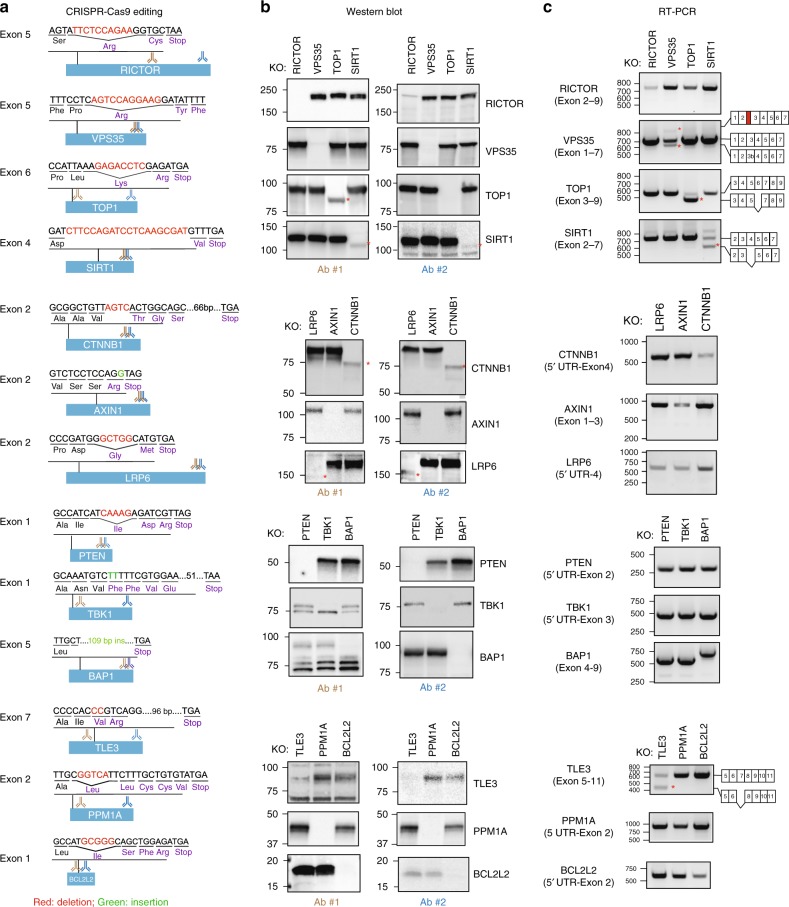
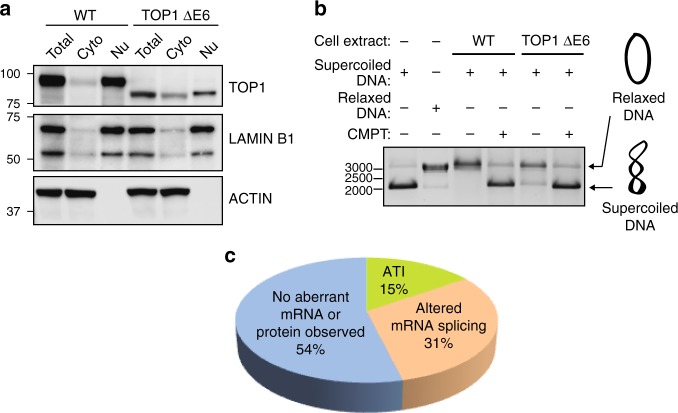
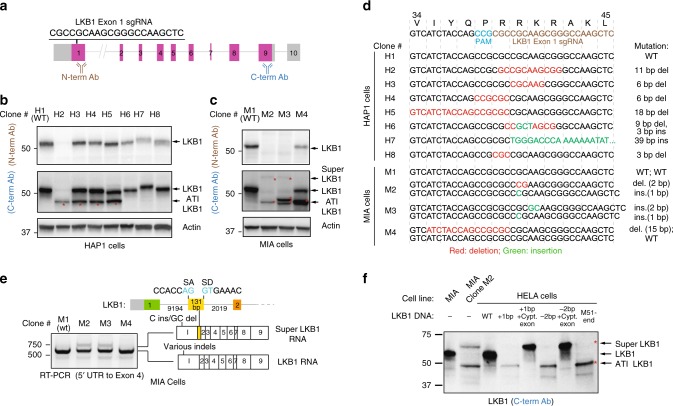
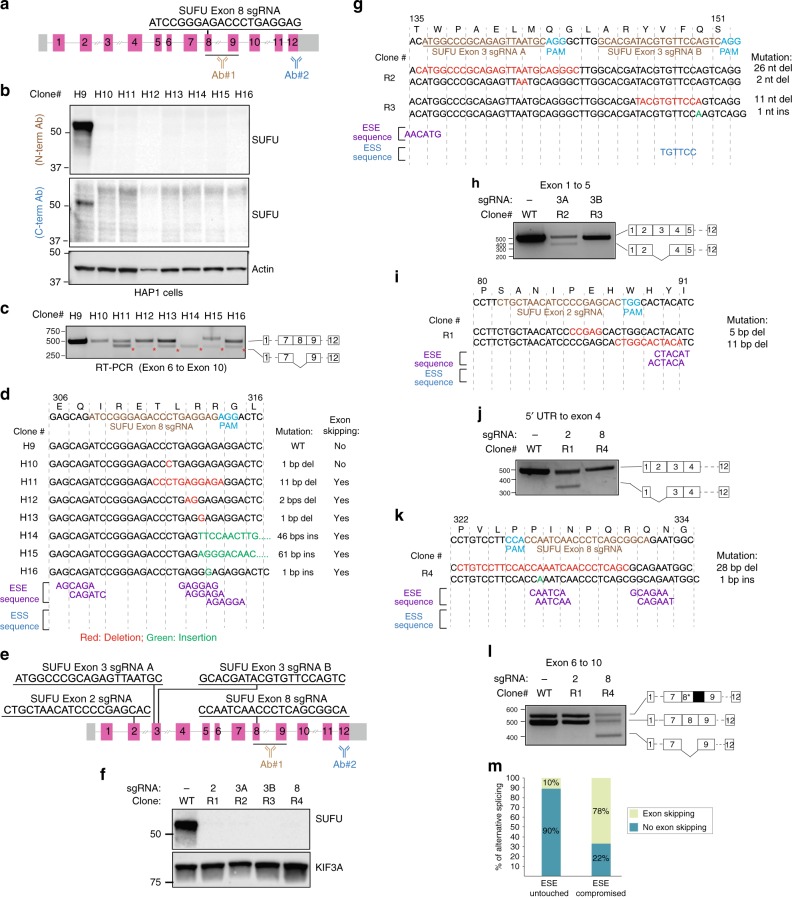
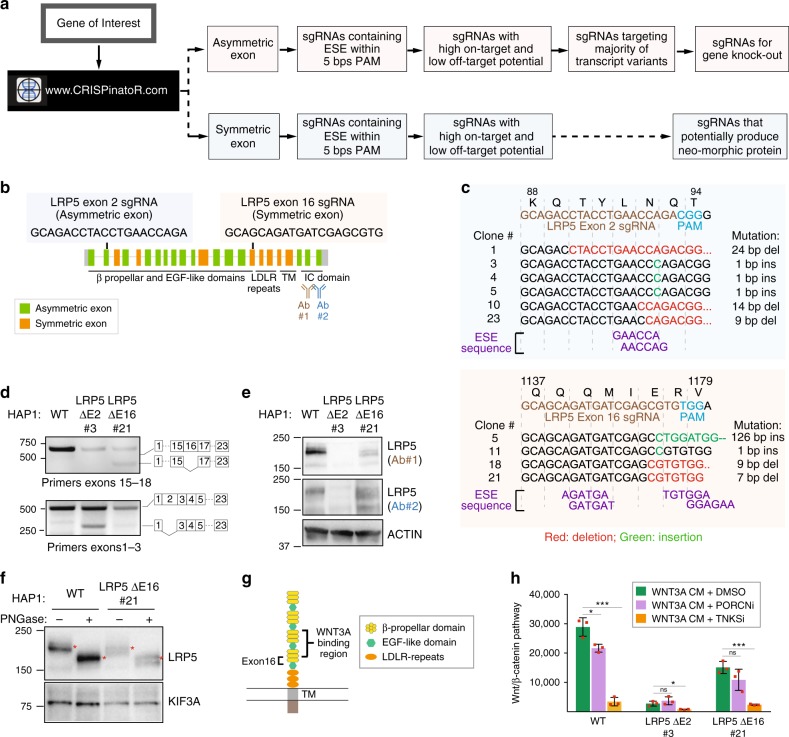
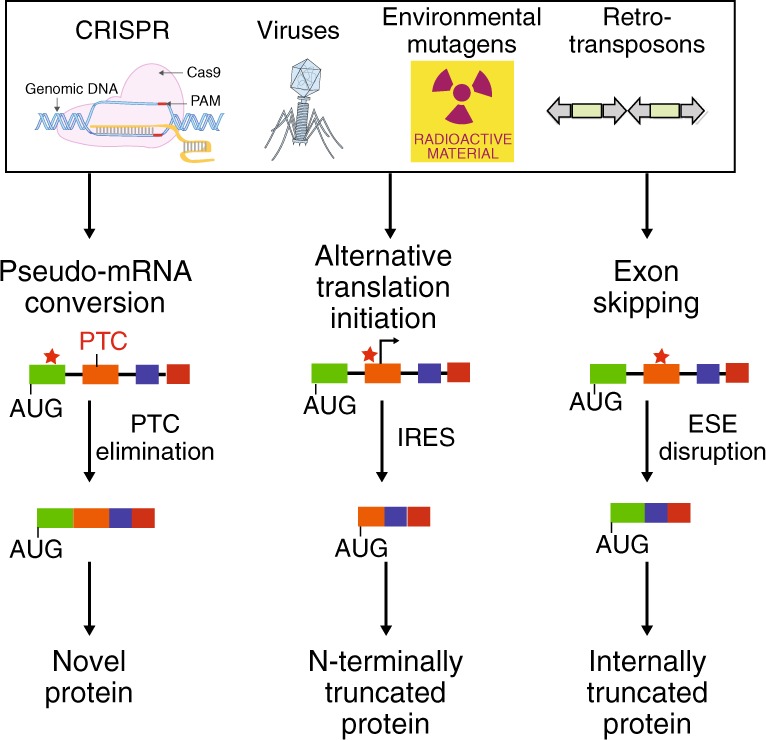
The introduction of insertion-deletions (INDELs) by non-homologous end-joining (NHEJ) pathway underlies the mechanistic basis of CRISPR-Cas9-directed genome editing. Selective gene ablation using CRISPR-Cas9 is achieved by installation of a premature termination codon (PTC) from a frameshift-inducing INDEL that elicits nonsense-mediated decay (NMD) of the mutant mRNA. Here, by examining the mRNA and protein products of CRISPR targeted genes in a cell line panel with presumed gene knockouts, we detect the production of foreign mRNAs or proteins in ~50% of the cell lines. We demonstrate that these aberrant protein products stem from the introduction of INDELs that promote internal ribosomal entry, convert pseudo-mRNAs (alternatively spliced mRNAs with a PTC) into protein encoding molecules, or induce exon skipping by disruption of exon splicing enhancers (ESEs). Our results reveal challenges to manipulating gene expression outcomes using INDEL-based mutagenesis and strategies useful in mitigating their impact on intended genome-editing outcomes.
Overview
The claims and statistics of this paper haven’t been checked yet.
Free: it reads the open-access text and checks the first 5 claims that cite a source we can check. Create a free account to check every claim.
Integrity signals
Registry
Cites
Statistics
Figures
Verification
Claims the paper makes
The claims and statistics of this paper haven’t been checked yet.
Free: it reads the open-access text and checks the first 5 claims that cite a source we can check. Create a free account to check every claim.
Claims other papers make about this one
Each is checked against this paper’s own text: does it say what the citing paper says it does?
The source backs part of the claim, not all of it — or backs it for a different population, condition or comparison.
In the citing paper
“It should be added that low levels of peptides from the C-terminal DENND10 sequence were detected in sgDennd10_No2 by mass spectrometry (see below, Table S1), likely due to truncated protein expression from cryptic alternative splicing events, a phenomenon observed in approximately 50% of CRISPR-edited cells.50”
From Endosomal protein DENND10 promotes developmental competence of neurite extension (2025) · cites this paper as [50]
Experimental — accuracy not yet measuredIn the citing paper
“Further, analogous to how Cas9-nuclease targeting often produces RNAs degraded by nonsense mediated decay13, it is possible that Cas13 cleavage produces RNA molecules that can be detected by scRNA-seq but cannot be translated into functional protein14, suggesting that the level of measured RNA knockdown underestimates the phenotypic effect of Cas13 perturbation.”
From Efficient combinatorial targeting of RNA transcripts in single cells with Cas13 RNA Perturb-seq (2023) · cites this paper as [13]
Self-check
Percentages, sums and reported differences re-computed from the paper’s own numbers.
The self-check needs the paper’s full text.
Citations
Cites
Fast and accurate short read alignment with Burrows-Wheeler transform
Li, H., & Durbin, R. (2009) · Bioinformatics · doi:10.1093/bioinformatics/btp324 · Cited by 58,607
Fast and accurate long-read alignment with Burrows-Wheeler transform.
Li, H., & Durbin, R. (2010) · Bioinformatics · doi:10.1093/bioinformatics/btp698 · Cited by 12,063
The new frontier of genome engineering with CRISPR-Cas9
Doudna, J. A., & Charpentier, E. (2014) · Science · doi:10.1126/science.1258096 · Cited by 7,062
Development and Applications of CRISPR-Cas9 for Genome Engineering
Hsu, P. D., Lander, E. S., & Zhang, F. (2014) · Cell · doi:10.1016/j.cell.2014.05.010 · Cited by 5,762 · cited 1×
“A conserved stem loop motif in the 5'untranslated region regulates transforming growth factor-beta(1) translation.”
Cpf1 Is a Single RNA-Guided Endonuclease of a Class 2 CRISPR-Cas System
Zetsche, B., Gootenberg, J. S., Abudayyeh, O. O., Slaymaker, I. M., Makarova, K. S., Essletzbichler, P., Volz, S. E., Joung, J., van der Oost, J., Regev, A., et al. (2015) · Cell · doi:10.1016/j.cell.2015.09.038 · Cited by 4,761
DNA targeting specificity of RNA-guided Cas9 nucleases
Hsu, P. D., Scott, D. A., Weinstein, J. A., Ran, F. A., Konermann, S., Agarwala, V., Li, Y., Fine, E. J., Wu, X., Shalem, O., et al. (2013) · Nature Biotechnology · doi:10.1038/nbt.2647 · Cited by 4,741
Self-citationOptimized sgRNA design to maximize activity and minimize off-target effects of CRISPR-Cas9
Doench, J. G., Fusi, N., Sullender, M., Hegde, M., Vaimberg, E. W., Donovan, K. F., Smith, I., Tothova, Z., Wilen, C., Orchard, R., et al. (2016) · Nature Biotechnology · doi:10.1038/nbt.3437 · Cited by 4,637
Zerbino, D. R., Achuthan, P., Akanni, W., Amode, M. R., Barrell, D., Bhai, J., Billis, K., Cummins, C., Gall, A., Girón, C. G., et al. (2018) · Nucleic Acids Research · doi:10.1093/nar/gkx1098 · Cited by 2,605
Listening to silence and understanding nonsense: exonic mutations that affect splicing
Cartegni, L., Chew, S. L., & Krainer, A. R. (2002) · Nature Reviews Genetics · doi:10.1038/nrg775 · Cited by 2,209
Wang, J. C. (1996) · Annual Review of Biochemistry · doi:10.1146/annurev.bi.65.070196.003223 · Cited by 1,832
Cited by
Items 101–200 of 219
Using a Dual CRISPR/Cas9 Approach to Gain Insight into the Role of LRP1B in Glioblastoma
Peixoto, J., Príncipe, C., Pestana, A., Osório, H., Pinto, M. T., Prazeres, H., Soares, P., & Lima, R. T. (2023) · International Journal of Molecular Sciences · doi:10.3390/ijms241411285 · Cited by 12
“Still, as CRISPR/Cas9 systems may not result in the total elimination of the gene-targeted regions (as previously observed in this study) and may also result in unexpected alterations in mRNA expression [44], we evaluated other LRP1B mRNA regions, using specific real-time primer assays for LRP1B exons 3-4 and 85-86 ju…”
MethodGoolab, S., & Scholefield, J. (2024) · Frontiers in Genome Editing · doi:10.3389/fgeed.2024.1464531 · Cited by 10
“…developed a free-to-use computational tool for gRNA selection to avoid these events by providing a prediction of exon skipping at on-target and off-target sites to select for PTC that elicit NMD for generating a true gene knockout as shown in Figure 1 (right schematic) (Tuladhar et al., 2019).”
MethodSPLICER: a highly efficient base editing toolbox that enables in vivo therapeutic exon skipping
Miskalis, A., Shirguppe, S., Winter, J., Elias, G., Swami, D., Nambiar, A., Stilger, M., Woods, W. S., Gosstola, N. C., Gapinske, M., et al. (2024) · Nature Communications · doi:10.1038/s41467-024-54529-y · Cited by 14
“Nonetheless, their reliance on DNA double-strand breaks (DSBs) has been linked to undesirable effects, including chromosomal deletions 2 , chromothripsis 3 , activation of the p53-mediated DNA damage response pathway 4 , and mRNA misregulation 5 , all of which can hinder their implementation 6,7 .”
A Hyperbolic Discrete Diffusion 3D RNA Inverse Folding Model for Functional RNA Design
Hou, D., Zhang, S., Ma, M., Lin, H., Wan, Z., Zhao, H., Zhou, R., He, X. D., Wei, X., Ju, D., et al. (2025) · Journal of Chemical Information and Modeling · doi:10.1021/acs.jcim.5c00527 · Cited by 13
PINCER: improved CRISPR/Cas9 screening by efficient cleavage at conserved residues
Veeneman, B. A., Gao, Y., Grant, J., Fruhling, D., Ahn, J. H., Bosbach, B., Bienkowska, J. R., Follettie, M. T., Arndt, K. T., Myers, J. S., et al. (2020) · Nucleic Acids Research · doi:10.1093/nar/gkaa645 · Cited by 12
“We did not include features too rare to be feasible as inclusion criteria (CDD Site), too common or weak in effect to be feasible as exclusion criteria (PAM = TGG, high Tm), too likely to cause unpredictable change of function variants (splice site), or those subsumed by other features (NMD, Uniprot secondary structur…”
BackgroundInfluentialZan, E. D., van Stiphout, R. G. P. M., Gapp, B. V., Blomen, V. A., Brummelkamp, T. R., & Nijman, S. M. B. (2020) · Science Signaling · doi:10.1126/scisignal.aba5665 · Cited by 10
Çetin, R., Quandt, E., & Kaulich, M. (2021) · Cells · doi:10.3390/cells10020260 · Cited by 13
“Weaknesses Considerable off-target effects [48,49] Incomplete silencing of the target gene (knockdown) [52] Stimulate immune response [53,54] Transient gene silencing [74] Residual protein expression (incomplete KO/truncated transcripts) [75,76] Target space depends on PAM [57] Stochastic mutational outcome (dependent…”
BackgroundPreliminary analysis of InSAR data from south-west part of Upper Silesian Coal Basin
Mirek, K., & Isakow, Z. (2009) · Gospodarka Surowcami Mineralnymi - Mineral Resources Management · Cited by 9
Direct and indirect effects of multiplex genome editing of F5H and FAD2 in oil crop camelina
van Belle, J., Schaart, J. G., Dechesne, A. C., Fei, D., Cisneros, A., Serafini, M., Visser, R. G. F., & van Loo, E. N. (2025) · Plant Biotechnology Journal · doi:10.1111/pbi.14593 · Cited by 9
“…can be mediated through for example truncated proteins interacting with the wildtype proteins produced by the non-mutant genes (Meinke, 2013), as premature stop codons occurring with frameshifts caused by CRISPR/Cas9 do not always elicit nonsense-mediated mRNA decay (NMD) (Tuladhar et al ., 2019).”
InfluentialGenetic and Molecular Quality Control of Genetically Engineered Mice
Lintott, L. G., & Nutter, L. M. J. (2023) · Methods in molecular biology · doi:10.1007/978-1-0716-2990-1_3 · Cited by 8
Quinn, J. M., Wang, Y., Wood, M. N., Flozak, A. S., Le, P. M., Yemelyanov, A., Oakes, P. W., & Gottardi, C. J. (2024) · Molecular Biology of the Cell · doi:10.1091/mbc.e23-01-0036 · Cited by 7
“We chose to restore WT α -cat and mutant using α -cat KO clone 2.2. which commonly leads to internal ribosome entry and alternative protein products (Tuladhar et al. , 2019).”
InfluentialZebrafish as a Model to Understand Human Genetic Diseases
Phillips, J. B., & Westerfield, M. (2019) · Elsevier eBooks · doi:10.1016/b978-0-12-812431-4.00047-6 · Cited by 8
Clément, C. W.-Y., & Ajena, F. (2021) · Agroecology and Sustainable Food Systems · doi:10.1080/21683565.2021.1890307 · Cited by 16
Mountoufaris, G., Nair, A., Yang, B., Kim, D., & Anderson, D. J. (2023) · bioRxiv (Cold Spring Harbor Laboratory) · doi:10.1101/2023.11.01.565073 · Cited by 8
Wu, Y., Zhong, A., Evangelisti, A., Sidharta, M., Huangfu, D., Studer, L., & Zhou, T. (2025) · Stem Cell Reports · doi:10.1016/j.stemcr.2025.102499 · Cited by 7
“The KLF17 knockout line showed a significant decrease in KLF17 mRNA, suggesting that the truncation of the KLF17 coding sequence caused by frameshift knockouts might lead to transcript degradation via nonsense-mediated mRNA decay (Tuladhar et al., 2019).”
Ritter, M. U., Nasri, M., Dannenmann, B., Mir, P., Secker, B., Amend, D., Klimiankou, M., Welte, K., & Skokowa, J. (2024) · The CRISPR Journal · doi:10.1089/crispr.2024.0006 · Cited by 8
“14 To mitigate this risk, we recently established a knockdown approach by targeting the ELANE promoter.”
Rhea, L., Reeb, T., Adelizzi, E., Garnica, B., Stein, A., Kollash, A., Dunnwald, E., & Dunnwald, M. (2024) · Developmental Dynamics · doi:10.1002/dvdy.759 · Cited by 6
“49,50 Given that the antibodies we used were generated using an epitope at the C-terminus of the ARHGAP29 protein and the bands observed in controls and ARHGAP29 knockdown lines were all near the expected size of ARHGAP29 (142 kDa), we speculate that keratinocytes may adopt an alternative…”
Kawarada, L., Fukaya, M., Saito, R., Kassai, H., Sakagami, H., & Aiba, A. (2021) · FEBS Letters · doi:10.1002/1873-3468.14098 · Cited by 7
Kiel, J. S., Ferràndez‐Cañadell, C., & Tosquella, J. (1999) · Revista española de micropaleontología · Cited by 10
Analysis of human neuronal cells carrying ASTN2 deletion associated with psychiatric disorders
Hayashi, Y., Okumura, H., Arioka, Y., Kushima, I., Mori, D., Lo, T., Otgonbayar, G., Kato, H., Nawa, Y., Kimura, H., et al. (2024) · Translational Psychiatry · doi:10.1038/s41398-024-02962-4 · Cited by 9
“Genome editing using the CRISPR-Cas9 system may sometimes cause the expression of unanticipated proteins, similar in size to the wild-type protein, from the out-of-frame variant alleles [41, 42].”
BackgroundLoss of peptidase D binding restores the tumor suppressor functions of oncogenic p53 mutants
Yang, L., Li, Y., Bhattacharya, A., & Zhang, Y. (2021) · Communications Biology · doi:10.1038/s42003-021-02880-x · Cited by 7
Gómez-Herranz, M., Faktor, J., Mayordomo, M. Y., Pilch, M., Nekulová, M., Hernychová, L., Ball, K. L., Vojtěšek, B., Hupp, T. R., & Kote, S. (2022) · Biomolecules · doi:10.3390/biom12081090 · Cited by 8
“These data might be expected if gene editing creates indels that result in stop codon mutations or alterations in the amino acid sequence which cause mRNA degradation by NMD [61].”
BackgroundWang, L., Xie, X., Gu, W., Zheng, Z., Chen, M., & Wang, G. (2023) · Algal Research · doi:10.1016/j.algal.2023.103249 · Cited by 6
Genotyping Protocols for Genetically Engineered Mice
Limaye, A., Cho, K., Hall, B., Khillan, J. S., & Kulkarni, A. B. (2023) · Current Protocols · doi:10.1002/cpz1.929 · Cited by 6
Targeted mutagenesis in human iPSCs using CRISPR genome-editing tools
Long, Y., & Cech, T. R. (2021) · Methods · doi:10.1016/j.ymeth.2021.01.002 · Cited by 8
“unexpected changes to the genome [13,22,23], and therefore for mutational study it is extremely important to obtain a WT control that is edited exactly the same way except for the mutated sequences.”
BackgroundNon‐genetic and genetic rewiring underlie adaptation to hypomorphic alleles of an essential gene
Targa, A., Larrimore, K. E., Wong, C. K., Chong, Y. L., Fung, R., Lee, J., Choi, H., & Rancati, G. I. (2021) · The EMBO Journal · doi:10.15252/embj.2021107839 · Cited by 4
“Previous reports have indicated that early PTC or indels generated by genome editing can be bypassed by exon skip-ping, resulting in mutant alleles that are generally expressed or translated at lower levels (Smits et al , 2019; Tuladhar et al , 2019).”
A Robust Protocol for CRISPR‐Cas9 Gene Editing in Human Suspension Cell Lines
Wardyn, J. D., Chan, A. S. Y., & Jeyasekharan, A. D. D. (2021) · Current Protocols · doi:10.1002/cpz1.286 · Cited by 7
Structure-optimized sgRNA selection with PlatinumCRISPr for efficient Cas9 generation of knockouts
Haussmann, I. U., Dix, T. C., McQuarrie, D. W. J., Dezi, V., Hans, A. I., Arnold, R. R., & Soller, M. (2024) · Genome Research · doi:10.1101/gr.279479.124 · Cited by 7
Moffa, J. C., Bland, I. N., Tooley, J. R., Kalyanaraman, V., Heitmeier, M. R., Creed, M. C., & Copits, B. A. (2024) · eNeuro · doi:10.1523/eneuro.0438-23.2024 · Cited by 10
“There is additional evidence to suggest that noncanonical translation initiation events and alternative mRNA splicing can circumvent NMD in up to 50% of cases (Tuladhar et al., 2019).”
i-Silence, Please! An Alternative for Gene Disruption via Adenine Base Editors
Jang, H., & Bae, S. (2020) · Molecular Therapy · doi:10.1016/j.ymthe.2020.01.009 · Cited by 6
“Recently, genes edited to contain PTCs by frameshift have been reported to produce aberrant proteins (detected by western blot).(15) Themechanisms involved alternative translation initiation (ATI) or mRNA transcription skipping of the PTC-bearing exon.”
BackgroundShin, J., & Oh, J. (2020) · BMB Reports · doi:10.5483/bmbrep.2020.53.7.070 · Cited by 8
Senevirathne, A., Hewawaduge, C., & Lee, J. H. (2021) · Veterinary Research · doi:10.1186/s13567-021-00995-x · Cited by 5
“of causing indel mutations [35], a similar activity can also be expected in vivo in virus-infected chickens.”
BackgroundMarzluf, J., Klein, J., Kirchmeier, D., Stärk, A., Ziegner, D., Gehrung, M., Rauh, F., Rattay, M., Zehe, C., & Leroux, A. (2026) · Frontiers in Bioengineering and Biotechnology · doi:10.3389/fbioe.2026.1750646 · Cited by 5
Song, X. Y. R., Jansen, M. I., Marzagalli, R., Musumeci, G., D’Agata, V., & Castorina, A. (2025) · Cells · doi:10.3390/cells14110769 · Cited by 5
“This phenomenon is not uncommon when employing CRISPR-Cas9-based gene editing [35] and was not corroborated by protein expression data.”
CRISPR GENome and epigenome engineering improves loss-of-function genetic-screening approaches
Stadager, J., Bernardini, C., Hartmann, L., May, H., Wiepcke, J., Kuban, M., Najafova, Z., Johnsen, S. A., Legewie, S., Traube, F. R., et al. (2025) · Cell Reports Methods · doi:10.1016/j.crmeth.2025.101078 · Cited by 6
“Such screens have been employed in many studies, 1 but applications around CRISPR knockout (CRISPRko) can show unpredictable outcomes of non-homologous end joining (NHEJ), resulting in in-frame DNA repair or alternative splicing products 2–9 leading to residual active protein expression.”
Single cell transcriptional perturbome in pluripotent stem cell models
Balmas, E., Ratto, M. L., Snijders, K. E., Becca, S., Liaci, C., Ricca, I., Merlo, G. R., Calogero, R., Alessandrì, L., Mendjan, S., et al. (2025) · Molecular Systems Biology · doi:10.1038/s44320-025-00172-8 · Cited by 6
“…knockouts due to their irreversibility and susceptibility to genetic compensation (Rossi et al, 2015; El-Brolosy et al, 2019), mRNA misregulation (Tuladhar et al, 2019), and p53-led genotoxic effects, particularly problematic in hPSCs (Merkle et al, 2017; Ihry et al, 2018; Haapaniemi et al,…”
Jones, L. A., Conway, G. E., Nguyen, A., Burnell, S. E. A., Jenkins, G. J. S., Conlan, R. S., & Doak, S. H. (2023) · Cellular and Molecular Biology · doi:10.14715/cmb/2023.69.4.28 · Cited by 5
“CRISPR/Cas9 technology can induce complete gene knockout, as opposed to the transient gene knockdown offered by siRNA silencing (37,38).”
BackgroundXiao-Jing, L., Bao, X., Meng-Yu, W., Li, X., Wang, X., & Wang, Z. (2023) · GM crops & food · doi:10.1080/21645698.2023.2229927 · Cited by 8
“This result suggested that Cas9 edited target genes may trigger mRNA dysregulation at the target sites.(15) In plants, the effects of CRISPR-Cas9 and base editors on plant transcription and protein levels have not been reported.”
BackgroundBagheri, A., Culp, P., DuBridge, R. B., & Chen, T.-H. T. (2022) · Biochemistry and Biophysics Reports · doi:10.1016/j.bbrep.2022.101205 · Cited by 4
“Others have also observed alternative proteins arise after CRISPR/ Cas9 treatment; however, the same antibody was used before and after gene-disruption to detect these mutants [23,24].”
BackgroundCRISPR/Cas9-mediated NlInR2 mutants: Analyses of residual mRNA and truncated proteins
Lü, J., Chen, J., Hu, Y., Chen, L., Li, S., ZHANG, Y.-B., & Zhang, W. (2023) · Journal of Integrative Agriculture · doi:10.1016/j.jia.2023.06.039 · Cited by 4
CRISPR-Click Enables Dual-Gene Editing with Modular Synthetic sgRNAs
Park, H., Osman, E. A., Cromwell, C. R., Laurent, C. D. S., Liu, Y., Kitova, E. N., Klassen, J. S., Hubbard, B. P., Macauley, M. S., & Gibbs, J. M. (2022) · Bioconjugate Chemistry · doi:10.1021/acs.bioconjchem.2c00106 · Cited by 4
A minimal CRISPR-Cas3 system for genome engineeringPreprint
Csörgő, B., León, L. M., Chau-Ly, I. J., Vasquez-Rifo, A., Berry, J. D., Mahendra, C., Crawford, E. D., Lewis, J. D., & Bondy‐Denomy, J. (2019) · bioRxiv (Cold Spring Harbor Laboratory) · doi:10.1101/860999 · Cited by 4
Venhuizen, A. J., van Os, Y., Kaptein, M. L., Aarts, M. T., Xanthakis, D., Jordens, I., & Maurice, M. M. (2025) · iScience · doi:10.1016/j.isci.2025.114501 · Cited by 3
“34 As AXIN1 Δ N variants lack the tank-yrase (TNKS)-binding and RGS domains, tumors harboring these mutations will be insensitive to TNKS1/2 inhibitors that AXIN1 or to the small molecule KYA1797, that binds AXIN1 RGS and increases β -catenin phosphorylation by promoting GSK3 activity.”
Efficient CRISPR-Cas9-Mediated Genome Editing of the Cane Toad ( Rhinella marina )
Clark, M., Funk, A. T., Paporakis, A., Brown, G. P., Beach, S. J., Tay, A. P., Deering, S., Cooper, C. A., Tizard, M. L., Jolly, C. J., et al. (2025) · The CRISPR Journal · doi:10.1177/25731599251382427 · Cited by 3
“49 This precise targeting ability makes CRISPR-Cas9 an ideal tool for gene KO studies.”
A hypomorphic mutation in the mouse Csn1s1 gene generated by CRISPR/Cas9 pronuclear microinjection
Smirnov, A. V., Шнайдер, Т. А., Korablev, A. N., Yunusova, A., Serova, I. A., & Баттулин, Н. Р. (2021) · Vavilov Journal of Genetics and Breeding · doi:10.18699/vj21.036 · Cited by 3
“Essentially, exon skipping could be promoted by internal exon splicing enhancers and suppressors (ESEs and ESSs) which are hard to predict (Sterne-Weiler, Sanford, 2014; Tuladhar et al., 2019), unlike typical splice site mutations (Cartegni et al.”
BackgroundSeumen, C. H. T., Tomasiunaite, U., Legler, D. F., & Hauck, C. R. (2021) · Scientific Reports · doi:10.1038/s41598-021-03618-9 · Cited by 4
Introducing Large Genomic Deletions in Human Pluripotent Stem Cells Using CRISPR‐Cas3
Hou, Z., Hu, C., Ke, A., & Zhang, Y. (2022) · Current Protocols · doi:10.1002/cpz1.361 · Cited by 3
“…cell mutant libraries generated by Cas9 indels, pseudo-mRNA and/or aberrant protein products accumulate in over one-third of the mutant lines, stemming from exon-skipping events, internal ribosome entry, and so on (Kapahnke, Banning, & Tikkanen, 2016; Smits et al., 2019; Tuladhar et al., 2019).”
BackgroundZhang, L., Ma, J., Jin, X., Zhang, L., Zhang, M., Li, P. Z., Li, J., & Zhang, L. (2022) · Journal of Interferon & Cytokine Research · doi:10.1089/jir.2022.0158 · Cited by 3
Smeir, M., Chumala, P., Katselis, G. S., & Liu, L. (2024) · Biomolecules · doi:10.3390/biom14010111 · Cited by 5
“Exon skipping and formation of truncated proteins following CRISPR-Cas9 editing have been demonstrated in previous studies [33,34].”
ResultGenome editing in Acinetobacter baumannii through enhanced natural transformation
Yilmaz, I., & Özbek, T. (2024) · Journal of Basic Microbiology · doi:10.1002/jobm.202300644 · Cited by 4
“This selection is significant as it underscores the importance of both HR and A ‐ NHEJ mechanisms in the repair process, ultimately resulting in specific in/del mutations [49, 50].”
BackgroundOn the edge of deletion: Using natural and engineered microhomology to edit the human genome
Martínez‐Gálvez, G., Lee, S., Niwa, R., & Woltjen, K. (2024) · Gene and Genome Editing · doi:10.1016/j.ggedit.2024.100033 · Cited by 4
Severino, M. B., Morelli, A. P., Pavan, I. C. B., Mancini, M. C. S., Góis, M. M., Borges, R. J., Braga, R. R., da Silva, L. G. S., Ruiz, N. Q., Costa, M. M., et al. (2025) · Journal of Biological Chemistry · doi:10.1016/j.jbc.2025.108308 · Cited by 5
“However, the functions of this isoform remained unclear (17).”
Jiang, H., Jing, Q., Yang, Q., Qiao, C., Liao, Y., Liu, W., & Xing, Y. (2022) · Genes · doi:10.3390/genes13050835 · Cited by 3
“NHEJ pathways often induce insertion/deletion mutations (indels), causing the loss of protein function, although, sometimes, they can produce new functional proteins [3].”
BackgroundDevelopment of a Cellular Model Mimicking Specific HDAC Inhibitors
Hess, L., Moos, V., & Seiser, C. (2022) · Methods in molecular biology · doi:10.1007/978-1-0716-2788-4_4 · Cited by 3
Unreported off-target integration of beta-lactamase from plasmid in gene-edited hornless cowsPreprint
Chakraborty, S. (2019) · OSF Preprints (OSF Preprints) · doi:10.31219/osf.io/kuf3z · Cited by 3
Chakraborty, S. (2019) · OSF Preprints (OSF Preprints) · doi:10.31219/osf.io/42rct · Cited by 4
Functional genomic profiling of schizophrenia-associated genes reveals key microglial regulators
Horng, J. E., McCrea, L. T., Batorsky, R., Bowen, J. J., Boschian, C., Song, Y., Perlis, R. H., & Sheridan, S. D. (2026) · Neuropsychopharmacology · doi:10.1038/s41386-026-02406-1 · Cited by 2
“This may indicate that the selected gRNAs failed to cause nonsense-mediated decay (NMD) [56, 57] of their target transcripts, even though some of these resulted in modest changes in phagocytosis ( e.g. VRK2 , Fig.”
Aryal, S., Curtiss, B. M., Zhou, X., Lu, R., & Cheng, C. (2026) · Leukemia · doi:10.1038/s41375-026-02917-2 · Cited by 3
Yadav, N., & Thelma, B. K. (2023) · Glia · doi:10.1002/glia.24333 · Cited by 2
“ever, newer studies show mRNA mis-regulation/splicing by disruption in ESE binding sites induced by CRISPR/Cas9-based mutagenesis (Tuladhar et al., 2019); which lend support to splicing alteration observed in our study.”
BackgroundOn techno-fixes in the era of crises: genomic interventions in food crops
González-Ortega, E., Piñeyro‐Nelson, A., & Debat, C. M. (2024) · Agroecology and Sustainable Food Systems · doi:10.1080/21683565.2024.2429620 · Cited by 3
“Several unexpected outcomes of the gene editing process in or close to the target site have also been documented (Kosicki, Tomberg, and Bradley 2018; Lalonde et al. 2017; Mou et al. 2017; Park, Cao, and Bao 2023; Tuladhar et al. 2019).”
Novel regulation on the mitotic checkpoint revealed by knocking out CDC20
Wang, Y., Zhang, Y., & Zhang, G. (2023) · Frontiers in Cell and Developmental Biology · doi:10.3389/fcell.2023.1276532 · Cited by 2
“reinitiation utilizes the inframe AUG downstream of the original start codon to produce N-terminal truncated proteins, while alternative splicing generates internally altered proteins (Smits et al., 2019; Tuladhar et al., 2019; Zhang et al., 2019).”
BackgroundGouw, A. M. (2020) · Zygon® · doi:10.1111/zygo.12591 · Cited by 2
A memory of RPS25 loss drives resistance phenotypesPreprint
Johnson, A. G., Flynn, R. A., Lapointe, C. P., Ooi, Y. S., Zhao, M. L., Richards, C. M., Qiao, W., Yamada, S. B., Couthouis, J., Gitler, A. D., et al. (2019) · bioRxiv (Cold Spring Harbor Laboratory) · doi:10.1101/805663 · Cited by 2
“Since RPS25 KOs made by completely different strategies (CRISPR/Cas9 and gene trap insertion) behave similarly, the state change appears to be driven by the true loss of eS25 expression, rather than other potential artifacts from CRISPR/Cas9 insertions and deletions (Tuladhar et al., 2019).”
BackgroundHosur, V., Low, B. E., Li, D., Stafford, G. A., Kohar, V., Shultz, L. D., & Wiles, M. V. (2020) · bioRxiv (Cold Spring Harbor Laboratory) · doi:10.1101/2020.04.22.041087 · Cited by 2
Lee, H., Li, Z., Akl, C. F., Lee, J.-H., Piester, G., Antel, J. P., Rothhammer, V., Wheeler, M. A., Prat, A., Clark, I. C., et al. (2025) · bioRxiv (Cold Spring Harbor Laboratory) · doi:10.1101/2025.05.30.657119 · Cited by 2
Loss of cped1 does not affect bone and lean tissue in zebrafish
Alvarado, K., Tang, W., Watson, C. J., Ahmed, A. R., Gómez, A. E., Rajashekar, D., Amemiya, C. T., Karasik, D., Hsu, Y., & Kwon, R. Y. (2024) · JBMR Plus · doi:10.1093/jbmrpl/ziae159 · Cited by 1
“While CRISPR-induced indels have been shown to generate novel splice variants that can help protect against deleterious mutations [43], we did not observe evidence of exon skipping resulting in loss of exon 15 in cped1 sa20221 mutants.”
BackgroundA Novel Role for Coilin in Vertebrate Innate Immunity
McLaurin, D. M., Tucker, S. K., Siddique, S. J., Challagundla, L., Gibert, Y., & Hebert, M. D. (2025) · The FASEB Journal · doi:10.1096/fj.202403276r · Cited by 2
“It is noted that alternative translation initiation is not uncommon when conducting CRISPR/Cas9 mutagenesis [83].”
CRISPR-directed exon skipping; friend or foe (opportunity or warning sign)?
Banas, K. H., & Kmiec, E. B. (2025) · Molecular Therapy — Nucleic Acids · doi:10.1016/j.omtn.2025.102539 · Cited by 1
Palma-Cobo, M., Toribio, V., Morales, J., López‐Martín, S., Enrich, C., Lu, A., & Yáñez‐Mó, M. (2025) · Journal of Extracellular Vesicles · doi:10.1002/jev2.70166 · Cited by 1
“This occurs as the resulting messenger RNAs fail to generate the corresponding proteins due to alterations in the reading frame or the emergence of premature stop codons (Ran et al. 2013; Tuladhar et al. 2019).”
Ueno, R., Ito, S., & Oyama, T. (2025) · Scientific Reports · doi:10.1038/s41598-025-25062-9 · Cited by 1
“NHEJ induces point mutations or insertions/deletions (indels) around the DSB site, which alter the functions of the target gene by changing the amino acid sequence, including the introduction of a premature termination codon 42 .”
ABE9 fused to SpRY Cas9 nickase enables precise generation of bystander free mouse models
Ong, J. K., Bhunia, S., Hilbert, B., Kirschner, V., Duglosz, S., Zimmermann, F., Freichel, M., & Cornean, A. (2026) · Scientific Reports · doi:10.1038/s41598-026-40642-z · Cited by 2
“…missense mutations, as they can easily mask or disrupt the interpretation of the desired mutation 63 , (2) indels on the edited allele to avoid frameshifts and truncated proteins 64 , and (3) off-target edits, which can persist despite outcrossing 65 and may require genome-wide validation.”
Reliable Detection of SGLT2 Protein by Knockout-Based Antibody Characterization
Hirose, T., Ito, H., Endo, A., Sato, S., Takahashi, C., Kaburaki, T., Yano, K., Ishikawa, R., Kamada, A., Oba‐Yabana, I., et al. (2026) · Hypertension · doi:10.1161/hypertensionaha.125.26135 · Cited by 5
Translating base editors: a decade of progress from the bench to the clinic
Gaudelli, N. M., & Komor, A. C. (2026) · Nature Reviews Drug Discovery · doi:10.1038/s41573-026-01548-7 · Cited by 1
Banicka, V., Martens, M. C., Panzer, R., Schrama, D., Emmert, S., Boeckmann, L., & Thiem, A. (2022) · International Journal of Molecular Sciences · doi:10.3390/ijms231911649 · Cited by 1
“NHEJ is also fundamental for CRISPR/Cas9-mediated gene knockouts [21,23,24].”
BackgroundInfluentialFu, S., Peng, C. Y., Zeng, Y.-Y., Qiu, Y., Liu, Y., & Fei, J. (2023) · Cell Transplantation · doi:10.1177/09636897231200059 · Cited by 3
“NMD is a cellular process that selectively targets and degrades mRNAs containing premature stop codons, thereby preventing the production of truncated or non-functional proteins.”
BackgroundCortázar, M. A., & Jagannathan, S. (2024) · Methods in molecular biology · doi:10.1007/978-1-0716-4176-7_23 · Cited by 1
(EFSA), E. F. S. A., Raffaello, T., Casacuberta, J., Dalmay, T., Guerche, P., Hejátko, J., Nogué, F., Serrano, J. J. S., Gennaro, A., Paraskevopoulos, K., et al. (2020) · EFSA Supporting Publications · doi:10.2903/sp.efsa.2020.en-1972 · Cited by 1
The recent progress of CRISPR/Cas genome editing technology and its application in crop improvement
Lai, Z., Huang, Z., Sun, J., Jing, X., Xiang, L., Haiming, Z., Mo, C.-H., & Hou, X. (2022) · Chinese Science Bulletin (Chinese Version) · doi:10.1360/tb-2022-0197 · Cited by 2
Gómez-Herranz, M., Faktor, J., Mayordomo, M. Y., Pilch, M., Hernychová, L., Ball, K. L., Vojtěšek, B., Hupp, T. R., & Kote, S. (2022) · bioRxiv (Cold Spring Harbor Laboratory) · doi:10.1101/2022.02.02.478792 · Cited by 1
Chakraborty, S. (2019) · OSF Preprints (OSF Preprints) · doi:10.31219/osf.io/jf6pe · Cited by 1
Salem, S. M., & Yahya, S. M. M. (2024) · Research Square · doi:10.21203/rs.3.rs-4576441/v1 · Cited by 1
Hosur, V., Erhardt, V., Hartig, E., Lorenzo, K., Megathlin, H. R., & Tarchini, B. (2024) · Research Square · doi:10.21203/rs.3.rs-4595968/v1 · Cited by 1
Shin, U., Nakhro, K., Oh, C.-K., Carrington, B., Song, H., Varshney, G., Kim, Y., Song, H., Jeon, S., Robbins, G., et al. (2020) · bioRxiv (Cold Spring Harbor Laboratory) · doi:10.1101/2020.10.04.325621
“To further examine the roles of Atad5a on brain development, we first analyzed the functional property of atad5acu33/cu33 mutants (referred as atad5−/− for brevity) and observed no functional Atad5a due to nonsense-mediated mRNA decay (NMD) (Tuladhar et al., 2019) (Fig.”
BackgroundCRISPR-Click Enables Multi-Gene Editing with Modular Synthetic sgRNAsPreprint
Park, H., Osman, E. A., Cromwell, C. R., Laurent, C. S., Liu, Y., Kitova, E. N., Klassen, J. S., Hubbard, B. P., Macauley, M. S., & Gibbs, J. M. (2021) · doi:10.33774/chemrxiv-2021-7pdz9
CRISPR/Cas9 Inducible Gene Knockout in Brown Adipose Tissue
Romanelli, S. M. (2021) · Deep Blue (University of Michigan) · doi:10.7302/2997
Genome editing tools to modify immune cells
Stoczyńska-Fidelus, E., & Rieske, P. (2021) · Alergologia Polska - Polish Journal of Allergology · doi:10.5114/pja.2021.111800 · Cited by 2
“Prowadzi to, poza heterozygotycznym knock out niezamierzonych genów, do pojawienia się złożonych zaburzeń translacji białek [32].”
BackgroundMulder, N. (2020) · Faculty Opinions – Post-Publication Peer Review of the Biomedical Literature · doi:10.3410/f.738024093.793575805
Commercially Available Reagents and Contract Research Services for CRISPR‐Based Studies
Maratou, K., Cheng, A. T., Behan, F. M., Sun, N., & Lu, Q. (2022) · Wiley eBooks · doi:10.1002/9781119671404.ch4
Genome Editing in Cellular Disease Models
Theurey, P., Thiam, K., Chérifi, Y., Fraichard, A., & Rezza, A. (2022) · Wiley eBooks · doi:10.1002/9781119671404.ch6
Chakraborty, S. (2019) · OSF Preprints (OSF Preprints) · doi:10.31219/osf.io/hystx
Suh, Y. (2020) · Faculty Opinions – Post-Publication Peer Review of the Biomedical Literature · doi:10.3410/f.737033311.793579902
c-Myc Knockout as a Model for Gene Editing for Training Healthcare Professional Students
Rao, P. S., & Rao, U. S. (2023) · American Journal of Molecular Biology · doi:10.4236/ajmb.2023.134018
Unexpected extra exon skipping in the DYSF gene during restoring the reading frame by CRISPR/Cas9
Levchenko, O. A., Panchuk, I., Kochergin-Nikitsky, K. S., Petrova, I. O., Nagieva, S. E., Pilkin, M., Антонович, Я. И., Smirnikhina, S., Deev, R. V., & Лавров, А. В. (2023) · Biosystems · doi:10.1016/j.biosystems.2023.105072 · Cited by 1
Understanding genetic heterogeneity in gene-edited hematopoietic stem cell products
Becker, H., & Yamazaki, S. (2023) · Experimental Hematology · doi:10.1016/j.exphem.2023.11.007 · Cited by 2
Pinaud, M., & Zamborlini, A. (2025) · Journal of Visualized Experiments · doi:10.3791/67469 · Cited by 3
Endosomal protein DENND10 promotes developmental competence of neurite extension
Li, A., Zhang, J., Ma, C., Qi, L., Hu, Q., Li, Q., Fang, Y., Song, J., Liu, Y., & Zhang, Y. (2025) · iScience · doi:10.1016/j.isci.2025.112385
Jung, Y., Seo, E., Yang, S., Bae, S., Kim, J. H., Jang, H., & Jo, D. (2025) · Scientific Reports · doi:10.1038/s41598-025-10600-2 · Cited by 1
“Furthermore, Cas9-induced indel mutation can alter the splicing of target gene, leading to the production of aberrant mRNA and proteins, which result in incomplete disruption of the target gene 41 .”
Self-citationTasaki, K., Yoshida, M., Nakajima, M., Higuchi, A., Watanabe, A., & Nishihara, M. (2020) · Figshare · doi:10.6084/m9.figshare.12775086
Hosur, V., Low, B. E., Li, D., Stafford, G. A., Kohar, V., Shultz, L. D., & Wiles, M. V. (2020) · Figshare · doi:10.6084/m9.figshare.12637750
Metadata
- Authors
- Tuladhar, R., Yeu, Y., Tyler Piazza, J., Tan, Z., Rene Clemenceau, J., Wu, X., Barrett, Q., Herbert, J., Mathews, D. H., Kim, J., Hyun Hwang, T., & Lum, L.
- Affiliations
- The University of Texas Southwestern Medical Center (US)
- Cleveland Clinic (US)
- University of Rochester Medicine (US)
- Corresponding author
- Lum, Lawrence
- ORCID
- Venue
- Nature Communications
- Published
- 2019-09-06
- Volume
- 10
- Issue
- 1
- Pages
- 4056-4056
- ISSN
- 2041-1723 (ISSN-L)
- PMC
- PMC6731291
- OpenAlex
- W2972019268
- Semantic Scholar
- dbf0afc42fa9eebf6b76de442c873bc00db2223f
- Cited by
- 219
- References
- 44
- Citations by year
- 2026: 18 · 2025: 22 · 2024: 30 · 2023: 23 · 2022: 29 · 2021: 36 · 2020: 46 · 2019: 12
- FWCI
- 10.18
- Type
- journal article
- Language
- en
- Open access
- gold
- doi.org
- Licence
- cc-by
- creativecommons.org/licenses/by/4.0 (tdm)
- creativecommons.org/licenses/by/4.0 (vor)
- Locations
- Nature Communications (publishedVersion, cc-by)
- bioRxiv (Cold Spring Harbor Laboratory) (acceptedVersion)
- Europe PMC (PubMed Central) (publishedVersion, cc-by)
- PubMed Central (publishedVersion, cc-by)
- PubMed (publishedVersion)
- RePEc: Research Papers in Economics (submittedVersion)
- DOAJ (DOAJ: Directory of Open Access Journals) (submittedVersion, cc-by-sa)
- DOAJ (DOAJ: Directory of Open Access Journals) (submittedVersion)
- Funders
- Welch Foundation (I-1665)
- U.S. Department of Health & Human Services | NIH | National Cancer Institute (1R01 CA168761)
- American Cancer Society (RSG-16-090-01-TBG)
- Cancer Prevention and Research Institute of Texas (RP130212)
- U.S. Department of Health & Human Services | NIH | Center for Information Technology (R01GM076485)
- Topics
- Life Sciences › Biochemistry, Genetics and Molecular Biology › Molecular Biology › CRISPR and Genetic Engineering
- Life Sciences › Biochemistry, Genetics and Molecular Biology › Molecular Biology › RNA regulation and disease
- Life Sciences › Biochemistry, Genetics and Molecular Biology › Molecular Biology › RNA Research and Splicing
- Keywords
- CRISPR/Cas9 mutagenesis, nonsense-mediated mRNA decay, premature stop codon, insertion-deletion mutations, non-homologous end joining, exon skipping, alternative splicing
- MeSH terms
- Gene Editing, Amino Acid Sequence, Base Sequence, Cell Line, HeLa Cells, Humans, RNA, Messenger, Gene Expression Regulation, Neoplastic, Mutagenesis, Frameshift Mutation, Codon, Nonsense, RNA Stability, Cell Line, Tumor, INDEL Mutation, Gene Knockout Techniques, CRISPR-Cas Systems
About these checks
Registry, retraction, Cites and statistics results are computed, not judged, with one exception: a printed reference that no index lists is read once by a model before it counts as a citation error. Claims are extracted by a model and kept only when their quote appears verbatim in the text; each cited source is then checked, with a model’s help, for whether it says what the claim relies on. Those verdicts can be wrong — read the claim’s quote and the cited source before relying on one.
Statistics and arithmetic are recomputed, not judged.
Confidence bands are shown only for fields calibrated on our annotated test set. None is calibrated yet, so no band is shown.
What counts as a claim ›How we measure confidence ›How we check this ›
Are you an author, or do you see a problem with this page? Request a review
Data sources
Bibliographic data: Semantic Scholar, OpenAlex, Crossref.
Contains information from the Semantic Scholar Academic Graph Datasets, made available under the ODC Attribution License (ODC-BY 1.0).
Semantic Scholar’s data is described in: Kinney, R., et al. (2023). The Semantic Scholar Open Data Platform. arXiv:2301.10140.
