

Training deep quantum neural networks
Open accessThe DOI matches its Crossref record; 57 of the 57 references it cites were found in a registry or an index; 1 of the 5 sources its claims cite were checked for support.
Abstract
Neural networks enjoy widespread success in both research and industry and, with the advent of quantum technology, it is a crucial challenge to design quantum neural networks for fully quantum learning tasks. Here we propose a truly quantum analogue of classical neurons, which form quantum feedforward neural networks capable of universal quantum computation. We describe the efficient training of these networks using the fidelity as a cost function, providing both classical and efficient quantum implementations. Our method allows for fast optimisation with reduced memory requirements: the number of qudits required scales with only the width, allowing deep-network optimisation. We benchmark our proposal for the quantum task of learning an unknown unitary and find remarkable generalisation behaviour and a striking robustness to noisy training data.
Overview
CoChat Summary
TL;DR
The paper proposes a quantum perceptron defined as an arbitrary unitary on input and output qubits, forming feedforward quantum neural networks capable of universal quantum computation. It gives a fidelity-based training algorithm whose memory scales with network width, and numerical simulations for learning an unknown unitary show generalization and robustness to noisy training data.
Key findings
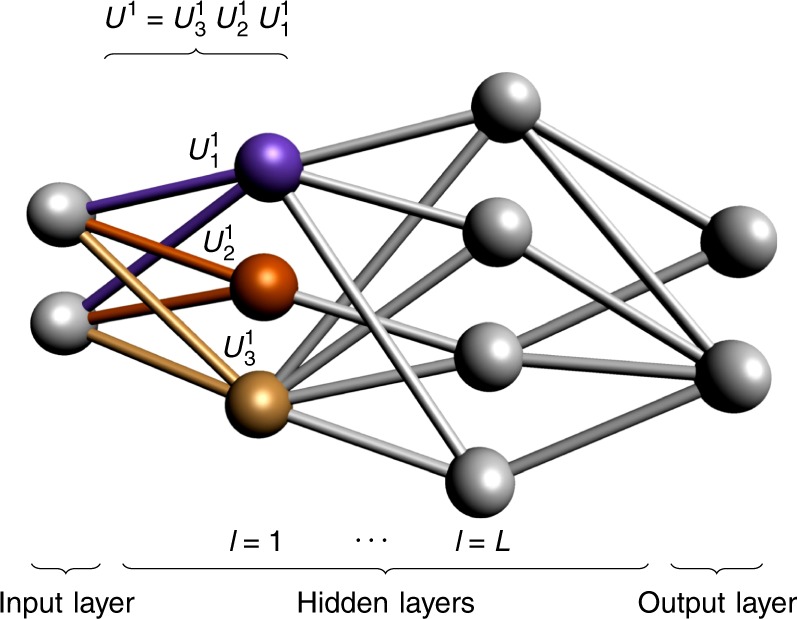
- A quantum perceptron is an arbitrary unitary with \(m\) input and \(n\) output qubits; QNNs built from them can carry out universal quantum computation even for two-input one-output qubit perceptrons, and commuting 4-level qudit perceptrons within each layer also suffice.
- Training uses the fidelity between QNN output and desired output as cost; parameter matrices are computed layer-by-layer, accessing only two layers at a time, so memory scales with width rather than depth, enabling deep-network optimization.
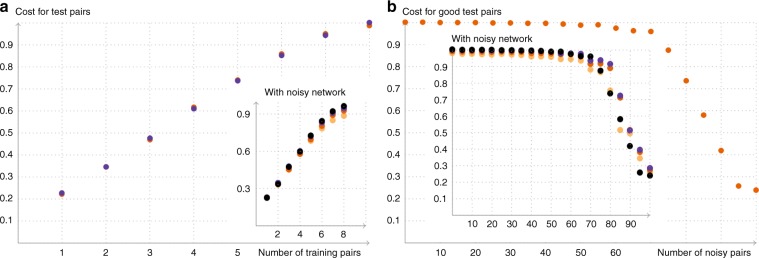
- In simulations, a 3-3-3 network trained with \(\epsilon=0.1\), \(\eta=2/3\) for 1000 rounds with \(n=1,\dots,8\) training pairs and evaluated on 10 test pairs matched a theoretical optimal cost estimate, averaged over 20 rounds.
- A 2-3-2 network trained with \(\epsilon=0.1\), \(\eta=1\) for 300 rounds with 100 training pairs remained robust when some pairs were replaced by random noisy data; insets show approximate depolarizing noise strengths \(t=0, 0.0033, 0.0066, 0.01\).
Methods
- Architecture: perceptrons are arbitrary unitaries on \(m\) input and \(n\) output qubits; a QNN is a quantum circuit of perceptrons organized into \(L\) hidden layers, with output expressed as a composition of completely positive layer-to-layer transition maps.
- Training: the cost is average fidelity between QNN output and desired output; perceptron unitaries are updated by gradient ascent, with parameter matrices computed from the previous layer’s output state and adjoint channels applied to the desired output state up to the current layer.
- Simulations: classical pilot simulations for input/output spaces of \(m=2\) and \(3\) qubits learning a random unitary \(V\), covering generalization from limited random training pairs and robustness to corrupted training data under an approximate depolarizing noise model.
Limitations
- Stated: classical simulation is impossible for more than a handful of qubits due to exponential Hilbert-space growth, so the authors were restricted to small-width QNNs; near-term large networks may require sparse connectivity because copies per training round scale linearly with the number of network parameters, and multiple network evaluations are needed to estimate the derivative.
- Stated: the introduction notes that one would still have to study how noise in the network itself influences performance; future work includes generalizing the perceptron to general CP maps, studying overfitting, and optimized NISQ implementation.
- Evident: empirical validation is limited to classical simulations of small-width QNNs (\(m=2,3\) qubits), with no experimental demonstration; no overfitting analysis is reported despite being listed as future work.
Model-written summary. Check it against the paper before relying on it.
Integrity signals
Registry
Cites
Statistics
Figures
Verification
Claims the paper makes
1 Valid · 2 Not valid · 3 Not checked · 31 Own results and interpretations
The cited sources support only part of this claim — read each source’s verdict below.
In the paper
“However, in the near term, this tradeoff is a happy one as many NISQ architectures—most notably superconducting qubit devices—can easily and rapidly repeat executions of a quantum circuit.”
§ Training deep quantum neural networks > Discussion
What the sources say
- Partly supportedcites [46] Arute F Quantum supremacy using a programmable superconducting processor Nature 2019 574 505 510 10.1038/s41586-019-1666-5 31645734 sourceExperimental — accuracy not yet measured
Our copy supports the superconducting part concretely: in 'The classical computational cost' (p. 509) it states 'it took 600 seconds to sample the circuit on the quantum processor three million times, where sampling time is limited by control hardware communications; in fact, the net quantum processor time is only about 30 seconds,' and in 'The future' it notes that 'for m = 20, obtaining a million samples on the quantum processor takes 200 seconds.' The paper also frames its result as heralding 'the era of noisy intermediate-scale quantum (NISQ) technologies' (intro, crediting Preskill 2018). What it does not support is the generalization to 'many NISQ architectures': the device-level statements are about its own 53-qubit superconducting processor only, and no other NISQ platform is shown to repeat circuit executions easily and rapidly. (LLM, conf=0.70)
plain- Asserted: passes — The authors put it forward as true.
- Checkable: passes — It can be checked against evidence.
- Load-bearing: passes — The paper’s conclusions depend on it.
- Based: passes — The paper gives a reason why it holds.
- Partly supported
In the paper
“It is also an important observation that there is no barren plateau in the cost function landscape.”
- Also stated in: § Simulation of learning tasks · boosted
“A crucial consequence of our numerical investigations was the absence of a “barren plateau” in the cost function landscape for our QNNs45.”
- Also stated in: § Discussion · boosted
“The resulting QML algorithm, when applied to our QNNs, demostrates remarkable capabilities, including, the ability to generalise, tolerance to noisy training data, and an absence of a barren plateau in the cost function landscape.”
§ Training deep quantum neural networks > Introduction
What the sources say
- Not checked yetcites McClean et al.45 McClean JR Boixo S Smelyanskiy VN Babbush R Neven H Barren plateaus in quantum neural network training landscape Nat. Commun. 2018 9 4812 10.1038/s41467-018-07090-4 30446662 PMC6240101 source
boosted- Asserted: passes — The authors put it forward as true.
- Checkable: passes — It can be checked against evidence.
- Load-bearing: passes — The paper’s conclusions depend on it.
- Based: passes — The paper gives a reason why it holds.
- Also stated in: § Simulation of learning tasks · boosted
A result the paper reports from its own data — it cites no other source for it, so there is none to check. The quote shows it is in the paper.
In the paper
“Interestingly, we have obtained numerical evidence that, for approximate depolarising noise, QNNs are robust (see inset of Fig. 2).”
§ Training deep quantum neural networks > Discussion
hedged- Asserted: passes — The authors put it forward as true.
- Checkable: passes — It can be checked against evidence.
- Load-bearing: unclear — It is unclear whether the paper’s conclusions depend on it.
- Based: passes — The paper gives a reason why it holds.
- Rests on an assumption not shown here.
A result the paper reports from its own data — it cites no other source for it, so there is none to check. The quote shows it is in the paper.
In the paper
“Here we see that the QNN matches the theoretical estimate and demonstrates the remarkable ability of our QNNs to generalise.”
§ Training deep quantum neural networks > Results > Simulation of learning tasks
boosted- Asserted: passes — The authors put it forward as true.
- Checkable: passes — It can be checked against evidence.
- Load-bearing: passes — The paper’s conclusions depend on it.
- Based: passes — The paper gives a reason why it holds.
A result the paper reports from its own data — it cites no other source for it, so there is none to check. The quote shows it is in the paper.
In the paper
“In addition, we always initialised our QNNs with random unitaries and we did not observe any exponential reduction in the value of the parameter matrices K (which arise from the derivative of our QNN with respect to the parameters).”
§ Training deep quantum neural networks > Results > Simulation of learning tasks
plain- Asserted: passes — The authors put it forward as true.
- Checkable: passes — It can be checked against evidence.
- Load-bearing: passes — The paper’s conclusions depend on it.
- Based: passes — The paper gives a reason why it holds.
17 more claims
Create a free account to see all 37 claims and to verify the 4 references still open.
- The quote only partly states this claim. 1
- It may state two separate claims as one. 9
- Probably not a substantial claim. 5
Claims other papers make about this one
Each is checked against this paper’s own text: does it say what the citing paper says it does?
The cited source doesn’t support the claim as written.
In the citing paper
“Ref. [174] proposed a VQA for learning continuous distributions which is meant to be a quantum version of GANs.”
From Variational quantum algorithms (2021) · cites this paper as [174]
Checked by a reasoning model — may be wrong.
Experimental — accuracy not yet measuredThe cited source says what the claim attributes to it.
In the citing paper
“there has been significant efforts put forward to use quantum algorithms for machine learning applications [154, 157, 174, 287].”
From Variational quantum algorithms (2021) · cites this paper as [174]
The check wasn’t confident either way, so it gives no verdict — never disputed.
In the citing paper
“We remark that the cost function in (1) contains as special cases many relevant applications.For instance, in a binary classification problem the cost function is given by the mean squarederror C(θ) = x (y x -y(θ, ρ x )) 2 [16,17,39,40].”
From Effect of barren plateaus on gradient-free optimization (2021) · cites this paper as [16]
Experimental — accuracy not yet measured
Self-check
Percentages, sums and reported differences re-computed from the paper’s own numbers.
Each contradiction between two passages listed here was confirmed by an independent check.
Rated minor: it would not touch a result — a value no result rests on, a p-value that stays on the same side of the significance level, or a conflict that is clerical, resolved elsewhere in the paper, or outside its own findings.
In the paper
§ Training deep quantum neural networks > Results > Simulation of learning tasks
“where N was smaller than the Hilbert space dimension.”
§ Training deep quantum neural networks > Results > Simulation of learning tasks
“We trained a 3-3-3 network with ϵ = 0.1, η = 2∕3 for 1000 rounds with n = 1, 2, …, 8 training pairs”
Citations
Cites
Book Review: Pattern Recognition and Machine Learning
Nasrabadi, N. M. (2007) · Journal of Electronic Imaging · doi:10.1117/1.2819119 · Cited by 22,066 · cited 1×
“(4), we obtain a formula for the parameter matrices (this is described in detail in Supplementary Note 2).”
MethodQuantum Computation and Quantum Information
Nielsen, M. A., Chuang, I., & Grover, L. K. (2002) · American Journal of Physics · doi:10.1119/1.1463744 · Cited by 21,895
Machine learning: Trends, perspectives, and prospects
Jordan, M. I., & Mitchell, T. M. (2015) · Science · doi:10.1126/science.aaa8415 · Cited by 9,955
Pattern Recognition and Machine Learning
(2006) · doi:10.1007/978-0-387-45528-0 · Cited by 9,824
Quantum Computation and Quantum Information: 10th Anniversary Edition
Nielsen, M. A., & Chuang, I. L. (2012) · doi:10.1017/cbo9780511976667 · Cited by 8,436
Quantum supremacy using a programmable superconducting processor
Arute, F., Arya, K., Babbush, R., Bacon, D., Bardin, J. C., Barends, R., Biswas, R., Boixo, S., Brandao, F. G. S. L., Buell, D. A., et al. (2019) · Nature · doi:10.1038/s41586-019-1666-5 · Cited by 7,720
Biamonte, J., Wittek, P., Pancotti, N., Rebentrost, P., Wiebe, N., & Lloyd, S. (2017) · Nature · doi:10.1038/nature23474 · Cited by 4,779
Pattern recognition and machine learning
(2007) · Choice Reviews Online · doi:10.5860/choice.44-5091 · Cited by 2,650
Barren plateaus in quantum neural network training landscapes
McClean, J. R., Boixo, S., Smelyanskiy, V. N., Babbush, R., & Neven, H. (2018) · Nature Communications · doi:10.1038/s41467-018-07090-4 · Cited by 2,329
Solving the quantum many-body problem with artificial neural networks
Carleo, G., & Troyer, M. (2017) · Science · doi:10.1126/science.aag2302 · Cited by 2,215
Mitarai, K., Negoro, M., Kitagawa, M., & Fujii, K. (2018) · Physical Review A · doi:10.1103/physreva.98.032309 · Cited by 1,639
Machine learning & artificial intelligence in the quantum domain: a review of recent progress
Dunjko, V., & Briegel, H. J. (2018) · Reports on Progress in Physics · doi:10.1088/1361-6633/aab406 · Cited by 1,055
PennyLane: Automatic differentiation of hybrid quantum-classical computations
Bergholm, V., Izaac, J., Schuld, M., Gogolin, C., Ahmed, S., Ajith, V., Alam, M. S., Alonso-Linaje, G., AkashNarayanan, B., Asadi, A., et al. (2018) · arXiv · doi:10.48550/arxiv.1811.04968 · Cited by 732
The quest for a Quantum Neural Network
Schuld, M., Sinayskiy, I., & Petruccione, F. (2014) · Quantum Information Processing · doi:10.1007/s11128-014-0809-8 · Cited by 671
Classification with Quantum Neural Networks on Near Term Processors
Farhi, E., & Neven, H. (2018) · arXiv · doi:10.48550/arxiv.1802.06002 · Cited by 598
Amin, M. H., Andriyash, E., Rolfe, J., Kulchytskyy, B., & Melko, R. (2018) · Physical Review X · doi:10.1103/physrevx.8.021050 · Cited by 520
Neural Networks and Deep Learning
(2016) · Computer Age Statistical Inference · doi:10.1017/cbo9781316576533.019 · Cited by 509
Quantum-Enhanced Machine Learning
Dunjko, V., Taylor, J. M., & Briegel, H. J. (2016) · Physical Review Letters · doi:10.1103/physrevlett.117.130501 · Cited by 460
Continuous-variable quantum neural networks
Killoran, N., Bromley, T. R., Arrazola, J. M., Schuld, M., Quesada, N., & Lloyd, S. (2019) · Physical Review Research · doi:10.1103/physrevresearch.1.033063 · Cited by 418
Continuous-variable quantum neural networks
Killoran, N., Bromley, T. R., Arrazola, J. M., Schuld, M., Quesada, N., & Lloyd, S. (2018) · DSpace@MIT (Massachusetts Institute of Technology) · Cited by 360
Classification with Quantum Neural Networks on Near Term Processors
Farhi, E., & Neven, H. (2020) · doi:10.37686/qrl.v1i2.80 · Cited by 332
Hierarchical quantum classifiers
Grant, E., Benedetti, M., Cao, S., Hallam, A., Lockhart, J., Stojevic, V., Green, A. G., & Severini, S. (2018) · npj Quantum Information · doi:10.1038/s41534-018-0116-9 · Cited by 318
Hierarchical quantum classifiers
Grant, E., Benedetti, M., Cao, S., Hallam, A., Lockhart, J., Stojevic, V, Green, A. G., & Simone Severini, B. (2018) · UCL Discovery (University College London) · Cited by 296
Quantum generalisation of feedforward neural networks
Wan, K. H., Dahlsten, O., Kristjánsson, H., Gardner, R., & Kim, M. S. (2017) · npj Quantum Information · doi:10.1038/s41534-017-0032-4 · Cited by 276
Quantum speed-up for unsupervised learning
Aïmeur, E., Brassard, G., & Gambs, S. (2013) · Machine Learning · doi:10.1007/s10994-012-5316-5 · Cited by 214
Quantum optical neural networks
Steinbrecher, G. R., Olson, J. P., Englund, D., & Carolan, J. (2019) · npj Quantum Information · doi:10.1038/s41534-019-0174-7 · Cited by 209
Quantum Speedup for Active Learning Agents
Paparo, G. D., Dunjko, V., Makmal, A., Martin-Delgado, M. A., & Briegel, H. J. (2014) · Physical Review X · doi:10.1103/physrevx.4.031002 · Cited by 192
Simulating a perceptron on a quantum computer
Schuld, M., Sinayskiy, I., & Petruccione, F. (2015) · Physics Letters A · doi:10.1016/j.physleta.2014.11.061 · Cited by 162
Machine Learning in a Quantum World
Aïmeur, E., Brassard, G., & Gambs, S. (2006) · Lecture Notes in Computer Science · doi:10.1007/11766247_37 · Cited by 161
Optimal quantum learning of a unitary transformation
Bisio, A., Chiribella, G., D’Ariano, G. M., Facchini, S., & Perinotti, P. (2010) · Physical Review A · doi:10.1103/physreva.81.032324 · Cited by 147
Qubit neural network and its learning efficiency
Kouda, N., Matsui, N., Nishimura, H., & Peper, F. (2005) · Neural Computing and Applications · doi:10.1007/s00521-004-0446-8 · Cited by 132
Machine learning method for state preparation and gate synthesis on photonic quantum computers
Arrazola, J. M., Bromley, T. R., Izaac, J., Myers, C. R., Brádler, K., & Killoran, N. (2019) · Quantum Science and Technology · doi:10.1088/2058-9565/aaf59e · Cited by 131
Quantum Neuron: an elementary building block for machine learning on quantum computers
Cao, Y., Guerreschi, G. G., & Aspuru‐Guzik, A. (2017) · arXiv (Cornell University) · doi:10.48550/arxiv.1711.11240 · Cited by 105
Unitary quantum perceptron as efficient universal approximator
Torrontegui, E., & García-Ripoll, J. J. (2019) · EPL (Europhysics Letters) · doi:10.1209/0295-5075/125/30004 · Cited by 102
Quantum learning and universal quantum matching machine
Sasaki, M., & Carlini, A. (2002) · Physical Review A · doi:10.1103/physreva.66.022303 · Cited by 101
Quantum perceptron over a field and neural network architecture selection in a quantum computer
da Silva, A. J., Ludermir, T. B., & de Oliveira, W. R. (2016) · Neural Networks · doi:10.1016/j.neunet.2016.01.002 · Cited by 101
Altaisky, M. V. (2001) · arXiv · doi:10.48550/arxiv.quant-ph/0107012 · Cited by 101
Wiebe, N., Kapoor, A., & Svore, K. M. (2016) · arXiv (Cornell University) · doi:10.48550/arxiv.1602.04799 · Cited by 96
Optimal Probabilistic Storage and Retrieval of Unitary Channels
Sedlák, M., Bisio, A., & Ziman, M. (2019) · Physical Review Letters · doi:10.1103/physrevlett.122.170502 · Cited by 83
Differential Evolution for Many-Particle Adaptive Quantum Metrology
Lovett, N. B., Crosnier, C., Perarnau-Llobet, M., & Sanders, B. C. (2013) · Physical Review Letters · doi:10.1103/physrevlett.110.220501 · Cited by 71
A universal training algorithm for quantum deep learning
Verdon, G., Pye, J., & Broughton, M. (2018) · arXiv · doi:10.48550/arxiv.1806.09729 · Cited by 68
Adaptive quantum computation in changing environments using projective simulation
Tiersch, M., Ganahl, E. J., & Briegel, H. J. (2015) · Scientific Reports · doi:10.1038/srep12874 · Cited by 57
Quantum learning without quantum memory
Sentís, G., Calsamiglia, J., Muñoz-Tapia, R., & Bagan, E. (2012) · Scientific Reports · doi:10.1038/srep00708 · Cited by 56
Quantum Information Theory — an Invitation
Werner, R. F. (2007) · Springer eBooks · doi:10.1007/3-540-44678-8_2 · Cited by 55 · cited 1×
“Our classical simulation results are very promising and suggest the imminent feasibility of our procedure for noisy intermediate scale (NISQ) quantum devices.”
BackgroundSupervised Quantum Learning without Measurements
Álvarez Rodríguez, U., Lamata Manuel, L., Escandell Montero, P., Martín‐Guerrero, J. D., & Solano Villanueva, E. L. (2017) · LA Referencia (Red Federada de Repositorios Institucionales de Publicaciones Científicas) · Cited by 54
Unsupervised Classification of Quantum Data
Sentís, G., Monràs, A., Muñoz-Tapia, R., Calsamiglia, J., & Bagán, E. (2019) · Physical Review X · doi:10.1103/physrevx.9.041029 · Cited by 52
Quantum classificationPreprint
Gambs, S. (2008) · arXiv (Cornell University) · doi:10.48550/arxiv.0809.0444 · Cited by 50
Supervised Quantum Learning without Measurements
Alvarez-Rodriguez, U., Lamata, L., Escandell-Montero, P., Martín-Guerrero, J. D., & Solano, E. (2017) · Scientific Reports · doi:10.1038/s41598-017-13378-0 · Cited by 47
Quantum Information Theory - an InvitationPreprint
Werner, R. F. (2001) · arXiv (Cornell University) · doi:10.48550/arxiv.quant-ph/0101061 · Cited by 47 · cited 1×
“Our classical simulation results are very promising and suggest the imminent feasibility of our procedure for noisy intermediate scale (NISQ) quantum devices.”
BackgroundLewenstein, M. (1994) · Journal of Modern Optics · doi:10.1080/09500349414552331 · Cited by 46
Inductive Supervised Quantum Learning
Monràs, A., Sentís, G., & Wittek, P. (2017) · Physical Review Letters · doi:10.1103/physrevlett.118.190503 · Cited by 38
Quantum Neural Machine Learning: Backpropagation and Dynamics
Gonçalves, C. P. (2016) · NeuroQuantology · doi:10.14704/nq.2017.15.1.1008 · Cited by 21
Mathematical Foundations for Supervised Learning
Hoogendoorn, M., & Funk, B. (2017) · Cognitive systems monographs · doi:10.1007/978-3-319-66308-1_6 · Cited by 15 · cited 2×
“[42]), the training data is a set of instances of some (unknown) probability distribution.”
BackgroundThe Expressive Power of Parameterized Quantum CircuitsPreprint
Du, Y., Hsieh, M., Liu, T., & Tao, D. (2018) · arXiv (Cornell University) · doi:10.48550/arxiv.1810.11922 · Cited by 14
Algebraic approach to quantum theory: a finite-dimensional guidePreprint
Bény, C., & Richter, F. (2015) · arXiv (Cornell University) · doi:10.48550/arxiv.1505.03106 · Cited by 10
From the Quantum Moore's Law toward Silicon Based Universal Quantum Computing
Prati, E., Rotta, D., Sebastiano, F., & Edoardo Charbon, A. (2017) · IEEE International Conference on Rebooting Computing (ICRC) · doi:10.1109/icrc.2017.8123662 · Cited by 9
Circuit-centric quantum classifiers
Schuld, M., Bocharov, A., Svore, K., et al. (2018) · arXiv · doi:10.48550/arxiv.1804.00633
Research works printed but not linked: 1
- Goodfellow, I., Bengio, Y. & Courville, A. Deep Learning (MIT Press, 2016).
Cited by
Variational quantum algorithms
Cerezo, M., Arrasmith, A., Babbush, R., Benjamin, S. C., Endo, S., Fujii, K., McClean, J. R., Mitarai, K., Yuan, X., Cincio, L., et al. (2021) · Nature Reviews Physics · doi:10.1038/s42254-021-00348-9 · Cited by 3,385
“[132, 149, 150] proposed perceptron-based QNNs.”
Parameterized quantum circuits as machine learning models
Benedetti, M., Lloyd, E., Sack, S., & Fiorentini, M. (2019) · Quantum Science and Technology · doi:10.1088/2058-9565/ab4eb5 · Cited by 1,144
“[40] use separate qubit registers for input and output, and define the quantum neuron as a completely positive map between the two.”
MethodCost function dependent barren plateaus in shallow parametrized quantum circuits
Cerezo, M., Sone, A., Volkoff, T., Cincio, L., & Coles, P. J. (2021) · Nature Communications · doi:10.1038/s41467-021-21728-w · Cited by 1,047
Noise-induced barren plateaus in variational quantum algorithms
Wang, S., Fontana, E., Cerezo, M., Sharma, K., Sone, A., Cincio, L., & Coles, P. J. (2021) · Nature Communications · doi:10.1038/s41467-021-27045-6 · Cited by 773
“[60] Kerstin Beer, Dmytro Bondarenko, Terry Farrelly, Tobias J Osborne, Robert Salzmann, Daniel Scheiermann, and Ramona Wolf, “Training deep quantum neural networks,” Nature Communications 11, 1–6 (2020).”
BackgroundChallenges and opportunities in quantum machine learning
Cerezo, M., Verdon, G., Huang, H.-Y., Cincio, L., & Coles, P. J. (2022) · Nature Computational Science · doi:10.1038/s43588-022-00311-3 · Cited by 689
“4(a) we show a dissipative QNN [40] which generalizes the classical feed-forward network.”
Background
Metadata
- Authors
- Beer, K., Bondarenko, D., Farrelly, T., Osborne, T. J., Salzmann, R., Scheiermann, D., & Wolf, R.
- Affiliations
- Leibniz University Hannover (DE)
- Corresponding author
- Beer, Kerstin
- ORCID
- Venue
- Nature Communications
- Published
- 2020-02-10
- Volume
- 11
- Issue
- 1
- Pages
- 808-808
- ISSN
- 2041-1723 (ISSN-L)
- PMC
- PMC7010779
- OpenAlex
- W3004965358
- Semantic Scholar
- 9c8e8416bf64e592444e25e484f3f729480fd146
- Cited by
- 726
- References
- 52
- Citations by year
- 2026: 96 · 2025: 138 · 2024: 134 · 2023: 118 · 2022: 95 · 2021: 113 · 2020: 28
- FWCI
- 34.79
- Type
- journal article
- Language
- en
- Open access
- gold
- doi.org
- Licence
- cc-by
- creativecommons.org/licenses/by/4.0 (tdm)
- creativecommons.org/licenses/by/4.0 (vor)
- Locations
- Nature Communications (publishedVersion, cc-by)
- PubMed Central (publishedVersion, cc-by)
- PubMed (publishedVersion)
- arXiv (Cornell University) (submittedVersion)
- Institutional Repository of Leibniz Universität Hannover (Leibniz Universität Hannover) (submittedVersion, cc-by-nc-nd)
- LA Referencia (Red Federada de Repositorios Institucionales de Publicaciones Científicas) (submittedVersion, cc-by)
- RePEc: Research Papers in Economics (submittedVersion)
- DOAJ (DOAJ: Directory of Open Access Journals) (submittedVersion, cc-by-sa)
- Institutional Repository of Leibniz Universität Hannover (Leibniz Universität Hannover) (submittedVersion, cc-by)
- Apollo (University of Cambridge) (submittedVersion, cc-by)
- arXiv (Cornell University)
- Leibniz Universität Hannover (cc-by)
- Apollo (cc-by)
- Funders
- Deutsche Forschungsgemeinschaft (SFB 1227, RTG 1991, EXC 2123)
- Topics
- Physical Sciences › Computer Science › Artificial Intelligence › Quantum Computing Algorithms and Architecture
- Physical Sciences › Physics and Astronomy › Atomic and Molecular Physics, and Optics › Quantum Information and Cryptography
- Physical Sciences › Physics and Astronomy › Atomic and Molecular Physics, and Optics › Quantum many-body systems
- Keywords
- quantum neural networks, quantum neurons, quantum machine learning, qudits, deep neural network training, noisy data robustness, generalization
About these checks
Registry, retraction, Cites and statistics results are computed, not judged, with one exception: a printed reference that no index lists is read once by a model before it counts as a citation error. Claims are extracted by a model and kept only when their quote appears verbatim in the text; each cited source is then checked, with a model’s help, for whether it says what the claim relies on. Those verdicts can be wrong — read the claim’s quote and the cited source before relying on one.
The claim verdicts this report counts are experimental: their accuracy is not yet measured.
A language model drew the claims from the paper on 2026-10-08, under version 3 of the claim definition (model deepseek-v4.1-flash, prompt extract-v3).
A second model labelled each claim on 2026-10-08 (model jev-1.13-20260917, definition revision gold-guideline-v0.2).
Cited sources are checked with a language model’s help (qwen3.8-omni-flash).
Statistics and arithmetic are recomputed, not judged.
Confidence bands are shown only for fields calibrated on our annotated test set. None is calibrated yet, so no band is shown.
What counts as a claim ›How we measure confidence ›How we check this ›
Are you an author, or do you see a problem with this page? Request a review
Data sources
Bibliographic data: Semantic Scholar, OpenAlex, Crossref.
Contains information from the Semantic Scholar Academic Graph Datasets, made available under the ODC Attribution License (ODC-BY 1.0).
Semantic Scholar’s data is described in: Kinney, R., et al. (2023). The Semantic Scholar Open Data Platform. arXiv:2301.10140.
