

Training deep quantum neural networks
Open accessThe DOI matches its Crossref record; 57 of the 57 references it cites were found in a registry or an index; 1 of the 5 sources its claims cite were checked for support.
Abstract
Neural networks enjoy widespread success in both research and industry and, with the advent of quantum technology, it is a crucial challenge to design quantum neural networks for fully quantum learning tasks. Here we propose a truly quantum analogue of classical neurons, which form quantum feedforward neural networks capable of universal quantum computation. We describe the efficient training of these networks using the fidelity as a cost function, providing both classical and efficient quantum implementations. Our method allows for fast optimisation with reduced memory requirements: the number of qudits required scales with only the width, allowing deep-network optimisation. We benchmark our proposal for the quantum task of learning an unknown unitary and find remarkable generalisation behaviour and a striking robustness to noisy training data.
Overview
CoChat Summary
TL;DR
The paper proposes a quantum perceptron defined as an arbitrary unitary on input and output qubits, forming feedforward quantum neural networks capable of universal quantum computation. It gives a fidelity-based training algorithm whose memory scales with network width, and numerical simulations for learning an unknown unitary show generalization and robustness to noisy training data.
Key findings
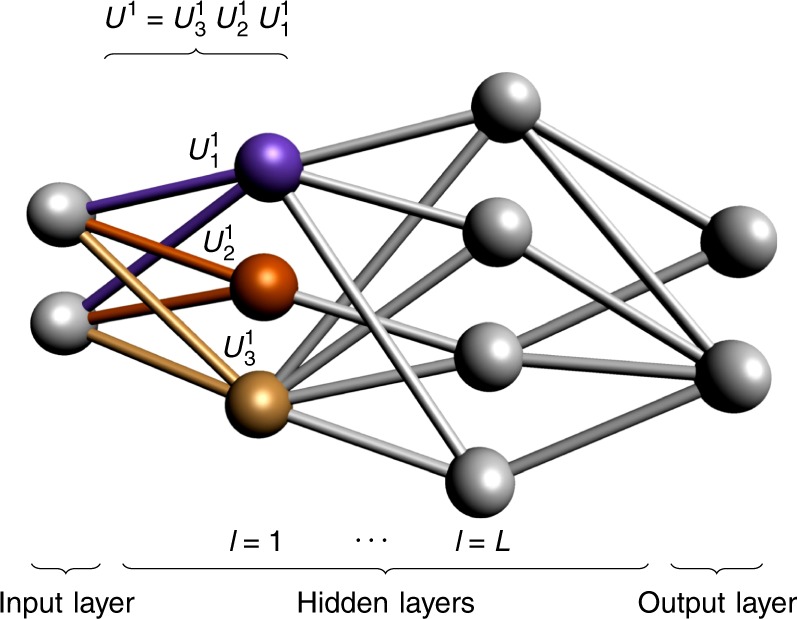
- A quantum perceptron is an arbitrary unitary with \(m\) input and \(n\) output qubits; QNNs built from them can carry out universal quantum computation even for two-input one-output qubit perceptrons, and commuting 4-level qudit perceptrons within each layer also suffice.
- Training uses the fidelity between QNN output and desired output as cost; parameter matrices are computed layer-by-layer, accessing only two layers at a time, so memory scales with width rather than depth, enabling deep-network optimization.
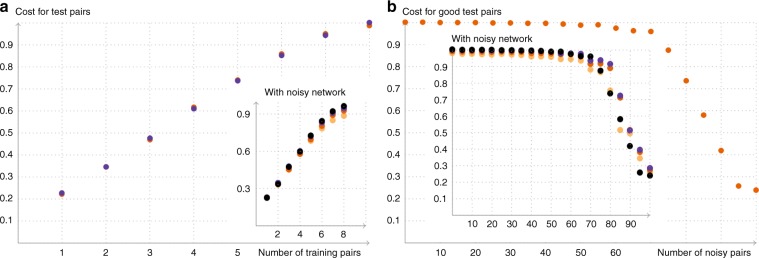
- In simulations, a 3-3-3 network trained with \(\epsilon=0.1\), \(\eta=2/3\) for 1000 rounds with \(n=1,\dots,8\) training pairs and evaluated on 10 test pairs matched a theoretical optimal cost estimate, averaged over 20 rounds.
- A 2-3-2 network trained with \(\epsilon=0.1\), \(\eta=1\) for 300 rounds with 100 training pairs remained robust when some pairs were replaced by random noisy data; insets show approximate depolarizing noise strengths \(t=0, 0.0033, 0.0066, 0.01\).
Methods
- Architecture: perceptrons are arbitrary unitaries on \(m\) input and \(n\) output qubits; a QNN is a quantum circuit of perceptrons organized into \(L\) hidden layers, with output expressed as a composition of completely positive layer-to-layer transition maps.
- Training: the cost is average fidelity between QNN output and desired output; perceptron unitaries are updated by gradient ascent, with parameter matrices computed from the previous layer’s output state and adjoint channels applied to the desired output state up to the current layer.
- Simulations: classical pilot simulations for input/output spaces of \(m=2\) and \(3\) qubits learning a random unitary \(V\), covering generalization from limited random training pairs and robustness to corrupted training data under an approximate depolarizing noise model.
Limitations
- Stated: classical simulation is impossible for more than a handful of qubits due to exponential Hilbert-space growth, so the authors were restricted to small-width QNNs; near-term large networks may require sparse connectivity because copies per training round scale linearly with the number of network parameters, and multiple network evaluations are needed to estimate the derivative.
- Stated: the introduction notes that one would still have to study how noise in the network itself influences performance; future work includes generalizing the perceptron to general CP maps, studying overfitting, and optimized NISQ implementation.
- Evident: empirical validation is limited to classical simulations of small-width QNNs (\(m=2,3\) qubits), with no experimental demonstration; no overfitting analysis is reported despite being listed as future work.
Model-written summary. Check it against the paper before relying on it.
Integrity signals
Registry
Cites
Statistics
Figures
Verification
Claims the paper makes
1 Valid · 2 Not valid · 3 Not checked · 31 Own results and interpretations
The cited sources support only part of this claim — read each source’s verdict below.
In the paper
“However, in the near term, this tradeoff is a happy one as many NISQ architectures—most notably superconducting qubit devices—can easily and rapidly repeat executions of a quantum circuit.”
§ Training deep quantum neural networks > Discussion
What the sources say
- Partly supportedcites [46] Arute F Quantum supremacy using a programmable superconducting processor Nature 2019 574 505 510 10.1038/s41586-019-1666-5 31645734 sourceExperimental — accuracy not yet measured
Our copy supports the superconducting part concretely: in 'The classical computational cost' (p. 509) it states 'it took 600 seconds to sample the circuit on the quantum processor three million times, where sampling time is limited by control hardware communications; in fact, the net quantum processor time is only about 30 seconds,' and in 'The future' it notes that 'for m = 20, obtaining a million samples on the quantum processor takes 200 seconds.' The paper also frames its result as heralding 'the era of noisy intermediate-scale quantum (NISQ) technologies' (intro, crediting Preskill 2018). What it does not support is the generalization to 'many NISQ architectures': the device-level statements are about its own 53-qubit superconducting processor only, and no other NISQ platform is shown to repeat circuit executions easily and rapidly. (LLM, conf=0.70)
plain- Asserted: passes — The authors put it forward as true.
- Checkable: passes — It can be checked against evidence.
- Load-bearing: passes — The paper’s conclusions depend on it.
- Based: passes — The paper gives a reason why it holds.
- Partly supported
In the paper
“It is also an important observation that there is no barren plateau in the cost function landscape.”
- Also stated in: § Simulation of learning tasks · boosted
“A crucial consequence of our numerical investigations was the absence of a “barren plateau” in the cost function landscape for our QNNs45.”
- Also stated in: § Discussion · boosted
“The resulting QML algorithm, when applied to our QNNs, demostrates remarkable capabilities, including, the ability to generalise, tolerance to noisy training data, and an absence of a barren plateau in the cost function landscape.”
§ Training deep quantum neural networks > Introduction
What the sources say
- Not checked yetcites McClean et al.45 McClean JR Boixo S Smelyanskiy VN Babbush R Neven H Barren plateaus in quantum neural network training landscape Nat. Commun. 2018 9 4812 10.1038/s41467-018-07090-4 30446662 PMC6240101 source
boosted- Asserted: passes — The authors put it forward as true.
- Checkable: passes — It can be checked against evidence.
- Load-bearing: passes — The paper’s conclusions depend on it.
- Based: passes — The paper gives a reason why it holds.
- Also stated in: § Simulation of learning tasks · boosted
A result the paper reports from its own data — it cites no other source for it, so there is none to check. The quote shows it is in the paper.
In the paper
“Interestingly, we have obtained numerical evidence that, for approximate depolarising noise, QNNs are robust (see inset of Fig. 2).”
§ Training deep quantum neural networks > Discussion
hedged- Asserted: passes — The authors put it forward as true.
- Checkable: passes — It can be checked against evidence.
- Load-bearing: unclear — It is unclear whether the paper’s conclusions depend on it.
- Based: passes — The paper gives a reason why it holds.
- Rests on an assumption not shown here.
A result the paper reports from its own data — it cites no other source for it, so there is none to check. The quote shows it is in the paper.
In the paper
“Here we see that the QNN matches the theoretical estimate and demonstrates the remarkable ability of our QNNs to generalise.”
§ Training deep quantum neural networks > Results > Simulation of learning tasks
boosted- Asserted: passes — The authors put it forward as true.
- Checkable: passes — It can be checked against evidence.
- Load-bearing: passes — The paper’s conclusions depend on it.
- Based: passes — The paper gives a reason why it holds.
A result the paper reports from its own data — it cites no other source for it, so there is none to check. The quote shows it is in the paper.
In the paper
“In addition, we always initialised our QNNs with random unitaries and we did not observe any exponential reduction in the value of the parameter matrices K (which arise from the derivative of our QNN with respect to the parameters).”
§ Training deep quantum neural networks > Results > Simulation of learning tasks
plain- Asserted: passes — The authors put it forward as true.
- Checkable: passes — It can be checked against evidence.
- Load-bearing: passes — The paper’s conclusions depend on it.
- Based: passes — The paper gives a reason why it holds.
17 more claims
Create a free account to see all 37 claims and to verify the 4 references still open.
- The quote only partly states this claim. 1
- It may state two separate claims as one. 9
- Probably not a substantial claim. 5
Claims other papers make about this one
Each is checked against this paper’s own text: does it say what the citing paper says it does?
The cited source doesn’t support the claim as written.
In the citing paper
“Ref. [174] proposed a VQA for learning continuous distributions which is meant to be a quantum version of GANs.”
From Variational quantum algorithms (2021) · cites this paper as [174]
Checked by a reasoning model — may be wrong.
Experimental — accuracy not yet measuredThe cited source says what the claim attributes to it.
In the citing paper
“there has been significant efforts put forward to use quantum algorithms for machine learning applications [154, 157, 174, 287].”
From Variational quantum algorithms (2021) · cites this paper as [174]
The check wasn’t confident either way, so it gives no verdict — never disputed.
In the citing paper
“We remark that the cost function in (1) contains as special cases many relevant applications.For instance, in a binary classification problem the cost function is given by the mean squarederror C(θ) = x (y x -y(θ, ρ x )) 2 [16,17,39,40].”
From Effect of barren plateaus on gradient-free optimization (2021) · cites this paper as [16]
Experimental — accuracy not yet measured
Self-check
Percentages, sums and reported differences re-computed from the paper’s own numbers.
Each contradiction between two passages listed here was confirmed by an independent check.
Rated minor: it would not touch a result — a value no result rests on, a p-value that stays on the same side of the significance level, or a conflict that is clerical, resolved elsewhere in the paper, or outside its own findings.
In the paper
§ Training deep quantum neural networks > Results > Simulation of learning tasks
“where N was smaller than the Hilbert space dimension.”
§ Training deep quantum neural networks > Results > Simulation of learning tasks
“We trained a 3-3-3 network with ϵ = 0.1, η = 2∕3 for 1000 rounds with n = 1, 2, …, 8 training pairs”
Citations
Cites
Book Review: Pattern Recognition and Machine Learning
Nasrabadi, N. M. (2007) · Journal of Electronic Imaging · doi:10.1117/1.2819119 · Cited by 22,066 · cited 1×
“(4), we obtain a formula for the parameter matrices (this is described in detail in Supplementary Note 2).”
MethodQuantum Computation and Quantum Information
Nielsen, M. A., Chuang, I., & Grover, L. K. (2002) · American Journal of Physics · doi:10.1119/1.1463744 · Cited by 21,895
Machine learning: Trends, perspectives, and prospects
Jordan, M. I., & Mitchell, T. M. (2015) · Science · doi:10.1126/science.aaa8415 · Cited by 9,955
Pattern Recognition and Machine Learning
(2006) · doi:10.1007/978-0-387-45528-0 · Cited by 9,824
Quantum Computation and Quantum Information: 10th Anniversary Edition
Nielsen, M. A., & Chuang, I. L. (2012) · doi:10.1017/cbo9780511976667 · Cited by 8,436
Quantum supremacy using a programmable superconducting processor
Arute, F., Arya, K., Babbush, R., Bacon, D., Bardin, J. C., Barends, R., Biswas, R., Boixo, S., Brandao, F. G. S. L., Buell, D. A., et al. (2019) · Nature · doi:10.1038/s41586-019-1666-5 · Cited by 7,720
Biamonte, J., Wittek, P., Pancotti, N., Rebentrost, P., Wiebe, N., & Lloyd, S. (2017) · Nature · doi:10.1038/nature23474 · Cited by 4,779
Pattern recognition and machine learning
(2007) · Choice Reviews Online · doi:10.5860/choice.44-5091 · Cited by 2,650
Barren plateaus in quantum neural network training landscapes
McClean, J. R., Boixo, S., Smelyanskiy, V. N., Babbush, R., & Neven, H. (2018) · Nature Communications · doi:10.1038/s41467-018-07090-4 · Cited by 2,329
Solving the quantum many-body problem with artificial neural networks
Carleo, G., & Troyer, M. (2017) · Science · doi:10.1126/science.aag2302 · Cited by 2,215
Research works printed but not linked: 1
- Goodfellow, I., Bengio, Y. & Courville, A. Deep Learning (MIT Press, 2016).
Cited by
Variational quantum algorithms
Cerezo, M., Arrasmith, A., Babbush, R., Benjamin, S. C., Endo, S., Fujii, K., McClean, J. R., Mitarai, K., Yuan, X., Cincio, L., et al. (2021) · Nature Reviews Physics · doi:10.1038/s42254-021-00348-9 · Cited by 3,385
“[132, 149, 150] proposed perceptron-based QNNs.”
Parameterized quantum circuits as machine learning models
Benedetti, M., Lloyd, E., Sack, S., & Fiorentini, M. (2019) · Quantum Science and Technology · doi:10.1088/2058-9565/ab4eb5 · Cited by 1,144
“[40] use separate qubit registers for input and output, and define the quantum neuron as a completely positive map between the two.”
MethodCost function dependent barren plateaus in shallow parametrized quantum circuits
Cerezo, M., Sone, A., Volkoff, T., Cincio, L., & Coles, P. J. (2021) · Nature Communications · doi:10.1038/s41467-021-21728-w · Cited by 1,047
Noise-induced barren plateaus in variational quantum algorithms
Wang, S., Fontana, E., Cerezo, M., Sharma, K., Sone, A., Cincio, L., & Coles, P. J. (2021) · Nature Communications · doi:10.1038/s41467-021-27045-6 · Cited by 773
“[60] Kerstin Beer, Dmytro Bondarenko, Terry Farrelly, Tobias J Osborne, Robert Salzmann, Daniel Scheiermann, and Ramona Wolf, “Training deep quantum neural networks,” Nature Communications 11, 1–6 (2020).”
BackgroundChallenges and opportunities in quantum machine learning
Cerezo, M., Verdon, G., Huang, H.-Y., Cincio, L., & Coles, P. J. (2022) · Nature Computational Science · doi:10.1038/s43588-022-00311-3 · Cited by 689
“4(a) we show a dissipative QNN [40] which generalizes the classical feed-forward network.”
BackgroundAbsence of Barren Plateaus in Quantum Convolutional Neural Networks
Pesah, A., Cerezo, M., Wang, S., Volkoff, T., Sornborger, A. T., & Coles, P. J. (2021) · Physical Review X · doi:10.1103/physrevx.11.041011 · Cited by 343
“First, let us remark that the variance for the correlated case is always larger than that of the uncorrelated case as in (32).”
BackgroundResultAbsence of Barren Plateaus in Quantum Convolutional Neural Networks
Pesah, A., Cerezo, M., Wang, S., Volkoff, T., Sornborger, A. T., & Coles, P. J. (2020) · arXiv · doi:10.48550/arxiv.2011.02966 · Cited by 343
Barren plateaus in variational quantum computing
Larocca, M., Thanasilp, S., Wang, S., Sharma, K., Biamonte, J., Coles, P. J., Cincio, L., McClean, J. R., Holmes, Z., & Cerezo, M. (2025) · Nature Reviews Physics · doi:10.1038/s42254-025-00813-9 · Cited by 257
“In quantum machine learning, the input states tend to be fixed as the encoding scheme for classical data, the measurement operator and the choice of loss function are generally more flexible, offering additional design freedom.”
A Survey of Important Issues in Quantum Computing and Communications
Yang, Z., Zolanvari, M., & Jain, R. (2023) · IEEE Communications Surveys & Tutorials · doi:10.1109/comst.2023.3254481 · Cited by 251
“Quantum neural network methods to simplify the internal network has been proposed to make the parameters of ground states much smaller [154].”
BackgroundMethodEffect of barren plateaus on gradient-free optimization
Arrasmith, A., Cerezo, M., Czarnik, P., Cincio, L., & Coles, P. J. (2021) · Quantum · doi:10.22331/q-2021-10-05-558 · Cited by 248
“For instance, in a binary classification problem the cost function is given by the mean squared-error C(θ) = ∑ x(yx − ỹ(θ, ρx)) 2 [14, 15, 31, 32].”
BackgroundMethodQuantum variational algorithms are swamped with traps
Anschuetz, E. R., & Kiani, B. T. (2022) · Nature Communications · doi:10.1038/s41467-022-35364-5 · Cited by 226
“…setting of qUSQ , we can evaluate the commonly used procedure of measuring the inner product or average fi delity of n -qubit states between a target unitary U * and a variationally chosen unitary V ( θ ) using statistical queries analogous to a swap test on actual quantum hardware 39,56 – 58 .”
A quantum deep convolutional neural network for image recognition
Li, Y., Zhou, R.-G., Xu, R., Luo, J., & Hu, W. (2020) · Quantum Science and Technology · doi:10.1088/2058-9565/ab9f93 · Cited by 225
Is Quantum Advantage the Right Goal for Quantum Machine Learning?
Schuld, M., & Killoran, N. (2022) · PRX Quantum · doi:10.1103/prxquantum.3.030101 · Cited by 207
Quantum circuit architecture search for variational quantum algorithms
Du, Y., Huang, T., You, S., Hsieh, M.-H., & Tao, D. (2022) · npj Quantum Information · doi:10.1038/s41534-022-00570-y · Cited by 184
“The variational quantum learning algorithms (VQAs) [1, 2], including quantum neural network [3–5] and variational quantum eigen-solvers [6–9], are a class of promising candidates to use noisy intermediate-scale quantum (NISQ) devices to solve practical tasks that are beyond the reach of classical…”
BackgroundSolving nonlinear differential equations with differentiable quantum circuits
Kyriienko, O., Paine, A. E., & Elfving, V. E. (2021) · Physical Review A · doi:10.1103/physreva.103.052416 · Cited by 185
“In particular, the large role for designing efficient algorithms is played by automatic differentiation and natural gradient techniques [73, 103–111], developing deep networks and new QNN architectures [112–115], as well as proposing operationally meaningful cost functions for optimization [70, 116], and optimal ansat…”
MethodSolving nonlinear differential equations with differentiable quantum circuits
Kyriienko, O., Paine, A. E., & Elfving, V. E. (2020) · arXiv · doi:10.48550/arxiv.2011.10395 · Cited by 185
“In particular, the large role for designing efficient algorithms is played by automatic differentiation and natural gradient techniques [73, 103–111], developing deep networks and new QNN architectures [112–115], as well as proposing operationally meaningful cost functions for optimization [70, 116], and optimal ansat…”
MethodTheory of overparametrization in quantum neural networks
Larocca, M., Ju, N., García-Martín, D., Coles, P. J., & Cerezo, M. (2023) · Nature Computational Science · doi:10.1038/s43588-023-00467-6 · Cited by 176
Trainability of Dissipative Perceptron-Based Quantum Neural Networks
Sharma, K., Cerezo, M., Cincio, L., & Coles, P. J. (2022) · Physical Review Letters · doi:10.1103/physrevlett.128.180505 · Cited by 159
“As shown in [37], the derivative of C ( s ) with respect to s is given by, where now Let us now consider time-step s = 0 .”
BackgroundMethodInfluentialOn Circuit-Based Hybrid Quantum Neural Networks for Remote Sensing Imagery Classification
Sebastianelli, A., Zaidenberg, D. A., Spiller, D., Le Saux, B., & Ullo, S. (2022) · IEEE Journal of Selected Topics in Applied Earth Observations and Remote Sensing · doi:10.1109/jstars.2021.3134785 · Cited by 162
Zhang, C., Sjarif, N. N. A., & Ibrahim, R. (2023) · Wiley Interdisciplinary Reviews Data Mining and Knowledge Discovery · doi:10.1002/widm.1519 · Cited by 282
“4.1.9 | Deep quantum neural networks (DQNNs) DQNNs are a type of neural network that combine concepts from quantum computing and classical deep learning (Beer et al., 2020).”
InfluentialMachine learning in the quantum realm: The state-of-the-art, challenges, and future vision
Houssein, E. H., Abohashima, Z., Elhoseny, M., & Mohamed, W. M. (2022) · Expert Systems with Applications · doi:10.1016/j.eswa.2022.116512 · Cited by 184
Efficient On-Chip Training of Optical Neural Networks Using Genetic Algorithm
Zhang, H., Thompson, J. E., Gu, M., Jiang, X. D., Cai, H. N., Liu, P. Y., Shi, Y., Zhang, Y., Karim, M. F., Lo, G. Q., et al. (2021) · ACS Photonics · doi:10.1021/acsphotonics.1c00035 · Cited by 159
The Role of Artificial Intelligence in Fighting the COVID-19 Pandemic
Piccialli, F., di Cola, V. S., Giampaolo, F., & Cuomo, S. (2021) · Information Systems Frontiers · doi:10.1007/s10796-021-10131-x · Cited by 143
“A final technique that appears to be promising in the field of medical image classification is the Gradient-weighted Class Activation Mapping (Grad-CAM) on CNNs: this technique offers interpretable outcomes proposing, to practitioners, attention regions to focus on Jin et al. (2020).”
BackgroundEquivalence of quantum barren plateaus to cost concentration and narrow gorges
Arrasmith, A., Holmes, Z., Cerezo, M., & Coles, P. J. (2022) · Quantum Science and Technology · doi:10.1088/2058-9565/ac7d06 · Cited by 137
“[19] Kerstin Beer, Dmytro Bondarenko, Terry Farrelly, Tobias J.”
Barren Plateaus Preclude Learning Scramblers
Holmes, Z., Arrasmith, A., Yan, B., Coles, P. J., Albrecht, A., & Sornborger, A. T. (2021) · Physical Review Letters · doi:10.1103/physrevlett.126.190501 · Cited by 125
“[26, 48].”
Quantum computing models for artificial neural networks
Mangini, S., Tacchino, F., Gerace, D., Bajoni, D., & Macchiavello, C. (2021) · Europhysics Letters (EPL) · doi:10.1209/0295-5075/134/10002 · Cited by 157
“(f) In a Dissipative QNN [10], qubits in one layer are coupled to ancillary qubits from the following layer in order to load the result of the computation, while previous layers are discarded (i.”
BackgroundInfluentialQNLP in Practice: Running Compositional Models of Meaning on a Quantum Computer
Lorenz, R., Pearson, A., Meichanetzidis, K., Kartsaklis, D., & Coecke, B. (2023) · Journal of Artificial Intelligence Research · doi:10.1613/jair.1.14329 · Cited by 219
“Finally, although not directly related to NLP, there is a lot of interesting work on quantum neural networks, see for example (Gupta and Zia, 2001; Beer et al., 2020).”
BackgroundQuantum convolutional neural network for image classification
Chen, G., Chen, Q., Long, S., Zhu, W., Yuan, Z., & Wu, Y. (2022) · Pattern Analysis and Applications · doi:10.1007/s10044-022-01113-z · Cited by 147
“Quantum techniques have brought new inspiration to many traditional machine learning algorithms such as supervised learning, principal component analysis and other dimension reduction algorithms, and have been a hot topic in research in recent years [1–4].”
MethodReview of Quantum Image Processing
Wang, Z., Xu, M., & Zhang, Y. (2021) · Archives of Computational Methods in Engineering · doi:10.1007/s11831-021-09599-2 · Cited by 137
Higher order derivatives of quantum neural networks with barren plateaus
Cerezo, M., & Coles, P. J. (2021) · Quantum Science and Technology · doi:10.1088/2058-9565/abf51a · Cited by 118
“[19] Kerstin Beer, Dmytro Bondarenko, Terry Farrelly, Tobias J Osborne, Robert Salzmann, Daniel Scheiermann, and Ramona Wolf, “Training deep quantum neural networks,” Nature Communications 11, 1–6 (2020).”
Quantum Autoencoders to Denoise Quantum Data
Bondarenko, D., & Feldmann, P. (2020) · Physical Review Letters · doi:10.1103/physrevlett.124.130502 · Cited by 118
Self-citationDeep Reinforcement Learning With Quantum-Inspired Experience Replay
Wei, Q., Ma, H., Chen, C., & Dong, D. (2021) · IEEE Transactions on Cybernetics · doi:10.1109/tcyb.2021.3053414 · Cited by 141
Quantum Federated Learning with Quantum Data
Chehimi, M. M., & Saad, W. (2022) · IEEE International Conference on Acoustics Speech and Signal Processing · doi:10.1109/icassp43922.2022.9746622 · Cited by 163
Herrmann, J., Masot-Llima, S., Remm, A., Zapletal, P., McMahon, N. A., Scarato, C., Swiadek, F., Andersen, C. K., Hellings, C., Krinner, S., et al. (2022) · Nature Communications · doi:10.1038/s41467-022-31679-5 · Cited by 171
Efficient Measure for the Expressivity of Variational Quantum Algorithms
Du, Y., Tu, Z., Yuan, X., & Tao, D. (2022) · Physical Review Letters · doi:10.1103/physrevlett.128.080506 · Cited by 192
Duong, T. Q., Ansere, J. A., Narottama, B., Sharma, V., Dobre, O. A., & Shin, H. (2022) · IEEE Open Journal of Vehicular Technology · doi:10.1109/ojvt.2022.3202876 · Cited by 106
“C ( w , b ) = 0 means that the cost function is optimized [58].”
BackgroundRecent advances for quantum classifiers
Li, W., & Deng, D.-L. (2021) · Science China Physics Mechanics and Astronomy · doi:10.1007/s11433-021-1793-6 · Cited by 136
“[54] aims to train a deep quantum neural network to achieve a unitary operation.”
BackgroundQuantum Algorithms for Deep Convolutional Neural Networks
Kerenidis, I., Landman, J., & Prakash, A. (2019) · arXiv · doi:10.48550/arxiv.1911.01117 · Cited by 102
“Several strategies have been proposed to implement a quantum neural networks [9, 11, 16] and even for quantum convolutional neural networks [17] designed to solve specific problems.”
BackgroundNokkala, J., Martínez‐Peña, R., Giorgi, G. L., Parigi, V., Soriano, M. C., & Zambrini, R. (2021) · Communications Physics · doi:10.1038/s42005-021-00556-w · Cited by 151
Learnability of Quantum Neural Networks
Du, Y., Hsieh, M.-H., Liu, T., You, S., & Tao, D. (2021) · PRX Quantum · doi:10.1103/prxquantum.2.040337 · Cited by 147
Nokkala, J., Martínez-Peña, R., Giorgi, G. L., Parigi, V., Soriano, M. C., & Zambrini, R. (2020) · arXiv · doi:10.48550/arxiv.2006.04821 · Cited by 94
Quantum computing in power systems
Zhou, Y., Tang, Z., Nikmehr, N., Babahajiani, P., Feng, F., Wei, T.-C., Zheng, H., & Zhang, P. (2022) · iEnergy · doi:10.23919/ien.2022.0021 · Cited by 122
An introduction to quantum machine learning: from quantum logic to quantum deep learning
Alchieri, L., Badalotti, D., Bonardi, P., & Bianco, S. (2021) · Quantum Machine Intelligence · doi:10.1007/s42484-021-00056-8 · Cited by 125
Jawad, A. T., Mâaloul, R., & Chaari, L. (2023) · Computer Networks · doi:10.1016/j.comnet.2023.110085 · Cited by 113
Biology and medicine in the landscape of quantum advantages
Cordier, B. A., Sawaya, N. P. D., Guerreschi, G. G., & McWeeney, S. K. (2022) · Journal of The Royal Society Interface · doi:10.1098/rsif.2022.0541 · Cited by 87
“In particular, theoretical and empirical evidence exist for improvements in generalization error [226, 227, 228, 229], trainability (i.”
BackgroundInfluentialQuantum implementation of an artificial feed-forward neural network
Tacchino, F., Barkoutsos, P., Macchiavello, C., Tavernelli, I., Gerace, D., & Bajoni, D. (2020) · Quantum Science and Technology · doi:10.1088/2058-9565/abb8e4 · Cited by 73
“It is worth noticing that the role of the partial trace operation has recently been recognized and extensively discussed in the literature as a possible ingredient for a more general theory of quantum neural networks [28, 29].”
BackgroundQuantumLeap: Hybrid quantum neural network for financial predictions
Paquet, E., & Soleymani, F. (2022) · Expert Systems with Applications · doi:10.1016/j.eswa.2022.116583 · Cited by 119
A survey on the complexity of learning quantum states
Anshu, A., & Arunachalam, S. (2023) · Nature Reviews Physics · doi:10.1038/s42254-023-00662-4 · Cited by 212
“…quantum dynamics, simulation 137–140 , continuous variable shadow tomography 141 , learning matrix product states 8,142–144 , fermionic states 145,146 , the investigation of quantum Born machines 147–149 , learning Hamiltonians in a heuristic manner 107,150,151 , and the power of QNNs 152,153 .”
Gujju, Y., Matsuo, A., & Raymond, R. (2024) · Physical Review Applied · doi:10.1103/physrevapplied.21.067001 · Cited by 137
Quantum Neural Network for Quantum Neural Computing
Zhou, M.-G., Liu, Z.-P., Yin, H.-L., Li, C.-L., Xu, T.-K., & Chen, Z.-B. (2023) · Research · doi:10.34133/research.0134 · Cited by 79
“Although running the network multiple times seems to consume more time and resources, this increase is only equivalent to an additional constant factor on the original consumption [15] and has no serious consequences.”
BackgroundSubtleties in the trainability of quantum machine learning models
Thanasilp, S., Wang, S., Nghiem, N. A., Coles, P. J., & Cerezo, M. (2023) · Quantum Machine Intelligence · doi:10.1007/s42484-023-00103-6 · Cited by 142
“In this section we argue that the dataset can negatively impact QML trainability if the input states to the QNN have high levels of entanglement and if the QNN employs local gates (which is the standard assumption in most widely used QNNs [5–8]).”
BackgroundTowards quantum enhanced adversarial robustness in machine learning
West, M. T., Tsang, S.-L., Low, J. S., Hill, C. D., Leckie, C., Hollenberg, L. C. L., Erfani, S. M., & Usman, M. (2023) · Nature Machine Intelligence · doi:10.1038/s42256-023-00661-1 · Cited by 79
“…quantum computing over the last few years, both on the hardware and software fronts, have led to quantum versions of most common ML algorithms [26, 29–33], giving birth to a new field of QML [18], with the anticipation that QML tasks may be amongst the first to demonstrate quantum advantage on…”
BackgroundQuantum Convolutional Neural Networks (QCNN) Using Deep Learning for Computer Vision Applications
Rajesh, V., Naik, U. P., & Mohana (2021) · International Conference on Recent Trends on Electronics, Information, Communication & Technology (RTEICT) · doi:10.1109/rteict52294.2021.9574030 · Cited by 96
“Kerstin Beer [17] proposed a truly quantum analogue of classical neurons.”
BackgroundNoise-Resilient Quantum Machine Learning for Stability Assessment of Power Systems
Zhou, Y., & Zhang, P. (2022) · IEEE Transactions on Power Systems · doi:10.1109/tpwrs.2022.3160384 · Cited by 107
“QML is promising for data processing and model training in high-dimensional space [22], [23].”
Can Error Mitigation Improve Trainability of Noisy Variational Quantum Algorithms?
Wang, S., Czarnik, P., Arrasmith, A., Cerezo, M., Cincio, Ł., & Coles, P. J. (2024) · Quantum · doi:10.22331/q-2024-03-14-1287 · Cited by 132
A hybrid quantum–classical neural network with deep residual learning
Liang, Y., Peng, W., Zheng, Z., Sílven, O., & Zhao, G. (2021) · Neural Networks · doi:10.1016/j.neunet.2021.05.028 · Cited by 81
Quantum-Enhanced Deep Learning-Based Lithology Interpretation From Well Logs
Liu, N., Huang, T., Gao, J., Xu, Z., Wang, D., & Li, F. (2021) · IEEE Transactions on Geoscience and Remote Sensing · doi:10.1109/tgrs.2021.3085340 · Cited by 74
“In terms of the quantum computing embedded machine learning, although multiple research works have proposed the quantum neural networks (QNNs) by using a quantum perceptron [2]–[5], the real implementation was not broadly available until recently.”
BackgroundLow-depth quantum state preparation
Zhang, X., Yung, M., & Yuan, X. (2021) · Physical Review Research · doi:10.1103/physrevresearch.3.043200 · Cited by 100
RETRACTED ARTICLE: A review on quantum computing and deep learning algorithms and their applications
Valdez, F., & Melín, P. (2022) · Soft Computing · doi:10.1007/s00500-022-07037-4 · Cited by 92
“In Boev et al. (2021), the authors developed a method for solving genome assembly tasks with the use of quantum and quantum-inspired optimization techniques.”
MethodRetractedRudnicka, Z., Proniewska, K. K., Perkins, M. D., & Pręgowska, A. (2024) · Electronics · doi:10.3390/electronics13050866 · Cited by 91
“Recently, some work has also been devoted to the development of quantum neural networks (QNNs) that are based on the idea of quantum mechanics [179,180].”
BackgroundFedQNN: Federated Learning using Quantum Neural Networks
Innan, N., Khan, M. A.-Z., Marchisio, A., Shafique, M., & Bennai, M. (2024) · International Joint Conference on Neural Networks (IJCNN) · doi:10.1109/ijcnn60899.2024.10651123 · Cited by 98
QuGAN: A Quantum State Fidelity based Generative Adversarial Network
Stein, S. A., Baheri, B., Chen, D., Mao, Y., Guan, Q., Li, A., Fang, B., & Xu, S. (2021) · 2021 IEEE International Conference on Quantum Computing and Engineering (QCE) · doi:10.1109/qce52317.2021.00023 · Cited by 69
“Currently, most Quantum GAN’s proposed discuss potential uses such as data loading or attempt to attain an advantage over their classical counterparts [19, 20, 21, 22, 23, 24, 25].”
BackgroundVariational Quantum Singular Value Decomposition
Wang, X., Song, Z., & Wang, Y. (2021) · Quantum · doi:10.22331/q-2021-06-29-483 · Cited by 106
“This trainability issue happens even when the ansatz is short depth [61] and the work [62] showed that the barren plateau phenomenon could also arise in the architecture of dissipative quantum neural networks [63–65].”
BackgroundHybrid quantum-classical-quantum convolutional neural networks
Long, C., Huang, M., Ye, X., Futamura, Y., & Sakurai, T. (2025) · Scientific Reports · doi:10.1038/s41598-025-13417-1 · Cited by 122
“Beer et al. 16 demonstrate that QNNs exhibit remarkable generalization performance and robustness against noisy training data, reinforcing their suitability for complex learning tasks under realistic conditions.”
Quantum Neural Networks for Resource Allocation in Wireless Communications
Narottama, B., & Shin, S. Y. (2021) · IEEE Transactions on Wireless Communications · doi:10.1109/twc.2021.3102139 · Cited by 72
“In [18], a quantum deep neural network was presented with a proposed training algorithm.”
MethodReformulation of the No-Free-Lunch Theorem for Entangled Datasets
Sharma, K., Cerezo, M., Holmes, Z., Cincio, L., Sornborger, A., & Coles, P. J. (2022) · Physical Review Letters · doi:10.1103/physrevlett.128.070501 · Cited by 62
“[30] Kerstin Beer, Dmytro Bondarenko, Terry Farrelly, Tobias J Osborne, Robert Salzmann, Daniel Scheiermann, and Ramona Wolf, “Training deep quantum neural networks,” Nature Communications 11, 1–6 (2020).”
BackgroundQDNN: deep neural networks with quantum layers
Zhao, C., & Gao, X.-S. (2021) · Quantum Machine Intelligence · doi:10.1007/s42484-021-00046-w · Cited by 99
Benchmarking adversarially robust quantum machine learning at scale
West, M. T., Erfani, S., Leckie, C. A., Sevior, M. E., Hollenberg, L. C. L., & Usman, M. (2023) · Physical Review Research · doi:10.1103/physrevresearch.5.023186 · Cited by 99
Information Scrambling in Quantum Neural Networks
Shen, H., Zhang, P., You, Y., & Zhai, H. (2020) · Physical Review Letters · doi:10.1103/physrevlett.124.200504 · Cited by 89
Learning quantum data with the quantum earth mover’s distance
Kiani, B. T., Palma, G. D., Marvian, M., Liu, Z.-W., & Lloyd, S. (2022) · Quantum Science and Technology · doi:10.1088/2058-9565/ac79c9 · Cited by 101
“, see [10]) is the maximum absolute value squared of the inner product between purifications of ρ and σ:”
BackgroundQuantum Machine Learning for Finance ICCAD Special Session Paper
Pistoia, M., Farhan, S., Ajagekar, A., Buts, A., Chakrabarti, S., Herman, D., Hu, S., Jena, A., Minssen, P., Niroula, P., et al. (2021) · International Conference on Computer Aided Design · doi:10.1109/iccad51958.2021.9643469 · Cited by 104
“This uses the deep quantum neural networks firstly introduced by Beer et al. [26].”
Ewald, V., Venkat, R. S., Asokkumar, A., Benedictus, R., Boller, C., & Groves, R. M. (2021) · Mechanical Systems and Signal Processing · doi:10.1016/j.ymssp.2021.108153 · Cited by 69
QuantumFed: A Federated Learning Framework for Collaborative Quantum Training
Xia, Q., & Li, Q. (2021) · Globecom · doi:10.1109/globecom46510.2021.9685012 · Cited by 84
“Here like [2], we use fidelity as our cost function to measure the difference between label data states and output states.”
MethodInfluentialQuantum generative adversarial networks with multiple superconducting qubits
Huang, K., Wang, Z., Song, C., Xu, K., Li, H., Wang, Z., Guo, Q., Song, Z., Liu, Z., Zheng, D. N., et al. (2021) · npj Quantum Information · doi:10.1038/s41534-021-00503-1 · Cited by 78
A tutorial on optimal control and reinforcement learning methods for quantum technologies
Giannelli, L., Sgroi, S., Brown, J., Paraoanu, G. S., Paternostro, M., Paladino, E., & Falci, G. (2022) · Physics Letters A · doi:10.1016/j.physleta.2022.128054 · Cited by 81
“it (Luigi Giannelli) Learning [11, 12, 13, 14], where machine learning algorithms are used to improve the understanding and the control of quantum systems [15, 16, 17], and the properties of quantum mechanics are used to improve machine learning algorithms [18, 19, 20].”
A Leap among Quantum Computing and Quantum Neural Networks: A Survey
Massoli, F. V., Vadicamo, L., Amato, G. M., & Falchi, F. (2022) · ACM Computing Surveys · doi:10.1145/3529756 · Cited by 94
“Interestingly, some QNNs have not exhibited barren plateau in the cost function landscape, such as dissipative quantum neural networks with shallow local perceptrons [20, 168] and Quantum Convolutional Neural Networks [52, 78, 143].”
BackgroundDevelopment of variational quantum deep neural networks for image recognition
Wang, Y., Wang, Y., Chen, C., Jiang, R., & Huang, W. (2022) · Neurocomputing · doi:10.1016/j.neucom.2022.06.010 · Cited by 68
Vasani, V., Prateek, K., Amin, R., Maity, S., & Dwivedi, A. D. (2024) · Journal of Industrial Information Integration · doi:10.1016/j.jii.2024.100594 · Cited by 80
Parthasarathy, R., & Bhowmik, R. T. (2021) · IEEE Access · doi:10.1109/access.2021.3098775 · Cited by 63
“Other researchers have also begun the integration of quantum computing principles into deep learning models, such as a fully quantum perceptron, the Quantum Neural Network [14].”
BackgroundWang, Z., & Wang, X. (2025) · International Journal for Numerical Methods in Engineering · doi:10.1002/nme.70073 · Cited by 57
Hybrid Quantum-Classical Neural Networks
Arthur, D., & Date, P. (2022) · IEEE International Conference on Quantum Computing and Engineering (QCE) · doi:10.1109/qce53715.2022.00023 · Cited by 68
“These limitations have inspired many to propose quantum approaches to deep learning [16], [17], [18], [19], [20], [21], [22].”
BackgroundStatistical complexity of quantum circuits
Bu, K., Koh, D. E., Li, L., Luo, Q., & Zhang, Y. (2022) · Physical Review A · doi:10.1103/physreva.105.062431 · Cited by 82
Contemporary Quantum Computing Use Cases: Taxonomy, Review and Challenges
Singh, J., & Bhangu, K. S. (2022) · Archives of Computational Methods in Engineering · doi:10.1007/s11831-022-09809-5 · Cited by 66
Models in quantum computing: a systematic review
Nimbe, P., Weyori, B. A., & Adekoya, A. F. (2021) · Quantum Information Processing · doi:10.1007/s11128-021-03021-3 · Cited by 65
Quantum Neural Network Classifiers: A Tutorial
Li, W., Lu, Z., & Deng, D.-L. (2022) · SciPost Physics Lecture Notes · doi:10.21468/scipostphyslectnotes.61 · Cited by 71
“[94] Propose a quantum analog of classical neurons to build quantum feedforward neural networks.”
BackgroundAdvances in Quantum Deep Learning: An Overview
Garg, S., & Ramakrishnan, G. (2020) · arXiv (Cornell University) · doi:10.48550/arxiv.2005.04316 · Cited by 45
“In [8], the first layer U 1 initializes a state of | 0 , . . . , 0 (cid:105) of dimension h (hidden state dimension) in addition to the input state | ψ 1 ...d | 0 (cid:105) .”
BackgroundInfluentialExpressivity of quantum neural networks
Wu, Y., Yao, J., Zhang, P., & Zhai, H. (2021) · Physical Review Research · doi:10.1103/physrevresearch.3.l032049 · Cited by 74
Quantum activation functions for quantum neural networks
Maronese, M., Destri, C., & Prati, E. (2022) · Quantum Information Processing · doi:10.1007/s11128-022-03466-0 · Cited by 61
lambeq: An Efficient High-Level Python Library for Quantum NLPPreprint
Kartsaklis, D., Fan, I., Yeung, R. W. K., Pearson, A., Lorenz, R., Toumi, A., de Felice, G., Meichanetzidis, K., Clark, S. R. L., & Coecke, B. (2021) · arXiv (Cornell University) · doi:10.48550/arxiv.2110.04236 · Cited by 160
“One of the areas that has attracted a lot of attention is quantum machine learning (Schuld and Petruccione, 2018), with some work on quantum neural networks; see for example (Gupta and Zia, 2001; Beer et al., 2020).”
BackgroundSV-sim: scalable PGAS-based state vector simulation of quantum circuits
Li, A., Fang, B., Granade, C., Prawiroatmodjo, G., Heim, B., Roetteler, M., & Krishnamoorthy, S. (2021) · International Conference for High Performance Computing, Networking, Storage and Analysis (SC) · doi:10.1145/3458817.3476169 · Cited by 50
“QNN for Power-Grid: In this application, we investigate the utilization of quantum machine-learning in the power-grid domain.”
BackgroundInfluentialDeep quantum neural networks on a superconducting processor
Pan, X., Lu, Z., Wang, W., Hua, Z., Xu, Y., Li, W., Cai, W., Li, X., Wang, H., Song, Y., et al. (2023) · Nature Communications · doi:10.1038/s41467-023-39785-8 · Cited by 72
“This merit makes it possible to realize DQNNs with reduced number of layers of qubits through qubit reusing 23 .”
Resonant quantum principal component analysis
Li, Z., Chai, Z., Guo, Y., Ji, W., Wang, M., Shi, F., Wang, Y., Lloyd, S., & Du, J. (2021) · Science Advances · doi:10.1126/sciadv.abg2589 · Cited by 61
Noise-resilient variational hybrid quantum-classical optimization
Gentini, L., Cuccoli, A., Pirandola, S., Verrucchi, P., & Banchi, L. (2020) · Physical Review A · doi:10.1103/physreva.102.052414 · Cited by 46
The Dilemma of Quantum Neural Networks
Yang, Q., Wang, X., Du, Y., Wu, X., & Tao, D. (2022) · IEEE Transactions on Neural Networks and Learning Systems · doi:10.1109/tnnls.2022.3208313 · Cited by 73
“Following this routine, the quantum neural networks (QNNs), as the quantum extension of DNNs, have been extensively investigated [21], [22], [23], [24], [25], [26], [27], [28].”
BackgroundReflection equivariant quantum neural networks for enhanced image classification
West, M. T., Sevior, M. E., & Usman, M. (2023) · Machine Learning Science and Technology · doi:10.1088/2632-2153/acf096 · Cited by 67
Risk assessment of utility tunnels through risk interaction-based deep learning
Xue, G., Liu, S., Ren, L., & Gong, D. (2023) · Reliability Engineering & System Safety · doi:10.1016/j.ress.2023.109626 · Cited by 46
Experimental Quantum Advantage with Quantum Coupon Collector
Zhou, M.-G., Cao, X., Lu, Y.-S., Wang, Y., Bao, Y., Jia, Z.-Y., Fu, Y., Yin, H., & Chen, Z. (2022) · Research · doi:10.34133/2022/9798679 · Cited by 46
Complex quantum networks: a topical review
Nokkala, J., Piilo, J., & Bianconi, G. (2024) · Journal of Physics A Mathematical and Theoretical · doi:10.1088/1751-8121/ad41a6 · Cited by 73
Resource-efficient high-dimensional subspace teleportation with a quantum autoencoder
Zhang, H., Wan, L., Haug, T., Mok, W., Paesani, S., Shi, Y., Cai, H. N., Chin, L. K., Karim, M. F., Xiao, L., et al. (2022) · Science Advances · doi:10.1126/sciadv.abn9783 · Cited by 51
“An immediate application of GA is to optimize hybrid quantum-classical systems, e.g., variational quantum eigensolvers ( 59 ), where optimization is carried out by a classical optimizer and the cost function is evaluated on a parametrized quantum circuit and hybrid quantum computers ( 60 , 61 ).”
MethodDensity Matrix Quantum Circuit Simulation via the BSP Machine on Modern GPU Clusters
Li, A., Subasi, O., Yang, X., & Krishnamoorthy, S. (2020) · International Conference for High Performance Computing, Networking, Storage and Analysis (SC) · doi:10.1109/sc41405.2020.00017 · Cited by 63
“Sometimes it is unknown on purpose [9].”
Background
Metadata
- Authors
- Beer, K., Bondarenko, D., Farrelly, T., Osborne, T. J., Salzmann, R., Scheiermann, D., & Wolf, R.
- Affiliations
- Leibniz University Hannover (DE)
- Corresponding author
- Beer, Kerstin
- ORCID
- Venue
- Nature Communications
- Published
- 2020-02-10
- Volume
- 11
- Issue
- 1
- Pages
- 808-808
- ISSN
- 2041-1723 (ISSN-L)
- PMC
- PMC7010779
- OpenAlex
- W3004965358
- Semantic Scholar
- 9c8e8416bf64e592444e25e484f3f729480fd146
- Cited by
- 726
- References
- 52
- Citations by year
- 2026: 96 · 2025: 138 · 2024: 134 · 2023: 118 · 2022: 95 · 2021: 113 · 2020: 28
- FWCI
- 34.79
- Type
- journal article
- Language
- en
- Open access
- gold
- doi.org
- Licence
- cc-by
- creativecommons.org/licenses/by/4.0 (tdm)
- creativecommons.org/licenses/by/4.0 (vor)
- Locations
- Nature Communications (publishedVersion, cc-by)
- PubMed Central (publishedVersion, cc-by)
- PubMed (publishedVersion)
- arXiv (Cornell University) (submittedVersion)
- Institutional Repository of Leibniz Universität Hannover (Leibniz Universität Hannover) (submittedVersion, cc-by-nc-nd)
- LA Referencia (Red Federada de Repositorios Institucionales de Publicaciones Científicas) (submittedVersion, cc-by)
- RePEc: Research Papers in Economics (submittedVersion)
- DOAJ (DOAJ: Directory of Open Access Journals) (submittedVersion, cc-by-sa)
- Institutional Repository of Leibniz Universität Hannover (Leibniz Universität Hannover) (submittedVersion, cc-by)
- Apollo (University of Cambridge) (submittedVersion, cc-by)
- arXiv (Cornell University)
- Leibniz Universität Hannover (cc-by)
- Apollo (cc-by)
- Funders
- Deutsche Forschungsgemeinschaft (SFB 1227, RTG 1991, EXC 2123)
- Topics
- Physical Sciences › Computer Science › Artificial Intelligence › Quantum Computing Algorithms and Architecture
- Physical Sciences › Physics and Astronomy › Atomic and Molecular Physics, and Optics › Quantum Information and Cryptography
- Physical Sciences › Physics and Astronomy › Atomic and Molecular Physics, and Optics › Quantum many-body systems
- Keywords
- quantum neural networks, quantum neurons, quantum machine learning, qudits, deep neural network training, noisy data robustness, generalization
About these checks
Registry, retraction, Cites and statistics results are computed, not judged, with one exception: a printed reference that no index lists is read once by a model before it counts as a citation error. Claims are extracted by a model and kept only when their quote appears verbatim in the text; each cited source is then checked, with a model’s help, for whether it says what the claim relies on. Those verdicts can be wrong — read the claim’s quote and the cited source before relying on one.
The claim verdicts this report counts are experimental: their accuracy is not yet measured.
A language model drew the claims from the paper on 2026-10-08, under version 3 of the claim definition (model deepseek-v4.1-flash, prompt extract-v3).
A second model labelled each claim on 2026-10-08 (model jev-1.13-20260917, definition revision gold-guideline-v0.2).
Cited sources are checked with a language model’s help (qwen3.8-omni-flash).
Statistics and arithmetic are recomputed, not judged.
Confidence bands are shown only for fields calibrated on our annotated test set. None is calibrated yet, so no band is shown.
What counts as a claim ›How we measure confidence ›How we check this ›
Are you an author, or do you see a problem with this page? Request a review
Data sources
Bibliographic data: Semantic Scholar, OpenAlex, Crossref.
Contains information from the Semantic Scholar Academic Graph Datasets, made available under the ODC Attribution License (ODC-BY 1.0).
Semantic Scholar’s data is described in: Kinney, R., et al. (2023). The Semantic Scholar Open Data Platform. arXiv:2301.10140.
