

Identifying degradation patterns of lithium ion batteries from impedance spectroscopy using machine learning
Open accessThe DOI matches its Crossref record; 38 of the 39 references it cites were found in a registry or an index; 8 of the 26 sources its claims cite were checked for support.
Abstract
Forecasting the state of health and remaining useful life of Li-ion batteries is an unsolved challenge that limits technologies such as consumer electronics and electric vehicles. Here, we build an accurate battery forecasting system by combining electrochemical impedance spectroscopy (EIS)-a real-time, non-invasive and information-rich measurement that is hitherto underused in battery diagnosis-with Gaussian process machine learning. Over 20,000 EIS spectra of commercial Li-ion batteries are collected at different states of health, states of charge and temperatures-the largest dataset to our knowledge of its kind. Our Gaussian process model takes the entire spectrum as input, without further feature engineering, and automatically determines which spectral features predict degradation. Our model accurately predicts the remaining useful life, even without complete knowledge of past operating conditions of the battery. Our results demonstrate the value of EIS signals in battery management systems.
Overview
CoChat Summary
TL;DR
A Gaussian process regression model using full electrochemical impedance spectra estimates Li-ion battery capacity and remaining useful life from a single impedance measurement, trained on over 20,000 EIS spectra from commercial LiCoO2/graphite coin cells. Automatic relevance determination shows low-frequency impedance features are most predictive, and the model outperforms discharge-curve features in the reported benchmark.
Key findings
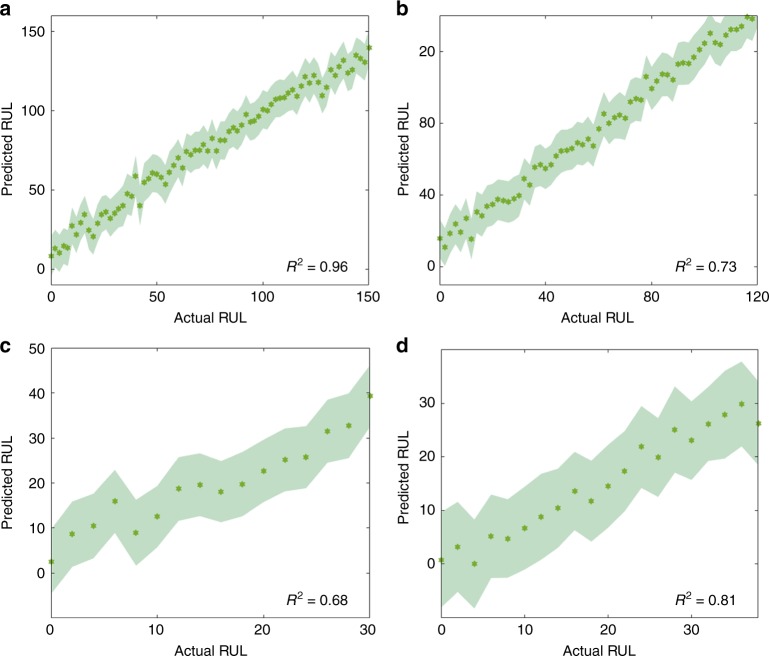
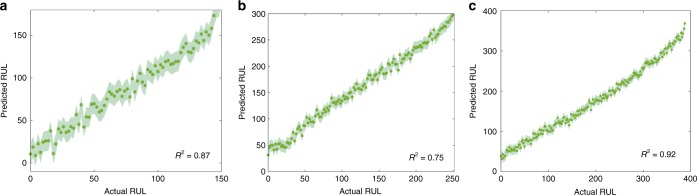
- The EIS-Capacity and EIS-RUL GPR models accurately estimate capacity and predict RUL from the current cycle’s EIS alone; for 25 °C testing cells, the end-of-life values were 150, 120, 30, and 38 cycles, and for multi-temperature testing cells they were 150, 252, and 396 cycles.
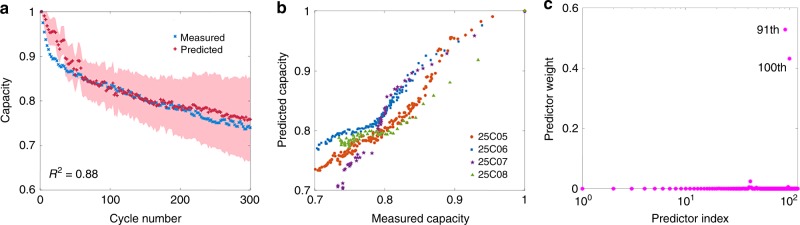
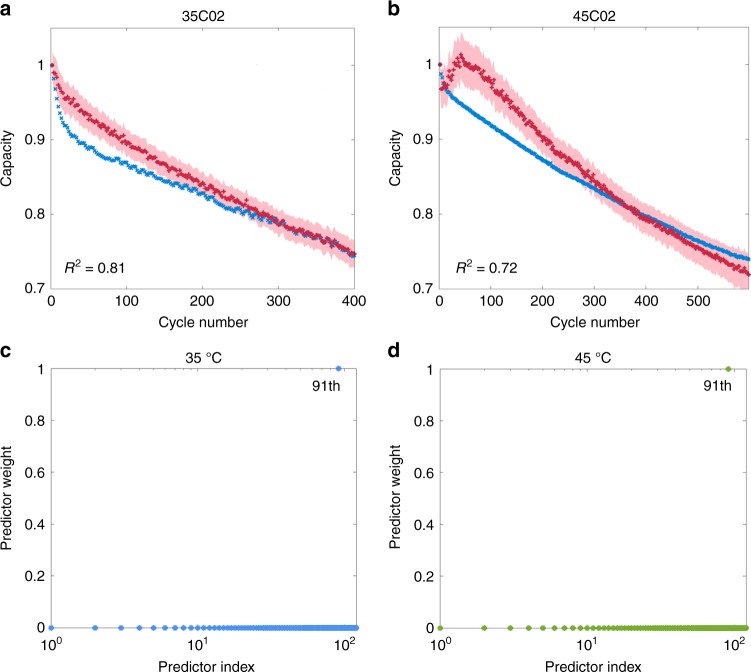
- ARD identified low-frequency impedance as most correlated with degradation: at 25 °C the largest weights were on the 91st and 100th features, corresponding to 17.80 and 2.16 Hz; at 35 °C and 45 °C the largest weight was on the 91st feature, 17.80 Hz.
- A multi-temperature model estimated capacity and predicted RUL for cells cycled at 35 °C and 45 °C without the cycling temperature as an input, under the simplification that temperature is constant over cycles.
- Under the same GPR method and train-test split, the EIS-based approach achieved lower predictive error than features extracted from the discharging curve (Supplementary Table 1).
Methods
- Twelve commercially available 45 mAh Eunicell LR2032 Li-ion coin cells with LiCoO2/graphite chemistry were cycled in climate chambers at 25 °C (25C01–25C08), 35 °C (35C01–35C02), and 45 °C (45C01–45C02); each cycle used 1C CC–CV charge to 4.2 V and 2C CC discharge to 3 V.
- EIS was measured every even-numbered cycle at nine charging/discharging stages over 0.02 Hz–20 kHz with 5 mA excitation after 15-min open circuit at SoC 0% and 100%; capacity loss was measured every odd cycle, and EoL was defined as capacity below 80% of initial after 30 room-temperature cycles.
- GPR used the real and imaginary impedance at 60 frequencies as inputs; capacity models used a squared exponential covariance with ARD, RUL models used a linear covariance, and feature importance was defined as \(w_m = \exp(-\sigma_m)\).
Limitations
- The paper states that all testing cells were charged and discharged the same way as training cells, and that estimating cells cycled at different operating charge/discharge rates requires further experiments.
- The paper states that more realistic settings—variations in cycling temperature over time or charge/discharge rate—would require a significantly larger training set, and the multi-temperature model assumes future operating temperature is close to previous operating temperature.
- Evident from the text: the dataset comprises only 12 small coin cells of one chemistry under controlled laboratory temperatures and constant rates, so validation on larger-format cells or real-world variable conditions is not reported.
Model-written summary. Check it against the paper before relying on it.
Integrity signals
Registry
Cites
Statistics
Figures
Verification
Claims the paper makes
3 Valid · 4 Not valid · 3 Not checked · 33 Own results and interpretations
Some cited sources support this claim and some don’t — read each source’s verdict below.
In the paper
“However, those models are all developed with the charging and discharging curve as input.”
§ Identifying degradation patterns of lithium ion batteries from impedance spectroscopy using machine learning > Introduction
What the sources say
- Disputedcites [33] Richardson RR Osborne MA Howey DA Gaussian process regression for forecasting battery state of health J. Power Sources 2017 357 209 219 10.1016/j.jpowsour.2017.05.004 sourceExperimental — accuracy not yet measured
The Introduction describes data-driven models that map cycle number to state of health and says recent support-vector-machine studies predict capacity from historical capacity-versus-cycle data. It also says capacity data can be obtained by methods other than charge–discharge measurements. These passages contradict the claim that all such models take charging and discharging curves as input; page numbers were not available in our copy. (LLM, conf=0.88)
Checked by a reasoning model — may be wrong.
- Not checked — no full text of the sourcecites [34] Yang D Zhang X Pan R Wang Y Chen Z A novel gaussian process regression model for state-of-health estimation of lithium-ion battery using charging curve J. Power Sources 2018 384 387 395 10.1016/j.jpowsour.2018.03.015 source
- Partly supportedcites [17] Richardson RR Birkl CR Osborne MA Howey DA Gaussian process regression for in situ capacity estimation of lithium-ion batteries IEEE Trans. Ind. Inform. 2019 15 127 136 10.1109/TII.2018.2794997 sourceExperimental — accuracy not yet measured
The Introduction (p. 1) describes earlier regression models that use features from incremental-capacity or differential-voltage curves as inputs. But it does not establish that all existing machine-learning models use charging and discharging curves; the Conclusions (p. 10) describe this paper’s own model as using small portions of voltage-time data instead. (LLM, conf=0.84)
- Disputedcites [18] Severson KA Data-driven prediction of battery cycle life before capacity degradation Nat. Energy 2019 4 383 391 10.1038/s41560-019-0356-8 sourceExperimental — accuracy not yet measured
The Machine learning approach section distinguishes models using discharge data alone from a model that considers both charging and discharging features. The Results section confirms that its “variance” model uses one feature from discharge curves and its “discharge” model uses discharge measurements only. The paper therefore contradicts the claim that all such models require both charging and discharging curves as input. (LLM, conf=0.87)
Checked by a reasoning model — may be wrong.
plain- Asserted: passes — The authors put it forward as true.
- Checkable: passes — It can be checked against evidence.
- Load-bearing: passes — The paper’s conclusions depend on it.
- Based: passes — The paper gives a reason why it holds.
- Disputed
The cited sources support only part of this claim — read each source’s verdict below.
In the paper
“suggesting that it is the change in the interfacial properties that underpins degradation for these batteries; this is consistent with the results obtained in previous works35”
§ Identifying degradation patterns of lithium ion batteries from impedance spectroscopy using machine learning > Results > Capacity estimation
What the sources say
- Partly supportedcites [35] Grugeon S Particle size effects on the electrochemical performance of copper oxides toward lithium J. Electrochem. Soc. 2001 148 A285 A292 10.1149/1.1353566 sourceExperimental — accuracy not yet measured
The Conclusions (page unavailable) say that an organic coating at the electrode surface can, depending on precursor size, negatively affect capacity retention during cycling. This supports a possible link between interfacial changes and degradation in the copper-oxide cells studied, but not the unqualified claim that such changes underpin degradation for these batteries generally. (LLM, conf=0.85)
hedgedstates a cause- Asserted: passes — The authors put it forward as true.
- Checkable: passes — It can be checked against evidence.
- Load-bearing: passes — The paper’s conclusions depend on it.
- Based: passes — The paper gives a reason why it holds.
- Partly supported
The cited sources support only part of this claim — read each source’s verdict below.
In the paper
“Features derived from the charging and discharging curve are by far the most commonly used inputs because typical battery management systems collect current–voltage data13–18.”
§ Identifying degradation patterns of lithium ion batteries from impedance spectroscopy using machine learning > Introduction
What the sources say
- Not checked — no full text of the sourcecites [13] Weng C Cui Y Sun J Peng H On-board state of health monitoring of lithium-ion batteries using incremental capacity analysis with support vector regression J. Power Sources 2013 235 36 44 10.1016/j.jpowsour.2013.02.012 source
- Not checked — no full text of the sourcecites [14] Weng C Feng X Sun J Peng H State-of-health monitoring of lithium-ion battery modules and packs via incremental capacity peak tracking Appl. Energy 2016 180 360 368 10.1016/j.apenergy.2016.07.126 source
- Not checked — no full text of the sourcecites [15] Berecibar M Garmendia M Gandiaga I Crego J Villarreal I State of health estimation algorithm of lifepo4 battery packs based on differential voltage curves for battery management system application Energy 2016 103 784 796 10.1016/j.energy.2016.02.163 source
- Not checked — no full text of the sourcecites [16] Berecibar M Online state of health estimation on nmc cells based on predictive analytics J. Power Sources 2016 320 239 250 10.1016/j.jpowsour.2016.04.109 source
- Partly supportedcites [17] Richardson RR Birkl CR Osborne MA Howey DA Gaussian process regression for in situ capacity estimation of lithium-ion batteries IEEE Trans. Ind. Inform. 2019 15 127 136 10.1109/TII.2018.2794997 sourceExperimental — accuracy not yet measured
The Introduction (p. 1) describes studies using features from IC/DV curves for capacity estimation, supporting the claim that charging-curve-derived features are used. It does not establish that they are by far the most common inputs or that their use is due to typical BMS data collection; instead, it calls model-parameter estimation the most common approach to capacity estimation. (LLM, conf=0.83)
- Partly supportedcites [18] Severson KA Data-driven prediction of battery cycle life before capacity degradation Nat. Energy 2019 4 383 391 10.1038/s41560-019-0356-8 sourceExperimental — accuracy not yet measured
The Machine learning approach section says the authors derive predictive features from discharge voltage curves and describes voltage curves and their derivatives as a rich source for degradation diagnosis. The Discussion says differential voltage-curve methods are used extensively. Neither passage establishes that charging and discharging curves are by far the most common inputs for battery health prediction or that their use is because typical battery management systems collect current–voltage data. (LLM, conf=0.84)
plainstates a cause- Asserted: passes — The authors put it forward as true.
- Checkable: passes — It can be checked against evidence.
- Load-bearing: unclear — It is unclear whether the paper’s conclusions depend on it.
- Based: passes — The paper gives a reason why it holds.
The sources with a verdict support this claim; the rest weren’t checked yet, have no full text we could read, or their verdicts aren’t rated yet.
In the paper
“Although GPR has been used in the literature in the context of Li-ion batteries17,33,34, we depart from those pioneering works by employing impedance spectra as input, as well employing ARD to shed light on salient frequencies.”
§ Identifying degradation patterns of lithium ion batteries from impedance spectroscopy using machine learning > Methods > Gaussian process regression
What the sources say
- Supportedcites [17] Richardson RR Birkl CR Osborne MA Howey DA Gaussian process regression for in situ capacity estimation of lithium-ion batteries IEEE Trans. Ind. Inform. 2019 15 127 136 10.1109/TII.2018.2794997 source
The Introduction (p. 1) identifies this as a Gaussian-process regression method for lithium-ion battery capacity estimation, supporting its citation as prior GPR work. The impedance-spectrum inputs and ARD are described as the citing authors’ departure, not as features attributed to this source; the Conclusions (p. 10) instead describe voltage-time inputs. (LLM, conf=0.93)
- Supportedcites [33] Richardson RR Osborne MA Howey DA Gaussian process regression for forecasting battery state of health J. Power Sources 2017 357 209 219 10.1016/j.jpowsour.2017.05.004 source
The Introduction (page unavailable) describes this paper's use of Gaussian processes to forecast lithium-ion battery capacity, supporting its citation as prior GPR work. In the citing sentence, “we depart” describes the citing authors’ own use of impedance spectra and ARD, not a method attributed to this source. (LLM, conf=0.92)
- Not checked — no full text of the sourcecites [34] Yang D Zhang X Pan R Wang Y Chen Z A novel gaussian process regression model for state-of-health estimation of lithium-ion battery using charging curve J. Power Sources 2018 384 387 395 10.1016/j.jpowsour.2018.03.015 source
plain- Asserted: passes — The authors put it forward as true.
- Checkable: passes — It can be checked against evidence.
- Load-bearing: passes — The paper’s conclusions depend on it.
- Based: passes — The paper gives a reason why it holds.
- Supported
A result the paper reports from its own data — it cites no other source for it, so there is none to check. The quote shows it is in the paper.
In the paper
“in Supplementary Fig. 3, we show there is a strong linear change of selected EIS features with cycle number in the Nyquist plot over cycle number at 25 °C.”
§ Identifying degradation patterns of lithium ion batteries from impedance spectroscopy using machine learning > Results > Capacity estimation
boostedstates an association- Asserted: passes — The authors put it forward as true.
- Checkable: passes — It can be checked against evidence.
- Load-bearing: passes — The paper’s conclusions depend on it.
- Based: passes — The paper gives a reason why it holds.
25 more claims
Create a free account to see all 43 claims and every source verdict.
- Probably not a substantial claim. 8
- It may state two separate claims as one. 8
- The quote only partly states this claim. 1
Self-check
Percentages, sums and reported differences re-computed from the paper’s own numbers.
Each contradiction between two passages listed here was confirmed by an independent check.
Rated minor: it would not touch a result — a value no result rests on, a p-value that stays on the same side of the significance level, or a conflict that is clerical, resolved elsewhere in the paper, or outside its own findings.
In the paper
§ Identifying degradation patterns of lithium ion batteries from impedance spectroscopy using machine learning > Results > Capacity estimation
“The pink points correspond to the 120 frequencies in the range of 0.02 Hz–20 kHz.”
§ Identifying degradation patterns of lithium ion batteries from impedance spectroscopy using machine learning > Methods > Gaussian process regression
“the real (Zre) and imaginary (Zim) parts of impedance spectra collected at 60 different frequencies (ωn, n = 1, 2, ..., 60) in the range of 0.02 Hz–20 kHz”
Citations
Cites
Lithium Batteries: Status, Prospects and Future
Scrosati, B., & Garche, J. (2010) · Journal of Power Sources · doi:10.1016/j.jpowsour.2009.11.048 · Cited by 5,153 · cited 1×
“L i-ion batteries enable a wide variety of technologies that are integral to modern life by virtue of their high energy and power density 1 – 4 . advancing However, a key stumbling block to those technologies is the unpredictability of battery degradation: accurate prediction of battery state of…”
BackgroundData-driven prediction of battery cycle life before capacity degradation
Severson, K. A., Attia, P. M., Jin, N., Perkins, N., Jiang, B., Yang, Z., Chen, M. H., Aykol, M., Herring, P. K., Fraggedakis, D., et al. (2019) · Nature Energy · doi:10.1038/s41560-019-0356-8 · Cited by 3,228 · cited 3×
“Features derived from the charging and discharging curve are by far the most commonly used inputs because typical battery management systems collect current – voltage data 13 – 18 .”
BackgroundMethodDesigning nanostructured Si anodes for high energy lithium ion batteries
Wu, H., & Cui, Y. (2012) · Nano Today · doi:10.1016/j.nantod.2012.08.004 · Cited by 2,350
Remaining useful life estimation – A review on the statistical data driven approaches
Si, X.-S., Wang, W., Hu, C.-H., & Zhou, D.-H. (2011) · European Journal of Operational Research · doi:10.1016/j.ejor.2010.11.018 · Cited by 2,162 · cited 1×
“To overcome this challenge, recent literature focuses on data-driven approaches 11,12 .”
BackgroundA review on lithium-ion battery ageing mechanisms and estimations for automotive applications
Barré, A., Deguilhem, B., Grolleau, S., Gérard, M., Suard, F., & Riu, D. (2013) · Journal of Power Sources · doi:10.1016/j.jpowsour.2013.05.040 · Cited by 1,758
A Unifying View of Sparse Approximate Gaussian Process Regression
Quiñonero-Candela, J., & Rasmussen, C. E. (2005) · doi:10.5555/1046920.1194909 · Cited by 1,671
Lithium ion secondary batteries; past 10 years and the future
Nishi, Y. (2001) · Journal of Power Sources · doi:10.1016/s0378-7753(01)00887-4 · Cited by 1,074 · cited 1×
“L i-ion batteries enable a wide variety of technologies that are integral to modern life by virtue of their high energy and power density 1 – 4 . advancing However, a key stumbling block to those technologies is the unpredictability of battery degradation: accurate prediction of battery state of…”
BackgroundYang, X.-G., Leng, Y., Zhang, G., Ge, S., & Wang, C.-Y. (2017) · Journal of Power Sources · doi:10.1016/j.jpowsour.2017.05.110 · Cited by 948
Pinson, M. B., & Bazant, M. Z. (2013) · Journal of The Electrochemical Society · doi:10.1149/2.044302jes · Cited by 946
Gaussian Processes for Machine Learning (GPML) Toolbox
Rasmussen, C. E., & Nickisch, H. (2010) · Max Planck Institute for Plasma Physics · doi:10.5555/1756006.1953029 · Cited by 895 · cited 1×
“We implement the EIS-capacity GPR model using the Gaussian processes for machine learning (GPML) toolbox 37 with a zero mean function and a diagonal squared exponential (SE) covariance function with ARD 38 where σ m represents the length scale for feature m , m = 1, 2, ..., d and σ f is the signal…”
Method
Research works printed but not linked: 1
- Popp, H., Einhorn, M. & Conte, F. V. Capacity decrease vs. impedance increase of lithium batteries. a comparative study. In Hybrid and Fuel Cell Electric Vehicle Symposium & Exhibition EVS26, Los Angeles, 6–9 (2012).
Cited by
Items 201–300 of 872
Juice Vesicles Bioreactors Technology for Constructing Advanced Carbon‐Based Energy Storage
Shen, S., Chen, Y., Gu, X., et al. (2024) · Advanced Materials · doi:10.1002/adma.202400245 · Cited by 51
Self-citationBattery health evaluation using a short random segment of constant current charging
Deng, Z., Hu, X., Xie, Y., Xu, L., Li, P., Lin, X., & Bian, X. (2022) · iScience · doi:10.1016/j.isci.2022.104260 · Cited by 61
Yin, J., Lei, Q., Li, X., Zhang, X., Meng, X., Jiang, Y., Tian, L., Zhou, S., & Li, Z. (2022) · Acta Materialia · doi:10.1016/j.actamat.2022.118420 · Cited by 51
Niu, B., Jiang, W., Jiang, B. Q., Lv, M., Wang, S., & Wang, W. (2022) · Nature Communications · doi:10.1038/s41467-022-30058-4 · Cited by 50
A Review of Non-Destructive Techniques for Lithium-Ion Battery Performance Analysis
Acaro, X., Laureti, S., Ricci, M., & Cappuccino, G. (2023) · World Electric Vehicle Journal · doi:10.3390/wevj14110305 · Cited by 65
“Additionally, the authors of [36] established the mapping relationship between health features and SOH using a BP neural network algorithm.”
Ding, R., Wang, R., Ding, Y., Yin, W., Liu, Y., Li, J., & Liu, J. (2020) · Angewandte Chemie · doi:10.1002/ange.202006928 · Cited by 52
Xing, Q., Zhang, M., Fu, Y., & Wang, K. (2025) · Journal of Energy Storage · doi:10.1016/j.est.2025.115345 · Cited by 48
A 3D indicator for guiding AI applications in the energy sector
Quest, H., Cauz, M., Heymann, F., Rod, C., Perret, L., Ballif, C., Virtuani, A., & Wyrsch, N. (2022) · Energy and AI · doi:10.1016/j.egyai.2022.100167 · Cited by 57
Recent Progress of Deep Learning Methods for Health Monitoring of Lithium-Ion Batteries
Madani, S. S., Ziebert, C., Vahdatkhah, P., & Sadrnezhaad, S. K. (2024) · Batteries · doi:10.3390/batteries10060204 · Cited by 61
“Zhang et al. [22] have made a significant contribution to the field of LIBs forecasting by developing an innovative forecasting system that combines EIS with Gaussian process machine learning.”
BackgroundMethodInfluentialInterpretable learning of voltage for electrode design of multivalent metal-ion batteries
Zhang, X., Zhou, J. R., Lü, J., & Shen, L. (2022) · npj Computational Materials · doi:10.1038/s41524-022-00858-9 · Cited by 59
Ali, M. A., Silva, C. M. D., & Amon, C. H. (2023) · Batteries · doi:10.3390/batteries9090434 · Cited by 67
“As an alternative to IC analysis, Zhang et al. [69] collected 20,000 electrochemical impedance spectroscopy (EIS) spectra at different SOHs for input to a Gaussian regression model to predict the LIB remaining useful life.”
MethodLyu, Z., Wang, Y., Ściążko, A., et al. (2023) · Journal of Energy Chemistry · doi:10.1016/j.jechem.2023.08.028 · Cited by 47
Kong, L., Fang, S., Niu, T., Chen, G., Yang, L., & Liao, R. (2023) · IEEE Transactions on Industry Applications · doi:10.1109/tia.2023.3324632 · Cited by 51
“Thefirstoneistoextractimpedancedataatallfrequencypoints fromthebroadbandEISasfeatures,e.g.,[20]usedimpedance dataat60frequencypointstoconstructadata-drivenmodel, whichinvolveshighcalculationcost.”
Park, J., Jin, Y., Kam, W., & Han, S. (2024) · Journal of Energy Storage · doi:10.1016/j.est.2024.112659 · Cited by 56
Zhao, F., Gao, D.-X., Cheng, Y.-M., & Yang, Q. (2024) · Scientific Reports · doi:10.1038/s41598-024-80421-2 · Cited by 83
Remaining useful life prediction of lithium-ion batteries via an EIS based deep learning approach
Li, J., Zhao, S., Miah, M. S., & Niu, M. (2023) · Energy Reports · doi:10.1016/j.egyr.2023.10.030 · Cited by 53
Investigating explainable transfer learning for battery lifetime prediction under state transitions
Lin, T., Chen, S., Harris, S. J., Zhao, T. S., Liu, Y., & Wan, J. (2024) · eScience · doi:10.1016/j.esci.2024.100280 · Cited by 52
Du, X., Meng, J., Xue, Z., Amirat, Y., Gao, F., & Benbouzid, M. (2025) · ACS Energy Letters · doi:10.1021/acsenergylett.5c00484 · Cited by 49
Battery SoC Estimation from EIS using Neural Nets
Messing, M., Shoa, T., Ahmed, R., & Habibi, S. R. (2020) · IEEE Transportation Electrification Conference and Expo · doi:10.1109/itec48692.2020.9161523 · Cited by 68
“In [16], a large EIS dataset was used with Gaussian process regression to estimate SoH.”
MethodA Hybrid Drive Method for Capacity Prediction of Lithium-Ion Batteries
Xu, T., Peng, Z., Liu, D., & Wu, L. (2022) · IEEE Transactions on Transportation Electrification · doi:10.1109/tte.2021.3118813 · Cited by 45
“2) Case2: Different battery capacity prediction: In order to better show that the SVR-Elman-ELM hybrid drive model has good robustness for battery capacity prediction, this paper uses the same training and testing method as in Ref.[18], that is, the input of the model is 120 EIS features, and the output is battery cap…”
MethodInfluentialZhang, Y., Zhao, M., & Xiong, R. (2023) · Journal of Power Sources · doi:10.1016/j.jpowsour.2023.234007 · Cited by 47
Self-citationYang, D., Wang, M., Luo, F., Liu, W., Chen, L., & Li, X. (2024) · Sustainable Production and Consumption · doi:10.1016/j.spc.2024.04.001 · Cited by 58
Guirguis, J., & Ahmed, R. (2024) · Energies · doi:10.3390/en17143502 · Cited by 62
Wu, Y., Lu, S., Ju, M.-G., Zhou, Q., & Wang, J. (2021) · Nanoscale · doi:10.1039/d1nr01117k · Cited by 44
Self-citationGong, D., Gao, Y., Kou, Y., & Wang, Y. (2022) · Journal of Energy Storage · doi:10.1016/j.est.2022.104376 · Cited by 47
Data‐driven battery degradation prediction: Forecasting voltage‐capacity curves using one‐cycle data
Tian, J., Xiong, R., Shen, W., & Lu, J. (2022) · EcoMat · doi:10.1002/eom2.12213 · Cited by 46
Chan, H. S., Dickinson, E. J. F., Heins, T. P., Park, J., Gaberšček, M., Lee, Y. Y., Heinrich, M., Ruiz, V., Napolitano, E., Kauranen, P., et al. (2022) · Journal of Power Sources · doi:10.1016/j.jpowsour.2022.231814 · Cited by 52
A Fast Impedance Measurement Method for Lithium-Ion Battery Using Power Spectrum Property
Peng, J., Meng, J., Du, X., Cai, L., & Stroe, D. (2022) · IEEE Transactions on Industrial Informatics · doi:10.1109/tii.2022.3217474 · Cited by 51
“For example, over 20 000 EIS measurements from 45 mAh Liion cells can accurately reflect the battery degradation pattern by Gaussian process regression in [6].”
MethodMachine learning for full lifecycle management of lithium-ion batteries
Zhai, Q., Jiang, H., Long, N., Kang, Q., Meng, X., Zhou, M., Yan, L., & Ma, T. (2024) · Renewable and Sustainable Energy Reviews · doi:10.1016/j.rser.2024.114647 · Cited by 51
Qian, G., Zheng, Y., Li, X., Sun, Y., Han, X., & Ouyang, M. (2025) · Applied Energy · doi:10.1016/j.apenergy.2025.125272 · Cited by 49
Babaeiyazdi, I., Rezaei‐Zare, A., & Shokrzadeh, S. (2022) · IEEE Transactions on Transportation Electrification · doi:10.1109/tte.2022.3170230 · Cited by 50
“The experimental data from [1] has been utilized in this study.”
BackgroundMethodInfluentialPhysics-Based SoH Estimation for Li-Ion Cells
Iurilli, P., Brivio, C., Carrillo, R. E., & Wood, V. C. (2022) · Batteries · doi:10.3390/batteries8110204 · Cited by 53
“The model is data-efficient, and does not require large datasets to be trained and its application may be more convenient for on-board applications in BMSs than data-driven approaches, hich usually require larger amount of data and ore co plex hard are [58,59].”
BackgroundSchaeffer, J., Gasper, P. J., Garcia-Tamayo, E., Gasper, R. J., Adachi, M., Gaviria-Cardona, J. P., Montoya‐Bedoya, S., Bhutani, A., Schiek, A. C., Goodall, R. E. A., et al. (2023) · Journal of The Electrochemical Society · doi:10.1149/1945-7111/acd8fb · Cited by 55
“Various data sets are available, 14,27,34,35 but the total amount of open data is still small compared to the wide range of applications and the diversity of EIS data that arises from those.”
BackgroundFast EIS acquisition method based on SSA-DNN prediction model
Chang, C., Pan, Y., Wang, S., Jiang, J., Tian, A., Gao, Y., Jiang, Y., & Wu, T. (2023) · Energy · doi:10.1016/j.energy.2023.129768 · Cited by 44
He, Y., Chen, Y., Chen, N., Xie, Y., Wang, H., Huang, W., Zhao, X., & Yang, C. (2024) · Journal of Power Sources · doi:10.1016/j.jpowsour.2023.234002 · Cited by 45
Exploiting domain knowledge to reduce data requirements for battery health monitoring
Tian, J., Ma, L., Zhang, T., Han, T., Mai, W., & Chung, C. Y. (2024) · Energy storage materials · doi:10.1016/j.ensm.2024.103270 · Cited by 62
Ren, J., Ma, J., Wang, H., Yu, T., & Wang, K. (2024) · Protection and Control of Modern Power Systems · doi:10.23919/pcmp.2024.000211 · Cited by 62
A Domain-Adversarial Neural Network for Transferable Lithium-Ion Battery State-of-Health Estimation
Meng, J., Hu, D., Lin, M., Peng, J., Wu, J., & Stroe, D. (2025) · IEEE Transactions on Transportation Electrification · doi:10.1109/tte.2025.3530536 · Cited by 53
“The first one is a public Li-ion battery EIS dataset from [36], which contains 12 Eunicell LR2032 coin cells for cycling aging test, whose nominal capacity is 45 mAh with LiCoO 2 /graphite chemistry.”
Fischer, M., Brand, M. J., Karger, A., Gomez, M. R., Rehm, M., Natterer, J., & Jossen, A. (2025) · Journal of Power Sources · doi:10.1016/j.jpowsour.2025.237921 · Cited by 57
Lithium–Ion Battery Data: From Production to Prediction
Hassini, M., Redondo-Iglesias, E., & Venet, P. (2023) · Batteries · doi:10.3390/batteries9070385 · Cited by 61
Zhao, X., Liu, S., Li, E., Wang, Z., Gu, F., & Ball, A. D. (2024) · Journal of Energy Storage · doi:10.1016/j.est.2024.110814 · Cited by 47
Battery degradation stage detection and life prediction without accessing historical operating data
Zhao, M., Zhang, Y., & Wang, H. (2024) · Energy storage materials · doi:10.1016/j.ensm.2024.103441 · Cited by 69
Self-citationZhang, S., Liu, Z., Xu, Y. H., Guo, J., & Su, H. (2024) · IEEE Transactions on Transportation Electrification · doi:10.1109/tte.2024.3471626 · Cited by 50
Xiang, Y., Fan, W., Zhu, J., Wei, X., & Dai, H. (2024) · Cell Reports Physical Science · doi:10.1016/j.xcrp.2023.101763 · Cited by 61
Liu, X., Tao, S., Fu, S., Ma, R., Cao, T., Fan, H., Zuo, J., Zhang, X., Wang, Y., & Sun, Y. (2024) · Applied Energy · doi:10.1016/j.apenergy.2024.123221 · Cited by 49
Giazitzis, S., Isse, A. A., Blasuttigh, N., Pavan, A. M., Raimondo, D. M., Badha, S., Rosetti, F., & Ogliari, E. (2025) · Journal of Power Sources · doi:10.1016/j.jpowsour.2025.237568 · Cited by 50
Chi, P., Paul, T., Su, Y.-H., Su, K.-H., Su, C.-Y., Wu, P. M., Wang, S., & Wu, M. (2022) · Scientific Reports · doi:10.1038/s41598-022-08584-4 · Cited by 39
Huang, P., Lukin, R. Y., Faleev, M., Kazeev, N., Al-Maeeni, A. R., Andreeva, D. V., Ustyuzhanin, A., Tormasov, A. G., Neto, A. H. C., & Novoselov, K. S. (2023) · npj 2D Materials and Applications · doi:10.1038/s41699-023-00369-1 · Cited by 55
Investigation of lithium-ion battery nonlinear degradation by experiments and model-based simulation
You, H., Wang, X., Zhu, J., Jiang, B., Han, G., Wei, X., & Dai, H. (2023) · Energy storage materials · doi:10.1016/j.ensm.2023.103083 · Cited by 65
Xiong, R., Wang, S., Takyi‐Aninakwa, P., Jin, S., Fernández, C., Huang, Q., Hu, W., & Zhan, W. (2024) · Protection and Control of Modern Power Systems · doi:10.23919/pcmp.2023.000234 · Cited by 42
Zhou, Y. (2024) · Applied Energy · doi:10.1016/j.apenergy.2024.123665 · Cited by 52
Bakenhaster, S. T., & Dewald, H. D. (2025) · Journal of Applied Electrochemistry · doi:10.1007/s10800-025-02273-6 · Cited by 61
Systematic feature design for cycle life prediction of lithium-ion batteries during formation
Rhyu, J., Schaeffer, J., Li, M. L., Cui, X., Chueh, W. C., Bazant, M. Z., & Braatz, R. D. (2025) · Joule · doi:10.1016/j.joule.2025.101884 · Cited by 51
“Our approach, which leverages the interplay between the data-driven feature design and mechanistic understanding, can be applied to other regression or classification problems in which limited domain knowledge is available.”
Aging datasets of commercial lithium-ion batteries: A review
Mayemba, Q., Mingant, R., Li, A., Ducret, G., & Venet, P. (2024) · Journal of Energy Storage · doi:10.1016/j.est.2024.110560 · Cited by 50
A Review on Lithium-Ion Battery Modeling from Mechanism-Based and Data-Driven Perspectives
Ji, C., Dai, J., Zhai, C., Wang, J., Tian, Y., & Sun, W. H. (2024) · Processes · doi:10.3390/pr12091871 · Cited by 53
Self-citationElectrochemical impedance spectroscopy analysis to accelerate electrocatalytic system innovation
Zhu, H., Liu, Y., Guo, W., Zheng, J., Zheng, Y., Cherevko, S., Tang, C., & Zhang, Q. (2024) · Science China Chemistry · doi:10.1007/s11426-024-2314-9 · Cited by 46
Lin, M., Hu, D., Meng, J., & Wu, J. (2025) · IEEE Transactions on Transportation Electrification · doi:10.1109/tte.2025.3533540 · Cited by 49
“Dataset A [45] contains 12 LiCoO2/graphite commercial Eunicell LR2032 cells with a capacity of 45 mAh.”
Time-Frequency Image Analysis and Transfer Learning for Capacity Prediction of Lithium-Ion Batteries
El-Dalahmeh, M., Al‐Greer, M., El‐Dalahmeh, M., & Short, M. (2020) · Energies · doi:10.3390/en13205447 · Cited by 42
“The Stochastic gradient descent from the measured terminal”
BackgroundMethodInfluentialSolid-State Lithium Battery Cycle Life Prediction Using Machine Learning
Cheng, D., Sha, W., Wang, L., Tang, S., Ma, A., Chen, Y., Wang, H., Lou, P., Lu, S., & Cao, Y. (2021) · Applied Sciences · doi:10.3390/app11104671 · Cited by 46
“The RULprediction results for the SR model were calculated by the fourth formula in Table 2, and the other three were calculated by the methods in references [4,22,24], respectively.”
BackgroundMethodGuo, R., Xu, Y., Hu, C., & Shen, W. (2023) · IEEE Transactions on Power Electronics · doi:10.1109/tpel.2023.3347236 · Cited by 39
“More research on battery capacity estimation using well-known ML techniques can be referred to GPR [11], [18], SVM [14], [19], ANN [17], [20], Markov chain [21], [22], and fuzzy logic [23].”
MethodChen, W., Yan, B., Xu, A., Mu, X., Zhou, X., Jiang, M., Wang, C., Li, R., Huang, J., & Dong, J. (2024) · Journal of Material Science and Technology · doi:10.1016/j.jmst.2024.05.024 · Cited by 42
Sun, Y., Xiong, R., Meng, X., Deng, X., Li, H., & Sun, F. (2024) · eTransportation · doi:10.1016/j.etran.2024.100347 · Cited by 43
Predictive Modeling for Electric Vehicle Battery State of Health: A Comprehensive Literature Review
Gong, J., Xu, B. S., Chen, F., & Zhou, G. (2025) · Energies · doi:10.3390/en18020337 · Cited by 48
AI‐Driven Defect Engineering for Advanced Thermoelectric Materials
Fu, C., Cheng, M., Hung, N. T., Rha, E., Chen, Z., Okabe, R., Carrizales, D. C., Mandal, M., Cheng, Y. Q., & Li, M. (2025) · Advanced Materials · doi:10.1002/adma.202505642 · Cited by 47
Shu, X., Yang, W., Yang, B., Wei, K., Punyawudho, K., & Liu, C. (2023) · Engineering Failure Analysis · doi:10.1016/j.engfailanal.2023.107764 · Cited by 40
Physics-informed battery degradation prediction: Forecasting charging curves using one-cycle data
Tang, A., Xu, Y., Tian, J., Shu, X., & Yu, Q. (2024) · Journal of Energy Chemistry · doi:10.1016/j.jechem.2024.10.018 · Cited by 39
Nusev, G., Juričić, Đ., Gaberšček, M., et al. (2021) · IEEE Access · doi:10.1109/access.2021.3058368 · Cited by 37
“[2], it was demonstrated on a huge set of long-term experiment data that information contained in EIS is very useful in diagnosing the degradation modes as well as assessing the remaining useful life.”
BackgroundDeep learning powered rapid lifetime classification of lithium-ion batteries
Fei, Z., Zhang, Z., Yang, F., & Tsui, K.-L. (2023) · eTransportation · doi:10.1016/j.etran.2023.100286 · Cited by 36
Lu, X., Qiu, J., Lei, G., & Zhu, J. G. (2023) · IEEE Transactions on Transportation Electrification · doi:10.1109/tte.2023.3240617 · Cited by 43
Zhou, Z., Li, Y., Wang, Q., & Yu, J. (2023) · IEEE Transactions on Instrumentation and Measurement · doi:10.1109/tim.2023.3272401 · Cited by 44
“using EIS data published in [33], where the EIS of commercial lithium-ion cells (LCO/graphite) are measured at different temperatures, SoCs, and aging cycles.”
MethodPredicting battery impedance spectra from 10-second pulse tests under 10 Hz sampling rate
Tang, X., Lai, X., Liu, Q., Zheng, Y., Zhou, Y., Ma, Y., & Gao, F. (2023) · iScience · doi:10.1016/j.isci.2023.106821 · Cited by 39
“5 Basically, it can be used for detecting the abnormal capacity fades 2,6 and determining the battery life span.”
BackgroundA low-cost approach to on-board electrochemical impedance spectroscopy for a lithium-ion battery
Mattia, L., Petrone, G., Pirozzi, F., & Zamboni, W. (2024) · Journal of Energy Storage · doi:10.1016/j.est.2023.110330 · Cited by 49
Real-time optimal control of an LNG-fueled hybrid electric ship considering battery degradations
Pang, B., Liu, S., Zhu, H., Feng, Y., & Dong, Z. (2024) · Energy · doi:10.1016/j.energy.2024.131170 · Cited by 41
Energy storage management in electric vehicles
Zhang, J., Che, Y., Teodorescu, R., Song, Z., & Hu, X. (2025) · Nature Reviews Clean Technology · doi:10.1038/s44359-024-00020-2 · Cited by 46
“Measurements are used to calculate the historical capacities of the battery, which can then be input into a degradation model to predict the future performance of the battery up until the end of its life 85,93 .”
Chen, L., Chang, C., Liu, X., Jiang, J., Jiang, Y., & Tian, A. (2025) · Journal of Energy Storage · doi:10.1016/j.est.2025.116559 · Cited by 43
Towards High-Safety Lithium-Ion Battery Diagnosis Methods
Zhang, Y., Jiang, M., Zhou, Y., Zhao, S., & Yuan, Y. (2023) · Batteries · doi:10.3390/batteries9010063 · Cited by 39
Self-citationZhou, Y. (2024) · Renewable Energy · doi:10.1016/j.renene.2024.120280 · Cited by 39
Data Science Applications in Circular Economy: Trends, Status, and Future
Zhao, B., Yu, Z., Wang, H., Shuai, C., Qu, S., & Xu, M. (2024) · Environmental Science & Technology · doi:10.1021/acs.est.3c08331 · Cited by 48
Tian, Y., Lin, C. W., Meng, X., Yu, X. Q., Li, H., & Xiong, R. (2024) · eScience · doi:10.1016/j.esci.2024.100325 · Cited by 41
Foundation Models for the Process Industry: Challenges and Opportunities
Ren, L., Wang, H., Wang, Y., Huang, K., Wang, L., & Li, B. (2025) · Engineering · doi:10.1016/j.eng.2025.03.023 · Cited by 47
A multi-stage lithium-ion battery aging dataset using various experimental design methodologies
Stroebl, F., Petersohn, R., Schricker, B., Schaeufl, F., Bohlen, O. S., & Palm, H. (2024) · Scientific Data · doi:10.1038/s41597-024-03859-z · Cited by 47
Kim, K., Park, K., Yoon, K., Moon, H., Pyeon, H., Kim, J., & Han, S. (2025) · Journal of Power Sources · doi:10.1016/j.jpowsour.2025.236169 · Cited by 44
Analysis of Aging and Degradation in Lithium Batteries Using Distribution of Relaxation Time
Sohaib, M., Akram, A. S., & Choi, W. (2025) · Batteries · doi:10.3390/batteries11010034 · Cited by 35
“The DRT method offers distinct advantages over traditional EIS analysis by deconvoluting overlapping electrochemical processes in Nyquist plots, providing higher resolution and greater insight into individual mechanisms such as SEI growth, charge transfer, and diffusion.”
Safety in lithium-ion battery circularity activities: A framework and evaluation methodology
Chen, Z., Yıldızbaşı, A., Wang, Y., & Sarkis, J. (2023) · Resources Conservation and Recycling · doi:10.1016/j.resconrec.2023.106962 · Cited by 42
State of Health Estimation of Lithium-Ion Battery Based on Electrochemical Impedance Spectroscopy
Fan, M., Geng, M., Yang, K., Zhang, M., & Liu, H. (2023) · Energies · doi:10.3390/en16083393 · Cited by 36
“Secondly, a quantitative relationship model between EIS and SOH is constructed by using a datadriven method [18,19].”
MethodNazim, M. S., Chakma, A., Joha, M. I., Alam, S. S., Rahman, M. M., Umam, M. K. S., & Jang, Y. M. (2025) · ICT Express · doi:10.1016/j.icte.2025.05.013 · Cited by 49
High-Entropy Materials Chemistry for Electrochemical Energy Storage
Yuan, S., Wei, J., Ma, Z., Chen, X., Cao, S., Ye, L., Huang, N.-Y., Xia, H., Tan, F. L., Ng, R. B. F., et al. (2026) · Chemical Reviews · doi:10.1021/acs.chemrev.5c00783 · Cited by 43
Enhanced capacity and thermal safety of lithium-ion battery graphite anodes with conductive binder
Gribble, D. A., McCulfor, E., Li, Z., Parekh, M. H., & Pol, V. G. (2022) · Journal of Power Sources · doi:10.1016/j.jpowsour.2022.232204 · Cited by 36
Increasing generalization capability of battery health estimation using continual learning
Che, Y., Zheng, Y., Onori, S., Hu, X., & Teodorescu, R. (2023) · Cell Reports Physical Science · doi:10.1016/j.xcrp.2023.101743 · Cited by 49
“…methods for battery health prognostics, which benefit from good flexi-bility, transferability, extrapolation capability, etc. 15–17 Zhang et al., 18 Gasper et al., 19 and Jones et al. 20 investigated the physical relationship between the electrochemical impedance spectroscopy (EIS) curve and…”
MethodResultXu, L., Xiao, Y., Yu, Z., Yang, Y., Yan, C., & Huang, J. (2024) · Angewandte Chemie · doi:10.1002/ange.202406054 · Cited by 32
Azizighalehsari, S., Boj, E. A., Venugopal, P., et al. (2024) · IEEE Transactions on Industry Applications · doi:10.1109/tia.2024.3430268 · Cited by 32
“This paper utilized the dataset generated by Cambridge University for a study, where the aim was to train a neural network to predict the battery’s state having impedance measurements as an input [20].”
MethodInfluentialWang, Q., Ye, M., Celik, S., Deng, Z., Li, B., Sauer, D. U., & Li, W. (2024) · Journal of Energy Chemistry · doi:10.1016/j.jechem.2024.08.037 · Cited by 43
Degradation path prediction of lithium-ion batteries under dynamic operating sequences
Kim, I., Kim, H., An, S., Oh, J., Kim, M., & Choi, J. W. (2025) · Energy & Environmental Science · doi:10.1039/d4ee04787g · Cited by 40
Xue, Q., Li, J., & Xu, P. (2022) · Energy · doi:10.1016/j.energy.2022.125210 · Cited by 34
SoC estimation on Li-ion batteries: A new EIS-based dataset for data-driven applications
Mustafa, H., Bourelly, C., Vitelli, M., Milano, F., Molinara, M., & Ferrigno, L. (2024) · Data in Brief · doi:10.1016/j.dib.2024.110947 · Cited by 38
“One of the largest EIS datasets available is published by Zhang et al. [ 12 ].”
Xu, J., Zhen, A., Cai, Z., Wang, P., Gao, K., & Jiang, D. (2021) · IEEE Access · doi:10.1109/access.2021.3083395 · Cited by 34
Chang, C., Wang, S., Jiang, J., Gao, Y., Jiang, Y., & Liao, L. (2022) · Journal of Electrochemical Energy Conversion and Storage · doi:10.1115/1.4054128 · Cited by 38
Zhang, Y., Wang, Y., Xia, Y. F., & Chen, W. (2022) · Journal of Energy Storage · doi:10.1016/j.est.2022.106323 · Cited by 34
Self-citationSadeghi, E., Gholami, M. M., Hamzeh, M., Alavi, S. M. M., & Saif, M. (2023) · Journal of Energy Storage · doi:10.1016/j.est.2023.106850 · Cited by 35
Tian, J., Xiong, R., Chen, C., Wang, C., Shen, W., & Sun, F. (2023) · Electrochimica Acta · doi:10.1016/j.electacta.2023.142218 · Cited by 30
Metadata
- Authors
- Zhang, Y., Tang, Q., Zhang, Y., Wang, J., Stimming, U., & Lee, A. A.
- Affiliations
- University of Cambridge (GB)
- The Faraday Institution (GB)
- Corresponding author
- Stimming, Ulrich
- Lee, Alpha A.
- Venue
- Nature Communications
- Published
- 2020-04-06
- Volume
- 11
- Issue
- 1
- Pages
- 1706-1706
- ISSN
- 2041-1723 (ISSN-L)
- PMC
- PMC7136228
- OpenAlex
- W3010408268
- Semantic Scholar
- ca94a1d2da80e813b707f40f38a31e9e2720c879
- Cited by
- 889
- References
- 39
- Citations by year
- 2026: 156 · 2025: 198 · 2024: 182 · 2023: 142 · 2022: 118 · 2021: 75 · 2020: 18
- FWCI
- 32.63
- Type
- journal article
- Language
- en
- Open access
- gold
- doi.org
- Licence
- cc-by
- creativecommons.org/licenses/by/4.0 (tdm)
- creativecommons.org/licenses/by/4.0 (vor)
- Locations
- Nature Communications (publishedVersion, cc-by)
- PubMed Central (publishedVersion, cc-by)
- PubMed (publishedVersion)
- Apollo (University of Cambridge) (submittedVersion)
- DOAJ (DOAJ: Directory of Open Access Journals) (submittedVersion, cc-by-sa)
- Apollo (University of Cambridge) (submittedVersion, cc-by)
- Apollo
- Funders
- RCUK | Engineering and Physical Sciences Research Council (EP/S003053/1)
- Topics
- Physical Sciences › Engineering › Automotive Engineering › Battery Modeling and Management
- Physical Sciences › Engineering › Electrical and Electronic Engineering › Advancements in Battery Materials
- Physical Sciences › Engineering › Safety, Risk, Reliability and Quality › Reliability and Maintenance Optimization
- Keywords
- lithium-ion batteries, battery degradation, electrochemical impedance spectroscopy, remaining useful life prediction, Gaussian process regression, battery management systems, electric vehicles, battery diagnostics
About these checks
Registry, retraction, Cites and statistics results are computed, not judged, with one exception: a printed reference that no index lists is read once by a model before it counts as a citation error. Claims are extracted by a model and kept only when their quote appears verbatim in the text; each cited source is then checked, with a model’s help, for whether it says what the claim relies on. Those verdicts can be wrong — read the claim’s quote and the cited source before relying on one.
The claim verdicts this report counts are experimental: their accuracy is not yet measured.
A language model drew the claims from the paper on 2026-10-10, under version 3 of the claim definition (model deepseek-v4.1-flash, prompt extract-v3).
A second model labelled each claim on 2026-10-10 (model jev-1.13-20260917, definition revision gold-guideline-v0.2).
Cited sources are checked with a language model’s help (gpt-6-sol).
Statistics and arithmetic are recomputed, not judged.
Confidence bands are shown only for fields calibrated on our annotated test set. None is calibrated yet, so no band is shown.
What counts as a claim ›How we measure confidence ›How we check this ›
Are you an author, or do you see a problem with this page? Request a review
Data sources
Bibliographic data: Semantic Scholar, OpenAlex, Crossref.
Contains information from the Semantic Scholar Academic Graph Datasets, made available under the ODC Attribution License (ODC-BY 1.0).
Semantic Scholar’s data is described in: Kinney, R., et al. (2023). The Semantic Scholar Open Data Platform. arXiv:2301.10140.
