

Identifying degradation patterns of lithium ion batteries from impedance spectroscopy using machine learning
Open accessThe DOI matches its Crossref record; 38 of the 39 references it cites were found in a registry or an index; 8 of the 26 sources its claims cite were checked for support.
Abstract
Forecasting the state of health and remaining useful life of Li-ion batteries is an unsolved challenge that limits technologies such as consumer electronics and electric vehicles. Here, we build an accurate battery forecasting system by combining electrochemical impedance spectroscopy (EIS)-a real-time, non-invasive and information-rich measurement that is hitherto underused in battery diagnosis-with Gaussian process machine learning. Over 20,000 EIS spectra of commercial Li-ion batteries are collected at different states of health, states of charge and temperatures-the largest dataset to our knowledge of its kind. Our Gaussian process model takes the entire spectrum as input, without further feature engineering, and automatically determines which spectral features predict degradation. Our model accurately predicts the remaining useful life, even without complete knowledge of past operating conditions of the battery. Our results demonstrate the value of EIS signals in battery management systems.
Overview
CoChat Summary
TL;DR
A Gaussian process regression model using full electrochemical impedance spectra estimates Li-ion battery capacity and remaining useful life from a single impedance measurement, trained on over 20,000 EIS spectra from commercial LiCoO2/graphite coin cells. Automatic relevance determination shows low-frequency impedance features are most predictive, and the model outperforms discharge-curve features in the reported benchmark.
Key findings
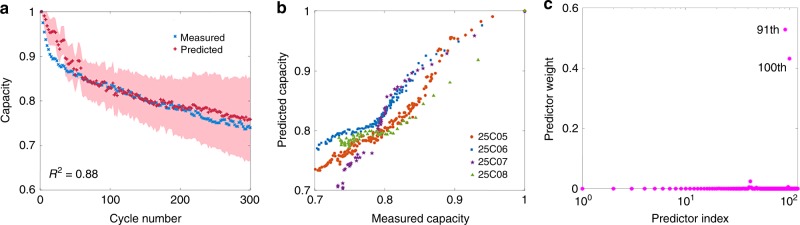
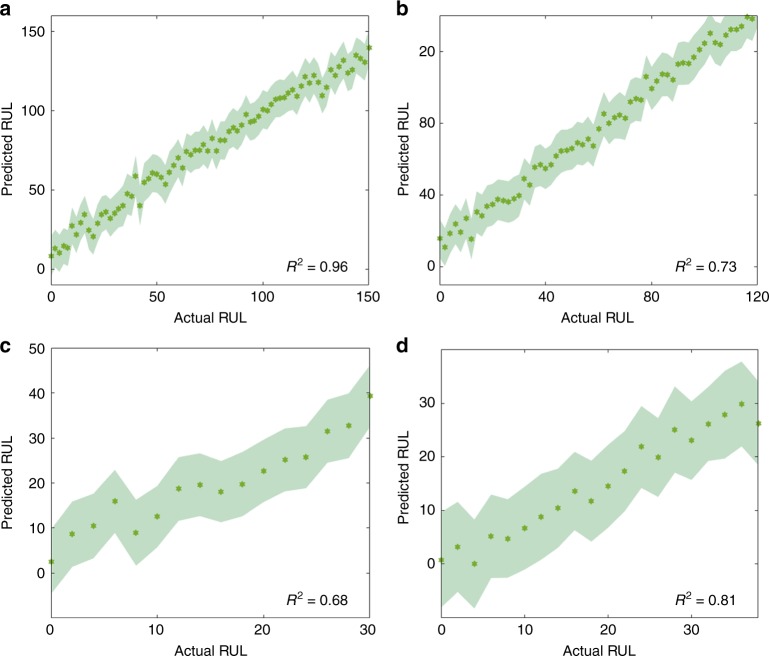
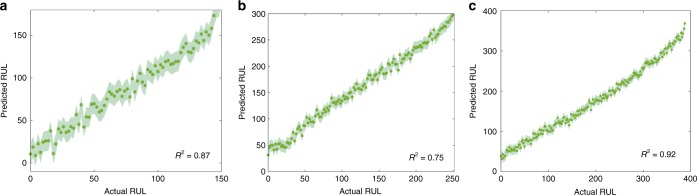
- The EIS-Capacity and EIS-RUL GPR models accurately estimate capacity and predict RUL from the current cycle’s EIS alone; for 25 °C testing cells, the end-of-life values were 150, 120, 30, and 38 cycles, and for multi-temperature testing cells they were 150, 252, and 396 cycles.
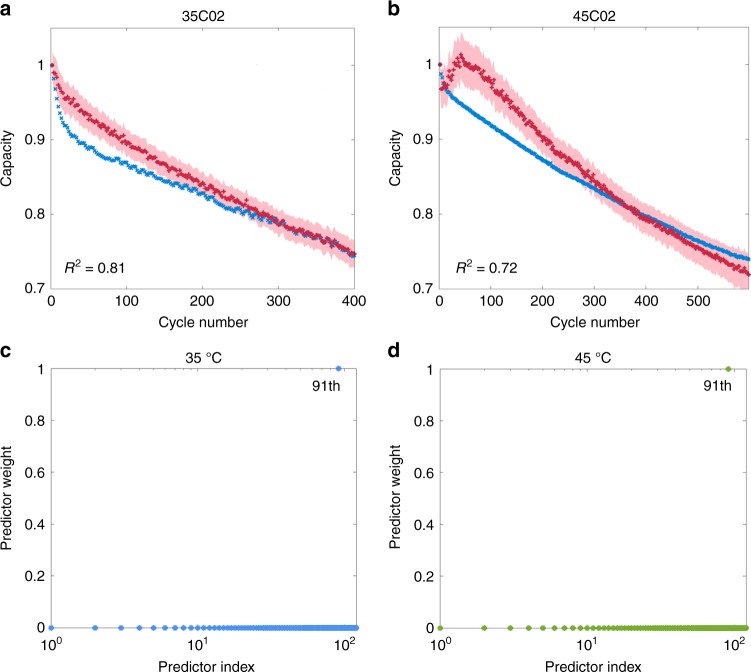
- ARD identified low-frequency impedance as most correlated with degradation: at 25 °C the largest weights were on the 91st and 100th features, corresponding to 17.80 and 2.16 Hz; at 35 °C and 45 °C the largest weight was on the 91st feature, 17.80 Hz.
- A multi-temperature model estimated capacity and predicted RUL for cells cycled at 35 °C and 45 °C without the cycling temperature as an input, under the simplification that temperature is constant over cycles.
- Under the same GPR method and train-test split, the EIS-based approach achieved lower predictive error than features extracted from the discharging curve (Supplementary Table 1).
Methods
- Twelve commercially available 45 mAh Eunicell LR2032 Li-ion coin cells with LiCoO2/graphite chemistry were cycled in climate chambers at 25 °C (25C01–25C08), 35 °C (35C01–35C02), and 45 °C (45C01–45C02); each cycle used 1C CC–CV charge to 4.2 V and 2C CC discharge to 3 V.
- EIS was measured every even-numbered cycle at nine charging/discharging stages over 0.02 Hz–20 kHz with 5 mA excitation after 15-min open circuit at SoC 0% and 100%; capacity loss was measured every odd cycle, and EoL was defined as capacity below 80% of initial after 30 room-temperature cycles.
- GPR used the real and imaginary impedance at 60 frequencies as inputs; capacity models used a squared exponential covariance with ARD, RUL models used a linear covariance, and feature importance was defined as \(w_m = \exp(-\sigma_m)\).
Limitations
- The paper states that all testing cells were charged and discharged the same way as training cells, and that estimating cells cycled at different operating charge/discharge rates requires further experiments.
- The paper states that more realistic settings—variations in cycling temperature over time or charge/discharge rate—would require a significantly larger training set, and the multi-temperature model assumes future operating temperature is close to previous operating temperature.
- Evident from the text: the dataset comprises only 12 small coin cells of one chemistry under controlled laboratory temperatures and constant rates, so validation on larger-format cells or real-world variable conditions is not reported.
Model-written summary. Check it against the paper before relying on it.
Integrity signals
Registry
Cites
Statistics
Figures
Verification
Claims the paper makes
3 Valid · 4 Not valid · 3 Not checked · 33 Own results and interpretations
Some cited sources support this claim and some don’t — read each source’s verdict below.
In the paper
“However, those models are all developed with the charging and discharging curve as input.”
§ Identifying degradation patterns of lithium ion batteries from impedance spectroscopy using machine learning > Introduction
What the sources say
- Disputedcites [33] Richardson RR Osborne MA Howey DA Gaussian process regression for forecasting battery state of health J. Power Sources 2017 357 209 219 10.1016/j.jpowsour.2017.05.004 sourceExperimental — accuracy not yet measured
The Introduction describes data-driven models that map cycle number to state of health and says recent support-vector-machine studies predict capacity from historical capacity-versus-cycle data. It also says capacity data can be obtained by methods other than charge–discharge measurements. These passages contradict the claim that all such models take charging and discharging curves as input; page numbers were not available in our copy. (LLM, conf=0.88)
Checked by a reasoning model — may be wrong.
- Not checked — no full text of the sourcecites [34] Yang D Zhang X Pan R Wang Y Chen Z A novel gaussian process regression model for state-of-health estimation of lithium-ion battery using charging curve J. Power Sources 2018 384 387 395 10.1016/j.jpowsour.2018.03.015 source
- Partly supportedcites [17] Richardson RR Birkl CR Osborne MA Howey DA Gaussian process regression for in situ capacity estimation of lithium-ion batteries IEEE Trans. Ind. Inform. 2019 15 127 136 10.1109/TII.2018.2794997 sourceExperimental — accuracy not yet measured
The Introduction (p. 1) describes earlier regression models that use features from incremental-capacity or differential-voltage curves as inputs. But it does not establish that all existing machine-learning models use charging and discharging curves; the Conclusions (p. 10) describe this paper’s own model as using small portions of voltage-time data instead. (LLM, conf=0.84)
- Disputedcites [18] Severson KA Data-driven prediction of battery cycle life before capacity degradation Nat. Energy 2019 4 383 391 10.1038/s41560-019-0356-8 sourceExperimental — accuracy not yet measured
The Machine learning approach section distinguishes models using discharge data alone from a model that considers both charging and discharging features. The Results section confirms that its “variance” model uses one feature from discharge curves and its “discharge” model uses discharge measurements only. The paper therefore contradicts the claim that all such models require both charging and discharging curves as input. (LLM, conf=0.87)
Checked by a reasoning model — may be wrong.
plain- Asserted: passes — The authors put it forward as true.
- Checkable: passes — It can be checked against evidence.
- Load-bearing: passes — The paper’s conclusions depend on it.
- Based: passes — The paper gives a reason why it holds.
- Disputed
The cited sources support only part of this claim — read each source’s verdict below.
In the paper
“suggesting that it is the change in the interfacial properties that underpins degradation for these batteries; this is consistent with the results obtained in previous works35”
§ Identifying degradation patterns of lithium ion batteries from impedance spectroscopy using machine learning > Results > Capacity estimation
What the sources say
- Partly supportedcites [35] Grugeon S Particle size effects on the electrochemical performance of copper oxides toward lithium J. Electrochem. Soc. 2001 148 A285 A292 10.1149/1.1353566 sourceExperimental — accuracy not yet measured
The Conclusions (page unavailable) say that an organic coating at the electrode surface can, depending on precursor size, negatively affect capacity retention during cycling. This supports a possible link between interfacial changes and degradation in the copper-oxide cells studied, but not the unqualified claim that such changes underpin degradation for these batteries generally. (LLM, conf=0.85)
hedgedstates a cause- Asserted: passes — The authors put it forward as true.
- Checkable: passes — It can be checked against evidence.
- Load-bearing: passes — The paper’s conclusions depend on it.
- Based: passes — The paper gives a reason why it holds.
- Partly supported
The cited sources support only part of this claim — read each source’s verdict below.
In the paper
“Features derived from the charging and discharging curve are by far the most commonly used inputs because typical battery management systems collect current–voltage data13–18.”
§ Identifying degradation patterns of lithium ion batteries from impedance spectroscopy using machine learning > Introduction
What the sources say
- Not checked — no full text of the sourcecites [13] Weng C Cui Y Sun J Peng H On-board state of health monitoring of lithium-ion batteries using incremental capacity analysis with support vector regression J. Power Sources 2013 235 36 44 10.1016/j.jpowsour.2013.02.012 source
- Not checked — no full text of the sourcecites [14] Weng C Feng X Sun J Peng H State-of-health monitoring of lithium-ion battery modules and packs via incremental capacity peak tracking Appl. Energy 2016 180 360 368 10.1016/j.apenergy.2016.07.126 source
- Not checked — no full text of the sourcecites [15] Berecibar M Garmendia M Gandiaga I Crego J Villarreal I State of health estimation algorithm of lifepo4 battery packs based on differential voltage curves for battery management system application Energy 2016 103 784 796 10.1016/j.energy.2016.02.163 source
- Not checked — no full text of the sourcecites [16] Berecibar M Online state of health estimation on nmc cells based on predictive analytics J. Power Sources 2016 320 239 250 10.1016/j.jpowsour.2016.04.109 source
- Partly supportedcites [17] Richardson RR Birkl CR Osborne MA Howey DA Gaussian process regression for in situ capacity estimation of lithium-ion batteries IEEE Trans. Ind. Inform. 2019 15 127 136 10.1109/TII.2018.2794997 sourceExperimental — accuracy not yet measured
The Introduction (p. 1) describes studies using features from IC/DV curves for capacity estimation, supporting the claim that charging-curve-derived features are used. It does not establish that they are by far the most common inputs or that their use is due to typical BMS data collection; instead, it calls model-parameter estimation the most common approach to capacity estimation. (LLM, conf=0.83)
- Partly supportedcites [18] Severson KA Data-driven prediction of battery cycle life before capacity degradation Nat. Energy 2019 4 383 391 10.1038/s41560-019-0356-8 sourceExperimental — accuracy not yet measured
The Machine learning approach section says the authors derive predictive features from discharge voltage curves and describes voltage curves and their derivatives as a rich source for degradation diagnosis. The Discussion says differential voltage-curve methods are used extensively. Neither passage establishes that charging and discharging curves are by far the most common inputs for battery health prediction or that their use is because typical battery management systems collect current–voltage data. (LLM, conf=0.84)
plainstates a cause- Asserted: passes — The authors put it forward as true.
- Checkable: passes — It can be checked against evidence.
- Load-bearing: unclear — It is unclear whether the paper’s conclusions depend on it.
- Based: passes — The paper gives a reason why it holds.
The sources with a verdict support this claim; the rest weren’t checked yet, have no full text we could read, or their verdicts aren’t rated yet.
In the paper
“Although GPR has been used in the literature in the context of Li-ion batteries17,33,34, we depart from those pioneering works by employing impedance spectra as input, as well employing ARD to shed light on salient frequencies.”
§ Identifying degradation patterns of lithium ion batteries from impedance spectroscopy using machine learning > Methods > Gaussian process regression
What the sources say
- Supportedcites [17] Richardson RR Birkl CR Osborne MA Howey DA Gaussian process regression for in situ capacity estimation of lithium-ion batteries IEEE Trans. Ind. Inform. 2019 15 127 136 10.1109/TII.2018.2794997 source
The Introduction (p. 1) identifies this as a Gaussian-process regression method for lithium-ion battery capacity estimation, supporting its citation as prior GPR work. The impedance-spectrum inputs and ARD are described as the citing authors’ departure, not as features attributed to this source; the Conclusions (p. 10) instead describe voltage-time inputs. (LLM, conf=0.93)
- Supportedcites [33] Richardson RR Osborne MA Howey DA Gaussian process regression for forecasting battery state of health J. Power Sources 2017 357 209 219 10.1016/j.jpowsour.2017.05.004 source
The Introduction (page unavailable) describes this paper's use of Gaussian processes to forecast lithium-ion battery capacity, supporting its citation as prior GPR work. In the citing sentence, “we depart” describes the citing authors’ own use of impedance spectra and ARD, not a method attributed to this source. (LLM, conf=0.92)
- Not checked — no full text of the sourcecites [34] Yang D Zhang X Pan R Wang Y Chen Z A novel gaussian process regression model for state-of-health estimation of lithium-ion battery using charging curve J. Power Sources 2018 384 387 395 10.1016/j.jpowsour.2018.03.015 source
plain- Asserted: passes — The authors put it forward as true.
- Checkable: passes — It can be checked against evidence.
- Load-bearing: passes — The paper’s conclusions depend on it.
- Based: passes — The paper gives a reason why it holds.
- Supported
A result the paper reports from its own data — it cites no other source for it, so there is none to check. The quote shows it is in the paper.
In the paper
“in Supplementary Fig. 3, we show there is a strong linear change of selected EIS features with cycle number in the Nyquist plot over cycle number at 25 °C.”
§ Identifying degradation patterns of lithium ion batteries from impedance spectroscopy using machine learning > Results > Capacity estimation
boostedstates an association- Asserted: passes — The authors put it forward as true.
- Checkable: passes — It can be checked against evidence.
- Load-bearing: passes — The paper’s conclusions depend on it.
- Based: passes — The paper gives a reason why it holds.
25 more claims
Create a free account to see all 43 claims and every source verdict.
- Probably not a substantial claim. 8
- It may state two separate claims as one. 8
- The quote only partly states this claim. 1
Self-check
Percentages, sums and reported differences re-computed from the paper’s own numbers.
Each contradiction between two passages listed here was confirmed by an independent check.
Rated minor: it would not touch a result — a value no result rests on, a p-value that stays on the same side of the significance level, or a conflict that is clerical, resolved elsewhere in the paper, or outside its own findings.
In the paper
§ Identifying degradation patterns of lithium ion batteries from impedance spectroscopy using machine learning > Results > Capacity estimation
“The pink points correspond to the 120 frequencies in the range of 0.02 Hz–20 kHz.”
§ Identifying degradation patterns of lithium ion batteries from impedance spectroscopy using machine learning > Methods > Gaussian process regression
“the real (Zre) and imaginary (Zim) parts of impedance spectra collected at 60 different frequencies (ωn, n = 1, 2, ..., 60) in the range of 0.02 Hz–20 kHz”
Citations
Cites
Lithium Batteries: Status, Prospects and Future
Scrosati, B., & Garche, J. (2010) · Journal of Power Sources · doi:10.1016/j.jpowsour.2009.11.048 · Cited by 5,153 · cited 1×
“L i-ion batteries enable a wide variety of technologies that are integral to modern life by virtue of their high energy and power density 1 – 4 . advancing However, a key stumbling block to those technologies is the unpredictability of battery degradation: accurate prediction of battery state of…”
BackgroundData-driven prediction of battery cycle life before capacity degradation
Severson, K. A., Attia, P. M., Jin, N., Perkins, N., Jiang, B., Yang, Z., Chen, M. H., Aykol, M., Herring, P. K., Fraggedakis, D., et al. (2019) · Nature Energy · doi:10.1038/s41560-019-0356-8 · Cited by 3,228 · cited 3×
“Features derived from the charging and discharging curve are by far the most commonly used inputs because typical battery management systems collect current – voltage data 13 – 18 .”
BackgroundMethodDesigning nanostructured Si anodes for high energy lithium ion batteries
Wu, H., & Cui, Y. (2012) · Nano Today · doi:10.1016/j.nantod.2012.08.004 · Cited by 2,350
Remaining useful life estimation – A review on the statistical data driven approaches
Si, X.-S., Wang, W., Hu, C.-H., & Zhou, D.-H. (2011) · European Journal of Operational Research · doi:10.1016/j.ejor.2010.11.018 · Cited by 2,162 · cited 1×
“To overcome this challenge, recent literature focuses on data-driven approaches 11,12 .”
BackgroundA review on lithium-ion battery ageing mechanisms and estimations for automotive applications
Barré, A., Deguilhem, B., Grolleau, S., Gérard, M., Suard, F., & Riu, D. (2013) · Journal of Power Sources · doi:10.1016/j.jpowsour.2013.05.040 · Cited by 1,758
A Unifying View of Sparse Approximate Gaussian Process Regression
Quiñonero-Candela, J., & Rasmussen, C. E. (2005) · doi:10.5555/1046920.1194909 · Cited by 1,671
Lithium ion secondary batteries; past 10 years and the future
Nishi, Y. (2001) · Journal of Power Sources · doi:10.1016/s0378-7753(01)00887-4 · Cited by 1,074 · cited 1×
“L i-ion batteries enable a wide variety of technologies that are integral to modern life by virtue of their high energy and power density 1 – 4 . advancing However, a key stumbling block to those technologies is the unpredictability of battery degradation: accurate prediction of battery state of…”
BackgroundYang, X.-G., Leng, Y., Zhang, G., Ge, S., & Wang, C.-Y. (2017) · Journal of Power Sources · doi:10.1016/j.jpowsour.2017.05.110 · Cited by 948
Pinson, M. B., & Bazant, M. Z. (2013) · Journal of The Electrochemical Society · doi:10.1149/2.044302jes · Cited by 946
Gaussian Processes for Machine Learning (GPML) Toolbox
Rasmussen, C. E., & Nickisch, H. (2010) · Max Planck Institute for Plasma Physics · doi:10.5555/1756006.1953029 · Cited by 895 · cited 1×
“We implement the EIS-capacity GPR model using the Gaussian processes for machine learning (GPML) toolbox 37 with a zero mean function and a diagonal squared exponential (SE) covariance function with ARD 38 where σ m represents the length scale for feature m , m = 1, 2, ..., d and σ f is the signal…”
Method
Research works printed but not linked: 1
- Popp, H., Einhorn, M. & Conte, F. V. Capacity decrease vs. impedance increase of lithium batteries. a comparative study. In Hybrid and Fuel Cell Electric Vehicle Symposium & Exhibition EVS26, Los Angeles, 6–9 (2012).
Cited by
Items 601–700 of 872
Yin, S., Liu, Y., Wang, Y., Si, Y., Xiao, Y., Su, M., & Zhou, X. (2026) · Applied Energy · doi:10.1016/j.apenergy.2026.127736 · Cited by 4
Liu, Y., Shi, Y., Zhou, Q., Bian, X., Wang, K., Fan, W., & Li, Q. (2026) · Journal of Energy Storage · doi:10.1016/j.est.2026.122058 · Cited by 6
Qin, D., Huang, F., Zhu, G., et al. (2022) · Nanomaterials · doi:10.3390/nano12193530 · Cited by 3
“The Rct values of the three materials are all higher after cycling than that before cycling in terms of SEI film formation [68,69].”
BackgroundA Breif Review on Data-driven Battery Health Estimation Methods for Energy Storage Systems
Chen, M., & Wu, H. (2022) · IEEE International Conference on Networking, Sensing and Control (ICNSC) · doi:10.1109/icnsc55942.2022.10004051 · Cited by 7
“Zhang et al [38] carry out the EIS-capacity GPR model through the Gaussian processes with a zero mean function and a diagonal squared exponential (SE) covariance function with automatic relevance determination (ARD).”
MethodWang, Y., Luo, Q., Cao, L., Seth, A., Liu, J., Gopaluni, R. B., & Cao, Y. (2024) · The Canadian Journal of Chemical Engineering · doi:10.1002/cjce.25394 · Cited by 3
Park, C., Kim, T.-H., Sung, Y., Ryu, K., & Park, J. (2024) · Korean Journal of Chemical Engineering · doi:10.1007/s11814-024-00277-0 · Cited by 5
“From a different point of view, Zhang et al. [37] developed a novel GPR model with other data types.”
Huang, R., Fogelquist, J., Kuang, S., & Lin, X. (2024) · Journal of Energy Storage · doi:10.1016/j.est.2025.116009 · Cited by 5
Xia, M., Ding, P., Wang, X., Gao, Q., Pan, H., Guo, W., Shi, P., & Min, Y. (2025) · Ionics · doi:10.1007/s11581-025-06294-1 · Cited by 3
“The dataset for the experiment came from the Cavendish Laboratory at the University of Cambridge [39], which contains cycling data for a total of 12 Eunicell LR2032 commercial batteries with a capacity of 45 mAh, their positive and negative materials are LiCoO 2 and Graphite, respectively.”
Hazama, H., & Kondo, H. (2021) · Journal of The Electrochemical Society · doi:10.1149/1945-7111/ac2703 · Cited by 3
Battery Capacity Trajectory Prediction with Multi-output Gaussian Process
Li, J., Deng, Z., & Hu, X. (2022) · International Conference on Smart Power & Internet Energy Systems (SPIES) · doi:10.1109/spies55999.2022.10082007 · Cited by 3
“To capture the non-linear declining changes of battery, some advanced machine learning algorithms such as support vector machine (SVM) [16], relevance vector machine (RVM) [17], Gaussian process regression (GPR) [18], and neural network (NN) [19] are popularly used.”
MethodStudy and modeling of internal resistance of Li-Ion battery with change in temperature & SoC
Abhishek, K., & Roy, N. K. (2022) · International Conference on Smart and Sustainable Technologies in Energy and Power Sectors (SSTEPS) · doi:10.1109/ssteps57475.2022.00024 · Cited by 3
Hammou, A., Meng, J., Diallo, D., et al. (2023) · Prognostics and Health Management Conference (PHM) · doi:10.1109/phm58589.2023.00050 · Cited by 3
“The authors in [9] use a Gaussian Process Regression (GPR) to predict the remaining cycles to reach the EoL using Electrochemical Impedance Spectroscopy measurements (EIS).”
MethodPech-Rodríguez, W. J., Rodríguez‐Varela, F. J., Calles-Arriaga, C. A., et al. (2023) · Revista Mexicana de Ingeniería Química · doi:10.24275/rmiq/sim2387 · Cited by 3
Ning, Z., Venugopal, P., Rietveld, G., & Soeiro, T. B. (2023) · IEEE International Conference on Metrology for eXtended Reality, Artificial Intelligence and Neural Engineering (MetroXRAINE) · doi:10.1109/metroxraine58569.2023.10405626 · Cited by 4
“The data set used in this article includes EIS and capacity data of 8 LiCoO 2 /graphite cells, all obtained from [10]”
BackgroundMethodLiu, R., Zhang, D., Li, Z., Bauer, P., & Qin, Z. (2024) · International Power Electronics and Motion Control Conference (EPE-PEMC) · doi:10.1109/ipemc-ecceasia60879.2024.10567365 · Cited by 4
“Therefore, accurate SOH estimation becomes imperative for gaining insights into the current level of battery ageing and making informed decisions on the optimal time for battery replacement [3,4].”
BackgroundMethodEnhancing battery health estimation using model selection criteria-based genetic programming
Su, S.-S., Di, G., Vandana, Gao, L., Li, W., & Garg, A. (2024) · Journal of Energy Storage · doi:10.1016/j.est.2024.114077 · Cited by 4
State-of-Health Estimation of Lithium-Ion Batteries Based on EIS and CNN-Transformer Network
Wang, M., Sui, Z., & Zhang, L. (2024) · Global Reliability and Prognostics and Health Management Conference (PHM) · doi:10.1109/phm-beijing63284.2024.10874815 · Cited by 5
MSTAN-SelectiveMamba: A hybrid deep learning framework for precise battery life prediction
Li, K., Lei, Z., & Deng, C. (2025) · Journal of Energy Storage · doi:10.1016/j.est.2025.118018 · Cited by 4
Vanem, E., Alnes, Ø. Å., & Lam, J. (2021) · Annual Conference of the PHM Society · doi:10.36001/phmconf.2021.v13i1.2972 · Cited by 4
“EIS measurements are used together with model-based approaches in (Kuipers et al., 2020; X. Wang, Wei, & Dai, 2019) and with data-driven approaches in e.g. (Y. Zhang et al., 2020) for SOH estimation and RUL prediction.”
MethodClassification of (Micro)Plastics Using Cathodoluminescence and Machine LearningPreprint
Höppener, E. M., Shahmohammadi, S., Parker, L. A., et al. (2022) · SSRN Electronic Journal · doi:10.2139/ssrn.4123090 · Cited by 3
Xiang, Y., Fan, W., Zhu, J., Wei, X., & Dai, H. (2023) · SSRN Electronic Journal · doi:10.2139/ssrn.4529651 · Cited by 3
Wu, J., Luo, L., Meng, J., et al. (2023) · IEEE/IAS Industrial and Commercial Power System Asia (I&CPS Asia) · doi:10.1109/icpsasia58343.2023.10294687 · Cited by 2
“According to the research paper [8], the impedance characteristics of the real part and imaginary part at 17.80 Hz and 2.16 Hz frequencies, which are significantly related to aging, are first extracted, and other related features are manually extracted based on the geometric variation of graphics.”
MethodInfluentialCharacterization of battery materials by electrochemical method
Dai, H., Zhu, J., & Zhu, Y. (2024) · Elsevier eBooks · doi:10.1016/b978-0-323-91304-1.00020-4 · Cited by 2
Bae, Y. S., Lee, S., & Moon, J. (2024) · Batteries · doi:10.3390/batteries10110389 · Cited by 3
Medić, M., Simić, M., Risojević, V., & Bulić, P. (2025) · International Symposium INFOTEH-JAHORINA (INFOTEH) · doi:10.1109/infoteh64129.2025.10959178 · Cited by 2
“The reason behind these augmentations is the lack of available measured data on real Li-Ion batteries [14], [18], [19].”
Furugori, M., & Katayama, N. (2025) · IEEJ Transactions on Electrical and Electronic Engineering · doi:10.1002/tee.70057 · Cited by 3
Early Cycle Life Prediction of Lithium‐Metal Batteries with the Aid of Machine Learning
Eftekharnia, M., Nguyen, T., Forsyth, M., Tran, T., Howlett, P. C., & Kerr, R. (2025) · Batteries & Supercaps · doi:10.1002/batt.202500261 · Cited by 3
Luo, P., Zhang, Y., Shen, Z. W., Hu, Y., Chen, H., & Ma, Z. (2025) · Chemical Engineering Science · doi:10.1016/j.ces.2025.122600 · Cited by 2
Self-citationLiang, T., Chen, Y., Xu, J., & Jin, Y. (2025) · Batteries & Supercaps · doi:10.1002/batt.202500536 · Cited by 17
Chen, N., Xie, Y., Cheng, Y., Wang, H., Zhou, Y., Zhao, X., Chen, J., & Yang, C. (2025) · Energies · doi:10.3390/en18195289 · Cited by 5
Extending battery cycle life via recovery of reversible lithium losses reversible lithium losses
Wang, H., An, H., Chen, M., Duan, R., Liu, J., Xu, F., Song, Y., Chen, C., Cai, K., & Wang, J. (2025) · Nano Energy · doi:10.1016/j.nanoen.2025.111512 · Cited by 4
Self-citationEIS data analysis tools: recent advance and an AI-assisted EIS analysis web platform
Zhao, Z., Zou, L., Yang, X., et al. (2025) · Journal of Electroanalytical Chemistry · doi:10.1016/j.jelechem.2025.119641 · Cited by 2
Health evaluation for in-service electric vehicle battery pack with recursive Gaussian process
Liu, H., Zheng, Y., Che, Y., Li, J., Pan, Y., & Hu, X. (2025) · Energy · doi:10.1016/j.energy.2025.139380 · Cited by 2
Yu, B., Yang, Z., Yu, Y., & Xiang, G. (2025) · IEEE Transactions on Instrumentation and Measurement · doi:10.1109/tim.2025.3635303 · Cited by 3
“In addition, electrochemical impedance spectroscopy (EIS) has emerged as an alternative monitoring approach, providing frequency-domain insights into internal electrochemical processes [16].”
Wan, Q., Qu, J., & Xu, J. (2025) · Journal of Energy Storage · doi:10.1016/j.est.2025.119713 · Cited by 5
State of Health Estimation of Lithium-Ion Batteries Across Temperatures Using EIS-Based Features
Yang, B., Huang, L., Wei, K., Shu, X., & Li, Y. (2026) · Journal of The Electrochemical Society · doi:10.1149/1945-7111/ae32b7 · Cited by 4
Addressing the OCV-SOC Flat Region in LFP Cells for SOC Estimations Using EIS Measurements
Li, Y., & Hu, P. (2026) · Journal of The Electrochemical Society · doi:10.1149/1945-7111/ae33fc · Cited by 9
Alyoubi, M., Çetinkaya, D., Zoromba, M. S., Abdel-Aziz, M. H., Bassyouni, M. I., Mahmoud, E. R. I., Ali, I., & Abdelkader, A. M. (2026) · Journal of Energy Storage · doi:10.1016/j.est.2025.119930 · Cited by 2
Zhang, Z., Shang, Y., Li, X., & Cheng, Z. (2026) · Energy storage materials · doi:10.1016/j.ensm.2026.104892 · Cited by 3
Lee, J., Lee, M., Cho, S., Kim, Y., Oh, J., & Kim, J. (2026) · Journal of Energy Storage · doi:10.1016/j.est.2026.120588 · Cited by 2
Bibliometric Insights Into Lithium‐Ion Battery Research and Recycling Trends (2011–2022)
Baskaran, D., Rajeswari, S., Kanimozhi, K., & Byun, H.-S. (2026) · International Journal of Energy Research · doi:10.1155/er/4339273 · Cited by 4
Fei, Z., Li, M., Zhang, Z., & Tsui, K. (2026) · The Innovation · doi:10.1016/j.xinn.2026.101342 · Cited by 4
Liang, B., Wang, X., Kang, L., & Xie, D. (2026) · Journal of Power Sources · doi:10.1016/j.jpowsour.2026.239804 · Cited by 3
d’Apolito, L., Tong, R., Hong, H., Yang, Y., & Shen, S. (2026) · Ionics · doi:10.1007/s11581-026-07008-x · Cited by 2
LLMB: AI Agent for Lithium Metal Battery Research Using Large Language Model
Lee, J., Woo, J., Kim, Y.-H., Kim, S., Paulina, C., Park, H., Kim, H.-T., Park, S., & Kim, J. (2026) · ACS Central Science · doi:10.1021/acscentsci.5c02433 · Cited by 10
Gao, J., Huang, T., Zhang, Y., Chen, B., Ren, X., Hu, J., Zhang, Q., & Xie, H. (2026) · Nano Energy · doi:10.1016/j.nanoen.2026.111978 · Cited by 3
Self-citationArtificial intelligence-facilitated multiscale theoretical modelling to advance battery science
Shi, J., Tian, Y., Sun, M., Zhang, X., & Zhou, Z. (2026) · Science China Chemistry · doi:10.1007/s11426-025-3306-8 · Cited by 2
Zhang, Z., Shang, Y., Zhang, Q., Li, Y., Li, X., & Cheng, Z. (2026) · Green Energy and Intelligent Transportation · doi:10.1016/j.geits.2026.100428 · Cited by 2
Data-driven full life-cycle state parameter assessment of Li-ion batteries
Liu, J., Miao, Z., & Wang, Q. (2022) · Chinese Science Bulletin (Chinese Version) · doi:10.1360/tb-2022-0550 · Cited by 3
Field Test on Seasonal Behavior of an Electric Vehicle in Everyday Operation
Wego, A. (2023) · International Interdisciplinary PhD Workshop (IIPhDW) · doi:10.1109/iiphdw54739.2023.10124430 · Cited by 2
“It is known from other studies of this topic [2] that the degradation curve tends to flatten over the period of vehicle use, so that it seems not to be reasonable to extrapolate it linearly.”
BackgroundLee, Y., Choi, K., Jo, S.-W., Rahim, G., Kwon, K., & Lee, S. (2023) · IEEE International Instrumentation and Measurement Technology Conference · doi:10.1109/i2mtc53148.2023.10176024 · Cited by 2
“Electrochemical impedance spectroscopy (EIS) is a powerful tool to estimate the battery states by measuring the impedance spectrum over an interested frequency range in a non-invasive manner [3], [4].”
BackgroundLiu, G., Tong, X., Ma, W., Zong, M., & Zhang, N. (2024) · Multiscale and Multidisciplinary Modeling Experiments and Design · doi:10.1007/s41939-023-00359-2 · Cited by 2
“Sometimes, optimization algorithms (Zhang et al. 2020) are used to increase the performance of fuzzy systems.”
Alagić, M., Caponetto, R., Blasi, A. D., Vujkov, B., Cvetićanin, S. M., & Dumnic, B. P. (2024) · Telecommunications Forum (TELFOR) · doi:10.1109/telfor63250.2024.10819186 · Cited by 2
Gao, G., Zhang, Q., Pan, L., Shi, Y., Tang, X., Wang, T., & Li, X. (2024) · Asia-Pacific Power and Energy Engineering Conference (APPEEC) · doi:10.1109/appeec61255.2024.10922356 · Cited by 3
“Zhang et al. [8] utilized the comprehensive aging information captured by EIS to estimate battery capacity degradation; however, the high dimensionality of this method could compromise model accuracy.”
Tao, S., Zhu, J., Li, Y., Wei, C., Dai, H., & Wei, X. (2025) · SAE technical papers on CD-ROM/SAE technical paper series · doi:10.4271/2025-01-8561 · Cited by 3
Impedance Field-Based Fault Diagnosis for Fuel Cells
Guo, B., Yu, H., Zhao, Z., Xu, S., Wang, Z., Fu, Y., & Zhao, J. (2025) · IEEE Transactions on Instrumentation and Measurement · doi:10.1109/tim.2025.3577816 · Cited by 4
“Following the discussion of EIS image features, we explore the classification using the largest dataset of EIS [7].”
InfluentialIdentifying Failure Conditions in Li-Ion Batteries Using Distribution of Relaxation Time Method
Sohaib, M., Akram, A. S., & Choi, W. (2026) · Applied Sciences · doi:10.3390/app16052469 · Cited by 3
Online Capacity Estimation of Lithium-ion Batteries by Partial Incremental Capacity Curve
Wang, Y., Zhu, J., Cao, L., Gopaluni, R. B., & Cao, Y. (2022) · IEEE Vehicle Power and Propulsion Conference (VPPC) · doi:10.1109/vppc55846.2022.10003439 · Cited by 5
“Zhang et al. [9] introduced a capacity estimation method by combining the electrochemical impedance spectroscopy (EIS) spectrum with GPR.”
MethodA Fast Estimation Algorithm for State of Health of Lithium-ion Battery Modules Based on Lorenz Plot
Wen, X., Zhong, J., Li, X., Zhicheng, L. I. N., Luyan, W. A. N. G., & Liao, Q. (2023) · Electrochemistry · doi:10.5796/electrochemistry.23-00038 · Cited by 3
Ruiz, D., Casas, A., & Pérez, A. (2023) · European Space Power Conference (ESPC) · doi:10.1109/espc59009.2023.10298188 · Cited by 3
Alidadi, P., Schlösser, A. E. K., & Salek, F. (2024) · SAE technical papers on CD-ROM/SAE technical paper series · doi:10.4271/2024-01-2427 · Cited by 2
TFDSUNet: Time-Frequency Dual-Stream Uncertainty Network for Battery SOH/SOC PredictionPreprint
Xiao, W., Zhu, Z., Wang, Q., Pang, L., Shu, C., Meng, D., & Cao, X. (2023) · Research Square · doi:10.21203/rs.3.rs-2943579/v1 · Cited by 6
Lin, Y., Ruan, S.-J., Chen, Y., et al. (2023) · SSRN Electronic Journal · doi:10.2139/ssrn.4462759 · Cited by 2
Visualizing Diffusion Impedance across Electrochemical Energy Technologies
Yang, P. (2026) · ACS Energy Letters · doi:10.1021/acsenergylett.6c00568 · Cited by 2
Moura, J. J. P., Camboim, M. M., Nunes, T. M. S., Rosolem, M. D. F. N. C., Beck, R. F., & Arioli, V. T. (2024) · SAE technical papers on CD-ROM/SAE technical paper series · doi:10.4271/2023-36-0073 · Cited by 1
Khiati, W., Habchi, A. E., Zerrouk, I., Aissi, M., Moumen, Y., Berrich, J., & Bouchentouf, T. (2024) · Lecture notes in networks and systems · doi:10.1007/978-3-031-68660-3_33 · Cited by 2
A Comparative Study on the Performance of Battery Impedance Models in State-of-Charge Estimation
Gholami, M. M., & Rezazadeh, A. (2024) · doi:10.1109/icemd64575.2024.10963635 · Cited by 2
“In contrast to other studies, such as [12], [16], which consider the entire impedance spectrum in the frequency domain along with ECM parameters to achieve optimal accuracy, this article conducts SoC estimation solely based on ECM parameters.”
Battery lifetime prediction considering domain-variate error
Lu, T., Deng, W., Liu, G., Zhai, X., Yu, C., Wan, J., Li, X., & Li, X. (2025) · Integration · doi:10.1016/j.vlsi.2025.102438 · Cited by 1
EIS Mimicking DC Measurement Technique: A Novel Path for Battery Aging Analysis
Sakallıoğlu, S. H., Dönmez, K. B., & Onur, B. (2025) · Energy Storage · doi:10.1002/est2.70229 · Cited by 2
Xu, M., Cheng, K., Shi, Q., Li, Z., Jiang, K., & Wang, K. (2025) · IEEE Transportation Electrification Conference and Expo · doi:10.1109/itec63604.2025.11097947 · Cited by 1
“The first uses features extracted from some fixed-frequency impedances since the onboard EIS measurement is much easier and quicker to implement at only a few key frequencies [5].”
Fast lithium-ion battery impedance measurement via filter-free discrete interval trinary sequence
Peng, J., Zhu, L. Z., Meng, J., Cai, L., & Peng, Q. (2025) · Journal of Power Sources · doi:10.1016/j.jpowsour.2025.238053 · Cited by 1
Machine-learning based Li-Ion Cell state prediction using Impedance spectroscopy
Klemm, C. P., & Frömling, T. (2025) · Machine Learning with Applications · doi:10.1016/j.mlwa.2025.100729 · Cited by 2
Gomez, W., Wang, F., & Chou, J. (2025) · Journal of Energy Engineering · doi:10.1061/jleed9.eyeng-6267 · Cited by 1
Tulabi, M., & Bubbico, R. (2025) · Energies · doi:10.3390/en18236124 · Cited by 3
Kim, S.-W., & Cho, I. (2025) · Energies · doi:10.3390/en18236300 · Cited by 1
Research on SOH Estimation Methods for Lithium-Ion Batteries Based on DRT
Wu, Y., Zhang, H., Rao, B., et al. (2025) · doi:10.1109/icepae66132.2025.11275762 · Cited by 1
“The study uses lithium-ion battery aging data obtained by Zhang's team[7] through EIS and machine learning methods as the basic dataset, and analyzes it using the DRT method.”
Technology needs for realizing a circular battery supply chain
Pilon, L., Greenwald, J. E., Vail, S., Duthu, R., & Tidwell, J. (2025) · Journal of Power Sources · doi:10.1016/j.jpowsour.2025.238705 · Cited by 3
Experimental analysis of the effects of aging on impedance dependencies
Rosenmüller, C., Kowal, J., & Bohlen, O. S. (2026) · Future Batteries · doi:10.1016/j.fub.2026.100145 · Cited by 2
Jiang, H., Zhai, Q., Long, N., Kang, Q., Meng, X., Zhou, M., Yan, L., & Ma, T. (2026) · Applied Energy · doi:10.1016/j.apenergy.2026.127398 · Cited by 1
Adaptive confidence-calibrated semi-supervised ensemble for early-cycle battery lifetime prediction
Bi, J., Fei, Z., & Wang, J. (2026) · Applied Energy · doi:10.1016/j.apenergy.2026.127515 · Cited by 1
Self-citationEchelon utilization of retired electric bus batteries: Economic and environmental potential
Xu, W., Guo, W., Gao, K., Yang, C., Shangguan, Y., Yin, Y., Yao, W., & Jin, S. (2026) · Transportation Research Part E Logistics and Transportation Review · doi:10.1016/j.tre.2026.104778 · Cited by 2
Changepoint detection as a light data-driven approach to battery state-of-health prediction
Hamed, H., Reis, A. C., Choobar, B. G., Pang, Q., Killick, R., & Safari, M. (2026) · Cell Reports Physical Science · doi:10.1016/j.xcrp.2026.103157 · Cited by 2
Natterer, J., Gomez, M. R., Zonta, E., Thielmann, J., Rehm, M., Cronau, M., & Jossen, A. (2026) · Journal of Power Sources · doi:10.1016/j.jpowsour.2026.239896 · Cited by 3
El-Dalahmeh, M., Hui, Z., Zhang, J. M., & Mamlouk, M. (2026) · Journal of Energy Storage · doi:10.1016/j.est.2026.121714 · Cited by 1
A hybrid neural network architecture for lithium-ion battery remaining useful life prediction
Guan, L., Yun, Z., WANG, J., Li, X., & Hu, Y. (2026) · Journal of Energy Storage · doi:10.1016/j.est.2026.121851 · Cited by 1
Self-citationRen, Y., Huang, R., Zhao, S., Zhu, X., Lin, Y., Su, T., Wang, C., & Ren, N. (2026) · Green Energy & Environment · doi:10.1016/j.gee.2026.03.027 · Cited by 1
Operando Impedance Signatures of Lithium-Ion Battery Solid Electrolyte Interphase Formation
Tyree, D., Su, H., Mao, N., & Zhou, X. (2026) · Energies · doi:10.3390/en19081895 · Cited by 1
Kim, D. J., Hong, T. H., Kim, N., et al. (2026) · Materials Today · doi:10.1016/j.mattod.2026.103332 · Cited by 1
Xu, Y., & Zhang, X. (2026) · Journal of Energy Storage · doi:10.1016/j.est.2026.121902 · Cited by 2
AI for Lithium-ion battery research under data-scarce scenarios
Zhang, J., Zhai, X., Zhang, Q. (., Li, P., Li, M., Wu, K., Yang, L. I. U., & Wan, J. (2026) · The Innovation Materials · doi:10.59717/j.xinn-mater.2026.100209 · Cited by 2
Li, A., Cui, P., Cao, Y., Zhou, P., Yang, L., Bian, G., & Shao, Z. (2026) · Batteries · doi:10.3390/batteries12040145 · Cited by 2
“Model-based approaches, such as Electrochemical Impedance Spectroscopy (EIS), offer high accuracy but demand specialized instrumentation and strict laboratory conditions [1,2].”
Wett, C., Lampe, J., Danz, J., Seeger, T., & Turan, B. (2026) · Journal of Power Sources · doi:10.1016/j.jpowsour.2026.240164 · Cited by 1
Lu, Y., Zou, J., Zhang, L., Wang, H., & Kim, F. (2026) · ACS Applied Materials & Interfaces · doi:10.1021/acsami.6c02666 · Cited by 1
Xiang, H., Zhang, Y., & Feng, W. (2026) · Next Energy · doi:10.1016/j.nxener.2026.100665 · Cited by 2
Self-citationNasution, M. H. I., Habib, S., Ehsan, F., Gulzar, M. M., Al-Awami, A. T., & Khan, B. (2026) · Results in Engineering · doi:10.1016/j.rineng.2026.111055 · Cited by 2
AI-enabled cross-scale modeling and parameter transfer for lithium-ion batteries
Hu, Y., Xie, Y., Zhao, L., Zhu, X., Meng, W., Zhu, Z., Chen, X., Qiu, J., Ming, H., & Zhang, H. (2026) · Energy storage materials · doi:10.1016/j.ensm.2026.105222 · Cited by 2
Wang, H., Chen, Z., Chen, K., Li, S., Liu, Y., Wang, P., & Yang, L. (2026) · Journal of Electroanalytical Chemistry · doi:10.1016/j.jelechem.2026.120221 · Cited by 1
Valizadeh, M., Servati, M., Ataei, H., & Hamrang, F. (2026) · Journal of Energy Storage · doi:10.1016/j.est.2026.122642 · Cited by 1
A data denoising method based on the ICEEMDAN-EA algorithm for SOH estimation
Zhou, C., Su, J., Lai, J., & Yao, J. (2026) · Journal of Power Sources · doi:10.1016/j.jpowsour.2026.240448 · Cited by 1
Tian, A., Wang, H., Dong, Q., Wang, L., Tang, S., & Jiang, J. (2026) · Journal of Energy Storage · doi:10.1016/j.est.2026.122974 · Cited by 2
Metadata
- Authors
- Zhang, Y., Tang, Q., Zhang, Y., Wang, J., Stimming, U., & Lee, A. A.
- Affiliations
- University of Cambridge (GB)
- The Faraday Institution (GB)
- Corresponding author
- Stimming, Ulrich
- Lee, Alpha A.
- Venue
- Nature Communications
- Published
- 2020-04-06
- Volume
- 11
- Issue
- 1
- Pages
- 1706-1706
- ISSN
- 2041-1723 (ISSN-L)
- PMC
- PMC7136228
- OpenAlex
- W3010408268
- Semantic Scholar
- ca94a1d2da80e813b707f40f38a31e9e2720c879
- Cited by
- 889
- References
- 39
- Citations by year
- 2026: 156 · 2025: 198 · 2024: 182 · 2023: 142 · 2022: 118 · 2021: 75 · 2020: 18
- FWCI
- 32.63
- Type
- journal article
- Language
- en
- Open access
- gold
- doi.org
- Licence
- cc-by
- creativecommons.org/licenses/by/4.0 (tdm)
- creativecommons.org/licenses/by/4.0 (vor)
- Locations
- Nature Communications (publishedVersion, cc-by)
- PubMed Central (publishedVersion, cc-by)
- PubMed (publishedVersion)
- Apollo (University of Cambridge) (submittedVersion)
- DOAJ (DOAJ: Directory of Open Access Journals) (submittedVersion, cc-by-sa)
- Apollo (University of Cambridge) (submittedVersion, cc-by)
- Apollo
- Funders
- RCUK | Engineering and Physical Sciences Research Council (EP/S003053/1)
- Topics
- Physical Sciences › Engineering › Automotive Engineering › Battery Modeling and Management
- Physical Sciences › Engineering › Electrical and Electronic Engineering › Advancements in Battery Materials
- Physical Sciences › Engineering › Safety, Risk, Reliability and Quality › Reliability and Maintenance Optimization
- Keywords
- lithium-ion batteries, battery degradation, electrochemical impedance spectroscopy, remaining useful life prediction, Gaussian process regression, battery management systems, electric vehicles, battery diagnostics
About these checks
Registry, retraction, Cites and statistics results are computed, not judged, with one exception: a printed reference that no index lists is read once by a model before it counts as a citation error. Claims are extracted by a model and kept only when their quote appears verbatim in the text; each cited source is then checked, with a model’s help, for whether it says what the claim relies on. Those verdicts can be wrong — read the claim’s quote and the cited source before relying on one.
The claim verdicts this report counts are experimental: their accuracy is not yet measured.
A language model drew the claims from the paper on 2026-10-10, under version 3 of the claim definition (model deepseek-v4.1-flash, prompt extract-v3).
A second model labelled each claim on 2026-10-10 (model jev-1.13-20260917, definition revision gold-guideline-v0.2).
Cited sources are checked with a language model’s help (gpt-6-sol).
Statistics and arithmetic are recomputed, not judged.
Confidence bands are shown only for fields calibrated on our annotated test set. None is calibrated yet, so no band is shown.
What counts as a claim ›How we measure confidence ›How we check this ›
Are you an author, or do you see a problem with this page? Request a review
Data sources
Bibliographic data: Semantic Scholar, OpenAlex, Crossref.
Contains information from the Semantic Scholar Academic Graph Datasets, made available under the ODC Attribution License (ODC-BY 1.0).
Semantic Scholar’s data is described in: Kinney, R., et al. (2023). The Semantic Scholar Open Data Platform. arXiv:2301.10140.
