

Identifying degradation patterns of lithium ion batteries from impedance spectroscopy using machine learning
Open accessThe DOI matches its Crossref record; 38 of the 39 references it cites were found in a registry or an index; 8 of the 26 sources its claims cite were checked for support.
Abstract
Forecasting the state of health and remaining useful life of Li-ion batteries is an unsolved challenge that limits technologies such as consumer electronics and electric vehicles. Here, we build an accurate battery forecasting system by combining electrochemical impedance spectroscopy (EIS)-a real-time, non-invasive and information-rich measurement that is hitherto underused in battery diagnosis-with Gaussian process machine learning. Over 20,000 EIS spectra of commercial Li-ion batteries are collected at different states of health, states of charge and temperatures-the largest dataset to our knowledge of its kind. Our Gaussian process model takes the entire spectrum as input, without further feature engineering, and automatically determines which spectral features predict degradation. Our model accurately predicts the remaining useful life, even without complete knowledge of past operating conditions of the battery. Our results demonstrate the value of EIS signals in battery management systems.
Overview
CoChat Summary
TL;DR
A Gaussian process regression model using full electrochemical impedance spectra estimates Li-ion battery capacity and remaining useful life from a single impedance measurement, trained on over 20,000 EIS spectra from commercial LiCoO2/graphite coin cells. Automatic relevance determination shows low-frequency impedance features are most predictive, and the model outperforms discharge-curve features in the reported benchmark.
Key findings
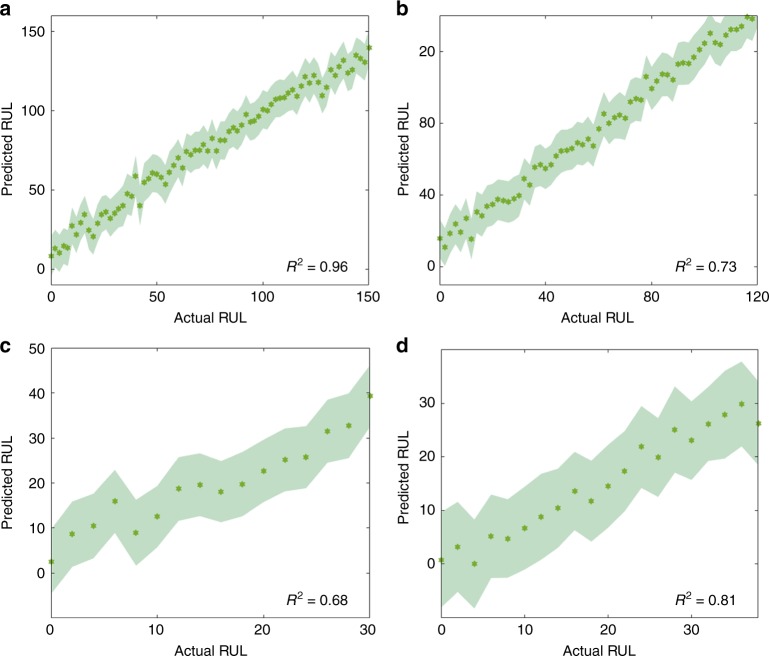
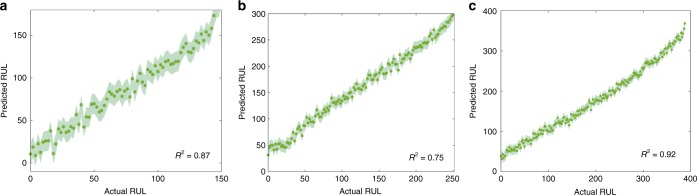
- The EIS-Capacity and EIS-RUL GPR models accurately estimate capacity and predict RUL from the current cycle’s EIS alone; for 25 °C testing cells, the end-of-life values were 150, 120, 30, and 38 cycles, and for multi-temperature testing cells they were 150, 252, and 396 cycles.
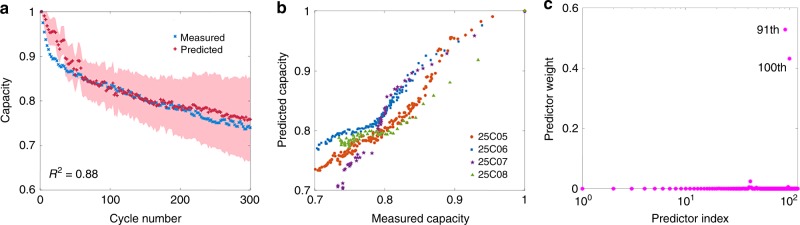
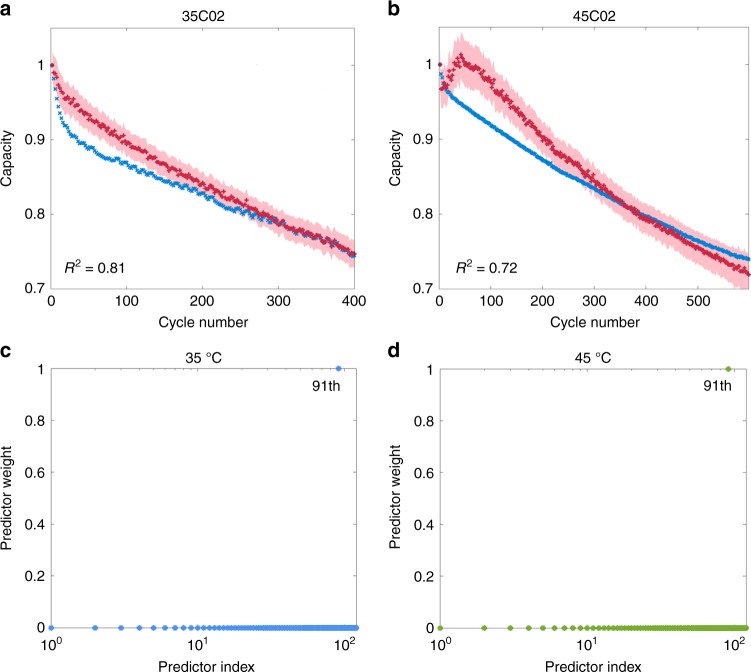
- ARD identified low-frequency impedance as most correlated with degradation: at 25 °C the largest weights were on the 91st and 100th features, corresponding to 17.80 and 2.16 Hz; at 35 °C and 45 °C the largest weight was on the 91st feature, 17.80 Hz.
- A multi-temperature model estimated capacity and predicted RUL for cells cycled at 35 °C and 45 °C without the cycling temperature as an input, under the simplification that temperature is constant over cycles.
- Under the same GPR method and train-test split, the EIS-based approach achieved lower predictive error than features extracted from the discharging curve (Supplementary Table 1).
Methods
- Twelve commercially available 45 mAh Eunicell LR2032 Li-ion coin cells with LiCoO2/graphite chemistry were cycled in climate chambers at 25 °C (25C01–25C08), 35 °C (35C01–35C02), and 45 °C (45C01–45C02); each cycle used 1C CC–CV charge to 4.2 V and 2C CC discharge to 3 V.
- EIS was measured every even-numbered cycle at nine charging/discharging stages over 0.02 Hz–20 kHz with 5 mA excitation after 15-min open circuit at SoC 0% and 100%; capacity loss was measured every odd cycle, and EoL was defined as capacity below 80% of initial after 30 room-temperature cycles.
- GPR used the real and imaginary impedance at 60 frequencies as inputs; capacity models used a squared exponential covariance with ARD, RUL models used a linear covariance, and feature importance was defined as \(w_m = \exp(-\sigma_m)\).
Limitations
- The paper states that all testing cells were charged and discharged the same way as training cells, and that estimating cells cycled at different operating charge/discharge rates requires further experiments.
- The paper states that more realistic settings—variations in cycling temperature over time or charge/discharge rate—would require a significantly larger training set, and the multi-temperature model assumes future operating temperature is close to previous operating temperature.
- Evident from the text: the dataset comprises only 12 small coin cells of one chemistry under controlled laboratory temperatures and constant rates, so validation on larger-format cells or real-world variable conditions is not reported.
Model-written summary. Check it against the paper before relying on it.
Integrity signals
Registry
Cites
Statistics
Figures
Verification
Claims the paper makes
3 Valid · 4 Not valid · 3 Not checked · 33 Own results and interpretations
Some cited sources support this claim and some don’t — read each source’s verdict below.
In the paper
“However, those models are all developed with the charging and discharging curve as input.”
§ Identifying degradation patterns of lithium ion batteries from impedance spectroscopy using machine learning > Introduction
What the sources say
- Disputedcites [33] Richardson RR Osborne MA Howey DA Gaussian process regression for forecasting battery state of health J. Power Sources 2017 357 209 219 10.1016/j.jpowsour.2017.05.004 sourceExperimental — accuracy not yet measured
The Introduction describes data-driven models that map cycle number to state of health and says recent support-vector-machine studies predict capacity from historical capacity-versus-cycle data. It also says capacity data can be obtained by methods other than charge–discharge measurements. These passages contradict the claim that all such models take charging and discharging curves as input; page numbers were not available in our copy. (LLM, conf=0.88)
Checked by a reasoning model — may be wrong.
- Not checked — no full text of the sourcecites [34] Yang D Zhang X Pan R Wang Y Chen Z A novel gaussian process regression model for state-of-health estimation of lithium-ion battery using charging curve J. Power Sources 2018 384 387 395 10.1016/j.jpowsour.2018.03.015 source
- Partly supportedcites [17] Richardson RR Birkl CR Osborne MA Howey DA Gaussian process regression for in situ capacity estimation of lithium-ion batteries IEEE Trans. Ind. Inform. 2019 15 127 136 10.1109/TII.2018.2794997 sourceExperimental — accuracy not yet measured
The Introduction (p. 1) describes earlier regression models that use features from incremental-capacity or differential-voltage curves as inputs. But it does not establish that all existing machine-learning models use charging and discharging curves; the Conclusions (p. 10) describe this paper’s own model as using small portions of voltage-time data instead. (LLM, conf=0.84)
- Disputedcites [18] Severson KA Data-driven prediction of battery cycle life before capacity degradation Nat. Energy 2019 4 383 391 10.1038/s41560-019-0356-8 sourceExperimental — accuracy not yet measured
The Machine learning approach section distinguishes models using discharge data alone from a model that considers both charging and discharging features. The Results section confirms that its “variance” model uses one feature from discharge curves and its “discharge” model uses discharge measurements only. The paper therefore contradicts the claim that all such models require both charging and discharging curves as input. (LLM, conf=0.87)
Checked by a reasoning model — may be wrong.
plain- Asserted: passes — The authors put it forward as true.
- Checkable: passes — It can be checked against evidence.
- Load-bearing: passes — The paper’s conclusions depend on it.
- Based: passes — The paper gives a reason why it holds.
- Disputed
The cited sources support only part of this claim — read each source’s verdict below.
In the paper
“suggesting that it is the change in the interfacial properties that underpins degradation for these batteries; this is consistent with the results obtained in previous works35”
§ Identifying degradation patterns of lithium ion batteries from impedance spectroscopy using machine learning > Results > Capacity estimation
What the sources say
- Partly supportedcites [35] Grugeon S Particle size effects on the electrochemical performance of copper oxides toward lithium J. Electrochem. Soc. 2001 148 A285 A292 10.1149/1.1353566 sourceExperimental — accuracy not yet measured
The Conclusions (page unavailable) say that an organic coating at the electrode surface can, depending on precursor size, negatively affect capacity retention during cycling. This supports a possible link between interfacial changes and degradation in the copper-oxide cells studied, but not the unqualified claim that such changes underpin degradation for these batteries generally. (LLM, conf=0.85)
hedgedstates a cause- Asserted: passes — The authors put it forward as true.
- Checkable: passes — It can be checked against evidence.
- Load-bearing: passes — The paper’s conclusions depend on it.
- Based: passes — The paper gives a reason why it holds.
- Partly supported
The cited sources support only part of this claim — read each source’s verdict below.
In the paper
“Features derived from the charging and discharging curve are by far the most commonly used inputs because typical battery management systems collect current–voltage data13–18.”
§ Identifying degradation patterns of lithium ion batteries from impedance spectroscopy using machine learning > Introduction
What the sources say
- Not checked — no full text of the sourcecites [13] Weng C Cui Y Sun J Peng H On-board state of health monitoring of lithium-ion batteries using incremental capacity analysis with support vector regression J. Power Sources 2013 235 36 44 10.1016/j.jpowsour.2013.02.012 source
- Not checked — no full text of the sourcecites [14] Weng C Feng X Sun J Peng H State-of-health monitoring of lithium-ion battery modules and packs via incremental capacity peak tracking Appl. Energy 2016 180 360 368 10.1016/j.apenergy.2016.07.126 source
- Not checked — no full text of the sourcecites [15] Berecibar M Garmendia M Gandiaga I Crego J Villarreal I State of health estimation algorithm of lifepo4 battery packs based on differential voltage curves for battery management system application Energy 2016 103 784 796 10.1016/j.energy.2016.02.163 source
- Not checked — no full text of the sourcecites [16] Berecibar M Online state of health estimation on nmc cells based on predictive analytics J. Power Sources 2016 320 239 250 10.1016/j.jpowsour.2016.04.109 source
- Partly supportedcites [17] Richardson RR Birkl CR Osborne MA Howey DA Gaussian process regression for in situ capacity estimation of lithium-ion batteries IEEE Trans. Ind. Inform. 2019 15 127 136 10.1109/TII.2018.2794997 sourceExperimental — accuracy not yet measured
The Introduction (p. 1) describes studies using features from IC/DV curves for capacity estimation, supporting the claim that charging-curve-derived features are used. It does not establish that they are by far the most common inputs or that their use is due to typical BMS data collection; instead, it calls model-parameter estimation the most common approach to capacity estimation. (LLM, conf=0.83)
- Partly supportedcites [18] Severson KA Data-driven prediction of battery cycle life before capacity degradation Nat. Energy 2019 4 383 391 10.1038/s41560-019-0356-8 sourceExperimental — accuracy not yet measured
The Machine learning approach section says the authors derive predictive features from discharge voltage curves and describes voltage curves and their derivatives as a rich source for degradation diagnosis. The Discussion says differential voltage-curve methods are used extensively. Neither passage establishes that charging and discharging curves are by far the most common inputs for battery health prediction or that their use is because typical battery management systems collect current–voltage data. (LLM, conf=0.84)
plainstates a cause- Asserted: passes — The authors put it forward as true.
- Checkable: passes — It can be checked against evidence.
- Load-bearing: unclear — It is unclear whether the paper’s conclusions depend on it.
- Based: passes — The paper gives a reason why it holds.
The sources with a verdict support this claim; the rest weren’t checked yet, have no full text we could read, or their verdicts aren’t rated yet.
In the paper
“Although GPR has been used in the literature in the context of Li-ion batteries17,33,34, we depart from those pioneering works by employing impedance spectra as input, as well employing ARD to shed light on salient frequencies.”
§ Identifying degradation patterns of lithium ion batteries from impedance spectroscopy using machine learning > Methods > Gaussian process regression
What the sources say
- Supportedcites [17] Richardson RR Birkl CR Osborne MA Howey DA Gaussian process regression for in situ capacity estimation of lithium-ion batteries IEEE Trans. Ind. Inform. 2019 15 127 136 10.1109/TII.2018.2794997 source
The Introduction (p. 1) identifies this as a Gaussian-process regression method for lithium-ion battery capacity estimation, supporting its citation as prior GPR work. The impedance-spectrum inputs and ARD are described as the citing authors’ departure, not as features attributed to this source; the Conclusions (p. 10) instead describe voltage-time inputs. (LLM, conf=0.93)
- Supportedcites [33] Richardson RR Osborne MA Howey DA Gaussian process regression for forecasting battery state of health J. Power Sources 2017 357 209 219 10.1016/j.jpowsour.2017.05.004 source
The Introduction (page unavailable) describes this paper's use of Gaussian processes to forecast lithium-ion battery capacity, supporting its citation as prior GPR work. In the citing sentence, “we depart” describes the citing authors’ own use of impedance spectra and ARD, not a method attributed to this source. (LLM, conf=0.92)
- Not checked — no full text of the sourcecites [34] Yang D Zhang X Pan R Wang Y Chen Z A novel gaussian process regression model for state-of-health estimation of lithium-ion battery using charging curve J. Power Sources 2018 384 387 395 10.1016/j.jpowsour.2018.03.015 source
plain- Asserted: passes — The authors put it forward as true.
- Checkable: passes — It can be checked against evidence.
- Load-bearing: passes — The paper’s conclusions depend on it.
- Based: passes — The paper gives a reason why it holds.
- Supported
A result the paper reports from its own data — it cites no other source for it, so there is none to check. The quote shows it is in the paper.
In the paper
“in Supplementary Fig. 3, we show there is a strong linear change of selected EIS features with cycle number in the Nyquist plot over cycle number at 25 °C.”
§ Identifying degradation patterns of lithium ion batteries from impedance spectroscopy using machine learning > Results > Capacity estimation
boostedstates an association- Asserted: passes — The authors put it forward as true.
- Checkable: passes — It can be checked against evidence.
- Load-bearing: passes — The paper’s conclusions depend on it.
- Based: passes — The paper gives a reason why it holds.
25 more claims
Create a free account to see all 43 claims and every source verdict.
- Probably not a substantial claim. 8
- It may state two separate claims as one. 8
- The quote only partly states this claim. 1
Self-check
Percentages, sums and reported differences re-computed from the paper’s own numbers.
Each contradiction between two passages listed here was confirmed by an independent check.
Rated minor: it would not touch a result — a value no result rests on, a p-value that stays on the same side of the significance level, or a conflict that is clerical, resolved elsewhere in the paper, or outside its own findings.
In the paper
§ Identifying degradation patterns of lithium ion batteries from impedance spectroscopy using machine learning > Results > Capacity estimation
“The pink points correspond to the 120 frequencies in the range of 0.02 Hz–20 kHz.”
§ Identifying degradation patterns of lithium ion batteries from impedance spectroscopy using machine learning > Methods > Gaussian process regression
“the real (Zre) and imaginary (Zim) parts of impedance spectra collected at 60 different frequencies (ωn, n = 1, 2, ..., 60) in the range of 0.02 Hz–20 kHz”
Citations
Cites
Lithium Batteries: Status, Prospects and Future
Scrosati, B., & Garche, J. (2010) · Journal of Power Sources · doi:10.1016/j.jpowsour.2009.11.048 · Cited by 5,153 · cited 1×
“L i-ion batteries enable a wide variety of technologies that are integral to modern life by virtue of their high energy and power density 1 – 4 . advancing However, a key stumbling block to those technologies is the unpredictability of battery degradation: accurate prediction of battery state of…”
BackgroundData-driven prediction of battery cycle life before capacity degradation
Severson, K. A., Attia, P. M., Jin, N., Perkins, N., Jiang, B., Yang, Z., Chen, M. H., Aykol, M., Herring, P. K., Fraggedakis, D., et al. (2019) · Nature Energy · doi:10.1038/s41560-019-0356-8 · Cited by 3,228 · cited 3×
“Features derived from the charging and discharging curve are by far the most commonly used inputs because typical battery management systems collect current – voltage data 13 – 18 .”
BackgroundMethodDesigning nanostructured Si anodes for high energy lithium ion batteries
Wu, H., & Cui, Y. (2012) · Nano Today · doi:10.1016/j.nantod.2012.08.004 · Cited by 2,350
Remaining useful life estimation – A review on the statistical data driven approaches
Si, X.-S., Wang, W., Hu, C.-H., & Zhou, D.-H. (2011) · European Journal of Operational Research · doi:10.1016/j.ejor.2010.11.018 · Cited by 2,162 · cited 1×
“To overcome this challenge, recent literature focuses on data-driven approaches 11,12 .”
BackgroundA review on lithium-ion battery ageing mechanisms and estimations for automotive applications
Barré, A., Deguilhem, B., Grolleau, S., Gérard, M., Suard, F., & Riu, D. (2013) · Journal of Power Sources · doi:10.1016/j.jpowsour.2013.05.040 · Cited by 1,758
A Unifying View of Sparse Approximate Gaussian Process Regression
Quiñonero-Candela, J., & Rasmussen, C. E. (2005) · doi:10.5555/1046920.1194909 · Cited by 1,671
Lithium ion secondary batteries; past 10 years and the future
Nishi, Y. (2001) · Journal of Power Sources · doi:10.1016/s0378-7753(01)00887-4 · Cited by 1,074 · cited 1×
“L i-ion batteries enable a wide variety of technologies that are integral to modern life by virtue of their high energy and power density 1 – 4 . advancing However, a key stumbling block to those technologies is the unpredictability of battery degradation: accurate prediction of battery state of…”
BackgroundYang, X.-G., Leng, Y., Zhang, G., Ge, S., & Wang, C.-Y. (2017) · Journal of Power Sources · doi:10.1016/j.jpowsour.2017.05.110 · Cited by 948
Pinson, M. B., & Bazant, M. Z. (2013) · Journal of The Electrochemical Society · doi:10.1149/2.044302jes · Cited by 946
Gaussian Processes for Machine Learning (GPML) Toolbox
Rasmussen, C. E., & Nickisch, H. (2010) · Max Planck Institute for Plasma Physics · doi:10.5555/1756006.1953029 · Cited by 895 · cited 1×
“We implement the EIS-capacity GPR model using the Gaussian processes for machine learning (GPML) toolbox 37 with a zero mean function and a diagonal squared exponential (SE) covariance function with ARD 38 where σ m represents the length scale for feature m , m = 1, 2, ..., d and σ f is the signal…”
Method
Research works printed but not linked: 1
- Popp, H., Einhorn, M. & Conte, F. V. Capacity decrease vs. impedance increase of lithium batteries. a comparative study. In Hybrid and Fuel Cell Electric Vehicle Symposium & Exhibition EVS26, Los Angeles, 6–9 (2012).
Cited by
Application of electrochemical impedance spectroscopy to commercial Li-ion cells: A review
Meddings, N., Heinrich, M., Overney, F., Lee, J.-S., Ruiz, V., Napolitano, E., Seitz, S., Hinds, G., Raccichini, R., Gaberšček, M., et al. (2020) · Journal of Power Sources · doi:10.1016/j.jpowsour.2020.228742 · Cited by 885
Data-driven capacity estimation of commercial lithium-ion batteries from voltage relaxation
Zhu, J., Wang, Y., Huang, Y., Bhushan Gopaluni, R., Cao, Y., Heere, M., Mühlbauer, M. J., Mereacre, L., Dai, H., Liu, X., et al. (2022) · Nature Communications · doi:10.1038/s41467-022-29837-w · Cited by 815
Impedance Analysis of Electrochemical Systems
Vivier, V., & Orazem, M. E. (2022) · Chemical Reviews · doi:10.1021/acs.chemrev.1c00876 · Cited by 615
Vadhva, P., Hu, J., Johnson, M. J., Stocker, R., Braglia, M., Brett, D. J. L., & Rettie, A. J. E. (2021) · ChemElectroChem · doi:10.1002/celc.202100108 · Cited by 531
A review on second-life of Li-ion batteries: prospects, challenges, and issues
Shahjalal, M., Roy, P. K., Shams, T., Fly, A., Chowdhury, J. I., Ahmed, M. R., & Liu, K. (2022) · Energy · doi:10.1016/j.energy.2021.122881 · Cited by 511
“Zhang et al. [56] applied Gaussian process machine learning to 20,000 EIS spectra to estimate capacity, remaining useful life and identify features of interested in improved SOH diagnostics.”
BackgroundArtificial Intelligence Applied to Battery Research: Hype or Reality?
Lombardo, T., Duquesnoy, M., El-Bouysidy, H., Årén, F., Gallo-Bueno, A., Jørgensen, P. B., Bhowmik, A., Demortière, A., Ayerbe, E., Alcaide, F., et al. (2022) · Chemical Reviews · doi:10.1021/acs.chemrev.1c00108 · Cited by 503
A Review of the Design of Advanced Binders for High‐Performance Batteries
Zou, F., & Manthiram, A. (2020) · Advanced Energy Materials · doi:10.1002/aenm.202002508 · Cited by 465
Wang, X., Wei, X., Zhu, J., Dai, H., Zheng, Y., Xu, X., & Chen, Q. (2021) · eTransportation · doi:10.1016/j.etran.2020.100093 · Cited by 451
Wang, Z., Feng, G., Zhen, D., Gu, F., & Ball, A. (2021) · Energy Reports · doi:10.1016/j.egyr.2021.08.113 · Cited by 441
Hu, W., Peng, Y., Wei, Y., & Yang, Y. (2023) · The Journal of Physical Chemistry C · doi:10.1021/acs.jpcc.3c00033 · Cited by 429
The challenge and opportunity of battery lifetime prediction from field data
Sulzer, V., Mohtat, P., Aitio, A., Lee, S., Yeh, Y. T., Steinbacher, F., Khan, M. U., Lee, J. W., Siegel, J. B., Stefanopoulou, A. G., et al. (2021) · Joule · doi:10.1016/j.joule.2021.06.005 · Cited by 411
“[33], who use raw electrochemical impedance spectroscopy data to predict remaining useful life (RUL).”
BackgroundLv, C., Zhou, X., Zhong, L., Yan, C., Srinivasan, M., Seh, Z. W., Liu, C., Pan, H., Li, S., Wen, Y., et al. (2022) · Advanced Materials · doi:10.1002/adma.202101474 · Cited by 412
Wu, B., Widanage, W. D., Yang, S., & Liu, X. (2020) · Energy and AI · doi:10.1016/j.egyai.2020.100016 · Cited by 396
“Zhang et al. [59] for instance showed that by taking the entire EIS spectrum and combining this with Gaussian process regression and an automatic relevance determination algorithm, that accurate RUL estimations can be achieved.”
MethodLithium-ion battery data and where to find it
dos Reis, G., Strange, C., Yadav, M., & Li, S. (2021) · Energy and AI · doi:10.1016/j.egyai.2021.100081 · Cited by 377
Jiang, B., Zhu, J., Wang, X., Wei, X., Shang, W., & Dai, H. (2022) · Applied Energy · doi:10.1016/j.apenergy.2022.119502 · Cited by 367
Deep neural network battery charging curve prediction using 30 points collected in 10 min
Tian, J., Xiong, R., Shen, W., Lu, J., & Yang, X.-G. (2021) · Joule · doi:10.1016/j.joule.2021.05.012 · Cited by 340
Rauf, H., Khalid, M., & Arshad, N. (2022) · Renewable and Sustainable Energy Reviews · doi:10.1016/j.rser.2021.111903 · Cited by 326
End-of-life or second-life options for retired electric vehicle batteries
Zhu, J., Mathews, I., Ren, D., Li, W., Cogswell, D., Xing, B., Sedlatschek, T., Kantareddy, S. N. R., Yi, M., Gao, T., et al. (2021) · Cell Reports Physical Science · doi:10.1016/j.xcrp.2021.100537 · Cited by 306
The Application of Data-Driven Methods and Physics-Based Learning for Improving Battery Safety
Finegan, D. P., Zhu, J., Feng, X., Keyser, M., Ulmefors, M., Li, W., Bazant, M. Z., & Cooper, S. J. (2021) · Joule · doi:10.1016/j.joule.2020.11.018 · Cited by 303
“A typical example of such extrapolative validations in battery research is the prediction of RUL of battery cells by using measured data during the service life.(11,53) Various data-driven approaches based on machine Figure 3.”
MethodTowards Long Lifetime Battery: AI-Based Manufacturing and Management
Liu, K., Wei, Z., Zhang, C., Shang, Y., Teodorescu, R., & Han, Q.-L. (2022) · IEEE/CAA Journal of Automatica Sinica · doi:10.1109/jas.2022.105599 · Cited by 302
“For example, according to a parametric model for describing prior information of battery ageing, a GPR-based model with multiple outputs was proposed in [94] for battery RUL prediction.”
MethodPrognostics and health management of Lithium-ion battery using deep learning methods: A review
Zhang, Y., & Li, Y.-F. (2022) · Renewable and Sustainable Energy Reviews · doi:10.1016/j.rser.2022.112282 · Cited by 295
Self-citationLuo, K., Chen, X., Zheng, H., & Shi, Z. (2022) · Journal of Energy Chemistry · doi:10.1016/j.jechem.2022.06.049 · Cited by 292
State of charge prediction of EV Li-ion batteries using EIS: A machine learning approach
Babaeiyazdi, I., Rezaei-Zare, A., & Shokrzadeh, S. (2021) · Energy · doi:10.1016/j.energy.2021.120116 · Cited by 281
Liu, Y., Wang, L., Li, D., & Wang, K. (2023) · Protection and Control of Modern Power Systems · doi:10.1186/s41601-023-00314-w · Cited by 279
“…joint prior distribution of y , the posterior distribution p ( y ∗ | x , y , y ∗ ) can be calculated as: In (21), predicting the average value y ∗ and covariance cov ( y ∗ ) is as follows: In [101], the largest international database on the impedance and corresponding aging of LIBs is established.”
Ren, Z., & Du, C. (2023) · Energy Reports · doi:10.1016/j.egyr.2023.01.108 · Cited by 277
Hasib, S. A., Islam, S., Chakrabortty, R. K., Ryan, M. J., Saha, D. K., Ahamed, M. H., Moyeen, S. I., Das, S. K., Ali, M. F., Islam, M. R., et al. (2021) · IEEE Access · doi:10.1109/access.2021.3089032 · Cited by 272
“[242], showed that the gaussian process regression (GPR) can predict the RUL and estimate the capacity of LIBs utilizing electrochemical”
BackgroundLi, C., Yang, L., Li, Q., Zhang, Q., Zhou, Z., Meng, Y., Zhao, X., Wang, L., Zhang, S., Li, Y., et al. (2024) · Journal of Energy Storage · doi:10.1016/j.est.2024.111167 · Cited by 268
Zhang, Q., Huang, C.-G., Li, H., Feng, G., & Peng, W. (2022) · IEEE Transactions on Transportation Electrification · doi:10.1109/tte.2022.3160021 · Cited by 263
Perspective—Combining Physics and Machine Learning to Predict Battery Lifetime
Aykol, M., Gopal, C. B., Anapolsky, A., Herring, P. K., van Vlijmen, B., Berliner, M. D., Bazant, M. Z., Braatz, R. D., Chueh, W. C., & Storey, B. D. (2021) · Journal of The Electrochemical Society · doi:10.1149/1945-7111/abec55 · Cited by 264
Wang, S., Jin, S., Bai, D., Fan, Y., Shi, H., & Fernandez, C. (2021) · Energy Reports · doi:10.1016/j.egyr.2021.08.182 · Cited by 258
Electric vehicle batteries alone could satisfy short-term grid storage demand by as early as 2030
Xu, C., Behrens, P., Gasper, P., Smith, K., Hu, M., Tukker, A., & Steubing, B. (2023) · Nature Communications · doi:10.1038/s41467-022-35393-0 · Cited by 255
“Degradation model approaches include physics-based degradation models 68 as well as machine learning models 69,70 though there is no agreed-upon best practice 71 .”
Tian, J., Xiong, R., Shen, W., Lu, J., & Sun, F. (2022) · Energy Storage Materials · doi:10.1016/j.ensm.2022.06.053 · Cited by 245
Comprehensive recycling of lithium-ion batteries: Fundamentals, pretreatment, and perspectives
Yu, W., Guo, Y., Xu, S., Yang, Y., Zhao, Y., & Zhang, J. (2023) · Energy Storage Materials · doi:10.1016/j.ensm.2022.10.033 · Cited by 248
Lu, J., Xiong, R., Tian, J., Wang, C., Hsu, C.-W., Tsou, N.-T., Sun, F., & Li, J. (2022) · Energy Storage Materials · doi:10.1016/j.ensm.2022.05.007 · Cited by 244
“The RUL prediction performance is also investigated as it is concerned by most existing studies [9 – 11].”
MethodResultZhao, Z., Zou, Y., Liu, P., Lai, Z., Wen, L., & Jin, Y. (2022) · Electrochimica Acta · doi:10.1016/j.electacta.2022.140350 · Cited by 241
Samanta, A., Chowdhuri, S., & Williamson, S. S. (2021) · Electronics · doi:10.3390/electronics10111309 · Cited by 231
“The performance of GPR in diagnosis and prognosis in LIB was demonstrated by Zhang et al. [65].”
Zhang, M., Liu, Y., Li, D., Cui, X., Wang, L., Li, L., & Wang, K. (2023) · Energies · doi:10.3390/en16041599 · Cited by 230
The development of machine learning-based remaining useful life prediction for lithium-ion batteries
Li, X., Yu, D., Søren Byg, V., & Daniel Ioan, S. (2023) · Journal of Energy Chemistry · doi:10.1016/j.jechem.2023.03.026 · Cited by 227
Impedance-based forecasting of lithium-ion battery performance amid uneven usage
Jones, P. K., Stimming, U., & Lee, A. A. (2022) · Nature Communications · doi:10.1038/s41467-022-32422-w · Cited by 227
“Over a long timescale, the focus is on predicting the remaining useful life 21 , end of life 22 , or the ‘ knee-point ’ in the battery ’ s life trajectory at which degradation accelerates 23 .”
BackgroundMethodSelf-citationEntwistle, J., Ge, R., Pardikar, K., Smith, R., & Cumming, D. (2022) · Renewable and Sustainable Energy Reviews · doi:10.1016/j.rser.2022.112624 · Cited by 221
Electrode ageing estimation and open circuit voltage reconstruction for lithium ion batteries
Tian, J., Xiong, R., Shen, W., & Sun, F. (2021) · Energy Storage Materials · doi:10.1016/j.ensm.2021.02.018 · Cited by 216
Battery Safety: Machine Learning-Based Prognostics
Zhao, J., Feng, X., Pang, Q., Fowler, M., Lian, Y., Ouyang, M., & Burke, A. F. (2024) · Progress in Energy and Combustion Science · doi:10.1016/j.pecs.2023.101142 · Cited by 216
Kong, J.-Z., Yang, F., Zhang, X., Pan, E., Peng, Z., & Wang, D. (2021) · Energy · doi:10.1016/j.energy.2021.120114 · Cited by 202
Shu, X., Shen, S., Shen, J., Zhang, Y., Li, G., Chen, Z., & Liu, Y. (2021) · iScience · doi:10.1016/j.isci.2021.103265 · Cited by 208
“Tomeasure internal resistance, pulse discharge and EIS are twomainstreammethods (Zhang et al., 2020b).”
BackgroundMethodSelf-citationMulti-modal framework for battery state of health evaluation using open-source electric vehicle data
Liu, H., Li, C., Hu, X., Li, J., Zhang, K., Xie, Y., Wu, R., & Song, Z. (2025) · Nature Communications · doi:10.1038/s41467-025-56485-7 · Cited by 209
“Zhang et al. 11 compiled a comprehensive dataset featuring over 20,000 electrochemical impedance spectroscopy (EIS) spectra from commercial batteries across various SOH, state ofcharge (SOC), and temperatures.”
Control of innate immune response by biomaterial surface topography, energy, and stiffness
Abaricia, J. O., Farzad, N., Heath, T. J., Simmons, J., Morandini, L., & Olivares-Navarrete, R. (2021) · Acta Biomaterialia · doi:10.1016/j.actbio.2021.04.021 · Cited by 199
Battery SOC estimation from EIS data based on machine learning and equivalent circuit model
Buchicchio, E., De Angelis, A., Santoni, F., Carbone, P., Bianconi, F., & Smeraldi, F. (2023) · Energy · doi:10.1016/j.energy.2023.128461 · Cited by 189
Konz, Z. M., McShane, E. J., & McCloskey, B. D. (2020) · ACS Energy Letters · doi:10.1021/acsenergylett.0c00831 · Cited by 181
Li, D., Yang, D., Li, L., Wang, L., & Wang, K. (2022) · Energies · doi:10.3390/en15186665 · Cited by 182
Predicting the impact of formation protocols on battery lifetime immediately after manufacturing
Weng, A., Mohtat, P., Attia, P. M., Sulzer, V., Lee, S., Less, G., & Stefanopoulou, A. (2021) · Joule · doi:10.1016/j.joule.2021.09.015 · Cited by 173
Intelligent disassembly of electric-vehicle batteries: a forward-looking overview
Meng, K., Xu, G., Peng, X., Youcef-Toumi, K., & Li, J. (2022) · Resources, Conservation and Recycling · doi:10.1016/j.resconrec.2022.106207 · Cited by 172
Dang, W., Liao, S., Yang, B., Yin, Z., Liu, M., Yin, L., & Zheng, W. (2023) · Journal of Energy Storage · doi:10.1016/j.est.2022.106469 · Cited by 172
An overview of data-driven battery health estimation technology for battery management system
Chen, M., Ma, G., Liu, W., Zeng, N., & Luo, X. (2023) · Neurocomputing · doi:10.1016/j.neucom.2023.02.031 · Cited by 172
Energy Autonomous Sweat‐Based Wearable Systems
Manjakkal, L., Yin, L., Nathan, A., Wang, J., & Dahiya, R. (2021) · Advanced Materials · doi:10.1002/adma.202100899 · Cited by 170
Self-citationRecent advances in electrochemical impedance spectroscopy for solid-state batteries
Zhang, L., Dai, Y., Li, C., Dang, Y., Zheng, R., Wang, Z., Wang, Y., Cui, Y., Arandiyan, H., Shao, Z., et al. (2024) · Energy Storage Materials · doi:10.1016/j.ensm.2024.103378 · Cited by 172
Applying Machine Learning to Rechargeable Batteries: From the Microscale to the Macroscale
Chen, X., Liu, X., Shen, X., & Zhang, Q. (2021) · Angewandte Chemie International Edition · doi:10.1002/anie.202107369 · Cited by 166
Ma, G., Xu, S., Yang, T., Du, Z., Zhu, L., Ding, H., & Yuan, Y. (2024) · IEEE Transactions on Neural Networks and Learning Systems · doi:10.1109/tnnls.2022.3176925 · Cited by 159
“Regression algorithms mainly include a variety of Gaussian process regression (GPR) [1], artifi-cial neural networks (ANNs) [25], recurrent neural networks (RNNs) [26], random forest (RF) [27], Bayesian learning [28], deep kernel learning (DKL) [29], and kernel ridge regression (KRR) [30].”
BackgroundMethodMiranda, D., Gonçalves, R., Wuttke, S., Costa, C. M., & Lanceros‐Méndez, S. (2023) · Advanced Energy Materials · doi:10.1002/aenm.202203874 · Cited by 160
Obregon, J., Han, Y.-R., Ho, C. W., Mouraliraman, D., Lee, C. W., & Jung, J. (2023) · Journal of Energy Storage · doi:10.1016/j.est.2023.106680 · Cited by 164
Tao, S., Liu, H., Sun, C., Ji, H., Ji, G., Han, Z., Gao, R., Ma, J., Ma, R., Chen, Y., et al. (2023) · Nature Communications · doi:10.1038/s41467-023-43883-y · Cited by 192
“In other battery-related topics, machine learning has recently allowed us to auto-maticallydiscovercomplexbatterymechanisms 17 – 19 ,predictremaining useful life 20 – 24 , evaluate the state of health 19,25,26 , optimize the cycling pro fi le 27,28 , approximate the failure distribution 29 , even to…”
BackgroundTao, S., Ma, R., Zhao, Z., Ma, G., Su, L., Chang, H., Chen, Y., Liu, H., Liang, Z., Cao, T., et al. (2024) · Nature Communications · doi:10.1038/s41467-024-54454-0 · Cited by 202
Kim, S., Choi, Y. Y., Kim, K. J., & Choi, J. (2021) · Journal of Energy Storage · doi:10.1016/j.est.2021.102893 · Cited by 147
Intelligence-assisted predesign for the sustainable recycling of lithium-ion batteries and beyond
Zheng, M., Salim, H., Liu, T., Stewart, R. A., Lu, J. B., & Zhang, S. (2021) · Energy & Environmental Science · doi:10.1039/d1ee01812d · Cited by 143
Prospects for managing end‐of‐life lithium‐ion batteries: Present and future
Wang, X., Gu, Z., Ang, E. H., Zhao, X., Wu, X., & Liu, Y. (2022) · Interdisciplinary Materials · doi:10.1002/idm2.12041 · Cited by 120
“The built‐in sensor can decode chemical and thermal events in the battery and collect the data covering all battery health‐related information, such as charge and discharge curves, temperature evolution, internal resistance, SOC, and OCV over its entire lifecycle, which is then uploaded to the IoT and stored in a powe…”
MethodElectrochemical impedance spectroscopy beyond linearity and stationarity—A critical review
Hallemans, N., Howey, D. A., Battistel, A., Saniee, N. F., Scarpioni, F., Wouters, B., Mantia, F. L., Hubin, A., Widanage, W. D., & Lataire, J. (2023) · Electrochimica Acta · doi:10.1016/j.electacta.2023.142939 · Cited by 173
Sun, X., Zhang, Y., Zhang, Y., Wang, L., & Wang, K. (2023) · Energies · doi:10.3390/en16155682 · Cited by 143
Self-citationMachine learning for battery systems applications: Progress, challenges, and opportunities
Nozarijouybari, Z., & Fathy, H. K. (2024) · Journal of Power Sources · doi:10.1016/j.jpowsour.2024.234272 · Cited by 154
Wang, S., Ren, P., Takyi-Aninakwa, P., Jin, S., & Fernandez, C. (2022) · Energies · doi:10.3390/en15145053 · Cited by 127
“Therefore, the posterior distribution of the random variable x is obtained by introducing data [106].”
Improving state-of-health estimation for lithium-ion batteries via unlabeled charging data
Lin, C., Xu, J., & Mei, X. (2022) · Energy storage materials · doi:10.1016/j.ensm.2022.10.030 · Cited by 124
Guo, W., Sun, Z., Vilsen, S. B., Meng, J., & Stroe, D. I. (2022) · Journal of Energy Storage · doi:10.1016/j.est.2022.105992 · Cited by 126
“Zhang et.al [149] collected 20,000 electrochemical impedance spectroscope (EIS) measurements of Li-ion batteries under different SOC, SOH and temperature.”
BackgroundCloud-based in-situ battery life prediction and classification using machine learning
Zhang, Y., & Zhao, M. (2023) · Energy storage materials · doi:10.1016/j.ensm.2023.02.035 · Cited by 132
Self-citationLiu, X., Zhang, X., Chen, X., Zhu, G., Yan, C., Huang, J., & Peng, H. (2021) · Journal of Energy Chemistry · doi:10.1016/j.jechem.2021.12.004 · Cited by 131
Data‐Driven Safety Risk Prediction of Lithium‐Ion Battery
Jia, Y., Li, J., Yuan, C., Gao, X., Yao, W., Lee, M., & Xu, J. (2021) · Advanced Energy Materials · doi:10.1002/aenm.202003868 · Cited by 124
Recovering large-scale battery aging dataset with machine learning
Tang, X., Liu, K., Li, K., Widanage, W. D., Kendrick, E., & Gao, F. (2021) · Patterns · doi:10.1016/j.patter.2021.100302 · Cited by 120
“19,20 However, the aging-related testings in the lab are intensely laborious and time consuming.”
BackgroundMass load prediction for lithium-ion battery electrode clean production: A machine learning approach
Liu, K., Wei, Z., Yang, Z., & Li, K. (2021) · Journal of Cleaner Production · doi:10.1016/j.jclepro.2020.125159 · Cited by 121
Niri, M. F., Rashid, M., Sansom, J. E. H., Sheikh, M. A., Widanage, D., & Marco, J. (2022) · Journal of Energy Storage · doi:10.1016/j.est.2022.106295 · Cited by 136
Lin, M., Yan, C., Wang, W., Dong, G., Meng, J., & Wu, J. (2023) · Energy · doi:10.1016/j.energy.2023.127675 · Cited by 134
Next-generation energy systems for sustainable smart cities: Roles of transfer learning
Himeur, Y., Elnour, M., Fadli, F., Meskin, N., Petri, I., Rezgui, Y., Bensaali, F., & Amira, A. (2022) · Sustainable Cities and Society · doi:10.1016/j.scs.2022.104059 · Cited by 139
Su, X., Sun, B., Wang, J., Zhang, W., Ma, S., He, X., & Ruan, H. (2022) · Applied Energy · doi:10.1016/j.apenergy.2022.119516 · Cited by 121
Self-citationRapid health estimation of in-service battery packs based on limited labels and domain adaptation
Deng, Z., Xu, L., Liu, H., Hu, X., Wang, B., & Zhou, J. (2023) · Journal of Energy Chemistry · doi:10.1016/j.jechem.2023.10.056 · Cited by 130
Semi-supervised learning for explainable few-shot battery lifetime prediction
Guo, N., Chen, S., Tao, J., Liu, Y., Wan, J., & Li, X. (2024) · Joule · doi:10.1016/j.joule.2024.02.020 · Cited by 130
Chang, C., Wang, S., Chen, T., Jiang, J., Jiang, Y., & Wang, L. (2022) · Measurement · doi:10.1016/j.measurement.2022.111795 · Cited by 123
Panwar, N. G., Singh, S., Garg, A., Gupta, A. K., & Gao, L. (2021) · Energy Technology · doi:10.1002/ente.202000984 · Cited by 110
Tao, S., Ma, R., Chen, Y., Liang, Z., Ji, H., Han, Z., Wei, G., Zhang, X., & Zhou, G. (2024) · Journal of Power Sources · doi:10.1016/j.jpowsour.2024.234156 · Cited by 120
A review of direct recycling methods for spent lithium-ion batteries
Cao, Y., Li, J., Ji, H., Wei, X., Zhou, G., & Cheng, H. (2024) · Energy storage materials · doi:10.1016/j.ensm.2024.103475 · Cited by 171
Machine learning for battery research
Wei, Z. X., He, Q., & Zhao, Y. (2022) · Journal of Power Sources · doi:10.1016/j.jpowsour.2022.232125 · Cited by 122
A review on rapid state of health estimation of lithium-ion batteries in electric vehicles
Wang, Z., Zhao, X., Fu, L., Zhen, D., Gu, F., & Ball, A. D. (2023) · Sustainable Energy Technologies and Assessments · doi:10.1016/j.seta.2023.103457 · Cited by 107
Khaleghi, S., Hosen, M. S., Mierlo, J. V., & Berecibar, M. (2023) · Renewable and Sustainable Energy Reviews · doi:10.1016/j.rser.2023.114224 · Cited by 125
A guide to equivalent circuit fitting for impedance analysis and battery state estimation
Santoni, F., Angelis, A. D., Moschitta, A., Carbone, P., Galeotti, M., Cinà, L., Giammanco, C., & Carlo, A. D. (2024) · Journal of Energy Storage · doi:10.1016/j.est.2023.110389 · Cited by 125
Keshun, Y., Guangqi, Q., & Gu, Y. (2023) · Measurement Science and Technology · doi:10.1088/1361-6501/acfbef · Cited by 123
“Since the degradation to failure process of Li-ion batteries involves changes in complex physical and electrochemical properties [4], it is difficult to find a realistic model that can simulate this process [5].”
Jiang, Y., Chen, Y., Yang, F., & Peng, W. (2022) · Journal of Power Sources · doi:10.1016/j.jpowsour.2022.232466 · Cited by 107
Toward a Unified Description of Battery Data
Clark, S., Bleken, F. L., Stier, S., Flores, E., Andersen, C. W., Marcinek, M. L., Szczęsna‐Chrzan, A., Gaberšček, M., Palacín, M. R., Uhrin, M., et al. (2021) · Advanced Energy Materials · doi:10.1002/aenm.202102702 · Cited by 116
Luo, K., Zheng, H., & Shi, Z. (2023) · Journal of Power Sources · doi:10.1016/j.jpowsour.2023.233139 · Cited by 112
Battery capacity estimation using 10-second relaxation voltage and a convolutional neural network
Fan, G., & Zhang, X. (2022) · Applied Energy · doi:10.1016/j.apenergy.2022.120308 · Cited by 109
A review of state-of-health estimation for lithium-ion battery packs
Li, Q., Song, R., & Wei, Y. (2025) · Journal of Energy Storage · doi:10.1016/j.est.2025.116078 · Cited by 132
Zhao, Z., Hu, H., He, Z. Y., Iu, H. H., Davari, P., & Blaabjerg, F. (2023) · IEEE Transactions on Power Electronics · doi:10.1109/tpel.2023.3265278 · Cited by 112
“, machine learning algorithms [204], [205]) are used to obtain the relationship”
MethodNagulapati, V. M., Lee, H., Jung, D., Brigljevic, B., Choi, Y., & Lim, H. (2021) · Reliability Engineering & System Safety · doi:10.1016/j.ress.2021.108048 · Cited by 91
Liu, X., Zhang, L., Yu, H., Wang, J., Li, J., Yang, K., Zhao, Y., Wang, H., Wu, B., Brandon, N. P., et al. (2022) · Advanced Energy Materials · doi:10.1002/aenm.202200889 · Cited by 104
Self-citationVanem, E., Salucci, C. B., Bakdi, A., & Alnes, Ø. Å. S. (2021) · Journal of Energy Storage · doi:10.1016/j.est.2021.103158 · Cited by 92
Li, A. G., West, A. C., & Preindl, M. (2022) · Applied Energy · doi:10.1016/j.apenergy.2022.119030 · Cited by 93
Metadata
- Authors
- Zhang, Y., Tang, Q., Zhang, Y., Wang, J., Stimming, U., & Lee, A. A.
- Affiliations
- University of Cambridge (GB)
- The Faraday Institution (GB)
- Corresponding author
- Stimming, Ulrich
- Lee, Alpha A.
- Venue
- Nature Communications
- Published
- 2020-04-06
- Volume
- 11
- Issue
- 1
- Pages
- 1706-1706
- ISSN
- 2041-1723 (ISSN-L)
- PMC
- PMC7136228
- OpenAlex
- W3010408268
- Semantic Scholar
- ca94a1d2da80e813b707f40f38a31e9e2720c879
- Cited by
- 889
- References
- 39
- Citations by year
- 2026: 156 · 2025: 198 · 2024: 182 · 2023: 142 · 2022: 118 · 2021: 75 · 2020: 18
- FWCI
- 32.63
- Type
- journal article
- Language
- en
- Open access
- gold
- doi.org
- Licence
- cc-by
- creativecommons.org/licenses/by/4.0 (tdm)
- creativecommons.org/licenses/by/4.0 (vor)
- Locations
- Nature Communications (publishedVersion, cc-by)
- PubMed Central (publishedVersion, cc-by)
- PubMed (publishedVersion)
- Apollo (University of Cambridge) (submittedVersion)
- DOAJ (DOAJ: Directory of Open Access Journals) (submittedVersion, cc-by-sa)
- Apollo (University of Cambridge) (submittedVersion, cc-by)
- Apollo
- Funders
- RCUK | Engineering and Physical Sciences Research Council (EP/S003053/1)
- Topics
- Physical Sciences › Engineering › Automotive Engineering › Battery Modeling and Management
- Physical Sciences › Engineering › Electrical and Electronic Engineering › Advancements in Battery Materials
- Physical Sciences › Engineering › Safety, Risk, Reliability and Quality › Reliability and Maintenance Optimization
- Keywords
- lithium-ion batteries, battery degradation, electrochemical impedance spectroscopy, remaining useful life prediction, Gaussian process regression, battery management systems, electric vehicles, battery diagnostics
About these checks
Registry, retraction, Cites and statistics results are computed, not judged, with one exception: a printed reference that no index lists is read once by a model before it counts as a citation error. Claims are extracted by a model and kept only when their quote appears verbatim in the text; each cited source is then checked, with a model’s help, for whether it says what the claim relies on. Those verdicts can be wrong — read the claim’s quote and the cited source before relying on one.
The claim verdicts this report counts are experimental: their accuracy is not yet measured.
A language model drew the claims from the paper on 2026-10-10, under version 3 of the claim definition (model deepseek-v4.1-flash, prompt extract-v3).
A second model labelled each claim on 2026-10-10 (model jev-1.13-20260917, definition revision gold-guideline-v0.2).
Cited sources are checked with a language model’s help (gpt-6-sol).
Statistics and arithmetic are recomputed, not judged.
Confidence bands are shown only for fields calibrated on our annotated test set. None is calibrated yet, so no band is shown.
What counts as a claim ›How we measure confidence ›How we check this ›
Are you an author, or do you see a problem with this page? Request a review
Data sources
Bibliographic data: Semantic Scholar, OpenAlex, Crossref.
Contains information from the Semantic Scholar Academic Graph Datasets, made available under the ODC Attribution License (ODC-BY 1.0).
Semantic Scholar’s data is described in: Kinney, R., et al. (2023). The Semantic Scholar Open Data Platform. arXiv:2301.10140.
