

Identifying degradation patterns of lithium ion batteries from impedance spectroscopy using machine learning
Open accessThe DOI matches its Crossref record; 38 of the 39 references it cites were found in a registry or an index; 8 of the 26 sources its claims cite were checked for support.
Abstract
Forecasting the state of health and remaining useful life of Li-ion batteries is an unsolved challenge that limits technologies such as consumer electronics and electric vehicles. Here, we build an accurate battery forecasting system by combining electrochemical impedance spectroscopy (EIS)-a real-time, non-invasive and information-rich measurement that is hitherto underused in battery diagnosis-with Gaussian process machine learning. Over 20,000 EIS spectra of commercial Li-ion batteries are collected at different states of health, states of charge and temperatures-the largest dataset to our knowledge of its kind. Our Gaussian process model takes the entire spectrum as input, without further feature engineering, and automatically determines which spectral features predict degradation. Our model accurately predicts the remaining useful life, even without complete knowledge of past operating conditions of the battery. Our results demonstrate the value of EIS signals in battery management systems.
Overview
CoChat Summary
TL;DR
A Gaussian process regression model using full electrochemical impedance spectra estimates Li-ion battery capacity and remaining useful life from a single impedance measurement, trained on over 20,000 EIS spectra from commercial LiCoO2/graphite coin cells. Automatic relevance determination shows low-frequency impedance features are most predictive, and the model outperforms discharge-curve features in the reported benchmark.
Key findings
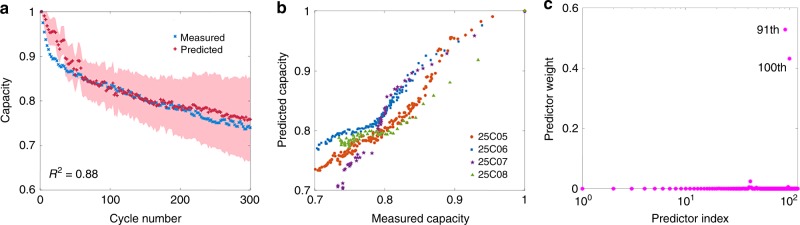
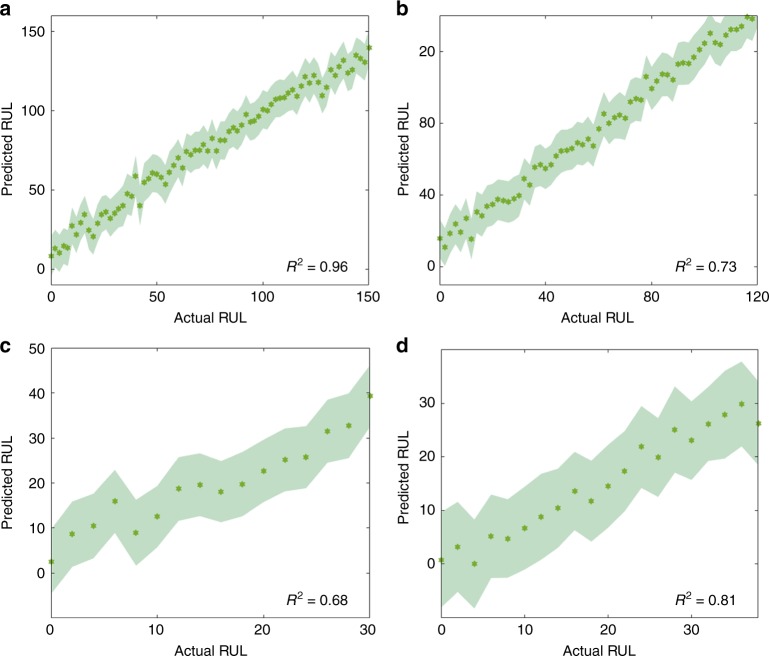
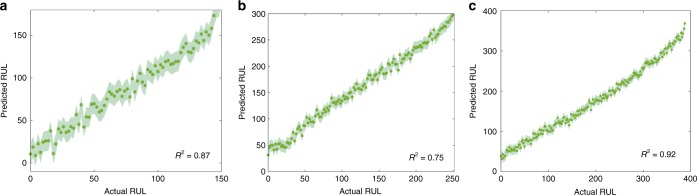
- The EIS-Capacity and EIS-RUL GPR models accurately estimate capacity and predict RUL from the current cycle’s EIS alone; for 25 °C testing cells, the end-of-life values were 150, 120, 30, and 38 cycles, and for multi-temperature testing cells they were 150, 252, and 396 cycles.
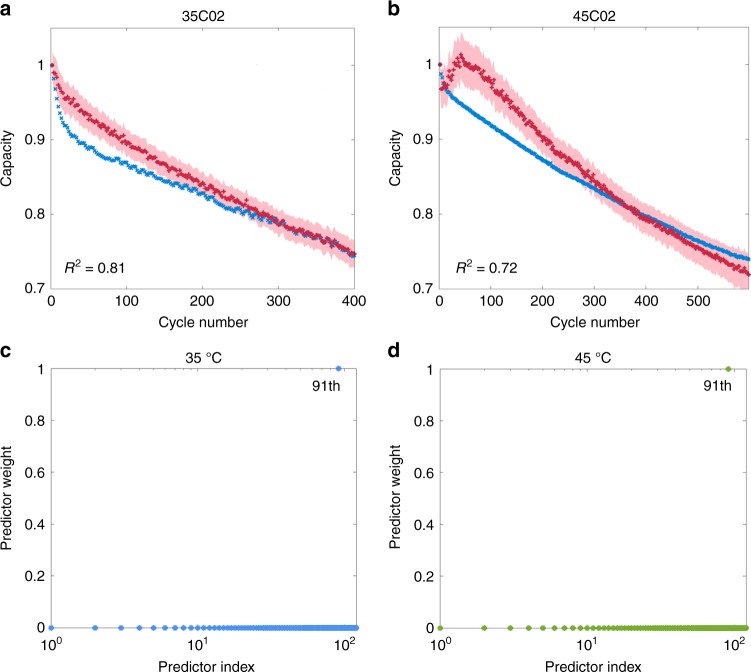
- ARD identified low-frequency impedance as most correlated with degradation: at 25 °C the largest weights were on the 91st and 100th features, corresponding to 17.80 and 2.16 Hz; at 35 °C and 45 °C the largest weight was on the 91st feature, 17.80 Hz.
- A multi-temperature model estimated capacity and predicted RUL for cells cycled at 35 °C and 45 °C without the cycling temperature as an input, under the simplification that temperature is constant over cycles.
- Under the same GPR method and train-test split, the EIS-based approach achieved lower predictive error than features extracted from the discharging curve (Supplementary Table 1).
Methods
- Twelve commercially available 45 mAh Eunicell LR2032 Li-ion coin cells with LiCoO2/graphite chemistry were cycled in climate chambers at 25 °C (25C01–25C08), 35 °C (35C01–35C02), and 45 °C (45C01–45C02); each cycle used 1C CC–CV charge to 4.2 V and 2C CC discharge to 3 V.
- EIS was measured every even-numbered cycle at nine charging/discharging stages over 0.02 Hz–20 kHz with 5 mA excitation after 15-min open circuit at SoC 0% and 100%; capacity loss was measured every odd cycle, and EoL was defined as capacity below 80% of initial after 30 room-temperature cycles.
- GPR used the real and imaginary impedance at 60 frequencies as inputs; capacity models used a squared exponential covariance with ARD, RUL models used a linear covariance, and feature importance was defined as \(w_m = \exp(-\sigma_m)\).
Limitations
- The paper states that all testing cells were charged and discharged the same way as training cells, and that estimating cells cycled at different operating charge/discharge rates requires further experiments.
- The paper states that more realistic settings—variations in cycling temperature over time or charge/discharge rate—would require a significantly larger training set, and the multi-temperature model assumes future operating temperature is close to previous operating temperature.
- Evident from the text: the dataset comprises only 12 small coin cells of one chemistry under controlled laboratory temperatures and constant rates, so validation on larger-format cells or real-world variable conditions is not reported.
Model-written summary. Check it against the paper before relying on it.
Integrity signals
Registry
Cites
Statistics
Figures
Verification
Claims the paper makes
3 Valid · 4 Not valid · 3 Not checked · 33 Own results and interpretations
Some cited sources support this claim and some don’t — read each source’s verdict below.
In the paper
“However, those models are all developed with the charging and discharging curve as input.”
§ Identifying degradation patterns of lithium ion batteries from impedance spectroscopy using machine learning > Introduction
What the sources say
- Disputedcites [33] Richardson RR Osborne MA Howey DA Gaussian process regression for forecasting battery state of health J. Power Sources 2017 357 209 219 10.1016/j.jpowsour.2017.05.004 sourceExperimental — accuracy not yet measured
The Introduction describes data-driven models that map cycle number to state of health and says recent support-vector-machine studies predict capacity from historical capacity-versus-cycle data. It also says capacity data can be obtained by methods other than charge–discharge measurements. These passages contradict the claim that all such models take charging and discharging curves as input; page numbers were not available in our copy. (LLM, conf=0.88)
Checked by a reasoning model — may be wrong.
- Not checked — no full text of the sourcecites [34] Yang D Zhang X Pan R Wang Y Chen Z A novel gaussian process regression model for state-of-health estimation of lithium-ion battery using charging curve J. Power Sources 2018 384 387 395 10.1016/j.jpowsour.2018.03.015 source
- Partly supportedcites [17] Richardson RR Birkl CR Osborne MA Howey DA Gaussian process regression for in situ capacity estimation of lithium-ion batteries IEEE Trans. Ind. Inform. 2019 15 127 136 10.1109/TII.2018.2794997 sourceExperimental — accuracy not yet measured
The Introduction (p. 1) describes earlier regression models that use features from incremental-capacity or differential-voltage curves as inputs. But it does not establish that all existing machine-learning models use charging and discharging curves; the Conclusions (p. 10) describe this paper’s own model as using small portions of voltage-time data instead. (LLM, conf=0.84)
- Disputedcites [18] Severson KA Data-driven prediction of battery cycle life before capacity degradation Nat. Energy 2019 4 383 391 10.1038/s41560-019-0356-8 sourceExperimental — accuracy not yet measured
The Machine learning approach section distinguishes models using discharge data alone from a model that considers both charging and discharging features. The Results section confirms that its “variance” model uses one feature from discharge curves and its “discharge” model uses discharge measurements only. The paper therefore contradicts the claim that all such models require both charging and discharging curves as input. (LLM, conf=0.87)
Checked by a reasoning model — may be wrong.
plain- Asserted: passes — The authors put it forward as true.
- Checkable: passes — It can be checked against evidence.
- Load-bearing: passes — The paper’s conclusions depend on it.
- Based: passes — The paper gives a reason why it holds.
- Disputed
The cited sources support only part of this claim — read each source’s verdict below.
In the paper
“suggesting that it is the change in the interfacial properties that underpins degradation for these batteries; this is consistent with the results obtained in previous works35”
§ Identifying degradation patterns of lithium ion batteries from impedance spectroscopy using machine learning > Results > Capacity estimation
What the sources say
- Partly supportedcites [35] Grugeon S Particle size effects on the electrochemical performance of copper oxides toward lithium J. Electrochem. Soc. 2001 148 A285 A292 10.1149/1.1353566 sourceExperimental — accuracy not yet measured
The Conclusions (page unavailable) say that an organic coating at the electrode surface can, depending on precursor size, negatively affect capacity retention during cycling. This supports a possible link between interfacial changes and degradation in the copper-oxide cells studied, but not the unqualified claim that such changes underpin degradation for these batteries generally. (LLM, conf=0.85)
hedgedstates a cause- Asserted: passes — The authors put it forward as true.
- Checkable: passes — It can be checked against evidence.
- Load-bearing: passes — The paper’s conclusions depend on it.
- Based: passes — The paper gives a reason why it holds.
- Partly supported
The cited sources support only part of this claim — read each source’s verdict below.
In the paper
“Features derived from the charging and discharging curve are by far the most commonly used inputs because typical battery management systems collect current–voltage data13–18.”
§ Identifying degradation patterns of lithium ion batteries from impedance spectroscopy using machine learning > Introduction
What the sources say
- Not checked — no full text of the sourcecites [13] Weng C Cui Y Sun J Peng H On-board state of health monitoring of lithium-ion batteries using incremental capacity analysis with support vector regression J. Power Sources 2013 235 36 44 10.1016/j.jpowsour.2013.02.012 source
- Not checked — no full text of the sourcecites [14] Weng C Feng X Sun J Peng H State-of-health monitoring of lithium-ion battery modules and packs via incremental capacity peak tracking Appl. Energy 2016 180 360 368 10.1016/j.apenergy.2016.07.126 source
- Not checked — no full text of the sourcecites [15] Berecibar M Garmendia M Gandiaga I Crego J Villarreal I State of health estimation algorithm of lifepo4 battery packs based on differential voltage curves for battery management system application Energy 2016 103 784 796 10.1016/j.energy.2016.02.163 source
- Not checked — no full text of the sourcecites [16] Berecibar M Online state of health estimation on nmc cells based on predictive analytics J. Power Sources 2016 320 239 250 10.1016/j.jpowsour.2016.04.109 source
- Partly supportedcites [17] Richardson RR Birkl CR Osborne MA Howey DA Gaussian process regression for in situ capacity estimation of lithium-ion batteries IEEE Trans. Ind. Inform. 2019 15 127 136 10.1109/TII.2018.2794997 sourceExperimental — accuracy not yet measured
The Introduction (p. 1) describes studies using features from IC/DV curves for capacity estimation, supporting the claim that charging-curve-derived features are used. It does not establish that they are by far the most common inputs or that their use is due to typical BMS data collection; instead, it calls model-parameter estimation the most common approach to capacity estimation. (LLM, conf=0.83)
- Partly supportedcites [18] Severson KA Data-driven prediction of battery cycle life before capacity degradation Nat. Energy 2019 4 383 391 10.1038/s41560-019-0356-8 sourceExperimental — accuracy not yet measured
The Machine learning approach section says the authors derive predictive features from discharge voltage curves and describes voltage curves and their derivatives as a rich source for degradation diagnosis. The Discussion says differential voltage-curve methods are used extensively. Neither passage establishes that charging and discharging curves are by far the most common inputs for battery health prediction or that their use is because typical battery management systems collect current–voltage data. (LLM, conf=0.84)
plainstates a cause- Asserted: passes — The authors put it forward as true.
- Checkable: passes — It can be checked against evidence.
- Load-bearing: unclear — It is unclear whether the paper’s conclusions depend on it.
- Based: passes — The paper gives a reason why it holds.
The sources with a verdict support this claim; the rest weren’t checked yet, have no full text we could read, or their verdicts aren’t rated yet.
In the paper
“Although GPR has been used in the literature in the context of Li-ion batteries17,33,34, we depart from those pioneering works by employing impedance spectra as input, as well employing ARD to shed light on salient frequencies.”
§ Identifying degradation patterns of lithium ion batteries from impedance spectroscopy using machine learning > Methods > Gaussian process regression
What the sources say
- Supportedcites [17] Richardson RR Birkl CR Osborne MA Howey DA Gaussian process regression for in situ capacity estimation of lithium-ion batteries IEEE Trans. Ind. Inform. 2019 15 127 136 10.1109/TII.2018.2794997 source
The Introduction (p. 1) identifies this as a Gaussian-process regression method for lithium-ion battery capacity estimation, supporting its citation as prior GPR work. The impedance-spectrum inputs and ARD are described as the citing authors’ departure, not as features attributed to this source; the Conclusions (p. 10) instead describe voltage-time inputs. (LLM, conf=0.93)
- Supportedcites [33] Richardson RR Osborne MA Howey DA Gaussian process regression for forecasting battery state of health J. Power Sources 2017 357 209 219 10.1016/j.jpowsour.2017.05.004 source
The Introduction (page unavailable) describes this paper's use of Gaussian processes to forecast lithium-ion battery capacity, supporting its citation as prior GPR work. In the citing sentence, “we depart” describes the citing authors’ own use of impedance spectra and ARD, not a method attributed to this source. (LLM, conf=0.92)
- Not checked — no full text of the sourcecites [34] Yang D Zhang X Pan R Wang Y Chen Z A novel gaussian process regression model for state-of-health estimation of lithium-ion battery using charging curve J. Power Sources 2018 384 387 395 10.1016/j.jpowsour.2018.03.015 source
plain- Asserted: passes — The authors put it forward as true.
- Checkable: passes — It can be checked against evidence.
- Load-bearing: passes — The paper’s conclusions depend on it.
- Based: passes — The paper gives a reason why it holds.
- Supported
A result the paper reports from its own data — it cites no other source for it, so there is none to check. The quote shows it is in the paper.
In the paper
“in Supplementary Fig. 3, we show there is a strong linear change of selected EIS features with cycle number in the Nyquist plot over cycle number at 25 °C.”
§ Identifying degradation patterns of lithium ion batteries from impedance spectroscopy using machine learning > Results > Capacity estimation
boostedstates an association- Asserted: passes — The authors put it forward as true.
- Checkable: passes — It can be checked against evidence.
- Load-bearing: passes — The paper’s conclusions depend on it.
- Based: passes — The paper gives a reason why it holds.
25 more claims
Create a free account to see all 43 claims and every source verdict.
- Probably not a substantial claim. 8
- It may state two separate claims as one. 8
- The quote only partly states this claim. 1
Self-check
Percentages, sums and reported differences re-computed from the paper’s own numbers.
Each contradiction between two passages listed here was confirmed by an independent check.
Rated minor: it would not touch a result — a value no result rests on, a p-value that stays on the same side of the significance level, or a conflict that is clerical, resolved elsewhere in the paper, or outside its own findings.
In the paper
§ Identifying degradation patterns of lithium ion batteries from impedance spectroscopy using machine learning > Results > Capacity estimation
“The pink points correspond to the 120 frequencies in the range of 0.02 Hz–20 kHz.”
§ Identifying degradation patterns of lithium ion batteries from impedance spectroscopy using machine learning > Methods > Gaussian process regression
“the real (Zre) and imaginary (Zim) parts of impedance spectra collected at 60 different frequencies (ωn, n = 1, 2, ..., 60) in the range of 0.02 Hz–20 kHz”
Citations
Cites
Lithium Batteries: Status, Prospects and Future
Scrosati, B., & Garche, J. (2010) · Journal of Power Sources · doi:10.1016/j.jpowsour.2009.11.048 · Cited by 5,153 · cited 1×
“L i-ion batteries enable a wide variety of technologies that are integral to modern life by virtue of their high energy and power density 1 – 4 . advancing However, a key stumbling block to those technologies is the unpredictability of battery degradation: accurate prediction of battery state of…”
BackgroundData-driven prediction of battery cycle life before capacity degradation
Severson, K. A., Attia, P. M., Jin, N., Perkins, N., Jiang, B., Yang, Z., Chen, M. H., Aykol, M., Herring, P. K., Fraggedakis, D., et al. (2019) · Nature Energy · doi:10.1038/s41560-019-0356-8 · Cited by 3,228 · cited 3×
“Features derived from the charging and discharging curve are by far the most commonly used inputs because typical battery management systems collect current – voltage data 13 – 18 .”
BackgroundMethodDesigning nanostructured Si anodes for high energy lithium ion batteries
Wu, H., & Cui, Y. (2012) · Nano Today · doi:10.1016/j.nantod.2012.08.004 · Cited by 2,350
Remaining useful life estimation – A review on the statistical data driven approaches
Si, X.-S., Wang, W., Hu, C.-H., & Zhou, D.-H. (2011) · European Journal of Operational Research · doi:10.1016/j.ejor.2010.11.018 · Cited by 2,162 · cited 1×
“To overcome this challenge, recent literature focuses on data-driven approaches 11,12 .”
BackgroundA review on lithium-ion battery ageing mechanisms and estimations for automotive applications
Barré, A., Deguilhem, B., Grolleau, S., Gérard, M., Suard, F., & Riu, D. (2013) · Journal of Power Sources · doi:10.1016/j.jpowsour.2013.05.040 · Cited by 1,758
A Unifying View of Sparse Approximate Gaussian Process Regression
Quiñonero-Candela, J., & Rasmussen, C. E. (2005) · doi:10.5555/1046920.1194909 · Cited by 1,671
Lithium ion secondary batteries; past 10 years and the future
Nishi, Y. (2001) · Journal of Power Sources · doi:10.1016/s0378-7753(01)00887-4 · Cited by 1,074 · cited 1×
“L i-ion batteries enable a wide variety of technologies that are integral to modern life by virtue of their high energy and power density 1 – 4 . advancing However, a key stumbling block to those technologies is the unpredictability of battery degradation: accurate prediction of battery state of…”
BackgroundYang, X.-G., Leng, Y., Zhang, G., Ge, S., & Wang, C.-Y. (2017) · Journal of Power Sources · doi:10.1016/j.jpowsour.2017.05.110 · Cited by 948
Pinson, M. B., & Bazant, M. Z. (2013) · Journal of The Electrochemical Society · doi:10.1149/2.044302jes · Cited by 946
Gaussian Processes for Machine Learning (GPML) Toolbox
Rasmussen, C. E., & Nickisch, H. (2010) · Max Planck Institute for Plasma Physics · doi:10.5555/1756006.1953029 · Cited by 895 · cited 1×
“We implement the EIS-capacity GPR model using the Gaussian processes for machine learning (GPML) toolbox 37 with a zero mean function and a diagonal squared exponential (SE) covariance function with ARD 38 where σ m represents the length scale for feature m , m = 1, 2, ..., d and σ f is the signal…”
Method
Research works printed but not linked: 1
- Popp, H., Einhorn, M. & Conte, F. V. Capacity decrease vs. impedance increase of lithium batteries. a comparative study. In Hybrid and Fuel Cell Electric Vehicle Symposium & Exhibition EVS26, Los Angeles, 6–9 (2012).
Cited by
Items 301–400 of 872
Wang, C., Su, Y., Ye, J., Xu, P., Xu, E., & Ouyang, T. (2024) · Journal of Energy Storage · doi:10.1016/j.est.2024.110755 · Cited by 31
Hui, Z., Shi, Z., Wang, R., Yang, M., Li, H., Ren, J., Cao, Y., & Sun, Y. (2024) · Materials Today Energy · doi:10.1016/j.mtener.2024.101562 · Cited by 43
Hu, W., & Qian, Q. (2024) · iScience · doi:10.1016/j.isci.2024.109980 · Cited by 39
Hu, E., Choo, H. H., Zhang, W., Sumboja, A., Anggraningrum, I. T., Zulfia, A., Zhu, Q., Xu, J., Loh, X. J., Pan, H., et al. (2025) · Advanced Functional Materials · doi:10.1002/adfm.202422601 · Cited by 36
Xian, Y., Li, C., Xu, Y., Zhou, Y., & Xue, D. (2025) · SusMat · doi:10.1002/sus2.70030 · Cited by 42
Bridging battery degradation and safety: Challenges and opportunities
Zhao, Y., Wang, Z., Yan, L., Sun, Z., Liu, P. J., Zhang, L., & Li, W. (2025) · eTransportation · doi:10.1016/j.etran.2025.100497 · Cited by 48
Huotari, M., Arora, S., Malhi, A. K., & Främling, K. (2021) · Applied Soft Computing · doi:10.1016/j.asoc.2021.107670 · Cited by 36
Howard, J. M., Wang, Q., Srivastava, M., Gong, T., Lee, E., Abate, A., & Leite, M. S. (2022) · The Journal of Physical Chemistry Letters · doi:10.1021/acs.jpclett.2c00131 · Cited by 36
Ruan, Y., He, Z., Liu, Z., Wang, W., Hao, L., Xu, L. H., Robertson, A. W., & Sun, Z. (2023) · Journal of Materials Chemistry A · doi:10.1039/d3ta04848a · Cited by 30
Liu, Y., Yang, L., Liao, R., Hu, C., Xiao, Y., He, C., Wu, X., Zhang, Y., & Li, S. (2025) · Energy · doi:10.1016/j.energy.2025.137064 · Cited by 31
Self-citationProbabilistic Modeling of Li-Ion Battery Remaining Useful Life
Chiodo, E., Falco, P. D., & Noia, L. P. D. (2022) · IEEE Transactions on Industry Applications · doi:10.1109/tia.2022.3170525 · Cited by 34
Liu, H., Xiao, Q., Jin, Y., Mu, Y., Meng, J., Zhang, T., Jia, H., & Teodorescu, R. (2022) · Symmetry · doi:10.3390/sym14081584 · Cited by 37
“The model-based RUL prediction method usually uses prior knowledge to model the battery degradation mechanism [6] and identifies the parameters in the model by means of the least square method [7] or the observer [8] through the battery lifecycle test data [9] and electrochemical impedance spectroscopy (EIS) [10].”
MethodTemiz, S., Kurban, H., Erol, S., & Dalkilic, M. M. (2022) · Journal of Energy Storage · doi:10.1016/j.est.2022.105022 · Cited by 29
Li, Q., Yi, D., Dang, G., et al. (2023) · World Electric Vehicle Journal · doi:10.3390/wevj14120321 · Cited by 28
“In addition, Zhang et al. [14] collected EIS data from more than 20,000 commercial lithium-ion batteries under different health states, states of charge, and temperatures.”
Camboim, M. M., Moreira, A. C., Rosolem, M. D. F. N. C., Beck, R. F., Arioli, V. T., Omae, C., & Ding, H. (2023) · Journal of Energy Storage · doi:10.1016/j.est.2023.110063 · Cited by 32
Research Advances on Lithium‐Ion Batteries Calendar Life Prognostic Models
Pan, T., Li, Y., Yao, Z., Liu, S., Zhu, Y., Wang, X., Wang, J., Zheng, C., & Sun, W. (2025) · Carbon Neutralization · doi:10.1002/cnl2.192 · Cited by 35
Self-citationZhang, Z., Gu, X., Zhu, Y., Wang, T., Gong, Y., & Shang, Y. (2025) · Communications Engineering · doi:10.1038/s44172-025-00372-y · Cited by 42
Gao, Z., Jin, Y., Zhang, Y., Zhang, Z., Li, S., Liu, J., & Wang, H. (2025) · Measurement · doi:10.1016/j.measurement.2025.117780 · Cited by 29
Self-citationYamanaka, T., Takagishi, Y., & Yamaue, T. (2020) · Journal of The Electrochemical Society · doi:10.1149/1945-7111/ab975c · Cited by 28
Degradation Mode Knowledge Transfer Method for LFP Batteries
Lu, X., Qiu, J., Lei, G., & Zhu, J. G. (2022) · IEEE Transactions on Transportation Electrification · doi:10.1109/tte.2022.3196087 · Cited by 30
“[15] employed ML with electrochemical impedance spectroscopy (EIS) to predict the”
MethodDing, R. F., Ma, M., Chen, Y., Wang, X., Li, J., Wang, G., & Liu, J. (2022) · Nano Research · doi:10.1007/s12274-022-4763-y · Cited by 27
Meng, J., Du, X., Peng, J., Lin, M., & Song, Z. (2023) · IEEE Transactions on Industrial Electronics · doi:10.1109/tie.2023.3306426 · Cited by 29
“Battery impedance provides detailed information reflect-ing the material characteristics and electrochemical behaviors, which have been widely reported in the literature to aid in battery states estimation [3] and failure diagnostic [4].”
BackgroundSuh, S., Mittal, D., Bello, H., Zhou, B., Jha, M., & Lukowicz, P. (2024) · Heliyon · doi:10.1016/j.heliyon.2024.e36236 · Cited by 41
“Various machine learning algorithms, including support vector regression (SVR) [6], naive Bayes (NB) [7], Gaussian process regression (GPR) [8], convolutional neural networks (CNN) [9, 10], and long short-term memory (LSTM) networks [11, 12, 13], have been utilized to predict the RUL of Lithium-ion…”
MethodKort-Kamp, W. J. M., Ferrandon, M. S., Wang, X. P., Park, J. H., Malla, R. K., Ahmed, T., Holby, E. F., Myers, D. J., & Zelenay, P. (2022) · Journal of Power Sources · doi:10.1016/j.jpowsour.2022.232583 · Cited by 27
El-Dalahmeh, M., Al‐Greer, M., El‐Dalahmeh, M., & Bashir, I. (2023) · Journal of Energy Storage · doi:10.1016/j.est.2023.108046 · Cited by 34
Battery Charge Curve Prediction via Feature Extraction and Supervised Machine Learning
Su, L., Zhang, S., McGaughey, A. J. H., Reeja‐Jayan, B., & Manthiram, A. (2023) · Advanced Science · doi:10.1002/advs.202301737 · Cited by 31
Sun, Z., He, W., Wang, J., & He, X. (2024) · Energies · doi:10.3390/en17112487 · Cited by 29
Self-citationYuan, Y., Jiang, B., Chen, Q., Wang, X., Wei, X., & Dai, H. (2025) · Energy · doi:10.1016/j.energy.2025.136658 · Cited by 32
Zhou, X. D., Wang, X., Yuan, Y., Dai, H., & Wei, X. (2024) · Automotive Innovation · doi:10.1007/s42154-023-00278-5 · Cited by 25
“Zhang et al. [21] built an accurate battery forecasting system by combining EIS with Gaussian process machine learning.”
InfluentialFault diagnosis of PEMFC based on the AC voltage response and 1D convolutional neural network
Zhou, S., Tranter, T. G., Neville, T. P., Shearing, P. R., Brett, D. J. L., & Jervis, R. (2022) · Cell Reports Physical Science · doi:10.1016/j.xcrp.2022.101052 · Cited by 27
Chen, B., Police, Y. R., Li, M., Chinnam, P. R., Tanim, T. R., & Dufek, E. J. (2023) · Frontiers in Energy Research · doi:10.3389/fenrg.2023.1132876 · Cited by 44
“Most of the computational methods involve data featurization, such as converting the Nyquist plots to mathematical features (Zhang et al., 2020; Babaeiyazdi et al., 2021; Jones et al., 2022), which allows computers to select fitting parameters based on the features.”
BackgroundMethodInfluentialAttention towards chemistry agnostic and explainable battery lifetime prediction
Rahmanian, F., Lee, R. M., Linzner, D., Michel, K., Merker, L., Berkes, B. B., Nuss, L., & Stein, H. S. (2024) · npj Computational Materials · doi:10.1038/s41524-024-01286-7 · Cited by 33
Discrete Pulse Control Strategy for Embedded Li-ion Batteries Broadband EIS Measurement System
Sha, J., Li, X., & Qiu, G. (2024) · IEEE Transactions on Power Electronics · doi:10.1109/tpel.2024.3438804 · Cited by 24
Kim, C., & Jang, I. (2025) · ChemElectroChem · doi:10.1002/celc.202500005 · Cited by 31
Modeling the Multiwavelength Variability of Mrk 335 Using Gaussian Processes
Griffiths, R., Jiang, J., Buisson, D. J. K., Wilkins, D., Gallo, L. C., Ingram, A., Lee, A. A., Grupe, D., Kara, E., Parker, M. L., et al. (2021) · The Astrophysical Journal · doi:10.3847/1538-4357/abfa9f · Cited by 24
Self-citationJiang, H., Wang, H., Su, Y., Kang, Q., Meng, X., Yan, L., & Ma, T. (2022) · Journal of Power Sources · doi:10.1016/j.jpowsour.2022.231818 · Cited by 24
Liu, Y., Sun, G., & Liu, X. (2023) · Journal of Energy Storage · doi:10.1016/j.est.2023.109308 · Cited by 29
Zhang, Y., Lin, X., Zhai, W., Shen, Y., Chen, S., Zhang, Y., Yu, Y., He, X., & Liu, W. (2024) · Nano Letters · doi:10.1021/acs.nanolett.4c00902 · Cited by 24
Self-citationZhang, S., Yuan, W., Wang, Y., Cheng, S., & Wang, J. (2024) · Journal of Power Sources · doi:10.1016/j.jpowsour.2024.235153 · Cited by 25
Self-citationRapid estimation of lithium-ion battery capacity and resistances from short duration current pulses
Nowacki, B., Ramamurthy, J. R., Thelen, A., Tischer, C., Pint, C. L., & Hu, C. K. (2024) · Journal of Power Sources · doi:10.1016/j.jpowsour.2024.235813 · Cited by 26
Lou, C., Zhang, J., Mu, X., Zeng, F., & Wang, K. (2025) · Frontiers of Chemical Science and Engineering · doi:10.1007/s11705-025-2553-2 · Cited by 26
Fu, S., Fan, H., Jin, Z., Ji, F., Tao, Y., Dong, Y., Chen, X. T., Shao, M., Yuan, S., Wang, Y., et al. (2025) · Renewable and Sustainable Energy Reviews · doi:10.1016/j.rser.2025.116323 · Cited by 38
A Review on the Prediction of Health State and Serving Life of Lithium‐Ion Batteries
Pang, X., Zhong, S., Wang, Y., Yang, W. B., Zheng, W., & Sun, G. (2022) · The Chemical Record · doi:10.1002/tcr.202200131 · Cited by 28
Diagnostics of electrocatalytic systems by electrochemical impedance spectroscopy
Sanginario, A., & Hernández, S. (2022) · Current Opinion in Green and Sustainable Chemistry · doi:10.1016/j.cogsc.2022.100727 · Cited by 23
Temiz, S., Erol, S., Kurban, H., & Dalkilic, M. M. (2023) · Journal of Energy Storage · doi:10.1016/j.est.2023.107085 · Cited by 24
Cardenas‐Sierra, I., Vijay, U., Aguesse, F., Antuñano, N., Ayerbe, E., Gold, L., Naumann, A., Otaegui, L., Recham, N., Stier, S., et al. (2025) · Journal of Power Sources · doi:10.1016/j.jpowsour.2024.236158 · Cited by 25
Jiang, Y., & Song, W. (2023) · Batteries · doi:10.3390/batteries9080413 · Cited by 31
Valizadeh, A., Amirhosseini, M. H., & Ghorbani, Y. (2024) · Computers & Chemical Engineering · doi:10.1016/j.compchemeng.2024.108623 · Cited by 28
Zhao, H., Zhan, Z., Cui, B., Wang, Y., Yin, G., Han, G., Xiang, L., & Du, C. (2024) · Journal of Power Sources · doi:10.1016/j.jpowsour.2024.234511 · Cited by 22
Review on Lithium-ion Battery PHM from the Perspective of Key PHM Steps
Kong, J., Liu, J., Zhu, J., Zhang, X., Tsui, K., Peng, Z., & Wang, D. (2024) · Chinese Journal of Mechanical Engineering · doi:10.1186/s10033-024-01055-z · Cited by 25
“Zhang et al. [56] reduced the dimension of EIS spectrum data to low-dimensional features and used it as an input of a GPR model to predict battery health state and RUL at different temperatures.”
MethodDai, H., Lai, Y., Huang, Y., Yu, H., Yang, Y., & Zhu, L. (2024) · Journal of Power Sources · doi:10.1016/j.jpowsour.2024.235482 · Cited by 25
Wei, L., Xu, H., Sun, Y., Diao, Q., Tan, X., Fan, Y., & Liu, H. (2025) · IEEE Transactions on Transportation Electrification · doi:10.1109/tte.2025.3525557 · Cited by 28
“Conventional machine learning methods, including support vector machines (SVMs) [10], Gaussian regression processes (GPR) [11], [12], relevance vector machines (RVMs) [13], and random forest (RF) [14], are widely used to predict battery SOH; however, a critical part of these machine learning…”
Wu, B., Qiu, S., & Liu, W. (2025) · Sensors · doi:10.3390/s25113564 · Cited by 39
Accelerating Optimizing the Design of Carbon‐based Electrocatalyst via Machine Learning
Yu, Z., & Huang, W. (2021) · Electroanalysis · doi:10.1002/elan.202100224 · Cited by 21
Impedimetric Sensing: An Emerging Tool for Combating the COVID-19 Pandemic
Ong, V., Soleimani, A., Amirghasemi, F., Nejad, S. K., Abdelmonem, M., Razaviyayn, M., Hosseinzadeh, P., Comai, L., & Mousavi, M. P. S. (2023) · Biosensors · doi:10.3390/bios13020204 · Cited by 21
“collected 20,000 EIS spectra of commercial lithium-ion batteries and used a Gaussian process regression model to predict the health and the effective remaining lifetime of the battery [85].”
MethodAn SVM-Based Health Classifier for Offline Li-Ion Batteries by Using EIS Technology
Luo, W., Syed, A. U., Nicholls, J. R., & Gray, S. (2023) · Journal of The Electrochemical Society · doi:10.1149/1945-7111/acc09f · Cited by 24
Parikh, N., Akın, S., Kalam, A., Prochowicz, D., & Yadav, P. (2023) · ACS Applied Materials & Interfaces · doi:10.1021/acsami.3c00269 · Cited by 22
A fast estimation method for state-of-health of retired batteries based on health features
Wang, Y., Huang, H., Wang, H., & Wu, X. (2023) · Journal of Energy Storage · doi:10.1016/j.est.2023.108677 · Cited by 22
Fan, Y., Li, Y., Zhao, J., Wang, L., Yan, C., Wu, X., Zhang, P., Wang, J., Gao, G., & Wei, L. (2023) · Batteries · doi:10.3390/batteries9110539 · Cited by 22
“These datasets were derived from experimental data from the Battery Cycle Life Test Platform [35].”
MethodSelf-citationHealth Prediction for Lithium-Ion Batteries Under Unseen Working Conditions
Che, Y., Forest, F., Zheng, Y., Xu, L., & Teodorescu, R. (2024) · IEEE Transactions on Industrial Electronics · doi:10.1109/tie.2024.3379664 · Cited by 20
“Recently, features extracted from voltage relaxation [14] and impedance spectrums [15], [16] have been proposed for battery SOH estimation, and the experimental validations show satisfactory results with various loading pro fi les.”
Bi: A rising star for low-temperature fast-charging sodium-ion batteries
Bai, J., Li, H. P., Zheng, Y., Zhang, H., Yang, C. C., & Jiang, Q. (2025) · Materials Science and Engineering R Reports · doi:10.1016/j.mser.2025.101056 · Cited by 20
Batch diagnosis of batteries within one second
Zhou, S., Du, W., Mager, B., Shearing, P. R., Miller, T. S., & Jervis, R. (2025) · Joule · doi:10.1016/j.joule.2025.102099 · Cited by 21
Interpretable Machine Learning for Battery Prognosis: Retrospect and Prospect
Wang, T., Liu, K., Peng, H., & Liu, X. (2025) · Advanced Energy Materials · doi:10.1002/aenm.202503067 · Cited by 31
Le, G. T., Mastropasqua, L., Brouwer, J., & Adler, S. B. (2022) · Journal of The Electrochemical Society · doi:10.1149/1945-7111/ac59f4 · Cited by 22
Prediction of Remaining Useful Life of the Lithium-Ion Battery Based on Improved Particle Filtering
Wu, T., Zhao, T., & Xu, S. (2022) · Frontiers in Energy Research · doi:10.3389/fenrg.2022.863285 · Cited by 22
“2 Unscented Kalman Filtering Algorithm Instead of approximating the Taylor series expansion term of the nonlinear function, the UKF algorithm approximates the probability density distribution of the state vector in the nonlinear function and then uses the prior mean and covariance to generate a series of determined si…”
MethodClassification of (Micro)Plastics Using Cathodoluminescence and Machine Learning
Höppener, E. M., Shahmohammadi, S., Parker, L. A., Henke, S., & Urbanus, J. H. (2022) · Talanta · doi:10.1016/j.talanta.2022.123985 · Cited by 25
Huang, Z., Sugiarto, L., & Lu, Y. (2023) · EcoMat · doi:10.1002/eom2.12345 · Cited by 23
Chen, Y., Liu, Y., He, Z., Xu, L., Yu, P., Sun, Q., Li, W., Jie, Y., Cao, R., Cheng, T., et al. (2023) · National Science Open · doi:10.1360/nso/20230039 · Cited by 32
“[100] collected over 20,000 EIS spectra of Li-ion batteries as an ML dataset for battery degradation prediction, and they achieved an accurate prediction of remaining life.”
BackgroundMethodInfluentialLiu, Y., Chen, S., Li, P., Wan, J., & Li, X. (2024) · IET Cyber-Physical Systems Theory & Applications · doi:10.1049/cps2.12086 · Cited by 22
Xing, Q., Sun, X., Fu, Y., & Wang, K. (2025) · Ionics · doi:10.1007/s11581-024-05982-8 · Cited by 20
“They combined the training data collected at three different temperatures (25°C, 35°C, and 45°C) to ensure that the model can produce accurate predictions under different temperatures (Table 1) [33].”
Li, Y., Wang, S., Shi, Y.-H., Fan, C., Lin, J. G., Wu, X., Sun, H., Zhang, J., & Xie, H. (2020) · Dalton Transactions · doi:10.1039/d0dt02877k · Cited by 19
Alzamer, H., Jaafreh, R., Kim, J.-G., & Hamad, K. (2025) · Crystals · doi:10.3390/cryst15020114 · Cited by 26
Sun, Y., Xiong, R., Wang, P., Li, H., & Sun, F. (2025) · Journal of Energy Chemistry · doi:10.1016/j.jechem.2025.05.014 · Cited by 34
Kireeva, N. V., & Solov’ev, V. P. (2021) · Journal of Physics and Chemistry of Solids · doi:10.1016/j.jpcs.2021.110178 · Cited by 19
Saunders, L., Wang, J., & Stimming, U. (2022) · Journal of Applied Electrochemistry · doi:10.1007/s10800-022-01713-x · Cited by 19
Self-citationWang, H., Sun, M., & Li, Y. (2023) · IEEE Transactions on Consumer Electronics · doi:10.1109/tce.2023.3279135 · Cited by 23
“The dataset contains charge and discharge data for the full life cycle of ten Eunicell LR2032 Li-ion button batteries [36].”
MethodTracking the Lifecycle of a 21700 Cell: A 4D Tomography and Digital Disassembly Study
Kok, M. D. R., Jnawali, A., Heenan, T. M. M., Tranter, T. G., Brett, D. J. L., Shearing, P. R., & Robinson, J. B. (2023) · Journal of The Electrochemical Society · doi:10.1149/1945-7111/acf412 · Cited by 22
“10 Recently, studies have investigated the interplay between the macrostructure in the cell and the capacity loss: Waldmann et al. looked at the effect of the cell ’ s overall design speci fi cally whether there was a central pin in the jelly-roll, on how the cell degraded and deformed, 11 and…”
BackgroundWang, H., Li, Y., & Zhang, Y. (2023) · Renewable and Sustainable Energy Reviews · doi:10.1016/j.rser.2023.113728 · Cited by 25
Self-citationZhu, R., Li, Z., Li, M., et al. (2024) · The Journal of Physical Chemistry Letters · doi:10.1021/acs.jpclett.4c00698 · Cited by 19
Domenteanu, A., Cotfas, L., Diaconu, P., Tudor, G.-A., & Delcea, C. (2025) · Electronics · doi:10.3390/electronics14020378 · Cited by 23
Zhang, M., Hu, T., Wu, L., Kang, G., & Guan, Y. (2021) · Energy · doi:10.1016/j.energy.2021.120959 · Cited by 19
Modeling the Multiwavelength Variability of Mrk 335 Using Gaussian Processes
Griffiths, R., Jiang, J., Buisson, D. J. K., Wilkins, D., Gallo, L., Ingram, A., Lee, A. A., Grupe, D., Kara, E., Parker, M. L., et al. (2021) · ScholarWorks - MoreheadState (Morehead State University) · doi:10.17863/cam.76886 · Cited by 28
Self-citationStrategies for improving rechargeable lithium-ion batteries: From active materials to CO 2 emissions
Chiluwal, S., Rao, A. M., & Podila, R. (2021) · Nanotechnology Reviews · doi:10.1515/ntrev-2021-0114 · Cited by 21
Cheng, L., Sun, J., & Miller, T. F. (2022) · Journal of Chemical Theory and Computation · doi:10.1021/acs.jctc.2c00396 · Cited by 25
Liu, S., Fang, L., Zhao, X., Wang, S., Hu, C., Gu, F., & Ball, A. (2024) · Journal of Energy Storage · doi:10.1016/j.est.2024.114052 · Cited by 18
Zhang, T., Tan, R., Zhu, P., Zhang, T., & Huang, J. (2025) · ACS Energy Letters · doi:10.1021/acsenergylett.4c03054 · Cited by 25
Early-cycle prediction of battery aging onset across chemistries
Tan, X., Zeng, N., Deng, Y., Sun, S., Rui, B., & Xu, J. (2025) · Journal of Energy Chemistry · doi:10.1016/j.jechem.2025.01.035 · Cited by 20
Thomas, H., & Weatherspoon, M. H. (2025) · Batteries · doi:10.3390/batteries11040162 · Cited by 23
“The dataset used for this study includes EIS and its corresponding capacity data for every even cycle in the cycle life of four LCO coin cells [29].”
Si, Q., Matsuda, S., Ando, Y., et al. (2025) · Advanced Science · doi:10.1002/advs.202502336 · Cited by 18
Advances in Impedimetric Biosensors: Current Applications and Future Directions
Verma, A., Arqam, M., & Fraiwan, A. (2025) · Micromachines · doi:10.3390/mi16111244 · Cited by 22
“The team collected 20,000 EIS spectra of commercial lithium-ion batteries and used a Gaussian process regression model to predict the effective remaining lifespan and health of the battery [96].”
Machine learning in advancing anode materials for Lithium-Ion batteries – A review
Islam, M. A., Ahsan, Z., Rahman, M., Abdullah, M. I., Rana, M., Hossain, N., & Chowdhury, M. A. (2024) · Inorganic Chemistry Communications · doi:10.1016/j.inoche.2024.113577 · Cited by 19
Lai, X., Ke, P., Zheng, Y., Zhu, J., Cheng, E., Tang, B., Shen, K., & Sun, T. (2024) · Journal of Energy Storage · doi:10.1016/j.est.2024.114563 · Cited by 20
SOC and SOH Prediction of Lithium‐Ion Batteries Based on LSTM–AUKF Joint Algorithm
Song, Y., Lu, J., Zhang, H., & Liu, G. (2025) · Energy Science & Engineering · doi:10.1002/ese3.1992 · Cited by 16
“Zhang et al. [18], Zhu et al. [19], and Li et al. [16] have proposed the use of machine learning algorithms to accurately predict the SOH by analyzing the electrochemical impedance spectroscopy (EIS) of batteries.”
Li, S., Gao, H. O., & You, F. (2024) · Nexus · doi:10.1016/j.ynexs.2024.100026 · Cited by 25
Peng, J., Gao, Y. Y., Cai, L., Zhang, M., Sun, C., & Liu, H. (2025) · World Electric Vehicle Journal · doi:10.3390/wevj16040224 · Cited by 24
“Zhang et al. [15] demonstrated the value of EIS data in BMS by using the entire EIS data with Gaussian Process Regression (GPR) to achieve an accurate prediction of the remaining battery life, and in the Nyquist plot, the imaginary parts of the two frequency points, 17.80 Hz and 2.16 Hz, are…”
InfluentialZhang, L., Chen, B., Lyu, D., Wang, L., & Wang, K. (2025) · Journal of Power Sources · doi:10.1016/j.jpowsour.2025.237957 · Cited by 21
He, K., Tao, S., Fu, S., Fan, H., Tao, Y., Wang, Y., & Sun, Y. (2023) · Journal of The Electrochemical Society · doi:10.1149/1945-7111/acbf7e · Cited by 22
A flexible battery capacity estimation method based on partial voltage curves and polynomial fitting
Cao, M., Liu, Y., Zhang, T., Wang, Y., Wang, R., & Shi, Z. (2023) · Energy and Buildings · doi:10.1016/j.enbuild.2023.113045 · Cited by 18
Degradation diagnosis of lithium-ion batteries considering internal gas evolution
Ju, L., Li, X., Geng, G., & Jiang, Q. (2023) · Journal of Energy Storage · doi:10.1016/j.est.2023.108084 · Cited by 19
Krishna, G., Singh, R., Gehlot, A., Singh, P., Rana, S., Akram, S. V., & Joshi, K. K. (2023) · Review of Computer Engineering Research · doi:10.18488/76.v10i2.3413 · Cited by 21
“[24] Battery EIS dataset 12 coin cell LCO 2019”
Metadata
- Authors
- Zhang, Y., Tang, Q., Zhang, Y., Wang, J., Stimming, U., & Lee, A. A.
- Affiliations
- University of Cambridge (GB)
- The Faraday Institution (GB)
- Corresponding author
- Stimming, Ulrich
- Lee, Alpha A.
- Venue
- Nature Communications
- Published
- 2020-04-06
- Volume
- 11
- Issue
- 1
- Pages
- 1706-1706
- ISSN
- 2041-1723 (ISSN-L)
- PMC
- PMC7136228
- OpenAlex
- W3010408268
- Semantic Scholar
- ca94a1d2da80e813b707f40f38a31e9e2720c879
- Cited by
- 889
- References
- 39
- Citations by year
- 2026: 156 · 2025: 198 · 2024: 182 · 2023: 142 · 2022: 118 · 2021: 75 · 2020: 18
- FWCI
- 32.63
- Type
- journal article
- Language
- en
- Open access
- gold
- doi.org
- Licence
- cc-by
- creativecommons.org/licenses/by/4.0 (tdm)
- creativecommons.org/licenses/by/4.0 (vor)
- Locations
- Nature Communications (publishedVersion, cc-by)
- PubMed Central (publishedVersion, cc-by)
- PubMed (publishedVersion)
- Apollo (University of Cambridge) (submittedVersion)
- DOAJ (DOAJ: Directory of Open Access Journals) (submittedVersion, cc-by-sa)
- Apollo (University of Cambridge) (submittedVersion, cc-by)
- Apollo
- Funders
- RCUK | Engineering and Physical Sciences Research Council (EP/S003053/1)
- Topics
- Physical Sciences › Engineering › Automotive Engineering › Battery Modeling and Management
- Physical Sciences › Engineering › Electrical and Electronic Engineering › Advancements in Battery Materials
- Physical Sciences › Engineering › Safety, Risk, Reliability and Quality › Reliability and Maintenance Optimization
- Keywords
- lithium-ion batteries, battery degradation, electrochemical impedance spectroscopy, remaining useful life prediction, Gaussian process regression, battery management systems, electric vehicles, battery diagnostics
About these checks
Registry, retraction, Cites and statistics results are computed, not judged, with one exception: a printed reference that no index lists is read once by a model before it counts as a citation error. Claims are extracted by a model and kept only when their quote appears verbatim in the text; each cited source is then checked, with a model’s help, for whether it says what the claim relies on. Those verdicts can be wrong — read the claim’s quote and the cited source before relying on one.
The claim verdicts this report counts are experimental: their accuracy is not yet measured.
A language model drew the claims from the paper on 2026-10-10, under version 3 of the claim definition (model deepseek-v4.1-flash, prompt extract-v3).
A second model labelled each claim on 2026-10-10 (model jev-1.13-20260917, definition revision gold-guideline-v0.2).
Cited sources are checked with a language model’s help (gpt-6-sol).
Statistics and arithmetic are recomputed, not judged.
Confidence bands are shown only for fields calibrated on our annotated test set. None is calibrated yet, so no band is shown.
What counts as a claim ›How we measure confidence ›How we check this ›
Are you an author, or do you see a problem with this page? Request a review
Data sources
Bibliographic data: Semantic Scholar, OpenAlex, Crossref.
Contains information from the Semantic Scholar Academic Graph Datasets, made available under the ODC Attribution License (ODC-BY 1.0).
Semantic Scholar’s data is described in: Kinney, R., et al. (2023). The Semantic Scholar Open Data Platform. arXiv:2301.10140.
