

A mechanistic account of serotonin’s impact on mood
Open accessThe DOI matches its Crossref record; 57 of the 59 references it cites were found in a registry or an index.
Abstract
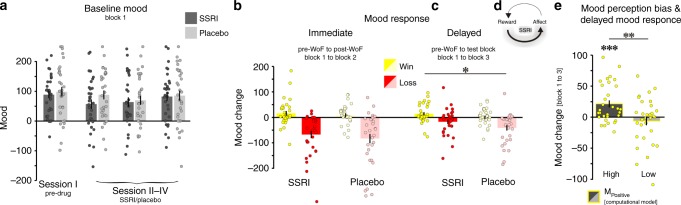
Selective serotonin reuptake inhibitors (SSRIs) constitute a first-line antidepressant intervention, though the precise cognitive and computational mechanisms that explain treatment response remain elusive. Using week-long SSRI treatment in healthy volunteer participants, we show serotonin enhances the impact of experimentally induced positive affect on learning of novel, and reconsolidation of previously learned, reward associations. Computational modelling indicated these effects are best accounted for by a boost in subjective reward perception during learning, following a positive, but not negative, mood induction. Thus, instead of influencing affect or reward sensitivity directly, SSRIs might amplify an interaction between the two, giving rise to a delayed mood response. We suggest this modulation of affect-learning dynamics may explain the evolution of a gradual mood improvement seen with these agents and provides a novel candidate mechanism for the unfolding of serotonin’s antidepressant effects over time.
Overview
The claims and statistics of this paper haven’t been checked yet.
Free: it reads the open-access text and checks the first 5 claims that cite a source we can check. Create a free account to check every claim.
Integrity signals
Registry
Cites
Statistics
Figures
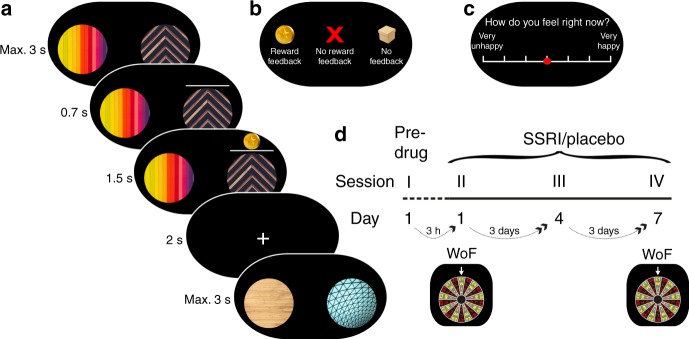
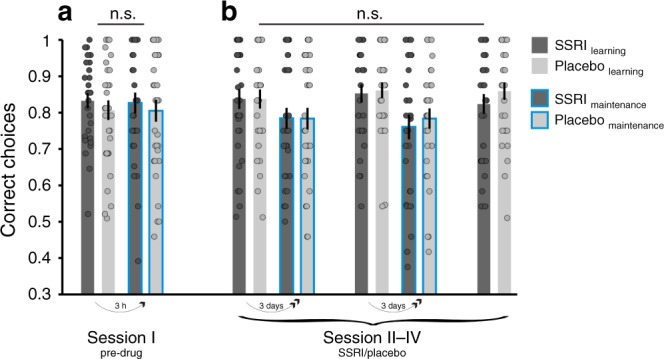
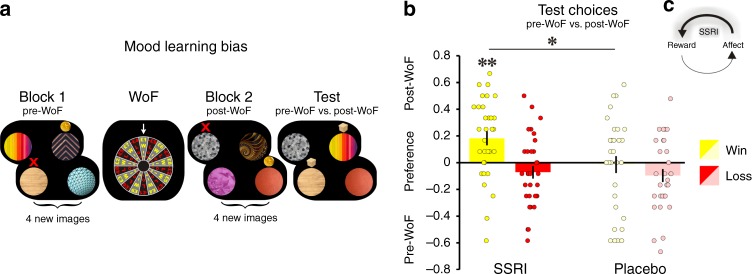
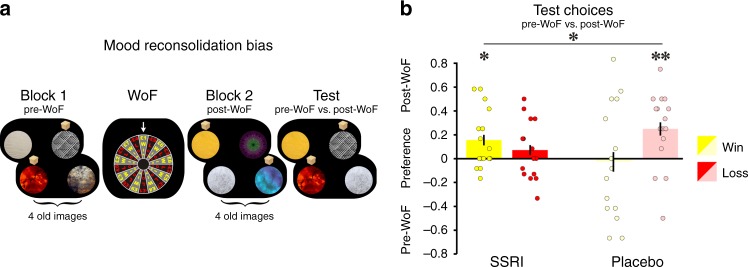
Verification
Claims the paper makes
The claims and statistics of this paper haven’t been checked yet.
Free: it reads the open-access text and checks the first 5 claims that cite a source we can check. Create a free account to check every claim.
Claims other papers make about this one
Each is checked against this paper’s own text: does it say what the citing paper says it does?
The cited source says what the claim attributes to it.
In the citing paper
“Some studies suggest that SSRIs have acute or subacute effects on cognition, e.g., affective processing bias [25–27]”
From Effects of escitalopram on synaptic density in the healthy human brain: a randomized controlled trial (2023) · cites this paper as [27]
Self-check
Percentages, sums and reported differences re-computed from the paper’s own numbers.
The self-check needs the paper’s full text.
Citations
Cites
Prospect Theory: An Analysis of Decision under Risk
Kahneman, D., & Tversky, A. (1979) · Econometrica · doi:10.2307/1914185 · Cited by 48,524
Prospect theory: An analysis of decision under risk
Kahneman, D., & Tversky, A. (1988) · Decision, Probability and Utility · doi:10.1017/cbo9780511609220.014 · Cited by 32,474
Development and validation of brief measures of positive and negative affect: The PANAS scales.
Watson, D., Clark, L. A., & Tellegen, A. (1988) · Journal of Personality and Social Psychology · doi:10.1037/0022-3514.54.6.1063 · Cited by 32,433
Reinforcement Learning: An Introduction
Sutton, R. S., & Barto, A. G. (1998) · IEEE Transactions on Neural Networks · doi:10.1109/tnn.1998.712192 · Cited by 27,225
(1970) · Cited by 24,983
Reinforcement Learning: An Introduction
(2005) · IEEE Transactions on Neural Networks · doi:10.1109/tnn.2004.842673 · Cited by 24,496
Beck, A. T., Steer, R. A., & Brown, G. (2011) · PsycTESTS Dataset · doi:10.1037/t00742-000 · Cited by 7,535
Cipriani, A., Furukawa, T. A., Salanti, G., Chaimani, A., Atkinson, L. Z., Ogawa, Y., Leucht, S., Ruhe, H. G., Turner, E. H., Higgins, J. P. T., et al. (2018) · The Lancet · doi:10.1016/s0140-6736(17)32802-7 · Cited by 3,541
Ferrari, A. J., Charlson, F. J., Norman, R. E., Patten, S. B., Freedman, G., Murray, C. J. L., Vos, T., & Whiteford, H. A. (2013) · PLoS Medicine · doi:10.1371/journal.pmed.1001547 · Cited by 3,115
Pearce, J. M., & Hall, G. (1980) · Psychological Review · doi:10.1037/0033-295x.87.6.532 · Cited by 3,023
Ekman, P. (1999) · Handbook of Cognition and Emotion · doi:10.1002/0470013494.ch3 · Cited by 2,125
A scale for the assessment of hedonic tone the Snaith-Hamilton pleasure scale
Snaith, R. P., Hamilton, M., Morley, S., Humayan, A., Hargreaves, D., & Trigwell, P. (1995) · British Journal of Psychiatry · doi:10.1192/bjp.167.1.99 · Cited by 1,778
Neural mechanisms of the cognitive model of depression.
Disner, S. G., Beevers, C. G., Haigh, E. A. P., & Beck, A. T. (2011) · Nature Reviews Neuroscience · doi:10.1038/nrn3027 · Cited by 1,718
Handbook of Cognition and Emotion
(1999) · Wiley eBooks · doi:10.1002/0470013494 · Cited by 1,670
Eye tracking of attention in the affective disorders: a meta-analytic review and synthesis
Armstrong, T., & Olatunji, B. O. (2012) · Clinical Psychology Review · doi:10.1016/j.cpr.2012.09.004 · Cited by 1,049
Behavioral activation treatment for depression: returning to contextual roots
Jacobson, N. S., Martell, C. R., & Dimidjian, S. (2001) · Clinical Psychology: Science and Practice · doi:10.1093/clipsy.8.3.255 · Cited by 1,011
A meta-analysis of emotional reactivity in major depressive disorder
Bylsma, L. M., Morris, B. H., & Rottenberg, J. (2008) · Clinical Psychology Review · doi:10.1016/j.cpr.2007.10.001 · Cited by 933
Reward processing dysfunction in major depression, bipolar disorder and schizophrenia
Whitton, A. E., Treadway, M. T., & Pizzagalli, D. A. (2015) · Current Opinion in Psychiatry · doi:10.1097/yco.0000000000000122 · Cited by 739
Artigas, F., Romero, L., de Montigny, C., & Blier, P. (1996) · Trends in Neurosciences · doi:10.1016/s0166-2236(96)10037-0 · Cited by 655
Linking Molecules to Mood: New Insight Into the Biology of Depression
Krishnan, V., & Nestler, E. J. (2010) · American Journal of Psychiatry · doi:10.1176/appi.ajp.2009.10030434 · Cited by 643
How do antidepressants work? New perspectives for refining future treatment approaches
Harmer, C. J., Duman, R. S., & Cowen, P. J. (2017) · The Lancet Psychiatry · doi:10.1016/s2215-0366(17)30015-9 · Cited by 616
5-HT1A receptor function in major depressive disorder
Savitz, J., Lucki, I., & Drevets, W. C. (2009) · Progress in Neurobiology · doi:10.1016/j.pneurobio.2009.01.009 · Cited by 574
Harmer, C. J., Shelley, N. C., Cowen, P. J., & Goodwin, G. M. (2004) · American Journal of Psychiatry · doi:10.1176/appi.ajp.161.7.1256 · Cited by 554
Cognitive Mechanisms of Treatment in Depression
Roiser, J. P., Elliott, R., & Sahakian, B. J. (2012) · Neuropsychopharmacology · doi:10.1038/npp.2011.183 · Cited by 535
Serotonin and dopamine: unifying affective, activational, and decision functions.
Cools, R., Nakamura, K., & Daw, N. D. (2011) · Neuropsychopharmacology · doi:10.1038/npp.2010.121 · Cited by 464
Opponency revisited: competition and cooperation between dopamine and serotonin
Boureau, Y.-L., & Dayan, P. (2011) · Neuropsychopharmacology · doi:10.1038/npp.2010.151 · Cited by 456
A computational and neural model of momentary subjective well-being
Rutledge, R. B., Skandali, N., Dayan, P., & Dolan, R. J. (2014) · Proceedings of the National Academy of Sciences · doi:10.1073/pnas.1407535111 · Cited by 444
Self-citationReduced Reward Learning Predicts Outcome in Major Depressive Disorder
Vrieze, E., Pizzagalli, D. A., Demyttenaere, K., Hompes, T., Sienaert, P., de Boer, P., Schmidt, M., & Claes, S. (2013) · Biological Psychiatry · doi:10.1016/j.biopsych.2012.10.014 · Cited by 441
Huys, Q. J. M., Eshel, N., O'Nions, E., Sheridan, L., Dayan, P., & Roiser, J. P. (2012) · PLoS Computational Biology · doi:10.1371/journal.pcbi.1002410 · Cited by 439
Uher, R., Perlis, R. H., Henigsberg, N., Zobel, A., Rietschel, M., Mors, O., Hauser, J., Dernovsek, M. Z., Souery, D., Bajs, M., et al. (2012) · Psychological Medicine · doi:10.1017/s0033291711001905 · Cited by 420
Taylor, M. J., Freemantle, N., Geddes, J. R., & Bhagwagar, Z. (2006) · Archives of General Psychiatry · doi:10.1001/archpsyc.63.11.1217 · Cited by 406
Mood as representation of momentum
Eldar, E., Rutledge, R. B., Dolan, R. J., & Niv, Y. (2016) · Trends in Cognitive Sciences · doi:10.1016/j.tics.2015.07.010 · Cited by 383
Self-citationA comprehensive meta-analysis of interpretation biases in depression
Everaert, J., Podina, I. R., & Koster, E. H. W. (2017) · Clinical Psychology Review · doi:10.1016/j.cpr.2017.09.005 · Cited by 378
Activity patterns of serotonin neurons underlying cognitive flexibility
Matias, S., Lottem, E., Dugué, G. P., & Mainen, Z. F. (2017) · eLife · doi:10.7554/elife.20552 · Cited by 239
Interaction between emotional state and learning underlies mood instability
Eldar, E., & Niv, Y. (2015) · Nature Communications · doi:10.1038/ncomms7149 · Cited by 193
Self-citationTranter, R., Bell, D., Gutting, P., Harmer, C., Healy, D., & Anderson, I. M. (2009) · Journal of Affective Disorders · doi:10.1016/j.jad.2009.01.028 · Cited by 184
Harmer, C. J., & Cowen, P. J. (2013) · Philosophical Transactions of the Royal Society B: Biological Sciences · doi:10.1098/rstb.2012.0407 · Cited by 183
Godlewska, B. R., Browning, M., Norbury, R., Cowen, P. J., & Harmer, C. J. (2016) · Translational Psychiatry · doi:10.1038/tp.2016.130 · Cited by 181
5-HT receptors and reward-related behaviour: A review
Hayes, D. J., & Greenshaw, A. J. (2011) · Neuroscience & Biobehavioral Reviews · doi:10.1016/j.neubiorev.2011.03.005 · Cited by 171
A cognitive neuropsychological model of antidepressant drug action
Pringle, A., Browning, M., Cowen, P. J., & Harmer, C. J. (2011) · Progress in Neuro-Psychopharmacology and Biological Psychiatry · doi:10.1016/j.pnpbp.2010.07.022 · Cited by 130
Crying threshold and intensity in major depressive disorder
Rottenberg, J., Gross, J. J., Wilhelm, F. H., Najmi, S., & Gotlib, I. H. (2002) · Journal of Abnormal Psychology · doi:10.1037/0021-843x.111.2.302 · Cited by 122
Antidepressants in bipolar depression: An enduring controversy
Gitlin, M. J. (2018) · International Journal of Bipolar Disorders · doi:10.1186/s40345-018-0133-9 · Cited by 116
Mood Instability and Reward Dysregulation—A Neurocomputational Model of Bipolar Disorder
Mason, L., Eldar, E., & Rutledge, R. B. (2017) · JAMA Psychiatry · doi:10.1001/jamapsychiatry.2017.3163 · Cited by 113
Self-citationShiroma, P. R., Thuras, P., Johns, B., & Lim, K. O. (2014) · International Journal of Geriatric Psychiatry · doi:10.1002/gps.4104 · Cited by 110
Short-term antidepressant treatment modulates amygdala response to happy faces
Norbury, R., Taylor, M. J., Selvaraj, S., Murphy, S. E., Harmer, C. J., & Cowen, P. J. (2009) · Psychopharmacology · doi:10.1007/s00213-009-1597-1 · Cited by 109
A Translational Rodent Assay of Affective Biases in Depression and Antidepressant Therapy
Stuart, S. A., Butler, P., Munafò, M. R., Nutt, D. J., & Robinson, E. S. (2013) · Neuropsychopharmacology · doi:10.1038/npp.2013.69 · Cited by 103
Do dorsal raphe 5-HT neurons encode “beneficialness”?
Luo, M., Li, Y., & Zhong, W. (2016) · Neurobiology of Learning and Memory · doi:10.1016/j.nlm.2016.08.008 · Cited by 90
Noble, S., & Benfield, P. (1997) · CNS Drugs · doi:10.2165/00023210-199708050-00009 · Cited by 86
Decodability of Reward Learning Signals Predicts Mood Fluctuations
Eldar, E., Roth, C., Dayan, P., & Dolan, R. J. (2018) · Current Biology · doi:10.1016/j.cub.2018.03.038 · Cited by 83
Self-citationStuart, S. A., Butler, P., Munafò, M. R., Nutt, D. J., & Robinson, E. S. (2015) · Neuropsychopharmacology · doi:10.1038/npp.2015.59 · Cited by 71
Robinson, E. S. J. (2018) · Philosophical Transactions of the Royal Society B Biological Sciences · doi:10.1098/rstb.2017.0036 · Cited by 69
Mood induction in depressive patients: a comparative multidimensional approach.
Falkenberg, I., Kohn, N., Schoepker, R., & Habel, U. (2012) · PLoS ONE · doi:10.1371/journal.pone.0030016 · Cited by 47
Horner, M. S., Siegle, G. J., Schwartz, R. M., Price, R. B., Haggerty, A. E., Collier, A., & Friedman, E. S. (2014) · Depression and Anxiety · doi:10.1002/da.22244 · Cited by 46
Hieronymus, F., Lisinski, A., Nilsson, S., & Eriksson, E. (2018) · Molecular Psychiatry · doi:10.1038/mp.2017.147 · Cited by 44
Steady‐State Pharmacokinetics of Citalopram in Young and Elderly Subjects
Gutierrez, M., & Abramowitz, W. (2000) · Pharmacotherapy: The Journal of Human Pharmacology and Drug Therapy · doi:10.1592/phco.20.19.1441.34851 · Cited by 40
Affective and cognitive reactivity to mood induction in chronic depression
Guhn, A., Sterzer, P., Haack, F. H., & Köhler, S. (2018) · Journal of Affective Disorders · doi:10.1016/j.jad.2017.12.090 · Cited by 33
Computational approaches and machine learning for individual-level treatment predictions
Paulus, M. P., & Thompson, W. K. (2019) · Psychopharmacology · doi:10.1007/s00213-019-05282-4 · Cited by 31
Research works printed but not linked: 2
- Frijda, N. H. in Handbook of Emotions (eds Lewis, M. & Haviland, J. M.) 381–403 (Guilford Press, 1993).
- Bishop, C. M. Pattern Recognition and Machine Learning (Springer, 2006).
Cited by
Computational Psychiatry Needs Time and Context
Hitchcock, P. F., Fried, E. I., & Frank, M. J. (2022) · Annual Review of Psychology · doi:10.1146/annurev-psych-021621-124910 · Cited by 131
Smartphones and the Neuroscience of Mental Health
Gillan, C. M., & Rutledge, R. B. (2021) · Annual Review of Neuroscience · doi:10.1146/annurev-neuro-101220-014053 · Cited by 90
“…with this, week-long SSRI treatment in healthy volunteers has recently been shown to enhance the impact of positive mood inductions on subsequent learning, consistent with the proposal that the delayed mood response relates to how SSRIs influence learning in the world (Michely et al. 2020).”
ResultSharma, S., Chawla, S., Kumar, P., Ahmad, R., & Verma, P. K. (2024) · Brain Research · doi:10.1016/j.brainres.2024.149123 · Cited by 111
Emotions as ComputationsPreprint
Emanuel, A., & Eldar, E. (2022) · PsyArXiv (OSF Preprints) · doi:10.1016/j.neubiorev.2022.104977 · Cited by 97
Self-citationWang, K., Khoramjoo, M., Srinivasan, K. K., Gordon, P. M. K., Mandal, R., Jackson, D., Sligl, W., Grant, M. B., Penninger, J. M., Borchers, C. H., et al. (2023) · Cell Reports Medicine · doi:10.1016/j.xcrm.2023.101254 · Cited by 86
“26,27 Downregulation of glycerophospholipids, sphingolipids, phosphatidylcholines, and fatty acids has been demonstrated during the acute SARS-CoV-2 infection, particularly in severe patients.”
Background
Metadata
- Authors
- Michely, J., Eldar, E., Martin, I. M., & Dolan, R. J.
- Affiliations
- Wellcome Centre for Human Neuroimaging (GB)
- Hebrew University of Jerusalem (IL)
- Corresponding author
- Michely, Jochen
- Venue
- Nature Communications
- Published
- 2020-05-11
- Volume
- 11
- Issue
- 1
- Pages
- 2335-2335
- ISSN
- 2041-1723 (ISSN-L)
- PMC
- PMC7214430
- OpenAlex
- W3023864941
- Cited by
- 72
- References
- 59
- Citations by year
- 2026: 7 · 2025: 8 · 2024: 21 · 2023: 11 · 2022: 10 · 2021: 12 · 2020: 3
- FWCI
- 4.13
- Type
- journal article
- Language
- en
- Open access
- gold
- doi.org
- Licence
- cc-by
- creativecommons.org/licenses/by/4.0 (tdm)
- creativecommons.org/licenses/by/4.0 (vor)
- Locations
- Nature Communications (publishedVersion, cc-by)
- PubMed Central (publishedVersion, cc-by)
- PubMed (publishedVersion)
- RePEc: Research Papers in Economics (submittedVersion)
- DOAJ (DOAJ: Directory of Open Access Journals) (submittedVersion, cc-by-sa)
- UCL Discovery (University College London) (submittedVersion)
- MPG.PuRe (Max Planck Society) (submittedVersion)
- Funders
- Deutsche Forschungsgemeinschaft (MI 2158/1-1)
- Topics
- Life Sciences › Neuroscience › Cellular and Molecular Neuroscience › Neurotransmitter Receptor Influence on Behavior
- Health Sciences › Medicine › Pharmacology (medical) › Treatment of Major Depression
- Life Sciences › Neuroscience › Cognitive Neuroscience › Neural and Behavioral Psychology Studies
- Keywords
- serotonin, mood, selective serotonin reuptake inhibitors, antidepressant mechanism, reward learning, memory reconsolidation, positive affect, computational modelling, mood induction, treatment response
- MeSH terms
- Adult, Affect, Female, Humans, Learning, Male, Reward, Serotonin, Task Performance and Analysis, Selective Serotonin Reuptake Inhibitors, Young Adult
About these checks
Registry, retraction, Cites and statistics results are computed, not judged, with one exception: a printed reference that no index lists is read once by a model before it counts as a citation error. Claims are extracted by a model and kept only when their quote appears verbatim in the text; each cited source is then checked, with a model’s help, for whether it says what the claim relies on. Those verdicts can be wrong — read the claim’s quote and the cited source before relying on one.
Statistics and arithmetic are recomputed, not judged.
Confidence bands are shown only for fields calibrated on our annotated test set. None is calibrated yet, so no band is shown.
What counts as a claim ›How we measure confidence ›How we check this ›
Are you an author, or do you see a problem with this page? Request a review
Data sources
Bibliographic data: Semantic Scholar, OpenAlex, Crossref.
Contains information from the Semantic Scholar Academic Graph Datasets, made available under the ODC Attribution License (ODC-BY 1.0).
Semantic Scholar’s data is described in: Kinney, R., et al. (2023). The Semantic Scholar Open Data Platform. arXiv:2301.10140.
