

Circadian control of brain glymphatic and lymphatic fluid flow
Open accessThe DOI matches its Crossref record; 69 of the 69 references it cites were found in a registry or an index.
Abstract
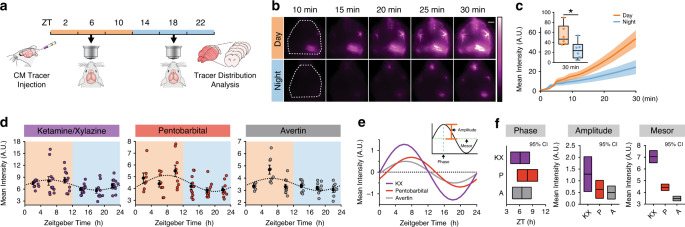
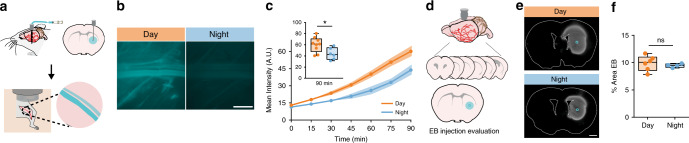
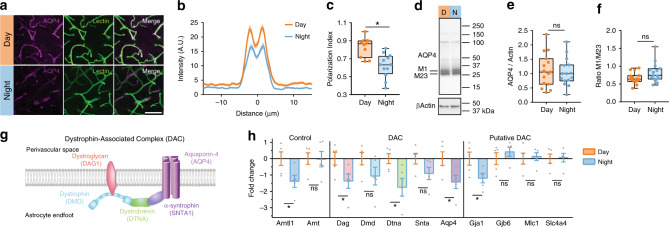
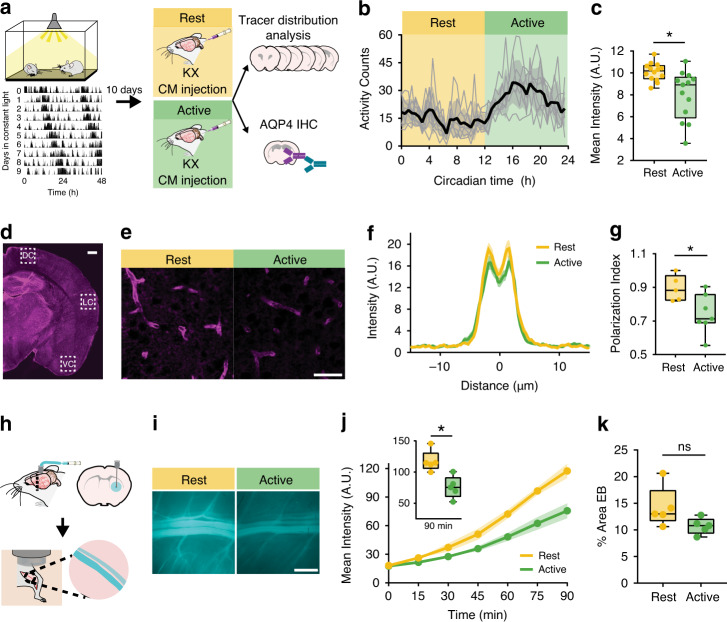
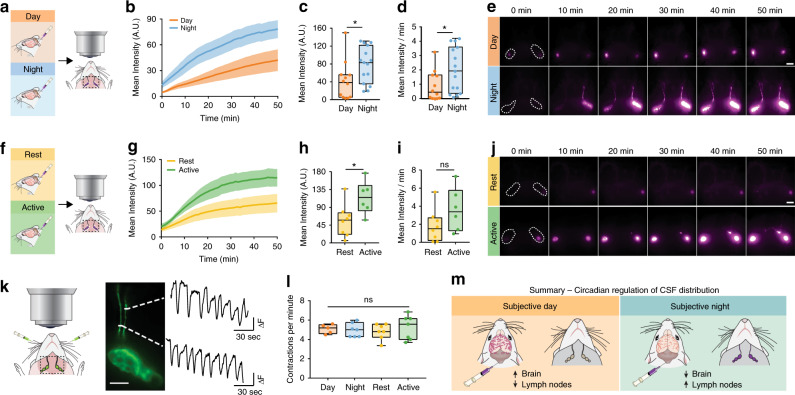
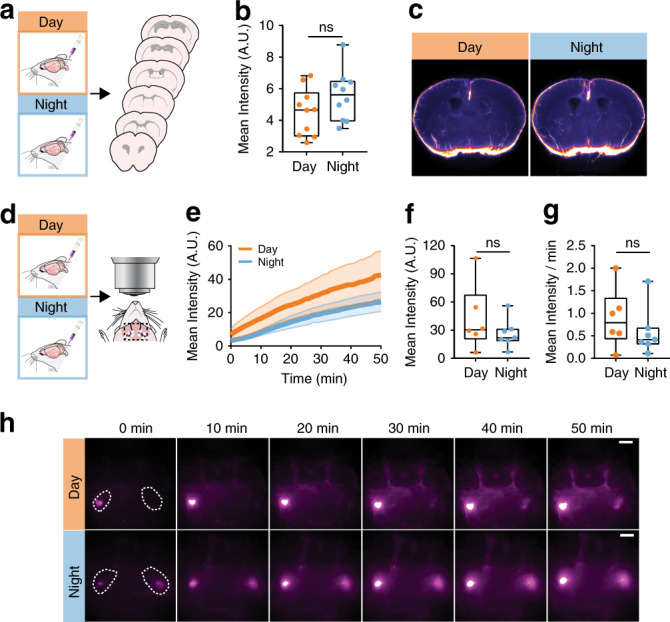
The glymphatic system is a network of perivascular spaces that promotes movement of cerebrospinal fluid (CSF) into the brain and clearance of metabolic waste. This fluid transport system is supported by the water channel aquaporin-4 (AQP4) localized to vascular endfeet of astrocytes. The glymphatic system is more effective during sleep, but whether sleep timing promotes glymphatic function remains unknown. We here show glymphatic influx and clearance exhibit endogenous, circadian rhythms peaking during the mid-rest phase of mice. Drainage of CSF from the cisterna magna to the lymph nodes exhibits daily variation opposite to glymphatic influx, suggesting distribution of CSF throughout the animal depends on time-of-day. The perivascular polarization of AQP4 is highest during the rest phase and loss of AQP4 eliminates the day-night difference in both glymphatic influx and drainage to the lymph nodes. We conclude that CSF distribution is under circadian control and that AQP4 supports this rhythm.
Overview
The claims and statistics of this paper haven’t been checked yet.
Free: it reads the open-access text and checks the first 5 claims that cite a source we can check. Create a free account to check every claim.
Integrity signals
Registry
Cites
Statistics
Figures
Verification
Claims the paper makes
The claims and statistics of this paper haven’t been checked yet.
Free: it reads the open-access text and checks the first 5 claims that cite a source we can check. Create a free account to check every claim.
Claims other papers make about this one
Each is checked against this paper’s own text: does it say what the citing paper says it does?
In the citing paper
“A recent analysis showed that glymphatic flow is also regulated by circadian rhythmicity, such that fluid transport peaks during the sleep phase of diurnal activity, and falls during the active phase, independent of the light cycle.”
From Glymphatic failure as a final common pathway to dementia (2020) · cites this paper as [38]
In the citing paper
“This rhythm is supported by the temporally-regulated localization of AQP4 via the dystrophin associated complex, providing a dynamic link to the molecular circadian clock (38),”
From Glymphatic failure as a final common pathway to dementia (2020) · cites this paper as [38]
Self-check
Percentages, sums and reported differences re-computed from the paper’s own numbers.
The self-check needs the paper’s full text.
Citations
Cites
A new mathematical model for relative quantification in real-time RT-PCR
Pfaffl, M. W. (2001) · Nucleic Acids Research · doi:10.1093/nar/29.9.e45 · Cited by 34,610
Yushkevich, P. A., Piven, J., Hazlett, H. C., Smith, R. G., Ho, S., Gee, J. C., & Gerig, G. (2006) · NeuroImage · doi:10.1016/j.neuroimage.2006.01.015 · Cited by 8,868
Iliff, J. J., Wang, M., Liao, Y., Plogg, B. A., Peng, W., Gundersen, G. A., Benveniste, H., Vates, G. E., Deane, R., Goldman, S. A., et al. (2012) · Science Translational Medicine · doi:10.1126/scitranslmed.3003748 · Cited by 5,824
Self-citationSleep Drives Metabolite Clearance from the Adult Brain
Xie, L., Kang, H., Xu, Q., Chen, M. J., Liao, Y., Thiyagarajan, M., O’Donnell, J., Christensen, D. J., Nicholson, C., Iliff, J. J., et al. (2013) · Science · doi:10.1126/science.1241224 · Cited by 5,411
Self-citationZhang, Y., Chen, K., Sloan, S. A., Bennett, M. L., Scholze, A. R., O'Keeffe, S., Phatnani, H. P., Guarnieri, P., Caneda, C., Ruderisch, N., et al. (2014) · The Journal of Neuroscience · doi:10.1523/jneurosci.1860-14.2014 · Cited by 4,875
Pittendrigh, C. S., & Daan, S. (1976) · Journal of Comparative Physiology ? A · doi:10.1007/bf01417856 · Cited by 2,127
Pittendrigh, C. S., & Daan, S. (1976) · Journal of Comparative Physiology ? A · doi:10.1007/bf01417860 · Cited by 1,636
Mop3 is an essential component of the master circadian pacemaker in mammals.
Bunger, M. K., Wilsbacher, L. D., Moran, S. M., Clendenin, C., Radcliffe, L. A., Hogenesch, J. B., Simon, M. C., Takahashi, J. S., & Bradfield, C. A. (2000) · Cell · doi:10.1016/s0092-8674(00)00205-1 · Cited by 1,621
The two‐process model of sleep regulation: a reappraisal
Borbély, A. A., Daan, S., Wirz‐Justice, A., & Deboer, T. (2016) · Journal of Sleep Research · doi:10.1111/jsr.12371 · Cited by 1,577
Impairment of paravascular clearance pathways in the aging brain
Kress, B. T., Iliff, J. J., Xia, M., Wang, M., Wei, H. S., Zeppenfeld, D., Xie, L., Kang, H., Xu, Q., Liew, J. A., et al. (2014) · Annals of Neurology · doi:10.1002/ana.24271 · Cited by 1,521 · cited 2×
“In both a standard LD cycle (day: n= 7 mice; night n= 5 mice) and in 10 days LL (rest: n= 7 mice; active: n= 7 mice) we found no significant differences in contractions per minute between the rest and active phases (two-way analysis of variance (ANOVA), main effect of phase: F(1, 22)= 0.”
MethodSelf-citationCerebral Arterial Pulsation Drives Paravascular CSF–Interstitial Fluid Exchange in the Murine Brain
Iliff, J. J., Wang, M., Zeppenfeld, D. M., Venkataraman, A., Plog, B. A., Liao, Y., Deane, R., & Nedergaard, M. (2013) · The Journal of Neuroscience · doi:10.1523/jneurosci.1592-13.2013 · Cited by 1,319
Self-citationCircadian control of the immune system
Scheiermann, C., Kunisaki, Y., & Frenette, P. S. (2013) · Nature Reviews Immunology · doi:10.1038/nri3386 · Cited by 1,135
Flow of cerebrospinal fluid is driven by arterial pulsations and is reduced in hypertension.
Mestre, H., Tithof, J., Du, T., Song, W., Peng, W., Sweeney, A. M., Olveda, G., Thomas, J. H., Nedergaard, M., & Kelley, D. H. (2018) · Nature Communications · doi:10.1038/s41467-018-07318-3 · Cited by 1,110
Self-citationA circadian clock in macrophages controls inflammatory immune responses
Keller, M., Mazuch, J., Abraham, U., Eom, G. D., Herzog, E. D., Volk, H.-D., Kramer, A., & Maier, B. (2009) · Proceedings of the National Academy of Sciences · doi:10.1073/pnas.0906361106 · Cited by 843
Aquaporin-4-dependent glymphatic solute transport in the rodent brain
Mestre, H., Hablitz, L. M., Xavier, A. L., Feng, W., Zou, W., Pu, T., Monai, H., Murlidharan, G., Castellanos Rivera, R. M., Simon, M. J., et al. (2018) · eLife · doi:10.7554/elife.40070 · Cited by 738
Self-citationMa, Q., Ineichen, B. V., Detmar, M., & Proulx, S. T. (2017) · Nature Communications · doi:10.1038/s41467-017-01484-6 · Cited by 690
Hablitz, L. M., Vinitsky, H. S., Sun, Q., Stæger, F. F., Sigurdsson, B., Mortensen, K. N., Lilius, T. O., & Nedergaard, M. (2019) · Science Advances · doi:10.1126/sciadv.aav5447 · Cited by 629
Self-citationSignaling at the Gliovascular Interface
Simard, M., Arcuino, G., Takano, T., Liu, Q. S., & Nedergaard, M. (2003) · The Journal of Neuroscience · doi:10.1523/jneurosci.23-27-09254.2003 · Cited by 586
Self-citationAmiry-Moghaddam, M., Otsuka, T., Hurn, P. D., Traystman, R. J., Haug, F.-M., Froehner, S. C., Adams, M. E., Neely, J. D., Agre, P., Ottersen, O. P., et al. (2003) · Proceedings of the National Academy of Sciences · doi:10.1073/pnas.0437946100 · Cited by 534
Cerebrospinal fluid influx drives acute ischemic tissue swelling
Mestre, H., Du, T., Sweeney, A. M., Liu, G., Samson, A. J., Peng, W., Mortensen, K. N., Stæger, F. F., Bork, P. A. R., Bashford, L., et al. (2020) · Science · doi:10.1126/science.aax7171 · Cited by 494
Self-citationThe Meningeal Lymphatic System: A New Player in Neurophysiology
Da Mesquita, S., Fu, Z., & Kipnis, J. (2018) · Neuron · doi:10.1016/j.neuron.2018.09.022 · Cited by 479
Circadian Clocks in the Immune System
Labrecque, N., & Cermakian, N. (2015) · Journal of Biological Rhythms · doi:10.1177/0748730415577723 · Cited by 466
Role of the circadian system in cardiovascular disease
Thosar, S. S., Butler, M. P., & Shea, S. A. (2018) · Journal of Clinical Investigation · doi:10.1172/jci80590 · Cited by 443
Astrocytes Control Circadian Timekeeping in the Suprachiasmatic Nucleus via Glutamatergic Signaling
Brancaccio, M., Patton, A. P., Chesham, J. E., Maywood, E. S., & Hastings, M. H. (2017) · Neuron · doi:10.1016/j.neuron.2017.02.030 · Cited by 434
Constant light desynchronizes mammalian clock neurons
Ohta, H., Yamazaki, S., & McMahon, D. G. (2005) · Nature Neuroscience · doi:10.1038/nn1395 · Cited by 405
Pauley, S. M. (2004) · Medical Hypotheses · doi:10.1016/j.mehy.2004.03.020 · Cited by 392
Ferri, P., Guadi, M., Marcheselli, L., Balduzzi, S., Magnani, D., & Di Lorenzo, R. (2016) · Risk Management and Healthcare Policy · doi:10.2147/rmhp.s115326 · Cited by 392
Changes in the composition of brain interstitial ions control the sleep-wake cycle
Ding, F., O’Donnell, J., Xu, Q., Kang, N., Goldman, N., & Nedergaard, M. (2016) · Science · doi:10.1126/science.aad4821 · Cited by 387
Self-citationStrengths and Limitations of Period Estimation Methods for Circadian Data
Zielinski, T., Moore, A. M., Troup, E., Halliday, K. J., & Millar, A. J. (2014) · PLoS ONE · doi:10.1371/journal.pone.0096462 · Cited by 344
Cell-autonomous clock of astrocytes drives circadian behavior in mammals
Brancaccio, M., Edwards, M. D., Patton, A. P., Smyllie, N. J., Chesham, J. E., Maywood, E. S., & Hastings, M. H. (2019) · Science · doi:10.1126/science.aat4104 · Cited by 327
Circadian rhythms and cardiovascular health
Portaluppi, F., Tiseo, R., Smolensky, M. H., Hermida, R. C., Ayala, D. E., & Fabbian, F. (2012) · Sleep Medicine Reviews · doi:10.1016/j.smrv.2011.04.003 · Cited by 310
Kreutzmann, J. C., Havekes, R., Abel, T., & Meerlo, P. (2015) · Neuroscience · doi:10.1016/j.neuroscience.2015.04.053 · Cited by 309
Astrocytes Regulate Daily Rhythms in the Suprachiasmatic Nucleus and Behavior
Tso, C. F., Simon, T., Greenlaw, A. C., Puri, T., Mieda, M., & Herzog, E. D. (2017) · Current Biology · doi:10.1016/j.cub.2017.02.037 · Cited by 260
Lymphatic drainage system of the brain: A novel target for intervention of neurological diseases
Sun, B.-L., Wang, L.-H., Yang, T., Sun, J.-Y., Mao, L.-L., Yang, M.-F., Yuan, H., Colvin, R. A., & Yang, X.-Y. (2018) · Progress in Neurobiology · doi:10.1016/j.pneurobio.2017.08.007 · Cited by 255
Critical role of aquaporin-4 (AQP4) in astrocytic Ca 2+ signaling events elicited by cerebral edema
Thrane, A. S., Rappold, P. M., Fujita, T., Torres, A., Bekar, L. K., Takano, T., Peng, W., Wang, F., Rangroo Thrane, V., Enger, R., et al. (2011) · Proceedings of the National Academy of Sciences · doi:10.1073/pnas.1015217108 · Cited by 254
Self-citationA Circadian Clock in the Blood-Brain Barrier Regulates Xenobiotic Efflux
Zhang, S. L., Yue, Z., Arnold, D. M., Artiushin, G., & Sehgal, A. (2018) · Cell · doi:10.1016/j.cell.2018.02.017 · Cited by 253
Oster, H., Damerow, S., Hut, R. A., & Eichele, G. (2006) · Journal of Biological Rhythms · doi:10.1177/0748730406293053 · Cited by 233
Circadian variation in human cerebrospinal fluid production measured by magnetic resonance imaging
Nilsson, C., Stahlberg, F., Thomsen, C., Henriksen, O., Herning, M., & Owman, C. (1992) · American Journal of Physiology-Regulatory, Integrative and Comparative Physiology · doi:10.1152/ajpregu.1992.262.1.r20 · Cited by 233
Circadian regulation of human cortical excitability
Ly, J. Q. M., Gaggioni, G., Chellappa, S. L., Papachilleos, S., Brzozowski, A., Borsu, C., Rosanova, M., Sarasso, S., Middleton, B., Luxen, A., et al. (2016) · Nature Communications · doi:10.1038/ncomms11828 · Cited by 230
Rapid lymphatic efflux limits cerebrospinal fluid flow to the brain
Ma, Q., Ries, M., Decker, Y., Müller, A., Riner, C., Bücker, A., Fassbender, K., Detmar, M., & Proulx, S. T. (2019) · Acta Neuropathologica · doi:10.1007/s00401-018-1916-x · Cited by 210
Quantitative analysis of light-phase restricted feeding reveals metabolic dyssynchrony in mice
Bray, M. S., Ratcliffe, W. F., Grenett, M. H., Brewer, R. A., Gamble, K. L., & Young, M. E. (2013) · International Journal of Obesity · doi:10.1038/ijo.2012.137 · Cited by 202
Regulation of the Blood–Brain Barrier by Circadian Rhythms and Sleep
Cuddapah, V. A., Zhang, S. L., & Sehgal, A. (2019) · Trends in Neurosciences · doi:10.1016/j.tins.2019.05.001 · Cited by 200
Selective neuronal lapses precede human cognitive lapses following sleep deprivation
Nir, Y., Andrillon, T., Marmelshtein, A., Suthana, N., Cirelli, C., Tononi, G., & Fried, I. (2017) · Nature Medicine · doi:10.1038/nm.4433 · Cited by 197
The choroid plexus is an important circadian clock component
Myung, J., Schmal, C., Hong, S., Tsukizawa, Y., Rose, P., Zhang, Y., Holtzman, M. J., De Schutter, E., Herzel, H., Bordyugov, G., et al. (2018) · Nature Communications · doi:10.1038/s41467-018-03507-2 · Cited by 193
Cell-Autonomous Regulation of Astrocyte Activation by the Circadian Clock Protein BMAL1
Lananna, B. V., Nadarajah, C. J., Izumo, M., Cedeño, M. R., Xiong, D. D., Dimitry, J., Tso, C. F., McKee, C. A., Griffin, P., Sheehan, P. W., et al. (2018) · Cell Reports · doi:10.1016/j.celrep.2018.09.015 · Cited by 164
PDGF-B Is Required for Development of the Glymphatic System
Munk, A. S., Wang, W., Bèchet, N. B., Eltanahy, A. M., Cheng, A. X., Sigurdsson, B., Benraiss, A., Mäe, M. A., Kress, B. T., Kelley, D. H., et al. (2019) · Cell Reports · doi:10.1016/j.celrep.2019.02.050 · Cited by 141
Self-citationAggregation state determines the localization and function of M1– and M23–aquaporin-4 in astrocytes
Smith, A. J., Jin, B.-J., Ratelade, J., & Verkman, A. S. (2014) · Journal of Cell Biology · doi:10.1083/jcb.201308118 · Cited by 125
Lundgaard, I., Wang, W., Eberhardt, A., Vinitsky, H. S., Reeves, B. C., Peng, S., Lou, N., Hussain, R., & Nedergaard, M. (2018) · Scientific Reports · doi:10.1038/s41598-018-20424-y · Cited by 120
Self-citationShift work and overall and cause-specific mortality in the Danish nurse cohort
Jørgensen, J. T., Karlsen, S., Stayner, L., Andersen, J., & Andersen, Z. J. (2017) · Scandinavian Journal of Work, Environment & Health · doi:10.5271/sjweh.3612 · Cited by 107
Plog, B. A., Mestre, H., Olveda, G. E., Sweeney, A. M., Kenney, H. M., Cove, A., Dholakia, K. Y., Tithof, J., Nevins, T. D., Lundgaard, I., et al. (2018) · JCI Insight · doi:10.1172/jci.insight.120922 · Cited by 101
Self-citationHow does general anaesthesia affect the circadian clock?
Poulsen, R. C., Warman, G. R., SLEIGH, J. W., Ludin, N. M., & Cheeseman, J. F. (2016) · Sleep Medicine Reviews · doi:10.1016/j.smrv.2016.12.002 · Cited by 97
Imaging the effect of the circadian light–dark cycle on the glymphatic system in awake rats
Cai, X., Qiao, J., Kulkarni, P., Harding, I. C., Ebong, E., & Ferris, C. F. (2020) · Proceedings of the National Academy of Sciences · doi:10.1073/pnas.1914017117 · Cited by 87
Ciappelloni, S., Bouchet, D., Dubourdieu, N., Boué‐Grabot, É., Kellermayer, B., Manso, C., Marignier, R., Oliet, S. H. R., Tourdias, T., & Groc, L. (2019) · Cell Reports · doi:10.1016/j.celrep.2019.05.097 · Cited by 85
Environmental disruption of the circadian clock leads to altered sleep and immune responses in mouse
Phillips, D. J., Savenkova, M. I., & Karatsoreos, I. N. (2014) · Brain Behavior and Immunity · doi:10.1016/j.bbi.2014.12.008 · Cited by 74
Simon, M. J., Wang, M. X., Murchison, C. F., Roese, N. E., Boespflug, E. L., Woltjer, R. L., & Iliff, J. J. (2018) · Scientific Reports · doi:10.1038/s41598-018-30779-x · Cited by 71
Deciphering Neural Codes of Memory during Sleep
Chen, Z., & Wilson, M. A. (2017) · Trends in Neurosciences · doi:10.1016/j.tins.2017.03.005 · Cited by 66
Alzheimer's Disease and Sleep–Wake Disturbances: Amyloid, Astrocytes, and Animal Models
Vanderheyden, W. M., Lim, M. M., Musiek, E. S., & Gerstner, J. R. (2018) · The Journal of Neuroscience · doi:10.1523/jneurosci.1135-17.2017 · Cited by 66
Differential effects of anaesthesia on the contractility of lymphatic vessels in vivo
Bachmann, S. B., Proulx, S. T., He, Y., Ries, M., & Detmar, M. J. (2019) · The Journal of Physiology · doi:10.1113/jp277254 · Cited by 57
Kalliokoski, O., Teilmann, A. C., Jacobsen, K. R., Abelson, K. S. P., & Hau, J. (2014) · PLoS ONE · doi:10.1371/journal.pone.0111065 · Cited by 47
Nilsson, C., Stahlberg, F., Gideon, P., Thomsen, C., & Henriksen, O. (1994) · American Journal of Physiology-Regulatory, Integrative and Comparative Physiology · doi:10.1152/ajpregu.1994.267.6.r1445 · Cited by 41
Sweeney, A. M., Plá, V., Du, T., Liu, G., Sun, Q., Peng, S., Plog, B. A., Kress, B. T., Wang, X., Mestre, H., et al. (2019) · Journal of Visualized Experiments · doi:10.3791/59774 · Cited by 37
Self-citationvan der Spek, R., Fliers, E., la Fleur, S. E., & Kalsbeek, A. (2018) · Frontiers in Endocrinology · doi:10.3389/fendo.2018.00206 · Cited by 35
Simon, M. J., Murchison, C., & Iliff, J. J. (2017) · Journal of Neuroscience Research · doi:10.1002/jnr.24082 · Cited by 33
Orešković, D., & Klarica, M. (2014) · Croatian Medical Journal · doi:10.3325/cmj.2014.55.317 · Cited by 30
Effect of prolonged wakefulness on electroencephalographic oscillatory activity during sleep
Olbrich, E., Landolt, H., & Achermann, P. (2013) · Journal of Sleep Research · doi:10.1111/jsr.12123 · Cited by 23
Hablitz, L. M., Molzof, H. E., Paul, J. R., Johnson, R. L., & Gamble, K. L. (2014) · The Journal of Physiology · doi:10.1113/jphysiol.2014.282079 · Cited by 22
Self-citationOrešković, D., Klarica, M., Vukić, M., & Maraković, J. (2003) · PubMed · Cited by 16
Light Pulse Duration Differentially Regulates Mouse Locomotor Suppression and Phase Shifts
Morin, L. P., & Studholme, K. M. (2014) · Journal of Biological Rhythms · doi:10.1177/0748730414547111 · Cited by 14
Takahashi, H., Tanaka, H., Fujita, N., Murase, K., & Tomiyama, N. (2011) · Japanese Journal of Radiology · doi:10.1007/s11604-010-0525-y · Cited by 14
Cited by
Glymphatic failure as a final common pathway to dementia
Nedergaard, M., & Goldman, S. A. (2020) · Science · doi:10.1126/science.abb8739 · Cited by 1,145
Self-citationRasmussen, M. K., Mestre, H., & Nedergaard, M. (2022) · Physiological Reviews · doi:10.1152/physrev.00031.2020 · Cited by 597
Self-citationCircadian Mechanisms in Medicine
Allada, R., & Bass, J. (2021) · New England Journal of Medicine · doi:10.1056/nejmra1802337 · Cited by 519
The Glymphatic System: A Novel Component of Fundamental Neurobiology
Hablitz, L. M., & Nedergaard, M. (2021) · The Journal of Neuroscience · doi:10.1523/jneurosci.0619-21.2021 · Cited by 453
“Rodent studies have demonstrated that during sleep, CSF transport along the glymphatic system is fast (minutes to hours; Xie et al., 2013) compared with during the active phase, where CSF redistributes to the mandibular lymph nodes in an equally fast manner (Hablitz et al., 2020).”
BackgroundInfluentialSelf-citationMultisensory gamma stimulation promotes glymphatic clearance of amyloid
Murdock, M. H., Yang, C.-Y., Sun, N., Pao, P.-C., Blanco-Duque, C., Kahn, M. C., Kim, T., Lavoie, N. S., Victor, M. B., Islam, M. R., et al. (2024) · Nature · doi:10.1038/s41586-024-07132-6 · Cited by 379
“We used established methods to quantify AQP4 polarization 12,21 .”
BackgroundMethodInfluential
Metadata
- Authors
- Hablitz, L. M., Plá, V., Giannetto, M., Vinitsky, H. S., Stæger, F. F., Metcalfe, T., Nguyen, R., Benrais, A., & Nedergaard, M.
- Affiliations
- University of Rochester Medicine (US)
- University of Copenhagen (DK)
- Corresponding author
- Hablitz, Lauren M.
- ORCID
- Venue
- Nature Communications
- Published
- 2020-09-02
- Volume
- 11
- Issue
- 1
- Pages
- 4411-4411
- ISSN
- 2041-1723 (ISSN-L)
- PMC
- PMC7468152
- OpenAlex
- W3082563867
- Cited by
- 704
- References
- 69
- Citations by year
- 2026: 149 · 2025: 151 · 2024: 132 · 2023: 123 · 2022: 79 · 2021: 65 · 2020: 5
- FWCI
- 31.17
- Type
- journal article
- Language
- en
- Open access
- gold
- doi.org
- Licence
- cc-by
- creativecommons.org/licenses/by/4.0 (tdm)
- creativecommons.org/licenses/by/4.0 (vor)
- Locations
- Nature Communications (publishedVersion, cc-by)
- PubMed Central (publishedVersion, cc-by)
- PubMed (publishedVersion)
- Research at the University of Copenhagen (University of Copenhagen) (publishedVersion, cc-by)
- RePEc: Research Papers in Economics (submittedVersion)
- DOAJ (DOAJ: Directory of Open Access Journals) (submittedVersion, cc-by-sa)
- Funders
- U.S. Department of Health & Human Services | NIH | National Institute of Neurological Disorders and Stroke (R01NS100366, RF1AG057575)
- United States Department of Defense | United States Army | U.S. Army Research, Development and Engineering Command | Army Research Office (MURI W911NF1910280)
- Fondation Leducq Transatlantic Networks of Excellence Program, Novo Nordisk and Lundbeck Foundations, and the EU Horizon 2020 research and innovation program
- Topics
- Health Sciences › Medicine › Clinical Neurology › Cerebrospinal fluid and hydrocephalus
- Life Sciences › Biochemistry, Genetics and Molecular Biology › Molecular Biology › Ion Transport and Channel Regulation
- Life Sciences › Neuroscience › Cognitive Neuroscience › Sleep and Wakefulness Research
- Keywords
- glymphatic system, circadian rhythm, cerebrospinal fluid, aquaporin-4, astrocytes, perivascular spaces, cerebrospinal fluid drainage, lymphatic drainage, sleep, cisterna magna, lymph nodes, waste clearance
- MeSH terms
- Glymphatic System, Animals, Astrocytes, Brain, Cerebrospinal Fluid, Circadian Rhythm, Cisterna Magna, Lymph Nodes, Mice, Aquaporin 4
About these checks
Registry, retraction, Cites and statistics results are computed, not judged, with one exception: a printed reference that no index lists is read once by a model before it counts as a citation error. Claims are extracted by a model and kept only when their quote appears verbatim in the text; each cited source is then checked, with a model’s help, for whether it says what the claim relies on. Those verdicts can be wrong — read the claim’s quote and the cited source before relying on one.
Statistics and arithmetic are recomputed, not judged.
Confidence bands are shown only for fields calibrated on our annotated test set. None is calibrated yet, so no band is shown.
What counts as a claim ›How we measure confidence ›How we check this ›
Are you an author, or do you see a problem with this page? Request a review
Data sources
Bibliographic data: Semantic Scholar, OpenAlex, Crossref.
Contains information from the Semantic Scholar Academic Graph Datasets, made available under the ODC Attribution License (ODC-BY 1.0).
Semantic Scholar’s data is described in: Kinney, R., et al. (2023). The Semantic Scholar Open Data Platform. arXiv:2301.10140.
