

The DOI matches its Crossref record; 41 of the 42 references it cites were found in a registry or an index; 5 of the 18 sources its claims cite were checked for support.
On demand shape memory polymer via light regulated topological defects in a dynamic covalent network
Open accessAbstract
Applying this strategy to functional shape memory networks yields custom designable multi-shape and reversible shape memory characteristics. This molecular principle expands the design versatility for network polymers, with broad implications in many other areas including soft robotics, flexible electronics, and medical devices.
Overview
CoChat Summary
TL;DR
A dynamic covalent PEG-based network can undergo light-regulated topological isomerization via transesterification with pendent hydroxyls, changing crosslinking, dangling/free chains, and crystallinity. This enables programmable thermomechanical properties and custom reversible/triple-shape memory behaviors.
Key findings
- Thermal isomerization of PEG-X networks (120 °C, 60 min) increased melting temperature and crystallinity for PEG-1 and PEG-2, with higher increase for PEG-2; PEG-0 barely changed. Gel fractions of as-synthesized PEG-0, PEG-1, and PEG-2 were between 95.8% and 94.1%, and after isomerization PEG-1 and PEG-2 reduced to 68.6% and 53.0%, respectively, while PEG-0 remained unchanged.
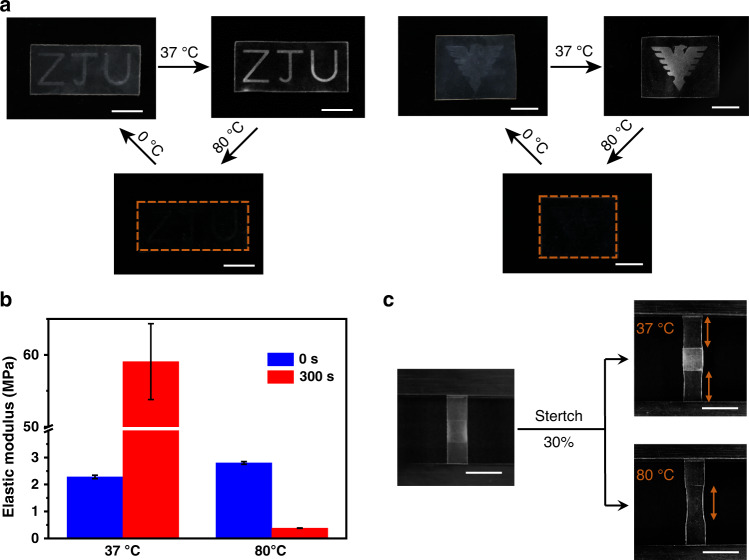
- A photobase generator allowed UV-dose control of isomerization: longer irradiation led to progressively higher Tm, higher crystallinity, higher room-temperature storage modulus, and lower gel fraction. At 37 °C, the non-isomerized region had modulus 25 times that of the isomerized region; at 80 °C, the isomerized region became 7 times softer than the non-isomerized region.
- Non-isomerized PEG-2 showed reversible shape memory between −20 and 80 °C with 20% reversible strain under 0.8 MPa constant stress, and reversible strain decreased linearly with external stress. Patterned isomerization enabled stress-free reversible shape memory between 0 and 37 °C and triple-shape memory, with different 3D shapes produced by light patterns under identical linear stretching of 30%.
Methods
- PEGDA was synthesized from PEG (Mn = 3350), acryloyl chloride, and trimethylamine; networks PEG-X were made by photoinitiated radical polymerization of PEGDA with N-hydroxyethylacrylamide at varied hydroxyl/ester molar ratios. For PEG-2, PEGDA (0.5 g, 0.15 mmol), N-hydroxyethylacrylamide (0.07 g, 0.6 mmol), and Irgacure 2959 (1.5 wt%) were UV irradiated for 180 s at 60 mW/cm².
- A photobase generator was introduced by soaking in 2 wt% PBG toluene solution for 20 min, incorporating 6 wt% PBG; irradiation was applied equally to both sides and reported as summed exposure time. Thermal isomerization was conducted at 120 °C for 60 min initially and at 80 °C for 30 min for light-controlled experiments.
- Characterization included DSC (TA Q200; equilibrate at 80 °C, cool to −50 °C at 5 °C/min, second heating at 5 °C/min), DMA (TA Q800; controlled force and multi-frequency strain at 20 µm, 1 Hz), tensile tests (Zwick/Roell Z005, 10 mm/min, at least three dumbbell specimens), and gel fraction tests by CHCl3 soaking for 24 h.
Limitations
- Stated: direct and quantitative experimental characterization of the complex isomerization is difficult, and the authors suggest future theoretical calculation.
- Stated: Fig. 1b,c are simplified; real networks contain unavoidable defects, and inter- and intra-chain transesterification can occur intermixed, producing more topologies beyond those shown.
- Evident from the text: the experimental demonstration centers on PEG-based networks and focuses on PEG-2 for further thermomechanical investigation, so broader applicability to other dynamic covalent networks is proposed rather than broadly tested.
Model-written summary. Check it against the paper before relying on it.
Integrity signals
Registry
Cites
Statistics
Figures



Verification
Claims the paper makes
4 Valid · 0 Not valid · 4 Not checked · 40 Own results and interpretations
The cited sources support only part of this claim — read each source’s verdict below.
In the paper
“two-stage polymerization typically leads to higher crosslinking densities, without significant other changes.”
§ On demand shape memory polymer via light regulated topological defects in a dynamic covalent network > Discussion
What the sources say
- Partly supportedcites [4] Jin, B. et al. Programming a crystalline shape memory polymer network with thermo- and photo-reversible bonds toward a single-component soft robot. Sci. Adv. 4, eaao3865 (2018). sourceExperimental — accuracy not yet measured
The Results (page unavailable) say that photo-induced dimerization forms additional network points, which supports the idea of increased crosslinking in this specific network. They also report improved actuation with more dimer linkages, so the paper does not support “without significant other changes.” It does not establish what two-stage polymerization typically does. (LLM, conf=0.86)
- Partly supportedcites [39] Zhang, B., kowsari, K., Serjouei, A., Dunn, M. L. & Ge, Q. Reprocessable thermosets for sustainable three-dimensional printing. Nat. Commun. 9, 1831 (2018). sourceExperimental — accuracy not yet measured
The Introduction says crosslinking density increases during the second, heat-triggered stage. But the Results section on reshapability reports substantial other changes: a higher glass-transition temperature and an increase in room-temperature Young’s modulus from 7.4 to about 900 MPa. The paper describes its particular two-stage process, not what two-stage polymerization typically does. (LLM, conf=0.90)
- Not checked — no full text of the sourcecites [40] Luo, C. et al. Chemomechanics of dual-stage reprocessable thermosets. J. Mech. Phys. Solids 126, 168–186 (2019). source
- Not checked — no full text of the sourcecites [41] Nair, D. P. et al. Two-stage reactive polymer network forming systems. Adv. Funct. Mater. 22, 1502–1510 (2012). source
plainstates a cause- Asserted: passes — The authors put it forward as true.
- Checkable: passes — It can be checked against evidence.
- Load-bearing: passes — The paper’s conclusions depend on it.
- Based: passes — The paper gives a reason why it holds.
- Partly supported
The cited sources support only part of this claim — read each source’s verdict below.
In the paper
“These defects affect the macroscopic mechanical and thermomechanical properties in a non-constructive way, but are statistically unavoidable30,31.”
§ On demand shape memory polymer via light regulated topological defects in a dynamic covalent network > Introduction
What the sources say
- Not checked — no full text of the sourcecites [30] Zhong, M., Wang, R., Kawamoto, K., Olsen, B. D. & Johnson, J. A. Quantifying the impact of molecular defects on polymer network elasticity. Science 353, 1264–1268 (2016). source
- Partly supportedcites [31] Wang, J. et al. Counting loops in sidechain-crosslinked polymers from elastic solids to single-chain nanoparticles. Chem. Sci. 10, 5332–5337 (2019). sourceExperimental — accuracy not yet measured
The rheology passage (section labeled Abstract; page unavailable) reports that primary and higher-order loops affect shear storage modulus, and that statistically distributed functional groups can produce strands too short to be elastically effective. It does not establish that dangling and free chains have the claimed effects, address thermomechanical properties, or say that all the listed defects are statistically unavoidable. (LLM, conf=0.84)
plainstates a cause- Asserted: passes — The authors put it forward as true.
- Checkable: passes — It can be checked against evidence.
- Load-bearing: passes — The paper’s conclusions depend on it.
- Based: passes — The paper gives a reason why it holds.
Every source the paper cites for this claim was checked and supports it.
In the paper
“The catalyst amount can be controlled by the light irradiation time.”
§ On demand shape memory polymer via light regulated topological defects in a dynamic covalent network > Results > Programming thermomechanical properties
What the sources say
- Supportedcites [29] Zou, W. et al. Light-triggered topological programmability in a dynamic covalent polymer network. Sci. Adv. 6, eaaz2362 (2020). source
The Results state that light irradiation releases the TBD catalyst and that its release increases approximately linearly with irradiation time before reaching a plateau at 11 minutes. This supports controlling the amount of released catalyst through irradiation time. (LLM, conf=0.93)
plainstates a cause- Asserted: passes — The authors put it forward as true.
- Checkable: passes — It can be checked against evidence.
- Load-bearing: passes — The paper’s conclusions depend on it.
- Based: passes — The paper gives a reason why it holds.
- Supported
Every source the paper cites for this claim was checked and supports it.
In the paper
“we employ a photobase generator that upon UV irradiation can release a strong organic base 1,5,7-triazabicyclo[4.4.0]dec-5-ene29.”
§ On demand shape memory polymer via light regulated topological defects in a dynamic covalent network > Results > Programming thermomechanical properties
What the sources say
- Supportedcites [29] Zou, W. et al. Light-triggered topological programmability in a dynamic covalent polymer network. Sci. Adv. 6, eaaz2362 (2020). source
The Results identify TBD as 1,5,7-triazabicyclo[4.4.0]dec-5-ene and state that the photo-latent catalyst releases it upon light irradiation. Materials and Methods specifies UV light for the release experiment. No page numbers are provided in our copy. (LLM, conf=0.93)
plainstates a cause- Asserted: passes — The authors put it forward as true.
- Checkable: passes — It can be checked against evidence.
- Load-bearing: passes — The paper’s conclusions depend on it.
- Based: passes — The paper gives a reason why it holds.
- Supported
A result the paper reports from its own data — it cites no other source for it, so there is none to check. The quote shows it is in the paper.
In the paper
“the melting temperature differences before and after isomerization remain almost identical for PEG-2 and PEG-3.”
§ On demand shape memory polymer via light regulated topological defects in a dynamic covalent network > Results > Programming thermomechanical properties
plain- Asserted: passes — The authors put it forward as true.
- Checkable: passes — It can be checked against evidence.
- Load-bearing: unclear — It is unclear whether the paper’s conclusions depend on it.
- Based: passes — The paper gives a reason why it holds.
26 more claims
Create a free account to see all 48 claims and every source verdict.
- It may state two separate claims as one. 14
- The quote only partly states this claim. 1
- Probably not a substantial claim. 2
Self-check
Percentages, sums and reported differences re-computed from the paper’s own numbers.
Each contradiction between two passages listed here was confirmed by an independent check.
Rated major: it would touch a result — a value a result rests on, reported and recomputed p-values on opposite sides of the significance level, two passages that conflict with no sign which is right, or a cited work retracted before this paper was published.
In the paper
§ On demand shape memory polymer via light regulated topological defects in a dynamic covalent network > Results > Spatio-selective topological isomerization
“At 37 °C, the Rn region is in its crystalline state and the Ri region in its rubbery state.”
§ On demand shape memory polymer via light regulated topological defects in a dynamic covalent network > Results > Spatio-selective topological isomerization
“When the temperature is raised to 37 °C, the contrast between the two regions become more evident due to the selective melting in the Rn region.”
Rated minor: it would not touch a result — a value no result rests on, a p-value that stays on the same side of the significance level, or a conflict that is clerical, resolved elsewhere in the paper, or outside its own findings.
In the paper
§ On demand shape memory polymer via light regulated topological defects in a dynamic covalent network > Results > Spatio-selective topological isomerization
“At 37 °C, the Rn region is in its crystalline state and the Ri region in its rubbery state. Consequently, the modulus of the former is 25 times that of the latter (Fig. 3b).”
§ On demand shape memory polymer via light regulated topological defects in a dynamic covalent network > Results > Spatio-selective topological isomerization
“At 80 °C, both regions are at their rubbery states and their modulus contrast is reversed. The Ri region becomes 7 times softer than the Rn region because of its lower crosslinking density and that the free PEG chains do not contribute to the modulus.”
Citations
Cites
Silica-Like Malleable Materials from Permanent Organic Networks
Montarnal, D., Capelot, M., Tournilhac, F., & Leibler, L. (2011) · Science · doi:10.1126/science.1212648 · Cited by 3,625
Tunable polymer multi-shape memory effect
Xie, T. (2010) · Nature · doi:10.1038/nature08863 · Cited by 1,380
Self-citationVoxelated liquid crystal elastomers
Ware, T. H., McConney, M. E., Wie, J. J., Tondiglia, V. P., & White, T. J. (2015) · Science · doi:10.1126/science.1261019 · Cited by 1,157
Tough and Water‐Insensitive Self‐Healing Elastomer for Robust Electronic Skin
Kang, J., Son, D., Wang, G. N., Liu, Y., Lopez, J., Kim, Y., Oh, J. Y., Katsumata, T., Mun, J., Lee, Y., et al. (2018) · Advanced Materials · doi:10.1002/adma.201706846 · Cited by 1,124
Dynamic Covalent Polymer Networks: from Old Chemistry to Modern Day Innovations
Zou, W., Dong, J., Luo, Y., Zhao, Q., & Xie, T. (2017) · Advanced Materials · doi:10.1002/adma.201606100 · Cited by 1,014
Self-citationScheutz, G. M., Lessard, J. J., Sims, M. B., & Sumerlin, B. S. (2019) · Journal of the American Chemical Society · doi:10.1021/jacs.9b07922 · Cited by 934
Heat‐ or Water‐Driven Malleability in a Highly Recyclable Covalent Network Polymer
Taynton, P., Yu, K., Shoemaker, R. K., Jin, Y., Qi, H. J., & Zhang, W. (2014) · Advanced Materials · doi:10.1002/adma.201400317 · Cited by 890
Mechanically Activated, Catalyst-Free Polyhydroxyurethane Vitrimers
Fortman, D. J., Brutman, J. P., Cramer, C. J., Hillmyer, M. A., & Dichtel, W. R. (2015) · Journal of the American Chemical Society · doi:10.1021/jacs.5b08084 · Cited by 811
Making Insoluble Polymer Networks Malleable via Olefin Metathesis
Lu, Y.-X., Tournilhac, F., Leibler, L., & Guan, Z. (2012) · Journal of the American Chemical Society · doi:10.1021/ja303356z · Cited by 568
Two-Way Reversible Shape Memory in a Semicrystalline Network
Chung, T., Romo-Uribe, A., & Mather, P. T. (2008) · Macromolecules · doi:10.1021/ma071517z · Cited by 531
Research works printed but not linked: 1
- Zheng, N. & Xie, T. Thermadapt shape memory polymer. Acta Polymerica Sin. 11, 46–55 (2017).
Cited by
Zheng, N., Xu, Y., Zhao, Q., & Xie, T. (2021) · Chemical Reviews · doi:10.1021/acs.chemrev.0c00938 · Cited by 1,399
Self-citationMaurin, V., Chang, Y., Ze, Q., Leanza, S., Wang, J., & Zhao, R. R. (2023) · Advanced Materials · doi:10.1002/adma.202302765 · Cited by 161
Biomedical applications of stimuli-responsive “smart” interpenetrating polymer network hydrogels
Wu, J., Xue, W., Yun, Z., Liu, Q., & Sun, X. (2024) · Materials Today Bio · doi:10.1016/j.mtbio.2024.100998 · Cited by 178
“This advanced technique, known as 4D printing, enables the creation of materials that can transform their shape over time through 3D printing [316,320 – 322].”
MethodMechanical behaviors and applications of shape memory polymer and its composites
Zhao, W. D., Li, N., Liu, L., Leng, J., & Liu, Y. (2023) · Applied Physics Reviews · doi:10.1063/5.0126892 · Cited by 128
Wu, Y., Chen, M., Zhao, G., Qi, D., Zhang, X., Li, Y., Huang, Y., & Yang, W. (2024) · Advanced Materials · doi:10.1002/adma.202311717 · Cited by 144
Metadata
- Authors
- Miao, W., Zou, W., Jin, B., Ni, C., Zheng, N., Zhao, Q., & Xie, T.
- Affiliations
- State Key Laboratory of Chemical Engineering (CN)
- Corresponding author
- Xie, Tao
- Venue
- Nature Communications
- Published
- 2020-08-26
- Volume
- 11
- Issue
- 1
- Pages
- 4257-4257
- ISSN
- 2041-1723 (ISSN-L)
- PMC
- PMC7450050
- OpenAlex
- W3080538606
- Cited by
- 152
- References
- 42
- Citations by year
- 2026: 21 · 2025: 26 · 2024: 26 · 2023: 17 · 2022: 34 · 2021: 28
- FWCI
- 7.49
- Type
- journal article
- Language
- en
- Open access
- gold
- doi.org
- Licence
- cc-by
- creativecommons.org/licenses/by/4.0 (tdm)
- creativecommons.org/licenses/by/4.0 (vor)
- Locations
- Nature Communications (publishedVersion, cc-by)
- PubMed Central (publishedVersion, cc-by)
- PubMed (publishedVersion)
- RePEc: Research Papers in Economics (submittedVersion)
- DOAJ (DOAJ: Directory of Open Access Journals) (submittedVersion, cc-by-sa)
- Funders
- National Natural Science Foundation of China (51822307, 51673169, 21625402)
- Topics
- Physical Sciences › Materials Science › Polymers and Plastics › Polymer composites and self-healing
- Physical Sciences › Engineering › Mechanical Engineering › Advanced Materials and Mechanics
- Physical Sciences › Chemistry › Organic Chemistry › Supramolecular Chemistry and Complexes
- Keywords
- shape memory polymers, dynamic covalent networks, topological defects, bond exchange, spatiotemporal control
About these checks
Registry, retraction, Cites and statistics results are computed, not judged, with one exception: a printed reference that no index lists is read once by a model before it counts as a citation error. Claims are extracted by a model and kept only when their quote appears verbatim in the text; each cited source is then checked, with a model’s help, for whether it says what the claim relies on. Those verdicts can be wrong — read the claim’s quote and the cited source before relying on one.
The claim verdicts this report counts are experimental: their accuracy is not yet measured.
A language model drew the claims from the paper on 2026-10-10, under version 3 of the claim definition (model deepseek-v4.1-flash, prompt extract-v3).
A second model labelled each claim on 2026-10-10 (model jev-1.13-20260917, definition revision gold-guideline-v0.2).
Cited sources are checked with a language model’s help (gpt-6-sol).
Statistics and arithmetic are recomputed, not judged.
Confidence bands are shown only for fields calibrated on our annotated test set. None is calibrated yet, so no band is shown.
What counts as a claim ›How we measure confidence ›How we check this ›
Are you an author, or do you see a problem with this page? Request a review
How to cite
Cite CoChat for the checks on this page, and the paper for its own findings.
- This page
- CoChat. (2026). Citation check: On demand shape memory polymer via light regulated topological defects in a dynamic covalent network. https://app.cochat.ai/papers/10.1038/s41467-020-18116-1
- The paper
- Miao, W., Zou, W., Jin, B., Ni, C., Zheng, N., Zhao, Q., & Xie, T. (2020). On demand shape memory polymer via light regulated topological defects in a dynamic covalent network. Nature Communications. https://doi.org/10.1038/s41467-020-18116-1
Data sources
Bibliographic data: Semantic Scholar, OpenAlex, Crossref.
Contains information from the Semantic Scholar Academic Graph Datasets, made available under the ODC Attribution License (ODC-BY 1.0).
Semantic Scholar’s data is described in: Kinney, R., et al. (2023). The Semantic Scholar Open Data Platform. arXiv:2301.10140.
