

On demand shape memory polymer via light regulated topological defects in a dynamic covalent network
Open accessThe DOI matches its Crossref record; 41 of the 42 references it cites were found in a registry or an index; 5 of the 18 sources its claims cite were checked for support.
Abstract
Applying this strategy to functional shape memory networks yields custom designable multi-shape and reversible shape memory characteristics. This molecular principle expands the design versatility for network polymers, with broad implications in many other areas including soft robotics, flexible electronics, and medical devices.
Overview
CoChat Summary
TL;DR
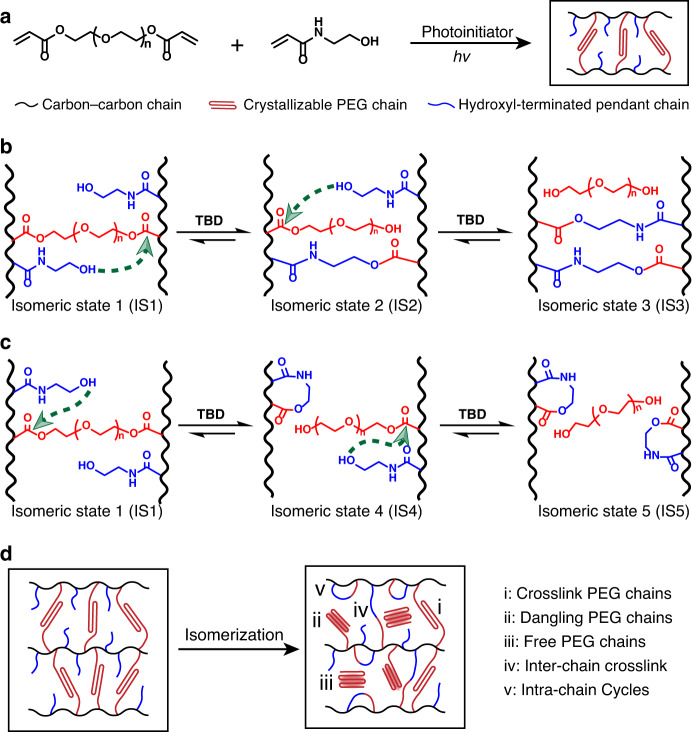
A dynamic covalent PEG-based network can undergo light-regulated topological isomerization via transesterification with pendent hydroxyls, changing crosslinking, dangling/free chains, and crystallinity. This enables programmable thermomechanical properties and custom reversible/triple-shape memory behaviors.
Key findings
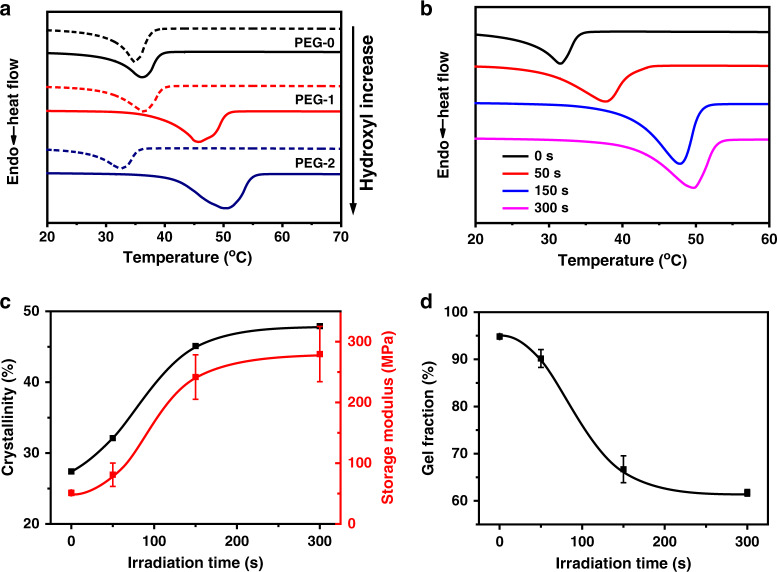
- Thermal isomerization of PEG-X networks (120 °C, 60 min) increased melting temperature and crystallinity for PEG-1 and PEG-2, with higher increase for PEG-2; PEG-0 barely changed. Gel fractions of as-synthesized PEG-0, PEG-1, and PEG-2 were between 95.8% and 94.1%, and after isomerization PEG-1 and PEG-2 reduced to 68.6% and 53.0%, respectively, while PEG-0 remained unchanged.
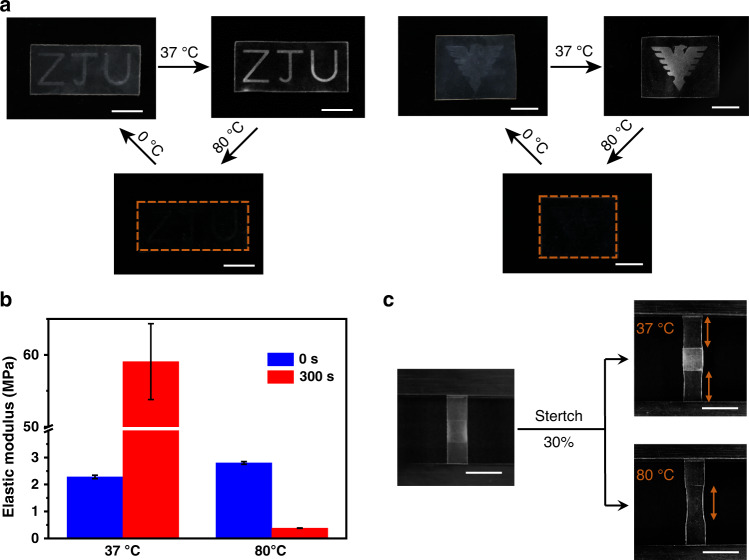
- A photobase generator allowed UV-dose control of isomerization: longer irradiation led to progressively higher Tm, higher crystallinity, higher room-temperature storage modulus, and lower gel fraction. At 37 °C, the non-isomerized region had modulus 25 times that of the isomerized region; at 80 °C, the isomerized region became 7 times softer than the non-isomerized region.
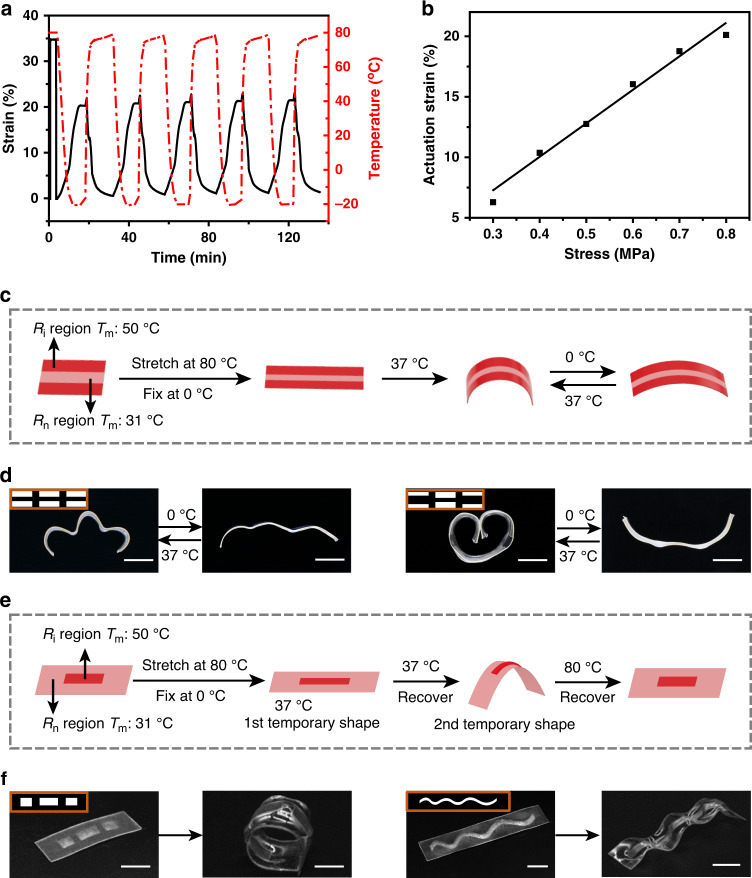
- Non-isomerized PEG-2 showed reversible shape memory between −20 and 80 °C with 20% reversible strain under 0.8 MPa constant stress, and reversible strain decreased linearly with external stress. Patterned isomerization enabled stress-free reversible shape memory between 0 and 37 °C and triple-shape memory, with different 3D shapes produced by light patterns under identical linear stretching of 30%.
Methods
- PEGDA was synthesized from PEG (Mn = 3350), acryloyl chloride, and trimethylamine; networks PEG-X were made by photoinitiated radical polymerization of PEGDA with N-hydroxyethylacrylamide at varied hydroxyl/ester molar ratios. For PEG-2, PEGDA (0.5 g, 0.15 mmol), N-hydroxyethylacrylamide (0.07 g, 0.6 mmol), and Irgacure 2959 (1.5 wt%) were UV irradiated for 180 s at 60 mW/cm².
- A photobase generator was introduced by soaking in 2 wt% PBG toluene solution for 20 min, incorporating 6 wt% PBG; irradiation was applied equally to both sides and reported as summed exposure time. Thermal isomerization was conducted at 120 °C for 60 min initially and at 80 °C for 30 min for light-controlled experiments.
- Characterization included DSC (TA Q200; equilibrate at 80 °C, cool to −50 °C at 5 °C/min, second heating at 5 °C/min), DMA (TA Q800; controlled force and multi-frequency strain at 20 µm, 1 Hz), tensile tests (Zwick/Roell Z005, 10 mm/min, at least three dumbbell specimens), and gel fraction tests by CHCl3 soaking for 24 h.
Limitations
- Stated: direct and quantitative experimental characterization of the complex isomerization is difficult, and the authors suggest future theoretical calculation.
- Stated: Fig. 1b,c are simplified; real networks contain unavoidable defects, and inter- and intra-chain transesterification can occur intermixed, producing more topologies beyond those shown.
- Evident from the text: the experimental demonstration centers on PEG-based networks and focuses on PEG-2 for further thermomechanical investigation, so broader applicability to other dynamic covalent networks is proposed rather than broadly tested.
Model-written summary. Check it against the paper before relying on it.
Integrity signals
Registry
Cites
Statistics
Figures
Verification
Claims the paper makes
4 Valid · 0 Not valid · 4 Not checked · 40 Own results and interpretations
The cited sources support only part of this claim — read each source’s verdict below.
In the paper
“two-stage polymerization typically leads to higher crosslinking densities, without significant other changes.”
§ On demand shape memory polymer via light regulated topological defects in a dynamic covalent network > Discussion
What the sources say
- Partly supportedcites [4] Jin B Programming a crystalline shape memory polymer network with thermo- and photo-reversible bonds toward a single-component soft robot Sci. Adv. 2018 4 eaao3865 29387791 PMC5787381 sourceExperimental — accuracy not yet measured
The Results (page unavailable) say that photo-induced dimerization forms additional network points, which supports the idea of increased crosslinking in this specific network. They also report improved actuation with more dimer linkages, so the paper does not support “without significant other changes.” It does not establish what two-stage polymerization typically does. (LLM, conf=0.86)
- Partly supportedcites [39] Zhang B kowsari K Serjouei A Dunn ML Ge Q Reprocessable thermosets for sustainable three-dimensional printing Nat. Commun. 2018 9 1831 29739944 PMC5940800 sourceExperimental — accuracy not yet measured
The Introduction says crosslinking density increases during the second, heat-triggered stage. But the Results section on reshapability reports substantial other changes: a higher glass-transition temperature and an increase in room-temperature Young’s modulus from 7.4 to about 900 MPa. The paper describes its particular two-stage process, not what two-stage polymerization typically does. (LLM, conf=0.90)
- Not checked — no full text of the sourcecites [40] Luo C Chemomechanics of dual-stage reprocessable thermosets J. Mech. Phys. Solids 2019 126 168 186 source
- Not checked — no full text of the sourcecites [41] Nair DP Two-stage reactive polymer network forming systems Adv. Funct. Mater. 2012 22 1502 1510 PMC3392718 22798700 source
plainstates a cause- Asserted: passes — The authors put it forward as true.
- Checkable: passes — It can be checked against evidence.
- Load-bearing: passes — The paper’s conclusions depend on it.
- Based: passes — The paper gives a reason why it holds.
- Partly supported
The cited sources support only part of this claim — read each source’s verdict below.
In the paper
“These defects affect the macroscopic mechanical and thermomechanical properties in a non-constructive way, but are statistically unavoidable30,31.”
§ On demand shape memory polymer via light regulated topological defects in a dynamic covalent network > Introduction
What the sources say
- Not checked — no full text of the sourcecites [30] Zhong M Wang R Kawamoto K Olsen BD Johnson JA Quantifying the impact of molecular defects on polymer network elasticity Science 2016 353 1264 1268 27634530 source
- Partly supportedcites [31] Wang J Counting loops in sidechain-crosslinked polymers from elastic solids to single-chain nanoparticles Chem. Sci. 2019 10 5332 5337 31191890 PMC6540913 sourceExperimental — accuracy not yet measured
The rheology passage (section labeled Abstract; page unavailable) reports that primary and higher-order loops affect shear storage modulus, and that statistically distributed functional groups can produce strands too short to be elastically effective. It does not establish that dangling and free chains have the claimed effects, address thermomechanical properties, or say that all the listed defects are statistically unavoidable. (LLM, conf=0.84)
plainstates a cause- Asserted: passes — The authors put it forward as true.
- Checkable: passes — It can be checked against evidence.
- Load-bearing: passes — The paper’s conclusions depend on it.
- Based: passes — The paper gives a reason why it holds.
Every source the paper cites for this claim was checked and supports it.
In the paper
“The catalyst amount can be controlled by the light irradiation time.”
§ On demand shape memory polymer via light regulated topological defects in a dynamic covalent network > Results > Programming thermomechanical properties
What the sources say
- Supportedcites [29] Zou W Light-triggered topological programmability in a dynamic covalent polymer network Sci. Adv. 2020 6 eaaz2362 32258406 PMC7101221 source
The Results state that light irradiation releases the TBD catalyst and that its release increases approximately linearly with irradiation time before reaching a plateau at 11 minutes. This supports controlling the amount of released catalyst through irradiation time. (LLM, conf=0.93)
plainstates a cause- Asserted: passes — The authors put it forward as true.
- Checkable: passes — It can be checked against evidence.
- Load-bearing: passes — The paper’s conclusions depend on it.
- Based: passes — The paper gives a reason why it holds.
- Supported
Every source the paper cites for this claim was checked and supports it.
In the paper
“we employ a photobase generator that upon UV irradiation can release a strong organic base 1,5,7-triazabicyclo[4.4.0]dec-5-ene29.”
§ On demand shape memory polymer via light regulated topological defects in a dynamic covalent network > Results > Programming thermomechanical properties
What the sources say
- Supportedcites [29] Zou W Light-triggered topological programmability in a dynamic covalent polymer network Sci. Adv. 2020 6 eaaz2362 32258406 PMC7101221 source
The Results identify TBD as 1,5,7-triazabicyclo[4.4.0]dec-5-ene and state that the photo-latent catalyst releases it upon light irradiation. Materials and Methods specifies UV light for the release experiment. No page numbers are provided in our copy. (LLM, conf=0.93)
plainstates a cause- Asserted: passes — The authors put it forward as true.
- Checkable: passes — It can be checked against evidence.
- Load-bearing: passes — The paper’s conclusions depend on it.
- Based: passes — The paper gives a reason why it holds.
- Supported
A result the paper reports from its own data — it cites no other source for it, so there is none to check. The quote shows it is in the paper.
In the paper
“the melting temperature differences before and after isomerization remain almost identical for PEG-2 and PEG-3.”
§ On demand shape memory polymer via light regulated topological defects in a dynamic covalent network > Results > Programming thermomechanical properties
plain- Asserted: passes — The authors put it forward as true.
- Checkable: passes — It can be checked against evidence.
- Load-bearing: unclear — It is unclear whether the paper’s conclusions depend on it.
- Based: passes — The paper gives a reason why it holds.
26 more claims
Create a free account to see all 48 claims and every source verdict.
- It may state two separate claims as one. 14
- The quote only partly states this claim. 1
- Probably not a substantial claim. 2
Self-check
Percentages, sums and reported differences re-computed from the paper’s own numbers.
Each contradiction between two passages listed here was confirmed by an independent check.
Rated major: it would touch a result — a value a result rests on, reported and recomputed p-values on opposite sides of the significance level, two passages that conflict with no sign which is right, or a cited work retracted before this paper was published.
In the paper
§ On demand shape memory polymer via light regulated topological defects in a dynamic covalent network > Results > Spatio-selective topological isomerization
“At 37 °C, the Rn region is in its crystalline state and the Ri region in its rubbery state.”
§ On demand shape memory polymer via light regulated topological defects in a dynamic covalent network > Results > Spatio-selective topological isomerization
“When the temperature is raised to 37 °C, the contrast between the two regions become more evident due to the selective melting in the Rn region.”
Rated minor: it would not touch a result — a value no result rests on, a p-value that stays on the same side of the significance level, or a conflict that is clerical, resolved elsewhere in the paper, or outside its own findings.
In the paper
§ On demand shape memory polymer via light regulated topological defects in a dynamic covalent network > Results > Spatio-selective topological isomerization
“At 37 °C, the Rn region is in its crystalline state and the Ri region in its rubbery state. Consequently, the modulus of the former is 25 times that of the latter (Fig. 3b).”
§ On demand shape memory polymer via light regulated topological defects in a dynamic covalent network > Results > Spatio-selective topological isomerization
“At 80 °C, both regions are at their rubbery states and their modulus contrast is reversed. The Ri region becomes 7 times softer than the Rn region because of its lower crosslinking density and that the free PEG chains do not contribute to the modulus.”
Citations
Cites
Silica-Like Malleable Materials from Permanent Organic Networks
Montarnal, D., Capelot, M., Tournilhac, F., & Leibler, L. (2011) · Science · doi:10.1126/science.1212648 · Cited by 3,625
Tunable polymer multi-shape memory effect
Xie, T. (2010) · Nature · doi:10.1038/nature08863 · Cited by 1,380
Self-citationVoxelated liquid crystal elastomers
Ware, T. H., McConney, M. E., Wie, J. J., Tondiglia, V. P., & White, T. J. (2015) · Science · doi:10.1126/science.1261019 · Cited by 1,157
Tough and Water‐Insensitive Self‐Healing Elastomer for Robust Electronic Skin
Kang, J., Son, D., Wang, G. N., Liu, Y., Lopez, J., Kim, Y., Oh, J. Y., Katsumata, T., Mun, J., Lee, Y., et al. (2018) · Advanced Materials · doi:10.1002/adma.201706846 · Cited by 1,124
Dynamic Covalent Polymer Networks: from Old Chemistry to Modern Day Innovations
Zou, W., Dong, J., Luo, Y., Zhao, Q., & Xie, T. (2017) · Advanced Materials · doi:10.1002/adma.201606100 · Cited by 1,014
Self-citationScheutz, G. M., Lessard, J. J., Sims, M. B., & Sumerlin, B. S. (2019) · Journal of the American Chemical Society · doi:10.1021/jacs.9b07922 · Cited by 934
Heat‐ or Water‐Driven Malleability in a Highly Recyclable Covalent Network Polymer
Taynton, P., Yu, K., Shoemaker, R. K., Jin, Y., Qi, H. J., & Zhang, W. (2014) · Advanced Materials · doi:10.1002/adma.201400317 · Cited by 890
Mechanically Activated, Catalyst-Free Polyhydroxyurethane Vitrimers
Fortman, D. J., Brutman, J. P., Cramer, C. J., Hillmyer, M. A., & Dichtel, W. R. (2015) · Journal of the American Chemical Society · doi:10.1021/jacs.5b08084 · Cited by 811
Making Insoluble Polymer Networks Malleable via Olefin Metathesis
Lu, Y.-X., Tournilhac, F., Leibler, L., & Guan, Z. (2012) · Journal of the American Chemical Society · doi:10.1021/ja303356z · Cited by 568
Two-Way Reversible Shape Memory in a Semicrystalline Network
Chung, T., Romo-Uribe, A., & Mather, P. T. (2008) · Macromolecules · doi:10.1021/ma071517z · Cited by 531
Research works printed but not linked: 1
- Zheng N Xie T Thermadapt shape memory polymer Acta Polymerica Sin. 2017 11 46 55
Cited by
Zheng, N., Xu, Y., Zhao, Q., & Xie, T. (2021) · Chemical Reviews · doi:10.1021/acs.chemrev.0c00938 · Cited by 1,399
Self-citationMaurin, V., Chang, Y., Ze, Q., Leanza, S., Wang, J., & Zhao, R. R. (2023) · Advanced Materials · doi:10.1002/adma.202302765 · Cited by 161
Biomedical applications of stimuli-responsive “smart” interpenetrating polymer network hydrogels
Wu, J., Xue, W., Yun, Z., Liu, Q., & Sun, X. (2024) · Materials Today Bio · doi:10.1016/j.mtbio.2024.100998 · Cited by 179
“This advanced technique, known as 4D printing, enables the creation of materials that can transform their shape over time through 3D printing [316,320 – 322].”
MethodMechanical behaviors and applications of shape memory polymer and its composites
Zhao, W. D., Li, N., Liu, L., Leng, J., & Liu, Y. (2023) · Applied Physics Reviews · doi:10.1063/5.0126892 · Cited by 128
Wu, Y., Chen, M., Zhao, G., Qi, D., Zhang, X., Li, Y., Huang, Y., & Yang, W. (2024) · Advanced Materials · doi:10.1002/adma.202311717 · Cited by 144
Fang, Z., Shi, Y., Mu, H., Lu, R., Wu, J., & Xie, T. (2023) · Nature Communications · doi:10.1038/s41467-023-37085-9 · Cited by 124
Self-citationReconfigurable 4D printing via mechanically robust covalent adaptable network shape memory polymer
Li, H., Zhang, B., Ye, H., Jian, B., He, X., Cheng, J., Sun, Z., Wang, R., Chen, Z., Lin, J., et al. (2024) · Science Advances · doi:10.1126/sciadv.adl4387 · Cited by 113
“…SMPs have been realized by incorporating thermally or optically induced BERs into the crystalline SMP systems, which mainly consist of high molecular weight linear chains such as polycaprolactone ( 27 – 31 ), polyurethane ( 32 – 35 ), polyethylene glycol ( 36 , 37 ), and others ( 38 – 40 ).”
BackgroundAhn, J., Gu, J., Choi, J., Han, C., Jeong, Y., Park, J., Cho, S., Oh, Y. S., Jeong, J., Amjadi, M., et al. (2022) · Advanced Materials Technologies · doi:10.1002/admt.202200041 · Cited by 98
Feng, P., Yang, F., Jia, J., Zhang, J., Tan, W., & Shuai, C. (2024) · International Journal of Extreme Manufacturing · doi:10.1088/2631-7990/ad7e5f · Cited by 97
Properties and mechanism of two-way shape memory polyurethane composite under stress-free condition
Yang, H., Shi, R., Jiang, Q., & Ren, J. (2022) · Advanced Composites and Hybrid Materials · doi:10.1007/s42114-022-00585-1 · Cited by 83
Weldable and closed-loop recyclable monolithic dynamic covalent polymer aerogels
Zhang, X., Zhao, J. H., Liu, K., Li, G., Zhao, D. X., Zhang, Z., Wan, J., Yang, X., Bai, R., Wang, Y., et al. (2022) · National Science Review · doi:10.1093/nsr/nwac012 · Cited by 82
Podstawczyk, D., Nizioł, M., Szymczyk‐Ziółkowska, P., & Fiedot‐Toboła, M. (2021) · Advanced Functional Materials · doi:10.1002/adfm.202009664 · Cited by 79
ai-corona: Radiologist-assistant deep learning framework for COVID-19 diagnosis in chest CT scans
Yousefzadeh, M., Esfahanian, P., Movahed, M. S., Gorgin, S., Rahmati, D., Kiani, A., Nadji, S. A., Haseli, S., Hoseinyazdi, M., Roshandel, J., et al. (2021) · PLoS ONE · doi:10.1371/journal.pone.0250952 · Cited by 82
Wenjie, Z., Jiang, C., & Wu, D. (2023) · ACS Applied Materials & Interfaces · doi:10.1021/acsami.3c01244 · Cited by 78
Qi, X., Pan, C., Zhang, L., & Yue, D. (2023) · ACS Applied Materials & Interfaces · doi:10.1021/acsami.2c19782 · Cited by 77
Dynamic Semicrystalline Networks of Polypropylene with Thiol-Anhydride Exchangeable Crosslinks
Saed, M. O., Lin, X., & Terentjev, E. M. (2021) · ACS Applied Materials & Interfaces · doi:10.1021/acsami.1c12099 · Cited by 75
Gao, M., Meng, Y., Shen, C. R., & Pei, Q. (2022) · Advanced Materials · doi:10.1002/adma.202109798 · Cited by 73
Zare, M., Davoodi, P., & Ramakrishna, S. (2021) · Nanomaterials · doi:10.3390/nano11040933 · Cited by 75
“used the concept of topological isomerizable network to design a light-triggered SMP based on polyethylene glycol diacrylate (PEGDA) offering ester bonds [74].”
MethodThree-Dimensional Printable, Highly Conductive Ionic Elastomers for High-Sensitivity Iontronics
Li, Q., Liu, Z., Zheng, S., Li, W., Ren, Y., Li, L., & Yan, F. (2022) · ACS Applied Materials & Interfaces · doi:10.1021/acsami.2c06682 · Cited by 69
Guo, H., Ruoko, T., Zeng, H., & Priimägi, A. (2023) · Advanced Functional Materials · doi:10.1002/adfm.202312068 · Cited by 71
Liu, H., Gu, J., Liu, Y., Yang, L., Wang, L., Yu, J., & Qin, X. (2022) · Nano Research · doi:10.1007/s12274-022-4733-4 · Cited by 60
Programming actuation onset of a liquid crystalline elastomer via isomerization of network topology
Chen, G., Feng, H., Zhou, X., Gao, F., Zhou, K., Huang, Y., Jin, B., Xie, T., & Zhao, Q. (2023) · Nature Communications · doi:10.1038/s41467-023-42594-8 · Cited by 76
Self-citationDynamic Bond Chemistry in Soft Materials: Bridging Adaptability and Mechanical Robustness
Lee, H., Kim, J., Lee, M. W., & Kang, J. (2025) · Chemical Reviews · doi:10.1021/acs.chemrev.5c00566 · Cited by 75
Notch signaling in cancer: Complexity and challenges on the path to clinical translation
Ferreira, A. P. A., & Aster, J. C. (2021) · Seminars in Cancer Biology · doi:10.1016/j.semcancer.2021.04.008 · Cited by 56
Miao, W., Yang, B., Jin, B., Ni, C., Feng, H., Xue, Y., Zheng, N., Zhao, Q., Shen, Y., & Xie, T. (2022) · Angewandte Chemie International Edition · doi:10.1002/anie.202109941 · Cited by 53
Self-citationShi, J., Wang, Z., Zheng, T., Liu, X., Guo, B., & Xu, J. (2022) · Materials Horizons · doi:10.1039/d2mh01005d · Cited by 55
Bicontinuous vitrimer heterogels with wide-span switchable stiffness-gated iontronic coordination
Zhao, Z., Cao, Z., Wu, Z., Du, W., Meng, X., Chen, H., Wu, Y., Jiang, L., & Liu, M. (2024) · Science Advances · doi:10.1126/sciadv.adl2737 · Cited by 58
“%) and the wide-span switchable mechanics (with a stiffness ratio exceeding 10 3 ) still cannot be simultaneously coordinated ( 13 , 14 ).”
A light tunable differentiation system for the creation and control of consortia in yeast
Aditya, C., Bertaux, F., Batt, G., & Ruess, J. (2021) · Nature Communications · doi:10.1038/s41467-021-26129-7 · Cited by 55
A Photoorganizable Triple Shape Memory Polymer for Deployable Devices
Sun, J., Peng, B., Lu, Y., Zhang, X., Wei, J., Zhu, C., & Yu, Y. (2021) · Small · doi:10.1002/smll.202106443 · Cited by 52
Cornellà, A. C., Furia, F., Assche, G. V., & Brancart, J. (2024) · Advanced Materials · doi:10.1002/adma.202407663 · Cited by 57
From Molecules to Machines: A Multiscale Roadmap to Intelligent, Multifunctional Soft Robotics
Li, Y., Schreiber, S., Yang, H., Liu, M., Little, J. M., Cao, W., Luo, Y., Bao, Y., Shih, C., Bai, H., et al. (2025) · Chemical Reviews · doi:10.1021/acs.chemrev.4c00972 · Cited by 55
Dynamic Polyamide Networks via Amide–Imide Exchange
Chen, Y., Zhang, H., Majumdar, S., van Benthem, R. A. T. M., Heuts, J. P. A., & Sijbesma, R. P. (2021) · Macromolecules · doi:10.1021/acs.macromol.1c01389 · Cited by 51
Sigmatropic Rearrangements of Polymer Backbones: Vinyl Polymers from Polyesters in One Step
Ditzler, R. A. J., & Zhukhovitskiy, A. V. (2021) · Journal of the American Chemical Society · doi:10.1021/jacs.1c09657 · Cited by 47
Cao, H., Li, Y., Xu, W., Yang, J., Liu, Z., Bai, L., Yang, W. M., & Yang, M. (2022) · ACS Applied Materials & Interfaces · doi:10.1021/acsami.2c15602 · Cited by 42
Zhang, C., Lu, X., Wang, Z., & Xia, H. (2022) · Macromolecular Rapid Communications · doi:10.1002/marc.202100768 · Cited by 46
Wang, D., Tang, Z., Wang, Z., Zhang, L., & Guo, B. (2021) · Polymer Chemistry · doi:10.1039/d1py01287h · Cited by 39
Triple-Bioinspired Shape Memory Microcavities with Strong and Switchable Adhesion
Li, Y., Liu, X., Wang, R., Jiao, S., Liu, Y., Lai, H., & Cheng, Z. (2023) · ACS Nano · doi:10.1021/acsnano.3c06651 · Cited by 44
Learning deep features for dead and living breast cancer cell classification without staining
Pattarone, G., Ación, L., Simian, M., Mertelsmann, R., Follo, M., & Iarussi, E. (2021) · Scientific Reports · doi:10.1038/s41598-021-89895-w · Cited by 47
Xie, L., Wang, Y., Chen, G., Feng, H., Zheng, N., Ren, H., Zhao, Q., & Xie, T. (2021) · Composites Communications · doi:10.1016/j.coco.2021.100979 · Cited by 39
Self-citationDirect 2D-to-3D transformation of pen drawings
Song, S. W., Lee, S., Choe, J. K., Kim, N., Kang, J., Lee, A. C., Choi, Y., Choi, A., Jeong, Y., Lee, W., et al. (2021) · Science Advances · doi:10.1126/sciadv.abf3804 · Cited by 36
Hao, X., Yu, B., Lin, L., Ju, H., Tian, M., & Cao, P. (2024) · Macromolecules · doi:10.1021/acs.macromol.4c00389 · Cited by 35
Covalent adaptable polymer networks with CO2-facilitated recyclability
Chen, J., Li, L., Luo, J., Meng, L., Zhao, X., Song, S., Demchuk, Z., Li, P., He, Y., Sokolov, A. P., et al. (2024) · Nature Communications · doi:10.1038/s41467-024-50738-7 · Cited by 44
“On the other hand, the temporary strategy allows reversible functionalities of CANs by applying or removing an external trigger such as pH, light, and magnet 35 – 37 , which is preferred for addressing such a trade-off.”
New Prospects Arising from Dynamically Crosslinked Polymers: Reprogramming Their Properties
Jia, Y., Qian, J., Hao, S., Zhang, S., Wei, F., Zheng, H., Li, Y., Song, J., & Zhao, Z. (2024) · Advanced Materials · doi:10.1002/adma.202313164 · Cited by 36
Jiang, L., Lei, Y., Xiao, Y., Xu, H., Yuan, A., Wei, Z., Chen, Y., & Lei, J. (2021) · Chemical Engineering Journal · doi:10.1016/j.cej.2020.128354 · Cited by 33
Qiu, Y., Munna, D. R., Wang, F., Xi, J., Wang, Z., & Wu, D. (2021) · Macromolecules · doi:10.1021/acs.macromol.1c00758 · Cited by 31
Gao, J., He, Y.-R., Cong, X., Yi, H., & Guo, J. (2022) · ACS Applied Materials & Interfaces · doi:10.1021/acsami.2c17494 · Cited by 33
Interpenetrating Polymer Networks in Biomedical Fields: Recent Advanced and Applications
Shahi, F., Zarei, S., Othman, R. S., Afshar, H., Kamran, F., Taromi, A. A., & Khonakdar, H. A. (2025) · Polymers for Advanced Technologies · doi:10.1002/pat.70099 · Cited by 33
Adhesive bonding in automotive battery pack manufacturing and dismantling: a review
Rodrigues, V. C., Kasaei, M. M., Marques, E. A. S., Carbas, R. J. C., & da Silva, L. F. M. (2025) · Discover Mechanical Engineering · doi:10.1007/s44245-025-00107-5 · Cited by 36
“Shape memory polymers (SMPs) possess a semi-crystalline network that offers unique properties that make them valuable as temporary adhesives, allowing detachment on demand through external stimuli such as temperature [231–234], UV exposure [235, 236] and Diels-Alder [237].”
Yu, X., Wang, Y., Li, M., Zhang, Y., Huang, Y., Qian, Q., Zheng, Y. H., Hou, Q., & Fan, X. (2023) · ACS Applied Polymer Materials · doi:10.1021/acsapm.3c00017 · Cited by 27
Du, Y., & Wang, D. (2024) · ACS Applied Materials & Interfaces · doi:10.1021/acsami.4c09123 · Cited by 29
Tuning Dual-Dynamic Network Materials through Polymer Architectural Features
Watuthanthrige, N. D. A., Dunn, D., Dolan, M. T., Sparks, J. L., Ye, Z., Zanjani, M. B., & Konkolewicz, D. (2022) · ACS Applied Polymer Materials · doi:10.1021/acsapm.1c01827 · Cited by 28
Lan, L., Li, F., Li, W., Chen, R., Xiong, Z., He, Y., Ouedraogo, N. A. N., Ai, B., Tao, L., Sun, K., et al. (2022) · ACS Applied Materials & Interfaces · doi:10.1021/acsami.2c03596 · Cited by 26
Feng, Z., Chen, S., Ahmad, A., Chen, L., & Bai, W. (2022) · Carbohydrate Polymers · doi:10.1016/j.carbpol.2022.119836 · Cited by 28
Hu, T., Xuan, S., Gao, Y., Shu, Q., Xu, Z., Sun, S., Li, J., & Gong, X. (2021) · Advanced Materials Technologies · doi:10.1002/admt.202100777 · Cited by 29
Li, L., Qin, X., Mei, H., Liu, L., & Zheng, S. (2021) · European Polymer Journal · doi:10.1016/j.eurpolymj.2021.110811 · Cited by 27
Adaptive IR- and Water-Gating Textiles Based on Shape Memory Fibers
Choe, A., Kwon, Y., Shin, Y., Yeom, J., Kim, J., & Ko, H. (2022) · ACS Applied Materials & Interfaces · doi:10.1021/acsami.2c15974 · Cited by 26
Hydration Programmable, Shape Memorable Artificial Muscles for Antagonistic Movements
Cui, Y., Lin, J., Zhai, Y., Xu, C., Chen, C., & Chang, C. (2024) · Advanced Functional Materials · doi:10.1002/adfm.202401005 · Cited by 28
Guo, Y., Xiao, J., Sun, Y., Song, B., Zhang, H., & Dong, B. (2021) · Journal of Materials Chemistry A · doi:10.1039/d1ta00190f · Cited by 22
On-demand catalyst-regulated distinctive topological transformations in a dynamic covalent network
Yang, B., Miao, W., Feng, H., Zhao, Q., Xie, T., & Zheng, N. (2022) · Journal of Materials Chemistry A · doi:10.1039/d2ta05256c · Cited by 18
Self-citationLi, Z., Wang, C., Duan, X., He, X., Wang, F., Ning, C., Wang, M., Qin, Z., Gao, W. Q., & Zhao, S. (2025) · Chemical Engineering Journal · doi:10.1016/j.cej.2025.159437 · Cited by 19
Low-Voltage Actuator with Bilayer Structure for Various Biomimetic Locomotions
Sun, W., Guan, Y., Wang, Y., Wang, T., Xu, Y., Kong, W.-W., Jia, L., Yan, D., & Li, Z. (2021) · ACS Applied Materials & Interfaces · doi:10.1021/acsami.1c14030 · Cited by 19
Ditzler, R. A. J., Rapagnani, R. M., Berney, N. K., Koby, R. F., Krist, E. C., Kruse, B. J., Fokwa, H. D., Tonks, I. A., & Zhukhovitskiy, A. V. (2024) · Journal of the American Chemical Society · doi:10.1021/jacs.4c02917 · Cited by 21
Debnath, S., Upadhyay, C., & Ojha, U. (2022) · ACS Applied Materials & Interfaces · doi:10.1021/acsami.1c24946 · Cited by 19
PVA–Polystyrene-Based Polymer Films with Water-Induced Shape-Memory Effect
Sahoo, S. D., Ravikumar, A., & Prasad, E. (2022) · Industrial & Engineering Chemistry Research · doi:10.1021/acs.iecr.1c04812 · Cited by 19
Versatile Adhesion-Based Gripping via an Unstructured Variable Stiffness Membrane
Luo, A., Pande, S. S., & Turner, K. T. (2022) · Soft Robotics · doi:10.1089/soro.2021.0065 · Cited by 18
Qin, X., Tian, Y., Zhao, H., Wang, J., Zhan, S., Qu, J., Zhang, L., & Liu, J. (2025) · Advanced Materials · doi:10.1002/adma.202515432 · Cited by 26
A DIY Fabrication Approach of Stretchable Sensors Using Carbon Nano Tube Powder for Wearable Device
Wiranata, A., Ohsugi, Y., Minaminosono, A., Mao, Z., Kurata, H., Hosoya, N., & Maeda, S. (2021) · Frontiers in Robotics and AI · doi:10.3389/frobt.2021.773056 · Cited by 17
“, 2021) a shape memory polymer (Besse et al., 2017; Li et al., 2020; Miao et al., 2020; Scalet, 2020; Zeng et al., 2020), and gel actuators (Maeda et al.”
BackgroundHu, Y., Podgórski, M., Mavila, S., Sinha, J., Fairbanks, B. D., McLeod, R. R., & Bowman, C. N. (2023) · Macromolecules · doi:10.1021/acs.macromol.2c02334 · Cited by 17
Sun, W., Guan, Y., Jia, L., Li, Y., Huang, H., Wang, Y., Tang, J., Yan, D., & Li, Z. (2022) · Composites Science and Technology · doi:10.1016/j.compscitech.2022.109399 · Cited by 16
From β-Dicarbonyl Chemistry to Dynamic Polymers
Ma, Y., Weder, C., Prez, F. D., & Berrocal, J. A. (2025) · Chemical Reviews · doi:10.1021/acs.chemrev.5c00307 · Cited by 19
Shi, J., Zheng, T., Yuan, J., Qiu, C., Ha, Y., Zhang, H., Guo, B., & Xu, J. (2024) · Macromolecules · doi:10.1021/acs.macromol.4c02201 · Cited by 18
Li, Z., Zhang, C., Huang, W., Cui, C., Chen, K., He, Z., Xu, T., Teng, H., Ge, Z., Ming, X., et al. (2024) · Chem & Bio Engineering · doi:10.1021/cbe.3c00128 · Cited by 15
Stereochemical Shape Morphing in Diels‐Alder Polymer Networks
Moon, J., Sang, Z., Rajagopalan, K. K., Gardea, F., & Sukhishvili, S. A. (2024) · Small · doi:10.1002/smll.202407858 · Cited by 14
Designing from biobased to closed-loop circularity: Flexible dynamic polyimine-amide networks
Subramaniyan, S., Zhang, B., Syrén, P., & Hakkarainen, M. (2024) · Chemical Engineering Journal · doi:10.1016/j.cej.2024.157632 · Cited by 17
Fulati, A., Uto, K., Iwanaga, M., Watanabe, M., & Ebara, M. (2022) · Advanced Healthcare Materials · doi:10.1002/adhm.202200050 · Cited by 13
Zhao, B., Mei, H., Hang, G., Li, L., & Zheng, S. (2022) · Macromolecules · doi:10.1021/acs.macromol.2c00183 · Cited by 14
Characterization Techniques to Assess Recyclability in Dynamic Polymer Networks
Lagron, A. B., El-Zaatari, B. M., & Hamachi, L. S. (2022) · Frontiers in Materials · doi:10.3389/fmats.2022.915296 · Cited by 16
“DSC has also been utilized to calculate degree of crystallization and melting temperature for crystalline CANs (Miao et al., 2020; Pronoitis et al., 2021).”
MethodZhang, X., Tang, W., Yang, D. S., Ma, J., Li, X., & Tian, G. (2025) · Chemical Engineering Journal · doi:10.1016/j.cej.2025.166372 · Cited by 19
Magneto-Responsive Actuating Surfaces with Controlled Wettability and Optical Transmittance
Lee, S. H., Kang, B. S., & Kwak, M. K. (2022) · ACS Applied Materials & Interfaces · doi:10.1021/acsami.1c24556 · Cited by 14
Wavelength-selective responsive hybrid structures utilizing shape memory poly(aryl ether ketone)
Yang, S., He, Y., Liu, Y., & Leng, J. (2021) · European Polymer Journal · doi:10.1016/j.eurpolymj.2021.110955 · Cited by 12
Isogai, T., & Hayashi, M. (2024) · Macromolecular Rapid Communications · doi:10.1002/marc.202400125 · Cited by 15
Wu, L., Liu, Y., Yang, W., Liu, Z., Liu, C., Yuan, X., Zhang, L., Ju, J., & Yao, X. (2025) · Advanced Science · doi:10.1002/advs.202416173 · Cited by 13
Single-Molecule Force Spectroscopy of a Tetraaryl Succinonitrile Mechanophore
van Galen, M. M., Prathap, K. J., Albada, B., et al. (2022) · The Journal of Physical Chemistry C · doi:10.1021/acs.jpcc.1c09314 · Cited by 11
Yang, S., He, Y., Song, Z., & Li, Y. (2025) · Polymers · doi:10.3390/polym17101360 · Cited by 21
“Therefore, diverse processing methods, easy processing procedure”
Ning, J., Huang, L., Zhao, F., Zhu, W., Yang, Y., Zeng, F., Tian, C., Liu, Q., Lv, J., Cui, M., et al. (2022) · Journal of Polymer Research · doi:10.1007/s10965-022-03114-2 · Cited by 12
Upadhyay, C., & Ojha, U. (2023) · Chemistry - An Asian Journal · doi:10.1002/asia.202201082 · Cited by 10
Jiang, M., Mahmud, N., Koelbl, C. B., Herr, D., & Worch, J. C. (2024) · Journal of Polymer Science · doi:10.1002/pol.20230982 · Cited by 12
Wang, J., Qiang, H., Huang, R., Zhao, D., Tong, Z., Fan, Z., Du, J., & Zhu, Y. (2025) · Advanced Science · doi:10.1002/advs.202503152 · Cited by 10
Enabling Superior Thermo–Oxidative Resistance Elastomers Based on a Structure Recovery Strategy
Xu, C. G., Zhang, H., Li, K., et al. (2021) · Macromolecular Rapid Communications · doi:10.1002/marc.202000762 · Cited by 10
Yang, S., He, Y., & Leng, J. (2021) · Composites Science and Technology · doi:10.1016/j.compscitech.2021.109246 · Cited by 11
Miao, W., Yang, B., Jin, B., Ni, C., Feng, H., Xue, Y., Zheng, N., Zhao, Q., Shen, Y., & Xie, T. (2022) · Angewandte Chemie · doi:10.1002/ange.202109941 · Cited by 9
Self-citationFeng, Y., Li, X., Liu, C., Wang, S., Zhao, S., Yang, J., He, W., & Guo, K. (2024) · ACS Applied Polymer Materials · doi:10.1021/acsapm.4c00160 · Cited by 9
3D-Printed Dual Photo- and Thermally Responsive Materials for Smart Adaptability
Zhang, T., Pacella, G., Chen, K., Ye, T., Portale, G., Voet, V. S. D., Folkersma, R., & Loos, K. (2025) · Macromolecules · doi:10.1021/acs.macromol.5c00567 · Cited by 10
Zhang, G., Zhang, Q., Guo, Z., Li, C., Ge, F., & Zhang, Q. (2023) · Small · doi:10.1002/smll.202306312 · Cited by 10
Chen, Q., Huang, W., Zhang, L., Ganesan, V., & Liu, J. (2024) · Macromolecules · doi:10.1021/acs.macromol.4c01849 · Cited by 9
One-way shape memory polyesters-evolution, growth, developments, and current trends
Basak, S., Dasgupta, P., & Bandyopadhyay, A. (2023) · Polymer-Plastics Technology and Materials · doi:10.1080/25740881.2023.2254372 · Cited by 11
“[51] 55] Table 1 lists some major commercially viable shape memory polyesters and their advantages and disadvantages.”
BackgroundWang, D., Zhang, L., Xu, L., Zhang, X., Cheng, C., & Zhang, A. (2021) · ACS Applied Materials & Interfaces · doi:10.1021/acsami.1c16264 · Cited by 9
Light‐Induced Topological Patterning toward 3D Shape‐Reconfigurable Origami
Hu, W., Ji, M., Chen, T., Wang, S., Tenjimbayashi, M., Sekiguchi, Y., Watanabe, I., Sato, C., & Naito, M. (2022) · Small · doi:10.1002/smll.202107078 · Cited by 9
Wong, J. H. M., Tan, R. P. T., Chang, J. J., Ow, V., Yew, P. Y. M., Chee, P. L., Kai, D., Loh, X. J., & Xue, K. (2022) · Chemistry - An Asian Journal · doi:10.1002/asia.202200628 · Cited by 7
Wang, X., He, Y., Xiao, X., et al. (2024) · Composites Part A Applied Science and Manufacturing · doi:10.1016/j.compositesa.2024.108151 · Cited by 7
Metadata
- Authors
- Miao, W., Zou, W., Jin, B., Ni, C., Zheng, N., Zhao, Q., & Xie, T.
- Affiliations
- State Key Laboratory of Chemical Engineering (CN)
- Corresponding author
- Xie, Tao
- Venue
- Nature Communications
- Published
- 2020-08-26
- Volume
- 11
- Issue
- 1
- Pages
- 4257-4257
- ISSN
- 2041-1723 (ISSN-L)
- PMC
- PMC7450050
- OpenAlex
- W3080538606
- Semantic Scholar
- 657bc2e50c9d8ba044da3481a118073f2d9055ed
- Cited by
- 152
- References
- 42
- Citations by year
- 2026: 21 · 2025: 26 · 2024: 26 · 2023: 17 · 2022: 34 · 2021: 28
- FWCI
- 7.49
- Type
- journal article
- Language
- en
- Open access
- gold
- doi.org
- Licence
- cc-by
- creativecommons.org/licenses/by/4.0 (tdm)
- creativecommons.org/licenses/by/4.0 (vor)
- Locations
- Nature Communications (publishedVersion, cc-by)
- PubMed Central (publishedVersion, cc-by)
- PubMed (publishedVersion)
- RePEc: Research Papers in Economics (submittedVersion)
- DOAJ (DOAJ: Directory of Open Access Journals) (submittedVersion, cc-by-sa)
- Funders
- National Natural Science Foundation of China (51822307, 51673169, 21625402)
- Topics
- Physical Sciences › Materials Science › Polymers and Plastics › Polymer composites and self-healing
- Physical Sciences › Engineering › Mechanical Engineering › Advanced Materials and Mechanics
- Physical Sciences › Chemistry › Organic Chemistry › Supramolecular Chemistry and Complexes
- Keywords
- shape memory polymers, dynamic covalent networks, topological defects, bond exchange, spatiotemporal control
About these checks
Registry, retraction, Cites and statistics results are computed, not judged, with one exception: a printed reference that no index lists is read once by a model before it counts as a citation error. Claims are extracted by a model and kept only when their quote appears verbatim in the text; each cited source is then checked, with a model’s help, for whether it says what the claim relies on. Those verdicts can be wrong — read the claim’s quote and the cited source before relying on one.
The claim verdicts this report counts are experimental: their accuracy is not yet measured.
A language model drew the claims from the paper on 2026-10-10, under version 3 of the claim definition (model deepseek-v4.1-flash, prompt extract-v3).
A second model labelled each claim on 2026-10-10 (model jev-1.13-20260917, definition revision gold-guideline-v0.2).
Cited sources are checked with a language model’s help (gpt-6-sol).
Statistics and arithmetic are recomputed, not judged.
Confidence bands are shown only for fields calibrated on our annotated test set. None is calibrated yet, so no band is shown.
What counts as a claim ›How we measure confidence ›How we check this ›
Are you an author, or do you see a problem with this page? Request a review
Data sources
Bibliographic data: Semantic Scholar, OpenAlex, Crossref.
Contains information from the Semantic Scholar Academic Graph Datasets, made available under the ODC Attribution License (ODC-BY 1.0).
Semantic Scholar’s data is described in: Kinney, R., et al. (2023). The Semantic Scholar Open Data Platform. arXiv:2301.10140.
