

On demand shape memory polymer via light regulated topological defects in a dynamic covalent network
Open accessThe DOI matches its Crossref record; 41 of the 42 references it cites were found in a registry or an index; 5 of the 18 sources its claims cite were checked for support.
Abstract
Applying this strategy to functional shape memory networks yields custom designable multi-shape and reversible shape memory characteristics. This molecular principle expands the design versatility for network polymers, with broad implications in many other areas including soft robotics, flexible electronics, and medical devices.
Overview
CoChat Summary
TL;DR
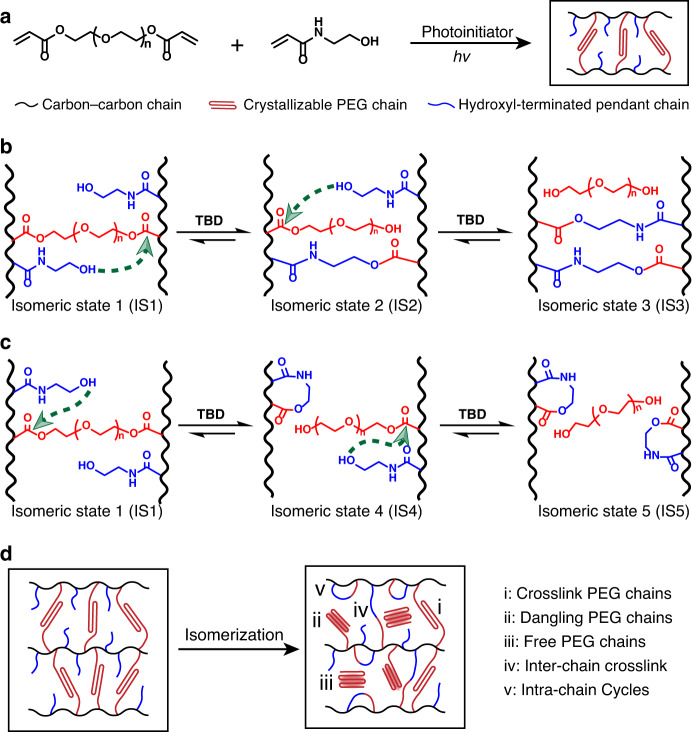
A dynamic covalent PEG-based network can undergo light-regulated topological isomerization via transesterification with pendent hydroxyls, changing crosslinking, dangling/free chains, and crystallinity. This enables programmable thermomechanical properties and custom reversible/triple-shape memory behaviors.
Key findings
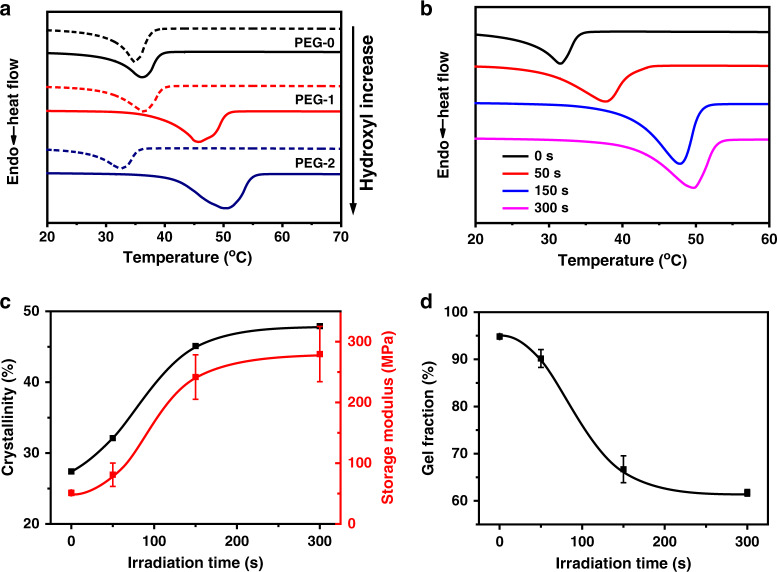
- Thermal isomerization of PEG-X networks (120 °C, 60 min) increased melting temperature and crystallinity for PEG-1 and PEG-2, with higher increase for PEG-2; PEG-0 barely changed. Gel fractions of as-synthesized PEG-0, PEG-1, and PEG-2 were between 95.8% and 94.1%, and after isomerization PEG-1 and PEG-2 reduced to 68.6% and 53.0%, respectively, while PEG-0 remained unchanged.
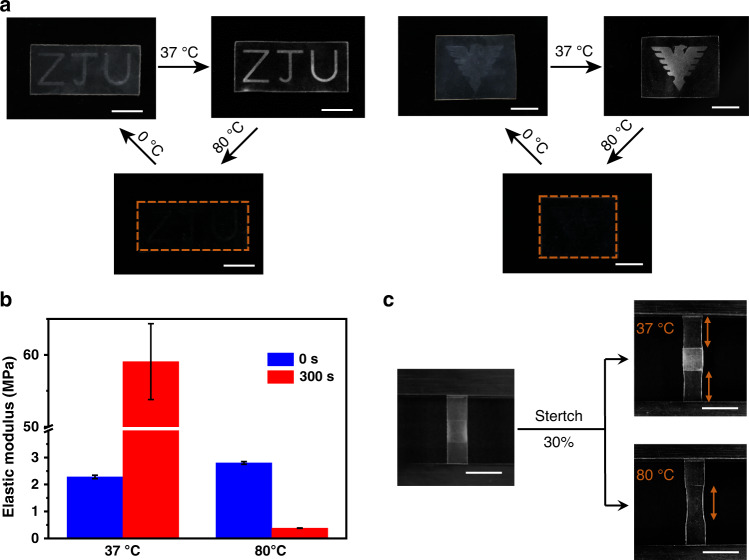
- A photobase generator allowed UV-dose control of isomerization: longer irradiation led to progressively higher Tm, higher crystallinity, higher room-temperature storage modulus, and lower gel fraction. At 37 °C, the non-isomerized region had modulus 25 times that of the isomerized region; at 80 °C, the isomerized region became 7 times softer than the non-isomerized region.
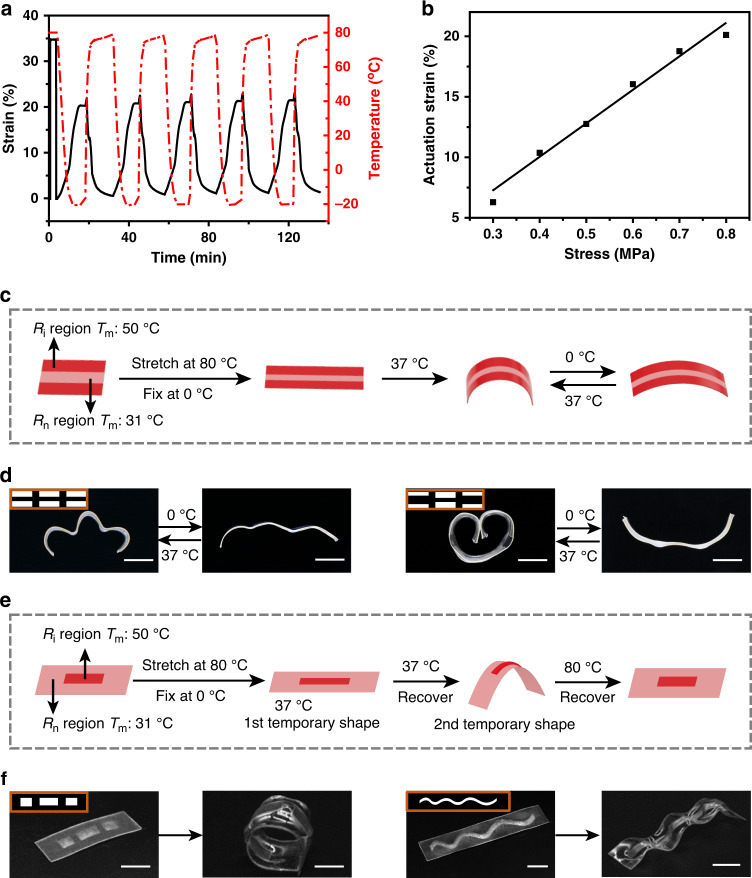
- Non-isomerized PEG-2 showed reversible shape memory between −20 and 80 °C with 20% reversible strain under 0.8 MPa constant stress, and reversible strain decreased linearly with external stress. Patterned isomerization enabled stress-free reversible shape memory between 0 and 37 °C and triple-shape memory, with different 3D shapes produced by light patterns under identical linear stretching of 30%.
Methods
- PEGDA was synthesized from PEG (Mn = 3350), acryloyl chloride, and trimethylamine; networks PEG-X were made by photoinitiated radical polymerization of PEGDA with N-hydroxyethylacrylamide at varied hydroxyl/ester molar ratios. For PEG-2, PEGDA (0.5 g, 0.15 mmol), N-hydroxyethylacrylamide (0.07 g, 0.6 mmol), and Irgacure 2959 (1.5 wt%) were UV irradiated for 180 s at 60 mW/cm².
- A photobase generator was introduced by soaking in 2 wt% PBG toluene solution for 20 min, incorporating 6 wt% PBG; irradiation was applied equally to both sides and reported as summed exposure time. Thermal isomerization was conducted at 120 °C for 60 min initially and at 80 °C for 30 min for light-controlled experiments.
- Characterization included DSC (TA Q200; equilibrate at 80 °C, cool to −50 °C at 5 °C/min, second heating at 5 °C/min), DMA (TA Q800; controlled force and multi-frequency strain at 20 µm, 1 Hz), tensile tests (Zwick/Roell Z005, 10 mm/min, at least three dumbbell specimens), and gel fraction tests by CHCl3 soaking for 24 h.
Limitations
- Stated: direct and quantitative experimental characterization of the complex isomerization is difficult, and the authors suggest future theoretical calculation.
- Stated: Fig. 1b,c are simplified; real networks contain unavoidable defects, and inter- and intra-chain transesterification can occur intermixed, producing more topologies beyond those shown.
- Evident from the text: the experimental demonstration centers on PEG-based networks and focuses on PEG-2 for further thermomechanical investigation, so broader applicability to other dynamic covalent networks is proposed rather than broadly tested.
Model-written summary. Check it against the paper before relying on it.
Integrity signals
Registry
Cites
Statistics
Figures
Verification
Claims the paper makes
4 Valid · 0 Not valid · 4 Not checked · 40 Own results and interpretations
The cited sources support only part of this claim — read each source’s verdict below.
In the paper
“two-stage polymerization typically leads to higher crosslinking densities, without significant other changes.”
§ On demand shape memory polymer via light regulated topological defects in a dynamic covalent network > Discussion
What the sources say
- Partly supportedcites [4] Jin B Programming a crystalline shape memory polymer network with thermo- and photo-reversible bonds toward a single-component soft robot Sci. Adv. 2018 4 eaao3865 29387791 PMC5787381 sourceExperimental — accuracy not yet measured
The Results (page unavailable) say that photo-induced dimerization forms additional network points, which supports the idea of increased crosslinking in this specific network. They also report improved actuation with more dimer linkages, so the paper does not support “without significant other changes.” It does not establish what two-stage polymerization typically does. (LLM, conf=0.86)
- Partly supportedcites [39] Zhang B kowsari K Serjouei A Dunn ML Ge Q Reprocessable thermosets for sustainable three-dimensional printing Nat. Commun. 2018 9 1831 29739944 PMC5940800 sourceExperimental — accuracy not yet measured
The Introduction says crosslinking density increases during the second, heat-triggered stage. But the Results section on reshapability reports substantial other changes: a higher glass-transition temperature and an increase in room-temperature Young’s modulus from 7.4 to about 900 MPa. The paper describes its particular two-stage process, not what two-stage polymerization typically does. (LLM, conf=0.90)
- Not checked — no full text of the sourcecites [40] Luo C Chemomechanics of dual-stage reprocessable thermosets J. Mech. Phys. Solids 2019 126 168 186 source
- Not checked — no full text of the sourcecites [41] Nair DP Two-stage reactive polymer network forming systems Adv. Funct. Mater. 2012 22 1502 1510 PMC3392718 22798700 source
plainstates a cause- Asserted: passes — The authors put it forward as true.
- Checkable: passes — It can be checked against evidence.
- Load-bearing: passes — The paper’s conclusions depend on it.
- Based: passes — The paper gives a reason why it holds.
- Partly supported
The cited sources support only part of this claim — read each source’s verdict below.
In the paper
“These defects affect the macroscopic mechanical and thermomechanical properties in a non-constructive way, but are statistically unavoidable30,31.”
§ On demand shape memory polymer via light regulated topological defects in a dynamic covalent network > Introduction
What the sources say
- Not checked — no full text of the sourcecites [30] Zhong M Wang R Kawamoto K Olsen BD Johnson JA Quantifying the impact of molecular defects on polymer network elasticity Science 2016 353 1264 1268 27634530 source
- Partly supportedcites [31] Wang J Counting loops in sidechain-crosslinked polymers from elastic solids to single-chain nanoparticles Chem. Sci. 2019 10 5332 5337 31191890 PMC6540913 sourceExperimental — accuracy not yet measured
The rheology passage (section labeled Abstract; page unavailable) reports that primary and higher-order loops affect shear storage modulus, and that statistically distributed functional groups can produce strands too short to be elastically effective. It does not establish that dangling and free chains have the claimed effects, address thermomechanical properties, or say that all the listed defects are statistically unavoidable. (LLM, conf=0.84)
plainstates a cause- Asserted: passes — The authors put it forward as true.
- Checkable: passes — It can be checked against evidence.
- Load-bearing: passes — The paper’s conclusions depend on it.
- Based: passes — The paper gives a reason why it holds.
Every source the paper cites for this claim was checked and supports it.
In the paper
“The catalyst amount can be controlled by the light irradiation time.”
§ On demand shape memory polymer via light regulated topological defects in a dynamic covalent network > Results > Programming thermomechanical properties
What the sources say
- Supportedcites [29] Zou W Light-triggered topological programmability in a dynamic covalent polymer network Sci. Adv. 2020 6 eaaz2362 32258406 PMC7101221 source
The Results state that light irradiation releases the TBD catalyst and that its release increases approximately linearly with irradiation time before reaching a plateau at 11 minutes. This supports controlling the amount of released catalyst through irradiation time. (LLM, conf=0.93)
plainstates a cause- Asserted: passes — The authors put it forward as true.
- Checkable: passes — It can be checked against evidence.
- Load-bearing: passes — The paper’s conclusions depend on it.
- Based: passes — The paper gives a reason why it holds.
- Supported
Every source the paper cites for this claim was checked and supports it.
In the paper
“we employ a photobase generator that upon UV irradiation can release a strong organic base 1,5,7-triazabicyclo[4.4.0]dec-5-ene29.”
§ On demand shape memory polymer via light regulated topological defects in a dynamic covalent network > Results > Programming thermomechanical properties
What the sources say
- Supportedcites [29] Zou W Light-triggered topological programmability in a dynamic covalent polymer network Sci. Adv. 2020 6 eaaz2362 32258406 PMC7101221 source
The Results identify TBD as 1,5,7-triazabicyclo[4.4.0]dec-5-ene and state that the photo-latent catalyst releases it upon light irradiation. Materials and Methods specifies UV light for the release experiment. No page numbers are provided in our copy. (LLM, conf=0.93)
plainstates a cause- Asserted: passes — The authors put it forward as true.
- Checkable: passes — It can be checked against evidence.
- Load-bearing: passes — The paper’s conclusions depend on it.
- Based: passes — The paper gives a reason why it holds.
- Supported
A result the paper reports from its own data — it cites no other source for it, so there is none to check. The quote shows it is in the paper.
In the paper
“the melting temperature differences before and after isomerization remain almost identical for PEG-2 and PEG-3.”
§ On demand shape memory polymer via light regulated topological defects in a dynamic covalent network > Results > Programming thermomechanical properties
plain- Asserted: passes — The authors put it forward as true.
- Checkable: passes — It can be checked against evidence.
- Load-bearing: unclear — It is unclear whether the paper’s conclusions depend on it.
- Based: passes — The paper gives a reason why it holds.
26 more claims
Create a free account to see all 48 claims and every source verdict.
- It may state two separate claims as one. 14
- The quote only partly states this claim. 1
- Probably not a substantial claim. 2
Self-check
Percentages, sums and reported differences re-computed from the paper’s own numbers.
Each contradiction between two passages listed here was confirmed by an independent check.
Rated major: it would touch a result — a value a result rests on, reported and recomputed p-values on opposite sides of the significance level, two passages that conflict with no sign which is right, or a cited work retracted before this paper was published.
In the paper
§ On demand shape memory polymer via light regulated topological defects in a dynamic covalent network > Results > Spatio-selective topological isomerization
“At 37 °C, the Rn region is in its crystalline state and the Ri region in its rubbery state.”
§ On demand shape memory polymer via light regulated topological defects in a dynamic covalent network > Results > Spatio-selective topological isomerization
“When the temperature is raised to 37 °C, the contrast between the two regions become more evident due to the selective melting in the Rn region.”
Rated minor: it would not touch a result — a value no result rests on, a p-value that stays on the same side of the significance level, or a conflict that is clerical, resolved elsewhere in the paper, or outside its own findings.
In the paper
§ On demand shape memory polymer via light regulated topological defects in a dynamic covalent network > Results > Spatio-selective topological isomerization
“At 37 °C, the Rn region is in its crystalline state and the Ri region in its rubbery state. Consequently, the modulus of the former is 25 times that of the latter (Fig. 3b).”
§ On demand shape memory polymer via light regulated topological defects in a dynamic covalent network > Results > Spatio-selective topological isomerization
“At 80 °C, both regions are at their rubbery states and their modulus contrast is reversed. The Ri region becomes 7 times softer than the Rn region because of its lower crosslinking density and that the free PEG chains do not contribute to the modulus.”
Citations
Cites
Silica-Like Malleable Materials from Permanent Organic Networks
Montarnal, D., Capelot, M., Tournilhac, F., & Leibler, L. (2011) · Science · doi:10.1126/science.1212648 · Cited by 3,625
Tunable polymer multi-shape memory effect
Xie, T. (2010) · Nature · doi:10.1038/nature08863 · Cited by 1,380
Self-citationVoxelated liquid crystal elastomers
Ware, T. H., McConney, M. E., Wie, J. J., Tondiglia, V. P., & White, T. J. (2015) · Science · doi:10.1126/science.1261019 · Cited by 1,157
Tough and Water‐Insensitive Self‐Healing Elastomer for Robust Electronic Skin
Kang, J., Son, D., Wang, G. N., Liu, Y., Lopez, J., Kim, Y., Oh, J. Y., Katsumata, T., Mun, J., Lee, Y., et al. (2018) · Advanced Materials · doi:10.1002/adma.201706846 · Cited by 1,124
Dynamic Covalent Polymer Networks: from Old Chemistry to Modern Day Innovations
Zou, W., Dong, J., Luo, Y., Zhao, Q., & Xie, T. (2017) · Advanced Materials · doi:10.1002/adma.201606100 · Cited by 1,014
Self-citationScheutz, G. M., Lessard, J. J., Sims, M. B., & Sumerlin, B. S. (2019) · Journal of the American Chemical Society · doi:10.1021/jacs.9b07922 · Cited by 934
Heat‐ or Water‐Driven Malleability in a Highly Recyclable Covalent Network Polymer
Taynton, P., Yu, K., Shoemaker, R. K., Jin, Y., Qi, H. J., & Zhang, W. (2014) · Advanced Materials · doi:10.1002/adma.201400317 · Cited by 890
Mechanically Activated, Catalyst-Free Polyhydroxyurethane Vitrimers
Fortman, D. J., Brutman, J. P., Cramer, C. J., Hillmyer, M. A., & Dichtel, W. R. (2015) · Journal of the American Chemical Society · doi:10.1021/jacs.5b08084 · Cited by 811
Making Insoluble Polymer Networks Malleable via Olefin Metathesis
Lu, Y.-X., Tournilhac, F., Leibler, L., & Guan, Z. (2012) · Journal of the American Chemical Society · doi:10.1021/ja303356z · Cited by 568
Two-Way Reversible Shape Memory in a Semicrystalline Network
Chung, T., Romo-Uribe, A., & Mather, P. T. (2008) · Macromolecules · doi:10.1021/ma071517z · Cited by 531
Research works printed but not linked: 1
- Zheng N Xie T Thermadapt shape memory polymer Acta Polymerica Sin. 2017 11 46 55
Cited by
Items 101–151 of 151
Yang, X., He, X., Wang, L., Zhao, C., Xiang, D., Li, H., Lai, J., Yan, G., Li, Z., Sun, L., et al. (2024) · Chemical Engineering Journal · doi:10.1016/j.cej.2024.151905 · Cited by 8
Delamination‐Resistant and Light‐Induced Shape‐Memory Supercapacitors for Wearable Devices
Zhao, Y., Liang, Q., Wang, C., Mugo, S. M., Karbarz, M., An, L., Lu, Y., & Zhang, Q. (2025) · Advanced Functional Materials · doi:10.1002/adfm.202517205 · Cited by 7
Chen, Y., Li, W., Pu, R., et al. (2025) · Chemical Engineering Journal · doi:10.1016/j.cej.2025.171257 · Cited by 7
Modeling size-dependent thermal-mechanical behaviors of shape memory polymer Timoshenko micro-beam
Zhao, F., Zheng, X., Zhou, S., et al. (2021) · Multidiscipline Modeling in Materials and Structures · doi:10.1108/mmms-12-2020-0290 · Cited by 7
Ding, M., Yuan, W., Xu, S., Yu, C., Zheng, Y., Zhou, J., Shan, G., Bao, Y., & Pan, P. (2022) · ACS Macro Letters · doi:10.1021/acsmacrolett.2c00237 · Cited by 7
A weak but inert hindered urethane bond for high-performance dynamic polyurethane polymers
Wang, F., Gao, W., & Li, C. (2023) · Chinese Chemical Letters · doi:10.1016/j.cclet.2023.109305 · Cited by 6
Computer-controlled ultra high voltage amplifier for dielectric elastomer actuators
Wiranata, A., Mao, Z., Kuwajima, Y., et al. (2023) · Biomimetic Intelligence and Robotics · doi:10.1016/j.birob.2023.100139 · Cited by 6
Topological Programmability of Isomerizable Polymers
Chen, Q., Xia, X., Huang, W., Zhang, L., Ni, R., & Liu, J. (2024) · Physical Review Letters · doi:10.1103/physrevlett.133.048101 · Cited by 8
Impact of Telechelic Polymer Precursors on the Viscoelastic Properties of Vitrimers
Nakamura, Y., Tenjimbayashi, M., Moriya, A., & Naito, M. (2022) · Macromolecular Chemistry and Physics · doi:10.1002/macp.202100433 · Cited by 7
Ikake, H., Hara, S., Kurebayashi, S., et al. (2022) · Journal of Materials Chemistry C · doi:10.1039/d1tc06055d · Cited by 6
Yong, Y., Liu, Y., Zhang, Z., Dai, S., Yang, X., Li, F., & Li, Z. (2024) · Macromolecular Rapid Communications · doi:10.1002/marc.202400105 · Cited by 7
Programming Chain Distribution of Branched Polymers via Bond Exchange Reactions
Chen, Q., Huang, W., Huang, Y., Zhang, L., Ganesan, V., & Liu, J. (2024) · Macromolecules · doi:10.1021/acs.macromol.4c01315 · Cited by 7
Dynamic Covalent Chemistry: A Boon for Closed-Loop Recycling of Polymer Networks
Yang, B., Ni, T., Zhao, Q., Li, Z., & Zheng, N. (2026) · Precision Chemistry · doi:10.1021/prechem.5c00370 · Cited by 8
Self-citationZhang, Y., Ma, W., Zhong, J., Zhou, Z., Yang, H., Cao, Z., & Wang, S. (2023) · Polymer · doi:10.1016/j.polymer.2023.126641 · Cited by 5
Recyclable Polyurea-Urethane Thermosets with De-Crosslinking Capability in Acetic Acid
Tao, X., Yi, W., Xu, X., & Wang, Y. (2022) · Chinese Journal of Polymer Science · doi:10.1007/s10118-022-2872-4 · Cited by 5
Li, X., Hou, Q., Zhang, J., Cui, Q., Xu, S., & Ding, X. (2021) · Polymer Engineering and Science · doi:10.1002/pen.25686 · Cited by 6
Extrudable Thermosets Based on Dynamic Covalent Polymers
Jia, Y., Li, H., Liu, H., Li, C., Li, Y., & Wei, F. (2025) · Chemistry - A European Journal · doi:10.1002/chem.202501165 · Cited by 4
Ghalehney, S. M., Mohammadi, V., Tajdani, M., et al. (2025) · International Conference on Rehabilitation Robotics · doi:10.1109/icorr66766.2025.11063121 · Cited by 3
“Various types of soft actuators have gained attention in this context, including pneumatic actuators, hydraulic systems [2], flexible pumps [3,4], shape memory polymers [5], gel-based actuators [6,7], paper-based soft robots [9], and dielectric elastomer actuators (DEAs) [8-11].”
A Computational Design Framework for Lubrication Interfaces With Active Micro-textures
Pekol, S., Kilinc, O., & Temizer, İ. (2024) · Journal of Tribology · doi:10.1115/1.4066018 · Cited by 3
Sun, W., Sun, H., Jia, L., Lei, J., Lin, H., Tang, J., Wang, Y., & Yan, D. (2022) · Industrial & Engineering Chemistry Research · doi:10.1021/acs.iecr.2c02540 · Cited by 3
Gao, Y., Chen, T., Chen, H., Gao, Z., Yin, L., Luo, Q., Ye, H., Ye, H., & Wu, D. (2025) · ACS Applied Materials & Interfaces · doi:10.1021/acsami.5c04361 · Cited by 2
Camas, K. L., Guzman, C. A. S., Upadhyay, P., Rahman, S. S., & Ullah, A. (2025) · ACS Applied Polymer Materials · doi:10.1021/acsapm.5c02550 · Cited by 2
Kumar, S. V., Ram Prasanth, S., Gopakumar, D. A., Sarath, P. S., Ratheesh, P. M., Kothandaraman, B., Parameswaranpillai, J., & George, J. J. (2025) · Journal of Macromolecular Science Part A · doi:10.1080/10601325.2025.2559271 · Cited by 4
“Therefore, the original networks and the newly formed networks have been considered in this work which hadn’t been [129] considered until now.”
Tailored cocrystal architectures enable highly reversible actuation in crystalline polymer networks
Chi, D., Wu, C., Gu, H., Sun, X., Zhao, R., Zhang, D., Xie, Z., Cheng, Z., & Liu, Y. (2025) · Chemical Engineering Journal · doi:10.1016/j.cej.2025.169166 · Cited by 2
An Elastocaloric Polymer with Ultra‐High Solid‐State Cooling via Defect Engineering
Yu, Z., Xu, D., Usmanova, Z., Ye, C., Swarnkar, A., Scott, E., Huang, S., Rao, S., Liu, X., Boriskina, S. V., et al. (2025) · Advanced Science · doi:10.1002/advs.202518106 · Cited by 2
Mao, Z., Liu, F., Cui, J., Guo, Y., Hu, X., Feng, S., Wang, Z., Lu, Z., Long, X., Yuan, S., et al. (2026) · Polymer Degradation and Stability · doi:10.1016/j.polymdegradstab.2026.112128 · Cited by 2
Li, N., Sun, W., Wang, Y., Yan, D., & Li, Z. (2022) · Polymer · doi:10.1016/j.polymer.2022.125591 · Cited by 2
Shimizu, Y., & Hayashi, M. (2025) · RSC Advances · doi:10.1039/d4ra08285k · Cited by 2
Achieving High‐Strength Polymer Adhesion Through Bond Exchange at the Interphase
Ohnishi, R., & Hayashi, M. (2025) · Macromolecular Rapid Communications · doi:10.1002/marc.202401059 · Cited by 4
Wang, J., Guo, X., Lü, B., Wu, C., Hao, X., Wang, Y., Liu, C., & Shen, C. (2025) · Advanced Functional Materials · doi:10.1002/adfm.202505155 · Cited by 1
Liu, D., Wei, W., Liang, Y., Liu, J., Liu, H., lv, H., & Wang, D. (2026) · Chemical Engineering Journal · doi:10.1016/j.cej.2026.175552 · Cited by 6
Polymeric Multimaterials Enabled by Aza-Michael Addition
Zou, W., Pan, R., & Li, Q. (2026) · Macromolecules · doi:10.1021/acs.macromol.6c00867 · Cited by 1
Self-citationFeng, Z., & Zhao, J. (2026) · Journal of Materials Chemistry C · doi:10.1039/d6tc00795c · Cited by 2
Costa, J. B., Silva‐Correia, J., Reis, R. L., & Oliveira, J. M. (2023) · Elsevier eBooks · doi:10.1016/b978-0-12-823948-3.00026-9 · Cited by 1
Tian, G., Tang, W., Zhang, X., Ma, J., Zhu, G., & Li, X. (2025) · Chemistry of Materials · doi:10.1021/acs.chemmater.5c01486
Molecular Dynamics Simulations of Dynamically Crosslinked Polymer Networks
Zhao, H., & Liu, J. (2025) · Royal Society of Chemistry eBooks · doi:10.1039/9781837676668-00116
Tian, G., Tang, W., Zhang, X., Yang, D., Zhang, X., & Zhu, G. (2026) · Macromolecules · doi:10.1021/acs.macromol.5c02475
Shohraty, F., Agyemang, M. F., Klein, M., Zechel, S., Schmitt, M., Popp, J., & Hager, M. D. (2026) · Journal of Applied Polymer Science · doi:10.1002/app.70595 · Cited by 1
Dual-sprayable, multi-functional hydrogel for effective prevention of peritoneal adhesions
Kim, H., Song, W., Sundaram, M. N., Lee, C., Li, X., So, K., Melero-Martin, J. M., & Hwang, N. S.-Y. (2026) · Journal of Tissue Engineering · doi:10.1177/20417314261427227
“11,12 Solid barriers, such as films or pre-formed hydrogels, may not adhere properly to tissue surfaces and can easily detach due to their excessive stiffness and strength, making them unsuitable for remaining on wounds.”
Shen, A., Chen, B., Wei, W., et al. (2026) · ACS Applied Polymer Materials · doi:10.1021/acsapm.6c01146
Koay, W. L., Mondal, S., Paul, S., Oh, X. Y., Thi, Q. V., Teh, Z. Q., Singh, N. D. P., & Truong, V. X. (2026) · SmartMat · doi:10.1002/smm2.70085
Olfactory-Interactive 4D materials from a carvone-based photocurable resin
Zhang, T., Chen, K., Janssen, K., Voet, V. S. D., Folkersma, R., & Loos, K. (2026) · Virtual and Physical Prototyping · doi:10.1080/17452759.2026.2690309
Dually Cross-linked Polymer Network with Super Toughness and CO2-Facilited Recyclability
Li, L., Wang, Y.-X., Chen, J. Y., et al. (2026) · Mechanisms and machine science · doi:10.1007/978-3-032-11169-2_95
Rapidly Adaptive Aromatic–Aliphatic Polyester Networks Enabled by TBD ‐Catalyzed Bond Exchange
Jyoti, & Singh, P. (2026) · Journal of Polymer Science · doi:10.1002/pola.70248
Bai, Y., Chen, Z. L., Wen, D., Liang, X., Guo, J., Zhang, C., Fan, W., & Li, Y. (2026) · Sensors and Actuators B Chemical · doi:10.1016/j.snb.2026.140465 · Cited by 1
Liu, W., Tian, P. W., Huang, Y., & Zhang, J. (2026) · Macromolecules · doi:10.1021/acs.macromol.6c00604
Du, S., Li, Z., Gan, T., Bai, Z., Li, Y., Chen, Y., Wang, C., Liu, G., Wu, H., Zhou, H., et al. (2026) · Chemical Engineering Journal · doi:10.1016/j.cej.2026.180179
Gong, L., Mu, H., Pu, X., Xu, F., Song, C., Zhao, Q., Chen, J., Wang, W., Fang, Z., Xie, T., et al. (2026) · ACS Applied Materials & Interfaces · doi:10.1021/acsami.6c11998
Self-citationZhao, X., Tang, G., Du, Z., He, X., Yang, C., Li, B., Li, L., Zhao, C., Li, Y., & Wang, Y. (2026) · European Polymer Journal · doi:10.1016/j.eurpolymj.2026.115068
Flash-Sole: A Smart Shoe with Integrated Artificial Muscles for Ankle Push-Off Assistance
Mohmmadi-Ghalehney, S., & Behboodi, A. (2026) · 2022 9th IEEE RAS/EMBS International Conference for Biomedical Robotics and Biomechatronics (BioRob) · doi:10.1109/biorob66782.2026.11681261
“A variety of soft actuator technologies have been explored for wearable robotics, including pneumatic artificial muscles [11], hydraulic [3] cylinders, compact flexible pumps, shape-memory materials, and hydrogel-based devices [12].”
Spatially confined crystallization enables reversible stress imaging in dual-network polymers
Sun, X., Chi, D., Zhang, D., et al. (2026) · Science China Materials · doi:10.1007/s40843-026-4291-0
Metadata
- Authors
- Miao, W., Zou, W., Jin, B., Ni, C., Zheng, N., Zhao, Q., & Xie, T.
- Affiliations
- State Key Laboratory of Chemical Engineering (CN)
- Corresponding author
- Xie, Tao
- Venue
- Nature Communications
- Published
- 2020-08-26
- Volume
- 11
- Issue
- 1
- Pages
- 4257-4257
- ISSN
- 2041-1723 (ISSN-L)
- PMC
- PMC7450050
- OpenAlex
- W3080538606
- Semantic Scholar
- 657bc2e50c9d8ba044da3481a118073f2d9055ed
- Cited by
- 152
- References
- 42
- Citations by year
- 2026: 21 · 2025: 26 · 2024: 26 · 2023: 17 · 2022: 34 · 2021: 28
- FWCI
- 7.49
- Type
- journal article
- Language
- en
- Open access
- gold
- doi.org
- Licence
- cc-by
- creativecommons.org/licenses/by/4.0 (tdm)
- creativecommons.org/licenses/by/4.0 (vor)
- Locations
- Nature Communications (publishedVersion, cc-by)
- PubMed Central (publishedVersion, cc-by)
- PubMed (publishedVersion)
- RePEc: Research Papers in Economics (submittedVersion)
- DOAJ (DOAJ: Directory of Open Access Journals) (submittedVersion, cc-by-sa)
- Funders
- National Natural Science Foundation of China (51822307, 51673169, 21625402)
- Topics
- Physical Sciences › Materials Science › Polymers and Plastics › Polymer composites and self-healing
- Physical Sciences › Engineering › Mechanical Engineering › Advanced Materials and Mechanics
- Physical Sciences › Chemistry › Organic Chemistry › Supramolecular Chemistry and Complexes
- Keywords
- shape memory polymers, dynamic covalent networks, topological defects, bond exchange, spatiotemporal control
About these checks
Registry, retraction, Cites and statistics results are computed, not judged, with one exception: a printed reference that no index lists is read once by a model before it counts as a citation error. Claims are extracted by a model and kept only when their quote appears verbatim in the text; each cited source is then checked, with a model’s help, for whether it says what the claim relies on. Those verdicts can be wrong — read the claim’s quote and the cited source before relying on one.
The claim verdicts this report counts are experimental: their accuracy is not yet measured.
A language model drew the claims from the paper on 2026-10-10, under version 3 of the claim definition (model deepseek-v4.1-flash, prompt extract-v3).
A second model labelled each claim on 2026-10-10 (model jev-1.13-20260917, definition revision gold-guideline-v0.2).
Cited sources are checked with a language model’s help (gpt-6-sol).
Statistics and arithmetic are recomputed, not judged.
Confidence bands are shown only for fields calibrated on our annotated test set. None is calibrated yet, so no band is shown.
What counts as a claim ›How we measure confidence ›How we check this ›
Are you an author, or do you see a problem with this page? Request a review
Data sources
Bibliographic data: Semantic Scholar, OpenAlex, Crossref.
Contains information from the Semantic Scholar Academic Graph Datasets, made available under the ODC Attribution License (ODC-BY 1.0).
Semantic Scholar’s data is described in: Kinney, R., et al. (2023). The Semantic Scholar Open Data Platform. arXiv:2301.10140.
