

Genetic variant effects on gene expression in human pancreatic islets and their implications for T2D
Open accessPublished version of a preprint
The DOI matches its Crossref record; 98 of the 99 references it cites were found in a registry or an index.
Abstract
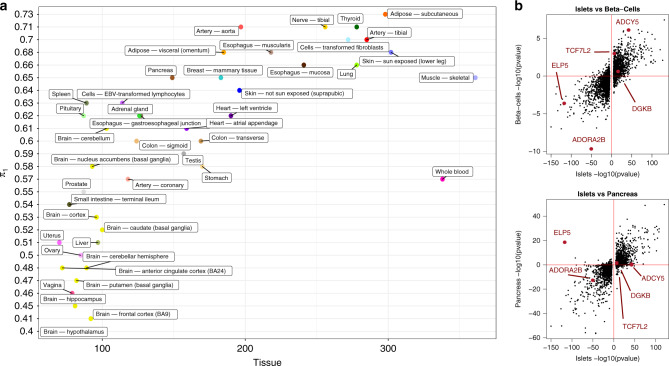
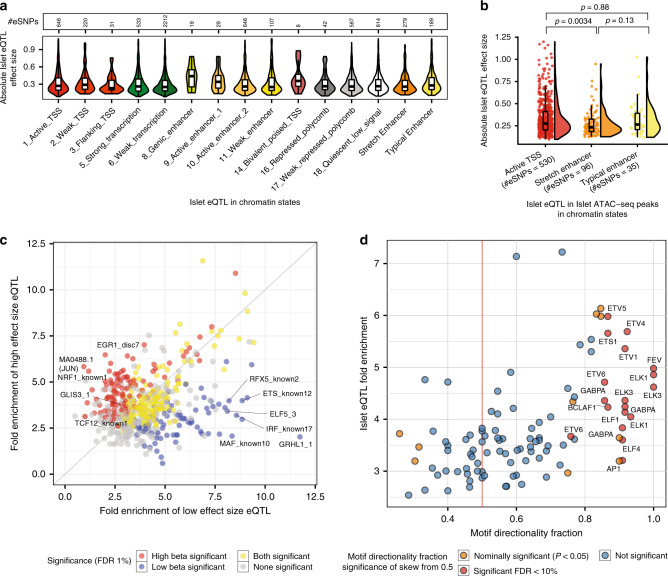
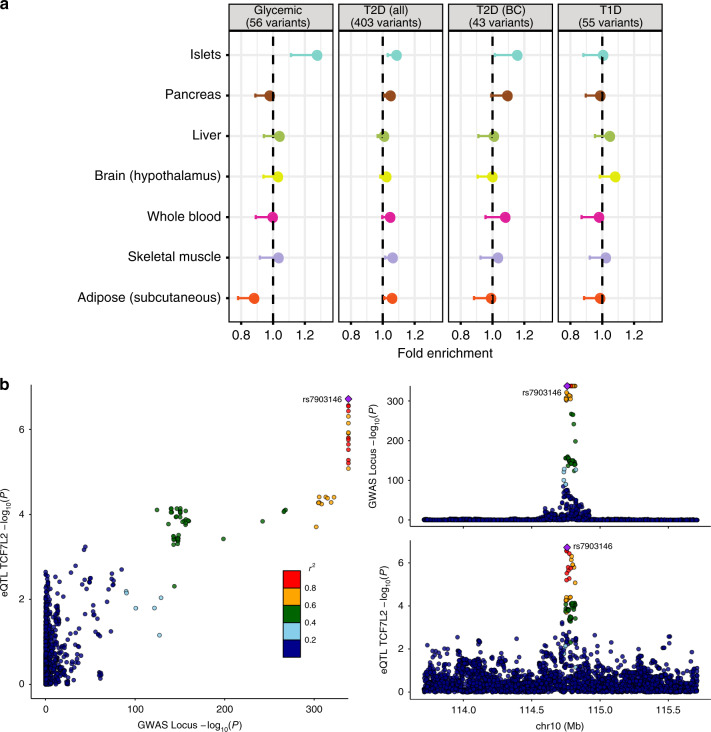
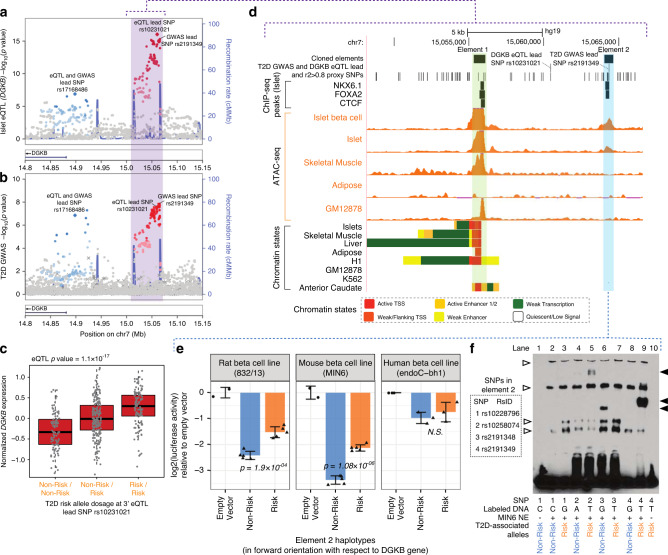
Most signals detected by genome-wide association studies map to non-coding sequence and their tissue-specific effects influence transcriptional regulation. However, key tissues and cell-types required for functional inference are absent from large-scale resources. Here we explore the relationship between genetic variants influencing predisposition to type 2 diabetes (T2D) and related glycemic traits, and human pancreatic islet transcription using data from 420 donors. We find: (a) 7741 cis -eQTLs in islets with a replication rate across 44 GTEx tissues between 40% and 73%; (b) marked overlap between islet cis- eQTL signals and active regulatory sequences in islets, with reduced eQTL effect size observed in the stretch enhancers most strongly implicated in GWAS signal location; (c) enrichment of islet cis- eQTL signals with T2D risk variants identified in genome-wide association studies; and (d) colocalization between 47 islet cis- eQTLs and variants influencing T2D or glycemic traits, including DGKB and TCF7L2 . Our findings illustrate the advantages of performing functional and regulatory studies in disease relevant tissues.
Overview
The claims and statistics of this paper haven’t been checked yet.
Free: it reads the open-access text and checks the first 5 claims that cite a source we can check. Create a free account to check every claim.
Integrity signals
Registry
Cites
Statistics
Figures
Verification
Claims the paper makes
The claims and statistics of this paper haven’t been checked yet.
Free: it reads the open-access text and checks the first 5 claims that cite a source we can check. Create a free account to check every claim.
Claims other papers make about this one
Each is checked against this paper’s own text: does it say what the citing paper says it does?
The check wasn’t confident either way, so it gives no verdict — never disputed.
In the citing paper
“However, the risk alleles in these loci all have relatively small effects and do not significantly enhance our ability to predict the risk of type 2 diabetes (396,397).”
From Guidelines and Recommendations for Laboratory Analysis in the Diagnosis and Management of Diabetes Mellitus (2023) · cites this paper as [396]
Experimental — accuracy not yet measured
Self-check
Percentages, sums and reported differences re-computed from the paper’s own numbers.
The self-check needs the paper’s full text.
Citations
Cites
Fast and accurate short read alignment with Burrows-Wheeler transform
Li, H., & Durbin, R. (2009) · Bioinformatics · doi:10.1093/bioinformatics/btp324 · Cited by 58,607
The Genome Analysis Toolkit: A MapReduce framework for analyzing next-generation DNA sequencing data
McKenna, A., Hanna, M., Banks, E., Sivachenko, A., Cibulskis, K., Kernytsky, A., Garimella, K., Altshuler, D., Gabriel, S., Daly, M., et al. (2010) · Genome Research · doi:10.1101/gr.107524.110 · Cited by 27,895
BEDTools: a flexible suite of utilities for comparing genomic features
Quinlan, A. R., & Hall, I. M. (2010) · Bioinformatics · doi:10.1093/bioinformatics/btq033 · Cited by 27,437
Initial sequencing and analysis of the human genome
International Human Genome Sequencing Consortium, Whitehead Institute for Biomedical Research, C. F. G. R., Lander, E. S., Linton, L. M., Birren, B., Nusbaum, C., Zody, M. C., Baldwin, J., Devon, K., Dewar, K., et al. (2001) · Nature · doi:10.1038/35057062 · Cited by 24,216
Second-generation PLINK: rising to the challenge of larger and richer datasets
Chang, C. C., Chow, C. C., Tellier, L. C., Vattikuti, S., Purcell, S. M., & Lee, J. J. (2015) · Gigascience · doi:10.1186/s13742-015-0047-8 · Cited by 12,709
Analysis of protein-coding genetic variation in 60,706 humans
Exome Aggregation Consortium, Lek, M., Karczewski, K. J., Minikel, E. V., Samocha, K. E., Banks, E., Fennell, T., O’Donnell-Luria, A. H., Ware, J. S., Hill, A. J., et al. (2016) · Nature · doi:10.1038/nature19057 · Cited by 9,587
Self-citationAn integrated map of genetic variation from 1,092 human genomes
The 1000 Genomes Project Consortium (2012) · Nature · doi:10.1038/nature11632 · Cited by 7,711
Buenrostro, J. D., Giresi, P. G., Zaba, L. C., Chang, H. Y., & Greenleaf, W. J. (2013) · Nature Methods · doi:10.1038/nmeth.2688 · Cited by 6,422
Integrative analysis of 111 reference human epigenomes
Roadmap Epigenomics Consortium, Kundaje, A., Meuleman, W., Ernst, J., Bilenky, M., Yen, A., Heravi-Moussavi, A., Kheradpour, P., Zhang, Z., Wang, J., et al. (2015) · Nature · doi:10.1038/nature14248 · Cited by 6,368
A Direct Approach to False Discovery Rates
Storey, J. D. (2002) · Journal of the Royal Statistical Society Series B: Statistical Methodology · doi:10.1111/1467-9868.00346 · Cited by 5,603
Cited by
Trends in insulin resistance: insights into mechanisms and therapeutic strategy
Li, M., Chi, X., Wang, Y., Setrerrahmane, S., Xie, W., & Xu, H. (2022) · Signal Transduction and Targeted Therapy · doi:10.1038/s41392-022-01073-0 · Cited by 939
“Consequently, the contributions of low-frequency and rare genetic variants towards the heritability of IR have also been explored through a combination of both genome and exosome sequencing.(196,197) Such studies have identified a low-frequency variant of CD300LG that is associated with fasting high-density lipoprotei…”
BackgroundMahajan, A., Spracklen, C. N., Zhang, W., Ng, M. C. Y., Petty, L. E., Kitajima, H., Yu, G. Z., Rüeger, S., Speidel, L., Kim, Y. J., et al. (2022) · Nature Genetics · doi:10.1038/s41588-022-01058-3 · Cited by 704
Self-citationMechanisms controlling pancreatic islet cell function in insulin secretion
Campbell, J. E., & Newgard, C. B. (2021) · Nature Reviews Molecular Cell Biology · doi:10.1038/s41580-020-00317-7 · Cited by 629
Sacks, D. B., Arnold, M., Bakris, G. L., Bruns, D. E., Horvath, A. R., Lernmark, Å., Metzger, B. E., Nathan, D. M., & Kirkman, M. S. (2023) · Diabetes Care · doi:10.2337/dci23-0036 · Cited by 351
Physiological and pathological roles of lipogenesis
Jeon, Y. G., Kim, Y. Y., Lee, G., & Kim, J. B. (2023) · Nature Metabolism · doi:10.1038/s42255-023-00786-y · Cited by 243
Sacks, D. B., Arnold, M. A., Bakris, G. L., Bruns, D. E., Horvath, A. R., Lernmark, Å., Metzger, B. E., Nathan, D. M., & Kirkman, M. S. (2023) · Clinical Chemistry · doi:10.1093/clinchem/hvad080 · Cited by 208
Insights from multi-omics integration in complex disease primary tissues
Kreitmaier, P., Katsoula, G., & Zeggini, E. (2023) · Trends in Genetics · doi:10.1016/j.tig.2022.08.005 · Cited by 161
Wigger, L., Barovic, M., Brunner, A.-D., Marzetta, F., Schöniger, E., Mehl, F., Kipke, N., Friedland, D., Burdet, F., Kessler, C., et al. (2021) · Nature Metabolism · doi:10.1038/s42255-021-00420-9 · Cited by 161
Rai, V., Quang, D. X., Erdos, M. R., Cusanovich, D. A., Daza, R. M., Narisu, N., Zou, L. S., Didion, J. P., Guan, Y., Shendure, J., et al. (2020) · Molecular Metabolism · doi:10.1016/j.molmet.2019.12.006 · Cited by 140
Self-citationInsights into pancreatic islet cell dysfunction from type 2 diabetes mellitus genetics
Krentz, N. A. J., & Gloyn, A. L. (2020) · Nature Reviews Endocrinology · doi:10.1038/s41574-020-0325-0 · Cited by 144
Self-citationMarselli, L., Piron, A., Suleiman, M., Colli, M. L., Yi, X., Khamis, A., Carrat, G., Rutter, G. A., Bugliani, M., Giusti, L., et al. (2020) · Cell Reports · doi:10.1016/j.celrep.2020.108466 · Cited by 135
TIGER: The gene expression regulatory variation landscape of human pancreatic islets
Alonso, L., Piron, A., Morán, I., Guindo-Martínez, M., Bonàs‐Guarch, S., Atla, G., Miguel-Escalada, I., Royo, R., Puiggròs, M., Garcia-Hurtado, X., et al. (2021) · Cell Reports · doi:10.1016/j.celrep.2021.109807 · Cited by 104
“To obtain a relevant comparison with the InsPIRE (Viñuela et al., 2020) dataset, we first applied the same multiple-testing correction method used in this study to the full nominal p values of the InsPIRE dataset.”
BackgroundMethodResultInfluentialSelf-citationGenetic risk converges on regulatory networks mediating early type 2 diabetes
Walker, J. T., Saunders, D. C., Rai, V., Chen, H., Orchard, P., Dai, C., Pettway, Y. D., Hopkirk, A. L., Reihsmann, C., Tao, Y., et al. (2023) · Nature · doi:10.1038/s41586-023-06693-2 · Cited by 94
“Seven islet RFX6 expression quantitative trait loci (eQTLs) with low pairwise linkage disequilibrium ( r 2 < 0.2) from the Integrated Network for Systemic analysis of Pancreatic Islet RNA Expression (InsPIRE) study 27 ( n = 420 donors; Supplementary Fig.”
InfluentialSelf-citationDelineating mouse β-cell identity during lifetime and in diabetes with a single cell atlas
Hrovatin, K., Bastidas-Ponce, A., Bakhti, M., Zappia, L., Büttner, M., Salinno, C., Sterr, M., Böttcher, A., Migliorini, A., Lickert, H., et al. (2023) · Nature Metabolism · doi:10.1038/s42255-023-00876-x · Cited by 86
Alsheikh, A. J., Wollenhaupt, S., King, E. A., Reeb, J., Ghosh, S., Stolzenburg, L. R., Tamim, S., Lazar, J., Davis, J. W., & Jacob, H. J. (2022) · BMC Medical Genomics · doi:10.1186/s12920-022-01216-w · Cited by 88
The TCF7L2 Locus: A Genetic Window Into the Pathogenesis of Type 1 and Type 2 Diabetes
Grant, S. F. A. (2019) · Diabetes Care · doi:10.2337/dci19-0001 · Cited by 91
The β Cell in Diabetes: Integrating Biomarkers With Functional Measures
Kahn, S. E., Chen, Y., Esser, N., Taylor, A. J., van Raalte, D. H., Zraika, S., & Verchere, C. B. (2021) · Endocrine Reviews · doi:10.1210/endrev/bnab021 · Cited by 80
“Finally, heterogeneity in the function of individual β cells within the islet, differences in the mass of β cells between individuals with and without type 2 diabetes, and the effect of gene variants on gene expression are also all likely to contribute to variation in β-cell function (113, 149-153).”
BackgroundWan, X.-X., Zhang, D.-Y., Khan, M. A., Zheng, S.-Y., Hu, X., Zhāng, Q., Yang, R., & Xiong, K. (2022) · Frontiers in Endocrinology · doi:10.3389/fendo.2022.859638 · Cited by 78
Identification of genetic effects underlying type 2 diabetes in South Asian and European populations
Loh, M. C. S., Zhang, W., Ng, H. K., Schmid, K., Lamri, A., Lin, T., Ahmad, M., Lee, J., Ng, M. C. Y., Petty, L. E., et al. (2022) · Communications Biology · doi:10.1038/s42003-022-03248-5 · Cited by 75
Self-citationWeng, C., Xi, J., Li, H., Cui, J., Gu, A., Lai, S., Leskov, K., Ke, L., Jin, F., & Li, Y. (2020) · Nature Metabolism · doi:10.1038/s42255-020-00314-2 · Cited by 65
Rottner, A. K., Ye, Y., Navarro‐Guerrero, E., Rajesh, V., Pollner, A., Bevacqua, R. J., Yang, J., Spigelman, A. F., Baronio, R., Bautista, A., et al. (2022) · Nature Genetics · doi:10.1038/s41588-022-01261-2 · Cited by 69
Self-citationHumanIslets.com: Improving accessibility, integration, and usability of human research islet data
Ewald, J., Lu, Y. P., Ellis, C. E., Worton, J., Kolic, J., Sasaki, S., Zhang, D., dos Santos, T., Spigelman, A. F., Bautista, A., et al. (2024) · Cell Metabolism · doi:10.1016/j.cmet.2024.09.001 · Cited by 62
Self-citationIslet Gene View—a tool to facilitate islet research
Asplund, O., Storm, P., Chandra, V., Hatem, G., Ottosson-Laakso, E., Aly, D. M., Krus, U., Ibrahim, H., Ahlqvist, E., Tuomi, T., et al. (2022) · Life Science Alliance · doi:10.26508/lsa.202201376 · Cited by 59
Self-citationRegulatory variants in TCF7L2 are associated with thoracic aortic aneurysm
Roychowdhury, T., Lu, H., Hornsby, W., Crone, B., Wang, G. T., Guo, D., Sendamarai, A. K., Devineni, P., Lin, M., Zhou, W., et al. (2021) · The American Journal of Human Genetics · doi:10.1016/j.ajhg.2021.06.016 · Cited by 58
“Common variants (rs7903146, index variant) in this locus are nal of Human Genetics 108, 1578–1589, September 2, 2021 1585 the strongest known genetic risk factor for T2D.42 Vinuela et al.55 demonstrated that the T2D risk allele of rs7903146 decreases pancreatic islet expression of the last (30) exon of TCF7L2.”
BackgroundBacos, K., Perfilyev, A., Karagiannopoulos, A., Cowan, E., Ofori, J. K., Bertonnier‐Brouty, L., Rönn, T., Lindqvist, A., Luan, C., Ruhrmann, S., et al. (2023) · Journal of Clinical Investigation · doi:10.1172/jci163612 · Cited by 57
“, islet purity, that were not available or used in the INSPIRE study (17), and since we used a cutoff for islet purity, we also performed an eQTL analysis adjusting for age, sex, BMI, DIC, purity, and T2D in the LUDC islet case-control cohort.”
Self-citationXue, D., Narisu, N., Taylor, D. L., Zhang, M., Grenko, C. M., Taylor, H. J., Yan, T., Tang, X., Sinha, N., Zhu, J., et al. (2023) · Cell Metabolism · doi:10.1016/j.cmet.2023.09.013 · Cited by 53
Self-citationArthur, T. D., Nguyen, J., Henson, B. A., D’Antonio‐Chronowska, A., Jaureguy, J., Silva, N., Arias, A. D., Benaglio, P., Berggren, W. T., Borja, V., et al. (2025) · Cell Genomics · doi:10.1016/j.xgen.2025.100775 · Cited by 54
Brown, A. A., Fernandez-Tajes, J. J., Hong, M., Brorsson, C., Koivula, R. W., Davtian, D., Dupuis, T., Sartori, A., Michalettou, T.-D., Forgie, I. M., et al. (2023) · Nature Communications · doi:10.1038/s41467-023-40569-3 · Cited by 58
Self-citationLoci for insulin processing and secretion provide insight into type 2 diabetes risk
Broadaway, K. A., Yin, X., Williamson, A., Parsons, V. A., Wilson, E. P., Moxley, A. H., Vadlamudi, S., Varshney, A., Jackson, A., Ahuja, V., et al. (2023) · The American Journal of Human Genetics · doi:10.1016/j.ajhg.2023.01.002 · Cited by 47
Self-citationWesolowska‐Andersen, A., Yu, G. Z., Nylander, V., Abaitua, F., Thurner, M., Torres, J., Mahajan, A., Gloyn, A. L., & McCarthy, M. I. (2020) · eLife · doi:10.7554/elife.51503 · Cited by 49
Self-citationThe landscape of expression and alternative splicing variation across human traits
García-Pérez, R., Ramírez, J. M., Ripoll-Cladellas, A., Chazarra-Gil, R., Oliveros, W., Soldatkina, O., Bosio, M., Rognon, P. J., Capella-Gutiérrez, S., Calvo, M., et al. (2022) · Cell Genomics · doi:10.1016/j.xgen.2022.100244 · Cited by 61
“Pancreas had fewer DEGs than nerve, likely because pancreatic islets, central to the etiology of both types of diabetes,(84,85) represent only 3% of the tissue, and thus, the whole pancreas is not representative of pancreatic islets.(29,86) The observation that there are many genes associated with diabetes in other ti…”
BackgroundDevelopments in data science solutions for carnivore tooth pit classification
Courtenay, L. A., Herranz‐Rodrigo, D., González‐Aguilera, D., & Yravedra, J. (2021) · Scientific Reports · doi:10.1038/s41598-021-89518-4 · Cited by 51
Genetic underpinning of the comorbidity between type 2 diabetes and osteoarthritis
Arruda, A. L., Hartley, A. E., Katsoula, G., Smith, G. D., Morris, A. P., & Zeggini, E. (2023) · The American Journal of Human Genetics · doi:10.1016/j.ajhg.2023.06.010 · Cited by 52
“For type 2 diabetes, we used eQTL data from pancreatic islets from the InsPIRE consortium.(18) In the pancreatic islets dataset, 37 individuals out of 420 were diabetic.”
MethodSex-stratified genome-wide association meta-analysis of major depressive disorder
Thomas, J. T., Thorp, J. G., Huider, F., Grimes, P. Z., Wang, R., Youssef, P., Coleman, J. R. I., Byrne, E. M., Adams, M. J., van Loo, H. M., et al. (2025) · Nature Communications · doi:10.1038/s41467-025-63236-1 · Cited by 45
Diabetes mellitus and the key role of endoplasmic reticulum stress in pancreatic β cells
Lytrivi, M., Tong, Y. A., Virgilio, E., Yi, X., & Cnop, M. (2025) · Nature Reviews Endocrinology · doi:10.1038/s41574-025-01129-5 · Cited by 45
“This approach identified a T2DM risk variant that increases islet EIF3C expression 164 .”
From Genetic Association to Molecular Mechanisms for Islet-cell Dysfunction in Type 2 Diabetes
Mattis, K. K., & Gloyn, A. L. (2020) · Journal of Molecular Biology · doi:10.1016/j.jmb.2019.12.045 · Cited by 41
Self-citationBenaglio, P., Zhu, H., Okino, M.-L., Yan, J., Elgamal, R. M., Nariai, N., Beebe, E., Korgaonkar, K., Qiu, Y., Donovan, M. K. R., et al. (2022) · Cell Genomics · doi:10.1016/j.xgen.2022.100214 · Cited by 42
Khetan, S., Kales, S., Kursawe, R., Jillette, A., Ulirsch, J. C., Reilly, S. K., Ucar, D., Tewhey, R., & Stitzel, M. L. (2021) · Nature Communications · doi:10.1038/s41467-021-25514-6 · Cited by 41
Self-citationTorres, J., Abdalla, M., Payne, A., Fernandez-Tajes, J. J., Thurner, M., Nylander, V., Gloyn, A. L., Mahajan, A., & McCarthy, M. I. (2020) · The American Journal of Human Genetics · doi:10.1016/j.ajhg.2020.10.009 · Cited by 39
“In human studies, variation at rs7903146 has been associated with chromatin accessibility and TCF7L2 gene expression in islets.(19,28) However, TCF7L2 activation also regulates Wnt signaling during adipogenesis, and in vivo deactivation of TCF7L2 protein in mature adipocytes results in hepatic insulin resistance and s…”
BackgroundSelf-citationSchlosser, P., Zhang, J., Liu, H., Surapaneni, A., Rhee, E. P., Arking, D. E., Yu, B., Boerwinkle, E., Welling, P. A., Chatterjee, N., et al. (2023) · Genome biology · doi:10.1186/s13059-023-02993-y · Cited by 40
“Hence, we extracted the eQTL / pQTL and kidney function / damage summary statistics for the underlying genes with a 250-kb flanking region [48] and identified independent associations based on approximate conditional analyses by the GCTA COJO-Slct algorithm, a step-wise-forward-selection approach (P conditional < 5 ×…”
MethodEvery islet matters: improving the impact of human islet research
Gloyn, A. L., Ibberson, M. R., Marchetti, P., Powers, A. C., Rorsman, P., Sander, M., & Solimena, M. (2022) · Nature Metabolism · doi:10.1038/s42255-022-00607-8 · Cited by 37
Self-citationTaylor, H. J., Hung, Y.-H., Narisu, N., Erdos, M. R., Kanke, M., Yan, T., Grenko, C. M., Swift, A. J., Bonnycastle, L. L., Sethupathy, P., et al. (2023) · Proceedings of the National Academy of Sciences · doi:10.1073/pnas.2206797120 · Cited by 36
“Next, we looked for trans-associations between rs174559 and protein coding genes in 228 samples [39 samples from this study and 189 samples from an independent dataset (33)] as trans-eQTL summary statistics from previous islet eQTL studies were not available (Materials and Methods).”
MethodInfluentialSelf-citationThe role of transcription factor 7‐like 2 in metabolic disorders
Zhang, Z., Xu, L. L., & Xu, X. (2020) · Obesity Reviews · doi:10.1111/obr.13166 · Cited by 35
HiChIPdb: a comprehensive database of HiChIP regulatory interactions
Zeng, W., Liu, Q., Yin, Q., Jiang, R., & Wong, W. H. (2022) · Nucleic Acids Research · doi:10.1093/nar/gkac859 · Cited by 33
Aylward, A., Okino, M.-L., Benaglio, P., Chiou, J., Beebe, E., Padilla, J. A., Diep, S., & Gaulton, K. J. (2021) · PLoS Genetics · doi:10.1371/journal.pgen.1009531 · Cited by 33
“We obtained islet expression QTL data from a published study [82].”
MethodGenetic regulation of RNA splicing in human pancreatic islets
Atla, G., Bonàs‐Guarch, S., Cuenca-Ardura, M., Beucher, A., Crouch, D. J. M., García-Hurtado, J., Morán, I., Cnop, M., Eliasson, L., Esguerra, J. L. S., et al. (2022) · Genome biology · doi:10.1186/s13059-022-02757-0 · Cited by 32
“6-fold change relative to the largest islet eQTL analysis so far [12] (Fig.”
BackgroundMethodResultInfluentialSelf-citationMolecular Mechanism of Pancreatic β-Cell Failure in Type 2 Diabetes Mellitus
Kaneto, H., Kimura, T., Shimoda, M., Obata, A., Sanada, J., Fushimi, Y., Matsuoka, T., & Kaku, K. (2022) · Biomedicines · doi:10.3390/biomedicines10040818 · Cited by 33
Diabetes mellitus polygenic risk scores: heterogeneity and clinical translation
Ortega, H. I., Udler, M. S., Gloyn, A. L., & Sharp, S. A. (2025) · Nature Reviews Endocrinology · doi:10.1038/s41574-025-01132-w · Cited by 32
Self-citationFoote, I. F., Flint, J. P., Fürtjes, A. E., Lawrence, J. M., Mullin, D. S., Fisk, J. D., Karakach, T. K., Rutenberg, A. D., Martin, N. G., Lupton, M. K., et al. (2025) · Nature Genetics · doi:10.1038/s41588-025-02269-0 · Cited by 29
Estimation and implications of the genetic architecture of fasting and non-fasting blood glucose
Qiao, Z., Sidorenko, J., Revez, J. A., Xue, A., Lu, X., Pärna, K., Snieder, H., Study, L. C., Visscher, P. M., Wray, N. R., et al. (2023) · Nature Communications · doi:10.1038/s41467-023-36013-1 · Cited by 27
Fine mapping spatiotemporal mechanisms of genetic variants underlying cardiac traits and disease
D’Antonio, M., Nguyen, J., Arthur, T. D., Arias, A. D., Arthur, T. D., Benaglio, P., Berggren, W. T., Borja, V., Belmonte, J. C. I., Cook, M., et al. (2023) · Nature Communications · doi:10.1038/s41467-023-36638-2 · Cited by 29
Kaur, S., Mirza, A. H., Overgaard, A. J., Pociot, F., & Størling, J. (2021) · Frontiers in Genetics · doi:10.3389/fgene.2021.630109 · Cited by 28
“Recently, Viñuela et al. (2020) profiled and genotyped human islet samples from 420 human organ donors as a part of Integrated Network for Systematic analysis of Pancreatic Islet RNA Expression (InsPIRE) consortium (Viñuela et al., 2020).”
BackgroundMethodInfluentialPancreatic Islet Transcriptional Enhancers and Diabetes
Cebola, I. (2019) · Current Diabetes Reports · doi:10.1007/s11892-019-1230-6 · Cited by 28
Deep single-cell decoding of human pancreatic islets reveals T2D β-cell gene expression defects
Bandesh, K., Motakis, E., Nargund, S., Kursawe, R., Selvam, V., Ansarullah, Bhuiyan, R. M., Eryilmaz, G. N., Willett, A., White, J. K., et al. (2026) · The EMBO Journal · doi:10.1038/s44318-026-00744-w · Cited by 30
“ND β -cell differential expression, including DGKB, ST6GAL1 , and STARD10 , reported as colocalized T2D genetic and islet eQTL association signals showing directionally consistent impact on gene expression (Alonso et al, 2021; Viñuela et al, 2020; van de Bunt et al, 2015).”
Self-citationFunctional Characterization of Genetic Variant Effects on Expression
Flynn, E. D., & Lappalainen, T. (2022) · Annual Review of Biomedical Data Science · doi:10.1146/annurev-biodatasci-122120-010010 · Cited by 29
From omics to AI —mapping the pathogenic pathways in type 2 diabetes
O’Sullivan, S., Qi, L., & Zalloua, P. (2025) · FEBS Letters · doi:10.1002/1873-3468.70115 · Cited by 28
“By examining chromatin accessibility, gene expression, and functional states in individual b -cells from non-diabetic, prediabetic, and T2D individuals, single-cell genomics can link specific genetic variants to disease mechanisms [43,52].”
Genetics of Type 2 Diabetes: Opportunities for Precision Medicine
Kim, D. S., Gloyn, A. L., & Knowles, J. W. (2021) · Journal of the American College of Cardiology · doi:10.1016/j.jacc.2021.03.346 · Cited by 27
Self-citationAsadi, F., & Dhanvantari, S. (2021) · Frontiers in Endocrinology · doi:10.3389/fendo.2021.726368 · Cited by 28
DICORPO, D. A., Gaynor, S. M., Russell, E. M., Westerman, K. E., Raffield, L. M., Majarian, T. D., Wu, P., Sarnowski, C., Highland, H. M., Jackson, A., et al. (2022) · Communications Biology · doi:10.1038/s42003-022-03702-4 · Cited by 26
Self-citationCOLOCdb: a comprehensive resource for multi-model colocalization of complex traits
Pan, S., Kang, H., Liu, X., Li, S., Yang, P., Wu, M., Yuan, N., Lin, S., Zheng, Q., & Jia, P. (2023) · Nucleic Acids Research · doi:10.1093/nar/gkad939 · Cited by 25
Cross-cohort analysis of expression and splicing quantitative trait loci in TOPMed
Orchard, P., Blackwell, T. W., Kachuri, L., Castaldi, P. J., Cho, M. H., Christenson, S. A., Durda, P., Gabriel, S., Hersh, C. P., Huntsman, S., et al. (2026) · Science · doi:10.1126/science.adx2989 · Cited by 24
Self-citationThe human batokine EPDR1 regulates β-cell metabolism and function
Cataldo, L. R., Gao, Q., Argemi‐Muntadas, L., Hodek, O., Cowan, E., Hladkou, S., Gheibi, S., Spégel, P., Prasad, R. B., Eliasson, L., et al. (2022) · Molecular Metabolism · doi:10.1016/j.molmet.2022.101629 · Cited by 24
“EPDR1 eQTLs are associated with functional outcomes of human islets To explore whether genetic variance could affect EPDR1 gene expression in human pancreatic islets, we first looked up genome-wide significant expression quantitative trait loci (eQTL) for EPDR1 in the Inspire cohort with data from 420 donors [28].”
BackgroundSelf-citationMadsen, A. L., Bonàs‐Guarch, S., Gheibi, S., Prasad, R. B., Vangipurapu, J., Ahuja, V., Cataldo, L. R., Dwivedi, O. P., Hatem, G., Atla, G., et al. (2024) · Nature Metabolism · doi:10.1038/s42255-024-01140-6 · Cited by 23
“5, Supplementary Table 12).”
Self-citationVerma, M., Loh, N. Y., Sabaratnam, R., Vasan, S. K., van Dam, A. D., Todorčević, M., Neville, M., Toledo, E. M., Karpe, F., & Christodoulides, C. (2022) · Metabolism · doi:10.1016/j.metabol.2022.155240 · Cited by 27
Molecular and functional profiling of human islets: from heterogeneity to human phenotypes
Drigo, R. A. E., Roy, B., & MacDonald, P. E. (2020) · Diabetologia · doi:10.1007/s00125-020-05159-8 · Cited by 24
Self-citationGagnon, É., Mitchell, P. L., & Arsenault, B. J. (2022) · The Journal of Clinical Endocrinology & Metabolism · doi:10.1210/clinem/dgac758 · Cited by 23
Hu, M., Kim, I., Morán, I., Peng, W., Sun, O., Bonnefond, A., Khamis, A., Bonàs‐Guarch, S., Froguel, P., & Rutter, G. A. (2024) · The FASEB Journal · doi:10.1096/fj.202301700rr · Cited by 22
Arunagiri, A., Alam, M., Haataja, L., Draz, H., Alasad, B., SAMY, P. J., Sadique, N., Tong, Y. A., Cai, Y., Shakeri, H., et al. (2024) · Protein Science · doi:10.1002/pro.4949 · Cited by 19
dos Santos, T., Dai, X.-Q., Jones, R. C., Spigelman, A. F., Mummey, H. M., Ewald, J., Ellis, C. E., Lyon, J. G., Smith, N. P., Bautista, A., et al. (2025) · Yearbook of pediatric endocrinology · doi:10.1172/jci195267 · Cited by 18
Self-citationNguyen, J., Arthur, T. D., Fujita, K., Salgado, B. M., Donovan, M. K. R., Aguiar, L. R., Arias, A. D., Benaglio, P., Berggren, W. T., Belmonte, J. C. I., et al. (2023) · Nature Communications · doi:10.1038/s41467-023-42560-4 · Cited by 17
“…singletons and 287 (21 e g QTLs+ 266 e AS QTLs) in modules; while 1977 (1175e g QTLs+802 e AS QTLs)were shared withadult pancreatic tissues, and 4326 (2066 e g QTLs+2260 e AS QTLs) failed one or more the stringent fi lters and were marked as ambiguous (Supplementary Data 10, Supplementary Data 11).”
InfluentialA deep learning model for identification of diabetes type 2 based on nucleotide signals
Daş, B. (2022) · Neural Computing and Applications · doi:10.1007/s00521-022-07121-8 · Cited by 18
Jiang, L., Miao, L., Yi, G., Li, X., Xue, C., Li, M. J., Huang, H., & Li, M. (2022) · The American Journal of Human Genetics · doi:10.1016/j.ajhg.2022.04.004 · Cited by 17
Characterization of the Secretome, Transcriptome, and Proteome of Human β Cell Line EndoC-βH1
Ryaboshapkina, M., Saitoski, K., Hamza, G. M., Jarnuczak, A. F., Pechberty, S., Berthault, C., Sengupta, K., Underwood, C. R., Andersson, S., & Scharfmann, R. (2022) · Molecular & Cellular Proteomics · doi:10.1016/j.mcpro.2022.100229 · Cited by 19
Hu, M., Cebola, I., Carrat, G., Jiang, S. S., Nawaz, S., Khamis, A., Canouil, M., Froguel, P., Schulte, A., Solimena, M., et al. (2021) · Cell Reports · doi:10.1016/j.celrep.2021.108703 · Cited by 19
Bernardo, E., Vas, M. G. D., Balboa, D., Cuenca-Ardura, M., Bonàs‐Guarch, S., Planas-Fèlix, M., Mollandin, F., Torrens-Dinarès, M., Maestro, M. A., García-Hurtado, J., et al. (2025) · Cell Metabolism · doi:10.1016/j.cmet.2025.07.007 · Cited by 16
Suleiman, M., Sawatani, T., Tesi, M., Yi, X., Papadopoulou, T. A., Rufer, C., Lytrivi, M., Bosi, E., Burdet, F., Fantuzzi, F., et al. (2025) · Science Advances · doi:10.1126/sciadv.ads2905 · Cited by 18
“Transcriptomic traits of T2D islets have been reported by a few groups, showing numerous DEGs in comparison with ND islets ( 18 , 54 , 55 ).”
Heterogeneous endocrine cell composition defines human islet functional phenotypes
Evans‐Molina, C., Pettway, Y. D., Saunders, D. C., Sharp, S. A., Bate, T. S. R., Sun, H., Durai, H. H., Mei, S., Coldren, A., Davis, C., et al. (2026) · Nature Communications · doi:10.1038/s41467-026-70689-5 · Cited by 16
Self-citationMultiplexed CRISPR gene editing in primary human islet cells with Cas9 ribonucleoprotein
Bevacqua, R. J., Zhao, W., Merheb, E., Kim, S. H., Marson, A., Gloyn, A. L., & Kim, S. K. (2023) · iScience · doi:10.1016/j.isci.2023.108693 · Cited by 15
Self-citationMachine learning for profile prediction in genomics
Schreiber, J. M., & Singh, R. (2021) · Current Opinion in Chemical Biology · doi:10.1016/j.cbpa.2021.04.008 · Cited by 20
Bartolomé, A. (2022) · International Journal of Molecular Sciences · doi:10.3390/ijms23010501 · Cited by 16
“These variants usually lead to altered transcriptional regulation [78,79,271].”
BackgroundHudaiberdiev, S., Taylor, D. L., Song, W., Narisu, N., Bhuiyan, R. M., Taylor, H. J., Tang, X., Yan, T., Swift, A. J., Bonnycastle, L. L., et al. (2023) · Proceedings of the National Academy of Sciences · doi:10.1073/pnas.2206612120 · Cited by 16
“Moreover, in human islets, the risk allele (G) is strongly associated with both increased expression of PDE8B —a gene with islet-specific expression patterns (20)—and ZBED3 (29).”
InfluentialSelf-citationUntangling the genetics of beta cell dysfunction and death in type 1 diabetes
Robertson, C. C., Elgamal, R. M., Henry-Kanarek, B. A., Arvan, P., Chen, S., Dhawan, S., Eizirik, D. L., Kaddis, J. S., Vahedi, G., Parker, S. C. J., et al. (2024) · Molecular Metabolism · doi:10.1016/j.molmet.2024.101973 · Cited by 13
“While this approach has been used to identify T2D target genes not yet supported by eQTL evidence, such as GLIS3 and INS [76 e 78], this approach has not yet been systematically applied to non-coding T1D risk variants.”
MethodSelf-citationPiron, A., Szymczak, F., Folon, L., Crouch, D. J. M., Papadopoulou, T. A., Lytrivi, M., Yue, T., Alvelos, M. I., Colli, M. L., Yi, X., et al. (2025) · Cell Genomics · doi:10.1016/j.xgen.2025.101004 · Cited by 15
Zmiz1 is required for mature β-cell function and mass expansion upon high fat feeding
Alghamdi, T. A., Krentz, N. A. J., Smith, N. P., Spigelman, A. F., Rajesh, V., Jha, A., Ferdaoussi, M., Suzuki, K., Yang, J., Fox, J. E. M., et al. (2022) · Molecular Metabolism · doi:10.1016/j.molmet.2022.101621 · Cited by 13
“Most genetic signals associated with T2D risk are located in non-coding regions, suggesting that they likely confer their risk through regulatory effects (Mahajan et al., 2022; Spracklen et al., 2020; Viñuela et al., 2020).”
BackgroundSelf-citationMulti-omics characterization of type 2 diabetes associated genetic variationPreprint
Mandla, R., Lorenz, K., Yin, X., Bocher, O., Huerta‐Chagoya, A., Arruda, A. L., Piron, A., Horn, S., Ken, S., Hatzikotoulas, K., et al. (2024) · medRxiv · doi:10.1101/2024.07.15.24310282 · Cited by 15
“These comprehensive studies take years to complete, and biological insights from previous studies were mostly described in EUR-like populations 14,18,19,24 , limiting findings for other populations in which T2D risk alleles are now being increasingly reported 11,15 .”
Self-citationA Transcription Start Site Map in Human Pancreatic Islets Reveals Functional Regulatory Signatures
Varshney, A., Kyono, Y., Elangovan, V. R., Wang, C., Erdos, M. R., Narisu, N., Albanus, R. D., Orchard, P., Stitzel, M. L., Collins, F. S., et al. (2021) · Diabetes · doi:10.2337/db20-1087 · Cited by 12
Self-citationHoedjes, K. M., Grath, S., Posnien, N., Ritchie, M. G., Schlötterer, C., Abbott, J. K., Almudí, I., Coronado‐Zamora, M., Mitchell, E. D., Flatt, T., et al. (2024) · Molecular Ecology · doi:10.1111/mec.17382 · Cited by 13
“Likewise, in a study on diabetes in humans, 35% of eQTLs identified from pancreatic islet data could not be detected when analysing whole pancreas data (Vinuela et al., 2020).”
Petty, L. E., Chen, H., Frankel, E. G., Zhu, W., Downie, C. G., Graff, M., Lin, P., Sharma, P., Zhang, X., Scartozzi, A., et al. (2025) · Nature Communications · doi:10.1038/s41467-025-58574-z · Cited by 13
“…and exhibit a tissue-speci fi c expression pro fi le (e.g., 40 – 73% of islet eQTLs replicate in GTEx), especially at T2D-relevant genes such as INS 23 , in addition to leveraging extant GTEx prediction models 107,108 we constructed models from extant pancreatic islet RNA sequence and associated…”
InfluentialSelf-citationUnique features of β‐cell metabolism are lost in type 2 diabetes
Muñoz, F., Fex, M., Möritz, T., Mulder, H., & Cataldo, L. R. (2024) · Acta Physiologica · doi:10.1111/apha.14148 · Cited by 11
“22,23 Nevertheless, the long-term trajectory and magnitude of insulin resistance, in conjunction with a genetically 24 and epigenetically 25 shaped individual sensitivity of β cells to heightened metabolic requirements can lead to a progressive decline in β - cell glucose responsiveness.”
BackgroundGenome-Wide Association Analysis of Pancreatic Beta-Cell Glucose Sensitivity
Deshmukh, H., Madsen, A. L., Viñuela, A., Have, C. T., Grarup, N., Tura, A., Mahajan, A., Heggie, A. J., Koivula, R. W., Masi, F. D., et al. (2020) · The Journal of Clinical Endocrinology & Metabolism · doi:10.1210/clinem/dgaa653 · Cited by 10
“To further explore the top associated variants, we extracted cis-expression quantitative trait loci (cis-eQTLs) associations from 43 GTEx tissues (22) and pancreatic islets from the InsPIRE study (23).”
BackgroundMethodInfluentialSelf-citationMummey, H. M., Elison, W. S., Korgaonkar, K., Elgamal, R. M., Kudtarkar, P., Griffin, E. N., Benaglio, P., Miller, M., Jha, A., Fox, J. E. M., et al. (2024) · bioRxiv (Cold Spring Harbor Laboratory) · doi:10.1101/2024.08.03.606460 · Cited by 10
Self-citationGenomic insights into the comorbidity between type 2 diabetes and schizophrenia
Arruda, A. L., Khandaker, G. M., Morris, A. P., Smith, G. D., Huckins, L. M., & Zeggini, E. (2024) · Schizophrenia · doi:10.1038/s41537-024-00445-5 · Cited by 9
Consequences for Pancreatic β-Cell Identity and Function of Unregulated Transcript Processing
Ghiasi, S. M., & Rutter, G. A. (2021) · Frontiers in Endocrinology · doi:10.3389/fendo.2021.625235 · Cited by 10
Islet Gene View - a tool to facilitate islet researchPreprint
Asplund, O., Storm, P., Chandra, V., Ottosson-Laakso, E., Hatem, G., Aly, D. M., Krus, U., Ibrahim, H., Ahlqvist, E., Tuomi, T., et al. (2018) · bioRxiv (Cold Spring Harbor Laboratory) · doi:10.1101/435743 · Cited by 9
Self-citationHuang, P., Venskutonytė, R., Wilson, C. J., Bsharat, S., Prasad, R. B., Gourdon, P. E., Artner, I., de Groot, B. L., & Lindkvist‐Petersson, K. (2025) · Nature Communications · doi:10.1038/s41467-025-67144-2 · Cited by 9
“Notably, the genome-wide SNP is also a β -cell eQTL 21 , and rs60223038 is nominally associated with fasting blood glucose ( p value= 0.000994).”
InfluentialSelf-citationMereu, E., Balboa, D., Liebig, J., Gonzalez, A., Casals, A. M., Mardamshina, M., Mollandin, F., Schicktanz, F., Sudy, A., Tosti, L., et al. (2026) · Cell Metabolism · doi:10.1016/j.cmet.2026.07.023 · Cited by 8
Transcriptome-wide association studies associated with Crohn’s disease: challenges and perspectives
Jia, K., & Shen, J. (2024) · Cell & Bioscience · doi:10.1186/s13578-024-01204-w · Cited by 8
“However, eQTL effect sizes for stretch enhancers may be smaller than for ubiquitous promoter regions, which may lead to prediction bias [34].”
BackgroundMethodBridging the variant-to-function gap in type 2 diabetes: advances and challenges
Maynard, A. G., Bhardwaj, R., Jones, T. R., & Claussnitzer, M. (2025) · Diabetologia · doi:10.1007/s00125-025-06600-6 · Cited by 10
“It is important to note that most traditional QTL analyses rely on bulk tissue samples, which can obscure cell type-specific effects due to cellular [43].”
Du, N., Sinturel, F., Nowak, N., Gosselin, P., Saini, C., Guessous, I., Jornayvaz, F. R., Philippé, J., Rey, G., Dermitzakis, E. T., et al. (2024) · European Journal of Neuroscience · doi:10.1111/ejn.16486 · Cited by 7
“We sought for published eQTLs in the pancreas (Viñuela et al., 2020) at rs7654787 and found suggestive evidence that rs6536810, which is in linkage disequilibrium with rs7654787 ( R 2 = .9956), is associated with lower expression of March1 ( p = 4e-07, slope = (cid:4) .21, T statistic = (cid:4)…”
Self-citationRouskas, K., Katsareli, E. A., Amerikanou, C., Dimopoulos, A. C., Glentis, S., Kalantzi, A., Skoulakis, A., Panousis, N. I., Ongen, H., Bielser, D., et al. (2023) · BMC Genomics · doi:10.1186/s12864-023-09532-w · Cited by 7
Self-citation
Metadata
- Authors
- Viñuela, A., Varshney, A., van de Bunt, M., Prasad, R. B., Asplund, O., Bennett, A., Boehnke, M., Brown, A. A., Erdos, M. R., Fadista, J., Hansson, O., Hatem, G., Howald, C., Iyengar, A. K., Johnson, P., Krus, U., MacDonald, P. E., Mahajan, A., Manning Fox, J. E., Narisu, N., Nylander, V., Orchard, P., Oskolkov, N., Panousis, N. I., Payne, A., Stitzel, M. L., Vadlamudi, S., Welch, R., Collins, F. S., Mohlke, K. L., Gloyn, A. L., Scott, L. J., Dermitzakis, E. T., Groop, L., Parker, S. C. J., & McCarthy, M. I.
- Affiliations
- University of Geneva (CH)
- University of Michigan (US)
- Lund University (SE)
- Centre for Human Genetics (GB)
- National Institutes of Health (US)
- Statens Serum Institut (DK)
- University of Helsinki (FI)
- University of North Carolina at Chapel Hill (US)
- University of Alberta (CA)
- University of Oxford (GB)
- University of Connecticut (US)
- Corresponding author
- Viñuela, Ana
- McCarthy, Mark I.
- ORCID
- Viñuela, Ana
- Varshney, Arushi
- Prasad, Rashmi B.
- Asplund, Olof
- Bennett, Amanda
- Boehnke, Michael
- Brown, Andrew A.
- Erdos, Michael R.
- Fadista, João
- Hansson, Ola
- Hatem, Gad
- Howald, Cédric
- Iyengar, Apoorva K.
- MacDonald, Patrick E.
- Mahajan, Anubha
- Narisu, Narisu
- Nylander, Vibe
- Orchard, Peter
- Oskolkov, Nikolay
- Panousis, Nikolaos I.
- Stitzel, Michael L.
- Vadlamudi, Swarooparani
- Welch, Ryan
- Collins, Francis S.
- Mohlke, Karen L.
- Gloyn, Anna L.
- Scott, Laura J.
- Dermitzakis, Emmanouil T.
- Groop, Leif
- Parker, Stephen C. J.
- McCarthy, Mark I.
- Venue
- Nature Communications
- Published
- 2020-09-30
- Volume
- 11
- Issue
- 1
- Pages
- 4912-4912
- ISSN
- 2041-1723 (ISSN-L)
- PMC
- PMC7528108
- OpenAlex
- W3091552000
- Semantic Scholar
- f615dc6a5917c553d721e2c521425bf3c991290b
- Cited by
- 152
- References
- 99
- Citations by year
- 2026: 10 · 2025: 28 · 2024: 19 · 2023: 28 · 2022: 25 · 2021: 26 · 2020: 9
- FWCI
- 13.49
- Type
- journal article
- Language
- en
- Open access
- gold
- doi.org
- Licence
- cc-by
- creativecommons.org/licenses/by/4.0 (tdm)
- creativecommons.org/licenses/by/4.0 (vor)
- Locations
- Nature Communications (publishedVersion, cc-by)
- bioRxiv (Cold Spring Harbor Laboratory) (acceptedVersion, cc-by)
- PubMed Central (publishedVersion, cc-by)
- PubMed (publishedVersion)
- Discovery Research Portal (University of Dundee) (publishedVersion, cc-by)
- Archive ouverte UNIGE (University of Geneva) (publishedVersion, other-oa)
- Carolina Digital Repository (University of North Carolina at Chapel Hill) (submittedVersion)
- RePEc: Research Papers in Economics (submittedVersion)
- Discovery Research Portal (University of Dundee) (submittedVersion, cc-by)
- DOAJ (DOAJ: Directory of Open Access Journals) (submittedVersion, cc-by-sa)
- Työväentutkimus Vuosikirja (submittedVersion)
- Lund University Publications (Lund University) (submittedVersion)
- The Mouseion at the JAXlibrary (Jackson Laboratory) (submittedVersion, cc-by)
- Archive ouverte UNIGE (University of Geneva) (submittedVersion, cc-by)
- UNC Libraries
- Zenodo (CERN European Organization for Nuclear Research) (cc-by)
- Funders
- American Diabetes Association
- AstraZeneca (2015-2558, 349-2006-237, 2009-1039)
- University of Michigan
- Åke Wiberg Stiftelse
- Wellcome Trust (212259, 098381, 095101, 090532, 203141, 200837, 106130, 200837/Z/16/Z)
- National Institute for Health and Care Research (NF-SI-0617-10090)
- University of Oxford
- European Commission (115317, HORIZON2020, 095101, 203141, 098381, 200837)
- European Foundation for the Study of Diabetes (115317)
- Schweizerischer Nationalfonds zur Förderung der Wissenschaftlichen Forschung (149984, 148451)
- Stiftelsen för Strategisk Forskning (Dnr 349-2006-237, 2009-1039, 349-2006-237, Dnr 2009-1039, Dnr IRC15‐0067, IRC15-0067)
- Novo Nordisk
- Vetenskapsrådet (349-2006-237, 2015-02558, 2006–237, 2009-1039, IRC15-0067, strategic Research Area Exodiab dnr 2009-1039, Dnr 349-2006-237, Dnr2009‐1039, Dnr IRC15-0067)
- Alberta Diabetes Foundation
- National Institutes of Health (NF-SI-0617-10090, 095101, NIH-R01, HG00040, ZIA-HG000024, HG000024)
- Canadian Institutes of Health Research (CIHR: 148451, 14845_1)
- Medical Research Council (/L020149/1, MR/L020149/1, L020149)
- National Institute of Mental Health (R01MH101814, R01MH090941)
- National Human Genome Research Institute (Z01HG000024, HG00040, T32 HG-00040, HG000024, T32HG000040, ZIAHG000024)
- National Institute of Diabetes and Digestive and Kidney Diseases (DK-072193, R01DK072193, R00DK099240, R00DK092251, U01DK062370, DK085545, 106130, 212259, R0-1-DK, 090532, U01DK085545, DK105561, NF-SI-0617-10090, U01DK105561, U01DK105535, U01-DK105535; U01-DK085545, K99DK092251, NIH R01, 098381, R01DK117960, 203141, P30DK020572, R01DK062370)
- Topics
- Life Sciences › Biochemistry, Genetics and Molecular Biology › Genetics › Genetic Associations and Epidemiology
- Health Sciences › Medicine › Endocrinology, Diabetes and Metabolism › Pancreatic function and diabetes
- Life Sciences › Biochemistry, Genetics and Molecular Biology › Molecular Biology › Genomics and Chromatin Dynamics
- Keywords
- type 2 diabetes, pancreatic islets, cis-eQTL, gene expression regulation, regulatory elements, TCF7L2, glycemic traits, colocalization, non-coding variants, tissue-specific gene expression
- MeSH terms
- RNA-Seq, Adolescent, Adult, Aged, Aged, 80 and over, Animals, Blood Glucose, Diabetes Mellitus, Type 2, Enhancer Elements, Genetic, Female, Gene Expression Regulation, Humans, Islets of Langerhans, Male, Middle Aged, Cohort Studies, Sequence Analysis, DNA, Diacylglycerol Kinase, Genetic Predisposition to Disease, Polymorphism, Single Nucleotide, Quantitative Trait Loci, Cell Line, Tumor, Mice, Genome-Wide Association Study, Young Adult, Transcription Factor 7-Like 2 Protein
About these checks
Registry, retraction, Cites and statistics results are computed, not judged, with one exception: a printed reference that no index lists is read once by a model before it counts as a citation error. Claims are extracted by a model and kept only when their quote appears verbatim in the text; each cited source is then checked, with a model’s help, for whether it says what the claim relies on. Those verdicts can be wrong — read the claim’s quote and the cited source before relying on one.
Statistics and arithmetic are recomputed, not judged.
Confidence bands are shown only for fields calibrated on our annotated test set. None is calibrated yet, so no band is shown.
What counts as a claim ›How we measure confidence ›How we check this ›
Are you an author, or do you see a problem with this page? Request a review
Data sources
Bibliographic data: Semantic Scholar, OpenAlex, Crossref.
Contains information from the Semantic Scholar Academic Graph Datasets, made available under the ODC Attribution License (ODC-BY 1.0).
Semantic Scholar’s data is described in: Kinney, R., et al. (2023). The Semantic Scholar Open Data Platform. arXiv:2301.10140.
