

Genetic variant effects on gene expression in human pancreatic islets and their implications for T2D
Open accessPublished version of a preprint
The DOI matches its Crossref record; 98 of the 99 references it cites were found in a registry or an index.
Abstract
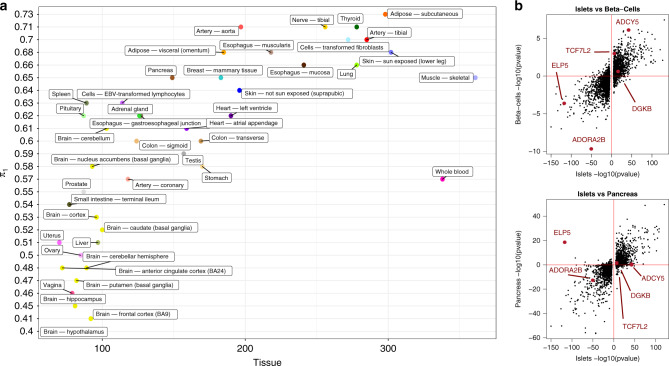
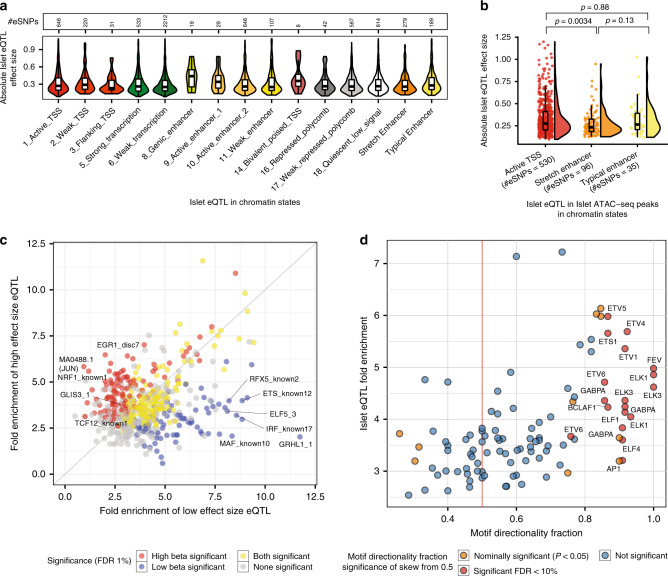
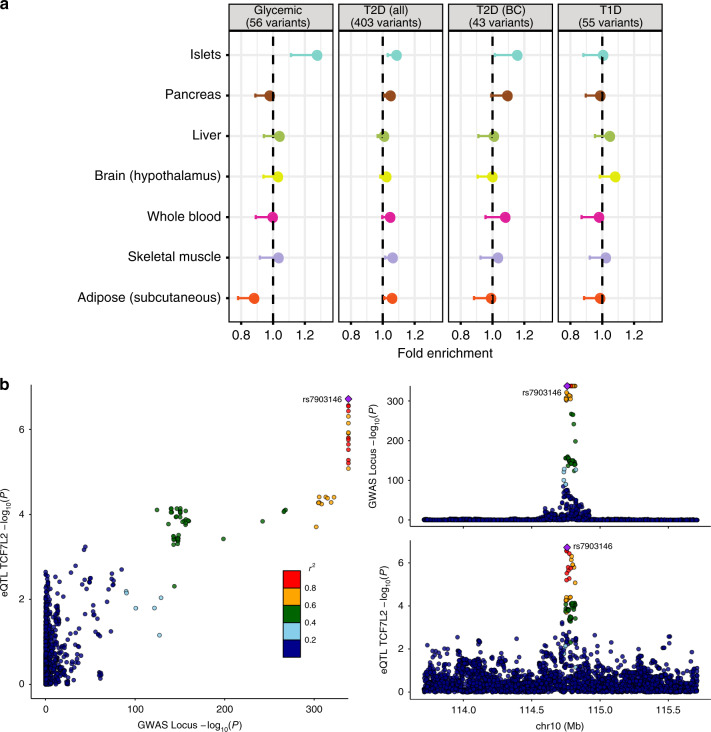
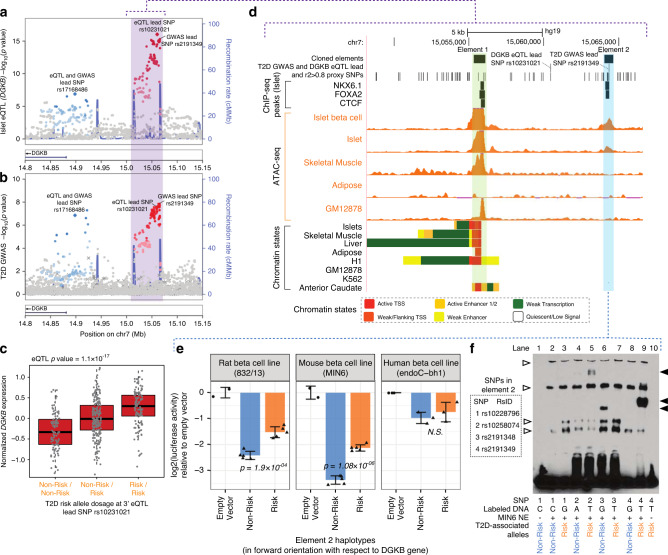
Most signals detected by genome-wide association studies map to non-coding sequence and their tissue-specific effects influence transcriptional regulation. However, key tissues and cell-types required for functional inference are absent from large-scale resources. Here we explore the relationship between genetic variants influencing predisposition to type 2 diabetes (T2D) and related glycemic traits, and human pancreatic islet transcription using data from 420 donors. We find: (a) 7741 cis -eQTLs in islets with a replication rate across 44 GTEx tissues between 40% and 73%; (b) marked overlap between islet cis- eQTL signals and active regulatory sequences in islets, with reduced eQTL effect size observed in the stretch enhancers most strongly implicated in GWAS signal location; (c) enrichment of islet cis- eQTL signals with T2D risk variants identified in genome-wide association studies; and (d) colocalization between 47 islet cis- eQTLs and variants influencing T2D or glycemic traits, including DGKB and TCF7L2 . Our findings illustrate the advantages of performing functional and regulatory studies in disease relevant tissues.
Overview
The claims and statistics of this paper haven’t been checked yet.
Free: it reads the open-access text and checks the first 5 claims that cite a source we can check. Create a free account to check every claim.
Integrity signals
Registry
Cites
Statistics
Figures
Verification
Claims the paper makes
The claims and statistics of this paper haven’t been checked yet.
Free: it reads the open-access text and checks the first 5 claims that cite a source we can check. Create a free account to check every claim.
Claims other papers make about this one
Each is checked against this paper’s own text: does it say what the citing paper says it does?
The check wasn’t confident either way, so it gives no verdict — never disputed.
In the citing paper
“However, the risk alleles in these loci all have relatively small effects and do not significantly enhance our ability to predict the risk of type 2 diabetes (396,397).”
From Guidelines and Recommendations for Laboratory Analysis in the Diagnosis and Management of Diabetes Mellitus (2023) · cites this paper as [396]
Experimental — accuracy not yet measured
Self-check
Percentages, sums and reported differences re-computed from the paper’s own numbers.
The self-check needs the paper’s full text.
Citations
Cites
Fast and accurate short read alignment with Burrows-Wheeler transform
Li, H., & Durbin, R. (2009) · Bioinformatics · doi:10.1093/bioinformatics/btp324 · Cited by 58,607
The Genome Analysis Toolkit: A MapReduce framework for analyzing next-generation DNA sequencing data
McKenna, A., Hanna, M., Banks, E., Sivachenko, A., Cibulskis, K., Kernytsky, A., Garimella, K., Altshuler, D., Gabriel, S., Daly, M., et al. (2010) · Genome Research · doi:10.1101/gr.107524.110 · Cited by 27,895
BEDTools: a flexible suite of utilities for comparing genomic features
Quinlan, A. R., & Hall, I. M. (2010) · Bioinformatics · doi:10.1093/bioinformatics/btq033 · Cited by 27,437
Initial sequencing and analysis of the human genome
International Human Genome Sequencing Consortium, Whitehead Institute for Biomedical Research, C. F. G. R., Lander, E. S., Linton, L. M., Birren, B., Nusbaum, C., Zody, M. C., Baldwin, J., Devon, K., Dewar, K., et al. (2001) · Nature · doi:10.1038/35057062 · Cited by 24,216
Second-generation PLINK: rising to the challenge of larger and richer datasets
Chang, C. C., Chow, C. C., Tellier, L. C., Vattikuti, S., Purcell, S. M., & Lee, J. J. (2015) · Gigascience · doi:10.1186/s13742-015-0047-8 · Cited by 12,709
Analysis of protein-coding genetic variation in 60,706 humans
Exome Aggregation Consortium, Lek, M., Karczewski, K. J., Minikel, E. V., Samocha, K. E., Banks, E., Fennell, T., O’Donnell-Luria, A. H., Ware, J. S., Hill, A. J., et al. (2016) · Nature · doi:10.1038/nature19057 · Cited by 9,587
Self-citationAn integrated map of genetic variation from 1,092 human genomes
The 1000 Genomes Project Consortium (2012) · Nature · doi:10.1038/nature11632 · Cited by 7,711
Buenrostro, J. D., Giresi, P. G., Zaba, L. C., Chang, H. Y., & Greenleaf, W. J. (2013) · Nature Methods · doi:10.1038/nmeth.2688 · Cited by 6,422
Integrative analysis of 111 reference human epigenomes
Roadmap Epigenomics Consortium, Kundaje, A., Meuleman, W., Ernst, J., Bilenky, M., Yen, A., Heravi-Moussavi, A., Kheradpour, P., Zhang, Z., Wang, J., et al. (2015) · Nature · doi:10.1038/nature14248 · Cited by 6,368
A Direct Approach to False Discovery Rates
Storey, J. D. (2002) · Journal of the Royal Statistical Society Series B: Statistical Methodology · doi:10.1111/1467-9868.00346 · Cited by 5,603
Cited by
Items 101–166 of 166
Spracklen, C. N., & Sim, X. (2021) · Current Diabetes Reports · doi:10.1007/s11892-021-01388-2 · Cited by 9
Hu, M., Cebola, I., Carrat, G., Jiang, S. S., Nawaz, S., Khamis, A., Canouil, M., Froguel, P., Schulte, A. M., Solimena, M., et al. (2021) · Cell Reports · doi:10.1016/j.celrep.2021.108881 · Cited by 6
Deletion of ABCB10 in beta-cells protects from high-fat diet induced insulin resistance
Shum, M., Segawa, M., Gharakhanian, R., Viñuela, A., Wortham, M., Baghdasarian, S., Wolf, D. M., Sereda, S. B., Nocito, L., Stiles, L., et al. (2021) · Molecular Metabolism · doi:10.1016/j.molmet.2021.101403 · Cited by 5
“[21], which contain total expression measurements of 13 exons of ABCB10.”
BackgroundMethodInfluentialSelf-citationeQTL analysis: A bridge from genome to mechanism
Jia, Z., Xu, J., Ma, Y., Wei, S., Sun, C., Chen, X., Kang, J., Chen, H., Zhang, C., Dong, Y., et al. (2025) · Genes & Diseases · doi:10.1016/j.gendis.2025.101850 · Cited by 6
“22,23 They are known to affect the structure of gene regulatory regions or chromatin and alter gene expression by influencing transcripts in the coding regions.”
From pancreas and islet resources to diabetes insights
Chen, S.-Y., Lekka, C., Lemvig, J., Yi, X., Cnop, M., Marchetti, P., Marselli, L., Xia, J., Madsen, J. G. S., Calvo, T. R., et al. (2026) · Diabetologia · doi:10.1007/s00125-026-06731-4 · Cited by 5
“One solution is to combine data from several sources, which has been accomplished with RNAseq [123– 126].”
Self-citationMulti-Omics Analysis Identifies Genetic Mechanisms and Therapeutic Targets for Acne Vulgaris
Qiu, X., Feng, Y., Mo, X., & Ju, Q. (2025) · Journal of Investigative Dermatology · doi:10.1016/j.jid.2025.04.032 · Cited by 5
T2D Risk Genes: Exome Sequencing Goes Straight to the Source
Alonso, L. C. (2019) · Cell Metabolism · doi:10.1016/j.cmet.2019.06.010 · Cited by 4
The Apo gene's genetic variants: hidden role in Asian vascular risk
Besin, V., Humardani, F. M., Yulianti, T., Putra, S. E. D., Triana, R., & Justyn, M. (2024) · Neurogenetics · doi:10.1007/s10048-024-00757-9 · Cited by 4
“This regulation is essential for numerous biological functions, particularly hormone regulation and glucose homeostasis [39].”
Yang, Y., Lorincz‐Comi, N. J., & Zhu, X. (2025) · Nature Communications · doi:10.1038/s41467-025-61423-8 · Cited by 6
Hemerich, D., Smit, R. A. J., Preuss, M. H., Stalbow, L. A., van der Laan, S. W., Asselbergs, F. W., van Setten, J., & Tragante, V. (2023) · Scientific Reports · doi:10.1038/s41598-023-30369-6 · Cited by 4
Furukawa, A., Tanaka, A., Yamaguchi, S., Kosuda, M., Yamana, M., Nagasawa, A., Kohno, G., & Ishihara, H. (2021) · Journal of Diabetes Investigation · doi:10.1111/jdi.13646 · Cited by 4
Trans-ancestral Genome Wide Association Study of Sporadic and Recurrent MiscarriagePreprint
Reynoso, A., Nandakumar, P., Shi, J., Bielenberg, J., Holmes, M. V., & Aslibekyan, S. W. (2024) · medRxiv · doi:10.1101/2024.03.20.24304624 · Cited by 4
“The eQTL annotation resources consist of a comprehensive collection of standardized variants impacting gene expression in various tissues obtained from publicly available datasets 57 ,58,59,60,61,62,63,64,65,66,67,6868,69 and datasets processed by the 23andMe eQTL pipeline.”
MethodDynamic Ca2+-Dependent Transcription Links Metabolic Stress to Impaired β-Cell Identity
Osipovich, A. B., Dickerson, M. T., Cartailler, J., Shrestha, S., Wright, N. M., Jacobson, D. A., & Magnuson, M. A. (2025) · Diabetes · doi:10.2337/db24-1141 · Cited by 3
Wilson, E. P., Broadaway, K. A., Parsons, V. A., Vadlamudi, S., Narisu, N., Brotman, S. M., Currin, K. W., Stringham, H. M., Erdos, M. R., Welch, R., et al. (2025) · The American Journal of Human Genetics · doi:10.1016/j.ajhg.2025.09.003 · Cited by 5
“11,12,61 The adipose and liver datasets were analyzed using a similar pipeline in APEX and included conditionally isolated signals.”
Self-citationThe Genetic Landscape of Diabetes Mellitus: Lessons from Monogenic and Polygenic Forms
Nilo, D., Nilo, R., Sircana, M. C., Sasso, F. C., Acierno, C., Bonfrate, L., & Caturano, A. (2026) · Life · doi:10.3390/life16030399 · Cited by 2
Howey, R. A. J., Adam, J., Adamski, J., Atabaki, N. N., Brunak, S., Chmura, P. J., Masi, F. D., Dermitzakis, E. T., Fernandez-Tajes, J. J., Forgie, I. M., et al. (2025) · PLoS Genetics · doi:10.1371/journal.pgen.1011776 · Cited by 2
“Therefore, Viñuela et al. (2020) [8] recommend regarding the genes highlighted by coincident GWAS and eQTL signals as candidate effector transcripts that should be further inter-rogated through experimental approaches that directly test for causality.”
InfluentialSelf-citationTCF7 is not essential for glucose homeostasis in mice
Kaur, K. D., Wong, C. K., Baggio, L. L., Beaudry, J. L., Fuchs, S., Panaro, B. L., Matthews, D., Cao, X., & Drucker, D. J. (2021) · Molecular Metabolism · doi:10.1016/j.molmet.2021.101213 · Cited by 2
“1 Original Article T2D [7].”
BackgroundInfluentialBlencowe, M., Saleem, Z., Liu, R., Wang, M., Tseng, I.-H., Wier, J. R., Mutter, S., Vaida, F., Guo, Y., Sandholm, N., et al. (2026) · Diabetologia · doi:10.1007/s00125-026-06721-6 · Cited by 1
Wang, X., Robertson, C. C., Varshney, A., Manickam, N., Orchard, P., Laakso, M., Tuomilehto, J., Lakka, T. A., Mohlke, K. L., Boehnke, M., et al. (2026) · Nature Communications · doi:10.1101/2025.09.09.674883 · Cited by 1
Self-citationGenome-Wide Association Study of Hypoglycemia in Adults With Diabetes in the Million Veteran Program
Raghavan, S., LITKOWSKI, E. M., Jensen, A. E., CHAREST, B. R., Wang, Z., Hui, Q., Chen, H., Rhee, M. K., Leong, A., Meigs, J. B., et al. (2025) · Diabetes · doi:10.2337/db25-0304 · Cited by 1
Siddiqui, M. K., Dupuis, T., Anjana, R. M., Dawed, A. Y., Bigossi, M., Srinivasan, S., Hodgson, S., Adedire, E. T., Taylor, A., Jebarani, S., et al. (2025) · Communications Medicine · doi:10.1038/s43856-025-01076-2 · Cited by 1
“rs7287124 is the lead eQTL variant for XBP1 expression in pancreatic islets Asingleintronicvariant;rs7287124(Chromosome22:29239157A > G)was reported to act as a cis -eQTL for XBP1 expression in pancreatic islets ( β expression = − 0.18, p = 2 × 10 − 4 , Table 1) by the InsPIRE study 44 .”
InfluentialSelf-citationConverging TCF7L2 and CDKAL1 pathways in the pathogenesis of type 2 diabetes mellitus
Farman, M. S., Salman, M. I., & Hassan, O. M. (2026) · Acta Diabetologica · doi:10.1007/s00592-026-02719-z · Cited by 1
Inferring causal genes at type 2 diabetes GWAS loci through chromosome interactions in islet cells.
Torres, J., Sun, H., Nylander, V., Downes, D. J., van de Bunt, M., McCarthy, M. I., Hughes, J. R., & Gloyn, A. L. (2023) · PubMed Central · doi:10.12688/wellcomeopenres.18653.2 · Cited by 2
“At the TCF7L2 locus, which was fine mapped to a single SNP, rs7903146, the T2D risk allele (T) associates with increased TCF7L2 expression in islets (Viñuela et al. , 2020) and the SNP overlaps an islet enhancer element and accessible chromatin in bulk islet tissue and islet alpha, beta, and delta…”
InfluentialSelf-citationA transcription start site map in human pancreatic islets reveals functional regulatory signaturesPreprint
Varshney, A., Kyono, Y., Elangovan, V. R., Wang, C., Erdos, M. R., Narisu, N., Albanus, R. D., Orchard, P., Stitzel, M. L., Collins, F. S., et al. (2019) · bioRxiv (Cold Spring Harbor Laboratory) · doi:10.1101/812552 · Cited by 1
Self-citationNguyen, J., D’Antonio‐Chronowska, A., Fujita, K., Salgado, B. M., Matsui, H., Arthur, T. D., Donovan, M. K. R., D’Antonio, M., & Frazer, K. A. (2021) · bioRxiv (Cold Spring Harbor Laboratory) · doi:10.1101/2021.10.20.465206 · Cited by 1
Inferring causal genes at type 2 diabetes GWAS loci through chromosome interactions in islet cellsPreprint
Torres, J., Sun, H., Nylander, V., Downes, D. J., van de Bunt, M., McCarthy, M. I., Hughes, J. R., & Gloyn, A. L. (2022) · bioRxiv (Cold Spring Harbor Laboratory) · doi:10.1101/2022.09.19.508549 · Cited by 1
Self-citationImpact of sample size and tissue relevance on T2D gene identificationPreprint
Davtian, D., Dupuis, T., Aly, D. M., Atabaki‐Pasdar, N., Walker, M., Franks, P. W., Rutters, F., Im, H. K., Pearson, E. R., van de Bunt, M., et al. (2024) · medRxiv · doi:10.1101/2024.10.31.24316435 · Cited by 1
“Previous studies have shown that processes occurring in the pancreatic islets are likely related to T2D by beta-cell dysfunction, while obesity related T2D or insulin resistance are linked to expression patterns in adipose or muscle tissues 4,28 .”
BackgroundSelf-citationVarshney, A., Manickam, N., Orchard, P., Tovar, A., Ventresca, C., Zhang, Z., Feng, F., Mears, J., Erdos, M. R., Narisu, N., et al. (2026) · Nature Genetics · doi:10.1038/s41588-026-02786-6
Self-citationZhang, H., Xiu, X., Yang, Y., Yang, Y., & Zhao, H. (2021) · medRxiv · doi:10.1101/2021.08.05.21261684
“KLHL42 encoded a protein in Kelch-like family (kelch like family member 42), and it was known to be a susceptible gene of T2D (50, 51).”
BackgroundSuleiman, M., Yi, X., Bosi, E., Burdet, F., Luca, C. D., Tesi, M., Guerra, S. D., Pocai, A., SIMONE, P. D., Boggi, U., et al. (2021) · Research Square · doi:10.21203/rs.3.rs-871924/v1
“The transcriptomic traits associated with T2D islets have been reported by a few groups, showing numerous DEGs in comparison with non-diabetic islets (22,42,43).”
BackgroundModulation of muscle cell insulin receptor signalling, transcription and trafficking by insulin
Cen, H. H. (2021) · cIRcle (University of British Columbia) · doi:10.14288/1.0401784 · Cited by 1
A Transcription Start Site Map in Human Pancreatic Islets Reveals Functional Regulatory Signatures
Varshney, A., Kyono, Y., Elangovan, V. R., Wang, C., Erdos, M. R., Narisu, N., Albanus, R. D., Orchard, P., Stitzel, M. L., Collins, F. S., et al. (2021) · doi:10.2337/figshare.14394707
Self-citationA Transcription Start Site Map in Human Pancreatic Islets Reveals Functional Regulatory Signatures
Varshney, A., Kyono, Y., Elangovan, V. R., Wang, C., Erdos, M. R., Narisu, N., Albanus, R. D., Orchard, P., Stitzel, M. L., Collins, F. S., et al. (2021) · doi:10.2337/figshare.14394707.v1
Self-citationAnálise do componente genético do Diabetes Mellitus tipo 2
Mota, D. M. D. (2024) · Digital Library of Theses and Dissertations (Universidade de São Paulo) · doi:10.11606/t.76.2024.tde-20032024-084845
Rouskas, K., Katsareli, E. A., Amerikanou, C., Dimopoulos, A. C., Glentis, S., Kalantzi, A., Skoulakis, A., Panousis, N. I., Ongen, H., Bielser, D., et al. (2023) · Figshare · doi:10.6084/m9.figshare.23896213
Self-citationRouskas, K., Katsareli, E. A., Amerikanou, C., Dimopoulos, A. C., Glentis, S., Kalantzi, A., Skoulakis, A., Panousis, N. I., Ongen, H., Bielser, D., et al. (2023) · Figshare · doi:10.6084/m9.figshare.23896204
Self-citationRouskas, K., Katsareli, E. A., Amerikanou, C., Dimopoulos, A. C., Glentis, S., Kalantzi, A., Skoulakis, A., Panousis, N. I., Ongen, H., Bielser, D., et al. (2023) · Figshare · doi:10.6084/m9.figshare.23896201
Self-citationSchlosser, P., Zhang, J., Liu, H., Surapaneni, A., Rhee, E. P., Arking, D. E., Yu, B., Boerwinkle, E., Welling, P. A., Chatterjee, N., et al. (2023) · Figshare · doi:10.6084/m9.figshare.23583591
Huang, Z. (2024) · medRxiv · doi:10.1101/2024.05.07.24306979
“…; CDKAL1 are involved in misfolded insulin, leading to oxidative and ER stress in the pancreatic -cells 29 ; DGKB is causally associated with T2DM 30 ; JAZF1 directly and negatively regulates insulin gene transcription 31 ; a loss-of-function of SLC30A8 protects against T2DM 32 ; HHEX are…”
BackgroundThe OMICS and PD models: Hopes or hypes
Elsamman, K. (2024) · Elsevier eBooks · doi:10.1016/b978-0-443-16128-5.00020-7
de Winter, T. J. J., Sovrovic, M., Sun, H., Johnson, J. D., MacDonald, P. E., Gloyn, A. L., Carlotti, F., de Koning, E. J. P., & Alemany, A. (2025) · bioRxiv (Cold Spring Harbor Laboratory) · doi:10.1101/2025.01.21.633530
Self-citationInvestigating the shared genetic architecture between type 2 diabetes and strokePreprint
Islam, T., Zeng, J., & Moni, M. A. (2025) · medRxiv · doi:10.1101/2025.03.24.25324577
“This protein helps control islet cells, which keeps glucose levels stable [40].”
Chen, Z., Millard, A., & Fernandez, E. (2025) · bioRxiv (Cold Spring Harbor Laboratory) · doi:10.1101/2025.06.26.661798
Identification of multi-omic pleiotropy factors for peripheral artery disease
Hu, J., Chaar, C. I. O., Zhao, H., & DeWan, A. T. (2026) · Human Molecular Genetics · doi:10.1093/hmg/ddag035
Kursawe, R., Bandesh, K., Krishnan, S. N., Liu, K. S., Bhuiyan, R. M., & Stitzel, M. L. (2025) · Annual Review of Genetics · doi:10.1146/annurev-genet-020525-114513
Self-citationMulti-omics Integration with GWAS Unveils Molecular Mechanistic Insights for Type 2 DiabetesPreprint
Abbas, M., Toh, H., Martin, P. M., Lindsey, M. L., Melese, M. T., Oteng, A., & Gaye, A. (2025) · bioRxiv (Cold Spring Harbor Laboratory) · doi:10.1101/2025.11.21.689764
Rouskas, K., Katsareli, E. A., Amerikanou, C., Dimopoulos, A. C., Glentis, S., Kalantzi, A., Skoulakis, A., Panousis, N. I., Ongen, H., Bielser, D., et al. (2023) · Figshare · doi:10.6084/m9.figshare.23896198
Self-citationRouskas, K., Katsareli, E. A., Amerikanou, C., Dimopoulos, A. C., Glentis, S., Kalantzi, A., Skoulakis, A., Panousis, N. I., Ongen, H., Bielser, D., et al. (2023) · Figshare · doi:10.6084/m9.figshare.23896210
Self-citationRouskas, K., Katsareli, E. A., Amerikanou, C., Dimopoulos, A. C., Glentis, S., Kalantzi, A., Skoulakis, A., Panousis, N. I., Ongen, H., Bielser, D., et al. (2023) · Figshare · doi:10.6084/m9.figshare.23896207
Self-citationSchlosser, P., Zhang, J., Liu, H., Surapaneni, A. L., Rhee, E. P., Arking, D. E., Yu, B., Boerwinkle, E., Welling, P. A., Chatterjee, N., et al. (2023) · Figshare · doi:10.6084/m9.figshare.23583594
Schlosser, P., Zhang, J., Liu, H., Surapaneni, A. L., Rhee, E. P., Arking, D. E., Yu, B., Boerwinkle, E., Welling, P. A., Chatterjee, N., et al. (2023) · Figshare · doi:10.6084/m9.figshare.23583597
Castillo Bonilla, A. (2021) · The Oberta in Open Access (Universitat Oberta de Catalunya)
Statistical strategies and resources for deciphering mechanisms of diabetes risk loci
Aylward, A. (2021) · eScholarship (California Digital Library)
Single nucleotide variants affecting placental gene expression and pregnancy outcome
Kikas, T. (2021) · DSpace repository (University of Tartu)
Nguyen, J. (2024) · eScholarship (California Digital Library)
AI in multi-omics analysis of type 2 diabetes
Singh, P., Malik, M. Z., Kumar, S., & Srivastava, A. (2026) · Progress in molecular biology and translational science · doi:10.1016/bs.pmbts.2026.02.002
Wang, N., DICORPO, D. A., Zhang, Y., Kleinbrink, E. L., Arnett, D. K., Barnard, J., Blangero, J., Bowden, D. W., Carson, A. P., Chen, Y. I., et al. (2026) · Diabetes · doi:10.2337/db25-0557
Disentangling adiposity-related and non-adiposity-related genetic pathways for type 2 diabetesPreprint
Su, C., & Lu, T. (2026) · medRxiv · doi:10.64898/2026.06.11.26355425
Ding, Y., Gao, S., Ying, L., Tang, J., Chang, G., Huang, Y., Yu, T., Li, X., & Wang, X. (2026) · Journal of Diabetes Research · doi:10.1155/jdr/9544974
Glutamine Metabolism Supports α cell Mass and Glucagon SecretionPreprint
Schornack, A. M. R., Rodgers, T. J., Shou, M., Siv, W., Yin, L., Sellick, K., Chigurupati, V., Debo, J., Saraf, S. S., Nickles, P. G., et al. (2026) · bioRxiv (Cold Spring Harbor Laboratory) · doi:10.64898/2026.07.09.735845
Narisu, N., Li, H. X., Rathbun, C. J. M., Varshney, A., Swift, A. J., Yan, T., Sinha, N., Currin, K. W., Xue, D., Robertson, C. C., et al. (2026) · medRxiv · doi:10.64898/2026.07.14.26358094
“Previous studies identified rs34584161 as the lead islet eQTL SNP for two nearby genes RNF6 and CDK8 in human islets, with the risk allele associated with increased expression of both genes 43 .”
Self-citationCheng, Z., Judaprawira, S., Perez, J., & Goldstein, A. (2026) · medRxiv · doi:10.64898/2026.09.08.26362488
liu, J., Yuan, C., Tan, J., liu, H., & wen, X. (2026) · SSRN Electronic Journal · doi:10.2139/ssrn.7506502
Utilizing single-cell data for per-cell type eQTL mapping in the human pancreasPreprint
Weidekamp, M. A., Lorenz, K., Elgamal, R. M., Kaestner, K. H., Gaulton, K. J., Grant, S. F. A., & Voight, B. F. (2026) · bioRxiv (Cold Spring Harbor Laboratory) · doi:10.64898/2026.09.23.753551
Multifaceted role of genetic and epigenetic architecture of glucose homeostasis and diabetes
Khokhar, M. (2026) · npj Metabolic Health and Disease · doi:10.1038/s44324-026-00135-z
“Colocalization of GWAS signals with eQTLs in islets has linked non-coding variants at loci including TCF7L2, KCNJ11, MTNR1B, and SLC30A8 to cell-type-speci fi c transcriptional effects that modulate insulin secretion capacity 23,24 .”
Rahman, F. U., & Wei, Z. (2026) · npj Metabolic Health and Disease · doi:10.1038/s44324-026-00137-x
“In addition, epigenomic studies of metabolic tissues in response to metabolic challenges, such as pancreatic islets from individuals with T2D 53,54 , show widespread cell-type-speci fi c changes in chromatin accessibility at regulatory regions enriched for chromatin remodeling activity.”
Metadata
- Authors
- Viñuela, A., Varshney, A., van de Bunt, M., Prasad, R. B., Asplund, O., Bennett, A., Boehnke, M., Brown, A. A., Erdos, M. R., Fadista, J., Hansson, O., Hatem, G., Howald, C., Iyengar, A. K., Johnson, P., Krus, U., MacDonald, P. E., Mahajan, A., Manning Fox, J. E., Narisu, N., Nylander, V., Orchard, P., Oskolkov, N., Panousis, N. I., Payne, A., Stitzel, M. L., Vadlamudi, S., Welch, R., Collins, F. S., Mohlke, K. L., Gloyn, A. L., Scott, L. J., Dermitzakis, E. T., Groop, L., Parker, S. C. J., & McCarthy, M. I.
- Affiliations
- University of Geneva (CH)
- University of Michigan (US)
- Lund University (SE)
- Centre for Human Genetics (GB)
- National Institutes of Health (US)
- Statens Serum Institut (DK)
- University of Helsinki (FI)
- University of North Carolina at Chapel Hill (US)
- University of Alberta (CA)
- University of Oxford (GB)
- University of Connecticut (US)
- Corresponding author
- Viñuela, Ana
- McCarthy, Mark I.
- ORCID
- Viñuela, Ana
- Varshney, Arushi
- Prasad, Rashmi B.
- Asplund, Olof
- Bennett, Amanda
- Boehnke, Michael
- Brown, Andrew A.
- Erdos, Michael R.
- Fadista, João
- Hansson, Ola
- Hatem, Gad
- Howald, Cédric
- Iyengar, Apoorva K.
- MacDonald, Patrick E.
- Mahajan, Anubha
- Narisu, Narisu
- Nylander, Vibe
- Orchard, Peter
- Oskolkov, Nikolay
- Panousis, Nikolaos I.
- Stitzel, Michael L.
- Vadlamudi, Swarooparani
- Welch, Ryan
- Collins, Francis S.
- Mohlke, Karen L.
- Gloyn, Anna L.
- Scott, Laura J.
- Dermitzakis, Emmanouil T.
- Groop, Leif
- Parker, Stephen C. J.
- McCarthy, Mark I.
- Venue
- Nature Communications
- Published
- 2020-09-30
- Volume
- 11
- Issue
- 1
- Pages
- 4912-4912
- ISSN
- 2041-1723 (ISSN-L)
- PMC
- PMC7528108
- OpenAlex
- W3091552000
- Semantic Scholar
- f615dc6a5917c553d721e2c521425bf3c991290b
- Cited by
- 152
- References
- 99
- Citations by year
- 2026: 10 · 2025: 28 · 2024: 19 · 2023: 28 · 2022: 25 · 2021: 26 · 2020: 9
- FWCI
- 13.49
- Type
- journal article
- Language
- en
- Open access
- gold
- doi.org
- Licence
- cc-by
- creativecommons.org/licenses/by/4.0 (tdm)
- creativecommons.org/licenses/by/4.0 (vor)
- Locations
- Nature Communications (publishedVersion, cc-by)
- bioRxiv (Cold Spring Harbor Laboratory) (acceptedVersion, cc-by)
- PubMed Central (publishedVersion, cc-by)
- PubMed (publishedVersion)
- Discovery Research Portal (University of Dundee) (publishedVersion, cc-by)
- Archive ouverte UNIGE (University of Geneva) (publishedVersion, other-oa)
- Carolina Digital Repository (University of North Carolina at Chapel Hill) (submittedVersion)
- RePEc: Research Papers in Economics (submittedVersion)
- Discovery Research Portal (University of Dundee) (submittedVersion, cc-by)
- DOAJ (DOAJ: Directory of Open Access Journals) (submittedVersion, cc-by-sa)
- Työväentutkimus Vuosikirja (submittedVersion)
- Lund University Publications (Lund University) (submittedVersion)
- The Mouseion at the JAXlibrary (Jackson Laboratory) (submittedVersion, cc-by)
- Archive ouverte UNIGE (University of Geneva) (submittedVersion, cc-by)
- UNC Libraries
- Zenodo (CERN European Organization for Nuclear Research) (cc-by)
- Funders
- American Diabetes Association
- AstraZeneca (2015-2558, 349-2006-237, 2009-1039)
- University of Michigan
- Åke Wiberg Stiftelse
- Wellcome Trust (212259, 098381, 095101, 090532, 203141, 200837, 106130, 200837/Z/16/Z)
- National Institute for Health and Care Research (NF-SI-0617-10090)
- University of Oxford
- European Commission (115317, HORIZON2020, 095101, 203141, 098381, 200837)
- European Foundation for the Study of Diabetes (115317)
- Schweizerischer Nationalfonds zur Förderung der Wissenschaftlichen Forschung (149984, 148451)
- Stiftelsen för Strategisk Forskning (Dnr 349-2006-237, 2009-1039, 349-2006-237, Dnr 2009-1039, Dnr IRC15‐0067, IRC15-0067)
- Novo Nordisk
- Vetenskapsrådet (349-2006-237, 2015-02558, 2006–237, 2009-1039, IRC15-0067, strategic Research Area Exodiab dnr 2009-1039, Dnr 349-2006-237, Dnr2009‐1039, Dnr IRC15-0067)
- Alberta Diabetes Foundation
- National Institutes of Health (NF-SI-0617-10090, 095101, NIH-R01, HG00040, ZIA-HG000024, HG000024)
- Canadian Institutes of Health Research (CIHR: 148451, 14845_1)
- Medical Research Council (/L020149/1, MR/L020149/1, L020149)
- National Institute of Mental Health (R01MH101814, R01MH090941)
- National Human Genome Research Institute (Z01HG000024, HG00040, T32 HG-00040, HG000024, T32HG000040, ZIAHG000024)
- National Institute of Diabetes and Digestive and Kidney Diseases (DK-072193, R01DK072193, R00DK099240, R00DK092251, U01DK062370, DK085545, 106130, 212259, R0-1-DK, 090532, U01DK085545, DK105561, NF-SI-0617-10090, U01DK105561, U01DK105535, U01-DK105535; U01-DK085545, K99DK092251, NIH R01, 098381, R01DK117960, 203141, P30DK020572, R01DK062370)
- Topics
- Life Sciences › Biochemistry, Genetics and Molecular Biology › Genetics › Genetic Associations and Epidemiology
- Health Sciences › Medicine › Endocrinology, Diabetes and Metabolism › Pancreatic function and diabetes
- Life Sciences › Biochemistry, Genetics and Molecular Biology › Molecular Biology › Genomics and Chromatin Dynamics
- Keywords
- type 2 diabetes, pancreatic islets, cis-eQTL, gene expression regulation, regulatory elements, TCF7L2, glycemic traits, colocalization, non-coding variants, tissue-specific gene expression
- MeSH terms
- RNA-Seq, Adolescent, Adult, Aged, Aged, 80 and over, Animals, Blood Glucose, Diabetes Mellitus, Type 2, Enhancer Elements, Genetic, Female, Gene Expression Regulation, Humans, Islets of Langerhans, Male, Middle Aged, Cohort Studies, Sequence Analysis, DNA, Diacylglycerol Kinase, Genetic Predisposition to Disease, Polymorphism, Single Nucleotide, Quantitative Trait Loci, Cell Line, Tumor, Mice, Genome-Wide Association Study, Young Adult, Transcription Factor 7-Like 2 Protein
About these checks
Registry, retraction, Cites and statistics results are computed, not judged, with one exception: a printed reference that no index lists is read once by a model before it counts as a citation error. Claims are extracted by a model and kept only when their quote appears verbatim in the text; each cited source is then checked, with a model’s help, for whether it says what the claim relies on. Those verdicts can be wrong — read the claim’s quote and the cited source before relying on one.
Statistics and arithmetic are recomputed, not judged.
Confidence bands are shown only for fields calibrated on our annotated test set. None is calibrated yet, so no band is shown.
What counts as a claim ›How we measure confidence ›How we check this ›
Are you an author, or do you see a problem with this page? Request a review
Data sources
Bibliographic data: Semantic Scholar, OpenAlex, Crossref.
Contains information from the Semantic Scholar Academic Graph Datasets, made available under the ODC Attribution License (ODC-BY 1.0).
Semantic Scholar’s data is described in: Kinney, R., et al. (2023). The Semantic Scholar Open Data Platform. arXiv:2301.10140.
