

The DOI matches its Crossref record; 22 of the 23 references it cites were found in a registry or an index.
Fusing subnational with national climate action is central to decarbonization: the case of the United States
Open accessAbstract
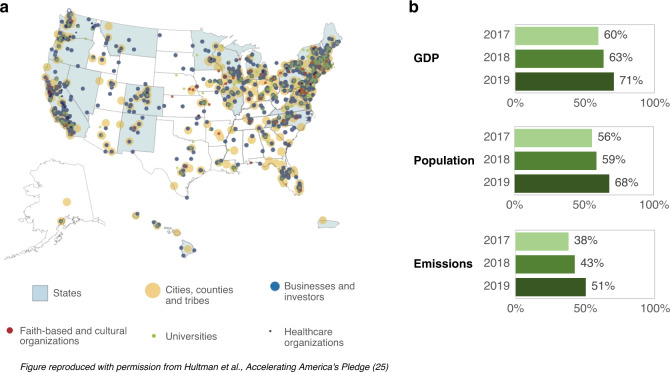
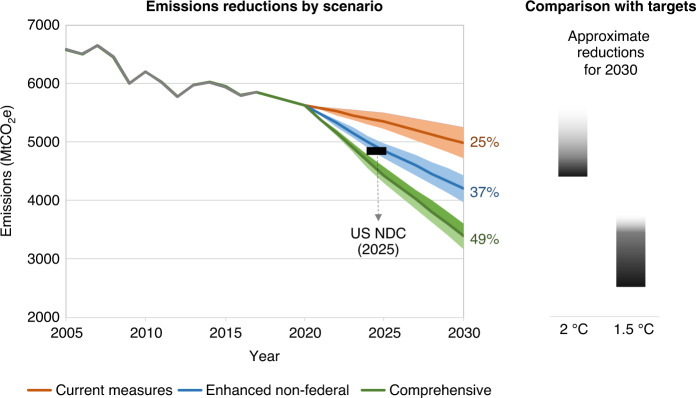
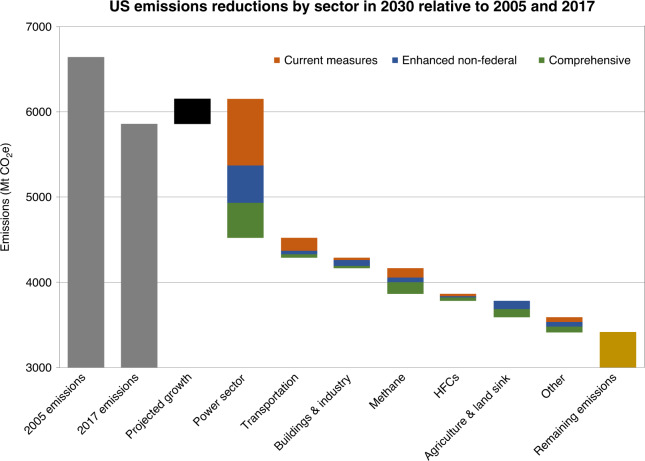
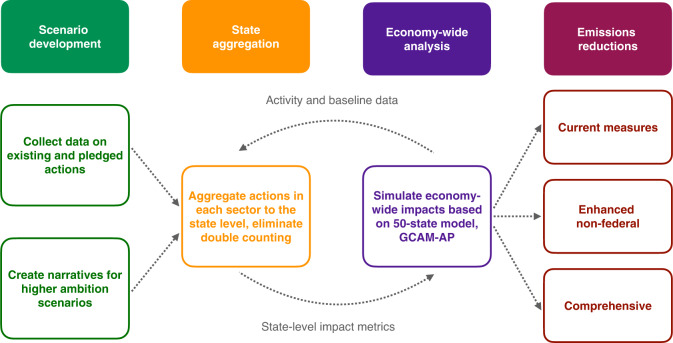
Approaches that root national climate strategies in local actions will be essential for all countries as they develop new nationally determined contributions under the Paris Agreement. The potential impact of climate action from non-national actors in delivering higher global ambition is significant. Sub-national action in the United States provides a test for how such actions can accelerate emissions reductions. We aggregated U.S. state, city, and business commitments within an integrated assessment model to assess how a national climate strategy can be built upon non-state actions. We find that existing commitments alone could reduce emissions 25% below 2005 levels by 2030, and that enhancing actions by these actors could reduce emissions up to 37%. We show how these actions can provide a stepped-up basis for additional federal action to reduce emissions by 49%—consistent with 1.5 °C. Our analysis demonstrates sub-national actions can lead to substantial reductions and support increased national action.
Overview
The claims and statistics of this paper haven’t been checked yet.
Run the check — free, no account needed. It reads the open-access text and checks the sources it cites.
Integrity signals
Registry
Cites
Statistics
Figures
Verification
Claims the paper makes
The claims and statistics of this paper haven’t been checked yet.
Run the check — free, no account needed. It reads the open-access text and checks the sources it cites.
Claims other papers make about this one
Each is checked against this paper’s own text: does it say what the citing paper says it does?
In the citing paper
“Currently, 25 US governors have committed to meeting the goals of the Paris Climate Agreement (9), and 23 of these, and the District of Columbia, have set economy-wide GHG reduction targets using statutory and/or legally binding executive action (10).”
From A framework for localizing global climate solutions and their carbon reduction potential (2021) · cites this paper as [9]
Self-check
Percentages, sums and reported differences re-computed from the paper’s own numbers.
The self-check needs the paper’s full text.
Citations
Cites
IPCC (2022) · Cambridge University Press eBooks · doi:10.1017/9781009157940 · Cited by 3,909
A roadmap for rapid decarbonization
Rockström, J., Gaffney, O., Rogelj, J., Meinshausen, M., Nakicenovic, N., & Schellnhuber, H. J. (2017) · Science · doi:10.1126/science.aah3443 · Cited by 1,225
Stokes, L. C. (2020) · doi:10.1093/oso/9780190074258.001.0001 · Cited by 544
“All Hands on Deck”: The Paris Agreement and Nonstate Climate Action
Hale, T. (2016) · Global Environmental Politics · doi:10.1162/glep_a_00362 · Cited by 448
Winning coalitions for climate policy
Meckling, J., Kelsey, N., Biber, E., & Zysman, J. (2015) · Science · doi:10.1126/science.aab1336 · Cited by 426
States on Steroids: The Intergovernmental Odyssey of American Climate Policy
Rabe, B. G. (2008) · Review of Policy Research · doi:10.1111/j.1541-1338.2007.00314.x · Cited by 277
Reinvigorating International Climate Policy: A Comprehensive Framework for Effective Nonstate Action
Chan, S., van Asselt, H., Hale, T. N., Abbott, K. W., Beisheim, M., Hoffmann, M. J., Guy, B., Höhne, N., Hsu, A., Pattberg, P. H., et al. (2015) · Global Policy · doi:10.1111/1758-5899.12294 · Cited by 260
The Paris Agreement: resolving the inconsistency between global goals and national contributions
Höhne, N., Kuramochi, T., Warnecke, C., Röser, F., Fekete, H., Hagemann, M., Day, T. J., Tewari, R., Kurdziel, M., Sterl, S. H., et al. (2016) · Climate Policy · doi:10.1080/14693062.2016.1218320 · Cited by 223
How to eat an elephant: a bottom-up approach to climate policy
Rayner, S. (2010) · Climate Policy · doi:10.3763/cpol.2010.0138 · Cited by 216
A research roadmap for quantifying non-state and subnational climate mitigation action
Hsu, A., Höhne, N., Kuramochi, T., Roelfsema, M., Weinfurter, A. J., Xie, Y., Lütkehermöller, K., Chan, S., Corfee-Morlot, J., Drost, P., et al. (2018) · Nature Climate Change · doi:10.1038/s41558-018-0338-z · Cited by 187
Self-citation
Research works printed but not linked: 1
- NewClimate Institute, Data-Driven Lab, PBL, German Development Institute/Deutsches Institut für Entwicklungspolitik (DIE), Blavatnik & School of Government, University of Oxford. Global Climate Action from Cities, Regions and Businesses: Impact of Individual Actors and Cooperative Initiatives on Global and National Emissions. https://newclimate.org/wp-content/uploads/2019/09/Report-Global-Climate-Action-from-Cities-Regions-and-Businesses_2019.pdf (2019).
Cited by
Sorted by citations
Deep mitigation of CO2 and non-CO2 greenhouse gases toward 1.5 °C and 2 °C futures
Ou, Y., Roney, C., Alsalam, J., Calvin, K., Creason, J., Edmonds, J., Fawcett, A. A., Kyle, P. G., Narayan, K. B., O’Rourke, P., et al. (2021) · Nature Communications · doi:10.1038/s41467-021-26509-z · Cited by 214
Self-citationChange in US state-level public opinion about climate change: 2008–2020
Marlon, J. R., Wang, X., Bergquist, P., Howe, P. D., Leiserowitz, A., Maibach, E. W., Mildenberger, M., & Rosenthal, S. A. (2022) · Environmental Research Letters · doi:10.1088/1748-9326/aca702 · Cited by 104
“Prior research has demonstrated that the heterogeneity of Americans’ climate views has important consequences for climate and energy policy [20, 21].”
BackgroundPricing indirect emissions accelerates low—carbon transition of US light vehicle sector
Wolfram, P., Weber, S. M., Gillingham, K. T., & Hertwich, E. G. (2021) · Nature Communications · doi:10.1038/s41467-021-27247-y · Cited by 78
Quantifying the regional stranded asset risks from new coal plants under 1.5 °C
Edwards, M. R., Cui, R. Y., Bindl, M., Hultman, N., Mathur, K., McJeon, H. C., Iyer, G. C., Song, J., & Zhao, A. (2022) · Environmental Research Letters · doi:10.1088/1748-9326/ac4ec2 · Cited by 66
Self-citationYang, S., Lao, K., Hui, H., & Chen, Y. (2024) · IEEE Transactions on Power Systems · doi:10.1109/tpwrs.2024.3381231 · Cited by 68
“Furthermore, the increase in RENs decreases the share of traditional generating units, resulting in insufficient operating reserves on the supply side [5].”
A framework for localizing global climate solutions and their carbon reduction potential
Brown, M. A., Dwivedi, P., Mani, S., Matisoff, D., Mohan, J. E., Mullen, J., Oxman, M., Rodgers, M., Simmons, R., Beasley, B., et al. (2021) · Proceedings of the National Academy of Sciences · doi:10.1073/pnas.2100008118 · Cited by 64
“To date, 191 parties to the Paris Climate Agreement have committed to Nationally Determined Contributions (NDCs).”
InfluentialOu, Y., Kittner, N., Babaee, S., Smith, S. J., Nolte, C. G., & Loughlin, D. H. (2021) · Applied Energy · doi:10.1016/j.apenergy.2021.117364 · Cited by 54
Municipal climate mitigation policy and policy learning - A review
Neij, L., & Heiskanen, E. (2021) · Journal of Cleaner Production · doi:10.1016/j.jclepro.2021.128348 · Cited by 66
The surprisingly inexpensive cost of state-driven emission control strategies
Peng, W., Iyer, G. C., Binsted, M. T., Marlon, J. R., Clarke, L., Edmonds, J., & Victor, D. G. (2021) · Nature Climate Change · doi:10.1038/s41558-021-01128-0 · Cited by 57
Self-citationMulti-level climate change planning: An analysis of the Italian case
Pietrapertosa, F., Salvia, M., Hurtado, S. D. G., Geneletti, D., D’Alonzo, V., & Reckien, D. (2021) · Journal of Environmental Management · doi:10.1016/j.jenvman.2021.112469 · Cited by 51
National and Sub-national Policies and Institutions
Change, I. P. O. C. (2023) · Cambridge University Press eBooks · doi:10.1017/9781009157926.015 · Cited by 81
Binsted, M. T., Iyer, G. C., Patel, P., Graham, N. T., Ou, Y., Khan, Z., Kholod, N., Narayan, K. B., Hejazi, M. I., Kim, S. H., et al. (2022) · Geoscientific model development · doi:10.5194/gmd-15-2533-2022 · Cited by 43
Marquardt, J., Fast, C., & Grimm, J. (2022) · Wiley Interdisciplinary Reviews Climate Change · doi:10.1002/wcc.791 · Cited by 46
“To flourish, these decarbonization initiatives require effective national climate policy frameworks (Hultman et al., 2020; Kuramochi et al., 2020).”
BackgroundThe global biodiversity framework needs a robust action agenda
Chan, S., Bauer, S., Betsill, M. M., Biermann, F., Boran, I., Bridgewater, P. B., Bulkeley, H., Bustamente, M. M. C., Deprez, A., Dodds, F., et al. (2022) · Nature Ecology & Evolution · doi:10.1038/s41559-022-01953-2 · Cited by 40
Onodera, H., Delage, R., & Nakata, T. (2024) · Applied Energy · doi:10.1016/j.apenergy.2024.123118 · Cited by 39
Wakiyama, T., & Zusman, E. (2021) · Renewable and Sustainable Energy Reviews · doi:10.1016/j.rser.2021.111337 · Cited by 38
Research on the carbon neutrality governance under a polycentric approach
Tan, X., Kong, L., Gu, B., Zeng, A., & Niu, M.-M. (2022) · Advances in Climate Change Research · doi:10.1016/j.accre.2022.01.005 · Cited by 39
Climate Ambition and Sustainable Development for a New Decade: A Catalytic Framework
Chan, S., Boran, I., van Asselt, H., Ellinger, P., Garcia, M., Hale, T. N., Hermwille, L., Mbeva, K., Mert, A., Roger, C., et al. (2020) · Global Policy · doi:10.1111/1758-5899.12932 · Cited by 34
Self-citationCombined heat and power as a platform for clean energy systems
Brown, M. A., & Herrera, V. S. (2021) · Applied Energy · doi:10.1016/j.apenergy.2021.117686 · Cited by 37
Parker, S. S., Clifford, M. J., & Cohen, B. S. (2023) · The Science of The Total Environment · doi:10.1016/j.scitotenv.2023.168639 · Cited by 32
Assessing subnational climate action in G20 cities and regions: Progress and ambition
Song, K., Farr, K. B., & Hsu, A. (2024) · One Earth · doi:10.1016/j.oneear.2024.10.001 · Cited by 36
Satellite Data Applications for Sustainable Energy Transitions
Edwards, M. R., Holloway, T., Pierce, R. B., Blank, L., Broddle, M., Choi, E., Duncan, B. N., Esparza, Á. E., Falchetta, G., Fritz, M., et al. (2022) · Frontiers in Sustainability · doi:10.3389/frsus.2022.910924 · Cited by 35
Self-citationHave consumption-based CO2 emissions in developed countries peaked?
Wang, Z., Yan, H., Gao, X., Liang, Q., Mi, Z., & Liu, L.-C. (2023) · Energy Policy · doi:10.1016/j.enpol.2023.113894 · Cited by 33
Zhao, A., O’Keefe, K. T. V., Binsted, M. T., McJeon, H. C., Bryant, A., Squire, C. V., Zhang, M., Smith, S. J., Cui, R. Y., Ou, Y., et al. (2024) · npj Climate Action · doi:10.1038/s44168-024-00145-x · Cited by 29
“Even beyond the signi fi cant actions by the federal government, the policy authorities of these subnational governments and other non-federal actors collectively are contributing substantially toward near-term emissions reductions 13 – 15 .”
BackgroundMethodInfluentialSelf-citationScott, W. A., Rhodes, E., & Hoicka, C. E. (2023) · Climate Policy · doi:10.1080/14693062.2023.2185586 · Cited by 33
“In North America, sub-national jurisdictions have been early actors on climate policy, such that their e ff ort has the potential to achieve large portions of national climate targets (Hultman et al., 2020; Kuramochi et al., 2020).”
BackgroundDaley, D. M., Abel, T. D., Stephan, M., Rai, S., & Rogers, E. (2023) · Environmental Policy and Governance · doi:10.1002/eet.2051 · Cited by 31
State-by-state energy-water-land-health impacts of the US net-zero emissions goal
Ou, Y., Iyer, G. C., McJeon, H. C., Cui, R. Y., Zhao, A., O’Keefe, K. T. V., Zhao, M., Qiu, Y. S., & Loughlin, D. H. (2023) · Energy and Climate Change · doi:10.1016/j.egycc.2023.100117 · Cited by 23
Self-citationRisks of relying on uncertain carbon dioxide removal in climate policy
Bindl, M., Edwards, M. R., & Cui, R. Y. (2025) · Nature Communications · doi:10.1038/s41467-025-61106-4 · Cited by 20
“Actors at different levels of government 2 — and increasingly in the private sector 3,4 — are making commitments to reach net-zero or net-negative carbon dioxide (CO 2 ) emissions and limit global warming to 1.5°C or well below 2°C this century, as set out in the Paris Agreement 5 .”
InfluentialSelf-citationThe statistical projection of global GHG emissions from a consumption perspective
Yuan, R., Rodrigues, J. F. D., Tukker, A., & Behrens, P. (2022) · Sustainable Production and Consumption · doi:10.1016/j.spc.2022.09.021 · Cited by 19
“Investigating these trajectories often involves two predominant modelling approaches: scenario analysis, in which parameters can be normatively altered to match future storylines, including technologies and sociopolitical trends (Tavoni et al., 2015; Schaeffer et al., 2020; Hultman et al., 2020); and statistical proje…”
BackgroundLamb, R., HURTT, G. C., Boudreau, T., Campbell, E. T., Carlo, E. S., Chu, H., de Mooy, J., Dubayah, R., Gonsalves, D., Guy, M., et al. (2021) · Environmental Research Letters · doi:10.1088/1748-9326/abe6c2 · Cited by 19
Self-citationObserved carbon decoupling of subnational production insufficient for net-zero goal by 2050
Zioga, M., Kotz, M., & Levermann, A. (2024) · Proceedings of the National Academy of Sciences · doi:10.1073/pnas.2411419121 · Cited by 18
“This highlights the importance of accounting for details within national borders which provides a crucial backdrop for effective policy and intervention, particularly those targeted at the subnational level (24).”
BackgroundHuang, X., Peng, W., Zhao, A., Ou, Y., Kennedy, S., Iyer, G. C., McJeon, H. C., Cui, R. Y., & Hultman, N. (2025) · One Earth · doi:10.1016/j.oneear.2025.101232 · Cited by 20
Self-citationAlif, H. A. (2025) · Theoretical and Applied Climatology · doi:10.1007/s00704-025-05746-y · Cited by 17
A U.S.‒China coal power transition and the global 1.5 °C pathway
Cui, R. Y., Hultman, N., Cui, D., McJeon, H. C., Clarke, L., Yuan, J., & Cai, W. (2021) · Advances in Climate Change Research · doi:10.1016/j.accre.2021.09.005 · Cited by 17
Self-citationThe heterogeneous driving forces behind carbon emissions change in 30 selective emerging economies
Li, S., Cui, C., Meng, J., Li, Y., Shan, Y., Zhao, W., Parikh, P., Yao, J., & Guan, D. (2023) · Patterns · doi:10.1016/j.patter.2023.100760 · Cited by 17
“Most developed countries reached their peak emissions point before 2020(1) and are pursuing energy transitions involving renewables and decarbonization.(2,3) In contrast, the”
BackgroundUS climate policy yields water quality cobenefits in the Mississippi Basin and Gulf of Mexico
Zuidema, S., Liu, J., Chepeliev, M. G., Johnson, D., Baldos, U. L. C., Frolking, S., Kucharik, C. J., Wollheim, W. M., & Hertel, T. W. (2023) · Proceedings of the National Academy of Sciences · doi:10.1073/pnas.2302087120 · Cited by 16
“Furthermore, to date, the most aggressive climate actions have been taken at the state and local levels, resulting in a patchwork of regulations which are often very difficult to quantify, much less incorporate into a national economic analysis (35, 36).”
Assessing CCS development uncertainties in China's energy system aligned with carbon neutrality
Shao, T., Pan, X., Wang, L., Xiong, W., Wang, T., & Song, J. (2025) · Applied Energy · doi:10.1016/j.apenergy.2025.126545 · Cited by 14
The Role of Remaining Carbon Budgets and Net-Zero CO2 Targets in Climate Mitigation Policy
Dickau, M., Matthews, H. D., & Tokarska, K. B. (2022) · Current Climate Change Reports · doi:10.1007/s40641-022-00184-8 · Cited by 20
Li, J., & Guo, Y. (2024) · Energy Reports · doi:10.1016/j.egyr.2024.06.020 · Cited by 14
Can U.S. multi-state climate mitigation agreements work? A perspective from embedded emission flows
Song, K., Baiocchi, G., Feng, K., Hubacek, K., Sun, L., Wang, D., & Guan, D. (2022) · Global Environmental Change · doi:10.1016/j.gloenvcha.2022.102596 · Cited by 14
Tie, M., & Zhu, M. (2022) · Resources Conservation and Recycling · doi:10.1016/j.resconrec.2022.106636 · Cited by 12
Ganji, F., Liu, L., & FELLOWS, S. (2024) · Energy and Climate Change · doi:10.1016/j.egycc.2024.100125 · Cited by 12
Zhu, M., Chaturvedi, V., Clarke, L., Hochstetler, K., Hultman, N., Vogt‐Schilb, A., & Wang, P. (2023) · One Earth · doi:10.1016/j.oneear.2023.08.015 · Cited by 11
Self-citationOpportunities beyond net-zero CO2 for cost-effective greenhouse gas mitigation in China.
Kang, Y., Tian, P.-P., Feng, K., Li, J.-S., & Hubacek, K. (2024) · Science Bulletin · doi:10.1016/j.scib.2024.08.012 · Cited by 12
Kandpal, R., & Trencher, G. (2025) · Energy Research & Social Science · doi:10.1016/j.erss.2025.104113 · Cited by 11
Zhang, L., Li, M., Zhang, Z., Li, L., Jin, Y., Zhu, S., Wang, H., Jia, M., Ruan, J., Pang, L., et al. (2025) · Environmental Science and Ecotechnology · doi:10.1016/j.ese.2025.100571 · Cited by 12
“As sub-national economies with distinct economic and resource pro fi les, provinces have the authority to formulate their net-zero policies and renewable energy development plans, positioning them as primary implementers of climate policies and key drivers of environmental action [8 e 10].”
The Impact of U.S. Re‐engagement in Climate on the Paris Targets
de Ven, D.-J. V., Westphal, M., González‐Eguino, M., Gambhir, A., Peters, G. P., Sognnæs, I., McJeon, H. C., Hultman, N., Kennedy, K., Cyrs, T., et al. (2021) · Earth s Future · doi:10.1029/2021ef002077 · Cited by 11
Self-citationChapter 21 : Northeast. Fifth National Climate Assessment
Whitehead, J. C., Mecray, E. L., Lane, E. D., Kerr, L. A., Finucane, M. L., Reidmiller, D. R., Bove, M. C., Montalto, F. A., O'Rourke, S., Zarrilli, D., et al. (2023) · doi:10.7930/nca5.2023.ch21 · Cited by 18
Javadi, P., O’Rourke, P., Fuhrman, J., McJeon, H. C., Doney, S. C., Shobe, W., & Clarens, A. F. (2024) · Environmental Research Energy · doi:10.1088/2753-3751/ad81fb · Cited by 11
Self-citationHighlighting regional decarbonization challenges with novel capacity expansion model
Farnsworth, A., & Gençer, E. (2023) · Cleaner Energy Systems · doi:10.1016/j.cles.2023.100078 · Cited by 10
Realizing Net-Zero Emissions: Good Practices in Countries
Elliott, C., Schumer, C., Gasper, R. R., Ross, K., & Singh, N. (2023) · doi:10.46830/wriwp.22.00134 · Cited by 10
State-led climate action can cut emissions at near-federal costs but favors different technologies
Mouat, G., Galik, C. S., Venkatesh, A., Jordan, K. H., Sinha, A., Jaramillo, P., & Johnson, J. X. (2025) · Nature Communications · doi:10.1038/s41467-025-59696-0 · Cited by 9
“Analytical approach I have not worked with this type of open source forecasting model, so I am unble to comment on the specifics.”
Could the US become a role model for electricity decarbonization?
Brown, M. A. (2021) · One Earth · doi:10.1016/j.oneear.2021.04.004 · Cited by 9
The role of electrification and the power sector in U.S. carbon neutrality
O’Keefe, K. T. V., Iyer, G. C., Kennedy, K. M., Ou, Y., Zhao, A., Cui, R. Y., McJeon, H. C., & Hultman, N. (2024) · Energy and Climate Change · doi:10.1016/j.egycc.2024.100155 · Cited by 8
“In reality, the transition will likely be supported by a range of state, city-and business-level policies and measures [19,37].”
Self-citationWeber, M., Pressburger, L., Chau, L. W., Khan, Z., Waite, T., Westphal, M., Ling, G. H. T., Ho, C. S., & Evans, M. (2024) · Frontiers in Energy Research · doi:10.3389/fenrg.2024.1336045 · Cited by 7
Self-citationModelling the impacts of policy sequencing on energy decarbonization
Luo, H., Peng, W., Fawcett, A. A., Green, J., Iyer, G. C., Meckling, J., Nahm, J., & Victor, D. G. (2025) · Nature Climate Change · doi:10.1038/s41558-025-02497-6 · Cited by 8
Zhang, J., Zhang, K. K., Zhang, M., Jiang, J. H., Rosen, P. E., & Fahy, K. A. (2022) · Frontiers in Climate · doi:10.3389/fclim.2022.1042018 · Cited by 7
“Even outside of federal regulation and legislation, such policies are already driving significant reductions in US emissions and could do more if expanded in line with recent trends (Hultman et al., 2020).”
BackgroundFuture research directions to facilitate climate action and energy transitions
Singh, U., & Singh, S. (2022) · Energy and Climate Change · doi:10.1016/j.egycc.2022.100092 · Cited by 8
Barbier, E. B. (2023) · Oxford Review of Economic Policy · doi:10.1093/oxrep/grad039 · Cited by 9
Krause, R. M., Park, A. Y. S., Hawkins, C. V., & Xin, A. (2025) · Cities · doi:10.1016/j.cities.2025.105769 · Cited by 6
Applying fairness in subnational carbon budget allocations
Lackner, T., Meyer, L. H., Nabernegg, S., Steininger, K. W., & Williges, K. (2025) · Nature Communications · doi:10.1038/s41467-025-66802-9 · Cited by 6
Chapter 32 : Mitigation. Fifth National Climate Assessment
Davis, S. J., Dodder, R., Turner, D. D., Azevedo, I. L., Bazilian, M., Bistline, J. E. T., Carley, S. R., Clack, C. T. M., Fargione, J., Grubert, E. A., et al. (2023) · doi:10.7930/nca5.2023.ch32 · Cited by 7
Air quality in smart sustainable cities: target and/or trigger?
Manjón-Antolín, M. C., & Crutzen, N. (2021) · The Annals of Regional Science · doi:10.1007/s00168-021-01089-4 · Cited by 5
“Despite the importance of global sustainability initiatives developed at the local level to reduce emissions and mitigate climate change (Hultman et al. 2020), “evidence of the effectiveness of these measures remains limited” (Kennedy et al.”
BackgroundFelkner, J., Nagy, Z., Beck, A. L., Reeves, D. C., Richter, S., Shastry, V., Ramthun, E., Mbata, E., Zigmund, S., Marshall, B., et al. (2024) · Journal of Building Performance Simulation · doi:10.1080/19401493.2024.2388229 · Cited by 6
“It is debated whether individual (bottom-up) action or system-level (top-down) action is more important and should receive greater focus in decarbonization efforts (Goldstein, Gounaridis, and Newell 2020; Hultman et al. 2020; Khanna et al. 2021).”
Strategies to accelerate US coal power phase-out using contextual retirement vulnerabilities
Gathrid, S., Wayland, J., Wayland, S., Deshmukh, R., & Wu, G. C. (2025) · Nature Energy · doi:10.1038/s41560-025-01871-0 · Cited by 3
“In the USA, studies suggest that a complete phase-out by 2035 is necessary to meet net-zero emissions targets and global climate goals 1–4 .”
Bridging China’s Climate Targets and Mitigation Capacity through Sectoral Policy Implementation
Wang, H., Liu, Y., Wu, F., Dai, H., Duan, H., Guo, F., Hultman, N., Lu, X., McJeon, H. C., Miller, A., et al. (2026) · Environmental Science & Technology · doi:10.1021/acs.est.5c11232 · Cited by 4
Self-citationNowcasting U.S. state-level CO2 emissions and energy consumption
Fosten, J., & Nandi, S. (2023) · International Journal of Forecasting · doi:10.1016/j.ijforecast.2023.10.002 · Cited by 3
In what regions can fusion help decarbonize the US power sector
Farnsworth, A., & Gençer, E. (2024) · Cell Reports Sustainability · doi:10.1016/j.crsus.2024.100238 · Cited by 3
Implementing a Low-Carbon Future
Gong, W. (2025) · doi:10.1093/9780197757451.001.0001 · Cited by 3
Drawdown Georgia Business Compact: A Partnership Advancing Collective Action for Climate Mitigation
Brown, M. A., Crowe, J., Lanier, J., Oxman, M., Richards, R., & Toktay, L. B. (2023) · Emerald Group Publishing Limited eBooks · doi:10.1108/978-1-80455-704-420231008 · Cited by 3
Roelfsema, M., Kuramochi, T., & den Elzen, M. G. J. (2024) · npj Climate Action · doi:10.1038/s44168-024-00098-1 · Cited by 3
“Several recent studies have focused on the potential GHG impact of climate actions from multiple non-state actors on a broader economy-wide scale 8 – 11 .”
Twumasi, Y. A., Merem, E. C., Ning, Z., Yeboah, H. B., Loh, P. M., Namwamba, J. B., Osei, J. D., Ferchaud, V. A., Anokye, M., Armah, R. N. D., et al. (2024) · Low Carbon Economy · doi:10.4236/lce.2024.154004 · Cited by 4
Jeon, S., Roh, M., Kim, M., & Kim, S. (2023) · Energy Strategy Reviews · doi:10.1016/j.esr.2023.101190 · Cited by 2
Global Energy System Transitions
Edmonds, J., Fujimori, S., Iyer, G. C., McJeon, H. C., O’Rourke, P., Pedersen, J. S. T., van Vuuren, D. P., & Yu, S. (2024) · Review of Environmental Economics and Policy · doi:10.1086/728206 · Cited by 2
“A few studies have pioneered the examination of heterogeneous policies and measures, for example, Calvin et al. (2014), Hultman et al. (2020), Peng et al. (2021a), van Soest et al. (2021a, 2021b), Baptista et al. (2022).”
BackgroundSelf-citationTax expenditures as tools for state-level climate action in the U.S.
Gilmore, E., & Clair, T. S. (2025) · Climate Policy · doi:10.1080/14693062.2025.2482111 · Cited by 2
“Indeed, researchers view subnational efforts as increasingly crucial to reaching global climate goals (Hultman et al., 2020), especially in light of frequent policy swings at the U.S. federal level and the inconsistency of national climate commitments.”
Murombedzi, J. C., & Chikozho, C. (2023) · International Journal of the Commons · doi:10.5334/ijc.1159 · Cited by 5
“However, the implementation of the Paris Agreement also demonstrates weaknesses in components of this architecture such as through the inability of actors to mobilise adequate financial resources to support climate actions for developing counties (Chowdhury and Jomo, 2022), the limited involvement of corporations and…”
BackgroundGreening the G7 Economies through a More Inclusive Climate Club
Barbier, E. B. (2023) · doi:10.56506/kyix1306 · Cited by 2
Jakob, M. (2025) · Springer eBooks · doi:10.1007/978-3-031-93968-6 · Cited by 1
Ittipornpaisarn, P., & Sae-Lim, P. (2025) · International Journal of Disclosure and Governance · doi:10.1057/s41310-025-00309-z · Cited by 1
“Nationally determined contributions (NDC) under the Paris Agreement are rooted in the commitment of industry engagement toward sustainability (Hultman et al. 2020; Kuramochi et al. 2020).”
Staying on track: a bottom-up Paris-aligned pathway driven by COP initiatives
Roelfsema, M., Dafnomilis, I., den Elzen, M. G. J., Harmsen, M. J. H. M., de Boer, H. S., Doelman, J., & van Vuuren, D. P. (2026) · Energy and Climate Change · doi:10.1016/j.egycc.2026.100237 · Cited by 1
Greenhouse gas accounting in urban digital twins
Lylykangas, K. S., Dembski, F., Joutsiniemi, A., & Heinonen, J. T. (2026) · Environmental Research Infrastructure and Sustainability · doi:10.1088/2634-4505/ae5a57 · Cited by 1
Managing a low urban emissions world
Lichtman, R. (2024) · npj Climate Action · doi:10.1038/s44168-024-00117-1 · Cited by 2
“Analyses (pre-Covid) of US state local government and business current emissions reductions commitments suggest a reduction of 25% by 2030, with a possible 37% reduction if more subnational actors coordinate and intensify efforts 98,99 .”
Will the United States make its most dramatic climate pledge yet?
Tollefson, J. (2021) · Nature · doi:10.1038/d41586-021-01000-3 · Cited by 1
Aggregating the Impacts of Non-State and Subnational Climate Actions: An Exploration of Methods
Elliott, C., Cyrs, T., Singh, N., & Sharp, A. (2022) · doi:10.46830/wriwp.20.00056 · Cited by 1
Self-citationAssessing Subnational Climate Action in G-20 Cities and Regions: Progress and AmbitionPreprint
Song, K., Farr, K. B., & Hsu, A. (2024) · SSRN Electronic Journal · doi:10.2139/ssrn.4785778 · Cited by 1
Binsted, M. T. (2021) · Geoscientific model development · doi:10.5194/gmd-2021-197-ac2
Binsted, M. T. (2021) · Geoscientific model development · doi:10.5194/gmd-2021-197-ac1
(2021) · Geoscientific model development · doi:10.5194/gmd-2021-197-rc2
(2021) · Geoscientific model development · doi:10.5194/gmd-2021-197-rc1
Accelerating climate action through an inclusive, innovative, and iterative stocktake
Zhang, C. (2023) · One Earth · doi:10.1016/j.oneear.2023.08.016
Huang, X., Peng, W., Zhao, A., Ou, Y., Kennedy, S., Iyer, G. C., McJeon, H. C., Cui, R. Y., & Hultman, N. (2024) · SSRN Electronic Journal · doi:10.2139/ssrn.4807756
Self-citationNet-Zero Emissions Goals: From Ambition to Action and Accountability
O’Keefe, K. T. V. (2024) · ACS symposium series · doi:10.1021/bk-2024-1483.ch002
The Public Utility Data Liberation Project: Providing Open Data For a Clean Energy Transition
Lamb, K., Belfer, E., Selvans, Z., Norman, B., Gosnell, C., Xia, D., Sharpe, A., & Schira, Z. (2024) · North American Power Symposium (NAPS) · doi:10.1109/naps61145.2024.10741747
Gong, W. (2025) · Oxford University Press eBooks · doi:10.1093/9780197757451.002.0007
A Leadership Approach to Low-Carbon Policy Implementation
Gong, W. (2025) · Oxford University Press eBooks · doi:10.1093/9780197757451.003.0003
Gong, W. (2025) · Oxford University Press eBooks · doi:10.1093/9780197757451.002.0006
Gong, W. (2025) · Oxford University Press eBooks · doi:10.1093/9780197757451.003.0005
List of Cited Interviews and Personal Conversations
Gong, W. (2025) · Oxford University Press eBooks · doi:10.1093/9780197757451.003.0010
Gong, W. (2025) · Oxford University Press eBooks · doi:10.1093/9780197757451.002.0005
Metadata
- Authors
- Hultman, N. E., Clarke, L., Frisch, C., Kennedy, K., McJeon, H., Cyrs, T., Hansel, P., Bodnar, P., Manion, M., Edwards, M. R., Cui, R., Bowman, C., Lund, J., Westphal, M. I., Clapper, A., Jaeger, J., Sen, A., Lou, J., Saha, D., Jaglom, W., Calhoun, K., Igusky, K., deWeese, J., Hammoud, K., Altimirano, J. C., Dennis, M., Henderson, C., Zwicker, G., & O’Neill, J.
- Affiliations
- University of Maryland, College Park (US)
- Rocky Mountain Institute (US)
- World Resources Institute (US)
- University of Wisconsin–Madison (US)
- Corresponding author
- Hultman, Nathan E.
- ORCID
- Venue
- Nature Communications
- Published
- 2020-10-16
- Volume
- 11
- Issue
- 1
- Pages
- 5255-5255
- ISSN
- 2041-1723 (ISSN-L)
- PMC
- PMC7568566
- OpenAlex
- W3092988441
- Cited by
- 116
- References
- 23
- Citations by year
- 2026: 12 · 2025: 29 · 2024: 21 · 2023: 20 · 2022: 14 · 2021: 19 · 2020: 1
- FWCI
- 11.69
- Type
- journal article
- Language
- en
- Open access
- gold
- doi.org
- Locations
- Nature Communications (publishedVersion, cc-by)
- PubMed Central (publishedVersion, cc-by)
- PubMed (publishedVersion)
- OSTI OAI (U.S. Department of Energy Office of Scientific and Technical Information) (submittedVersion)
- RePEc: Research Papers in Economics (submittedVersion)
- Communities in ADDI (University of the Basque Country) (submittedVersion, cc-by-nc-sa)
- DOAJ (DOAJ: Directory of Open Access Journals) (submittedVersion, cc-by-sa)
- Hispana (submittedVersion, cc-by-nc-sa)
- Funders
- Bloomberg Family Foundation
- Topics
- Social Sciences › Economics, Econometrics and Finance › Economics and Econometrics › Climate Change Policy and Economics
- Physical Sciences › Environmental Science › Global and Planetary Change › Sustainability and Climate Change Governance
- Physical Sciences › Environmental Science › Global and Planetary Change › Climate Change and Sustainable Development
- Keywords
- subnational climate action, national climate strategies, decarbonization, emission reduction, Paris Agreement, Nationally Determined Contributions, corporate climate commitments, integrated assessment models, 1.5°C target, United States climate policy, federal climate policy
About these checks
Registry, retraction, Cites and statistics results are computed, not judged, with one exception: a printed reference that no index lists is read once by a model before it counts as a citation error. Claims are extracted by a model and kept only when their quote appears verbatim in the text; each cited source is then checked, with a model’s help, for whether it says what the claim relies on. Those verdicts can be wrong — read the claim’s quote and the cited source before relying on one.
Statistics and arithmetic are recomputed, not judged.
Confidence bands are shown only for fields calibrated on our annotated test set. None is calibrated yet, so no band is shown.
What counts as a claim ›How we measure confidence ›How we check this ›
Are you an author, or do you see a problem with this page? Request a review
