

The DOI matches its Crossref record; 84 of the 85 references it cites were found in a registry or an index, and 1 are not checked yet.
The reductive glycine pathway allows autotrophic growth of Desulfovibrio desulfuricans
Open accessAbstract
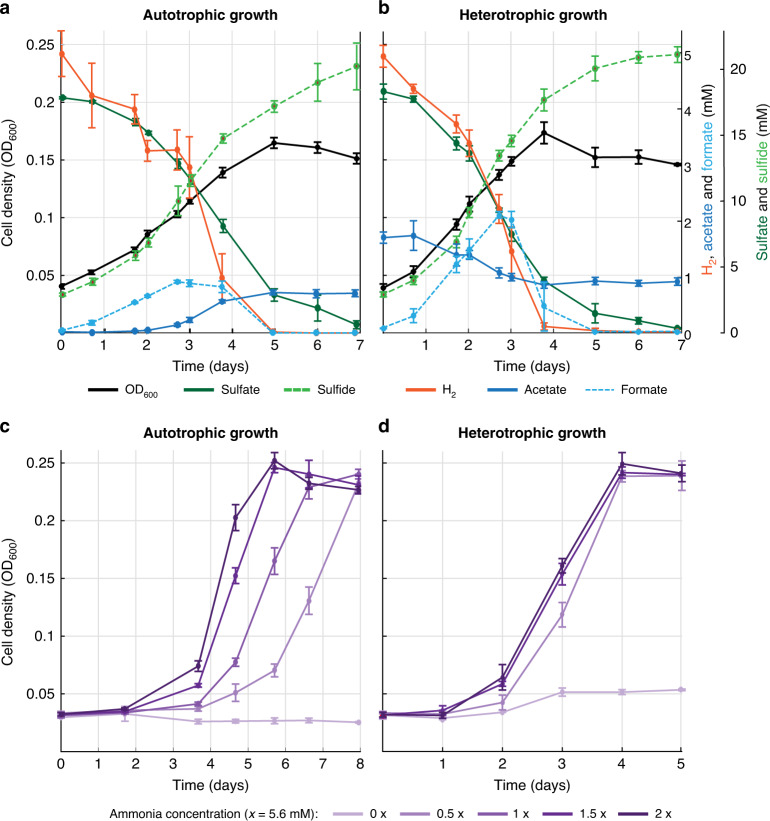
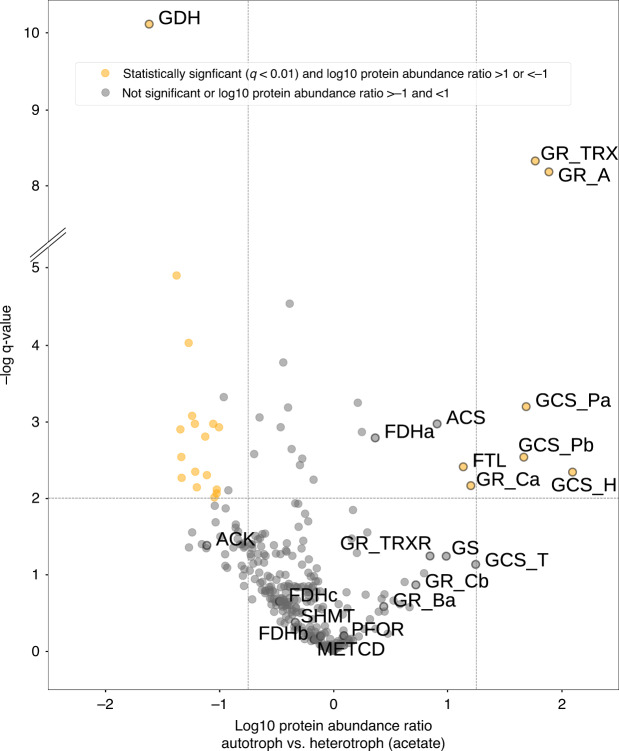
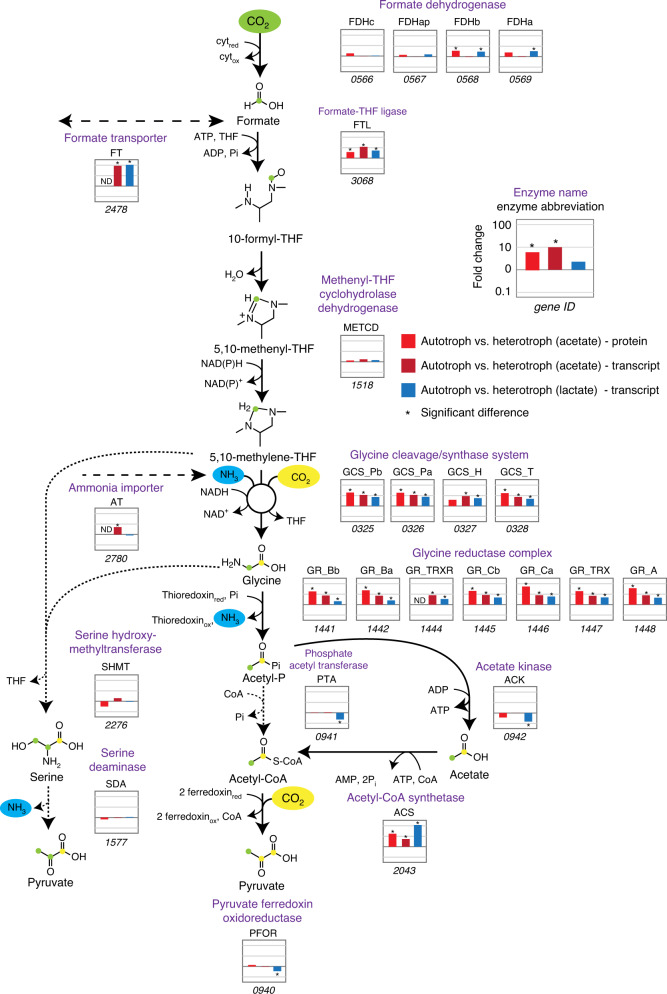
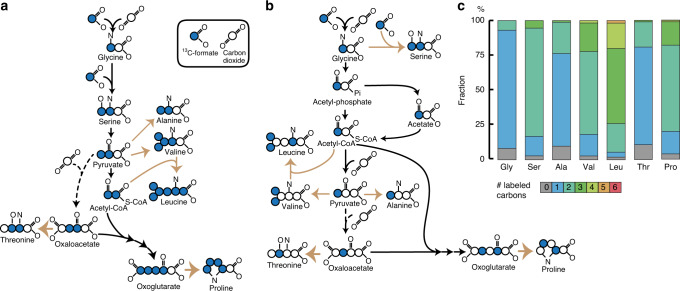
Six CO 2 fixation pathways are known to operate in photoautotrophic and chemoautotrophic microorganisms. Here, we describe chemolithoautotrophic growth of the sulphate-reducing bacterium Desulfovibrio desulfuricans (strain G11) with hydrogen and sulphate as energy substrates. Genomic, transcriptomic, proteomic and metabolomic analyses reveal that D. desulfuricans assimilates CO 2 via the reductive glycine pathway, a seventh CO 2 fixation pathway. In this pathway, CO 2 is first reduced to formate, which is reduced and condensed with a second CO 2 to generate glycine. Glycine is further reduced in D. desulfuricans by glycine reductase to acetyl-P, and then to acetyl-CoA, which is condensed with another CO 2 to form pyruvate. Ammonia is involved in the operation of the pathway, which is reflected in the dependence of the autotrophic growth rate on the ammonia concentration. Our study demonstrates microbial autotrophic growth fully supported by this highly ATP-efficient CO 2 fixation pathway.
Overview
The claims and statistics of this paper haven’t been checked yet.
Run the check — free, no account needed. It reads the open-access text and checks the sources it cites.
Integrity signals
Registry
Cites
Statistics
Figures
Verification
Claims the paper makes
The claims and statistics of this paper haven’t been checked yet.
Run the check — free, no account needed. It reads the open-access text and checks the sources it cites.
Claims other papers make about this one
Each is checked against this paper’s own text: does it say what the citing paper says it does?
The cited source says what the claim attributes to it.
In the citing paper
“It is distinct from the H2-dependent glycine reductase pathway of autotrophic CO2 fixation used by Desulfovibrio desulfuricans (Sánchez-Andrea et al., 2020).”
From Serpentinization as the source of energy, electrons, organics, catalysts, nutrients and pH gradients for the origin of LUCA and life (2023) · cites this paper as Sánchez-Andrea et al., 2020
Self-check
Percentages, sums and reported differences re-computed from the paper’s own numbers.
The self-check needs the paper’s full text.
Citations
Cites
Basic local alignment search tool
Altschul, S. F., Gish, W., Miller, W., Myers, E. W., & Lipman, D. J. (1990) · Journal of Molecular Biology · doi:10.1006/jmbi.1990.9999 · Cited by 98,669
Moderated estimation of fold change and dispersion for RNA-seq data with DESeq2
Love, M. I., Huber, W., & Anders, S. (2014) · Genome Biology · doi:10.1186/s13059-014-0550-8 · Cited by 95,106
The Sequence Alignment/Map format and SAMtools
Li, H., Handsaker, B., Wysoker, A., Fennell, T., Ruan, J., Homer, N., Marth, G., Abecasis, G., Durbin, R., & 1000 Genome Project Data Processing Subgroup (2009) · Bioinformatics · doi:10.1093/bioinformatics/btp352 · Cited by 62,041
Fast gapped-read alignment with Bowtie 2
Langmead, B., & Salzberg, S. L. (2012) · Nature Methods · doi:10.1038/nmeth.1923 · Cited by 56,400
Matplotlib: a 2D graphics environment
Hunter, J. D. (2007) · Computing in Science & Engineering · doi:10.1109/mcse.2007.55 · Cited by 39,249
Cutadapt removes adapter sequences from high-throughput sequencing reads
Martin, M. (2011) · EMBnet.journal · doi:10.14806/ej.17.1.200 · Cited by 33,889
HTSeq—a Python framework to work with high-throughput sequencing data
Anders, S., Pyl, P. T., & Huber, W. (2015) · Bioinformatics · doi:10.1093/bioinformatics/btu638 · Cited by 21,464
Prodigal: prokaryotic gene recognition and translation initiation site identification
Hyatt, D., Chen, G.-L., LoCascio, P. F., Land, M., Larimer, F. W., & Hauser, L. (2010) · BMC Bioinformatics · doi:10.1186/1471-2105-11-119 · Cited by 12,692
Parks, D. H., Imelfort, M., Skennerton, C. T., Hugenholtz, P., & Tyson, G. W. (2015) · Genome Research · doi:10.1101/gr.186072.114 · Cited by 12,496
A framework for variation discovery and genotyping using next-generation DNA sequencing data
DePristo, M. A., Banks, E., Poplin, R. E., Garimella, K. V., Maguire, J., Hartl, C., Philippakis, A., del Angel, G., Rivas, M. A., Hanna, M., et al. (2011) · Nature Genetics · doi:10.1038/ng.806 · Cited by 11,508
Cited by
Sorted by citations
A rooted phylogeny resolves early bacterial evolution
Coleman, G. A., Davín, A. A., Mahendrarajah, T. A., Szánthó, L. L., Spang, A., Hugenholtz, P., Szöllősi, G. J., & Williams, T. A. (2021) · Science · doi:10.1126/science.abe0511 · Cited by 285
Enzymatic Conversion of CO 2 : From Natural to Artificial Utilization
Bierbaumer, S., Nattermann, M., Schulz, L., Zschoche, R., Erb, T. J., Winkler, C. K., Tinzl, M., & Glueck, S. M. (2023) · Chemical Reviews · doi:10.1021/acs.chemrev.2c00581 · Cited by 283
Metabolic engineering strategies to enable microbial utilization of C1 feedstocks
Jiang, W., Hernández Villamor, D., Peng, H., Chen, J., Liu, L., Haritos, V., & Ledesma-Amaro, R. (2021) · Nature Chemical Biology · doi:10.1038/s41589-021-00836-0 · Cited by 216
Physiological limitations and opportunities in microbial metabolic engineering
López, J. M., Duran, L. A., & Avalos, J. L. (2021) · Nature Reviews Microbiology · doi:10.1038/s41579-021-00600-0 · Cited by 205
Fackler, N., Heijstra, B. D., Rasor, B. J., Brown, H., Martin, J. P., Ni, Z., Shebek, K. M., Rosin, R. R., Simpson, S. D., Tyo, K. E. J., et al. (2021) · Annual Review of Chemical and Biomolecular Engineering · doi:10.1146/annurev-chembioeng-120120-021122 · Cited by 176
Metadata
- Authors
- Sánchez-Andrea, I., Guedes, I. A., Hornung, B., Boeren, S., Lawson, C. E., Sousa, D. Z., Bar-Even, A., Claassens, N. J., & Stams, A. J. M.
- Affiliations
- Leiden University Medical Center (NL)
- Wageningen University & Research (NL)
- University of Wisconsin–Madison (US)
- Max Planck Institute of Molecular Plant Physiology (DE)
- Corresponding author
- Claassens, Nico J.
- Stams, Alfons J. M.
- ORCID
- Venue
- Nature Communications
- Published
- 2020-10-09
- Volume
- 11
- Issue
- 1
- Pages
- 5090-5090
- ISSN
- 2041-1723 (ISSN-L)
- PMC
- PMC7547702
- OpenAlex
- W3092013556
- Cited by
- 306
- References
- 84
- Citations by year
- 2026: 39 · 2025: 57 · 2024: 54 · 2023: 58 · 2022: 50 · 2021: 42 · 2020: 5
- FWCI
- 12.65
- Type
- journal article
- Language
- en
- Open access
- gold
- doi.org
- Locations
- Nature Communications (publishedVersion, cc-by)
- PubMed Central (publishedVersion, cc-by)
- PubMed (publishedVersion)
- Socio-Environmental Systems Modeling (acceptedVersion, cc-by)
- Portuguese National Funding Agency for Science, Research and Technology (RCAAP Project by FCT) (submittedVersion, cc-by)
- RePEc: Research Papers in Economics (submittedVersion)
- DOAJ (DOAJ: Directory of Open Access Journals) (submittedVersion, cc-by-sa)
- MPG.PuRe (Max Planck Society) (submittedVersion)
- Portuguese National Funding Agency for Science, Research and Technology (RCAAP Project by FCT) (submittedVersion, cc-by-nc-nd)
- Data Archiving and Networked Services (DANS) (submittedVersion, cc-by)
- Funders
- Nederlandse Organisatie voor Wetenschappelijk Onderzoek (024.002.002, Gravitation Grant 024.002.002, SIAM Gravitation Grant 024.002.002, 019.163LW.035, VI.Veni.192.156)
- Topics
- Life Sciences › Biochemistry, Genetics and Molecular Biology › Molecular Biology › Microbial metabolism and enzyme function
- Life Sciences › Biochemistry, Genetics and Molecular Biology › Biochemistry › Metalloenzymes and iron-sulfur proteins
- Life Sciences › Biochemistry, Genetics and Molecular Biology › Molecular Biology › Microbial Metabolic Engineering and Bioproduction
- Keywords
- reductive glycine pathway, Desulfovibrio desulfuricans, chemolithoautotrophic growth, CO2 fixation, sulfate reduction, glycine reductase, acetyl-CoA, sulfate-reducing bacteria
- MeSH terms
- Adenosine Triphosphate, Ammonia, Bacterial Proteins, Carbon Dioxide, Glycine, Genome, Bacterial, Gene Expression Profiling, Desulfovibrio desulfuricans, Autotrophic Processes, Metabolomics
About these checks
Registry, retraction, Cites and statistics results are computed, not judged, with one exception: a printed reference that no index lists is read once by a model before it counts as a citation error. Claims are extracted by a model and kept only when their quote appears verbatim in the text; each cited source is then checked, with a model’s help, for whether it says what the claim relies on. Those verdicts can be wrong — read the claim’s quote and the cited source before relying on one.
Statistics and arithmetic are recomputed, not judged.
Confidence bands are shown only for fields calibrated on our annotated test set. None is calibrated yet, so no band is shown.
What counts as a claim ›How we measure confidence ›How we check this ›
Are you an author, or do you see a problem with this page? Request a review
