

A protein tertiary structure mimetic modulator of the Hippo signalling pathway
Open accessThe DOI matches its Crossref record; 42 of the 42 references it cites were found in a registry or an index.
Abstract
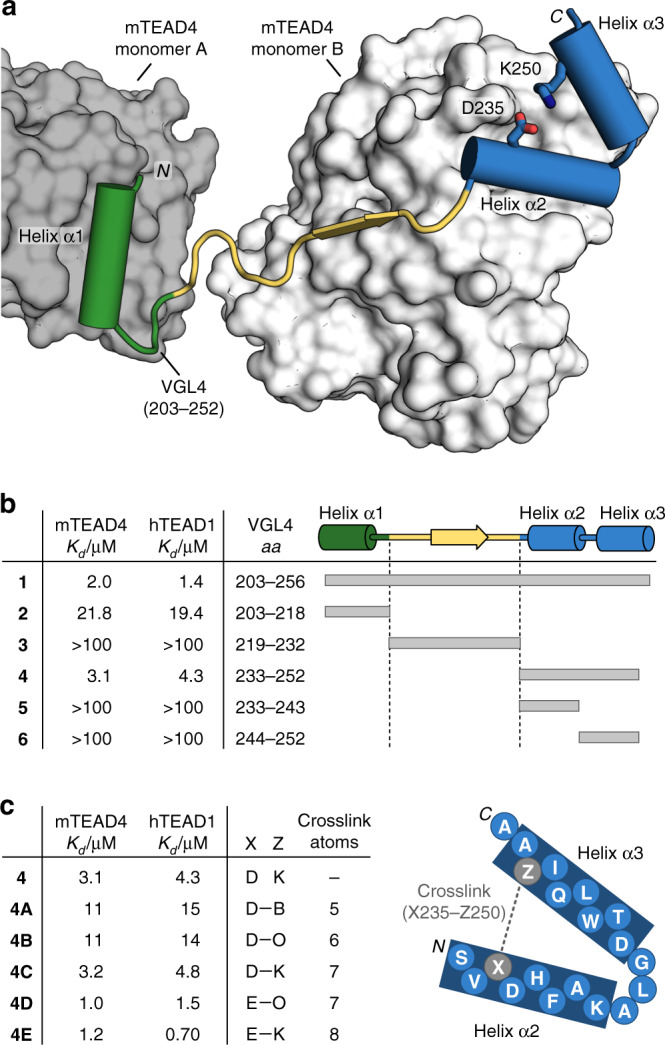
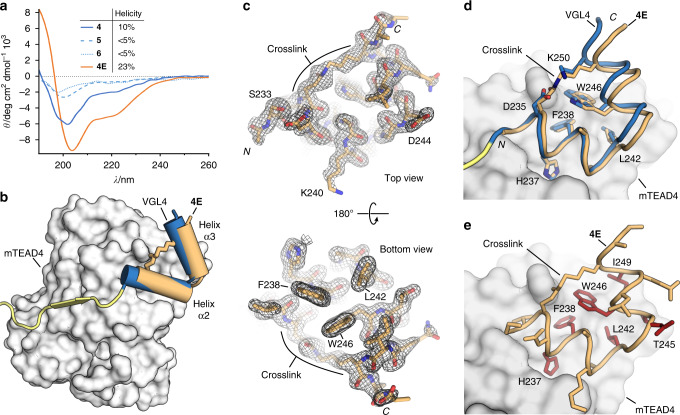
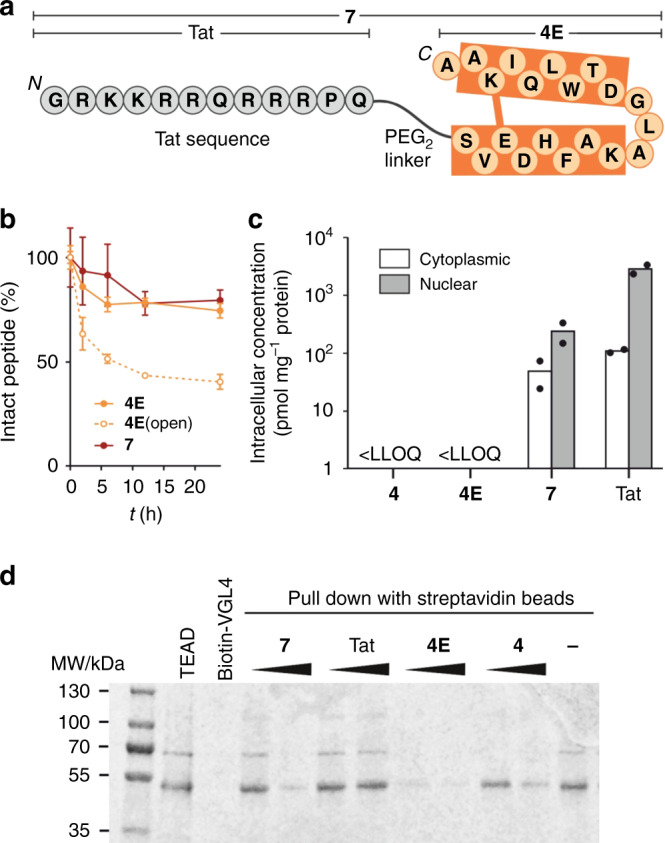
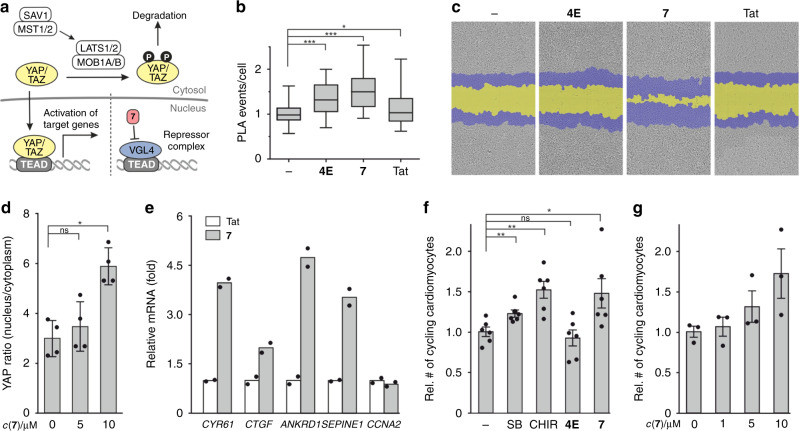
Transcription factors are key protein effectors in the regulation of gene transcription, and in many cases their activity is regulated via a complex network of protein–protein interactions (PPI). The chemical modulation of transcription factor activity is a long-standing goal in drug discovery but hampered by the difficulties associated with the targeting of PPIs, in particular when extended and flat protein interfaces are involved. Peptidomimetics have been applied to inhibit PPIs, however with variable success, as for certain interfaces the mimicry of a single secondary structure element is insufficient to obtain high binding affinities. Here, we describe the design and characterization of a stabilized protein tertiary structure that acts as an inhibitor of the interaction between the transcription factor TEAD and its co-repressor VGL4, both playing a central role in the Hippo signalling pathway. Modification of the inhibitor with a cell-penetrating entity yielded a cell-permeable proteomimetic that activates cell proliferation via regulation of the Hippo pathway, highlighting the potential of protein tertiary structure mimetics as an emerging class of PPI modulators.
Overview
The claims and statistics of this paper haven’t been checked yet.
Free: it reads the open-access text and checks the first 5 claims that cite a source we can check. Create a free account to check every claim.
Integrity signals
Registry
Cites
Statistics
Figures
Verification
Claims the paper makes
The claims and statistics of this paper haven’t been checked yet.
Free: it reads the open-access text and checks the first 5 claims that cite a source we can check. Create a free account to check every claim.
Claims other papers make about this one
Each is checked against this paper’s own text: does it say what the citing paper says it does?
The source backs part of the claim, not all of it — or backs it for a different population, condition or comparison.
In the citing paper
“The large unfavorable experimental binding ΔΔG, in this case, suggests that—as previously hypothesized [47]—a substantial rearrangement occurs for the unbound mutant peptide in the physical system, which was not sampled in simulation, and which would incur a reorganization penalty to adopt the binding-competent conformation present in the complex structure and FEP+ calculations.”
From Robust prediction of relative binding energies for protein-protein complex mutations using free energy perturbation calculations (2024) · cites this paper as [47]
Experimental — accuracy not yet measured
Self-check
Percentages, sums and reported differences re-computed from the paper’s own numbers.
The self-check needs the paper’s full text.
Citations
Cites
Vivès, E., Brodin, P., & Lebleu, B. (1997) · Journal of Biological Chemistry · doi:10.1074/jbc.272.25.16010 · Cited by 2,373
Lian, X., Zhang, J., Azarin, S. M., Zhu, K., Hazeltine, L. B., Bao, X., Hsiao, C., Kamp, T. J., & Palecek, S. P. (2013) · Nature Protocols · doi:10.1038/nprot.2012.150 · Cited by 1,748
Green, M., & Loewenstein, P. M. (1988) · Cell · doi:10.1016/0092-8674(88)90262-0 · Cited by 1,553
The Hippo pathway: regulators and regulations.
Yu, F.-X., & Guan, K.-L. (2013) · Genes & Development · doi:10.1101/gad.210773.112 · Cited by 1,231
The Hippo pathway in organ size control, tissue regeneration and stem cell self-renewal
Zhao, B., Tumaneng, K., & Guan, K.-L. (2011) · Nature Cell Biology · doi:10.1038/ncb2303 · Cited by 1,205
Hippo Pathway Inhibits Wnt Signaling to Restrain Cardiomyocyte Proliferation and Heart Size
Heallen, T., Zhang, M., Wang, J., Bonilla-Claudio, M., Klysik, E., Johnson, R. L., & Martin, J. F. (2011) · Science · doi:10.1126/science.1199010 · Cited by 1,092
Schafmeister, C. E., Po, J., & Verdine, G. L. (2000) · Journal of the American Chemical Society · doi:10.1021/ja000563a · Cited by 1,037
Hippo pathway effector Yap promotes cardiac regeneration
Xin, M., Kim, Y., Sutherland, L. B., Murakami, M., Qi, X., McAnally, J., Porrello, E. R., Mahmoud, A. I., Tan, W., Shelton, J. M., et al. (2013) · Proceedings of the National Academy of Sciences · doi:10.1073/pnas.1313192110 · Cited by 895
Rapid Transition of Cardiac Myocytes from Hyperplasia to Hypertrophy During Postnatal Development
Li, F. (1996) · Journal of Molecular and Cellular Cardiology · doi:10.1006/jmcc.1996.0163 · Cited by 833
Vassilev, A., Kaneko, K. J., Shu, H., Zhao, Y., & DePamphilis, M. L. (2001) · Genes & Development · doi:10.1101/gad.888601 · Cited by 719
Cited by
Targeting intracellular protein–protein interactions with macrocyclic peptides
Buyanova, M. Y., & Pei, D. (2021) · Trends in Pharmacological Sciences · doi:10.1016/j.tips.2021.11.008 · Cited by 96
Recent Therapeutic Approaches to Modulate the Hippo Pathway in Oncology and Regenerative Medicine
Barry, E., Simov, V., Valtingojer, I., & Venier, O. (2021) · Cells · doi:10.3390/cells10102715 · Cited by 78
“C motif chemokine 5 CYR61 Cysteine-rich angiogenic inducer 61 Cells 2021, 10, 2715 23 of 29 DSS Dextran sodium sulfate EdU Ethynyl deoxyuridine EGFR Epidermal growth factor receptor EML4 Echinoderm microtubule-associated protein-like 4 EMT Epithelial mesenchymal transition FOS Fos proto-oncogene, AP-1 transcription fa…”
BackgroundInfluentialWendt, M., Bellavita, R., Gerber, A., Efrém, N., van Ramshorst, T., Pearce, N. M., Davey, P. R. J., Everard, I., Vazquez‐Chantada, M., Chiarparin, E., et al. (2021) · Angewandte Chemie International Edition · doi:10.1002/anie.202102082 · Cited by 64
Self-citationTackling Undruggable Targets with Designer Peptidomimetics and Synthetic Biologics
Swenson, C., Mandava, G., Thomas, D. M., & Moellering, R. E. (2024) · Chemical Reviews · doi:10.1021/acs.chemrev.4c00423 · Cited by 64
Peptide‐based covalent inhibitors of protein–protein interactions
Paulussen, F. M., & Grossmann, T. N. (2022) · Journal of Peptide Science · doi:10.1002/psc.3457 · Cited by 58
Self-citationSileo, P., Simonin, C., Melnyk, P., Chartier‐Harlin, M., & Cotelle, P. (2022) · Cells · doi:10.3390/cells11223631 · Cited by 57
Protein-Protein Interaction Disruptors of the YAP/TAZ-TEAD Transcriptional Complex
Pobbati, A. V., & Rubin, B. P. (2020) · Molecules · doi:10.3390/molecules25246001 · Cited by 56
“Triazole carbohydrazides Hit 2 2 10 Triazole carbohydrazides Hit 2 Molecular modeling Potential PPID [28] 11 Compound 3.1 Molecular docking PPID Co-IP assay [29] Peptide binding to both Interfaces 2 & 3 12 Super-TDU YAP-VGLL4 fusion peptide Molecular modeling PPID Co-IP assay [30] Molecular modeling Potential PPID [28…”
MethodSelf-citationProgress with YAP/TAZ-TEAD inhibitors: a patent review (2018-present)
Zagiel, B., Melnyk, P., & Cotelle, P. (2022) · Expert Opinion on Therapeutic Patents · doi:10.1080/13543776.2022.2096436 · Cited by 50
“In another article [67], the same collaboration between Astra-Zeneca and academics led to the design of an eicosapeptide 4E (Figure 19) (derived from the VGL4 233–252 amino acid sequence by D to E replacement leading to crosslinked via lactamization of residues E235 and K250) linked to Tat sequence through a PEG2 link…”
BackgroundFrom Concepts to Inhibitors: A Blueprint for Targeting Protein–Protein Interactions
Hong, S. H., Nguyễn, T. T., Ongkingco, J. F., Nazzaro, A., & Arora, P. S. (2025) · Chemical Reviews · doi:10.1021/acs.chemrev.5c00046 · Cited by 46
Sturbaut, M., Bailly, F., Coevoet, M., Sileo, P., Pugnière, M., Liberelle, M., Magnez, R., Thuru, X., Chartier‐Harlin, M., Melnyk, P., et al. (2021) · European Journal of Medicinal Chemistry · doi:10.1016/j.ejmech.2021.113835 · Cited by 46
Cheng, J., Zhou, J., Kong, L., Wang, H., Zhang, Y., Wang, X., Liu, G., & Chu, Q. (2023) · RSC Medicinal Chemistry · doi:10.1039/d3md00487b · Cited by 42
Lou, J., Lu, Y., Cheng, J., Zhou, F., Yan, Z., Zhang, D., Meng, X., & Zhao, Y. (2022) · European Journal of Medicinal Chemistry · doi:10.1016/j.ejmech.2022.114684 · Cited by 40
In-Cell Quantification of Drugs by Magic-Angle Spinning Dynamic Nuclear Polarization NMR
Bertarello, A., Berruyer, P., Artelsmair, M., Elmore, C. S., Heydarkhan‐Hagvall, S., Schade, M., Chiarparin, E., Schantz, S., & Emsley, L. (2022) · Journal of the American Chemical Society · doi:10.1021/jacs.1c12442 · Cited by 39
Self-citationA Sos proteomimetic as a pan-Ras inhibitor
Hong, S. H., Yoo, D. Y., Conway, L. P., Richards-Corke, K. C., Parker, C. G., & Arora, P. S. (2021) · Proceedings of the National Academy of Sciences · doi:10.1073/pnas.2101027118 · Cited by 36
“where RT is the total concentration of H-Ras (1-166), LST is the total concentration of fluorescence peptide, and FSB is the fraction of bound fluorescence peptide.”
BackgroundpIChemiSt ─ Free Tool for the Calculation of Isoelectric Points of Modified Peptides
Frolov, A. I., Chankeshwara, S. V., Abdulkarim, Z., & Ghiandoni, G. M. (2022) · Journal of Chemical Information and Modeling · doi:10.1021/acs.jcim.2c01261 · Cited by 36
Protein Macrocyclization for Tertiary Structure Stabilization
Haim, A., Neubacher, S., & Grossmann, T. N. (2021) · ChemBioChem · doi:10.1002/cbic.202100111 · Cited by 34
Self-citationDesolvation of Peptide Bond by O to S Substitution Impacts Protein Stability
Khatri, B., Raghunathan, S., Chakraborti, S., Rahisuddin, R., Kumaran, S., Tadala, R., Wagh, P., Priyakumar, U. D., & Chatterjee, J. (2021) · Angewandte Chemie International Edition · doi:10.1002/anie.202110978 · Cited by 35
Covalent Proteomimetic Inhibitor of the Bacterial FtsQB Divisome Complex
Paulussen, F. M., Schouten, G. K., Moertl, C., Verheul, J., Hoekstra, I., Koningstein, G. M., Hutchins, G. H., Alkir, A., Luirink, R. A., Geerke, D. P., et al. (2022) · Journal of the American Chemical Society · doi:10.1021/jacs.2c06304 · Cited by 32
Self-citationZhang, L., Zhang, F., Liang, H., Qin, X., Mo, Y., Chen, S., Xie, J., Hou, X., Deng, J., Hao, E., et al. (2025) · Frontiers in Oncology · doi:10.3389/fonc.2025.1545952 · Cited by 30
A dimeric proteomimetic prevents SARS-CoV-2 infection by dimerizing the spike protein
Khatri, B., Pramanick, I., Malladi, S. K., Rajmani, R. S., Kumar, S., Ghosh, P., Sengupta, N., Rahisuddin, R., Kumar, N., Kumaran, S., et al. (2022) · Nature Chemical Biology · doi:10.1038/s41589-022-01060-0 · Cited by 28
Zhao, B., Pobbati, A. V., Rubin, B. P., & Stauffer, S. R. (2023) · Pharmaceuticals · doi:10.3390/ph16040583 · Cited by 26
“However, Adihou reported that the mutant Leu242mVGLL4 significantly reduced mVGLL4 binding to hTEAD1 [65].”
BackgroundInfluentialSelf-citationToward the Design of Ligands Selective for the C-Terminal Domain of TEADs
Liberelle, M., Toulotte, F., Renault, N., Gelin, M., Allemand, F., Melnyk, P., Guichou, J., & Cotelle, P. (2022) · Journal of Medicinal Chemistry · doi:10.1021/acs.jmedchem.2c00075 · Cited by 25
Sampson, J. M., Cannon, D. A., Duan, J., Epstein, J. C. K., Sergeeva, A. P., Katsamba, P. S., Mannepalli, S. M., Bahna, F. A., Adihou, H., Guéret, S. M., et al. (2024) · Journal of Molecular Biology · doi:10.1016/j.jmb.2024.168640 · Cited by 24
Self-citationZhang, Y., Wan, X.-C., Tang, Y., Chen, Y., Zheng, F.-H., Cui, Z., Zhang, H., Zhou, Z., & Fang, G. (2024) · Chemical Science · doi:10.1039/d4sc01992j · Cited by 23
TEAD-targeting small molecules induce a cofactor switch to regulate the Hippo pathway
Guarnaccia, A. D., Hagenbeek, T. J., Lee, W., Kljavin, N. M., Choi, M., Tombling, B. J., Peukert, C., Ulas, G., Kameswaran, V., Le, D., et al. (2025) · Proceedings of the National Academy of Sciences · doi:10.1073/pnas.2425984122 · Cited by 21
“In contrast, VGLL4 is a TEAD corepressor and is tumor suppressive ( 16 , 20 – 22 ).”
Stapling of Peptides Potentiates the Antibiotic Treatment of Acinetobacter baumannii In Vivo
Schouten, G. K., Paulussen, F. M., Kuipers, O. P., Bitter, W., Grossmann, T. N., & van Ulsen, P. (2022) · Antibiotics · doi:10.3390/antibiotics11020273 · Cited by 21
“All measurements were performed in triplicate [46,47].”
Self-citationMesrouze, Y., Gubler, H., Villard, F., Boesch, R., Ottl, J., Kallen, J. A., Reid, P., Scheufler, C., Marzinzik, A. L., & Chêne, P. (2023) · ACS Chemical Biology · doi:10.1021/acschembio.2c00936 · Cited by 18
Li, L., Li, R., & Wang, Y. (2022) · Bioorganic Chemistry · doi:10.1016/j.bioorg.2022.105707 · Cited by 16
Cell-permeable peptide-based delivery vehicles useful for subcellular targeting and beyond
Stillger, K., & Neundorf, I. (2023) · Cellular Signalling · doi:10.1016/j.cellsig.2023.110796 · Cited by 16
Unveiling the interaction between DNA G-quadruplexes and RG-rich peptides
Grasso, N., Graziano, R., Marzano, S., D’Aria, F., Merlino, F., Grieco, P., Randazzo, A., Pagano, B., & Amato, J. (2023) · International Journal of Biological Macromolecules · doi:10.1016/j.ijbiomac.2023.126749 · Cited by 14
Identification of an H-Ras nanocluster disrupting peptide
Steffen, C. L., Manoharan, G. B., Pavic, K., Yeste‐Vázquez, A., Knuuttila, M., Arora, N., Zhou, Y., Härmä, H., Gaigneaux, A., Grossmann, T. N., et al. (2024) · Communications Biology · doi:10.1038/s42003-024-06523-9 · Cited by 13
Self-citationNiu, J., Cederstrand, A. J., Eddinger, G. A., Yin, B., Checco, J. W., Bingman, C. A., Outlaw, V. K., & Gellman, S. H. (2022) · Journal of the American Chemical Society · doi:10.1021/jacs.1c13717 · Cited by 13
García, C. C., Becker, C., Förster, M., Lohmann, S., Freitag, P., Laufer, S., Sievers, S., Fleischmann, B. K., Hesse, M., & Schade, D. (2021) · Journal of Medicinal Chemistry · doi:10.1021/acs.jmedchem.1c01173 · Cited by 12
Self-citationA fragment-based protein interface design algorithm for symmetric assemblies
Laniado, J., Meador, K., & Yeates, T. O. (2021) · Protein Engineering Design and Selection · doi:10.1093/protein/gzab008 · Cited by 12
Novel Allosteric Effectors Targeting Human Transcription Factor TEAD
Ibrahim, M. T., Verkhivker, G. M., Misra, J. R., & Tao, P. (2023) · International Journal of Molecular Sciences · doi:10.3390/ijms24109009 · Cited by 11
Target‐Templated Construction of Functional Proteomimetics Using Photo‐Foldamer Libraries
Wéber, E., Ábrányi‐Balogh, P., Nagymihály, B., Menyhárd, D. K., Péczka, N., Gadanecz, M., Schlosser, G., Orgován, Z., Bogár, F., Bajusz, D., et al. (2024) · Angewandte Chemie International Edition · doi:10.1002/anie.202410435 · Cited by 10
Synthesis and Crystallographic Characterization of Helical Hairpin Oligourea Foldamers
Pendem, N., Nelli, Y. R., Cussol, L., Claude Didierjean, B., Kauffmann, B., Dolain, C., & Guichard, G. (2023) · Chemistry - A European Journal · doi:10.1002/chem.202300087 · Cited by 10
Grafted Coiled-Coil Peptides as Multivalent Scaffolds for Protein Recognition
Acevedo‐Jake, A. M., Mylemans, B., Kay, D. F., Zhang, P., Korona, B., Rhys, G. G., Leney, A. C., Huang, D. T. C., Edwards, T. A., Itzhaki, L. S., et al. (2025) · ACS Chemical Biology · doi:10.1021/acschembio.5c00137 · Cited by 9
Aurintricarboxylic acid is a canonical disruptor of the TAZ-TEAD transcriptional complex
Che, K., Pobbati, A. V., Seavey, C. N., Federov, Y., Komar, A. A., Burtscher, A., Ma, S., & Rubin, B. P. (2022) · PLoS ONE · doi:10.1371/journal.pone.0266143 · Cited by 7
“ATA was ineffective at disrupting the VGLL1-TEAD interaction whereas peptide 7 [32] a known disruptor that acts by binding at interface 2, was highly effective.”
BackgroundSelf-citationBinding Dynamics of a Stapled Peptide Targeting the Transcription Factor NF−Y
Durukan, C., Arbore, F., Klintrot, R., Bigiotti, C., Ilie, I. M., Vreede, J., Grossmann, T. N., & Hennig, S. (2024) · ChemBioChem · doi:10.1002/cbic.202400020 · Cited by 7
Self-citationSchießer, S., Ceklarz, J., Kollback, J., Borowiec, L., Fågerlund, J., Vahdat, S., Lindhagen, M., & Putra, O. D. (2023) · Chemistry - A European Journal · doi:10.1002/chem.202301421 · Cited by 6
Wendt, M., Bellavita, R., Gerber, A., Efrém, N., van Ramshorst, T., Pearce, N. M., Davey, P. R. J., Everard, I., Vázquez–Chantada, M., Chiarparin, E., et al. (2021) · Angewandte Chemie · doi:10.1002/ange.202102082 · Cited by 6
Self-citationTwo‐Helix Supramolecular Proteomimetic Binders Assembled via PNA‐Assisted Disulfide Crosslinking
Imiołek, M., & Winssinger, N. (2022) · ChemBioChem · doi:10.1002/cbic.202200561 · Cited by 7
Multiplex peptide evolution via efficient solid-phase and side-chain guanidyl-construction
Wang, N., Chen, B., Li, Y., Li, X., & Hu, H. (2025) · Cell Reports Physical Science · doi:10.1016/j.xcrp.2025.102651 · Cited by 5
Kahler, J. P., Ellenbroek, B. D., van der Noord, V. E., van de Water, B., & Pomplun, S. J. (2025) · Chem · doi:10.1016/j.chempr.2025.102839 · Cited by 4
Desolvation of Peptide Bond by O to S Substitution Impacts Protein Stability
Khatri, B., Raghunathan, S., Chakraborti, S., Rahisuddin, R., Kumaran, S., Tadala, R., Wagh, P., Priyakumar, U. D., & Chatterjee, J. (2021) · Angewandte Chemie · doi:10.1002/ange.202110978 · Cited by 4
Peptide-Tools–Web Server for Calculating Physicochemical Properties of Peptides
Frolov, A. I., Morley, J., dos Santos, A. G., Genapathy, S., & Ghiandoni, G. M. (2025) · Journal of Chemical Information and Modeling · doi:10.1021/acs.jcim.5c02296 · Cited by 3
Hippo signaling as a therapeutic switch for T cell functions and tumor immunity
Fan, J., Riaz, F., & Riaz, F. (2026) · Molecular Immunology · doi:10.1016/j.molimm.2025.12.013 · Cited by 2
Stapled peptide inhibitors target VGLL4/TEAD4 interactions to accelerate cutaneous wound healing
Chen, S., Gai, C., Wang, G., Dong, P., Zhuo, X., Zhang, W., Zhang, P.-C., Chai, X., Xue, H., Su, J., et al. (2025) · European Journal of Medicinal Chemistry · doi:10.1016/j.ejmech.2025.118508 · Cited by 1
From Protein Structures to Functional Biomimetics
Grossmann, T. N., & Durukan, C. (2024) · Synlett · doi:10.1055/a-2308-1795 · Cited by 1
Self-citationTarget‐Templated Construction of Functional Proteomimetics Using Photo‐Foldamer Libraries
Wéber, E., Ábrányi‐Balogh, P., Nagymihály, B., Menyhárd, D. K., Péczka, N., Gadanecz, M., Schlosser, G., Orgován, Z., Bogár, F., Bajusz, D., et al. (2024) · Angewandte Chemie · doi:10.1002/ange.202410435 · Cited by 1
Research progress in small-molecule modulators of protein-protein interactions
Yang, B., & Qi, X. (2023) · Chinese Science Bulletin (Chinese Version) · doi:10.1360/tb-2023-0034
Approaching novel antibiotic targets using peptidomimetics
Paulussen, F. M. (2023) · doi:10.5463/thesis.473
New Therapeutic Chemical Modalities: Compositions, Modes-of-action, and Drug Discovery
Valeur, E. (2023) · Royal Society of Chemistry eBooks · doi:10.1039/9781788018982-00911
Self-citationComparison of YAP/TAZ and TEAD activators on cellular models
Sileo, P. (2023) · theses.fr (ABES) · doi:10.70675/011cfc12z1c0dz472dz82c8z5c42ff76be91
Jones, D. (2025) · bioRxiv (Cold Spring Harbor Laboratory) · doi:10.1101/2025.03.20.644477
Cyclic Peptides for PPI Drug Discovery
Hu, H., & Li, X. (2025) · Wiley eBooks · doi:10.1002/9783527845828.ch11
Heath, S. L. (2023) · D-Scholarship@Pitt (University of Pittsburgh)
Toulotte, F. (2021) · theses.fr (ABES) · doi:10.70675/52b6eca8z0f48z4661z8d2dz44b19828a01a
Li, B., Perrin, M. E., Maillard, E., Vitard, A., Moal, G., Mbianda, J., André, C., Nunes, M. T., Vandamme, M., Pinna, G., et al. (2026) · Angewandte Chemie · doi:10.1002/ange.4112426
Li, B., Perrin, M. E., Maillard, E., Vitard, A., Moal, G., Mbianda, J., André, C., Nunes, M. T., Vandamme, M., Pinna, G., et al. (2026) · Angewandte Chemie International Edition · doi:10.1002/anie.4112426
Metadata
- Authors
- Adihou, H., Gopalakrishnan, R., Förster, T., Guéret, S. M., Gasper, R., Geschwindner, S., Carrillo García, C., Karatas, H., Pobbati, A. V., Vazquez‐Chantada, M., Davey, P., Wassvik, C. M., Pang, J. K. S., Soh, B. S., Hong, W., Chiarparin, E., Schade, D., Plowright, A. T., Valeur, E., Lemurell, M., Grossmann, T. N., & Waldmann, H.
- Affiliations
- AstraZeneca (Sweden) (SE)
- AstraZeneca (Germany) (DE)
- Max Planck Institute of Molecular Physiology (DE)
- Agency for Science, Technology and Research (SG)
- AstraZeneca (United Kingdom) (GB)
- Christian-Albrechts-Universität zu Kiel (DE)
- Vrije Universiteit Amsterdam (NL)
- TU Dortmund University (DE)
- Corresponding author
- Grossmann, Tom N.
- Waldmann, Herbert
- ORCID
- Venue
- Nature Communications
- Published
- 2020-10-27
- Volume
- 11
- Issue
- 1
- Pages
- 5425-5425
- ISSN
- 2041-1723 (ISSN-L)
- PMC
- PMC7591920
- OpenAlex
- W3096898590
- Semantic Scholar
- 71f1122d45e19d2a8c93b9ccaff62dd809d912e6
- Cited by
- 58
- References
- 42
- Citations by year
- 2026: 1 · 2025: 10 · 2024: 9 · 2023: 12 · 2022: 14 · 2021: 11 · 2020: 1
- FWCI
- 4.99
- Type
- journal article
- Language
- en
- Open access
- gold
- doi.org
- Licence
- cc-by
- creativecommons.org/licenses/by/4.0 (tdm)
- creativecommons.org/licenses/by/4.0 (vor)
- Locations
- Nature Communications (publishedVersion, cc-by)
- PubMed Central (publishedVersion, cc-by)
- PubMed (publishedVersion)
- VU Research Portal (publishedVersion, other-oa)
- DORA PSI (Paul Scherrer Institute) (submittedVersion, other-oa)
- National University of Singapore (submittedVersion, cc-by)
- RePEc: Research Papers in Economics (submittedVersion)
- DOAJ (DOAJ: Directory of Open Access Journals) (submittedVersion, cc-by-sa)
- MPG.PuRe (Max Planck Society) (submittedVersion)
- Data Archiving and Networked Services (DANS) (submittedVersion, other-oa)
- Funders
- Leibniz-Institut für Arbeitsforschung an der TU Dortmund
- Paul Scherrer Institut
- H2020 European Research Council (678623)
- Topics
- Life Sciences › Biochemistry, Genetics and Molecular Biology › Cell Biology › Hippo pathway signaling and YAP/TAZ
- Physical Sciences › Chemistry › Organic Chemistry › Chemical Synthesis and Analysis
- Life Sciences › Biochemistry, Genetics and Molecular Biology › Molecular Biology › Protein Structure and Dynamics
- Keywords
- Hippo signaling pathway, protein-protein interaction inhibitors, TEAD, peptidomimetics, cell-penetrating peptides, cell proliferation
- MeSH terms
- Hippo Signaling Pathway, TEA Domain Transcription Factors, DNA-Binding Proteins, Humans, Nuclear Proteins, Protein Binding, Transcription Factors, Signal Transduction, Protein Serine-Threonine Kinases, Protein Structure, Tertiary, Peptidomimetics
About these checks
Registry, retraction, Cites and statistics results are computed, not judged, with one exception: a printed reference that no index lists is read once by a model before it counts as a citation error. Claims are extracted by a model and kept only when their quote appears verbatim in the text; each cited source is then checked, with a model’s help, for whether it says what the claim relies on. Those verdicts can be wrong — read the claim’s quote and the cited source before relying on one.
Statistics and arithmetic are recomputed, not judged.
Confidence bands are shown only for fields calibrated on our annotated test set. None is calibrated yet, so no band is shown.
What counts as a claim ›How we measure confidence ›How we check this ›
Are you an author, or do you see a problem with this page? Request a review
Data sources
Bibliographic data: Semantic Scholar, OpenAlex, Crossref.
Contains information from the Semantic Scholar Academic Graph Datasets, made available under the ODC Attribution License (ODC-BY 1.0).
Semantic Scholar’s data is described in: Kinney, R., et al. (2023). The Semantic Scholar Open Data Platform. arXiv:2301.10140.
